




Abstract
This article delves into queer memorials: public artworks dedicated to, and commonly designed to commemorate, LGBTQ + people’s lives. As part of a broader international multisite project, we present the first comprehensive case-study survey (N = 343) of its kind, examining how everyday members of the public experience the Amsterdam Homomonument as an inclusive site of memory. As the world’s first publicly commissioned monument inaugurated for the gay community in 1987, our study shows how Amsterdam Homomonument currently occupies a realm intersecting gay and ‘post-gay’ public memories and imaginings. Through analysing Amsterdam Homomonument as a lived queer memorial, our study reveals the ambiguous experiences of inclusion and exclusion that publics derive from its place and community roles. We argue that queer sites of memory attain inclusiveness through establishing space that embraces broader arrays of gender and sexual differences, amid an era marked by heightened visibility of LGBTQ + communities (though not necessarily).
Introduction
Memorials don’t act; people do. As Rodney (2023, n.p.) observes: ‘the action of questioning in a focused, rigorous, probing, and relentless manner is something that humans do, not inanimate objects’. Memorials serve as mnemonic objects shaped through people’s interactions and experiences on the ground. This happens in real-time, but also through memories and imaginings extending beyond memorials’ original location and context (Johnson, 2002). This article addresses the underexplored niche of public experiences with the inclusivity of queer memorials: art objects in public spaces which are dedicated to the lives of lesbian, gay, bisexual, transgender and queer people and those who identify beyond heteronormative categories, referred to as LGBTQ + (Dunn, 2017; Zebracki et al., 2023). Queer memorials play an important role as LGBTQ + landmarks, promoting the visibility of gender and sexual populations traditionally marginalised in public history and memory (Ferentinos, 2014; Houlton, 2021). Orangias et al. (2018) defined queer memorials, in the authors’ important inventory, as ‘heritage sites that honour gender and sexual minorities, [which] represent communities that have often been excised in dominant public narratives’ (pp. 705–706). This underlines the vital role of queer memorials in addressing, or redressing, LGBTQ + marginalisation.
Much research has explored the ‘official’ roles of queer memorials as defined by their commissioners and makers (Ferentinos, 2014; Zebracki and Leitner, 2022), or their ‘encoding’ ends (Hall, 2006). However, there has been limited research into the experiences of everyday public users, or the ‘decoding’ publics (Hall, 2006). This gap is especially relevant to memorials centred around socially marginalised groups (Muzaini, 2023), where gender and sexual minorities have received particularly limited attention, despite a few recent exceptions (e.g. Duarte and Cymbalista, 2023; Oettler, 2021; Zebracki et al., 2023).
In this study, we examine how queer memorials are experienced, or lived, as inclusive places of LGBTQ + memory from the perspectives of everyday publics, including local residents, visitors from further afield in the Netherlands and international visitors (see Methodology). We adopt geographer Kong’s (2009) definition of ‘a socially inclusive space’ as ‘one in which support for and celebration of different aspects of social life exists’ (p. 20). In our case, this term implies how people across gender and sexual differences (LGBTQ + people, in particular, as well as straight audiences) feel represented and welcomed, both in the monument’s formal commemorative and everyday lived contexts.
We are interested in the publics’ perceptions of ‘queerness’, which we render as the experienced degree of inclusion of the lives of LGBTQ + people within these places. These experiences, as we will suggest in our methodology and analysis, should be understood intersectionally (see Crenshaw, 1991). That is, gender and sexual differences intersect with other relevant (minority) markers, in this case within the Dutch/Amsterdam and its international context, including age, ethnicity, and urban or regional origin (e.g. Weyers, 2023), which thus imply lived experiences beyond LGBTQ + alone.
Against the backdrop of grassroots LGBTQ + activism since the 1980s, many Western cities have seen queer memorial initiatives (Dunn, 2017; Orangias et al., 2018). Our study focuses on the Amsterdam Homomonument (HM) (Figure 1), seen as the world’s first publicly commissioned LGBTQ + memorial (Zebracki et al., 2023). Inaugurated on 5 September 1987 in the central Westermarkt square in the Dutch urban capital (Figure 2), it stands among other notable local site features including the Reformed Westerkerk Church, Keizersgracht canal, and Anne Frank House.
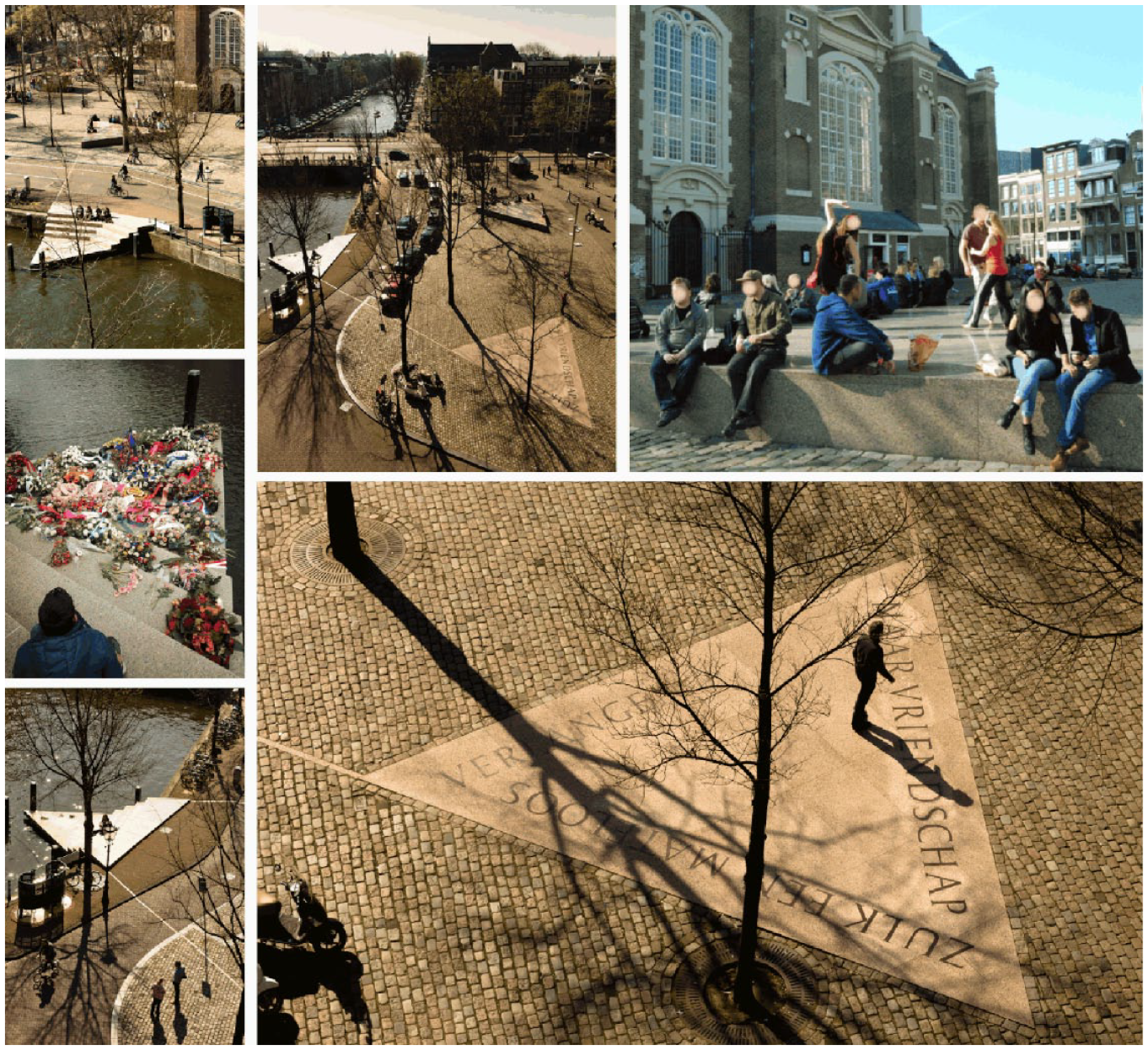
Homomonument (1987) in Amsterdam, designed by Karin Daan. The Dutch inscription on the triangular street-level structure reads, ‘naar vriendschap zulk een mateloos verlangen’ [such an endless desire for friendship], a line from Jacob Israël de Haan’s homoerotic poem ‘Aan eenen jongen Visscher’ [To a Young Fisherman].
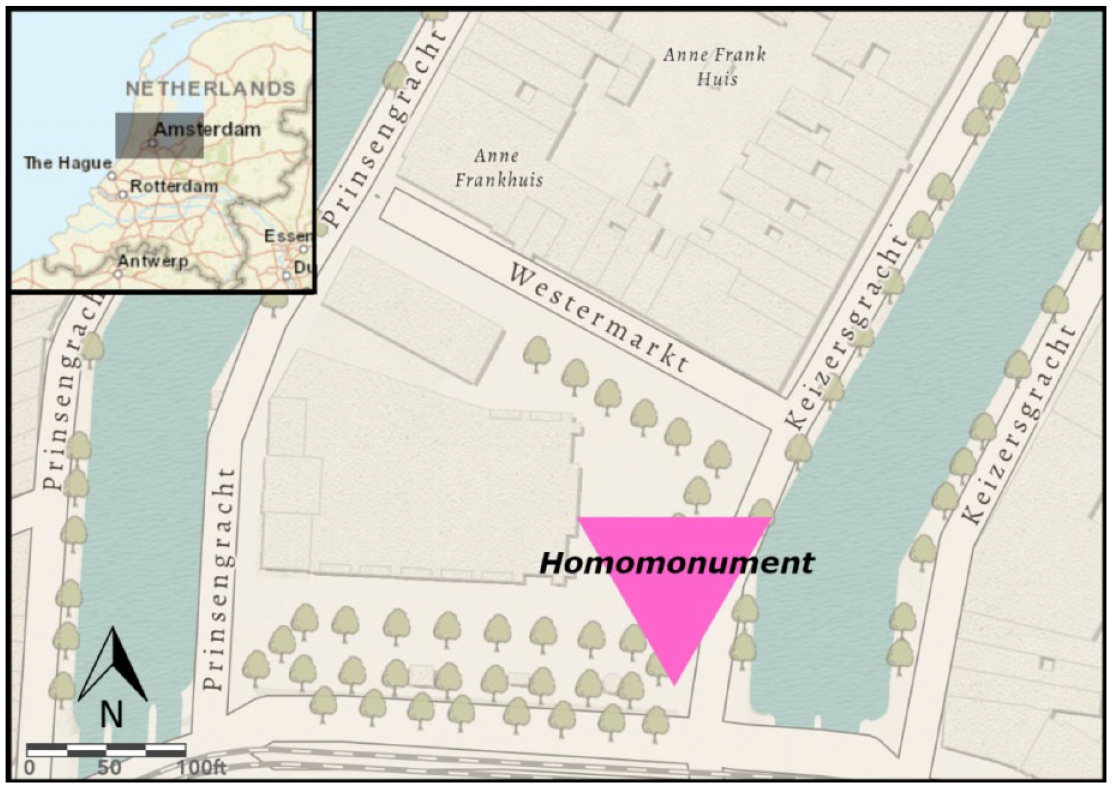
Homomonument located at Westermarkt in Amsterdam, the Netherlands.
HM was designed by Karin Daan and it consists of three pink granite triangles: in the artist’s vision, the triangle at street level represents the past, the ‘sunken’ triangle with stairs by the canal reflects the present and the elevated triangle, a kind of stage, points towards the future – from a bird’s-eye view, they make up a larger triangle (Bartels, 2003). The pink triangle references the emblem worn by homosexual inmates in World War II Nazi concentration camps – a badge of shame reappropriated as a symbol of queer pride in LGBTQ + liberation and activism since the 1970s. Binnie (1995) portrayed HM as a crucial site to commemorate gay victims during the Nazi occupation as well as the HIV/AIDS pandemic, which echoes Bartels’ (2003) view of HM as a compound war and ‘gay’ memorial. Metaphorically, Reed (1996) illustrated HM as both ‘subtle’ and ‘assertive’, arguing that ‘the placement of the elements at some distance from each other . . . makes the whole sculpture hover on the border of invisibility, creating a zone not immediately recognizable but then suddenly overwhelming in its scale’ (p. 65).
HM’s existence is credited to gay activist Bob van Schijndel who founded the Homomonument Foundation in 1979 with the mission to create a ‘living monument’, rather than a ‘misery on a pedestal’ (Koenders, 1987: 29). In 2018, HM received municipal recognition as a protected monument (Het Parool, 2018); but does it also serve as a ‘protected’ space in terms of accounting for a socially inclusive experience among its public users?
Queer urban scholarship has been developing around issues of LGBTQ + visibility and diversity in public spaces (e.g. Bitterman and Hess, 2021; Ghaziani, 2014; Gorman-Murray and Nash, 2016), including conflicts over LGBTQ + representation and legitimacy, described as ‘rainbow infrastruggles’ by Bain and Podmore (2023: 1). This scholarship tells that visibility and diversity are complex matters and socially and geographically non-linear trajectories, and do not universally result in greater acceptance and safety (e.g. Nash, 2011; see also Human Rights Watch, 2023), even in a ‘post-gay’ policy era that seeks greater inclusion of communities in everyday urban living beyond LGBTQ + identifications alone (Ghaziani, 2011). By using the perspective of queer memorials, we study how everyday members of the public experience places of memory inclusive of diverse LGBTQ + communities.
Nora (1989) coined the term ‘lieux de mémoire’ or ‘sites of memory’ to mark out the ordering of memory around physical sites and commemorative dates, serving as ‘containers’ of memories that are not necessarily tied to a physical place. Nora (1989) additionally discerned ‘milieux de memoire’, or ‘environments of memory’, the socially practised places of everyday identity formation and belonging. Johnson (2002: 294) noted that the environment of memory represents the real-world context wherein ‘official’ memorials (objects) and vernacular memories and encounters (social practices) intersect. Hence, memories are not only embodied through ‘official’ community rituals around the memorial (as site of memory), but also through people’s everyday lived experiences and social practices around the memorial (as environment of memory) (see Doss, 2008).
Consequently, memorials involve ‘memory-work’, understood by Alderman et al. (2020) as people’s ‘creative sociopolitical processes that build the capacity of the site to be remembered differently in the public eye, especially by opening up opportunities for marginalized people to lay claim to a sense of belonging in and through the place’ (pp. 45–46). Memory-work is not only shaped by individuals but also through wider social interactions, which Tolia-Kelly (2004) termed as ‘re-memory’. That is, memories relayed through family, friends and broader social networks. Moreover, memories map onto different times and territories, from the local to the global (Till, 2005). As Johnson (2002: 294) argued, ‘memory is not simply a recollection of times past, it is also anchored in places past’. Unlike ephemeral memories, memorials traditionally have a lasting material form, often ‘visualized in masonry and bronze’ (Johnson, 2002: 294), with HM being an example of the former.
Orangias et al. (2018) identified 47 queer memorials in the Western urban world since 1984, including the 1987 Homomonument in Amsterdam (see Bartels, 2003; Hernández, 2010; Zebracki, 2017, 2021; Zebracki et al., 2023), the 1992 Gay Liberation Monument in New York (see Conlon, 2004; Thompson, 2012), and the 2008 Memorial to Homosexuals Persecuted Under Nazism in Berlin (see Oettler, 2021). This inventory, like many historical records, is not final or exhaustive as definitions can vary and new queer memorials are in the making, or have been recently inaugurated, such as Gläntan (The Glade) in Gothenburg in 2023. The memorials in Orangias et al.’s (2018) inventory are mostly material, permanent and formally commissioned. Grassroots and ephemeral types of queer memorials exist in different historical and geographical contexts, even long before ‘queer’ was introduced as a term for gender and sexual activism (Houlton, 2021; Prosser, 1998). For example, Oram (2001) construed house items and diaries (objects) and homoromantic penfriendships (performances) as queer memorials avant la lettre.
Although Homomonument includes ‘monument’ in its title, we consistently refer to it as a memorial on these pages. It depends on perspective whether memorials are read as monuments, or vice versa. While Bruggeman (2019, n.p.) regarded both terms as ‘products of commemoration’, the author differentiated between memorials as objects commemorating the ‘profound loss’ of individuals and monuments as structures commemorating notable socio-historical events – although they could serve both aims simultaneously. As such, memorials (or, monuments) often result from emotional and ideological reactions to social events over time, paying tribute to communities, social movements or political organising (Houlton, 2021; Johnson, 2002).
Particularly, when memorials create space and visibility for marginalised communities, they can expose tensions in society, often emanating from conflicting worldviews and resulting in ‘dynamic genres of memory’ (Muzaini, 2023: 8). This is evident for objects like queer memorials facing resistances from heteropatriarchal norms and ideologies (Dunn, 2016). The material symbology of queer memorials and the social practices surrounding them (like commemorations and celebrations) could act as sites of resistance, too (after Soja, 1996) – or queer spaces through serving as counter-memorials to provide queer readings, or ‘queerings’, of hegemonic heteronormativities (Zebracki and Leitner, 2022).
Queer space should, therefore, be contemplated in critical dialogue with identity, where both are socially performed (Conlon, 2004). After Lefebvre’s production of space and Butler’s performativity, Conlon (2004) observed the queerness of the New York Gay Liberation Monument as contingent on-site-specific factors, such as the memorials’ design and placement, the visitor’s time and interest, the presence of other visitors, as well as broader social and political contexts.
We proceed with a deeper discussion of the specific problems around the inclusivity of queer memorials, followed by an outline of our case-study methodology. We then analyse our findings, organised around three key circularities: how people related themselves to HM and how they related HM to their community, how they experienced HM’s environment of memory, and to what extent they expressed a desire for potential changes to HM. We conclude with our study takeaways and suggest directions for further research on the ‘queering’ of queer memorials.
Queer memorials and LGBTQ + inclusion
In this section, we provide conceptual context for queer memorials and discuss claims on their roles in fostering social inclusion, drawing upon the small albeit significant literature on this subject. In our unpacking of the social inclusiveness around queer memorials, we differentiate between the memorial as an object (material place and form) and the performances surrounding it (social place and form). This approach, akin to Lefebvre (1991), is queering the memorial as a socially produced space. Reed’s (1996) observation of HM presents an interesting analogy between its ‘unrecognizability’ as a physical artwork and a ‘vernacular’ queer memorial (p. 65–66), one that is socially performed through commemorative events, referencing the example of grassroots community members painting red ribbons on rocks in Chicago’s Lincoln Park to commemorate victims of the HIV/AIDS pandemic (Reed, 1996).
Orangias et al. (2018) looked at the potential positive contributions of queer memorials and made a useful distinction between visibility provision, stigma reduction, public education and stimulation of broader equal rights debates. However, the actual implementation of these potential functions can differ from official discourses. Dunn (2017) highlighted the prevalent privilege, and over-representation, of white males in queer memorial practices, prompting us to reflect on ‘who is empowered to shape the nature of our shared commemorations within the LGBTQ community’ (Dunn, 2017: 211). Consequently, intersectional thought is pertinent to understanding how gender and sexual privileges – as well as forms of inclusion and exclusion – are embedded in broader white-society ‘othering’ processes (Akachar, 2015; Crenshaw, 1991).
Accordingly, urban queer spaces are not perceived as equally inclusive, safe or accessible for everyone, and, as such, they hold different representations and politics of queerness (see Prosser, 1998). As Goh (2018) argued, social and spatial oppressions create ‘unjust geographies’ that reveal ‘the complex and intersectional nature of queer marginalization in urban space’ (Goh, 2018: 463). Irazábal and Huerta (2016) illustrated this point by showing how especially people of colour in the New York LGBTQ + community experience multiple disenfranchisements along lines of gender, sexuality, race, class and age. These not only affected their exertion of rights to public spaces but also their access to public services.
Moreover, Doan’s (2018) survey on US urban queer spaces demonstrated how transgender people experienced heightened levels of harassment and violence, showing their general status as a gender-variant minority, including within LGBTQ + communities. In an interview-based case study on trans peoples’ complex, intersecting experiences with class and racial affiliations in Toronto’s queer spaces, Nash (2011) found how their visibility ‘demonstrates how these spaces are defended and maintained as well as constantly being reworked’ (p. 205), revealing the fluid and shifting nature of queer spaces as socially inclusive or politically liberatory for all (see also Prosser, 1998). Goh (2018), furthermore, engaged queer activism in New York neighbourhoods to explore the challenges of ensuring safe spaces ‘as places of refuge from anti-LGBT physical violence and hate speech’ (p. 469), which, as the study argued, should evolve from grassroots interventions in lieu of police interventions that are embedded in dominant urban politics.
Regarding queer memorials in particular, their official commissioners and creators have much power in imposing their own meanings on these memorials in public communication, such as through information panels and tourist information (Zebracki and Leitner, 2022). Queer memorials are often situated in urban entrepreneurial areas encoded as ‘queer’, ‘LGBTQ + friendly’ and therefore ‘progressive’ (e.g. Hubbard et al., 2017). The co-opting of LGBTQ + culture in LGBTQ + placemaking and processes of ‘gaybourhood’ gentrification can both materially and symbolically redefine LGBTQ + spaces (Bitterman and Hess, 2021). For example, Amsterdam was ‘invented’ as the world’s ‘gay capital’ under neoliberal city-marketing in the 1990s (Duyves, 1995), characterised by ‘homonormative’ LGBTQ + tourism and consumption (Hubbard et al., 2017).
Homonormative spaces may perpetuate heteronormative constructs of male dominance, coupledom, domestic economies, classed lifestyles, gay male intimacies and so on (Duggan, 2002; Gorman-Murray and Nash, 2017). In other words, they privilege desired, or undesired, LGBTQ + identities (Stillwagon and Ghaziani, 2019). These matters can reinforce gender and sexual exclusions both within and beyond LGBTQ + communities. Such processes can be part and parcel of the lack of political and organisational capital of certain community groups to express their needs and identity differences. Consequently, this might limit their capacity and social scope for cultural and political expression through memorial practices (Morrison, 2022), hence restricting the queerness of LGBTQ + spaces (e.g. Lewis, 2013).
Moreover, scrutiny should be in place for how LGBTQ + manifestations, such as pride marches and queer memorials, promote inclusive citizenship. They might be employed as political and capitalist instruments by governments, institutions and corporations (Rao, 2020) – and in so-called homonationalist pink agendas (Ammaturo, 2015). The latter may fortify problematic binary hierarchies and homogenisations of populations (e.g. migrant-othering), tolerance (progressive Western states) versus intolerance (‘backward’ non-Western states) and so forth. This is where community-led queer spaces play a vital role in allowing marginalised people, or transgressive ‘others’, to challenge normative sex and gender regimes – also within the ‘here’/West (Akachar, 2015) and so in Amsterdam as well.
Thus, it is important to consider how the spaces of queer memorials represent or are ‘lived’ by different LGBTQ + people to evaluate their social inclusivity, or queerness. Dragojlovic and Quinan (2023) helpfully proposed the concept of ‘queering memory’ as ‘a strategy for building alternative narratives that impact which memories are privileged and which are hidden or silenced’ (Dragojlovic and Quinan, 2023: 3; see also Dunn, 2021). This idea is not only relevant to pinpointing issues around gender and sexuality but also extends to intersectional issues straddling class, race, generation, origin and other identity segments (e.g. Akachar, 2015; Sullivan, 2021).
In an explorative study on HM, Hernández (2010) illustrated that its spaces may coexist with multiple bodily and identity expressions of queerness – drawing on Jones’s (2009) idea of ‘queer heterotopias’ (in turn building on Foucault, 1986). Hernández (2010) observed that homonormativity limited the sense of queerness around HM. Based on observations and 10 short on-site interviews with small groups of tourists and one resident couple, Hernández (2010) found that ‘the area becomes a path for tourists and that locals are estranged’ (Hernández, 2010: 85). Moreover, the author noticed a lack of community involvement in social organising around HM and limited opportunities for marginalised groups to strengthen their visibility. Hernández (2010) concluded that sexual citizenship around HM can be broadened by promoting more diverse activities around it: ‘celebrations for all sexual dissidents [sic] should be performed to meet the challenges that defying hegemonic heterosexuality brings’ (Hernández, 2010: 85–86).
In addition, Zebracki et al. (2023) conducted a study on HM that involved 68 interviews with key figures in LGBTQ + organising, demonstrating how annual social events on its site attracted diverse socio-cultural and intergenerational audiences. This study also showed that especially transgender and bisexual individuals often felt that these events were primarily catered to gay men and lesbian women. This finding echoes Doan’s (2007) critique of how queer urban spaces typically remain gendered and lack transgender-friendly practices (see also Prosser, 1998). This discovery similarly highlights a lack of representation and the favouring of certain populations within LGBTQ + communities, thereby showing the limitations to the inclusivity of queer spaces.
In conclusion, the possibilities for perceived inclusivity are not endless, as the material affordances of queer memorials simultaneously offer possibilities and limitations for social engagement (Burk, 2003; see also Massey and Rose, 2003). For instance, some memorials may consist of objects principally intended by their makers to be looked at, while other objects might double as public seating. However, memorials are more than just physical structures; they are also what Van Doorn (2016) referred to as ‘mnemonic technologies’ that transcend time and space. Take, for example, the stairs near HM’s lower triangle. On an ordinary day, they might be used as casual seating. However, during the annual World War II wreath-laying ceremony, this site could transform into a conduit for commemorating loss – an occasion for contemplation where memories and places are bridged from the past to the present (see Johnson, 2002). Consequently, the queering of materiality, functionality, temporality and spatiality matter to the perceived inclusiveness of queer memorials.
Methodology
Our empirical research involved a case-study survey (N = 343) on everyday publics’ experiences of social inclusivity around HM, adhering to the principles of informed consent, voluntary participation, anonymity and confidentiality. Table 1 summarises the sample’s user status and age cohorts, and Figure 3 displays the participant’s self-disclosed gender and sexual identities. As additional context, the study involved a majority of 263 respondents (77%) who self-identified as white, 33 (10%) as people of colour (5% Black or Brown, 5% Asian ethnic) and 12 (3%) as ‘other’. The ethnicity of 34 participants remained undisclosed. The analysis is based on self-reported identities, which might account for some inconsistencies or missing values in the reporting.
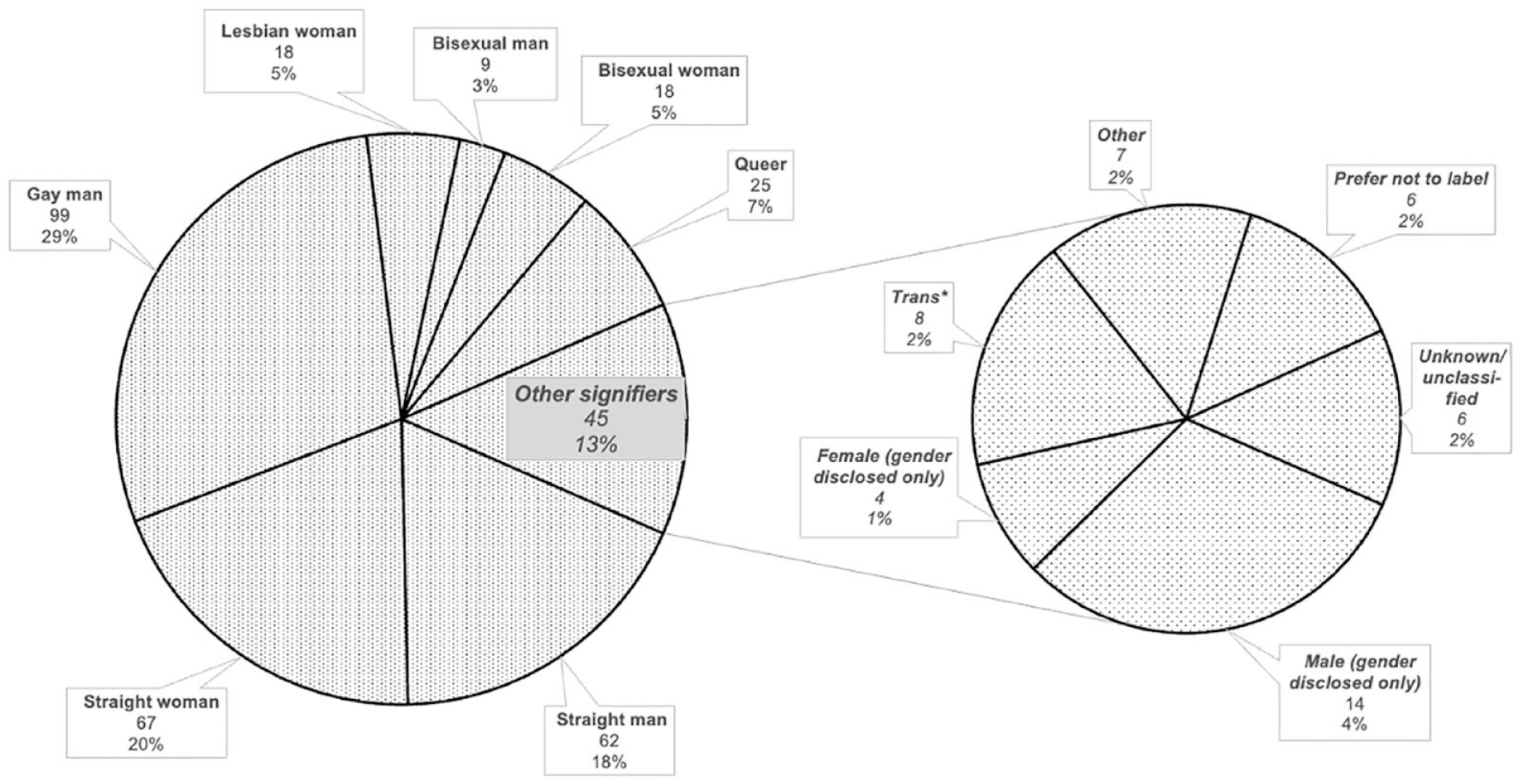
Summary profile of gender and sexual identities as self-disclosed by participants (N = 343).
Similar to Compton et al. (2018), we considered surveys an effective means of gathering public experience. We employed convenient sampling and jointly conducted 159 street intercept surveys, each taking 10–15 minutes, with everyday publics (both local residents and visitors from further afield) over 8 consecutive days in July 2019. We supplemented the street surveys with 184 online surveys (OS) administered via Jisc Online Surveys in July and August 2019, taking about 15 minutes to complete (the OS variant included pictures of HM for visual reference). The online survey was open to those who had previously experienced HM but did not participate in the street survey. Therefore, we assume that respondents would self-exclude if they had no such prior experience; also, we did not identify any duplicate participation based on the answers. We posted survey invitations via socials and street posters (featuring a QR code) and randomly distributed invitation letters to nearby residents. Our familiarity with the topic and the local LGBTQ + context facilitated recruitment. We conducted local observations to develop an embodied relation with the site and to better situate the survey responses.
Summary profile of user status and age cohort (N = 343).
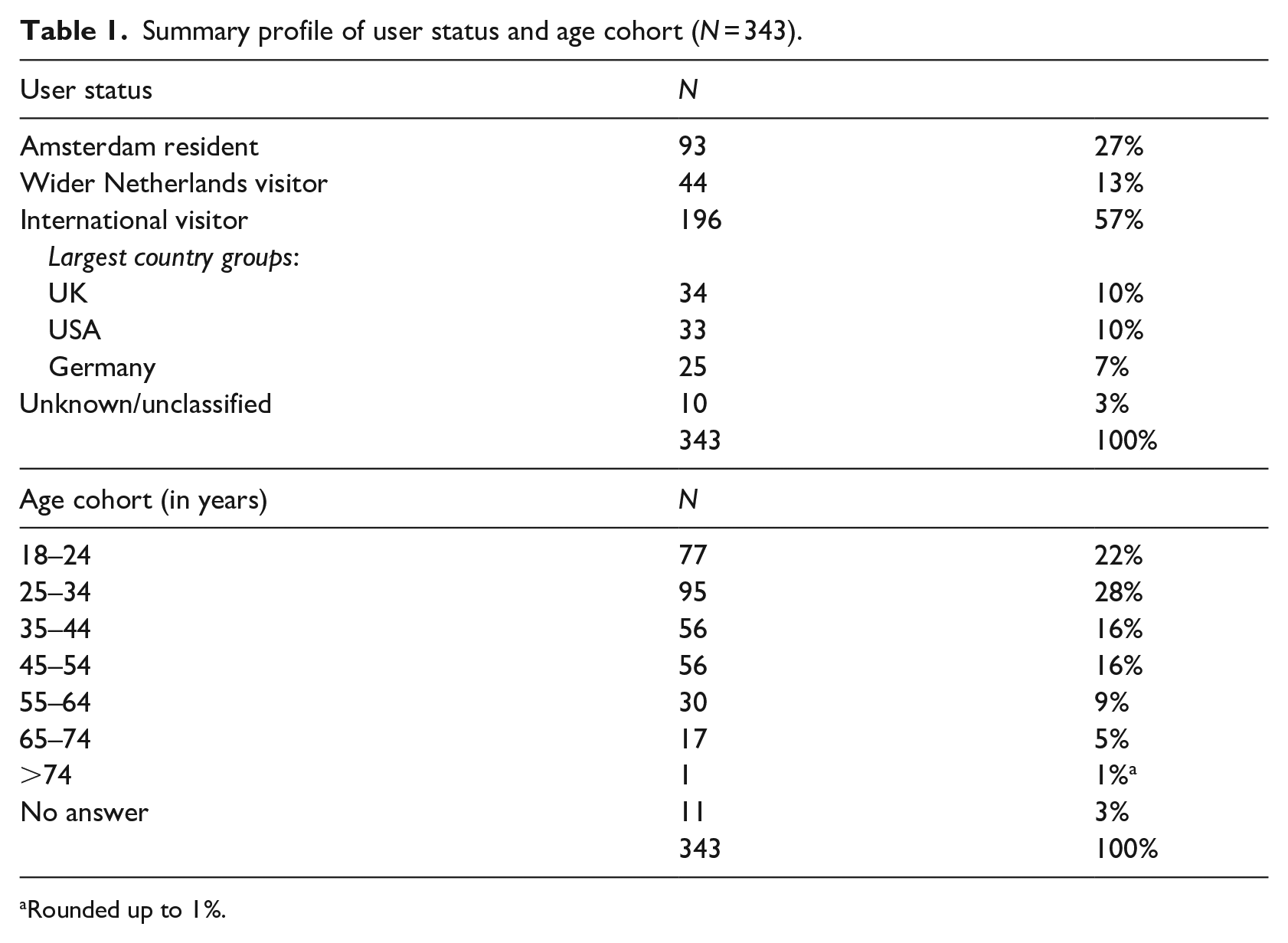
Rounded up to 1%.
Both on-site and online surveys followed a mixed-methods, semi-structured format, allowing participants to respond beyond pre-determined categories. Questions addressed motivations for visiting HM, personal connections with it (e.g. meeting people, attending social events, awareness of public debates), and keyword-based associations with HM. Participants were presented with Likert-type agree–disagree statements like ‘HM represents me’ and ‘this is a good location for HM’, along with opportunities to elaborate on answers. Questions also addressed who HM is for, its significance to the city, and desired changes to HM. For background, we collected demographic information as participants self-described. To add an interactive close to the street survey, we invited participants to capture the spirit of the place using our provided disposable analogue camera.
We offered the surveys in both Dutch and English and translated the Dutch responses into English. The lead researcher (Zebracki) is a Dutch native and accommodated participants who preferred to respond in this language. Language barriers were minimal (only one street survey was discontinued due to comprehension issues). Most participants had English as their second language, potentially affecting vocabulary choices compared to native English speakers. Responses from the hardcopy and online formats were transcribed and consolidated into a single dataset, coded, and inductively analysed to identify recurrent themes and patterns. Thereby, we qualitatively evaluated the interrelatedness of the participants’ responses.
We acknowledge limitations concerning potential recruitment bias, data interpretation, language translation and generalisability (see Ghaziani and Brim, 2019). Given the topic, there might have been a potentially greater willingness among LGBTQ + individuals to participate, especially among the self-selected online survey participants. Online respondents potentially may have had more time to consider their answers, which could account for the typically lengthier responses compared to the street surveys. On the contrary, the street survey’s interactive nature enabled us to promptly request clarifications when needed.
What has Homomonument got to do with me and my community?
The responses of members of the public revealed diverse perspectives on representation and inclusiveness as seen through HM. Hereinafter, we explore how individuals mutually connected HM to events in their lives and their respective communities, along with perceived impacts on themselves or deemed target audiences. Thereby, some respondents indicated challenges around belonging to the monument’s space, especially when experiencing certain vulnerabilities or insecurities about their LGBTQ + identity and expression. We organise our findings into three main aspects: meaningful encounters, global community roles and place-based identities.
Meaningful encounters
About two-thirds of the participants were familiar with HM prior to the survey, especially Dutch residents from Amsterdam or other parts of the country. A majority (65%) of the total respondents felt that HM carried personal associations for them, with many of them (62%) linking it to their self-identification as LGBTQ + . Others found meaning in HM, either as an ally of the LGBTQ + community or through connections with LGBTQ + friends or relatives.
Moreover, respondents derived place-based memories of HM through participation in activities such as parties, social gatherings, guided tours, protests and personal celebrations or mourning (some dating back to HM’s early days). HM appears to continue serving as a site of remembrance, especially for those who lost loved ones during the HIV/AIDS epidemic.
For example, an Amsterdam resident shared, ‘when my then lover died in 1994, we held a remembrance service for him there’ (OS, white gay man, 45–54 years). Another local recounted a feeling of liberation at HM: ‘my first time here in Amsterdam was in 1997. I encountered two women kissing and found that an amazing experience. It was total freedom, anything goes’ (white gay male Amsterdam, 35–44 years). Moreover, for a Dutch bisexual female visitor (45–54 years), HM signified LGBTQ + self-acceptance while sharing the unfortunate news that ‘I had a gay and transgender friend who committed suicide as they couldn’t cope with their sexuality’.
First-time visitors to HM, who reported to be unaware of its existence before the survey, struggled to assign personal meaning to it. Some relayed to be unaware of ‘the’ meaning – assuming the existence of an ‘official’ reading of HM as a site of memory (rather than it being open to manifold interpretations or uses within an environment of memory). Some respondents mentioned historical and cultural awareness-raising as their primary motivations for visiting HM.
Of the 37 participants who said they intentionally visited HM, 30 identified as LGBTQ +, potentially suggesting that HM may be a stronger pull factor among LGBTQ + than straight visitors. Nevertheless, a local resident remarked: ‘it’s really important to visitors, but not for those from Amsterdam’ (Dutch straight male, 35–44 years), which could be read as a critique of LGBTQ + cultural commodification for external tourists (see Hubbard et al., 2017).
Global community roles
Respondents often acknowledged HM as a significant LGBTQ + place of interest within Amsterdam, as well as an important LGBTQ + symbol and attraction for Dutch and international visitor communities. This international appeal was also observed by Binnie (1995: 175), who described HM as ‘a site of pilgrimage for lesbian and gay visitors from across the world’. For instance, a bisexual Middle Eastern resident in the Netherlands reported that HM meant ‘my first online post with my boyfriend’ (OS, 25–34 years). A testimonial from a respondent from Belgium envisioned HM as a ‘carrier’ of global LGBTQ + struggles for equal rights. In this light, a white migrant gay man, working as a lawyer in the United Kingdom, stated, ‘it’s a memorial to those like me who were persecuted for who they are’ [origin country unspecified].
A visitor from Australia saw HM as a beacon that ‘boosts recognition’, continuing that ‘[queer] monuments question societal norms; people ask questions about the monument [HM] and by answering them the awareness is raised’ (white straight female, 18–24 years). Some respondents critiqued the invisibility of trans people in LGBTQ + culture and heritage (see the work of March, 2021). A creative director from NYC argued that HM should be showcased to the world to raise awareness about the ‘current wave of nationalism against the LGBT + community, especially trans people’ (white straight man, 35–44 years).
Moreover, some international respondents connected HM with their personal involvement in LGBTQ + activism and organising. As an Irish respondent relayed:
I’m bisexual and worked as part of my country’s marriage equality campaign in 2015 and its abortion rights campaign the year that I visited the monument in 2018. It meant a lot to visit a monument that is core to commemorating the work of on-the-ground activists and the loss of people who fought for their right to exist. (OS, white female, 25–34 years)
In contrast, a Russian respondent commented, ‘I live in a country where people still have to explain that any orientation other than straight is normal. Unfortunately, in Russia, pride and monuments are still far away’ (OS, white female pansexual, 25–34 years). This respondent suggested that queer memorials were not ‘their priority’, as there are more pressing rights-related issues to tackle.
Place-based identities
Many respondents mentioned HM in the same breath as Amsterdam, suggesting HM as a central facet of this ‘gay capital’ (see Duyves, 1995). Yet, certain respondents exhibited homonationalist rhetoric, such as ‘Amsterdam is a rainbow city’ (white straight female, 18–24 years), and ‘Amsterdam is known for being the most open-minded . . . the Homomonument is interconnected with a feeling of an open city’ (white male, 25–34 years). These sentiments portrayed Amsterdam as the utmost logical place for an LGBTQ + memorial. A local LGBTQ + tour guide imparted similar thoughts, who said to emphasise in tours the ‘natural marriage’ between HM and Amsterdam, framing the city as ‘free’ where ‘everyone is allowed to live here as long as they get on well with everyone else’.
At the same time, ‘living here’ was presented as having ‘terms and conditions’ that uphold Dutch values – suggesting queer spaces are only safe for those who do not fall outside of social norms (see Goh, 2018). A Dutch respondent (residence unknown) found HM still of great importance, arguing that ‘gay violence is increasingly common, unfortunately’ (OS, white bisexual female, 35–44 years). For a Latinx queer respondent from London (OS, 25–34 years), HM prompted that ‘many [LGBTQ + people] do not have the protections they deserve’, adding that they are, due to the lack of such protections, typically left to ‘simple self-struggles’.
Simultaneously, some respondents shared personal or communal place-based identities of HM. As suggested by Reed (1996), HM’s symbolic-historical reference to the Nazi pink triangle is emphasised by its spatial proximity to the Anne Frank House, which opened in 1960 and is located 150 metres away from HM. The Anne Frank House appeared as the most popular visitor attraction among about one-third of our respondents, and many linked it with HM. Given this nearness, some respondents underlined HM’s role as a war memorial and decoupled its meaning from gender and sexuality (contrary to, as we have mentioned, Bartels’ (2003) view of HM as a war cum gay memorial). For example, a participant raised:
I’m bisexual, but I don’t have the feeling that I have anything to do with that monument because of that. That kind of stuff should be there for wars, deaths, meaningless violence; sexual orientation isn’t such a big deal for me. (OS, white female, 35–44 years).
Moreover, some mentioned HM’s adjacency to Pink Point Amsterdam in the same square, which is an LGBTQ + information kiosk established within the purview of the 1998 Amsterdam Gay Games. But not all adjacent LGBTQ +-related site features were reported, such as the Niek Engelschman bridge over Keizergracht, which was named after the founding chair of COC (the world’s longest-running LGBTQ + advocacy organisation since 1946) (see Hekma and Duyvendak, 2011). Westerkerk Church was perceived as another unique place identity marker. A local parish minister expressed a personal link with the place: ‘I love that it [HM] is right next to a church, which connects multiple of my identities [including sexuality and religion] that to me belong to each other closely’ (OS, white gay male, 45–55 years). This example illustrates the intersectional dimensions of place-based identity associations (see Irazábal and Huerta, 2016), emphasising HM’s broader significance beyond issues of gender and sexuality alone.
In this context, some participants acknowledged the importance of accommodating multiple claims on the same ‘site of memory’. As a respondent aptly articulated:
I have an opinion about what it’s designed for, but I am not entitled to remove people’s claim on it: that is a question for their own intersectionality, if they can’t see the idea of “living off the back” of grief that actually doesn’t relate to them. (OS, white gay male, 35–44 years)
This response reveals a need for inclusivity, or queerness, within HM as an environment of memory. Such inclusivity would endure as long as everyday publics embrace multiple experiences and interpretations of HM, thereby endorsing co-existing claims on its shared space.
What is Homomomument’s environment of memory?
In this section, we focus on HM’s environment of memory as a socially practised place, where the ‘stone’ of the official memorial intersects with everyday on-site practices (after Nora, 1989). In the following, we present our findings within three key themes: spatial harmonisation, social blending and public communication regarding HM.
Spatial harmonisation
Numerous respondents found HM’s location appealing, where its prominent position on the iconic Keizersgracht was viewed by many as a testament to the municipality’s commitment to HM’s important role in the city. While many residents knew of HM’s existence, some external visitors initially did not notice it, or perceived it as a form of street furniture. For example, an Australian visitor commented: ‘I expect a monument to be visible, noticeable without having to look for it, a landmark that can be recognised, not a pier-like thing on the floor, sorry’ (OS, straight female, 45–54 years).
Respondents noted that HM’s site can get busy during the day, potentially making it somewhat subtle or hidden for less familiar visitors. At the same time, a respondent found HM to be ‘beautifully integrated into ordinary life’ (Dutch white bisexual female, 55–64 years), as indeed intended by the designer. Westermarkt’s high-foot traffic, also visible from the tram and bus routes that intersect this place, was found by some to enhance this appeal. Participants often viewed HM in harmony with its history and place, as conveyed by this respondent:
It’s a place of memory of the battle from the past, the many people who died for who they were. It’s also a place in the present to calm down by the water or to bring a message to people through words or performances on the stage. It carries the core values of the [LGBTQ+] movement and offers us a chance to develop these further. (OS, white queer, 18–24 years)
The above view strikingly reverberates Binnie’s (1995: 175) observation of HM ‘as a place of tranquillity, of rest, of freedom’, as well as the designer’s documented reading of ‘the stage’, namely: ‘the “Future” is the springhigh rose triangle that’s pointing to the COC [. . .], the Actioncentre [sic] of the Homo-Movement [sic]. It’s a podium. It’s a place to fight from and for! If necessary!’ (Daan, n.d., n.p.). However, some respondents were disturbed by certain objects around HM, like the urinal next to the lower triangle and the traffic flow of taxis, buses and trams, and imagined some preferred changes in this respect, as we will discuss later.
Social blending
Many familiar with HM said to frequently visit it during official annual events, thereby stressing its role as a site of memory. Pride Amsterdam (early August) and Liberation Day (5 May) were indicated as the popular dates for socialising around HM. On these dates, as a local resident expressed, ‘the gay, lesbian, and trans people gather and celebrate the possibility of loving in freedom together’ (OS, white lesbian, 25–34 years). However, similarly to Zebracki et al. (2023), respondents raised concerns about the inclusivity as experienced at these events. For instance, a visitor from Germany who attended a couple of events at HM imparted: ‘I do not feel that lesbians are included; there’s a different form of oppression experienced by lesbians that is often denied’, which this respondent did not specify further (OS, white genderfluid gay, 45–54 years; see Dunn, 2016).
The official discourse and events around HM can render it a site of memory (as per Nora, 1989). Yet, the responses also indicated the need for more inclusive ‘memory-work’ (Alderman et al., 2020) and representation within HM’s everyday environment of memory, which should particularly involve overlooked people from within the LGBTQ + community. A local stated, ‘there is no real discussion about it [diversity]. It’s a place where gay parties take place, but that’s it’ (Turkish-Dutch asexual female, 35–44 years).
The latter echoes Hernández’s (2010) call for attracting diverse ethnic backgrounds to create greater diversity in social activities around HM. Zebracki et al. (2023) found that in annual parties at HM’s site, ‘some POC [people of colour] felt excluded through everyday decision-making, such as choice of music and catering provisions including food and drinks at the parties’, adding that ‘the organisation behind the key parties has been aiming for the monument to be a space inclusive of all’ (p. 322). Together, the insights from these studies and those from our surveys recommend a bottom-up approach to collective ‘memory-work’ – for example, by allowing grassroots organisations to expand the audiences and programming at parties to diversify HM’s environment of memory.
In addition, some respondents raised concerns about HM’s role in the commercialisation of LGBTQ + culture. A resident from London cautioned against an LGBTQ + ‘monetisation’ at the expense of empowerment, arguing that HM’s value should not be reduced to ‘raise funds for ‘hangers-on’’’ (OS, white gay male). An Amsterdam resident warned against homonationalist pinkwashing: ‘the Homomonument should come also with a political conscience. I’d not like to see it occupied by [. . .] Shell, far-right groups and journalists who use claims of homophobia to fuel anti-Muslim rhetoric in the Netherlands, for example’ (OS, gay male migrant, 25–34 years).
Public communication
Moreover, respondents reflected on how information about HM is disseminated through its public design and various means of communication with public audiences. Some respondents critiqued the official information provision of HM (alluding to its role as a site of memory), finding the two official information panels to be limiting in scope or difficult to find. One panel, which features a brief description in Dutch, English and French, is situated on a railing adjacent to the lower triangle. The other panel, available in nine additional languages (namely Arabic, Chinese, German, Hebrew, Italian, Japanese, Russian, Spanish and Turkish), is placed on an outdoor electrical enclosure at a considerable distance from the elevated triangle. Some respondents perceived the panel descriptions of HM as somewhat binary or restrictive, such as the opening sentence on the panel next to the lower triangle, which reads: ‘Homomonument commemorates all women and men ever oppressed and persecuted because of their homosexuality’.
The only text as part of HM’s memorial proper is the Dutch verse on the street-level triangle: ‘such an endless desire for friendship’ (Figure 1), which the designer conceived of as ‘a very open text, it has it’s [sic] meaning for everyone on his [sic] own way, it’s clear and beautiful. It’s as the Homomonument is, an open space where life is going through’ (Daan, n.d., n.p.) For some respondents, this text was meaningful, as an Amsterdam resident relayed: ‘the poem touches me and represents the alienation a lot of us feel’ (transgender, pansexual and mixed-raced Asian, 25–34 years).
However, some international visitors, unable to read Dutch, found it less resonant, unless a translation or explanation was provided on-site. Moreover, some suggested an interpretative panel that pushes beyond gender and sexual binaries. For example, a visitor from Germany suggested more inclusive language usage: ‘I have a trans daughter, and I [would rather] see three points: male, female, and queer’ (OS, white straight female, 45–54 years).
Overall, respondents’ experiences with HM illustrated it as an artwork for the public, a kind of ‘conversation piece’ (Kester, 2004), mediated through various public means in ordinary interactions, including guided tours, tourist information, and popular media portrayals, to raise LGBTQ + awareness. For instance, an Amsterdam resident said to ‘love’ using HM to ‘explain to visitors why it is important as a community to be visible’ (OS, white gay male, 35–44 years). A local history teacher (gay male, 65–74 years) anecdotally exemplified how he used photos of HM in his classes to educate younger generations about LGBTQ + rights. A Taiwanese visitor suggested that HM is needed in public debates until ‘true equality comes’ (Asian straight LGBTQ + ally, 35–44 years).
As a conversation piece, indeed, HM transcends through social space and time. Some responses raised points about enhancing possibilities for user interaction and experiences that communicate between everyday physical and virtual spaces. Interestingly, a respondent from Russia had engaged HM in such a hybrid context: ‘posting pictures with the monument was one of the tasks for an augmented reality game with elements of scavenger hunt’ (OS, white straight female, 25–34 years). The role of digital technologies might become a greater priority for memory-work on HM among future generations – one of the suggested changes that we will address in the next section.
Do publics want to change Homomonument?
The responses pointed to a trend in the publics’ desire to change HM for a more inclusive LGBTQ + site and environment of memory, with most participants suggesting concrete ideas for such transformation. In the following, we analyse the responses within three discursive threads: enhancing the visibility of HM (for greater prominence), modifying its design (for greater interaction), and changing its name (for greater LGBTQ + recognition). In so doing, we indicate appropriations and some tensions from within and across LGBTQ + communities and straight audiences. While our study relied on non-longitudinal data, some respondents indicated changes in their own awareness as well as in their observed perspectives of others.
Enhancing visibility?
A resident expressed that HM . . .
doesn’t really catch my attention, only until when someone told me about it. I initially thought it was some modern design and just stayed in the background of the place. I didn’t register it, so, it could be made more visually recognisable. (non-binary BDSM practitioner of colour, 45–54 years)
This perspective aligned with Hernández’s (2010) earlier observation that HM was concealed as an LGBTQ + landmark, often unnoticed among people until the point they read or heard about it.
Yet, respondents frequently appreciated HM’s central location: ‘we [i.e. LGBTQ + people] belong right in the middle of the city’ (white gay male Amsterdam resident, 55–64 years, OS). However, some respondents felt HM was a bit hidden in the square and recommended enhancing its visibility through LGBTQ + symbols (like rainbow flags), better tourist signage throughout the city, and further ‘official’ explanations of HM’s significance. Such interventions would thus establish HM as a more visible site of memory and attract more attention from everyday publics. A change to a more prominent location was also discussed, where a visitor from Sweden (OS, white gay male, 45–54 years) proposed to retain HM but to place a copy of it opposite the central station; ‘I’d like people to see it even better’, additionally suggesting a brighter, pinker colour (as HM’s instigators originally proposed; Bartels in Zebracki, 2021: 198).
Some other respondents suggested creating additional queer memorials to represent a greater diversity of the LGBTQ + community in the city’s public space, including commemorative and social events. For instance, a local non-binary pansexual transgender and Asian person of colour (25–34 years) argued that ‘their [non-binary, POC] struggle is unique and deserves its own representation’. This view contrasted with that of a straight female visitor (18–24 years) from Germany, imparting how the introduction of new LGBTQ + memorials might unintentionally ‘make a specific group special’ – suggesting that they would signal further segregation instead of inclusion. Others argued for maintaining HM as the city’s unified memorial to promote LGBTQ + solidarity. As put by a local gay man:
It’s a bit [in] the nature of queerness to be quite atomised; you don’t grow up amongst others like you, as is the case with race or class divisions. So, it’s important to have visible points of solidarity. It makes you feel part of a network. (OS)
Modifying the design?
We found little controversy about HM’s design, perhaps due to its static and less explicit content compared to some other queer memorials (for contrast, see Oettler’s (2021) discussion of the vandalised Berlin queer memorial featuring a video clip of a kissing same-sex couple). Nevertheless, some respondents suggested changing or complementing HM’s design. For example, a visitor from Spain (white male, 25–34 years) proposed adding figurative statues to better represent the diversity of the LGBTQ + community (without specifying exactly whom). This respondent also echoed the sentiments of other visitors suggesting placing information panels in more conspicuous locations at Westermarkt. These would help HM to stand out as a point of interest for those who are less familiar with its existence. Another visitor, from Australia, proposed public guidance that would ‘prevent people from sitting on it’, so that the monument ‘would stand out more’ (white straight female, 18–24 years).
To garner more visual attention, some locals proposed restricting traffic (or banning vehicles altogether) on the road that intersects the water-level triangle and the two triangles at street level. Furthermore, some participants wanted to see more digital applications to enhance interactions and storytelling. Strikingly, a visiting software engineer from Germany suggested adding a VR code, enabling ‘people to virtually tell their stories or listen to other stories’ (OS). Other participants suggested making the design more engaging through the use of digital technologies which may connect better with future, younger generations, as a local teacher suggested: ‘I’d put an interactive surface on top of the elevated element for children to play’ (white female, 55–64 years).
A frequent suggestion was to remove the urinal adjacent to the lower triangle, which some found unsightly or even ‘disturbing’. A local (Dutch-Indonesian straight female, 45–54 years) wanted to see ‘fresh flowers’ instead. However, several locals viewed the urinal – colloquially known as dubbele krul (Dutch for ‘double curl’), which is associated with a gay cruising spot – as a natural fabric of HM and Amsterdam as the ‘gay capital’. Our interpretation of a participant photo (Figure 4), taken by a local (white ‘fluid straight’, 25–34 years) with our disposable camera, aesthetically suggested such an association.
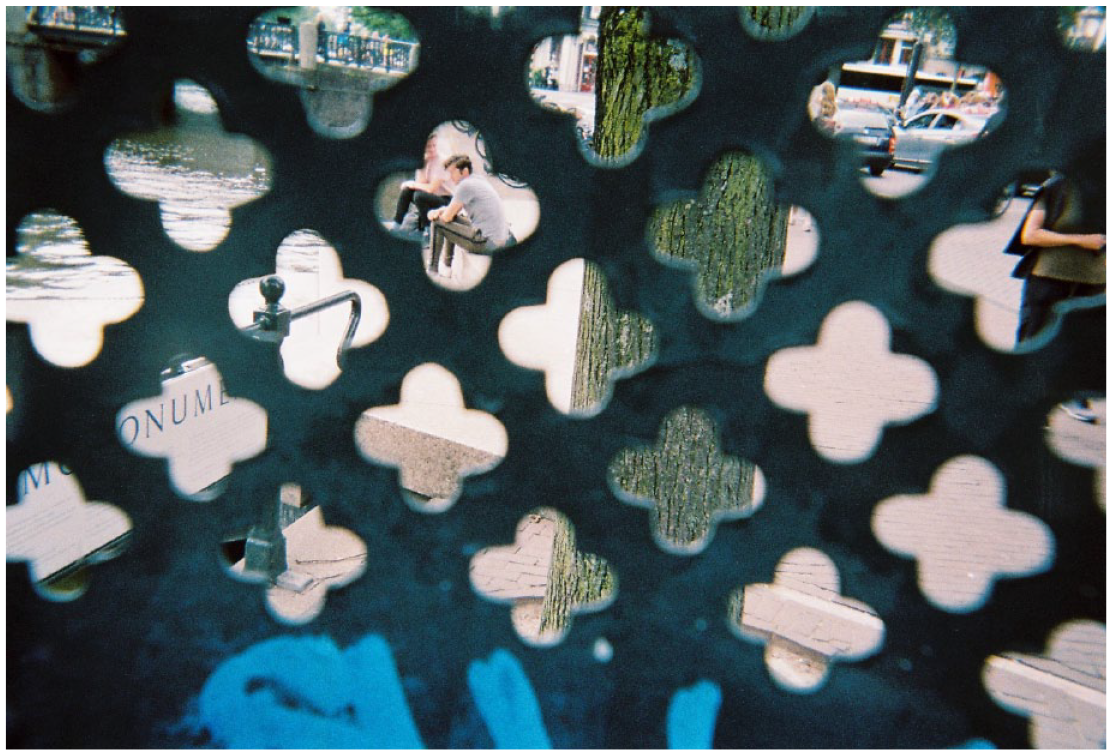
A participant photograph captures a view of Homomonument through the fence of the adjacent urinal, suggesting their inseparable connection.
Changing the name?
The memorial’s name appeared to be a significant point of discussion, revealing tensions between the perceived senses of queerness of HM. Although the Homomonument Foundation has not formally proposed a name change to HM thus far (Zebracki et al., 2023), some felt that the term ‘homo’ limits its representation and advocated for a more inclusive title, chiming with post-gay times of social diversity politics, which extend beyond sole associations of gender and sexuality (Ghaziani, 2011). Some wanted a name change to make it more representative of a greater gender and sexual diversity within society, including transgender people (see also Nash, 2011, and Prosser, 1998), which appeared to be a more common sentiment among younger respondents. An older visitor (>74 years) from the United States acknowledged such a generational shift in preferred terminology:
I personally wouldn’t change it [the name] because it refers to homo or LGBT, so keep it as it is. For more older people it’s clear, but I understand the word is variable; it has become LGBT for younger generations.
On that matter, a visitor from Belgium articulated that
the name [i.e. Homomonument] isn’t on par with the movement anymore, as that is about far more than just sexuality nowadays. The movement shifted from the gay movement to the holebi [Flemish Dutch for LGB] movement, to the LGBT+ movement.
The latter respondent also pointed out that ‘these developments are showing much later on the street or in the media’ (OS, white queer sex worker, 18–24 years).
Some respondents wanted to see an alternative name that would be considered less reductive and more empowering. For example, a Dutch respondent said that the current name ‘implies that it’s only for men’ (white male, 45–55 years). A local expressed a similar hunch: ‘I’m not sure if everyone who feels part of the LGBTQIA + alphabet feels the Homomonument is also for them’ (OS, white gay male, 45–54 years). Numerous alternative titles for HM were suggested, including ‘Monument for All Genders’, ‘Monument for Oppressed Sexual Minorities’ and ‘Monument for Freedom’. A Dutch individual suggested that the work’s title should ideally incorporate the commonly known term ‘pride’, ‘just as Pride Amsterdam is no longer called gay pride [. . .] with Pride it takes on a more inclusive name’ (OS, white genderfluid pansexual, 18–24 years). This idea resurfaced in some other proposed titles, such as ‘Pride Monument’ or ‘Pride Triangle’. A visitor from Germany said that an alternative title should be punchy and widely known, adding that it should ‘avoid long abbreviations that straight white people tend not to understand’ (OS, white gay male, 35–44 years).
However, some respondents did not desire a change in HM’s title or nomenclature at all. An Amsterdam resident conveyed that the current name, Homomonument, acts as a provocation of the hegemonic heterosexual society. Therefore, the resident argued that it should not be changed: ‘no, homo is a critical word. If you’d change it, you’d take a bit of the edge off the meaning when it was originally placed’ (white gay male, 35–44 years) – while ‘queer’ is internationally more recognised as an activist and political term associated with gender-variant lives (see Prosser, 1998).
The previous respondent desired HM to be primarily preserved as a site of memory. Moreover, this respondent observed a certain public fixation with renaming memorials and found this trivial in the face of global challenges to LGBTQ + rights: ‘the community is far more concerned with other issues, such as the Nashville Statement and the emergence of “straight pride” – well, parades for stupid forms of heteroactivism’ (white gay male, 35–44 years; see Nash and Browne, 2020). A Dutch intersex, transgender lesbian respondent (45–54 years) stated that HM should not change its name, putting this point in further perspective:
It [Homomonument] stands for what it is. Clearly, it’s a bit old-fashioned. It shows the spirit of the time and avoids a ‘it’s a hype again’ feeling. The other letters, LGBTQIA, within the community know that it’s for them, too. For the people who don’t have any connection with it, ‘LGBTQ+’ already induces irritation because they find that too complicated. That’s negative. With that, you stop conversations instead of stimulating them. (OS)
The above view reverberates some scholarly thought, suggesting that changes to the material spaces of gender-variant minorities do not solely lie in performative actions like name changes; instead, constructive actions should take place through serious dialogue (e.g. Doan, 2007; Nash, 2011).
In conclusion, the perception of LGBTQ + inclusivity associated with HM depends on its particular uses and how members of the community perceive it. As a visitor from Finland remarked: ‘monuments begin to live their own lives. While it [i.e. HM] was built for a very specific purpose, the way the community uses the place now is what determines how it should be viewed’ (white gay male, 25–34 years). While some respondents advocated for changes to better recognise and represent the diversity of the LGBTQ + community, others stressed the importance of preserving its historical continuity and, hence, its name.
Nevertheless, a few respondents believed that, for example, altering HM’s name would amount to an attempt to rewrite history as well as to undermine its official status as a site of memory. As a visitor from London conveyed: ‘history shouldn’t be changed even if times have moved on’ (OS, white straight male, 65–74 years). In all, the various proposed changes to HM, along with hesitations concerning such changes, reveal the complex and ambiguous dynamics of memory-work associated with queer memorials – which navigate between commemorative practices (sites of memory) and intersectional lived realities (environments of memory).
Discussion and conclusion
In this article, we have examined publics’ experiences of HM as a socially inclusive site and environment of memory (following Nora, 1989). Based on the analysis of a case-study survey (N = 343), we have unveiled kaleidoscopic, yet equivocal, ways in which respondents experienced HM’s place in the city and role in the community. We have also attended to how they envisioned HM’s future evolution. By treating HM as a socially practised place, we have examined how physical affordances of the object (HM) and everyday social practices surrounding it contribute to its perceived ‘queerness’ or inclusiveness – acknowledging that people’s experiences of HM’s significance intersect beyond gender and sexuality aspects alone.
While the Homomonument Foundation aims to engage HM with LGBTQ + communities in their fullest sense, our analysis has revealed some ambiguous nuances about such formal discourse. We have seen how HM’s environment of memory is not mutually exclusive from the site of memory; these may overlap when people’s lived experiences intersect with official discourses and commemorative practices. Also, the study has provided insights into publics’ perspectives of how queer memorials might be more welcoming and attain greater social inclusiveness, and thereby queerness, through the representation and involvement of a greater diversity of gender and sexual identities. Consequently, these might enhance conditions for safe(r) queer spaces (see Goh, 2018), an area that warrants more attention in future research on queer memorials.
Our study, akin to Oettler (2021), invited members of the public to uncover ‘meanings articulated in practice’ (p. 344), which supports this author’s finding that ‘the superficiality of most encounters did not impede the effort to create meaning’ (Oettler, 2021: 344). Our findings, to some degree, reverberated Reed’s (1996) view of HM as an ‘imminent’ entity, where it ‘disappears as art in order to emerge as the embodiment of a community’ (p. 65). HM serves as a platform for speech, protest, commemoration, dance, seating and so forth during LGBTQ + community events, such as Pride, reinforcing its role as a ‘performed’ queer memorial (after Conlon, 2014). This performance aspect holds, too, the potential for ‘fostering [inclusive] change’, marked by Orangias et al. (2018: 705) as one of queer memorials’ key functions.
For many, HM stood as a symbol of growing LGBTQ + acceptance along with opportunities for free expression on its site and beyond. HM was frequently experienced, and sometimes criticised, as a potential catalyst of inclusive change. Although some respondents relayed associations with LGBTQ + tolerance and acceptance, such associations may contrast with real-world experiences of marginalisation and under-representation. It is vital to look beyond instigators’ apparently dominant inclusive discourses and delve deeper into potential exclusionary implications that are not always clearly legible. Inclusion has often favoured more easily ‘digestible’ parts of the LGBTQ + spectrum, potentially side-lining individuals not conforming to social norms. Those living outside marginalised groups may possess more capital and better opportunities for identity representation. Therefore, processes of ‘memory-work’ (Alderman et al., 2020) should be ‘queeried’ and require foregrounding alternative experiences of the socially marginalised (Dragojlovic and Quinan, 2023).
The ambiguities and tensions in publics’ perspectives of HM reflect larger challenges in producing inclusive commemorative sites. Saliently, some responses alluded to HM as a lens through which to critique homonormative commodifications of LGBTQ + spaces (see Hubbard et al., 2017). Moreover, HM can be used as an interesting case to engage homonationalist rhetoric regarding which citizens are welcomed, and who are not (Rao, 2020). These aspects also warrant a deeper exploration that dovetails research on queer memorials’ inclusivity with intersectional thought.
Intersectionality can shed light on how processes of inclusion and exclusion within sexual and gender communities interact with class, race, generation and more (e.g. Sullivan, 2021). The public discourse on HM suggested an under-representation of LGBTQ + individuals beyond white gay males, notably people of colour, akin to the findings of Zebracki et al. (2023). Where the latter study mostly focused on the narratives of key professionals, event organisers and activists, our study has critically expanded this work through its use of a large-scale survey on the lived experiences of everyday publics regarding HM. As such, our work has provided a comprehensive understanding of its inclusivity as perceived by the publics, emphasising community engagement involving some contradictory ways wherein the intended inclusivity of HM is experienced in practice.
HM’s public space, including our own study context, appears to operate within white-gendered power dynamics (see Akachar, 2015). This suggests opportunities, both in research and practice, for amplifying people-of-colour voices within HM’s broader memorial context, and dedicating commemorative spaces beyond white LGBTQ + individuals and homonormative narratives. The findings underline the need for policymakers and curators to consider the intersectional nature of LGBTQ + identities and experiences in developing commemorative strategies around queer memorials.
While queer methods challenge, or ‘que(e)ry’, the homogenisation of gender and sexual identity categories of individuals and groups (Jagose, 1996), our study survey, while informative, could not fully capture the ‘messy’ diversity of LGBTQ + identities and experiences (e.g. Compton et al., 2018). To address barriers to ‘translating’ lived experiences (including in bilingual research contexts like ours), it might be of interest to expand narrative-based approaches by integrating visual methodologies (building on our experimental participant photography, e.g.). These could move beyond narrated content to capture more of the non-representational, performative aspects of how diverse individuals and groups engage with queer memorials across multiple intersectional registers.
Hence, the question arises: how can we advance our comprehension of queer memorials that pushes beyond pre-established sites of memory where users ‘passively’ read and consume conventional meanings? Instead, we can explore how to progress towards fathoming queer memorials as dynamic environments of memory. This approach would pay greater attention to how their physical dimensions (such as form and location) and intangible dimensions (including theme and narrative) can suitably respond to shifting social contexts and understandings of gender and sexuality (e.g. ‘post-gay’ identifications).
Coda
Despite HM’s historical significance being etched in ‘static’ stone, we should exercise caution when we consider its potentials for evolving as a ‘living monument’ (Koenders, 1987) that signifies progress for all. While the Homomonument Foundation (n.d.) underscored the importance of remaining vigilant, we stress that an inclusive environment of memory requires queering of both the physical space and its associated social practices through active engagement with diverse everyday communities.
We encourage future research, potentially comparative in nature, to focus on examining the impacts of these community engagement strategies on the perceived inclusivity of queer memorials and the collaborative creation of their social relevance. This means that LGBTQ + commemorative sites require a pro-active, ongoing process of interrogation and reinterpretation of meaning, creating space for expressing and engaging a wider spectrum of experiences and identities. This evolution could help challenge power structures and integrate diverse perspectives into decision-making around event programming, among others, to make this approach more intersectional. This might bridge tensions between historical commemoration, present-day inclusivity and the future relevance of LGBTQ + commemorative sites.
Postscript
This study was conducted in 2019, prior to the COVID-19 pandemic (2020–2022). Following the pandemic, during which some socially distanced commemorative events were held at HM, the Homomonument Foundation resumed its key events as usual, particularly around King’s Day in April and the National Remembrance Day and Liberation Day in May. In recent years, the Foundation (while maintaining its political neutrality) has adopted a more activist approach, echoing the mission of Queer Amsterdam (https://queer-amsterdam.org/en/), the grassroots counterpart to Pride Amsterdam. This shift has enhanced the integration of intersectional awareness in the fight for LGBTQ + equality. The approach has involved developing bespoke celebratory events, including around HM, for different target groups in advance of the annual Canal Parade in August. For more information about the Homomonument Foundation, see their official website https://www.homomonument.nl/en
Footnotes
Acknowledgements
The authors are deeply grateful to the participants in their research for sharing their experiences. The authors also extend their gratitude to Megan Waugh, the Queer Memorials project research assistant, for invaluable support in preparing and evaluating the fieldwork. The authors thank Ronald Berends, Thomas Coenraadts and Freek Janssens for providing updates on social activities surrounding Homomonument following the COVID-19 pandemic. Finally, the authors appreciate the constructive comments from the anonymous reviewers and journal editors, which have helped them strengthen this manuscript.
Funding
The author(s) disclosed receipt of the following financial support for the research, authorship, and/or publication of this article: This work was supported by the Arts and Humanities Research Council (AHRC) under Grant AH/P014976/1 for the project Queer Memorials (QMem): International Comparative Perspectives on Sexual Diversity and Social Inclusivity (led by Zebracki with Co-I Robert Vanderbeck)  Additional support was provided by a Laidlaw Foundation Scholarship (Kolar) and a Nuffield Foundation Q-Step Scholarship (Collis).