



Abstract
Emmanuel David on contemporary artist Cassils’s embodied struggle and trans politics.
On February 22, 2017, the Trump administration rescinded Obama-era federal protections requiring public schools to allow transgender students to use the bathrooms corresponding with their gender identities. This was just one in a series of recent rollbacks in transgender protections, including a ban on transgender military service. Many in the transgender community are understandably on edge.
“We are under siege,” said Cassils, a gender non-conforming, trans masculine visual artist and performer—and a 2017 Guggenheim recipient. Cassils, a Canadian artist now living in Los Angeles, uses a singular name and plural pronouns (they, them, theirs). I spoke with them briefly on the eve of the September 16, 2017 opening of their most recent exhibition, Monumental, at the Ronald Feldman Gallery in New York City.
Cassils, like many other artists engaging critical trans politics, tackles the tensions between visibility and invisibility, inclusion and exclusion. As sociologist Viviane Namaste has noted: “transsexuals are continually and perpetually erased in the cultural and institutional world.” Namaste argues this erasure “is organized at the micrological level, in the invisible functions of discourse and rhetoric, the taken for granted practices of institutions, and the unforeseen consequences of social policy.” At a time when transgender visibility in the media is exploding, described by some as the so-called “transgender tipping point,” Namaste’s words have continued relevance. That is, the exclusion of transgender and transsexual people continues, even as their presence in the mainstream culture seems to have grown.
Many of Cassils’s works are about duration, transformation, and the body. In their Monumental exhibition, viewers encounter a lenticular print titled “Before/After,” in which the image changes when viewed from different angles. Before/After shows what became of a 2,000-pound block of clay that Cassils punched and kicked during a 2014 performance of their “Becoming an Image” series. (Before/After is a tongue-in-cheek reference to the practice of dieters and bodybuilders sharing before and after photos as evidence of bodily change, a custom Cassils knows well from their previous work as a personal trainer). The Becoming an Image series usually takes place in total darkness, and Cassils even covers the doors and windows of the performance venues, making it impossible for the audience to see. As Cassils unleashes their bodily force against the clay block, a photographer captures the action during the intermittent flashes of light provided by a strobe.
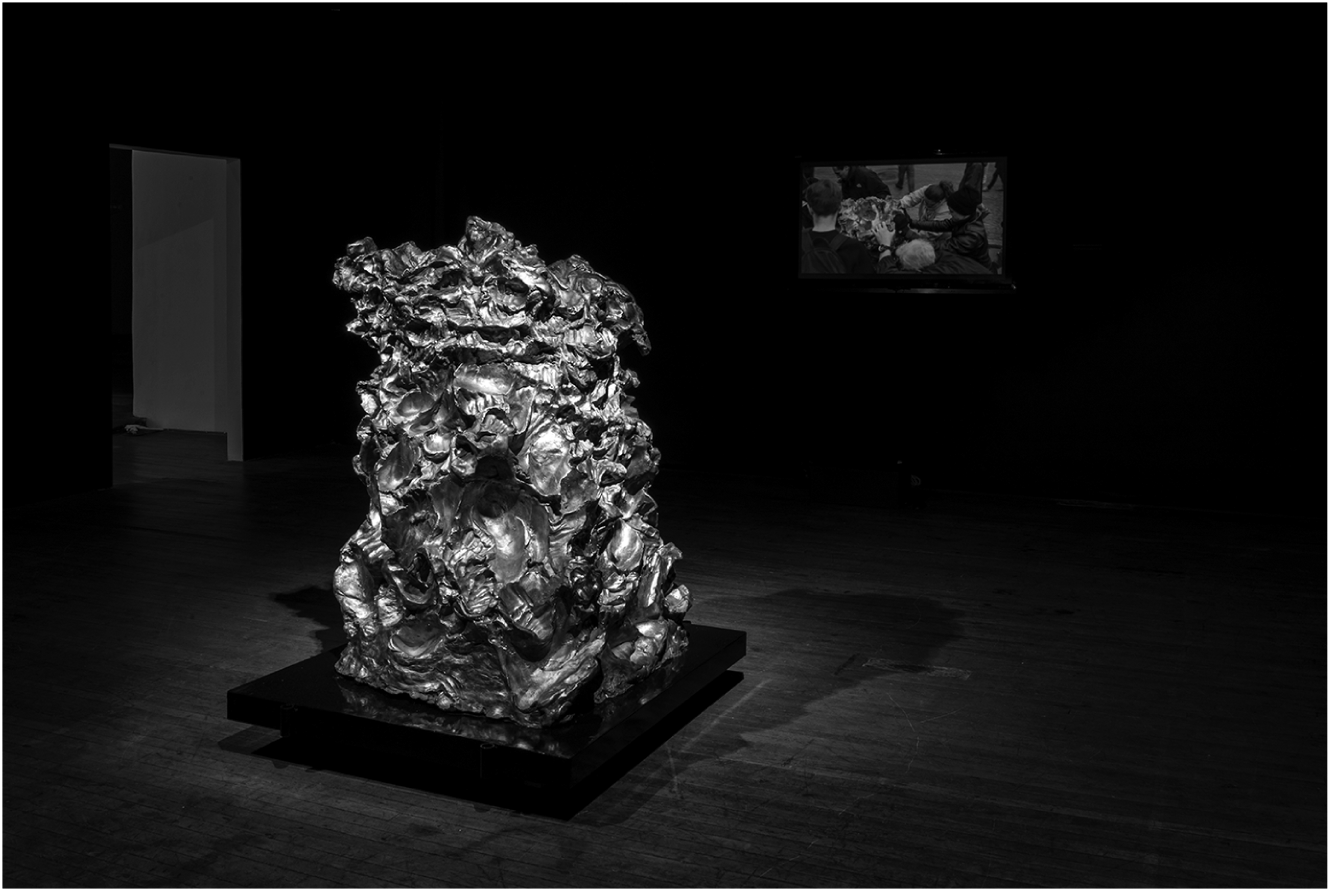
Cassils has repeated the performance at numerous locations in both the U.S. and Canada and, in 2016, they created a 1,300-pound bronze cast of one of the clay sculptures. In the center of a room in the Feldman Gallery, visitors encounter this cast, titled: “Resilience of the 20%.” Its name refers to a statistic from the Transgender Murder Monitoring project that found a 20% increase in the number of reported murders of transgender people worldwide from 2011 to 2012. Indentations from Cassils’s body, their knuckles and elbows, their knees, shins, and shoulders, were visible. Visitors were allowed to feel the cast—to rest their hands in the deep grooves and leave a mark on the work with their natural oils.
Many people have indeed touched the statue. The 2017 video, “Monument Push,” also part of the exhibition, documents a crowd pushing the sculpture through the streets of Omaha, Nebraska. For this collective action, Cassils reached out to members of the Omaha LGBT community, who struggle to weather the precarious political climate under the Trump administration. Pushing the sculpture gave them an opportunity to display their collective strength.
Cassils, Resilience of the 20%, 2016. Bronze sculpture.
Megan Paetzhold. Courtesy the artist and Ronald Feldman Gallery, New York
Cassils, Monument Push, Performance Document (Omaha, Nebraska), 2017.
Courtesy the artist and Ronald Feldman Gallery, New York.
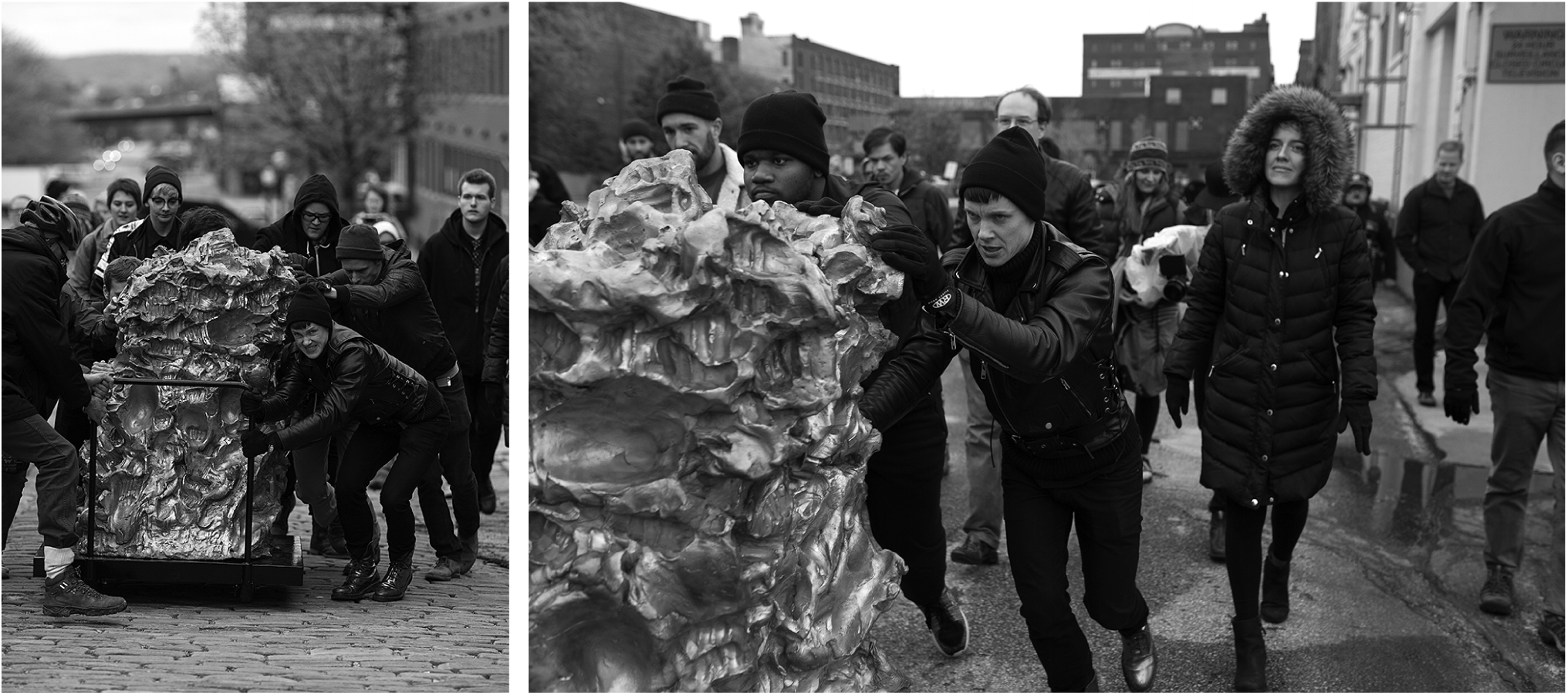
Participants in Monument Push moved the monument through carefully selected locations significant to local LGBT struggles. The large, bronze cast made its way down the path of the city’s first Gay Pride Parade in 1994 (where some attendees reportedly showed up with paper bags over their heads to remain anonymous) and through the streets just outside the Douglas County Correctional Facility, where one participant, Dominique Morgan, a queer person of color, had been locked up for engaging in sex work. Wearing a baseball cap emblazoned with the inmate number “56892,” Morgan appears in the video and talks about having been put in solitary confinement as a form of protection from other prisoners. This collective performance raised numerous intersectional issues: sex work, stigma, survival strategies, class struggle, institutional racism, and the prison industrial complex.
I had previously seen still images of the Omaha performance, and the visual evidence of solidarity moved me. But it was the grating sound of the monument being rolled slowly over concrete and cobblestone that struck me the most in the gallery presentation. The sound stressed the fact that pushing the heavy sculpture for many miles, over several hours—from one symbolic site of struggle to another—could only occur through collective action. As such, this work exhibited community resilience and visibility in the context of an otherwise hostile political environment.
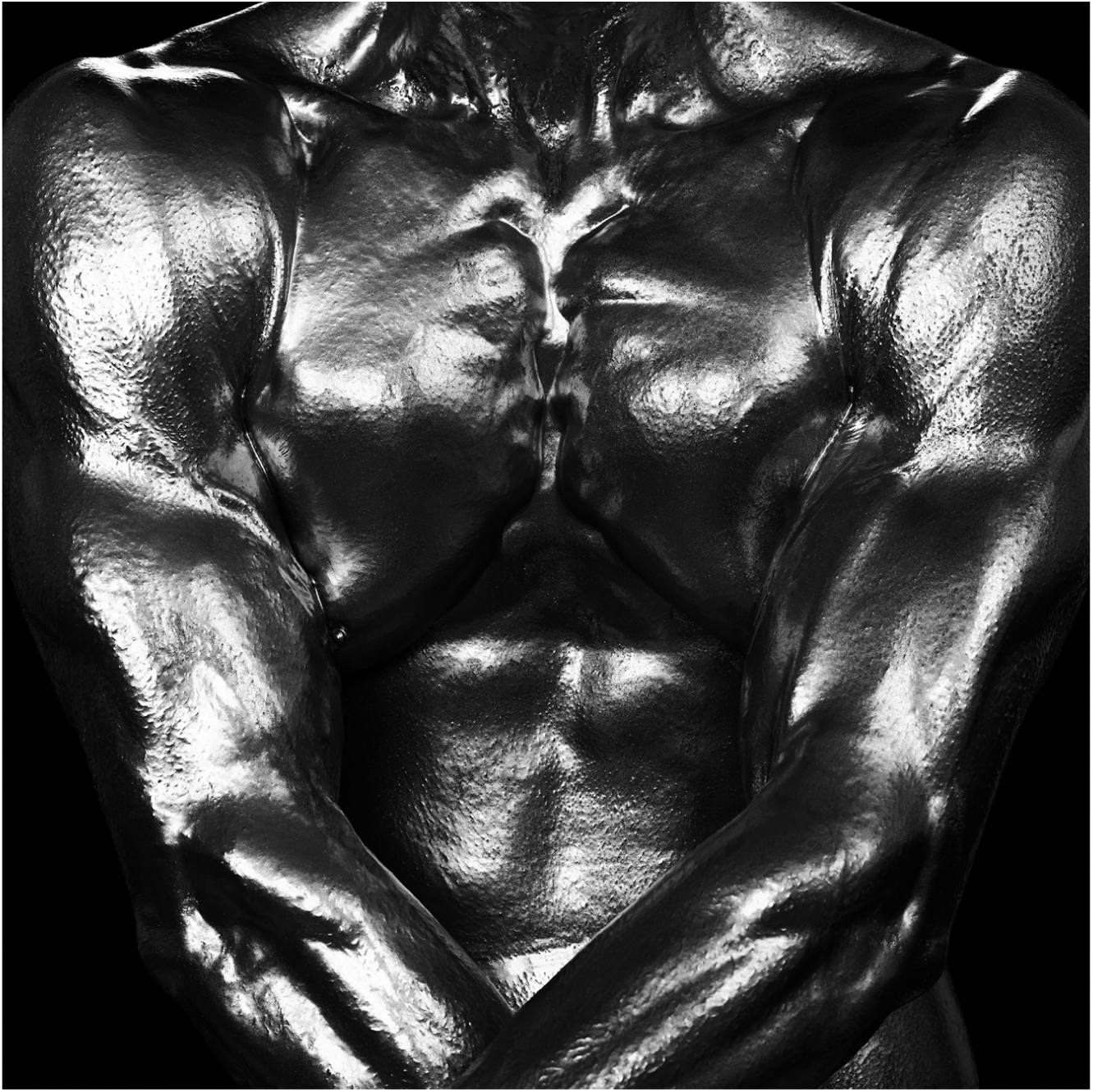
This recuperative aspect of queer and trans experiences was also at the center of another work in the gallery exhibition. “Alchemic,” a photographic series, depicts Cassils’s body painted in a lustrous golden hue and imagines transgender embodiment by evoking the alchemical transformation of ordinary materials into gold. By centering a self-determined transgender body, the work reclaims value at a time when transgender people are often told they are worthless. Countering erasure and devaluation, Alchemic evokes what art historian David Getsy calls “transgender capacity”: the “ability or the potential for making visible, bringing into experience, or knowing genders as mutable, successive, and multiple.” It serves as a powerful corrective to the rhetoric of transgender disposability.
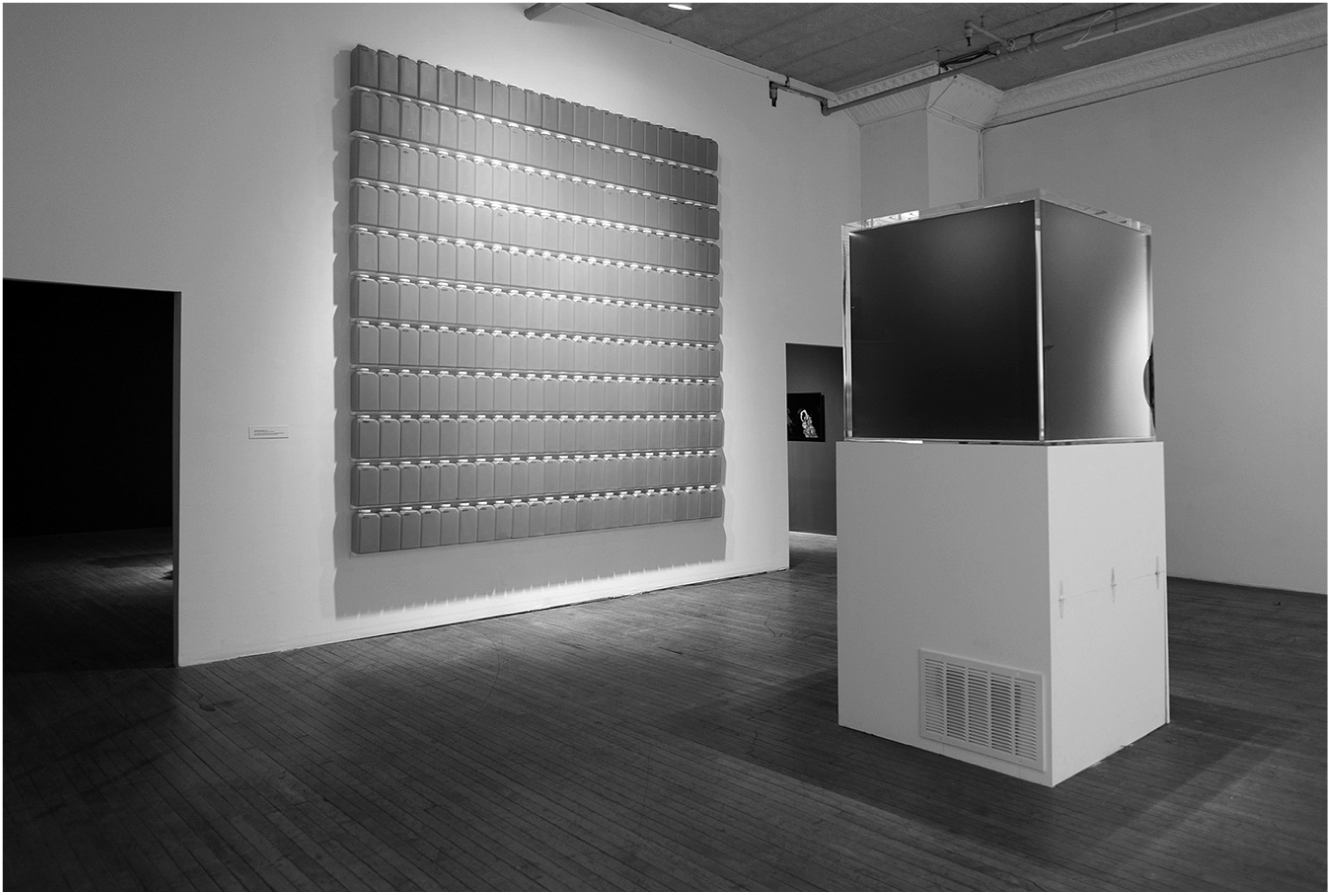
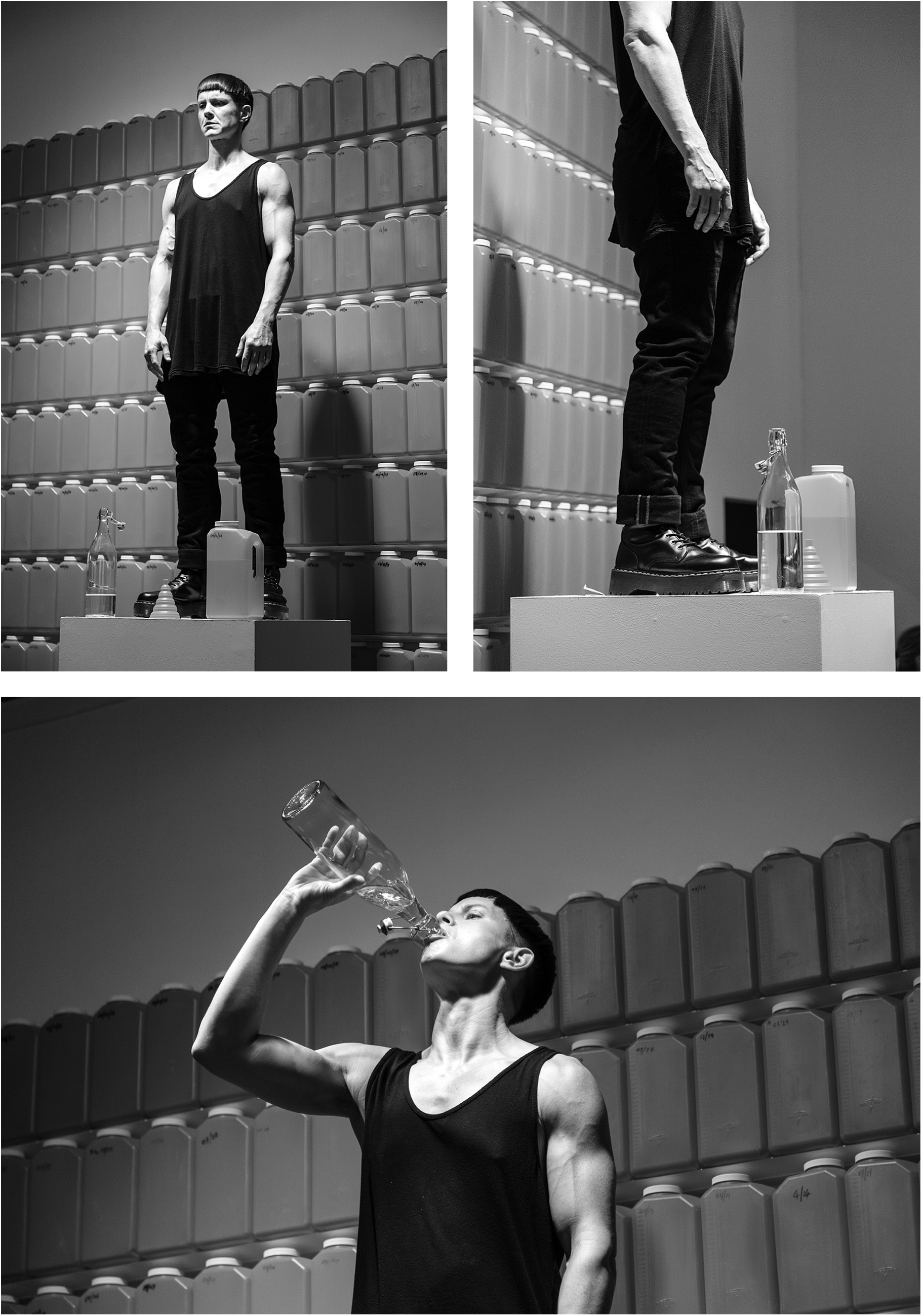
This transgender capacity also appears in “PISSED,” the installation that served as centerpiece in the Monumental exhibition. PISSED consists of a minimalist glass cube sculpture filled with 200 gallons of Cassils’s urine collected in the 200 days since the Trump administration reversed the bathroom protections for transgender students. As another durational work, PISSED is both an index of volume (how much urine is produced) and of the passage of time (how the color had changed as the urine oxidized).
An audio component gave important historical context: Visitors could listen to over two hours of sound recordings from the proceedings of the Gavin Grimms bathroom access case, as it went from the school board hearings in Virginia to the Fourth Circuit Court of Appeals. The audio included testimonies reflecting multiple perspectives on the bathroom issue, from religious positions to interpretations of Title IX legislation.
In addition to being an installation, PISSED was the stage for the live performance, “Fountain.” Beginning at 6pm on the night of the opening, Cassils stood still for two hours, on an elevated pedestal in front of a grid of 252 empty orange medical containers. They moved only to drink water from a large glass bottle and to drop their pants and urinate through a stand-to-pee device into the 253rd orange container, which completed the grid in the bottom right hand corner and marked the closing action of the 200-day performance.
Cassils, Alchemic no. 4, 2017. Color photograph, plexi mounted with aluminum backing. 30 × 30 in. Ed. 1/5.
Cassils with Robin Black. Courtesy the artist and Ronald Feldman Gallery, New York
Cassils, PISSED, 2017. 200 gallons of urine, 18,000 grams of boric acid, acrylic. Installation view.
Vince Ruvolo. Courtesy the artist and Ronald Feldman Gallery, New York
Turning the act of urination into a spectacle, this durational performance made the everyday act of peeing into a political act of defiance. As part of a long tradition of incorporating bodily fluids into the cultural production of art, Cassils’s PISSED sculpture and Fountain performance politicized corporeal substances and bodily waste. Fountain recalls Marcel Duchamp’s famous 1917 Dada work of the same title as well as more recent political art works. When weighing how to respond to the transgender bathroom cases of 2017, Cassils had considered organizing a national campaign to mail urine to the White House. This would have been a historical nod to David Wojnarowicz, the artist and AIDS activist who, in the early 1990s, called for bringing the bodies and ashes of those who died from AIDS to the White House lawn. There are still echoes of Wojnarowicz’s radical politics here, too, and of other queer and feminist artists like Hunter Reynolds, who used his HIV-positive blood in his artwork; Eduardo Costa, who created paintings with his semen; and Brown queer femme artist Xandra Ibarra, who is making an ongoing series of Rorschach prints using her menstrual blood.
Cassils, Fountain, 2017. performance still from Cassils’s closing action of 200 day durational performance PISSED.
Vince Ruvolo/ Courtesy the artist and Ronald Feldman Gallery, New York.
Beyond the echoes of AIDS activism and queer and feminist cultural criticism, I see in Cassils’s work powerful historical resonances with political action centered on bathroom access. I am reminded of crip/queer scholar Robert McRuer’s documentation of the passionate rallying cry of disability activists: “Make it Accessible or We’ll Piss Anywhere.” The politics of the bathroom are expansive; they show how injustices shape our everyday options and experiences that many think of as too personal to be touched by social rules. These injustices can be addressed through collective actions, like those generated around Monument Push, which show that movements can occur with all hands on deck. Furthermore, Cassils reminds us that bodies and objects deemed disposable can be transformed into something else, something with a golden hue.