



Abstract
pride is always a site of contentious politics, from the protest within the parade to the public’s response and the state’s securitization. the militarization of prides blurs the line between marchers as normal citizens and dangerous deviants.
At the Belgrade Pride Parade.
Courtesy Janice Irvine
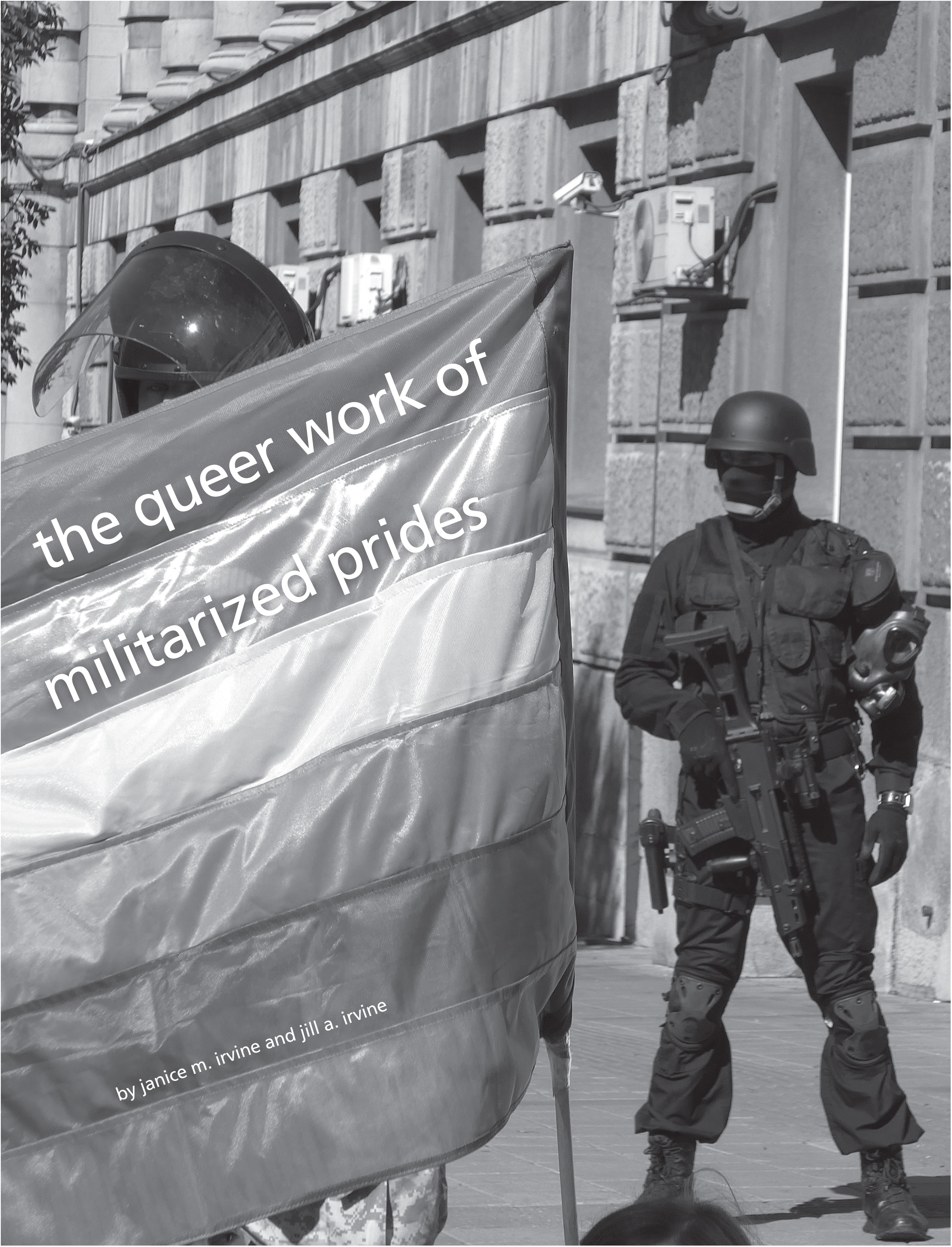
In September 2016, Belgrade held its third Pride Parade, largely without violence. Pressured by European Union accession requirements, the Serbian government allowed the parade to be held only after years of cancellation. In 2001, the first of Belgrade’s Pride Parades earned the title the “massacre Pride.” During that first march, footage of which can be viewed on YouTube, participants were beaten in the street as police stood by. In 2010, in what became known as the “bunker Pride,” the parade was held far from the city center and marchers were separated from potential onlookers by distance and walls of police. And in 2013, protesters gathered briefly in what would be remembered as “midnight Pride,” when the government cancelled Pride in the middle of the night. When Pride was again authorized in the city center in 2014, 7,000 police in full riot gear encircled a few hundred marchers on their short route through a ghostly downtown closed to the general public. Later that day, thousands of Serbian nationalists and Orthodox Christians marched freely through the bustling city to protest Pride. Critical observers might reasonably wonder which side had achieved the most successful visibility on Pride day.
The politics of visibility date to the mid-20th century U.S and European homophile movement. At the heart of this politics was the conviction that political mobilization and social and political change could only emerge once lesbian, gay, bisexual, and transgender (LGBTQ) individuals overcame their own invisibility to one another and the society in which they lived. Yet social movement scholars and activists disagree on how successfully these visibility strategies travel beyond the countries in which they originated, in particular the U.S. and Western Europe. Some have argued that the act of coming out epitomized by Pride Parades has been adapted successfully to myriad local conditions and that LGBTQ activism has, for several decades, been embedded into transnational networks and processes that have proved critical to its spread. Others charge that strategies such as Pride represent a western form of protest that cannot be imported uncritically.
We explore the debates over Pride in Serbia, Croatia, and Bosnia, using our interviews with LGBTQ activists in post-Yugoslav countries and participation in several Pride Parades in Belgrade and Zagreb. Despite being highly militarized, we find that these Pride Parades perform many sorts of paradoxical and sometimes ambiguous political work in achieving LGBTQ visibility and equality. Our work on this topic reflects our respective experiences in this region as well as our scholarly interests, which span several decades, post-Yugoslav countries, and projects. Janice spent a year at the University of Zagreb as a Fulbright scholar in 2009 and has written about the politics of sex education in Croatia. Jill has lived and worked in the region for several years and has written about the politics of nationalism, democratic transitions, and gender equality. We conducted the research for this piece from 2011-2015 in Bosnia, Serbia, and Croatia, where we marched in Pride Parades and conducted interviews in the three capital cities.
LGBTQ Activism in the Balkans
After the collapse of state socialism in Yugoslavia in 1990, LGBTQ activism unfolded in the context of the violent breakup of the state and the associated wars in Croatia, Bosnia, and Kosovo. During this decade of conflict, LGBTQ activists initially focused their energies on opposing the rise of ultranationalist politics and regimes, exposing their links to an ideology of “nationalist patriarchy” that rested on sexism, militarism, homophobia, and violence against the “other.” During this period, LGBTQ activists cooperated closely with feminist and peace organizations in calling for an end to militarism and its associated heteronationalism, an ideology rooted in the belief that traditional gender roles are necessary for the survival of the nation. And they succeeded, for example, in getting homosexuality decriminalized in Serbia and Croatia. After the signing of the 1995 Dayton Peace Accord, which brought an end to the fighting in Croatia and Bosnia (though there would be another outbreak of conflict in the contested region of Kosovo in 1999), LGBTQ activists joined the struggle to topple the semi-authoritarian regimes in Croatia and Serbia and build a new democratic state in Bosnia.
Although they are a spatial strategy of normalization, Prides—when militarized—blur the line between marchers as normal citizens and dangerous deviants. Visibility itself becomes simultaneously demonizing and normalizing.
With the wars finally over and the regimes that had directed them removed from power, in 2001, LGBTQ activism took a new direction. Activists in Croatia and Serbia began to embrace a politics of visibility, moving into the public sphere to make claims for LGBTQ rights within a larger human rights framework. Serbia’s postwar recovery and international legitimacy were linked with a greater respect for human rights, of which LGBTQ rights were an essential component. The violence surrounding the 2001 Pride Parade in Belgrade and subsequent assassination of liberal Prime Minister Zoran Djindjic, however, caused LGBTQ activists to modify their strategy of claiming public space for alternative sexual identities—although they continued to voice their political demands. At the same time, queer ideas and groups emerged, focusing on the need to create an alternative safe space and queer culture even as they articulated a more radical critique of transitional processes and Serbian political culture. The politics of visibility followed a similar trajectory in Zagreb, where, from the first Pride Parade in 2002, activists saw massive protests and violence and queer cultural spaces were formed as an alternative.
Even as activists made a partial retreat from a reliance on Pride Parades, they continued to engage in the interpersonal politics of visibility in order to build solidarity. They also continued to make demands of the state. This latter activity was fundamentally shaped by the process of EU accession, first in Croatia (which joined the European Union in 2014) and later in Serbia whose government was working toward EU membership. Although Bosnia was not an immediate candidate for EU accession, LGBTQ activism there, too, was shaped by the heavy presence of international monitors, administrators, and advisors. Activists began to focus heavily on legal strategies, including the passage of anti-discrimination legislation, same-sex partnerships, and other legal protections. But legislation wasn’t all the EU representatives in Brussels wished to see. They also insisted that holding peaceful Pride Parades was an essential step and necessary precondition for favorable membership consideration.
Exporting Pride Parades
Pride Parades have become a central feature of movements for LGBTQ rights around the world, but their export from their countries of origin has not been without its critics. This is particularly true in the post-communist countries of Europe, where Pride Parades have often been met with violence and counter-protest. Pride’s close association with international organizations and political pressure in the Balkans has, though, raised strategic dilemmas for LGBTQ activists involved in organizing them. Among the tensions and debates, for example, is the question of whether activists should cooperate with state authorities who are simply “checking a box” by agreeing to hold Pride Parades and actually subvert the intent and purpose of these parades with their heavy-handed security arrangements. Have Pride Parades become too closely associated with the EU and, by extension, with external sources and pressures, to resonate with local publics?
Perhaps most importantly, activists argue about what “pride” symbolizes when it is met by violence or when violence is only averted if marchers are surrounded and protected by a vast militarized police presence. Some worry the violence that has surrounded the parades has even resulted in further demonization rather than normalization for LGBTQ citizens. In short, in contrast to some European and North American countries, where Pride Parades have become corporate sponsored cultural festivals, their hyperpolitization in the Balkans means that, to some, they are rendered a more powerful and essential tool in promoting the goals of visibility politics and to others, that they have failed to serve their emancipatory purpose.
Pride is indeed a queer idea in the Balkans. Queer analysis highlights the multiplicity and instability of social and political life, and we use the term queer to capture the often-unresolvable ambiguous, fluid, and paradoxical dynamics of this particular activist initiative. In speaking with activists in these Balkan cities, we found multiple complexities involved in the cultural and political work of Pride. Here, we discuss two main tensions: the simultaneous normalization and demonization that militarized Prides produce and contested views of the East-West binary—whether Pride strategies can travel effectively beyond their countries of origin.
Soldiers stand by before Belgrade Pride.
Courtesy Janice Irvine
Normalization and Demonization
Pride Parades operate symbolically to signify LGBTQ visibility and activism. With the emergence of the gay liberation movements of the 1960s and 1970s, acts of coming out and Pride marches developed as strategies for social change through activist solidarity and cultural normalization of sexual minorities. They entailed, to borrow Phillip Ayoub’s distinction, both an interpersonal dimension, which fosters interaction with other LGBTQ individuals, and a public dimension, which involves interaction with the larger society and the state. Visibility strategies not only politicize the individuals involved—a process of consciousness-raising associated with the feminist notion that “the personal is political”—they also foster public and state recognition of the political and human rights of the LGBTQ community.
Yet the politics of visibility produce paradoxes of visibility. Pride Parades intend to normalize LGBTQ citizens, and yet marchers can be rendered invisible within their visibility strategy. Pride Parades are spatial; they bring outsiders to the inside, the marginalized to the center. Yet activists have no control over the configuration of the march or city space. At the 2009 Pride in Zagreb, hundreds of police in full protective gear lined up on both sides of the marchers, with their thick riot shields enclosing the march for much of the route. While it was a relief to be protected from the dangers posed by observers— spittle and rocks—it also made a zoo-like spectacle of marchers. Ambiguity emerged about whether the wall of shields was intended to protect marchers or observers. Although they are a spatial strategy of normalization, Prides—when militarized like this—blur the line between normal citizens and dangerous deviants. Visibility itself becomes simultaneously demonizing and normalizing.
Belgrade Pride in 2014 illustrates the queer work of these militarized Prides. After previously violent parades followed by three years of government bans, Serbia was under intense pressure by the European Union to demonstrate its commitment to human rights by allowing the parade and ensuring non-violence. Several EU ministers attended, along with the mayor of Belgrade and foreign ambassadors. One of the Parade’s organizers, Boban Stojanovic, hailed the generally peaceful march as a great achievement, and the EU claimed it as a “milestone in the modern history of democratic Serbia.”
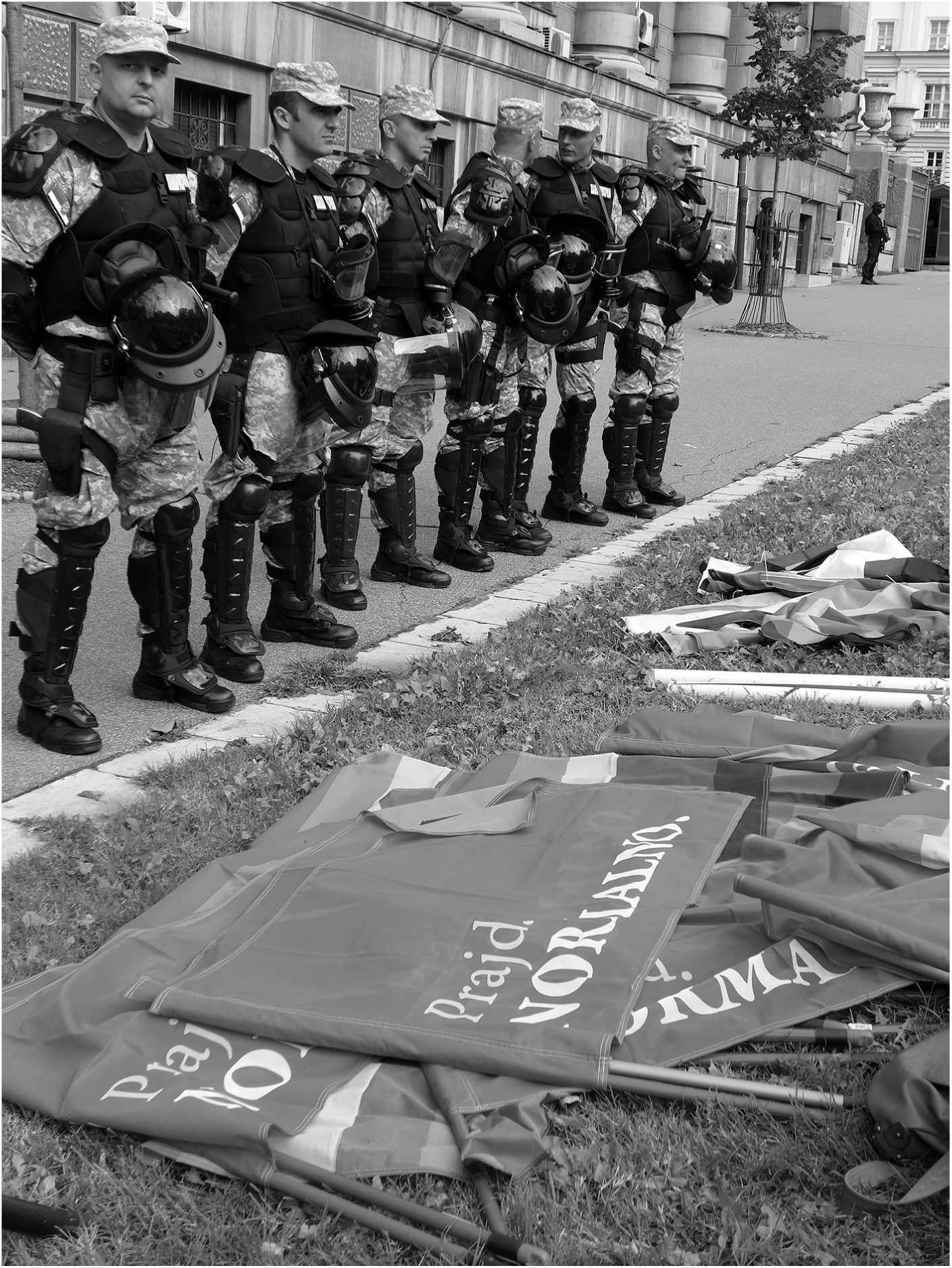
The parade, however, highlighted the paradoxes of visibility. The entire city was cordoned off so that anti-gay attackers could not disrupt the parade. In order to enter the site, everyone was frisked, screened with a metal detector, and identified with a neon-green wristband. Each was given a small rainbow flag. The parade stepped off predictably late and was a short walk through the empty city. A few people stared from their balconies, and police helicopters flew overhead. There was no one else on the streets. Later in the day, thousands of anti-gay demonstrators freely marched through the city chanting “Kill the gays” and “Serbia and Russia, we don’t need the European Union.”
In contrast to bright rainbow flags, colorful signs, and festive clothing of the marchers, the military police in their black riot gear stared with flinty expressions or remained inscrutable under their balaclavas. One easily imagined them supporting the hooligans rather than the marchers.
At a later press conference, Serbian Prime Minister Aleksander Vucic said, “Not one window was broken today and for that we have to credit the security forces because they showed that they can maintain security.” Yet while marchers were kept safe, the heavy security presence itself projected a sense of danger and hostility. In contrast to bright rainbow flags, colorful signs, and festive clothing of the marchers, the military police in their black riot gear stared with flinty expressions or remained inscrutable under their balaclavas. One easily imagined them supporting the hooligans rather than the marchers. Aside from some clashes in which hooligans attacked police officers and media representatives, the Pride Parade had been largely peaceful. Yet the price for peace was visibility itself.
Activists, therefore, can be entangled in a paradox of both supporting and opposing Pride as a visibility strategy. Even activists who do not attend or who express ambivalence about the parades nonetheless insist on their cultural importance. One Belgrade activist who criticized Pride because organizing one requires obtaining permits and other “collaboration with the state” told us that media coverage of Pride controversies is how most people learn about gay issues: “If you go to a small town in Serbia, Pride, that’s all they know—Pride, yes or no. In 2001, every citizen who reads news knew there are lesbians and gays in their country through the bad news [of massacre Pride].” Pride has become so symbolic of LGBTQ rights and visibility, that even events that are not parades are dubbed “Pride.” The organizer of a 2008 queer arts festival in Sarajevo that was shut down after violence erupted said the media relentlessly positioned the event as Pride: “I say ‘festival’ and [the media] put Pride. We have never said that.” Even as scholars and activists debate Pride as political strategy, “Pride” has suffused the cultural imagination, making the parade hard to disavow.
East–West Binary
Some critics argue that Pride is an inappropriate western import, part of the neo-colonial western gaze, a pale imitation, a “cut and paste” from the West. In this view, the association of LGBTQ rights with the West has hindered activists’ ability to gain legitimacy in their own countries and has contributed to creating and maintaining the distinction between the West as civilized, secular and liberal, and the East as oriental, primitive, religious and fanatical. It positions Europe and North America as paragons of civilization and defenders of human and LGBTQ rights and all other countries as travelling a never-ending road to reach this promised land. In effect, it reinforces the colonial divide between civilized states whose population supports gay rights and uncivilized states and groups that do not. This serves to delineate borders and maintain western hegemony over human rights discourse and political practices. Moreover, it has resulted in the further marginalization of LGBTQ migrants and immigrants within their own communities who are associated with these “oriental” origins and identities.
However, tensions and ambiguities abound in the claim that Pride is a foreign import from the West. For one, some activists have noted that Pride comes to symbolize “the enemy,” regardless of whether from the East or West. A Belgrade activist said, “When we were at the Pride in Croatia, these neo-Nazi groups were saying to participants, ‘go to Serbia,’ and here [in Belgrade] we had the opposite, ‘go to Croatia.’ It’s interesting where they recognize the evil coming from—it’s always from the other nation that is the threat in that moment.” The concepts “East” and “West” are fluid.
Second, the claim that Pride is a western import, while intended as critique, can actually reinforce the problematic East-West binary. If Pride is effective for the West but not the East, this fosters a monolithic and unduly optimistic construct of “the West.” Prides are still impossible in much of the U.S., which has its own “local” problem. For example, Pride is an established tradition in Janice’s hometown of Northampton, Massachusetts, but controversies still erupt over symbols such as painting a rainbow crosswalk. In Jill’s home state of Oklahoma, Pride Parades would be unthinkable in most towns, where LGBTQ youth seek community in virtual spaces only. Failure to develop a deeper, more complicated picture of the West can lead to us viewing strategies like Pride as more stable than they are. If the East is wrongly constructed as the space of intolerance, backwardness, bigotry and violence, the West (largely through silence about it) can be wrongly constructed as the space of tolerance and openness.
Finally, the critique of Pride as a foreign import suggests it is not local and not culturally authentic. This skepticism is situated within a larger discussion about cosmopolitan (universalistic) versus communal (local) strategies for change. The fear is that the politics of visibility have been transferred uncritically to other areas of the world where they do not speak to local realities or sensibilities. Borrowing these inauthentic forms of protest is problematic for activists because, according to political scientist Bojan Bilic, it “distances them from the peculiarities of the local environment.”
While these critics argue that LGBTQ rights and visibility politics should be “de-centered and de-westernized” in favor of new, more local forms of discourse and strategies, they have largely been silent about what “local” LGBTQ visibility might look like. Further, demands for “authenticity” can reinforce a static conception of both nation and culture, in which national culture can never change. Many activists have creatively and consciously adapted their activism to their local, communal context while maintaining their transnational linkages and discourse. For example, in an excellent “thick description” about Pride in Split, Croatia, Kevin Moss shows how activists used tactics and imagery that located Pride in both gay culture and national culture, creatively queering national symbols, monuments, and local songs and cultural expressions.
Pride as Politics
Debates over Pride among activists and scholars are not unique to the Balkans. In a forthcoming article, political scientist Kevin Henderson observes that each year brings new critiques of U.S. Prides as outdated, co-opted by corporate sponsors, and essentially empty rituals devoid of protest and politics. He disagrees, using archival material showing a long history of robust internal disagreement over inclusivity, march routes, who would lead the parade, corporate sponsorship, and many other deeply political issues. Pride, he suggests, is always a site of contentious politics, of protest within the parade.
Even as scholars and activists debate Pride as political strategy, “Pride” has suffused the cultural imagination, making the parade hard to disavow.
Likewise, activists in the Balkans disagree over whether a supposed lack of correspondence between local modes of protest and Pride Parades means that they are doomed to ineffectiveness as a tool of social change. As one scholar/activist explained her opposition to holding Pride Parades in Belgrade, “we have no indigenous tradition of these kinds of festival parades.” Indeed, some argue that Pride Parades have a largely negative effect, as they prompt more violent reactions from an unreceptive public than other, more local, forms of activism and protest. Yet one Bosnian activist noted that, despite violence, “change is happening. More visibility always sometimes brings with it more hostility.” As one of our interviewees in Zagreb said about their internal arguments about the “right time” for Pride, “No one is ever ready for Pride.” Prides themselves construct the local readiness for them, even if it takes decades. Many scholars would agree with the argument that the “politics of visibility” comes with risk, backlash, and sometimes more violence; it is also a potentially effective strategy to promote change if careful attention is paid to local contexts. A Belgrade Pride organizer concurs, “So, now I think the next three years will be very vulnerable years, but it’s like that time in U.S.; it was probably the ‘70s. You always have that tiny, tiny line which is very uncomfortable. You always have to find where’s the progress. And I find it, a lot of small spots.” The paradoxes and potentials of Pride are central to its politics and its power to change visions of nation, culture, and activism.