



Abstract
A curated collection of essays tracking the pulse of American democracy as the second Trump Administration comes into power, this special section considers the campaigns that were waged and previews the battles yet to come.
Just before the 2024 U.S. Presidential election, we asked a group of sociologists—all esteemed researchers from different subfields of our discipline—to think, observe, and write about America’s big decision. Here, we present a special, and very timely, section of the magazine: a curated collection of essays that track the pulse of our democracy. Sociologically speaking, elections are fascinating. They orbit broad questions, including why people choose to vote (or not vote) the way they do, how ideology shapes these decisions, and how organizations, like political parties, try (and often fail) to persuade people to choose their brand. Elections are a mirror, casting a reflection that may be familiar or, when “our” side loses, unsettling.
The last three U.S. elections have been marked by polarization, pandemics, economic instability, and social trauma. In this historical moment, the election does not just answer the mundane queries of political life. It digs into the very meaning of a “good society,” and it uncovers how the symbols surrounding these meanings are leveraged. It raises meditations on what we want the future to look like and how we are to get there. Indeed, it calls into question the assumptions many of us make about politics, particularly the clash between rationality and logic or else the primacy of intuition and emotion. Ultimately, it highlights sociology’s role in making sense of individual and group behaviors. As two of our writers note, people do not make choices in a vacuum. They are inextricably enmeshed in nuanced and ever-changing contexts as they describe and detangle their daily experiences.
Three of the essays provide complimentary explanations for why the Democratic Party has struggled for at least a decade and why Donald Trump was re-elected. Each focuses on core sociological concepts: class, organization, and framing. Daniel Laurison centers his analysis on data collected in poor and White Pennsylvanian communities, where the sometimes-hidden dimensions of socioeconomic class seem particularly salient. Mary Romero looks to the Democratic Party’s decision to nominate Kamala Harris without a deliberative process, symbolically bowing to the gerontocratic instincts the party has been cultivating, perhaps to its detriment. And Andrew J. Perrin and Amienne Spencer-Blume examine the impoverished model of voting unreflectively adopted by Democratic messaging.
Cecilia Menjivar’s essay turns to crucial historical analysis, contextualizing the immigration debate that was both background to and foregrounded in the run-up to the election. No issue seemed more relevant to Trump’s campaign, cutting across class, race, and other key voting blocs. And no issue seems to loom larger over the start of his second term.
Finally, Eduardo Bonilla-Silva examines the social movement dimensions of the election, noting that the very same coalition that seemed to support Harris will need to shift its focus from electoral politics to mobilizing resistance to the unjust policies many see on the horizon. Long interested in social change, sociologists like Bonilla-Silva recognize that charged events can provide openings for us to align how we think and how we act.
Our thanks to all the contributors for their election reflections and expertise. Together, they showcase the vital voice that sociologists have in the most significant events of our lives.
iStockPhoto // bryanregan

why democracy is losing the demos
by daniel laurison
Our democracy is in trouble, and it’s not only because a candidate with clear aspirations to authoritarian power won a second term as President after a campaign built on fomenting fear and hatred toward undocumented immigrants and transgender people like me. In many ways, the outcome in 2024 is a symptom of at least one underlying problem evident in election cycles for many decades now: there is a profound disconnect between many poor and working-class people and electoral politics.
Ryan, a White man in his 30s my research team interviewed after work in the summer of 2022, is emblematic. During our interview, he apologized repeatedly. He just didn’t know a lot about politics, he insisted; he was sorry he didn’t have better answers for me. I assured him that what he had to say was exactly what I wanted to hear. But he remained unsure whether he could make a useful contribution—to my work or as a citizen in U.S. democracy.
Ryan, whose name (like the others in this piece) is a pseudonym, had what he described as a “checkered past,” including a serious drug addiction from which he was four years sober. He hadn’t finished college, and he made around $40,000/year working as a groundskeeper—a job that required him to leave his house at 4:30 a.m. to take a bus to a wealthy suburb. Although he was uncertain when it came to talking about politics, it turned out he knew a lot about the issues affecting the small, poor city he lives in. He was appalled that teenagers were murdered just down the street from him. He talked to us about the lack of mental health services for people where he lives, the bullet casings he saw on his morning commute, and a general sense that “it just feels neglected.” He was adamantly pro-choice, and he wanted to see more resources for struggling people in his community.
Many working-class Americans feel that politics is something by and for other people—people with more education, more income, or more social connections to people in politics.
But Ryan told me that politics “feels like something completely out of my control.” He added that, because of his past, “I don’t feel like I’m the type of person that people really listen to. I don’t think I have much of a say in—I don’t think there’s anything I could do to change what’s going on.” Ryan had voted for Biden in 2020, primarily because he had heard that Trump was a White supremacist—Ryan may be White, but he is not OK with racism. However, he had seen his small investment in the stock market decline since Biden took office, and a friend had told him that Trump wasn’t actually a White supremacist—that it was only a rumor. Those developments made him worry he’d made the wrong choice with his vote. Thinking to the next election, he bemoaned the difficulty of finding accurate, unbiased information about politics.
I don’t know whether or how Ryan voted in 2024, but I wouldn’t be surprised if he switched to Trump or simply stayed home.
Over the last six years, my research team and I have interviewed over 250 poor and working-class people (White, Black, Asian, and Latine) across Pennsylvania. Many of them have echoed Ryan in saying that they feel like politics is something by and for other kinds of people—people with more education, more income, or more social connections to people in politics. Many, especially our interviewees who were Black and/or very poor, tell us that politicians don’t care about people like them or their communities and that, no matter who is President, little changes in their neighborhoods or in the poverty they face.
Lala, a Black mom who lived in West Philadelphia and worked in food service, told our research team that candidates “pander to” the Black community but don’t do much to make positive change. We spoke with her in 2018 and again in December 2024; the last time she voted was for Barack Obama. When she thought of politics, she said, she thought of “people in power that have money and that are above us and that don’t really fully understand struggles like being in debt, having a child, being on welfare. I think that’s what it’s like—a disconnection, that’s probably what I associate [politics] with.”
That disconnection is one reason why there is a steep class gradient in voting: research, like my own 2023 study with independent scholar Ankit Rastogi, finds lower-income and less-educated people are far more likely to skip voting than are those with more resources.
This class inequality in political participation is exacerbated by the fact that most people working in national politics are college-educated. Indeed, as I explore in my book, Producing Politics, political operatives are about 10 times more likely to have gone to an Ivy League or other elite college or university than the general population. They rarely prioritize outreach to poor and working-class people who are disconnected from politics (for more on this, I suggest the 2019 article “Passive Voter Suppression: Campaign Mobilization and the Effective Disfranchisement of the Poor”). Many of those people respond to being overlooked by staying home or by “voting for change” (that is, against whichever party currently holds power).
Despite the starkly different winners in the 2020 and 2024 U.S. presidential elections, the actual voting pattern in the U.S. remained remarkably stable. In both elections, the outcome was very close, and about half of those who voted chose each candidate; the margin in the three decisive states in 2024 was less than 230,000 votes. But what was also consistent was that about a third of those eligible to vote stayed home in both elections, and that those who didn’t vote were more likely to be poor or working-class than those who did.
Democracy requires buy-in from the majority of citizens, and what my team and I heard across hundreds of interviews with poor and working-class Pennsylvanians is that too many feel like no one in power is interested in making their lives better. When politics looks like a rigged game played by elites, it’s no surprise that more poor and working class people are not inspired to come out to vote, let alone to “defend democracy” against Trump.
the blame game
by mary romero
The realization, in early November 2024, that Donald J. Trump had been elected the 47th president of the United States was deeply troubling and shocking to many—not just Democrats. How could a rapist, a convicted felon, and a White supremacist win both the popular vote and the electoral college? We had already experienced the chaos of his first term: he proposed a ban on Muslim immigrants, separated immigrant families at the border, suggested bleach and horse medicine to fight the pandemic that killed more than a million Americans, and incited an insurrectionary attack on the Capitol. Reminiscent of the McCarthy era, we now have the first president that has promised to attack a long list of enemies in the Justice Department, the FBI, and civil servants deemed insufficiently loyal to the administration.
Earlier, Democrats had been relieved when President Joe Biden finally withdrew from the race after his disastrous performance at the first presidential debate. The contrast between the old, White, and increasingly confused Biden and the young, multiracial, and energetic new candidate Kamala Harris was a relief. Her vice-presidential nominee, Tim Walz from Minnesota, presented as a wholesome, no-nonsense White guy—a dad, former high school teacher, and coach. Democrats raved over Walz’s characterization of Donald Trump and the Republicans as “just weird” for their campaigns to ban books and make health decisions for women and transgender people. Leftish social media loved it, and Harris’s convention message of choosing joy and hope seemed a clever move away from Trump’s doom and gloom. Campaign donations and volunteers flooded in, as everyone was invited to join the fight to save democracy, regardless of race, gender, parental status, or sexuality.
Sociologists (and others) had some doubts and questions, of course. Harris had not survived the nomination process. She did not have deep ties with labor, long-since a Democratic stronghold; she had a history as a tough prosecutor, particularly of Black men for drug offenses; and, most especially, she voiced continuing support for Biden’s unquestioned funding of the ongoing Israeli genocide in Gaza. Plus, being anti-Trump was not a compelling policy platform.
In the end, not enough voters chose joy. They wanted lower grocery bills and good jobs for workers without college degrees. They were tired of culture wars. And “just weird” wasn’t a compelling counter to the Trump platform. Attacking Harris, a multiracial female, the Trump campaign successfully characterized her as an incompetent, undeserving candidate—nothing but a “diversity hire.”
Where Michelle Obama was depicted as an angry Black woman, Trump successfully portrayed Harris as another trope, the jezebel. He attributed her political success to sexual favors doled out to past male colleagues. Meanwhile, Republicans used the image of Harris’ joy and laughter to portray her as unserious, lazy, and flippant. They appropriated Harris’s quote, “You think you just fell out of a coconut tree,” stripped it of context, and used it as another example that she was kooky.
So, why did the Democratic Party lose the presidency? At first, many laid the blame on Kamala Harris’s campaign. She was unable to define herself. She was seen as a continuation of the Biden administration, just younger, multiracial, and female. Her policy proposals for building an economy of opportunity were confusing. She was unable to present domestic plans for her administration or defend her past positions. Other than on abortion, she appeared to flip-flop as she walked back positions articulated in her previous campaigns.
Others believed that Harris’s loss should be attributed to sexism, misogyny, and racism. Effectively, they blamed voters, insisting that Black men weren’t supportive enough (although 77% supported her at the polls) and that Latino males were too macho to vote for a woman (despite the fact that Mexico just elected its first woman president, a left-wing candidate). White men without college degrees, they figured, were always going to vote Republican, but White women weren’t swayed by abortion as much as Democrats hoped.
Laurie Shaull, Flickr CC
Kamala Harris accepts her party’s nomination for president at the Democratic National Convention, August 22, 2024.
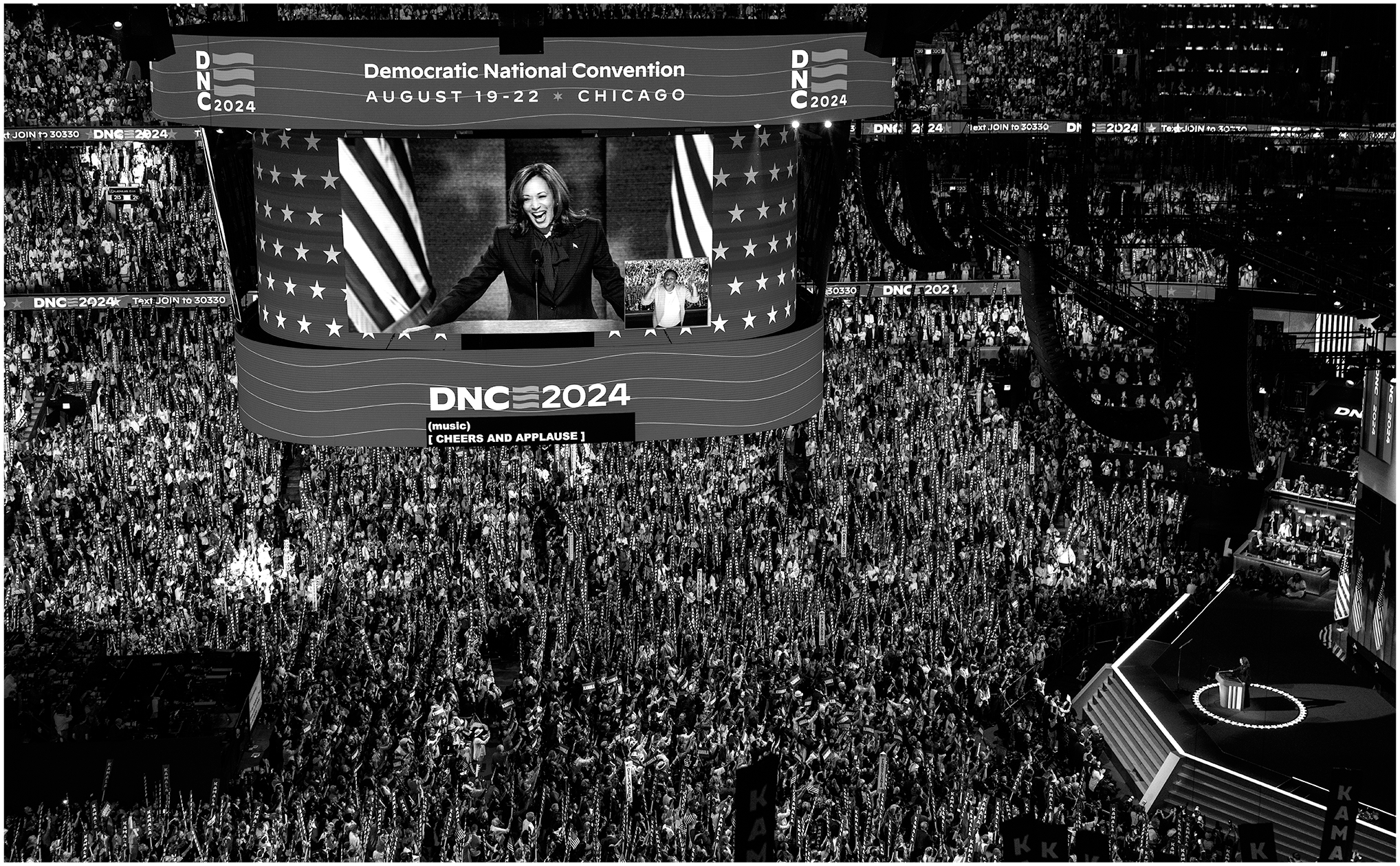
Buried beneath these categories is the shocking fact that an estimated 89 million Americans, about 36% of eligible voters, did not vote. But that fact is also understandable, because the popular vote does not determine the election, the electoral college does. If you didn’t live in a swing state, there wasn’t much reason to vote for president—your vote only counted when it came to local politics. (Of course, that doesn’t explain the Republican sweep of both the House and the Senate.)
At the end of the day, the Democratic National Committee (DNC) must take responsibility. When anyone interacting with him daily could see Joe Biden faltering, and when he promised he wouldn’t, he was still allowed to run for a second term. Indeed, the DNC has fostered a gerontocracy of politicians, such as Dianne Feinstein, holding on to major decision-making positions when they are no longer able to physically or mentally function. This has hurt the party and harmed future generations. Further, when Biden did drop out, the party denied voters the opportunity to elect their own presidential candidate. Imagine if Biden had not run, the Democrats held an open convention where Harris could have been one of many candidates, and the discussion had produced a strong party platform. Instead, Harris was placed in the weak position of running a 15-week campaign against a former president who had honed his message over four years, garnered the backing of billionaires, and had a detailed (if rhetorically distanced) platform, Project 2025, written by the right-wing Heritage Foundation.
The DNC has developed neither a transparent nor an appealing political agenda. It seems incapable of communicating clear messages to either college- or non-college-educated citizens. The union movement that was once its base of support has declined from representing 20% to just 11% of workers in 40 years, and yet Democrats have not worked to strengthen unions (neither traditional ones nor new attempts to organize fast-food and warehouse delivery systems). The Party’s priorities are still mired in funding proxy wars while funding the military without limit. Voters of color demanding strong support against police violence have been all but ignored. Abortion has had a strong defense, but beyond that, the DNC has let women’s rights take a back seat. The party has become a gerontocracy hostile to its own charismatic, populist, and progressive leaders. It needs to be reborn. It will have to create and build a strong new safety net eradicating poverty and fostering a healthy, secure future for American workers. The DNC is resting on laurels it no longer has, and the result is that it has lost power in all three branches of government.
the consequences of harvesting voters
by andrew j. perrin and amienne spencer-blume
Donald Trump’s 2016 campaign changed the rules of the game. Democrats have not yet figured out how to play.
In the 2024 election, Democratic candidate Kamala Harris’s policy proposals received greater support from registered voters than Trump’s, especially those regarding health care, the environment, social and reproductive issues, education, and even crime (this according to a November CNN report by Ariel Edwards-Levy). An earlier Gallup poll had found that 81% of U.S. adults favored a pathway to citizenship for immigrants living in the United States illegally who were brought to the country as children. And a Pew Research Center poll reported in the Washington Post in October found only 37% of registered voters favored deporting all immigrants living illegally in the United States—a core Trump proposal. A persuasive Democratic candidate could build on that base. But as of late, the Democratic Party package is less than the sum of its parts.
Democrats are underperforming their potential because they misunderstand how society forms voters’ decisions. They have bought into what we call the constancy hypothesis: the conventional wisdom that people walk around with packages of preformed opinions. These are understood as constant properties, mostly features of people’s demographic characteristics. Consequently, the best a campaign can hope for is to harvest enough compatible opinions to win the swing states.
The fact that the Democratic Party’s script has not meaningfully changed since 2012 is not an accident or an oversight. It indicates a true belief in the constancy hypothesis. But that hypothesis is probably not true. Good research in sociology, psychology, and political science shows that people adjust their opinions and ideas based on the contexts they are in and the messages they interpret.
In addition, the constancy hypothesis is bad for democracy: it solidifies opinions rather than stimulating reconsideration and debate. Mitt Romney’s loss in the 2012 U.S. presidential election plunged the Republican Party into a soul-searching frenzy, with many GOP faithful agreeing they needed to welcome immigrants due to shifting demographics and party coalitions. But Trump entered the ring in 2016 with an argument for why people should think differently about immigrants, not with the promise to represent what they already thought. He persuaded people into becoming certain kinds of subjects. He made people angry and became the candidate of angry people.
By contrast, Democrats rarely work intentionally to enlist voters by convincing them that the Democratic vision is better than their opponents’. Neglecting the pro-democratic virtues of persuasion and revisability, most liberal strategists ask only how to say the right things to the right audiences to harvest as many votes as possible. A better reading of sociological and political science research suggests they would win more and improve democracy by trying to persuade rather than just harvest.
iStockPhoto // EuToch
Research suggests liberal strategists would win more and improve democracy by trying to persuade rather than just harvest voters.

Sociologically, democracy is the set of practices we use to share society with people who are different from us. Sharing a polity with people who are all the same is trivial. You need democracy precisely to adjudicate and balance difference. And real, big, authentic difference is good for democracy. Embracing that deep pluralism means listening, talking, arguing, and persuading. The same person can embrace different ideas and values—even those that contradict each other—in different contexts and times. We call this the multiplicity hypothesis.
Researchers and pundits flummoxed by people who “should” vote for X but voted instead for Y have gotten something profoundly wrong about subjectivity.
We have all heard questions like: How could a Black person vote for Trump? A Latino, a woman? Alternatively: How could a working-class person vote for a California elitist like Harris? It’s not a paradox. People are contradictory. That’s the answer. Researchers and pundits flummoxed by people who “should” vote for X but voted instead for Y have gotten something profoundly wrong about subjectivity.
We academics are partially culpable for this. In Intro to Sociology, we teach students how to think about characteristics they think of as fixed—like race and gender—as actually accomplished in social life. We know from excellent research that people do gender, race, class, and sexuality differently in different contexts: that their meaning is forged from the intersections of self and context over time. But somehow when it comes to political position, we revert to thinking about people as fixed political selves. We have educated and instructed political actors on how to think about their base. We’ve reinforced a political subjectivity that’s both unlikely and undesirable, that de-emphasizes doing and becoming and encourages collecting passive subjects rather than forming active ones.
The multiplicity hypothesis can make sense of Democrats losing voters despite substantial national support for their key positions. What’s more, Harris took on the role of helper, proclaiming to understand people’s woes and promising to aid them. And she spoke about structural inequities. But Trump offered an alternative to the Democratic Savior—the Conservative Warrior. He asked people to enlist, not just check a box. This persuading can be more powerful because it asks something of people. It needs input. It emphasizes action, counteracting fears of the deep state acting behind people’s backs. It makes the volatility of opinions and the market of ideas explicit.
While Harris talked about herself as “of the people,” answering questions with stories about her parents and growing up in a middle-class working family, Trump did not try to be “like” the masses. No Trump voter told themself that Donald grew up like any other working-class White guy from central Pennsylvania. He didn’t go to town halls with blue-collar workers saying, “Actually, I’m just like you.” Rather, he said: “I am different but I’m on your side.” Candidates are, by definition, different from the people who vote for them. People don’t necessarily vote for the person who seems most like them. People like you and me don’t get shot at while we’re on stage.
Shifting from the constancy hypothesis to the multiplicity hypothesis would signal a momentous change in how to think about politics—and how to act politically. A Democratic Party that used a far more dynamic model of the citizen-subject would, we think, be much more successful in elections. It would also be better for democratic culture; democracy is more likely to succeed when people authentically try to persuade each other, listen well, and engage in active argument. To rejuvenate democratic society, revisability and persuasion ought to be everyday political practices.
beyond control: immigration under president trump… again
by cecilia menjívar
Few policy issues attracted more attention during the 2024 presidential election than immigration. The president-elect spoke enthusiastically about plans to deport approximately 11 million immigrants, signaling Latino populations, even using the army to accomplish the massive undertaking. But whatever the president-elect does, he won’t be starting from scratch. A look at the historical impetuses to deport certain immigrants reveals the legal and administrative resources available to the second Trump Administration on day 1.
Regardless of political party, previous administrations in Washington have helped amplify the twin systems that undergird the immigration regime—criminalizing laws and policies on the administrative side and ever-more draconian tactics on the enforcement side. Several past administrations have already tried to deport all undocumented immigrants, starting with Hoover, who repatriated approximately half a million to Mexico during the Great Depression, and Eisenhower, who oversaw the deportation of more than a million (also to Mexico) under Operation Wetback in 1954. The Clinton Administration bolstered these efforts significantly through its militarization of the southern border and criminalization of immigrants through the 1996 Immigrant Responsibility and Illegal Immigration Act. In 2003, the George W. Bush Administration’s newly created Department of Homeland Security proposed a 10-year strategic plan, “Endgame,” to detain and remove all “removable aliens” from the United States. The Obama Administration earnestly followed this plan, amplifying a deeply racialized deportation regime by removing about 3 million people—the highest number of deportations under any president in the country’s history—over 90% of them to Mexico, Guatemala, El Salvador, and Honduras. Among other sweeping measures, it also left in place a formidable enforcement architecture that drastically expanded family detention (including the detention of child asylum seekers). It also strengthened the network of for-profit managers of immigration enforcement and their powerful lobbyists. Today, these potent interests detain, deport, transport, and surveil the overwhelming majority of immigrants who come in contact with the system.
The first Trump administration zealously picked up where Obama left off, releasing a barrage of rules and orders immediately after inauguration day in 2017. Some of these, like the so-called “Muslim ban” and the shrinking of the U.S. asylum system, received much media attention. Much of that coverage focused on these policies’ detrimental consequences for certain racialized groups, such as immigrants from Middle Eastern countries and asylum seekers mainly from Central America. Less noted was that the Trump Administration went on to pass more than a thousand new immigration policies and directives between 2017 and 2021. The Biden Administration subsequently left in place some critical enforcement and legal tools that may help the second Trump administration implement its plans. These include 675 of the first Trump Administration’s new immigration policies that are still in effect, as well as agreements to engage local enforcement agencies in federal enforcement. Biden, with a record of rising detentions and deportations, expanded post-detention surveillance, further restricted access to asylum, planned for the creation of more detention facilities, and extended multi-billion-dollar contracts with the for-profit corporations that manage enforcement—one of which, signed in October 2024, will remain in effect until 2029.
It’s tempting to assume that, with a mighty enforcement architecture and a legal system already structured for detention and deportation, politically aligned chambers of government, and private corporations (which manage the world’s largest immigrant detention system) craving potential windfall revenues, the second Trump Administration will take swift and cruel action. Undoubtedly, there will be drastic measures, with vigorous efforts to curtail all forms of immigration. Temporary protections for certain groups will likely end, making them undocumented targets of enforcement overnight. There will be attempts to end birthright citizenship for the U.S.-born children of undocumented immigrants. And the asylum system as we know it will likely be dismantled. This would be a drastic departure, as every president since 1952, except Trump, has invoked humanitarian parole to protect certain groups (asylum admissions decreased by about 90% during the first Trump Administration). Any inkling of humanitarian considerations lingering in the system will be scratched.
iStockPhoto // zabelin
One thing is certain: Under the second Trump Administration, terrorizing immigrants with the threat of raids and random detentions will remain a key tool of immigration control.

However, the much-discussed mass deportations cannot be carried out in a vacuum. Logistically speaking, removing 11 million individuals would require unprecedented bureaucratic reorganization, the erection of new facilities, the mobilization of a new cadre of civil servants and enforcement agents, and an estimated $88 billion in annual funding. Such an effort may conflict with the newly created Department of Government Efficiency’s goal to trim at least $2 trillion from the federal budget. Courts, already backlogged with approximately 3 million pending cases, can further thwart mass deportation plans. The federal government would need to involve state and local governments to multiply the impact; some legislators in red states are already preparing to help, while those in blue states (especially in sanctuary cities) are laying out plans to impede the effort. Immigrant-sending countries may refuse to accept deportations. The U.S. public may oppose actions when they see their neighbors, coreligionists, and co-workers being taken away and local resources diverted to deportation efforts, which will make their communities unsafe. Still, there is no question there will be thousands of (highly publicized) deportations, likely breaking new records, and extreme actions are to be expected, especially in the first 100 days of Trump’s second term. While it is unlikely that 11 million individuals will be detained and deported, enough well-publicized spectacles will terrorize entire communities, an enforcement tactic already tested in previous enforcement efforts—the use of fear to make individuals leave, or “self-deport.” Fear and uncertainty are integral to a ruthless immigration enforcement design.
How will powerful employers (and the markets) react, given that immigrant labor is crucial across vital economic sectors, from service, agriculture, and hospitality to health care, tech, housing, and construction? I was doing fieldwork in Arizona when it was “ground zero” for immigration enforcement. Emboldened by their supposed success in passing SB1070 in 2010 (the “show me your papers” law), state legislators were eager to pass even more drastic policies. Yet, after the Chamber of Commerce strongly opposed these efforts in a letter signed by dozens of business owners, those new policies didn’t make it out of committee.
Regardless of how far or swiftly the new administration goes or which immigrant group is targeted first, one thing is certain: the second Trump Administration will instill deep uncertainty and fear among millions of immigrants, their families, and their communities. Terrorizing immigrants will be a tool of immigration control. I witnessed this during the first Trump Administration, as my research assistants and I conducted ethnographic fieldwork in a rural town in Kansas between 2016 and 2019. The worry and insecurity in the Guatemalan community there was palpable; they were unsure what would happen if they ventured outside their homes. At one point, a woman thought twice about taking the trash to the front of her house, and another was afraid to let her children board the school bus. Fear and uncertainty are integral to a ruthless enforcement design.
A particularly insidious enforcement strategy is to conduct random detentions anywhere immigrants live, but especially in Latino areas. During my ethnographic fieldwork in the Phoenix area, at the height of Maricopa County Sheriff Joe Arpaio’s reign of terror in Latino neighborhoods (2008-2012), Salvadoran and Guatemalan immigrants were beyond alarmed. In interviews, they would compare the anguish of being stopped on Phoenix streets and not knowing if they’d make it home to the fear they felt as they experienced political disappearances during their countries’ civil wars. While driving one evening, a woman in my study was detained and called me to ask if I could come to the spot on the side of the freeway. She worried that she would be detained and her children, who were in the car with her, would be sent to another facility. What if she never saw them again? She explained that since I was a U.S. citizen, she hoped I could claim her children and take them to family members. When I interviewed the Sheriff (the self-described “original Trump”) in 2011, he accepted the impossibility of apprehending all undocumented immigrants but explained his strategy. He was using the media to help signal imminent risk by broadcasting random stops and workplace raids on television and radio. By design, then, he hoped immigrants would either “self-deport” or live in perpetual fear.
We cannot know now whether the Trump Administration’s deportations will start by targeting immigrants already in detention, those on temporary statuses, or those lawfully residing in the country who might be racialized as undocumented. Will U.S.-born citizens be deported, as happened during Operation Wetback? Will all immigrants be targeted to achieve the high deportation targets the president-elect promised? And how will families, communities, and the U.S. public react when faced with the devastating consequences of mass deportation efforts?
What we do know is that immigrant rights, human rights, and legal aid organizations, policy advocates, faith communities, educational institutions, state and local governments, and a host of allied groups are already preparing, drawing on the lessons learned the last time around. Immigrants are prepared to respond, too, just as they did during the first Trump Administration. For instance, when the first Trump Administration threatened to end Temporary Protected Status for Salvadorans and Hondurans who had lived in the country for decades, they organized and formed the National TPS Alliance, successfully fighting those attempts in the courts and the streets. And when a national call for a “day without an immigrant” in 2017 reached the legally vulnerable Guatemalan immigrants in the Kansas town of our research, they observed it and didn’t show up to work. Their employer had no choice but to close for business that day. Yes, the actions an ideologically aligned government will undertake will be devastating, but I assure you: these groups will not be paralyzed by the uncertainty and fear baked into immigration control strategies.
chronicle of a foretold mess
by eduardo bonilla-silva
When asked to contribute to this collection, I originally drafted a beautiful essay criticizing our blind support and lofty expectations for Kamala Harris, a terribly flawed candidate for the U.S. presidency. However, as people still seem shocked by the 2024 election’s outcome, I have decided to address the Trump in the room. To paraphrase the title of García Márquez’s novella Crónica de Una Muerte Anunciada, Trump’s victory was a chronicle of a foretold mess.
the foretold mess
Most liberal-left leaning Americans believe their MSNBC-CNN God. Rather than worshipping false idols, they should have been clear that Harris’s chances at winning the presidency were slim. First, as a Black woman, she had two strikes against her. Men, for example, voted for Trump (55%) while Harris received significantly less support from women than did either Hillary Clinton or Joe Biden (this according to a day-after-the-election CNN report titled “Anatomy of Three Trump Elections”).
Second, they believed the polls, despite their small response rates, and had no concerns with “hidden Trump” supporters. They also disregarded that the polls had displayed a curiously one-sided 2-3 point “margin of error” for the Democrats. Given this, Trump’s victory by about 1.5 points should not have been surprising.
iStockPhoto // Gabriele Maltinti
For at least three broad reasons, liberals should not have been surprised by Trump’s 2024 triumph.

And third, the extreme focus of Harris’s campaign on democracy and abortion meant they downplayed the economy. Whatever happened to “It’s the economy stupid”? They badly missed the economic anxiety of the masses even though all indices of consumer confidence remained well below their levels during Trump’s term. Democrats’ insistence that people had a “perceptual gap” (i.e., they did not realize how much the economy had improved under Biden’s Administration) was profoundly anti-sociological and politically foolish.
trump’s (white) victory
Trump won because of Whites’ support. Whites comprised 71% of the electorate, and 57% of White voters supported him (84% of his total vote came from Whites). Young White Millennials and Gen-Xers, whom many sociologists have touted as woke, also supported Trump (54% of Whites in the 18-29 and 52% of those in the 30-44 age groups, according to Tufts University’s Center for Information and Research on Civil Learning and Engagement).
An important clarification: Whites who voted for Harris, much like those who voted for Barack Obama in the past, are not “beyond race.” Whites in both parties share the essentials on race matters, except that White Democrats express their opinions in the nicest tones of color-blind racism (as I wrote in Social Currents in 2019).
The false narratives of young folks being “woke” and White Democrats being racially progressive must be reexamined. To do so, we cannot continue putting our full faith in surveys. Sociologists should rely more on mixed-methods designs to study the many complex topics we need to investigate.
damned latinos (or asians or arab americans)!
For the record, except for Cubans, 56% of “Latinos” (mind you, there is no Latino group, because there are significant communal, racial, and political differences among the peoples that comprise this census category) went for Harris, per a post-election report from AS/COA. The issue was that Latinos’ level of support for the Democratic candidate was smaller in this election than it had been in the previous two elections. My Latin Americanization argument, which I outlined in Ethnic and Racial Studies in 2004, might explain elements of their vote, but religiosity (53% of Catholic and 64% of Protestant Latinos supported Trump, the Christian Post reported in November), masculinity, anti-communism, immigration, and frankly, anti-Blackness (for more, see Tanya Katerí Hernández’s Racial Innocence) were key factors, too.
However, blaming Latinos for Harris’s defeat is wrong and risky business. Democrats’ dismal work with Latinos over the years (they have treated them as electoral cattle) has a lot to do with how they voted. And within the minority cubicle in the Democratic party, Whites still regard African Americans as kings of the hill, despite Latinos’ growth (Latinos comprised 12% of the electorate in the election compared to Blacks’ 11% and are currently about 20% of the total U.S. population).
Another issue seldom discussed in public is African Americans’ expectation that Latinos and other groups of color would support Democratic candidates no matter what. An illustration of this was the chaos that ensued after Chicago’s Democrat mayor Harold Washington, a Black man, died in office in 1987. Although 75.3% of Latinos and a whopping 82.3% of Puerto Ricans had supported Washington in 1987 (Sánchez 2021), they were not shown any love in the 1987 special election. Not surprisingly, by 1989, leaders such as Luis Gutierrez supported White Democrat Richard Daley. His support was reciprocated in resources for his community and, later, in Daley’s support of Gutierrez’s candidacy for Congress where he served for many years. All communities of color need a less nationalistic consciousness to advance their interests. African Americans, in particular, must accept progressive Latino candidates as their representatives, whether for president of the country or of the Association of Black Sociologists. Love is always a two-way street!
what now?
Democracy, to borrow from V.I. Lenin, is the “best possible shell for [racial] capitalism.” Because it is not the best tool for attaining social justice, voting is always a tactical matter. If we want “change we can believe in,” we must return to social movement politics. We must build a multiracial, multiclass united front against Trump’s agenda and for social democracy. But if we keep dancing the Democrats’ electoral waltz of fear (“Us or the fascists”) in upcoming elections, we will rightfully deserve the fate of Gabriel García Márquez’s fictional town of Macondo: 100 years of solitude.