



Abstract
A look at the Trump administration’s attacks on Mexicans, Muslims, and unauthorized immigrants and how they’ve undermined longstanding policy and public perception.
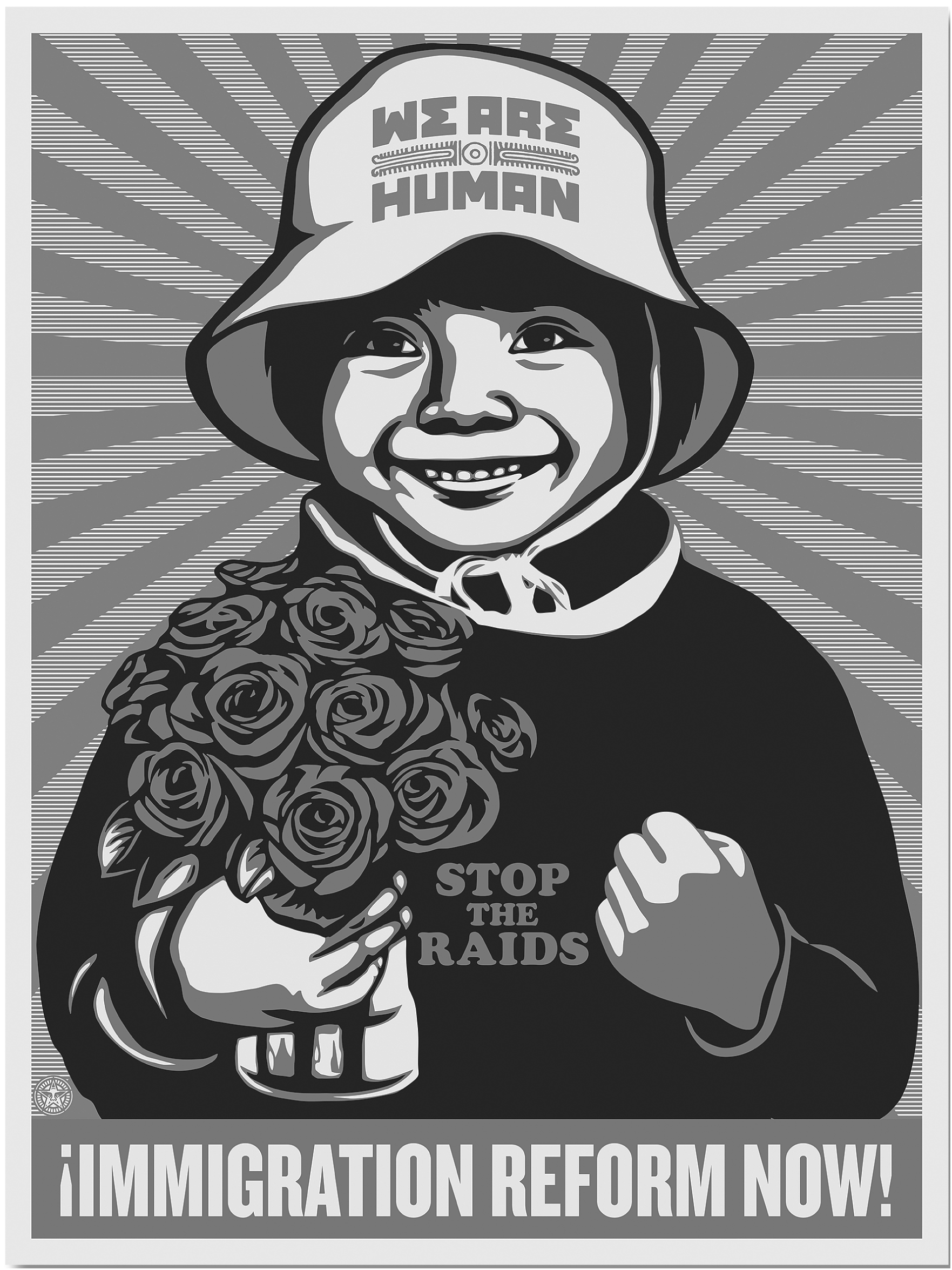
Poster created for inaugural protests, 2017, by Shepard Fairey and Ernesto Yerena, and made freely available for reproduction via Amplifier.org.
Courtesy Amplifier.org
Donald Trump characterizes Mexican immigrants as a threat to the U.S. and its citizens. While many of us find this racist rhetoric abhorrent, a recent study reported by Celia Olivia Lacayo in Sociology of Race and Ethnicity finds that at least some U.S. Whites believe that Latinos pass on a “deficient” culture from one generation to another. And Trump doesn’t stop with Mexicans. To him, Muslims are ubiquitously bad, locked in a dichotomy that pits “good” Americans against “evil” Muslims. (Scholars Nazil Kibria, Tobias Henry Watson, and Saher Selod call this dichotomy the “anti-Muslim racial discourse.”) And he has reportedly termed countries in Africa at the Caribbean “shitholes.” Trump’s binary worldview—good versus evil, the West versus Islam, “shithole” countries versus those sending desirable immigrants—is present in all his communication, from official speeches to inflammatory tweets. Trump seems to have a vendetta against countries with large percentages of Black and Brown people, as well as those Black and Brown people in the country he leads. Herein, a look at Trump’s continuous attacks on Mexicans, Muslims, and unauthorized immigrants throughout his first year in office and the ways his administration has succeeded in methodologically dismantling immigration policies and the public’s ideas about immigrants.
Trump versus Mexicans
As the Republican presidential candidate, Donald Trump entered the immigration debate with invective: “When Mexico sends it people, they’re not sending the best. They’re not sending you, they’re sending people that have lots of problems and they’re bringing those problems. They’re bringing drugs, they’re bringing crime. They’re rapists and some, I assume, are good people, but I speak to border guards and they’re telling us what we’re getting.” In addition to comments proclaiming the alleged cultural and pathological deficits of Mexicans, Trump promised to build a wall between the U.S. and Mexico, tweeting: “With Mexico being one of the highest crime Nations in the world, we must have THE WALL. Mexico will pay for it through reimbursement/other.”
Trump’s statements initially seem to synonymize Mexican with immigrant, particularly undocumented immigrant, but undocumented Mexican immigrants are only about half of all unauthorized immigrants living in the U.S. (a population that has, itself, been declining for at least two years). Their numbers have decreased from 6.4 million in 2009 to 5.6 million in 2016. Further, less than 10% of unauthorized immigrants living in the U.S. for less than five years hail from Mexico. Between 2009 and 2015, we have seen increases in unauthorized immigrants from Asia, Central America, and sub-Saharan Africa. So, rather than accurately framing unauthorized immigration, Trump is explicitly waging war on Mexicans.
The big, beautiful wall Trump wants to physically separate Mexico and the U.S. is, in this light, questionable in both necessity and feasibility. First, there is the problem of cost. While Trump claims that Mexico will pay for the wall, the Mexican government and President Enrique Peña Nieto have made it clear that they will not. So Trump has entertained other ways to pay for the wall, such as taxing remittances sent to Mexico, raising tariffs on imports, levying a “border adjustment tax” (lowering corporation tax on consumption not production), increasing travel visa and border crossing fees, and repeatedly threatening a government shutdown unless the legislative branch of government budgets for the expense. Trump’s consideration of all these measures has resulted in the devaluation of the Mexican peso and the cancelation of cross-border business ventures.
Of course, a second problem is that there is already a barrier in many places; what would be better? Trump touts the “much more powerful” effect of a wall rather than a fence, though he’s also mentioned solar panels and commissioned a series of “test wall” concepts complete with staged military attempts to scale or otherwise overcome the prototypes erected by would-be contractors. Among those who have concluded that Trump is imagining a concrete wall, Ali F. Rhuzkan, a New York-based structural engineer, reported to BBC would call for 12.5 million cubic yards of concrete. Meanwhile, Homeland Security’s Secretary has described the potential wall as transparent and relying “on sensors and other technology,” and Trump himself remarked that, unless you could see through the wall, a passerby might be hurt because, “A hundred pounds of drugs, they throw it over the wall. They have catapults. They throw it over the wall, and it lands and it hit somebody on the head.” The feasibility of a wall and its financial costs have not been well thought-out.
Trump’s binary worldview—good versus evil, the West versus Islam, “shithole” countries versus those sending desirable immigrants—is present in all his communication, from official speeches to inflammatory tweets.
Third, the wall would have to cover over 1,000 miles of terrain that includes remote and mountainous areas. The logistics of separating the border by a wall will result in serious human and environmental issues. This is evident by looking at the existing fences between the U.S. and Mexico. U.S. citizens residing on the border already find themselves cut off from the rest of the country. In many places, the terrain has forced the location of the wall/fence onto private property. In other cases, residents find themselves separated from towns and highways. Indigenous groups, such as the Yaquis, have settlements on both sides of the border, and even people with dual citizenship are denied the ability to freely move about their ancestral land, to visit relatives, and engage in daily activities. The lack of freedom of movement along the border is not only a civil rights issue but also an issue that threatens the ecosystem of animal and bird migrations. For instance, the endangered North American jaguar and black bears mate with their Mexican counterparts. The construction of a wall would disturb the ecosystem with serious consequences for populations on both sides of the border.
Trump versus Muslims
Another immigrant population Trump attacks are Muslims. Khizr and Ghazala Khan, a Gold Star Family, gave a speech about their son on the last day of the 2017 Democratic National Convention. Their son was Captain Humayun Khan, a Muslim Pakistani American soldier who died in the Iraq War in 2004. Khizr pointed to the ultimate sacrifice made by his son and his family while criticizing Trump’s proposed ban on Muslim immigration. He said to Trump, “You have sacrificed nothing—and no one.” Khan called attention to the patriots of all faiths, genders, and ethnicities buried at Arlington Cemetery, offered to loan Trump a copy of his United States Constitution, and told him to “look for the words ‘liberty’ and ‘equal protection of the law.’”
Trump was asked to respond in an ABC News interview. After suggesting that the Clinton campaign had written the speech, he continued to say, “I think I’ve made a lot of sacrifices . . . I’ve created thousands of thousands of jobs, tens of thousands of jobs, built great structures. I’ve had tremendous success. I think I’ve done a lot.” He continued by commenting on the presence of Ghazala (Khizr’s wife) and implied that she was not allowed to speak because of women’s role in Islam. She responded with an op-ed in The Washington Post, while other Muslim women protested Trump’s comments with the hashtag “#CanYouHearUsNow.” The Clinton campaign incorporated Humayun’s sacrifice into an ad featuring Khizr Khan’s voice asking, “I want to ask Mr. Trump: Would my son have a place in your America?”
On January 27, 2017, a week into his presidency, Trump’s actions answered Mr. Khan’s question. He attempted to fulfill his campaign promise of a “total and complete shutdown of Muslims entering the United States” with the issue of Executive Order 13769, Protecting the Nation from Foreign Terrorist Entry into the United States. The order limited the number of refugees to be admitted to the U.S. to 50,000 and suspended the entry of persons from Iran, Iraq, Libya, Somalia, Sudan, Syria, and Yemen. During his campaign, Trump had called for an end to the admittance of Muslim refugees, arguing they were “a rich pool of potential recruiting targets for Islamic terror groups.” The immediate result of the order was more than 700 travelers detained and up to 60,000 visas “provisionally revoked.” Described as a “Muslim ban,” protests and lawsuits followed. In response to the lawsuit, State of Washington and State of Minnesota v. Trump, the United States Court of Appeals for the Ninth Circuit issued a temporary restraining order on February 2, 2017.
Poster created for inaugural protests, 2017, by Shepard Fairey, and made freely available for reproduction via Amplifier.org.
Courtesy Amplifier.org

Poster created for inaugural protests, 2017, by Shepard Fairey, and made freely available for reproduction via Amplifier.org.
Courtesy Amplifier.org

By the six-month mark of his presidency, Trump had issued a second travel ban on six mainly Muslim countries—the original countries identified in the first ban, save Iraq. It was immediately challenged in Hawaii on the basis that its definition of family was too narrow and denied entry to foreign nationals who “credibly claim connections with this country.” Fifteen states and the District of Columbia joined Hawaii’s challenge, arguing the ban excluded grandparents and other relatives with connections in the U.S. The brief stated, “The artificially narrow line drawn by the federal government will thus likely impair the ability of institutions in the states not only to recruit but also retain individuals from the affected countries who do not wish to endure the hardship of disruption and separation from family members.” Further, as the ban was enforced by Immigration and Customs Enforcement (ICE), “an ailing grandmother could not receive end-of-life care from her foreign granddaughter. A niece whose foreign aunt was like a mother to her could not bring that aunt to witness and celebrate her wedding. And an orphaned child would not be permitted to receive a visit from the uncle who took care of her financial and emotional needs after her father’s untimely death.” A settlement agreement on August 31, 2017 required the federal government to identify travelers who had been en route to the U.S. but barred from entering the country when the ban was announced and to provide a list of organizations offering free legal services to assist with visas and other entry documents. It did not, however, include monetary compensation for travel or any award to groups who fought the ban in court. The agreement did not include refugees’ ties with resettlement programs in the U.S. as having “credible claim of a bona fide relationship with a person or entity in the United States,” though the Supreme Court stipulated exceptions for “students who have been admitted to study at an American university, workers who have accepted jobs at an American company, and lecturers who come to speak to an American audience.”
Trump Versus the Undocumented
On the campaign trail, Trump promised to deport two million immigrants upon taking office and to support Kate’s Law, which increases the penalties for deported immigrants who try to return to the U.S. Within days of his presidential inauguration, Trump signed an executive order requiring Homeland Security to take the needed measures for ICE to fulfill immigration law enforcement, including funding the addition of 10,000 agents to their current staff of 20,000. In April 2017, Attorney General Jeff Sessions announced new guidelines for immigration law enforcement, ending the practice of “catch and release” and encouraging the pursuit of felony charges for persons with a history of entering the country illegally (prioritizing identity theft, visa, or document fraud). These initiatives make no distinction between unauthorized immigrants working and residing in the U.S. and those arrested for violence committed as members of drug cartels such as the MS-13 criminal gang Trump so often cites. In response to the growing attacks on Mexican immigrants in the U.S., Mexican President Nieto established defense centers with 50 consulates to protect the rights of Mexican nationals.
Rather than accurately framing unauthorized immigration, Trump is explicitly waging war on Mexicans.
Trump’s immigration policies are great for the two largest for-profit prison companies in the U.S., CoreCivic and GEO Group (each of which donated $250,000 to Trump’s inauguration, in addition to GEO’s $225,000 donation to Trump’s presidential campaign). In 2016, ICE used private prisons to house 65% of detained immigrants. Although Obama’s monthly deportation rates in 2016 are higher than Trump’s monthly rates between February and June of 2017, the number of arrests and removal orders has increased. Much of the “catch and release” practice was eliminated under Obama’s administration, but GEO Group reported a 2% decline in profits in its 2017 second-quarter earnings. GEO Group Chairman and CEO George Zoley is reportedly optimistic now that profits will increase as ICE fills empty beds by expanding enforcement to the interior of the country. The reason is that immigrants arrested at the border are detained for an average of 27 days, while those arrested in the interior are detained for more than 52 days. The Department of Homeland Security pays for-profit prison companies approximately $126 per day for each detainee. Moving immigration enforcement to the interior also opens new opportunities for “processing centers” and more profit. Trump’s administration awarded GEO a $110 million contract to expand their capacity to detain more individuals. A total of $700 million was added to increase detention capacity by 5,000 beds in 2018. This will bring the total bed capacity to 44,000.
While family detention centers were reinstated under the Obama administration to address the number of women and unaccompanied children refugees seeking asylum from violence in Central America, a Texas judge recently denied licenses to detain children to the centers in Dilley and Karnes, Texas (which had been doing so for the last two years). Since ICE does not release data on the number of detained women and children seeking asylum, they are effectively hidden. Many of these refugees qualify for asylum but lack the legal knowledge and access to make strong cases. Immigrant advocates are closely watching these legal decisions to assess the declining use of family detention centers. However, housing detained women and children has resulted in a profit margin for private prisons like CoreCivic, which has earned $71.6 million in revenue from the Dilley center since 2015.
During his campaign, Trump had called for an end to the admittance of Muslim refugees, arguing they were “a rich pool of potential recruiting targets for Islamic terror groups.”
Concerns over human rights violations in private prisons are another carryover from the Obama administration, and the violations may be worsening due to longer detentions. In May 2017, The Center for Immigrants’ Clinic at Penn State Law released a report on two immigrant detention centers in Georgia. They found similar problems to those identified in their 2012 report on Imprisoned Justice. Detained immigrants were being transferred to different parts of the country, which separated them from family members and legal counsel. There were problems with the quantity and quality of food and water the detainees received, and the detention centers did not accommodate dietary needs related to health problems and religious beliefs. Poor living conditions, the use of solitary confinement, and the exploitation of labor have not been monitored by ICE. The report recommended finding alternatives to detention, closing detention centers that were not complying with ICE standards, protecting privacy and guaranteeing attorney-client privileges, and creating of a list of service providers that could ensure due process (pro-bono services, qualified interpreters, and law libraries). ICE has failed to ensure that detainees have immediate access to emergency medical care or have access to non-emergency care in a timely manner.
In her Sociology of Race and Ethnicity article, Amanda Armenta examines the colorblind ideology that obscures and normalizes local institutional practices and laws that are used to meet bed quotas and political demands for deportation. Latinos are disproportionately arrested and cited for minor infractions, and they are processed in local jails until moved to detention centers or deported. To fill beds, immigration enforcement can no longer limit detention to persons caught crossing the border illegally or to immigrants with criminal records. Since half of the current unauthorized immigrants residing in the U.S. have been here for over a decade and settled in the country’s interior, immigration enforcement can only increase their arrest rates by becoming more aggressive further away from the border. This shifting focus not only assures longer detentions while cases are adjudicated, but also targets immigrants with families, including their U.S.-born children, since those who have resided in the country for at least a decade are more likely to have become established, married, and have kids.
In response to Trump’s draconian measures in immigration law enforcement, several cities announced they were “sanctuary cities”—their local law enforcement will not cooperate with immigration law enforcement. Supporters of sanctuary cities argue that keeping city law enforcement separate from federal immigration enforcement increases trust between undocumented immigrants and police. Local communities, they claim, are safer because residents, regardless of their citizenship status, are more willing to report crime and cooperate in police investigations. Opponents argue simply that cities must comply with federal immigration laws. Congress passed a bill, the “No Sanctuary for Criminals Act,” to deny federal grants to sanctuary cities, after Trump gained support by highlighting a select few crimes across the country that were committed by undocumented immigrants. As some cities declare sanctuary, others continue to enter into 287(g) Agreements, which train local police officers in immigration law enforcement and allow state and local law enforcement to enter into partnerships with ICE.
A major setback for immigrant and human rights activists was Trump’s pardon of Joe Arpaio, the former sheriff of the Maricopa County Sheriff Office (MCSO) in Arizona. Arpaio first made international news for his human rights violations: establishing a tent prison in the Arizona desert, banning coffee and cooked meals, and restoring chain gangs.Over his 24 years as sheriff, Arpaio was accused of numerous incidents of police misconduct, mistreatment of prisoners, abuse of power, misuse of funds, failure to investigate sex crimes, unlawful enforcement of immigration laws, and election law violations. Over 2,700 lawsuits, concerning violations at the county’s prisons, were filed against Arpaio in Federal and County Courts. He tried to intimidate eleven of the judges, country supervisors, administrators, and attorneys involved by investigating their lives. Even judges have filed lawsuits against Arpaio.
The lawsuit that finally ended his career in law enforcement was a class action lawsuit, Ortega Melendres vs. Arpaio, which charged Sheriff Arpaio and MCSO with systematically targeting Latino drivers and passengers. In his decision, U.S. District Judge G. Murray Snow agreed that MCSO deputies targeted Latinos during traffic stops, with the presumption that they had entered the country illegally. He found these practices to be racially motivated and in violation of the Equal Protection Clause of the Fourteenth Amendment to the Constitution. Additionally, he found the prolonged traffic stops and baseless extended detention to be in violation of the Fourth Amendment. During his trial, Arpaio was found to have condoned and participated in the circulation of racist commentary about Latinos and to have created “a general culture of bias” in the Sheriff’s Office. In 2011, Judge Snow issued an order mandating changes in MCSO to eliminate misconduct and stop future violations of the community’s constitutional rights. Arpaio ignored the 2011 order to stop participating in immigration enforcement as well as court orders to audio and video recording all traffic stops, increase training and monitoring of employees, and maintain comprehensive records. Judge Snow found Arpaio in contempt and scheduled him for sentencing in October 2017. Although Arpaio was unlikely to do jail time, Trump pardoned him on August 25, 2017. Following Trump’s pardon, Arpaio’s attorneys filed motions to have the entire criminal case against him expunged from his record. In the meantime, court filings against Arpaio are still adding up—and Arpaio has announced his intention to run for the Arizona state Senate.
Attorney General Sessions’ announcement of the end of Deferred Action for Childhood Arrivals (DACA) program on September 5, 2017 was unlike any other immigration initiative proposed by Trump. For the most part, Congress has been able to push aside any meaningful funding for the wall, and they dragged their feet on passing and enforcing penalties against sanctuary cities or immigration law enforcement onto state and local law enforcement. DACA, which allows undocumented immigrants who arrived in the U.S. as children younger than 16 and under 31 years of age on June 15, 2012 to receive a renewable two-year period of deferred action from deportation and to be eligible for a work permit, is an Obama-era policy with bipartisan support. But registration for DACA now looks more like a ready-made deportation list for the Trump administration. DACA recipients—“Dreamers”—have seen Trump claim that “millions of Americans [are] victimized by this unfair system” and Sessions claim they are taking hundreds of thousands of Americans’ jobs. Research on DACA recipients does not support either of these claims. Native-born workers are not disadvantaged by immigrants entering the labor market. Instead, evidence points to DACA benefiting the U.S. economy and spurring a reduction of poverty in households with undocumented family members. As a result, opposition to ending DACA came from both sides of the aisle, from business executives, college presidents, and immigration activists. Yet, as of this writing, with House members holding the floor in marathon speeches and Senators holding the line on government shut-downs in support of the Dreamers, the Trump administration continues its attacks on immigrants. It is my hope that immigrants can continue to make meaningful contributions to the United States of America.