




Abstract
Recent acts of racial violence, the growing visibility of nationalized white power movements, and a drift toward a number of more restrictive laws and Supreme Court rulings have raised troubling questions about the significance and influence of social acceptance in the United States. Focusing on voters and elections, an important strain of scholarship has argued that declining acceptance of minority groups and marginalized communities contributed to the political rise of Donald Trump and his 2016 election to the presidency. However, the argument that low levels of social acceptance benefited Republican candidates is premised on a basic yet untested assumption: that social acceptance has decreased over the time period covered by the past several elections. In this study, we offer a new and systematic evaluation of this assumption through an analysis of change in the level of social acceptance within the American electorate and its political influence from the 2012 through 2020 elections. The analysis focuses on key target groups that include racial minorities, women, immigrants, and gay and lesbian individuals. We find that voters adopted more supportive and inclusive positions toward these marginalized social groups, resulting in a substantial increase in social acceptance over time. Contrasting further with much of the commentary regarding the rise of Donald Trump, our analysis indicates that these trends in social acceptance served to hurt Trump and to help his Democratic opponents. Supplemental analyses find little evidence that social desirability influences the measures of social acceptance or their estimated influence on voter choice.
For the past several decades, a recurring theme in scholarship on public opinion has been the growing liberalization of public attitudes toward social groups that have been the objects of hostility and historical patterns of resentment (Brooks and Bolzendahl 2003; Firebaugh and Davis 1988; Fussell 2014; Hout 2021; Loftus 2001; Rosenfeld 2017; Smith 1990; Stimson 2018). This growth in social acceptance has included women, racial minorities, immigrants, religious minorities, and the LGBTQ community. Leading explanations for trends in social acceptance highlight the importance of educational expansion (Bobo and Licari 1989; Ceobanu and Escandell 2010; Hello, Scheepers, and Sleegers 2006), economic growth (Hainmueller and Hopkins 2014; Inglehart and Norris 2003; Melcher 2023; Persell, Green, and Gurevich 2001; Scheve and Slaughter 2001), and increasing contact between social groups (Allport 1954; Dixon 2006; Pettigrew and Tropp 2000). Higher levels of social acceptance have been seen by a number of scholars as part of a broader cultural shift (Hout 2021; Schnabel and Sevell 2017; Smith 1990), one that signals a largely unfulfilled demand for greater social inclusion and egalitarian public policies.
Scholarship on social acceptance has significant theoretical implications because it highlights a potentially growing divergence between the increasingly liberal attitudes of the public and the deeply embedded exclusionary practices of political institutions. But it is interesting to note that until recently, the consequences of trends in social acceptance received little attention within scholarship on elections and voting behavior. Classic treatments tended instead to focus on the importance of partisanship, policy preferences, demographic attributes, and the economy (Achen and Bartels 2016; Levendusky 2009; Lewis-Beck and Stegmaier 2000; Theiss-Morse et al. 2018). To the extent that scholars of voting and elections considered issues of social acceptance, it was in service to examining whether the electorate was willing to vote for women or racial minorities (see e.g., Sigelman and Sigelman 1982). Largely absent from these discussions was a consideration of how the acceptance of marginalized social groups could be a political issue itself, one that motivates the electorate independently of candidates’ social identities.
Over the past decade, however, scholars have begun to take steps toward unpacking questions about how social acceptance may have emerged as a political issue in its own right to shape voter choice and election outcomes and, in turn, to potentially exert pressure on public policymaking. According to this emerging line of research, the growth in social acceptance among voters has propelled several political challengers to electoral victory during the 1990s and 2000s (Claggett and Shafer 2010; McThomas and Buchanan 2012; Wurgler and Brooks 2014). Furthermore, scholars looking beyond the field of elections have found that attitudes toward marginalized groups also appear to be associated with participation in and support for reform-oriented social movements (see also Becker and Wright 2011; McCright and Dunlap 2015; Soule and King 2006).
If there are indeed linkages to voting behavior, social movement mobilization, and broader patterns of cultural change, liberal trends in social acceptance represent a pivotal development for understanding U.S. politics over the past half century. Yet as provocative as this scenario is, the relevant lines of research and debate draw from studies that were conducted over a decade ago. Investigations into how the level and possible influence of social acceptance have changed over the past decade are scarce. Scholarly exchanges concerning the contemporary period (and the possibility of reversals) are thus largely inconclusive. Indeed, it is likely that skeptics will tend to doubt the value of past work on social acceptance, leading to a risk that its potential insights are lost to scholarship.
The challenge of engaging opinion liberalization scholarship and the need to analyze recent evidence take on additional importance in the face of two recent developments. First, hate crimes have grown over the past decade (Levin et al. 2022; Li and Lartey 2023), as have stereotype-laden communications that tend to facilitate and reinforce negative perceptions of minorities. At the same time, right-wing mobilization around issues of white supremacy, Christian nationalism, and traditional masculinity has increased (Cruz 2022; Kishi 2022), placing members of marginalized groups in positions of vulnerability and calling into question the robustness of public support for and acceptance of these groups. The past decade also witnessed the emergence of Donald Trump and other politicians whose rhetoric proclaims a restrictive ethno-nationalism that endorses nativism, xenophobia, and religious intolerance (Bonikowski, Luo, and Stuhler 2022). Scholarship investigating this rhetoric has found evidence that it promotes the expression of hostilities toward groups that have been targeted by Trump and his colleagues (Crandall, Miller, and White 2018; Schaffner 2020). Together, these events raise the possibility that earlier growth in social acceptance may have plateaued or even contracted during the past decade.
Contemporary theory and research on party identification presents a distinct yet critical scenario, specifically, that the political influence of social acceptance may have declined or become absorbed by the growing scope of polarization based on the partisan identities of voters (Campbell 2016; Gerber, Huber, and Washington 2010; Huddy, Mason, and Aaroe 2015). In contrast to earlier, rational choice scholarship that assumed party attachments were shaped by economic calculations or voters’ policy attitudes, the more recent view is that party identification is itself a key trigger on the formation of social and political attitudes and the processing of information (Mason 2015; Van Bavel and Pereira 2018). The increasing relevance of partisan attachments directly challenges expectations that attitudes involving animus versus acceptance toward social groups operate as a significant, independent factor behind the behavior of voters (and that trends in social acceptance, in turn, are capable of shaping the outcome of elections).
We have three goals in this study. The first is to evaluate whether there is evidence that the long-term trend of rising social acceptance has continued over the past decade—a period marked by rising incidents of violence and political-legal conflicts around issues of racial and gender equality, immigrant rights, and LGBTQ acceptance. Meeting the theoretical challenge of partisanship and political polarization scholarship, our second goal is to examine whether attitudes toward the acceptance of minority groups affected voter choice. This leads to our third goal of analyzing whether changing levels of social acceptance shaped the outcome of presidential elections during this period. We emphasize that despite the scholarly importance and even urgency of these questions, systematic research across multiple elections or time periods is notably scarce. 1 Indeed, we are not aware of any study that has sought to directly estimate the patterns of change in levels of social acceptance and evaluate evidence concerning the possible effects of these patterns for recent election outcomes. As a result, it is not clear whether social acceptance has trended up or even down and, in turn, what effect this trend may have had for the success versus failure of specific presidential candidates. At best, this has left scholars studying social acceptance with an incomplete picture of the phenomena at hand. At worst, the absence of relevant work has given skeptics grounds for prematurely writing off research on acceptance as naive in the face of recent historical events.
We seek to offer new empirical insights into social acceptance and its scholarly significance through a systematic analysis of the three most recent presidential elections, spanning the period from 2012 through 2020. To this end, we make use of the innovative and high-quality internet surveys recently conducted by the American National Election Studies (ANES). We take advantage of a broad array of ANES items that capture individual attitudes toward four key social groups, ones that have been of central consideration in scholarship and debate on social acceptance. We use the ANES data to directly evaluate how social acceptance has changed over time with respect to both aggregate levels of social acceptance and the political influence of social acceptance. The results of the study provide new momentum to scholarship on social acceptance while contributing to political-sociological research on elections.
To preview study results, our analysis offers three novel findings. First, in sharp contrast to expectations regarding an erosion of social acceptance, we find that levels of social acceptance are quite high by historical standards and experienced, moreover, a substantial increase during the 2012 to 2020 period. Second, we find that three of the four forms of social acceptance under investigation—racial, gender, and immigrant acceptance—have been influential sources of voter behavior over the past three elections. Furthermore, this influence is not simply an artifact of partisan identities. It appears that social acceptance has strongly shaped voter choices independently of partisan attachments. Third, moving to the consequences of recent historical trends in social acceptance, we find striking evidence that these trends provided Democratic candidates with a net advantage among voters through the 2020 presidential election. We discuss implications for political-sociological scholarship on voting and elections and for debates over social acceptance in the study’s conclusion.
Social Acceptance and Voter Choice
Conflict over acceptance versus animus toward marginalized groups has been a central driver of American politics. Widespread animosity toward minority groups spurred the rise of nativist political parties in the nineteenth century (Higham 2002). It also drove McCarthyism and the Red Scares of the mid-twentieth century (Polsby 1960). In the 1960s and 1970s, earlier historical patterns of hostility toward marginalized groups started to wane, coinciding with a new wave of policy changes that ushered in an expansion of voting rights and the implementation of anti-discrimination laws (Skrentny 2009). It is during this this time, and continuing through the 1980s, that changes in attitudes toward racism and civil rights (alongside women’s rights and First Amendment liberties) became the focus of a new scholarly debate and vein of research concerning opinion liberalization (Greeley and Sheatsley 1971; Mason, Czajka, and Arber 1976; Nunn, Crockett, and Williams 1978).
Over the past two decades, social acceptance has elicited substantial, if variable, attention in the social science literature, with scholars debating its implications for political behavior (Abrajano and Hajnal 2015; Carmines and Stimson 1989; Huddy and Feldman 2009; Hutchings and Valentino 2004). This scholarship indicates that social acceptance strongly shapes the choices of voters. Much of this research has focused on attitudes toward groups such as African Americans (and ethnic and racial minorities more generally), women, immigrants, and gays and lesbians. A consistent finding in these studies is that individuals who have higher levels of acceptance toward the groups in question are more likely to support and vote for Democratic candidates.
Evidence of a strong connection between social acceptance and voter behavior at the individual level also has potential implications at the aggregate level. It suggests that within the electorate, over-time changes in the levels of social acceptance could affect the contours of election outcomes, penalizing political candidates who endorse forms of animus that are in decline. Yet in contrast to investigations between linkages between acceptance and voter choice, how aggregate-level changes in social acceptance have shaped election outcomes has received far less attention.
Social Acceptance Trends in the Electorate
How has social acceptance changed over time? A recurring finding is that social acceptance increased from the 1970s into the 1990s (Davis 1992; Hout 2021; Leege et al. 2009; Smith 1990). Since the mid-1990s, however, trends in social acceptance have been the subject of greater debate. For example, although racial acceptance continued to increase through the early 2000s (Hunt 2007; Schuman et al. 1997), questions have emerged over whether there was a backlash after the election of Barack Obama in 2008 (Abrajano and Hajnal 2015; Moberg, Krysan, and Christianson 2019). In querying the robustness of trends, research on gender has argued that gender attitudes liberalized for much of the twentieth century but stalled thereafter (Cotter, Hermsen, and Vanneman 2011; England, Levine, and Mishel 2020; Knight and Brinton 2017). For their part, attitudes toward immigrants appear to have varied substantially over time, with some analysts arguing that the degree of immigrant acceptance is conditional on the specific historical context, particularly with respect to the presence of terrorist attacks and the degree of media focus on immigrants and immigration (Huddy and Feldman 2011; Kam and Kinder 2007).
Of the various dimensions of social acceptance, trends in attitudes toward the LGBTQ community arguably represent the clearest example of monotonic opinion trends. Empirical scholarships reports that LGBTQ acceptance has increased steadily over time (Adamczyk and Liao 2019; Rosenfeld 2017). Although these studies are not without limitations in terms of the particular groups under study, they nevertheless provide evidence that earlier patterns of animus toward gay and lesbian individuals have moved consistently in the direction of greater acceptance in the early decades of the twenty-first century.
By contrast, there is significant scholarly disagreement and greater uncertainty regarding how attitudes toward other marginalized groups have changed during the past two decades. Indeed, although trends in social acceptance provide clear evidence that the American public has become more supportive overall of marginalized groups, much of this research has focused on trends through the 1990s and early 2000s. Analyses of attitude change in the twenty-first century have been less frequent. One notable exception is Hout’s (2021) analysis of change in approximately 300 General Social Survey items from the 1970s to the 2010s. The analysis is deliberately broad, focusing on a range of items, including behaviors, identities, attitudes, and demographic characteristics. Although Hout finds that the majority of items have shifted in a liberal direction since the 1970s, he does not explicitly focus on how social acceptance across different groups has changed, particularly after the 2000s. As a result, the question of whether (and perhaps how) social acceptance has changed over the past decade remains open.
The absence of research on recent trends in social acceptance is also noteworthy because several developments appear to raise the likelihood that social acceptance plateaued or even declined. The past decade witnessed a number of high-profile acts of hate-based violence—including, for example, the killings of Treyvon Martin, George Floyd, and Breonna Taylor; the mass shooting at a gay nightclub in Orlando; and another mass shooting at a large retail store in El Paso. Trends in official statistics add to these concerns. According to data collected by the Federal Bureau of Investigation, hate crimes experienced an overall increase from 2010 to 2019, and the number of victims of hate crimes increased by 7 percent. These developments are in close line with the possibility that public willingness to endorse acceptance over animus may have weakened.
During the same time period, the United States witnessed increased levels of mobilization among hate groups. Some of the most notable are the collection of white nationalist hate groups that became more active in 2008, including the American Freedom Party, Oath Keepers, Proud Boys, and Three Percenters (Beirich 2019). Over the past decade, these groups have continued to grow in both size and their use of more confrontational tactics. The proliferation of these organizations can readily be construed as a signalizing a rise in animus and a corresponding decline in acceptance within the population (McVeigh and Estep 2019).
In addition to increases in hate crimes and hate mobilization, analysts have noted a shift among conservative elites toward more openly hostile discourse, particularly with respect to issues of immigration, diversity, and race (Bonikowski et al. 2022; Holland and Fermor 2021; Müller and Schwarz 2018). Experimental studies have linked this style of discourse to lower acceptance and negative affect toward minority groups (Crandall et al. 2018; Flores 2018; see also Bonikowski and Zhang 2023; Newman et al. 2021; Schaffner 2020; Wetts and Willer 2019), highlighting in particular how this style of rhetoric normalizes and promotes the open expression of hostilities aimed at vulnerable social groups. Perhaps not surprisingly, a recent study by GLAAD (2019) found evidence that there was a noticeable decline among younger Americans in people’s comfort with the LGBTQ community during the latter 2010s. Similarly, experimental and observational evidence regarding hostile discourse that targets minority groups raises questions about the continuation versus reversal of past trends in the public’s willingness to endorse acceptance over animus (Hopkins and Washington 2020; for more on the potential activation of animus, see Hopkins 2021). By the same token, however, it is quite possible that elite rhetoric seeking to foster popular resentment of marginalized groups has been ineffective or even counterproductive. Absent suitable research, the latter scenario cannot be ruled out, and ultimately, it is only through consideration of over-time data covering the most recent time period that debates over acceptance trends can be advanced, much less resolved.
Changes in the Electoral Influence of Social Acceptance
In addition to the question of how levels of social acceptance have changed over time, a second area of scholarly concern is whether and how the electoral influence of social acceptance may have changed. As noted earlier, the acceptance versus rejection of marginalized social groups has traditionally been viewed by scholars as a driving feature of American politics. However, despite its historical importance, classical scholarship on voting behavior did not offer evidence for the relevance of social acceptance to voter choice. Instead, these early models tended to emphasize the importance of other factors—in particular, ideology, partisanship, economic evaluations, and socioeconomic characteristics (Alvarez and Nagler 1998; Campbell et al. 1960; Lewis-Beck and Stegmaier 2000; see also Abramowitz 2013). To the extent that social acceptance received sustained scholarly attention, the focus was on individuals’ willingness to vote for women or racial minorities as political candidates (Huddy and Terkildsen 1993; Kinder and Sears 1981; McDermott 1998; Sigelman and Sigelman 1982). The question of whether social acceptance could itself be a political issue and shape elections regardless of the candidates’ social identities was largely absent.
By the turn of the century, however, scholars started to take more seriously the possibility that attitudes or perceptions of groups shape voting preferences (Brooks 2000; Citrin et al. 1997; Kinder and Sanders 1996; Kinder and Sears 1981; Mendelberg 2001; Stimson 2018). Motivated in part by theorizing on symbolic politics (Kinder and Sears 1981) and issue evolution (Carmines and Stimson 1989), scholars started to see issues relating to social acceptance as potentially motivating for voters, particularly when competing positions endorsed by politicians’ captured the attention of the electorate. A series of studies found that social acceptance of racial and ethnic minorities, women, immigrants, and LGBTQ individuals figured prominently in several elections, driving progressive voters to vote for Democratic candidates and conservative voters to vote for Republican candidates (Brooks 2000, 2002; Leege et al. 2009; Shafer and Spady 2014).
The past decade has provided scholars with grounds for anticipating a continuation of this pattern because Republican and Democratic candidates have seized on policy issues at the core of the clash of animus versus acceptance to motivate their respective bases. To that end, studies of specific elections—particularly the 2016 election—have delivered evidence that these issues mattered for voters, with a growing number of scholars highlighting the Republican-voting tendency of individuals with low levels of acceptance (Adamczyk and Liao 2019; Blair 2017; Carian and Sobotka 2018; Hooghe and Dassonneville 2018; MacWilliams 2016; Pascoe 2017; Perrin and Adesina Ifatunji 2020; Reny, Collingwood, and Valenzuela 2019; Valentino, Wayne, and Oceno 2018). Indeed, it is interesting that after a series of debates at the turn of the century over the declining relevance of social acceptance versus animus (cf. Sears, Sidanius, and Bobo 2000), scholarship appears to have rapidly tacked toward the conclusion that social acceptance may have actually increased in political importance and could now represent a central source of influence over voters (Ratliff et al. 2019; Sides, Vavreck, and Tesler 2019). It is notable, however, that these recent studies focus on the influence of social acceptance within specific elections. How those dynamics compare across elections—and specifically, whether the influence of social acceptance has changed—remains unclear and requires investigations tailored explicitly to questions about over-time change.
The absence of over-time analysis takes on further importance in light of scholarship that highlights the growing role of partisanship in driving the attitudes and behavior of voters in recent decades. Specifically, analysts have marshaled an impressive array of evidence that partisanship has come to occupy a dominant place in the minds of voters (Campbell 2016; Huddy et al. 2015; Iyengar et al. 2019). The ascendance of partisanship is evident not only in terms of the choice of political candidates but also with respect to political ideology, policy preferences, and even the operation of seemingly nonpolitical attitudes and behavior (Bafumi and Shapiro 2009; see also Gift and Gift 2015; Huber and Malhotra 2017; Levendusky 2009). This has led to a process of partisan sorting whereby party identities are increasingly correlated with and the basis of ideological placement, attitudes, and choice behavior.
Partisanship scholarship presents a critical challenge to research on the influence of social acceptance on voters. It suggests that social acceptance may not exert an influence over voter choice that is independent of partisan identities. Instead, scholarship on partisan sorting suggests that partisan identities are responsible for shaping both social acceptance attitudes and voter choice. For social acceptance scholarship, the possibility then raises a crucial test and question: Has the influence of social acceptance eroded or otherwise become eclipsed over time by partisanship? The key challenge for the current study is to systematically account for the potentially confounding influence of partisan identities on voter choice.
Summary
Our study addresses two unresolved issues that are central to scholarship on social acceptance. The first concerns how social acceptance has changed within the electorate. The second concerns how the influence of social acceptance has changed with respect to recent election outcomes. The absence of detailed analyses over the past decade raises the possibility that long-term gains in social acceptance may have eroded recently and gone undetected. Furthermore, the absence of over-time analyses also leaves unaddressed the possibility that social acceptance may have receded in importance as other bases of voter choice—specifically, partisanship—have ascended in importance.
Data, Measures, and Methods
Data
We seek to address unresolved issues regarding social acceptance through a systematic investigation of how levels of acceptance changed from 2012 to 2020 and how its influence on voter choice and election outcomes unfolded during the same time period. We emphasize that the novel design feature of the current study is its explicit focus on over-time processes, particularly as they relate to temporal changes in levels of social acceptance and parallel changes in estimates for the impact of social acceptance on voter choice. As discussed in the article’s first half, existing work of relevance has analyzed specific elections, making it impossible to develop estimates of temporal processes or address unresolved questions about social acceptance versus animus during the past decade.
To these ends, we offer new evidence based on analysis of data from the 2012 to 2020 American National Election Studies (ANES) presidential election surveys. The ANES represents the “gold standard” in survey data on voting behavior, and these data have been collected using two modes: in person and over the internet. In 2020, the COVID-19 pandemic resulted in the fielding of only an internet survey. To avoid the introduction of mode effects and to investigate the important 2020 election, we analyze the 2020 internet survey in conjunction with the ANES’s 2012 and 2016 internet surveys. Together, these three surveys span the key time period of interest in which scholarly debate and unresolved issues have outpaced empirical investigations of changes in the level of social acceptance and its influence on voters and elections.
Measures
All items we analyze in this study have been selected to employ identical question wording and response formats across the 2012 through 2020 ANES surveys. The dependent variable in our analysis is a binary outcome and indicates whether respondents voted for the Democratic versus Republicans candidate in the presidential election (1 = Democratic candidate, 0 = Republican candidate). Table 1 details the coding of voter choice and all other variables in the analysis.
Coding of Variables in Analysis, 2012–2020 American National Election Studies (N = 3,646).
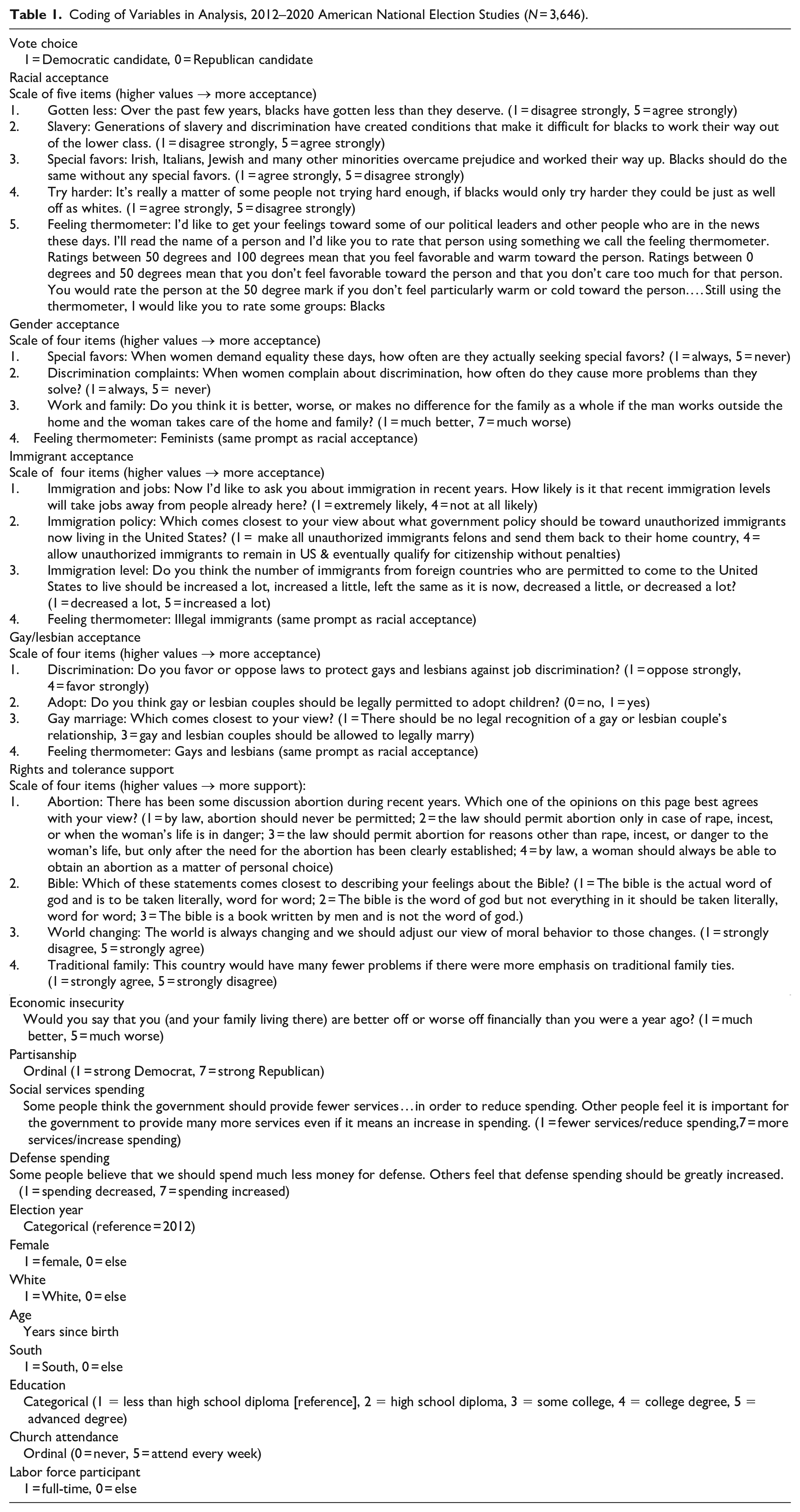
Our focus is on the influence of social acceptance in presidential elections. The ANES items enable us to build directly from past studies that examine group attitudes, including with respect to questions about acceptance. We follow previous studies (Brader, Valentino, and Suhay 2008; Keleher and Smith 2012; Kinder and Sanders 1996; Valentino et al. 2018) in using questions that reflect individuals’ attitudes toward key social groups that have historically been subject to marginalization—specifically, Black Americans, women, immigrants, and gay and lesbian individuals. 2
In choosing items with which to measure acceptance, we make use of items that (1) were fielded in all three election years and (2) use identical wording and response options. This leads to the inclusion of 17 items. Five of these items measure acceptance toward Black Americans, four measure acceptance toward women, four measure acceptance toward immigrants, and four measure acceptance toward gays and lesbians. All 17 items are coded so that higher values indicate greater acceptance. We use these items to create four separate measures of social acceptance. Racial acceptance is a scale of the five items that measure racial attitudes (α = .85). Gender acceptance is based on four items that measure gender attitudes (α = .69). Immigrant acceptance is a scale of the four items that measure attitudes toward immigrants and immigration (α = .73). Gay/lesbian acceptance is a scale of four items that measure attitudes toward gay and lesbian issues and individuals (α = .78).
One issue that confronts any analysis of social attitudes is the question of social desirability—and in the specific context of this study, whether individuals are providing honest answers to items measuring social acceptance or if instead they are providing socially acceptable but inauthentic responses. In supplemental analysis, we investigated this issue by taking advantage of the ANES’s dual modes of data collection (in person and internet-based). As discussed in the Appendix (“Social Desirability and the Measurement of Social Acceptance”), the results point to social desirability playing a minimal role in the analyses (see Figures A4–A9 and the associated discussion).
Our analysis also seeks to take into account the influence of other potentially confounding factors behind voter choice (Bartels 2000; Campbell et al. 1960; Miller and Shanks 1996). Foremost among these factors is partisanship, which measures the partisan identity of voters. Recall that inclusion of partisanship in the analysis is critical in light of overwhelming evidence that its relevance has grown in the United States at the expense of other factors, potentially including social acceptance. The partisanship variable is measured as a 7-point ordinal scale reflecting individuals’ identification with the two major parties (higher values indicate Republican identification).
Turning to the other statistical controls in our analysis, rights support is a scale reflecting individuals’ attitudes toward issues of civil rights and cultural change. Spending preferences are measured with two variables that indicate individuals’ respective preferences regarding spending on social services and national defense. Female, Black, South, and labor force participant are dichotomous measures that control for important social group memberships. Also included are age (a continuous measure), church attendance (a continuous measure), economic insecurity (an ordinal measure), and education (a categorical measure with less than a high school diploma as the reference category). Table 2 presents the summary statistics (means and standard deviations) for the variables in the analysis.
Summary Statistics for Variables in Analysis, 2012–2020 American National Election Studies (N = 3,646).

Note. Data are weighted to reflect the adult population in the United States.
Analytic Strategy
The dependent variable in the analysis—voting for the Democratic presidential candidate—is binary, and we use logistic regression models for our analysis. These models are estimated with robust standard errors to reduce bias associated with heteroscedasticity. We also use weights to make the results representative of the adult population in the United States. 3 After estimating models, we calculate predicted probabilities using Stata’s -margins- command. 4
Results
Trends in Social Acceptance
How has social acceptance changed over the past decade? Did it continue the long-term increase observed by some scholars during the late 1990s and early 2000s? Or did it recede in response to changes in the broader environment as a rising tide of Republican and conservative elites and far-right organizations engaged in aggressive communication and collective actions?
As a first step toward generating the evidence with which to address these questions, we examine how individuals’ responses to the 17 ANES items measuring social acceptance changed from 2012 to 2020. Figure 1 presents year-specific sample means for 2012 through 2020 for each item under study. The finding that these data convey is striking. Over the course of the past three presidential elections, social acceptance has substantially increased. Compared to 2012, individuals in 2020 adopted far more supportive and inclusive views toward marginalized groups. It is important to emphasize that items under consideration refer to a diverse set of groups that have historically been targets of hostility and exclusion. This suggests that the scope of increasing acceptance at hand is quite broad and not limited to one specific social group.

Trends in social acceptance items, 2012–2020 American National Election Studies (N = 3,646).
Considering patterns of change using the four standardized scales of social acceptance is equally informative (see Figure 2). These patterns provide further, simplifying evidence that the four types of social acceptance under investigation have increased consistently and substantially over time. Most of these increases in group-specific forms of acceptance are on the order of .5 SD, with racial acceptance showing the largest increase. These are very large shifts over a relatively short period of time. Although there is some variation in the pace of attitudinal change across the four target groups, there is also clear indication of a shared and approximately linear pattern of change between 2012 and 2020. This again suggests the existence of a recent and broad pattern of growth in social acceptance. 5

Trends in social acceptance scales, 2012–2020 American National Election Studies (N = 3,646).
These trends deserve emphasis in the context of recent events that have led commentators to suggest social acceptance may be in retreat. In particular, the recent rise of ethno-religious nationalism and the growth in hate-motivated violence and visibility of hate groups have given many the impression that the social acceptance of marginalized groups is in decline. In contrast to these expectations, however, the results from our over-time analyses of the ANES data provide clear evidence that acceptance has not receded among the adult population as a whole or even among Republican Party identifiers (see Note 5). Instead, public acceptance of four widely discussed groups subject to marginalization and exclusion substantially increased between 2012 and 2020, suggesting a continuation of a decades-long pattern of progressive change.
Social Acceptance and Voter Choice
What are the consequences of social acceptance attitudes for voter choice in the past three presidential elections? Are recent conflicts over racial violence, immigration, gay and lesbian rights, and sexual misconduct a sign that social acceptance has become (or remained) a potent social issue for voters’ decision-making? Or has the emergence of partisan-centered conflict muted these dynamics and pushed social acceptance to the margins of electoral relevance?
To answer these questions, we examine a model that estimates the influence of social acceptance on voter choice. This model accounts for the influence of a variety of relevant confounders, including education, economic perceptions, and racial identity. As discussed earlier, it is partisanship that is an especially strong candidate for causal confounding. Scholars have generated a considerable body of evidence that is consistent with the proposition that the ascendancy of partisanship may have relegated social acceptance to a position of minimal importance. Indeed, because partisanship may be responsible for individuals’ social acceptance views, social acceptance itself may not exert an influence on voter choice that is independent of partisan attachments. It is thus crucial that the model account for the role of partisan identities, and it does so by including partisanship a key control variable.
In Figure 3, we present the average marginal effects (AMEs) of the four types of social acceptance on voter choice. 6 According to these estimates, standard deviation increases in three of the four types of social acceptance are associated with large corresponding increases in the probability of voting for Democratic candidates. A standard deviation increase in racial acceptance increases the probability of voting for a Democratic presidential candidate by .05. Similarly, a standard deviation increase in gender acceptance increases the probability of voting for a Democratic presidential candidate by .05, and a standard deviation increase in immigrant acceptance increases the probability of voting for a Democratic presidential candidate by .04. In contrast to these effects, a standard deviation increase in gay and lesbian acceptance is not associated with a statistically significant change in the probability of voting for a Democratic presidential candidate. These models include an array of control variables—including, importantly, partisanship—yet three types of social acceptance nevertheless exert a statistically significant effect on voter choice, suggesting that social acceptance exerts an effect on voter choice that is independent of these possible confounders. Indeed, this suggests that the ongoing rise of partisanship, although consequential for how voters make decisions, has not eliminated the electoral influence of social acceptance.

Standardized effects of social acceptance, with controls, 2012–2020 American National Election Studies (N = 3,646).
It appears, then, that three types of social acceptance (racial, gender, and immigrant acceptance) significantly shape how individuals vote in elections. Those who stake out more progressive positions toward marginalized communities are much more likely to support Democratic candidates. For racial, gender, and immigrant acceptance, the influence on voter choice is substantial in magnitude.
We extend this line of investigation in the next stage of analysis by exploring whether the effects of social acceptance are moderated by voters’ partisan identities. Indeed, one possibility that emerges from scholarship on partisanship and recent historical observation is that social acceptance may shape the decisions of Democrats and Republicans in a heterogeneous fashion. Republicans may be especially responsive to cues from political elites that highlight issues of immigrant and gender acceptance. Conversely, Democratic voters may be particularly attuned to issues of racial justice. To assess this possibility, we add (Partisan ID × Acceptance) interaction terms for each type of partisan (Democrat, Republican, and Independent) and each form of social acceptance (racial, gender, immigrant, and gay/lesbian). Using this model, we then calculate the AMEs for each type of social acceptance for each partisan identity (see Figure 4).

Standardized effects of social acceptance, with controls, by party identification, 2012–2020 American National Election Studies (N = 3,646).
The AMEs indicate that racial acceptance and gender acceptance are significantly associated with a greater probability of voting for the Democratic presidential candidate for all three partisan identifier groups. Immigrant acceptance is associated with Democratic vote choice among Democrats and Republicans. Consistent with the main effects presented earlier, the influence of gay/lesbian acceptance lacks a statistically significant effect for all three partisan identities. In this context, we emphasize that additional tests indicate that the AMEs of all four types of social acceptance are not significantly different for Republicans, Democrats, and Independents (p > .05 for all pairwise tests). 7 These results suggest that the partisan dynamics associated with voting behavior operate in ways that are largely independent of social acceptance attitudes (and likewise, that the influence of social acceptance on voter choice is independent of the operation of partisanship). To that end, racial, gender, and immigrant acceptance matter equally with respect to both Republican, Independent, and Democratic identifiers. Recalling our earlier results, it appears that the key difference between Democratic versus Republican identifiers is not their behavioral response to social acceptance but rather, their baseline level of social acceptance. Democrats are more accepting of marginalized groups, and Republicans are less so (with Independents’ acceptance levels falling between the Democrats and Republicans).
Our final step in evaluating how social acceptance has shaped voter choice over the past three presidential elections involves assessing whether the influence of each type of social acceptance has varied across the three contests. The possibility that social acceptance may have distinct effects across election years is motivated in part by the focus of recent research on specific elections rather than multiple elections. Although these studies find evidence that social acceptance and group attitudes have shaped the behavior of voters, the absence of over-time comparisons makes it difficult to know if social acceptance has shifted in political importance over time. To examine the possibility of over-time differences in the effects of social acceptance, we take the model presented earlier and add (Year × Acceptance) interaction terms for each form of social acceptance. We then calculate the year-specific AMEs for each type of social acceptance and test whether the AMEs are significantly different across election years. The year-specific AMEs for each type of social acceptance are presented in Figure 5.

Standardized effects of social acceptance, with controls, by election year, 2012–2020 American National Election Studies (N = 3,646).
The AMEs reveal two key findings. First, racial and gender acceptance maintained statistically significant effects on voter choice across all three presidential elections under study, suggesting these are stable and robust influences on voter choice. Second, immigrant acceptance emerged in the 2016 and 2020 presidential elections as a strong source of influence on voters. Compared to the 2012 presidential election, the influence of immigrant acceptance was significantly higher in the 2016 presidential election, F(1, 3645) = 5.57, p < .05, and 2020 presidential election, F(1, 3645) = 4.37, p < .05. The new presence of immigrant acceptance as a statistically significant effect of social acceptance in the 2016 and 2020 presidential elections suggests the influence of social acceptance may be expanding in its breadth. Finally, in keeping with our earlier results, acceptance of gays/lesbians did not exert a significant influence on voting behavior in any of the past three presidential elections.
To summarize then, our analysis of whether social acceptance shaped voter choice over the last decade provides strong evidence in the affirmative. Voters with higher levels of three forms of social acceptance—racial, gender, and immigrant acceptance—were more likely to vote for Democratic candidates. Importantly, these effects were not reducible to the influence of other, potentially confounding variables, including most notably the partisan identities of voters. Also noteworthy is evidence that social acceptance has not declined in its predicted impact on voter choice. In the case of immigrant acceptance, it may even be trending upward in relevance for voters’ decisions in the 2016 through 2020 presidential elections.
The Electoral Consequences of Social Acceptance
The results up to this point lead to a pair of thematic findings. One is that the level of social acceptance has continued to increase over the past decade; the other is that social acceptance has operated (or emerged, in the case of immigrant acceptance) as a potent source of influence over voter choice during the past decade. In this section, we place these two findings in a further, novel context by unpacking their implications for presidential election outcomes. We focus specifically on the question of which party has benefited from these trends and by how much.
To answer this question, we calculate a series of counterfactual simulations that evaluate how the two-party share of presidential votes would be different if levels of social acceptance had not increased—that is, if it had remained perfectly stable from 2012 to 2020. This involves calculating the predicted vote share for Biden under two scenarios. The first calculation uses the observed 2020 sample means for all the covariates. This provides a baseline prediction that can be used to assess how the vote share would have varied under different counterfactual scenarios. The second calculation also uses these the observed 2020 sample means for the covariates but with one exception. In this calculation, the means for the social acceptance covariates are held at their 2012 levels. This simulates the counterfactual scenario in which the level of social acceptance (and only social acceptance) remained stable from 2012 to 2020. The resulting difference in the two predictions indicates how voting for the Biden in the 2020 election would have been different if social acceptance did not increase. All calculations are based on estimates from the model that includes control variables, including partisanship, and interaction terms of Election Year × Immigrant Acceptance. For the model estimates, see Table A4 in the Appendix. 8
Results of the simulations are presented in Figure 6. Under a scenario in which racial acceptance levels did not change over time, the predicted change in the probability of voting for the Biden is −14 percentage points. In other words, if racial acceptance did not increase (and was thus perfectly stable) from 2012 to 2020, the percentage of the electorate that voted for Biden would have been lower by 14 percentage points. This is a very large predicted effect on an election’s outcome.

Simulation for the trends in social acceptance, 2012–2020 American National Election Studies (N = 3,646).
Trends in two of the three other forms of social acceptance also appear to have been consequential. The effect of increasing gender acceptance is a 9 percentage point change in the share of votes for Biden. Rising immigrant acceptance also changes the vote share. The share of the electorate voting for Biden would have been lower by 16 percentage points had the electorate not become more accepting of immigrants. Because gay and lesbian acceptance did not influence voter choice, rising levels of gay and lesbian acceptance are not relevant to the 2020 election outcome, with the estimates suggesting the percentage of votes cast for Biden would have been lower by a statistically insignificant half-percentage point.
The magnitude of these estimates suggests in dramatic fashion just how important trends in acceptance levels have been for the outcomes of recent presidential elections. Although the individual-level influence of social acceptance may not rival the individual-level influence of partisanship for shaping voter choice, the large increase in social acceptance at the aggregate level has profoundly shaped election dynamics. We note that these calculations are based on a scenario of stable trends in acceptance. Had social acceptance actually declined over the past three presidential elections—as was the concern of some observers—then the estimates would be even larger. This further underscores the contribution of rising social acceptance to election outcomes. 9 As we discuss in the following section, these results are of novel relevance in advancing previous scholarship and in addressing gaps in ongoing debates concerning the political significance of social acceptance versus animus in the contemporary United States.
Discussion
Recent historical events and scholarship have raised new questions regarding the state of social acceptance in the American public and its influence on voters and elections. The rise of hate-based violence coupled with openly hostile rhetoric toward vulnerable populations has given many observers the impression that Americans have become less supportive and accepting of marginalized social groups. At the same time, scholarship documenting the growing reach of political polarization raises the possibility that partisanship leaves little room for conflicts over social acceptance versus animus to exert any influence at the ballot box. It is again worth emphasizing that in the absence of suitable, over-time analyses of social acceptance and voter choice, no prior hypothesis (regardless of its degree of initial plausibility) can be satisfactorily ruled out.
Against this backdrop, the current study examines three questions that have yet to be taken up by scholars and are critical to advancing scholarship. First, to what extent has social acceptance declined over the past decade, a period that encompasses much of the rise in hate and vitriol described by scholars and public intellectuals? Second, in the face of partisanship’s influence, to what extent has social acceptance shaped the behavior of voters over the past three presidential elections? Third, how have any recent patterns of change in social acceptance levels shaped the outcomes of these elections?
Coupling an over-time design with ANES data for the 2012 through 2020 presidential elections, our analyses shed new light on these questions. The first may be surprising to some commentators. We find that levels of social acceptance have trended upward over the 2012 to 2020 election period, to the point that high levels of social acceptance appear to be the most common orientation within the electorate. Racial, gender, immigrant, and gay/lesbian acceptance were all much higher that 2020 than in 2012. Indeed, levels of social acceptance likely reached their highest point in the current electoral period (a number of the ANES items we analyze are not available in earlier periods, prior to 2012, limiting longer-term comparisons for a number of items). 10 This is very much in keeping with past strains of public opinion scholarship, much of it focusing on the historical period through the 1990s and early 2000s. But we would we emphasize that ours is the first study of which we are aware that has sought to directly measure and investigate trends in animus levels in the current historical era witnessing the political rise of Donald Trump and other populist-nationalist politicians and influencers.
Our second novel result is that social acceptance appears to have exerted a very sizeable influence on voters during each of the three presidential elections from 2012 through 2020. In contrast to classic theorizing on voter choice but in line with more contemporary accounts, we find a strong association between social acceptance and voter choice. The consistent pattern of influence across three presidential elections suggests that social acceptance has become a formidable political issue in its own right, one that organizes questions of acceptance versus animus toward marginalized communities into partisan political conflicts. Furthermore, we find evidence for this relationship despite the ongoing rise of partisan identities as a central factor behind patterns of voting behavior. Indeed, our inclusion of partisanship in the model is an attempt to err on the side of methodologically conservative estimates of social acceptance’s impact on voters.
The recent growth of social acceptance coupled with its emergence as a substantial influence on voting behavior underlie our third question regarding how it may have advantaged Democratic candidates. We find that rising levels of social acceptance conferred a substantial benefit to Democratic candidates (and created strong headwinds for Republican candidates). Specifically, counterfactual scenarios suggest that increasing levels of social acceptance from 2012 to 2020 boosted the share of votes received by Democratic presidential candidates by as much as 23 percentage points.
We view these last two findings as startling, even perplexing, at least relative to many if not most of the predictions offered by scholars and public intellectuals. Indeed, the theoretical framing and cautionary rhetoric utilized in recent scholarship on group attitudes is suggestive of virtually the inverse of what we have found (Abrajano and Hajnal 2015; Jardina 2019; Valentino et al. 2018)—specifically, that low levels of social acceptance were key to facilitating (if not propelling) Trump’s candidacy in the 2016 and 2020 elections. It is possible that this is due to a tendency in past scholarship to focus on a specific election or time period, where evidence that social acceptance (or its inverse, social animus) predicts voter choice might be construed as favoring (or foretelling) the election on Donald Trump. If so, this would underscore the importance of an over-time research design capable of incorporating information on trends in social acceptance levels into the analysis.
Alternatively, the divergence between our results and widely accepted predictions may be due to the fact that many analysts and commentators have implicitly relied on interpreting trends in right-wing organizations and political elites—including the rise of hostile rhetoric and the spread of violence against members of marginalized communities—to infer that social acceptance is also receding within in the electorate. The latter phenomena are critically important in their own right and worthy of study. By the same token, however, our estimates suggest that the opposite is happening when the scholarly focus is on voters. We would also emphasize that the dramatic increase in social acceptance is consistent with earlier studies that identify a long-term trend in attitude liberalization. We believe that this provides compelling reason to reengage with this tradition of scholarship and to critically consider the insights it may have to offer, including when comparisons to political elites and right-wing influencers are undertaken.
From a theoretical perspective, our results also suggest the need for a possible reconsideration of social acceptance’s underlying degree of robustness versus malleability. The expectation of much current scholarship is that social acceptance trends tend to change slowly over time insofar as attitudes toward marginalized groups are rooted in glacially moving processes such as early childhood socialization exposure, personality traits, or susceptibility to authoritarianism (Jost 2009; Parker and Towler 2019; Sears 1988). We do not wish to deny the relevance of such factors to the acquisition of attitudes. Nonetheless, our study offers a partially contrasting portrait insofar as we find new evidence for a notable degree of historical malleability vis-à-vis large recent increases in social acceptance levels, a phenomenon that clearly is driven not only by generational replacement but also by features of the recent historical context. We believe this creates new motivation for reopening questions about the mechanisms underlying social acceptance’s malleability and what factors may have triggered the notably rapid recent increases in social acceptance that emerge from our analysis of the 2012–2020 ANES data.
Finally, we note that the results also have implications for campaign strategy within the context of the Electoral College. A sustained increase in social acceptance indicates that two electorally relevant groups are changing in their relative size. Specifically, Republican-leaning voters with low levels of social acceptance have contracted, and Democratic-leaning voters with high levels of social acceptance have expanded. To the extent that the Electoral College can give outsized influence to groups that may be relatively small in size, trends in social acceptance suggest that Republican candidates (and in particular Trump) may be more beholden to the demands of an increasingly small, vocal, and hostile group of conservative voters. Conversely, it also suggests that Democratic candidates may have more latitude (and by extension, more margin for error) when courting voters that are socially accepting by virtue of their relatively large size.
Conclusions
Conflicts over issues of social acceptance and inclusion alongside legislative attempts to roll back or block protections for a number of marginalized and vulnerable groups appear to have given many observers the impression that animus and hostility have overtaken acceptance and tolerance as the dominant group attitude in the United States, to the point that it has given Republican candidates a sizeable electoral advantage. But analysis of American National Election Studies survey data from the 2012 to 2020 presidential election cycles supports a very different empirical portrait. Instead of widespread and unchanging (or even rising) group hostilities, we have unearthed clear evidence that survey responses to a wide battery of questions measuring social acceptance suggest notably high and temporally increasing levels of acceptance in the contemporary United States. In an era when social acceptance has become a potent political issue in its own right, expanding levels of acceptance toward marginalized groups also appears to have set in place a degree of constraint on the electoral viability of more populist-nationalist candidates. We believe high levels of social acceptance complements ongoing investigations by political sociologists into the recent political mobilization of nationalism and White working-class voters (Bonikowski, Feinstein, and Bock 2021; Gorski and Perry 2022; Lamont, Park, and Ayala-Hurtado 2017), suggesting productive avenues for investigation that complement ongoing scholarship on forces that have activated and benefited right-wing politicians and movements.
