



Abstract
Neeraja Kolloju on the men who apparently won’t.
“I was at a Dusshera festival with my grandpa. There was a massive crowd and a man who was like 28 years old was behind me and touched my butt. At first, I thought it was accidental but later he literally started rubbing his hands on my butt... I was so scared… I locked myself in a room for a long time because I felt so dirty about myself.” Meghna (a pseudonym, as are names throughout) was a child when she was assaulted, but the memory was fresh when she posted on a public Facebook page called *The Indian (also a pseudonym) many years later. There, her account joined similar recollections that poured out in the aftermath of a mass groping attack against women celebrating New Year’s Eve 2017 on Mahatma Gandhi Road in Bengaluru.
Together, online comments like Meghna’s validate Indian women’s experiences with sexual assault and street harassment. They also seem to trigger men in their online communities to reply, questioning the utility of speaking up online. “Had all these women reported the cases instead of tweeting about it we’d get rid of some potential rapists in our society!!” reads one response in my sample of about 1,500 Indian commenters on posts about sexual violence against women (more than 70% of these posters were male and Hindu). The comment garnered 464 “likes.” On just 6 women’s posts, I counted 38 comments in which men subtly or overtly engaged in victim-blaming, rather than taking ownership or decrying the behaviors that harmed the original commentators.
We saw much the same during the 2018-2019 Facebook Indian #MeToo campaign, when men took to their keyboards to explain why “talking” or “ranting online” about sexual violence would not bring “real change.” Keep your faith in due process and the judicial system, they suggested, in a country where just 10% of high-court judges are women, and where less than 30% of the sexual assault cases lead to conviction.
The footage of the 2017 New Year’s Eve attacks in Bengaluru was barely uploaded before #NotAllMen began trending—a response many women found infuriating and discrediting.
BuzzFeed News Collage

In online forums like Facebook, women continued to make space to support each other, express solidarity, and point out that their experiences collectively point to problems with the justice system, from cops to courts. “I’ve heard police officers saying, he just groped you right? Why do you want to make a big deal about it?” read Priya’s post, while Swati rebutted male commenters’ emphasis on reporting by asking, “Haven’t y’all learnt from the Bengaluru case?? First, the police officer will ask us about the length of our clothes, then how were we feeling (in direct words, if we were enjoying being molested) undress us with his own eyes, tell us to not go out at wee hours.” The latter was “liked” 285 times.
As if to point out, once and for all, that official police channels are, in their own way, traumatizing and unsatisfactory, Monica on Facebook’s *The Indian page explained: “If we went to the cops every time someone molested us, we will be spending our lives in police stations…. So shut up and listen to us!”
While in my research, men did show a stronger belief in the efficacy of the judicial process, they did so mostly in response to women speaking up online. If you ask a random man-commentator in my sample, he will insist that he absolutely does not trust the police and that the law is not strict enough in punishing perpetrators of sexual violence. He’s also likely to enthusiastically support vigilantism. For instance, a post about a serial killer who targeted rapists received around 14,000 likes on *The Indian. Commentators applauded his imposition of “justice” where the state had “failed.” Still, they insisted that by venting online, women who were responding to their own victimization were wrong.
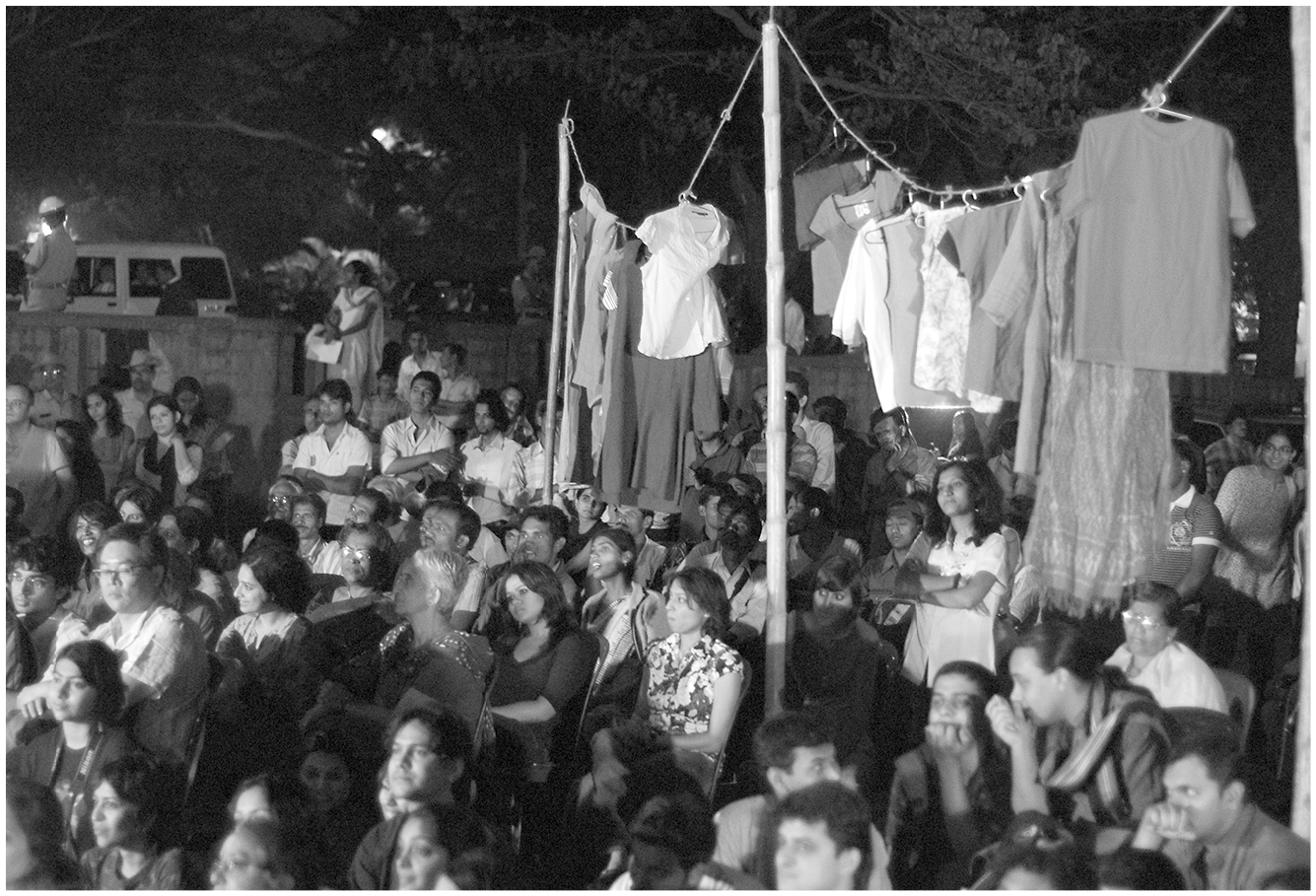
In 2009, a protest group called the Blank Noise Project displayed clothing donated by women who had been harrassed while wearing the pieces.
Kiran Jonnalagadda, Flickr CC
One of the reasons for men’s lack of support for women speaking up online may be their belief of prevalent fake rape cases. At least 33% of men in the above sample cast suspicion on women’s experiences by cautioning an equal, if not higher, chance of a rape report being false: “there are many real and fake ones posted on FB causing some feminazi stupid idiots blaming the whole manhood for it,” insisted Deepesh, for instance. These reactions echo the sentiments of Indian men’s rights campaigns of the 1980s and ’90s following the Dowry Prohibition Act. The law, which punishes anyone who gives or takes dowry, women’s studies professor Sharmila Lodhia notes, incited opposition from the same groups that fervently charge men are the real victims, put upon by volumes of supposedly fake cases brought against them by urban, educated, sexually “forward” women. Forty years later, I found the rhetoric crested anew in response to the Indian #MeToo campaign, led by Bollywood actresses such as Tanushree Dutta, tired of the way their accounts of workplace harassment were twisted into allegations of using sex to advance their careers.
Men’s anxious reactions to women speaking up—sharing disputed statistics of “false rape” cases, interpreting women’s calls for accountability as attacks on men, and claiming social media is an inappropriate place for women to share their stories—are buttressed by a state and judiciary long focused on protecting men and their privileges from fake cases. This is evident in the evolving definitions of rape and implementation of anti-rape laws over the years. Put simply, the system was set up to put women (and their sexual pasts) on trial, rather than those who would assault them. Until 1983, complainants were required to “prove” sexual assault; women with visible injuries were more likely to be acknowledged as victims than others. A 2001 United Nations report showed that around 55% of Indian judges sampled considered the “moral character” of the victim relevant to their decision in sexual assault cases. And it was only in 2013 that the “two-finger test,” an invasive and traumatizing physical examination purported to check for “virginity,” was declared unconstitutional.
Today, the Indian government continues to argue that criminalizing so-called marital rape destabilizes Indian marriages and puts husbands (but not wives) at risk of harassment.
In this climate, even men who believe and empathize with women who share assault stories can attribute the problem to a “few, abnormal men” and discourage women who gather online. Satish wrote, “What’s the point of sharing it on social media? You should report it to authorities who can take action against such people.” These commentators suggest strategies of self-reliance—learn self-defense techniques, be vigilant. Not only is this another form of victim-blaming and minimizing the systemic scope of the problem, it discourages women’s use of social media spaces as political tools. It may be a softer form of the often-virulent attacks on outspoken women on the Internet (sociologist Sarah Sobieraj’s recent book Credible Threat is an excellent read on the topic), but men’s defensive replies shut down discussion and seek to discredit all the same.
Women commentators on *The Indian do not necessarily see the act of sharing their #MeToo stories on Facebook India as revolutionary or feminist; but in doing so, they create a collective rallying cry against a patriarchal legal process that is doing exactly what it was set up to do. Public posting on Facebook exposes the problems of a worldview that passes the burden of safety onto the victims. And it opens public conversations that might not take place elsewhere, breaking a long-held, socially encouraged silence around sexual violence.
In India, it’s estimated that a woman is raped every 16 minutes. If my research is any indication, seeking justice may redouble the harm. So, too, might speaking justice online, where men seem all too ready to shut it down.