




Abstract
Research exploring sexual assault within universities and sexual harassment within companies has largely overlooked how leadership in organizations can shape constituents’ perceptions of sexual violence. This question has become particularly relevant as organizations are increasingly tasked with measuring and communicating about sexual violence. We use two national survey experiments to test how altering an organization’s communication of information about sexual assault or harassment affects participants’ agreement that it is a high-priority issue. In Study 1, we show that participants are strongly influenced by the way in which the leader interprets the problem of sexual violence at the organization and not by the placement of prevalence statistics in the statement. In Study 2, we identify the leader messages that are the most influential in shaping opinions about sexual assault and harassment. This research demonstrates the influence that leaders of organizations have in shaping narratives about sexual violence within them.
Neither sexual assault nor sexual harassment are new social problems (Brownmiller 1975; MacKinnon 1979), but public recognition of these issues has increased in the past several years (Steinhauer 2014a; Zacharek, Docterman, and Edwards 2017). On college campuses, student activists have brought attention to the striking frequency at which sexual assault occurs: By the end of their senior year, 19 percent to 26 percent of undergraduate women experience sexual assault (Cantor et al. 2017; Krebs et al. 2009). The #MeToo movement has raised public awareness of the widespread nature of sexual harassment in American workplaces, in which 40 percent to 75 percent of American women have experienced sexually harassing behaviors (McDonald 2012).
The public conversation about organizations’ role vis-à-vis sexual violence has frequently centered on their punitive response (or lack thereof) to individual cases. For example, whistleblowers such as Emma Sulcowicz at Columbia University and Susan Fowler at Uber have made headlines for highlighting their organizations’ failure to sanction perpetrators of sexual assault and harassment (Isaac 2017; Taylor 2015). Yet this emphasis on responding to sexual violence after the fact discounts the role that universities and companies play in either normalizing or problematizing sexual violence within their communities.
In this paper, we focus on the power organizations and their leaders wield in influencing how their constituents make sense of sexual violence. This issue has direct, real-world relevance as universities and companies are increasingly under pressure to measure and release information about the rates of sexual violence within them (Johnson, Widnall, and Benya 2018, Steinhauer 2014b). Using two novel national survey experiments, we test whether a brief, one-time informational statement released by an organization can shape a reader’s belief that sexual assault or harassment is a high-priority problem within that organization. We find that the response from the organization’s leader substantially affects how readers interpret the issue. Leaders’ influence in shaping these perceptions is significant because buy-in that sexual violence is a problem within an organization is an important precursor to enacting meaningful institutional change.
Organizations’ Role in Shaping the Reality of Sexual Violence
Although “the core of sociology has been virtually silent on sexual violence,” it is clear that organizations can and do enable sexual violence (Armstrong, Gleckman-Krut, and Johnson 2018:2.2). We focus our research on two types of sexual violence that are prevalent in organizational contexts: sexual assault in universities and sexual harassment in workplaces. Sexual assault is typically defined as sexual penetration or touching carried out through force or incapacitation, behaviors that generally meet legal definitions for rape or sexual battery (Cantor et al. 2017; Krebs et al. 2009). The definition of sexual harassment varies by context and study but commonly refers to unwanted offensive or threatening sexual behavior at work (which may include sexual assault; McDonald 2012). 1 However, as Elizabeth Armstrong and colleagues (2018) note in their recent Annual Review of Sociology paper and as feminist scholarship has long argued (e.g., Brownmiller 1975; MacKinnon 1979), sexual assault and sexual harassment both serve as tools of domination used to form or maintain power asymmetries and thereby sustain inequalities.
Sexual assault is facilitated by both organizational and cultural features of universities. Organizationally, policies prohibiting alcohol on campus effectively funnel student nightlife into unregulated off-campus spaces such as fraternities and bars, which are often structured in ways that make undergraduate women vulnerable to sexual assault (Armstrong et al. 2006; Becker and Tinkler 2015). Yet student cultures on campus also play a role in shaping sexual assault incidence. For example, scholars have found that groups like men’s athletic teams and fraternities vary in their attitudes toward women and that men in the groups with high hostility toward women are more likely to have perpetrated sexual violence against them (Boswell and Spade 1996; Humphrey and Kahn 2000). Thus, while the structuring of university nightlife impacts sexual assault incidence, so too do student cultures.
As in universities, organizational and cultural factors are also key predictors of sexual harassment incidence in the workplace. Among organizational factors, research shows that sexual harassment is most likely to occur in workplaces characterized by hierarchies with large power differentials and in professions that are male-stereotyped or have more men in the immediate working environment (Ilies et al. 2003; Willness, Steel, and Lee 2007). Yet one of the strongest predictors of sexual harassment in a workplace is the organizational climate as it pertains to sexual violence (Willness et al. 2007). Numerous studies have shown that workplaces in which employees perceive that sexual harassment is not taken seriously are those in which it is more likely to occur (Fitzgerald, Swan, and Magley 1997; Glomb et al. 1997; Williams, Fitzgerald, and Drasgow 1999). Experimental evidence indicates that men are more likely to engage in sexual harassment if such behavior is modeled or encouraged by others, which helps explain why organizational culture is so strongly linked to sexual violence prevalence (Hunt and Gonsalkorale 2014; Pryor, LaVite, and Stoller 1993).
In both universities and workplaces, sexual violence is clearly linked to organizational climate, but the extent to which a leader is able to shape that climate remains uncertain. Some evidence suggests that leadership may have a substantial impact: For example, women who report that their leaders model respectful behavior and make efforts to stop sexual harassment are less likely to have experienced sexual harassment (Buchanan et al. 2014; Firestone and Harris 2003; Pryor et al. 1993), and men are less likely to report engaging in sexual harassment if they perceive that their supervisor cares about the issue (Patel, Griggs, and Miller 2017). However, the relationship between leadership and organizational culture has not been shown to be causal. It might be the case that a leader is simply a product of the organization’s culture such that leaders who take a strong stance against sexual violence are selected to lead organizations in which sexual violence has already been problematized.
We seek to investigate whether an organization’s leadership can indeed have a measurable causal impact on its organizational climate toward sexual violence by experimentally evaluating whether a leader’s public stance toward sexual violence and their administration’s transparency in presenting the information meaningfully impacts others’ views. In the following, we develop our argument and test it with two experimental studies. Study 1 tests whether people’s agreement that a social issue is a problem is shaped by the tone of the leader’s messaging and the ordering of statistics in a short statement, and Study 2 further explores the impact of various types of leader messaging. From these results, we show how an organizational leadership can exemplify institutional courage (Freyd 2018) by persuading its constituency to prioritize the issue of sexual violence.
Study 1
Institutional communication predictions
We first conducted a survey experiment with a diverse sample of Americans to test how the presentation of information about sexual violence within an organization affects how important people judge the issue to be. We manipulate two aspects of the communication while keeping factual information constant. First, we manipulate the tone of the organization leader’s communication by including a quote that either emphasizes or downplays the issue. Given the relationship between leadership and organizational climate in the correlational studies reviewed previously, we hypothesize the following:
Hypothesis 1: Individuals exposed to a communication in which the leader emphasizes the importance of a social issue will rate it as a more important problem than individuals exposed to a communication in which the leader downplays the issue.
Second, we manipulate the transparency of the presentation of information by varying whether participants first view a large statistic (suggesting a high prevalence of sexual violence) followed by a smaller statistic or whether they first view a small statistic followed by a large statistic. For example, a company could first report the prevalence of sexual harassment among women in the company, followed by the overall rate for among all employees (which would be a larger statistic followed by a smaller one) or vice versa. Social psychological research finds that people often anchor their assessments on an initial value with which they are presented, suggesting that the ordering of information may impact how it is interpreted (Tversky and Kahneman 1974). Thus, we hypothesize:
Hypothesis 2: Individuals who read a statement beginning with a large statistic will rate the social issue as more important than those who read a statement beginning with a small statistic.
Although we are primarily concerned with how organizational communication shapes attitudes toward sexual violence, for comparison, we replicated these manipulations across four social issues: sexual assault, sexual harassment, police violence, and property theft. We deliberately chose issues that varied in their perceived politicization and media coverage: For example, at the time of the study, sexual assault and police violence were far more contested and in the media spotlight than sexual harassment or property theft.
We do not provide hypotheses for each social issue condition due to countervailing predictions. Some research suggests that across conditions, leaders should be able to influence peoples’ perceptions of these issues: Social psychological research has shown that high-status people such as those in leadership positions wield influence in shaping the attitudes and behaviors of others (for a review, see Correll and Ridgeway 2003), and business literature shows that a leader’s stated commitment to inclusion and diversity efforts comes with higher company performance on these issues (ORC Worldwide 2008). However, given the varying media coverage and politicization of the four issues, there may be room for leaders to influence peoples’ views on some topics but not others. Therefore, this aspect of the experiment was exploratory.
Experimental design
We recruited 766 adult US residents (36.8 percent male, 63.2 percent female) through Amazon Mechanical Turk (MTurk) in October 2016 and paid them $0.60 to complete a five-minute survey. Relative to the US population, MTurk samples tend to be better educated, younger, and more liberal (Weinberg, Freese, and McEllhatan 2014). Our sample was likewise well educated (58 percent had at least a four-year college degree), young (mean age = 39), and liberal-leaning (26 percent conservative, 29 percent moderate, and 45 percent liberal). Nonetheless, our sample is diverse across demographics, and previous studies have found that MTurk participant responses replicate responses provided by participants in population-based samples (Mullinix et al. 2015; Weinberg et al. 2014). Moreover, given that men and political conservatives are less likely than women and liberals to consider sexual violence a problem (e.g., Pew Research Center 2018), the effects we find here may be more consequential in the full US population, where people less readily agree that sexual violence is a problem from the outset.
We randomly assigned participants to read a communication for one of four social problems (sexual assault, sexual harassment, police violence, or property theft) that conveyed one of two leader messages (emphasizing or downplaying the issue) and varied statistic placement in one of two ways (leading with a statistic of 26 percent, followed later by 4 percent or leading with 4 percent, followed by 26 percent), creating a 4 × 2 × 2 between-subjects design. An experiment is the ideal research method to evaluate our predictions about how organizational communication shapes individual attitudes. Since we randomly assign individuals to condition, the myriad other factors known to shape attitudes are randomly distributed across condition, allowing us to isolate the causal effect of leader messaging and statistic placement on individuals’ attitudes toward sexual violence.
Organizational communication statement
For each social problem, we created a short statement that was ostensibly issued by the relevant organization (e.g., university, company). The statement was based on a synthesis of 11 different publicly available statements made by universities about the release of their sexual assault prevalence surveys (see Supplemental Material). These statements varied in two key ways. First, we found variation in the tone leaders used to describe the issue. For example, Harvard President Drew Faust emphasized the problem, saying, “The data reinforce the alarming frequency with which our students, especially but by no means only our undergraduates, experience incidents of sexual assault” (Faust 2015), whereas Texas A&M President Michael K. Young described the survey in self-congratulatory tones, saying, “The survey shows that while we have areas that need our attention, we have improved as an institution over the years and in some instances the data shows that we are better than the national norms and that our programs and processes in place are having a positive effect” (Texas A&M Today 2015). Second, we found variation in whether the leading statistic in the statement was a large statistic, representing the most affected population, or a small statistic, representing the full population. Based on the compiled messages, we created a statement about sexual assault at a fictitious university and then adapted the statement to describe three social issues in other contexts. Across each statement, we altered the text to manipulate leader messaging and statistic placement.
The following statement was created for the sexual assault conditions. Italicized words show the leader messaging and statistic placement manipulations. Underlined words show text that was varied for each social issue.
The results of a The survey was developed through the collaboration of the social science research firm Sonhow and In response, the [Second condition: “The results of the
The text with information about survey data collection was included to create meaningful distance between the first and second statistics in the text. The other three social issue conditions portrayed a CEO responding to sexual harassment in a company, a mayor responding to police violence in a municipality, and a mayor responding to property theft in a municipality (see Supplemental Material for these statements).
Dependent variable
After reading the statement, participants were asked to rate their agreement that the issue they had read about was “one of the most important problems facing the community today” on a 7-point Likert scale ranging from strongly disagree to strongly agree. By asking them to rank this problem as more important than others, participants were asked not simply to offer a low-stakes assessment that the issue was a problem (an easy item to agree with) but to take a somewhat stronger stance by rating the issue a high-priority problem. Table 1 shows the overall mean responses for each social problem and the mean for each combination of leader message and statistic placement. Generally, participants rated sexual harassment, property theft, and police violence similarly and sexual assault somewhat more of a problem.
Mean Level of Agreement That Social Issue Is an Important Problem, by Experimental Condition.

Note: Standard deviations in parentheses. Agreement was measured on a 7-point scale, with 1 indicating strongly disagree and 7 indicating strongly agree.
Other explanatory variables
Participants were randomly assigned to condition, so individual differences should be evenly distributed across condition. Nonetheless, we control for gender and political orientation in case the conditions were unbalanced on these dimensions, which could bias our estimates. Gender was captured with the options male, female, and other, and political orientation was captured with five responses ranging from very conservative to very liberal. 2
Analytic strategy
The models presented in the following were selected for their adherence to best practices in experimental methods, ease of interpretation, and consistency in interpretation across models. Therefore, we present separate models for each social issue (see Table 2). We show ordinary least squares regression models predicting participants’ likelihood of agreeing that the issue they had read about was one of the most important problems facing the community. We standardize the outcome variable, meaning regression coefficients for the experimental conditions can be interpreted as effect sizes using Cohen’s guidelines of .15 = small, .35 = moderate, and .60 = large effects (Cohen 1988). Models that instead use ordered logistic regression provide results that are comparable in direction and significance level to the models presented here and are available on request.
Y-Standardized Ordinary Least Squares Estimates of Agreement That Social Issue Is an Important Problem, by Social Issue Condition.

Note: Standard errors in parentheses. Coefficients are interpreted as a one-unit increase in x corresponds with a b standard deviation change in y.
p < .10. *p < .05. **p < .01. ***p < .001.
Results
Hypothesis 1 predicts that when leader messaging emphasizes a problem, people will be more likely to rate it as important, all else being equal, compared to when a leader downplays the issue. We find support for this hypothesis for three out of the four social issues. As indicated by the significant effects for the leader messaging dummy variable in Table 1, participants who read a leader quote emphasizing the problem of sexual assault, sexual harassment, or property theft were more likely to consider the issue an important problem than participants who instead read a leader quote downplaying the problem. Results did not vary in the police violence condition.
The magnitude of the effect of leader messaging varied across social issue. Participants who read the leader quote emphasizing the problem were more likely to agree that sexual assault was a high-priority problem by .34 standard deviations, a moderate effect size (Table 2, Model 1). In this condition, liberal participants were significantly more likely to rate sexual assault an important problem relative to conservative participants, and results did not vary by gender. However, holding political affiliation and gender constant does not change the effect of leader messaging about sexual assault: The coefficient for leader messaging remains significant when these controls are included (Model 2) and is nearly identical to the manipulation effect without controls (Model 1). 3
Participants who read about sexual harassment were even more strongly influenced by leader messaging than those who read about sexual assault. Participants who read the leader quote emphasizing the problem rated sexual harassment as a high-priority problem by .51 standard deviations more than those who read the downplaying quote, a substantively large effect size. Again, when political affiliation and gender are taken into account, the magnitude of the messaging effect does not change. For the two other social issues, we find that the effect of leader message emphasizing the problem of police violence was small and nonsignificant, but the effect of the leader message emphasizing property theft was substantively large and significant.
We next turn to our second hypothesis, that participants who read a message beginning with a large rather than small statistic would be more likely to consider the issue a high priority problem. Overall, we do not find support for this hypothesis. Statistic placement was not significantly associated with participant responses for any of the social issues. 4
Study 1 discussion
Data from Study 1 support our first hypothesis that a leader’s message shapes how people make sense of a social issue in most cases. Participants were significantly more likely to consider sexual assault, sexual harassment, and property theft important problems when they read a message in which the leader emphasized the importance of the issue. Conversely, the data do not support our second hypothesis that statistic placement affects how readers interpret the problem. Readers were as likely to rate each social issue a problem when they read a message leading with a small statistic as with a large statistic, indicating that they did not anchor on the first value they saw.
Notably, in the three conditions in which leader messaging had an effect, this effect held even when controlling for political affiliation and gender, meaning that leader messaging shifted attitudes for both men and women and liberals and conservatives. This indicates that leaders are able to shift peoples’ views on social issues regardless of key characteristics that may already inform their opinions.
Study 1 replication
The main purpose of Study 2, described in the following, was to expand on the effect of different types of leader communication, but it also allowed us to replicate the results of Study 1 in autumn 2017, at a time of prolific media coverage of workplace sexual harassment. We therefore ran an identical version of the Study 1 sexual violence conditions simultaneously with the second study to compare differences over time. We find that the effect of leader message was substantively similar in the replication (see Supplemental Material 2, Table A1). Interestingly, in 2017, leading with a high statistic was positively and significantly associated with regarding sexual assault but not sexual harassment as an important problem, providing tentative support for Hypothesis 2 that should be explored in further research.
Study 2
In this study, we included only the two social issues that are the focus of this research: sexual assault and sexual harassment. Having established that a leader’s message plays an important role in shaping how people interpret a social issue, we next sought to experimentally evaluate the effect of a variety of leader messages. Therefore, in addition to our original two conditions, in Study 2, we added three new leader messages downplaying the problem, two new leader messages emphasizing the problem, and three conditions in which the leader provided no message at all. These messages, presented in Table 3, were inspired by organizations’ reactions to social issues, such as the Air Force Academy superintendent’s condemnation of racism (“If you can’t treat someone with dignity and respect, then you need to get out”; Chappell 2017) and Fox News’ defense of Bill O’Reilly after news broke that five women had received settlements after he sexually harassed them (“No current or former Fox News employee ever took advantage of the 21st Century Fox hotline to raise a concern about Bill O’Reilly”; Steel and Schmidt 2017). The second study was exploratory, so we do not provide hypotheses.
Experimental Manipulations about Leader’s Perspective.

Note: Italicized text indicates words that were changed for the sexual harassment condition.
Leader messages used in Study 1.
Experimental design
We again recruited participants (59.4 percent women, 40.2 percent men, .5 percent another gender) from MTurk and randomly assigned them to each condition. The demographic characteristics of this sample are similar to those of Study 1: The sample was again well educated (57 percent had at least a four-year college degree), young (the mean age was 38), and liberal-leaning (22 percent of participants were conservative, 30 percent were moderate, and 49 percent were liberal). We did not allow participants from Study 1 to participate in Study 2 to ensure that all participants would be naïve to the study’s purpose.
Procedure and measures
Participants read 1 of 10 possible statements about either sexual assault or sexual harassment, which varied the type of leader message. In contrast to the first study, we held statistic placement constant by presenting the high statistic first and excluding the second statistic. When we compare the Study 1 replication to the analogous Study 2 conditions with only one statistic, we find the Study 2 condition that included only the high statistic was statistically indistinguishable from the Study 1 condition that led with the high statistic (see Supplemental Material, Figures A1 and A2). We used the same dependent measure as before.
Analytic strategy
As in Study 1, we present the mean agreement that the issue is an important problem for each condition. We then compare the difference between the mean of each condition and the overall mean for the emphasizing, downplaying, and no message conditions, denoting statistical significance from pairwise t tests, and calculate the effect size of the difference using Cohen’s d.
Results
We begin by examining the effect of leader messaging for those who read about sexual assault (Table 4). Participants were equally likely to rate sexual assault an important problem after reading any of the four downplaying messages. By contrast, one emphasizing message outperformed the others: When participants read a leader message describing the sexual assault prevalence as alarming, they were .79 points more likely to rate sexual assault as a high-priority problem than participants who had read any of the downplaying conditions; moreover, this difference came with a substantively large effect size of .53. Conversely, the message in which the leader stigmatized perpetrators was not significantly more likely to increase agreement that sexual assault was an important problem than the downplaying conditions. The effectiveness of the message in which the leader evoked personal responsibility fell in between. Surprisingly, among the no message conditions, we find that participants were almost as likely to rate sexual assault a problem after reading that the university president could not be reached for comment as after reading the leader message emphasizing the problem in an alarming tone. The statements in which the leader directed queries to the legal office or was not mentioned were statistically indistinguishable from the downplaying conditions.
Mean Agreement That Sexual Assault Is an Important Problem and Comparisons across Conditions.

Note: Agreement was measured on a 7-point scale, with 1 indicating strongly disagree and 7 indicating strongly agree.
p < .10. *p < .05. **p < .01. ***p < .001.
For participants who read about sexual harassment, responses were nearly identical across the emphasizing and no message conditions, with no one leader message prompting participants to consider sexual harassment more of a problem than another (Table 5). However, we find that two of the downplaying conditions significantly diminished concern about sexual harassment relative to the emphasizing and no message conditions: the message that the statistics were not trustworthy and the message that similar companies had worse rates of sexual harassment. Participants were at least half a point less likely to rate sexual harassment a problem after reading these messages relative to the emphasizing and no message conditions, a difference that came with a moderate effect size.
Mean Agreement That Sexual Harassment Is an Important Problem and Comparisons across Conditions.
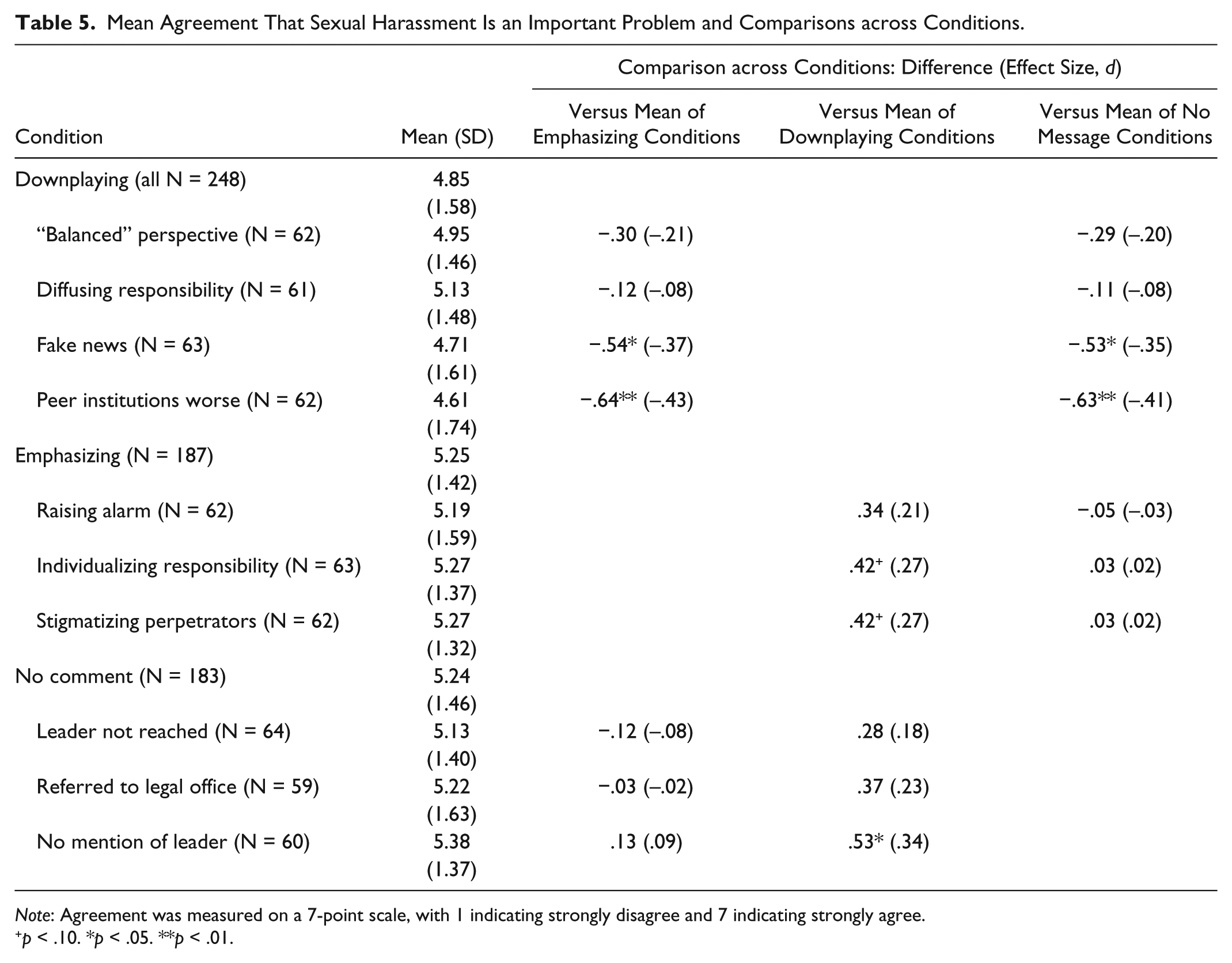
Note: Agreement was measured on a 7-point scale, with 1 indicating strongly disagree and 7 indicating strongly agree.
p < .10. *p < .05. **p < .01.
Study 2 discussion
In the second study, we find substantial variation in how participants perceive the issue of sexual violence in an organization depending on how the leader communicates about the issue. There were two specific conditions in which participants especially rated sexual assault a problem: when the leader raised alarm about the issue or when the leader was not reached for comment. Conversely, participants rated sexual harassment a problem to the same extent in almost all conditions but were less likely to do so after reading a leader quote either conveying that the reported rate of sexual harassment was unreliable or that other organizations had worse rates of sexual harassment.
In addition to our main dependent variable, we also asked participants how likely they would be to expel or fire a perpetrator of sexual assault or sexual harassment, respectively. We found that the leader message stigmatizing perpetrators made participants more likely to support a strong punishment for perpetrators. On a 7-point likert scale, participants were .72 points more likely to support expelling students found guilty of sexual assault (t = 2.81, df = 619, p < .01; d = .38) and 1.09 points more likely to support firing employees found guilty of sexual harassment (t = 4.48, df = 616, p < .001; d = .60) relative to participants who read other leader message conditions (full results for this measure are available in the Supplemental Material). Thus, although stigmatizing perpetrators of sexual assault did not particularly increase participants’ belief that sexual assault or harassment were high-priority problems, participants who read this leader message were more likely to support penalizing perpetrators.
Ceilings and Floors?
In effect, there seemed to be a ceiling effect for sexual harassment, by which we mean that participants could be persuaded that the issue was less of a problem but not more. Participants appeared to assume that the reported rate of sexual harassment in the company was a problem unless the leader specifically indicated otherwise. By contrast, there was seemingly a floor effect for sexual assault, by which we mean that participants could be persuaded that the issue was more of a problem but not less. Participants rated sexual assault similarly across conditions but were swayed to rate it more of a problem after reading particular emphasizing or no message conditions. This may reflect the timing of the study, when stories demonstrating the prevalence of sexual harassment were surging. In the midst of the #MeToo movement, a quote from a leader about sexual harassment at one fictitious company may have had a smaller effect than it would otherwise. With less media focus on campus sexual assault during this time, a quote from a leader about sexual assault may therefore have been relatively more impactful.
General Discussion
The results from these studies highlight the unique ability that organizations’ leaders have to shape how people make sense of sexual violence. Indeed, we find that peoples’ views about sexual violence within organizations are remarkably malleable. Even when presented with the same factual information about sexual violence, we find that people are more likely to consider sexual assault or harassment a high-priority problem when the leader of the organization emphasizes the problem and less likely to do so when the leader downplays the problem. If the goal is to make a community aware of the problem of sexual violence, leader messages that downplay the issue are especially problematic. Our results show that people are more likely to consider sexual violence a high-priority problem when a leader gives no comment than when a leader downplays the problem.
This research demonstrates the pivotal role that leaders play in shaping the reality of sexual violence in an organization. With just a few sentences, a leader’s interpretation of the prevalence of sexual violence in an organization altered peoples’ agreement that it was a high-priority problem, in some cases by half a standard deviation. In fact, while leader messaging affected how people perceived sexual violence, the size of the first statistic they read generally did not, suggesting that people are far more swayed by the narrative created about sexual violence than the numbers on which it is based. Because of this, leaders have tremendous power in affecting the reality of sexual violence in their organizations by shaping the very interpretation of that reality. The link between leaders’ actions and the reality of sexual violence within their organizations that we identify here is in line with findings from previous studies (Buchanan et al. 2014; Firestone and Harris 2003; Pryor et al. 1993). We add to this research by demonstrating that the role leaders play in shaping the organizational climate is not merely correlational but causal. Moreover, the effects we capture here are likely a conservative estimate: In everyday life, people receiving such messages are likely to receive the messaging more than once and are familiar with the leader.
The ability of a leader’s message to change perspectives on sexual violence is important because recognizing sexual violence as a problem within an organization is a critical action toward enacting meaningful change. Of course, leader messaging is not a comprehensive solution but rather a first step organizations can take to productively address sexual violence, as outlined by Freyd (2018). Yet a community whose members do not recognize sexual assault or harassment as high-priority issues, even when a substantial proportion of the community has been affected, is unlikely to seek to change those rates. Indeed, research has demonstrated that sexual assault and harassment flourish in cultures in which sexual violence is accepted rather than problematized (Pryor et al. 1993). Persuading members of an organization that sexual assault and harassment are high-priority problems is thus essential in creating a culture in which sexual violence is not tolerated.
Supplemental Material
LMSVappendix_revision_final – Supplemental material for Leader Messaging and Attitudes toward Sexual Violence
Supplemental material, LMSVappendix_revision_final for Leader Messaging and Attitudes toward Sexual Violence by Chloe Grace Hart, Alison Dahl Crossley and Shelley J. Correll in Socius
Footnotes
Acknowledgements
The authors would like to thank Chrystal Redekopp and Madeleine Lippey for their guidance and support.
Funding
The author(s) disclosed receipt of the following financial support for the research, authorship, and/or publication of this article: This research was made possible by funding through the Clayman Institute for Gender Research and the Association for Title IX Administrators.
1
While the statistics for women are most frequently cited, gender nonconforming people also experience sexual violence at high rates, and men experience sexual violence at lower but non-negligible rates (Cantor et al. 2017;  ).
).
2
3
In analyses not shown, we add an interaction term between gender and political affiliation to allow for gender differences within political affiliation (e.g., Do conservative men respond differently than conservative women to a statement about sexual assault?). Of the four social issue conditions, we find a significant interaction term only for police violence: In this condition, conservative women are less likely than conservative men to consider police violence an important problem and liberal women are more likely than liberal men to consider police violence an important problem. These analyses are available on request.
4
However, in results not shown, we find a positive and significant interaction between statistic placement and leader message in the sexual assault condition, indicating that participants who read the emphasizing leader messages were more likely to rate sexual assault an important problem when the statement began with a high statistic. Further, in a replication described in the following, we find a significant main effect for statistic placement in the sexual assault condition. These findings suggest that statistic placement may uniquely shape participants’ impression of sexual assault but not other social issues, perhaps because campus sexual assault statistics are so often contested.
Author Biographies
References
Supplementary Material
Please find the following supplemental material available below.
For Open Access articles published under a Creative Commons License, all supplemental material carries the same license as the article it is associated with.
For non-Open Access articles published, all supplemental material carries a non-exclusive license, and permission requests for re-use of supplemental material or any part of supplemental material shall be sent directly to the copyright owner as specified in the copyright notice associated with the article.
