



Abstract
Scholars share their experiences in bringing sociological analysis to the Senate floor in "Web of Denial" speeches rebutting climate change skeptics and revealing how echo chambers and network effects stifle the spread of scientific knowledge.
On July 11, 2016, Senate Minority Leader Harry Reid (D-Nevada) took to the floor of the Senate to discuss climate change. Rather than focusing on the well-known science of climate change, he focused on the “Web of Denial”—the network of think tanks and foundations that promote misinformation in order to delay action on climate change. Following Reid, Senator Sheldon Whitehouse (D-Rhode Island) delivered his 143rd speech about how it is “Time to Wake Up” about climate change as he provided an overview of the seventeen other Senators’ speeches to come in this organized, two-day “Web of Denial” marathon speech event.
The movement of ideas from academia to the Senate floor shows the important role that the sociological community can play in the generation of new cultural perspectives and informing democratic deliberations.
Senator Whitehouse notably acknowledged the contributions of sociological scholarship in bringing this issue to public scrutiny. He mentioned Riley Dunlap, Aaron McCright, and Justin Farrell by name before saying, “The scholarship of all these academics, all these organizations, and all these authors—the detectives who are exposing the Web of Denial—have shined a bright light into its dark corners and illuminated its concerted effort to dupe the American public and sabotage climate action in America, all to protect the fossil fuel industry that funds it.”
The sociological literature on climate misinformation efforts has provided intellectual space to reflexively critique, and potentially move beyond, the limited perspectives pushed by the Web of Denial. These speeches, however, represent public sociology, a debated term but one that involves expanding sociological analysis to encompass and inform the public about issues of common moral and political concern.
What ideas are normal and acceptable in society? Which are deviant and radical? This is the terrain of continual conflict between and among social groups as described by cultural sociologists. Based on a linguistic perspective, this approach focuses on the construction of different framings of the social worlds within which institutional practices are defined. Sociologists have observed that groups try to maintain particular framings that define the appropriate practices in a specific policy area, setting the conditions of appropriate and inappropriate institutional practices—and ultimately legal and illegal conduct in a policy arena. Struggle over the governing frame is thus a critical component in power contests between those who seek to maintain the status quo and those who seek social change and advocate for a different governing frame. Cultural sociologists’ analyses of such contests provide insight into the nature of political action and social change.
From a cultural perspective, then, environmental politics is organized around the interaction between groups supporting the dominant framing of a particular policy arena and alternative challengers. The main dominant actors usually include industry organizations and their trade associations, professional bodies, government actors, and advocacy organizations. Alternative challengers might include social justice activists and environmentalists. Struggles over public policy take the form of a contest over the appropriate field framing and involve building institutions (such as cultural, educational, and media organizations) that can act to maintain or transform the popular mentality so that the desired framing is accepted as common sense in that particular arena.
It needs to be understood that climate change policy debates are quite separate from the scientific findings regarding climate change. The most recent Intergovernmental Panel on Climate Change (IPCC) report shows that global warming is happening and is caused by humans. For nearly all scientists, as well as for populations and governments around the world, the debate about the existence of climate change is over. However, in the United States, the policy debate continues. On one side there is the climate movement that seeks to move the U.S. to take rapid and ambitious actions to address climate change by shifting quickly from fossil fuels to efficiency, conservation, and renewable energy. On the other side is the climate countermovement. Mostly funded by conservative foundations and fossil fuel interests, its strategy is to deny the scientific findings regarding the human cause of climate change, confound the public, and downplay the seriousness of this issue and the need for action. It is a long-standing framing dispute, with vast profits and the stability of Earth’s life support systems at stake.
Courtesy Sen. Whitehouse
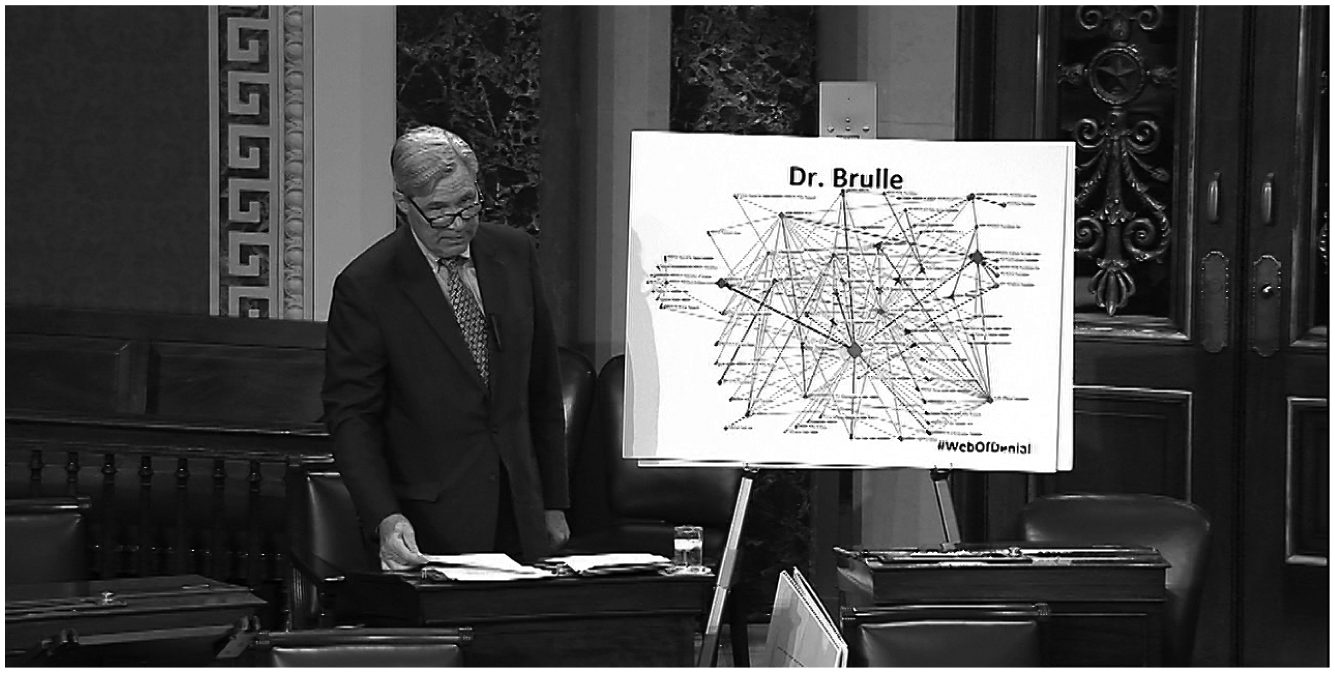
The Senate is the site of frequent speeches and events that highlight the issue of climate change. For example, in February 2015, Senator James Inhofe (R-Oklahoma) brought a snowball to the floor of the Senate to demonstrate that climate change was a hoax (see “Not a Snowball’s Chance for Science,” Contexts Fall 2015).
The marathon speeches about climate misinformation efforts in July 2016 were entirely different. Senator Reid’s speeches on the The Web of Denial were informed by extensive, peer-reviewed sociological research. The senators sought to show that the organized efforts at climate misinformation are grounded in organizations funded by vested interests (huge fossil fuel corporations) aiming to block government actions that would require rapid shifts in U.S. energy production. These senators are attempting to shift the debate away from the dangerous distortions of climate denial by revealing how the fossil fuel industry uses their political and economic power to systematically undermine our ability to act before it is too late.
Sociological research studying the development of misinformation and climate denial efforts has been crucial in this counter-effort. Beginning in the mid-1990s, sociologists began to analyze the nature of what they called the emerging “climate change countermovement.” In a series of papers, starting in 2000, Riley Dunlap and Aaron McCright provided critical insights into how conservative think tanks developed sophisticated strategies to promulgate doubt and misinformation about climate change science. In 2010, Naomi Oreskes published Merchants of Doubt, which documented the historical efforts of a small group of individuals similarly sowing doubt.
After these path-breaking works, scholarship in this area rapidly expanded. This research enabled the National Academy of Science to conclude in 2012 that the concerted campaign to promote scientific misinformation about climate science had affected media coverage of this issue. Concerted political effort had created the impression that there was a serious debate over climate change when, in fact, there was none. It contributed to the party-line polarization over the serious science of climate change.
Yet this well-developed scholarship was not represented in public debates. How did it manage to move out of sociological journals and books to the Senate floor, informing political debates in such an extensive and powerful manner? In the case of climate change, the community of scholars focused on an area of the climate countermovement and developed a robust sociological analysis of a new social phenomenon. The key to its diffusion from the academic community and into the public sphere was the activity of intermediary figures both familiar with the academic research and able to communicate these results. We were proud to participate in this important effort. Timmons Roberts met regularly Senator Whitehouse and his staff, and when they expressed interest in uncovering the roots of influence over Senate peers, was able to provide research like McCright, Dunlap, and Brulle’s 2014 article on the funding relationships between foundations and conservative think tanks. Senator Whitehouse subsequently utilized this material in his weekly floor speeches about climate change, and it served as a key resource in developing the collective Web of Denial speech event (one of the key graphics from Brulle’s 2014 paper was repeatedly displayed throughout).
Sociology is both an academic and public discipline. In this case, sociologists worked out new insights about the social phenomena of the climate countermovement and developed a robust literature. This knowledge diffused through the media and into the political sphere, informing an ongoing political effort to move the U.S. toward addressing climate change. This movement of ideas shows the important role that the sociological community can play in generating new cultural perspectives and informing democratic deliberations.