



Abstract
China and the U.S. look to each other’s educational systems as they try to balance individualism and collectivism, ability and effort, and grade school and college rigor.

Every time I visit China, I am asked, “When is the best time to send my children to study in the U.S.”? ★ The options these parents are considering are whether to send their kids abroad during high school or after high school. Things have clearly changed since I left China.
Fifteen years ago, after completing my undergraduate education, I came to the U.S. as a graduate student at Johns Hopkins. At that time, most of the Chinese students in the U.S. were graduate students like me, often doctoral students, funded by assistantships at American universities. Now, middle-class Chinese parents are more willing and able to finance a private high school education in the U.S., followed, of course, by a college education (with an even higher price tag).
These parents are among the beneficiaries of China’s economic boom. However, they are becoming increasingly disillusioned about the Chinese education system’s being too test-oriented. Most Chinese parents who voice their concerns about their children’s education are, ironically, in major cities, where education resources are more advantaged than in smaller cities or rural areas. They may be unaware of the recent first place ranking of students from Shanghai in the Program for International Student Assessment (PISA). Even if they are aware, they are dismissive—they know that their children will score well on tests. But in a country still dominated by strong testing culture, China’s newest economic and cultural elites also know that high test scores are not equivalent to high quality education. What they want is well-rounded education to develop their children’s potential and character.
Meanwhile, in America, the stellar performance of Chinese students on the PISA grabbed attention. In 2011, shortly after the results came out, Marc Tucker from the National Center on Education and the Economy wrote Surpassing Shanghai, an explicit effort to target Chinese schools as the primary competitors of U.S. schools. Tucker expressed concerns over the future of American leadership in the world. Scholars and critics such as Diane Ravitch and Yong Zhao have pointed out that this concern is part of a larger political narrative that perceives China, or its rise, as a threat. This story, which has ebbed and flowed since at least the 1950s, reflects Americans’ deep insecurity about losing their dominant position in the world.
So is the grass really greener on the other side? Why are China and the U.S. looking to each other in search of better education, even without a full understanding of the nature of the two systems’ differences?
I have identified three thematic differences in the education systems of the two countries. The first is individualism versus collectivism, which manifests in school organization, curricular structure, and college admissions. Second comes ability versus effort in driving the process and outcome of learning, especially in math and science. Finally, there is an opposite disconnect between pre-college and college education—China sees a stressful precollege but relaxed college experience for students, while the pattern is reversed in the U.S.
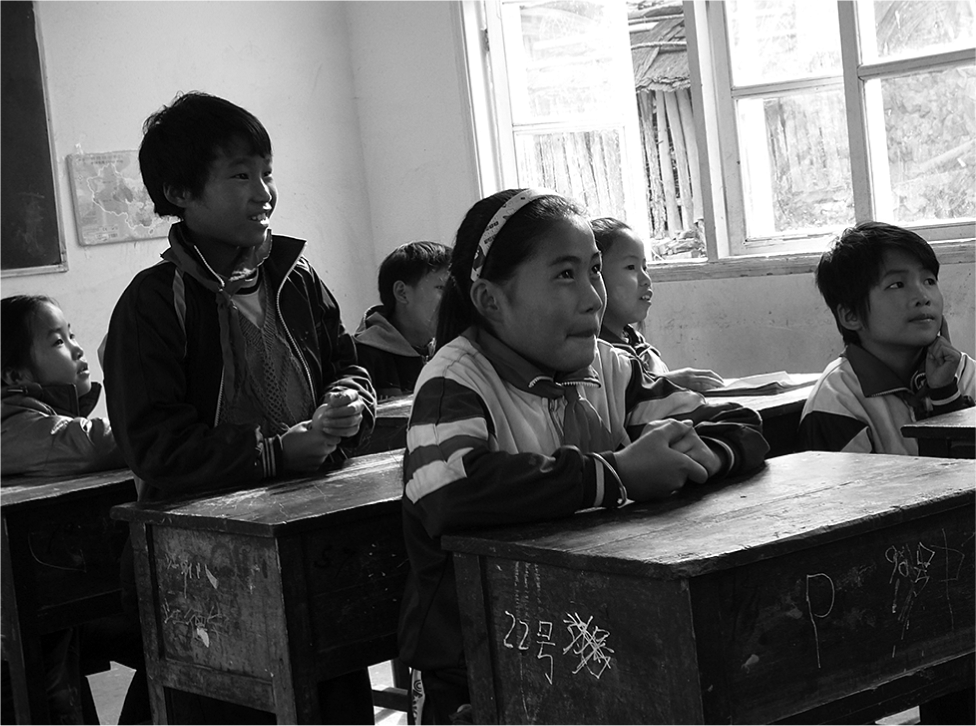
Chinese children in a rural classroom.
Thomas Galvez, Flickr Creative Commons
Individualism Versus Collectivism
American education prizes an individualistic approach, from valuing individual attention to students in the classroom to “individualized consideration” in college admissions. Mitchell Stevens analyzed the famous Supreme Court ruling Grutter v. Bollinger, regarding University of Michigan Law School admissions, and noted that “[t]he term ‘individualized consideration’ was sprinkled throughout the Grutter decision, leaving little doubt about the kind of evaluation the Supreme Court regarded as optimal.”
“Individualized consideration” reflects a fundamental American belief in the U.S.: people have unique abilities and temperaments. Therefore, education should be customized to match innate differences and potentials. In contrast, education in China is informed by the idea that educators can—and should—teach individual students to reach common academic goals. This belief is best captured by a famous Confucian saying: “Equality of education in spite of differences in backgrounds”  . While market reform begun in the late 1970s made China an increasingly individualistic society, the organization of its schools and educational philosophy have remained distinctly collective, perhaps because of the endurance of Confucianism even in modern Chinese schools.
American education prizes an individualistic approach, from valuing individual attention to students in the classroom to “individualized consideration” in college admissions.
A good illustration of how Chinese schools are collectively organized is in their morning exercises. Students line up on a school’s athletic fields, stretching their arms and legs, moving their shoulders, following the same instructions. Later in the day, many schools hold eye exercises, in which students take a break from their academic work, and, as music and instructions broadcast over the public address system, students massage their eye muscles, in an effort to guard against strain. This practice was in place 25 years ago, when I was in grade school, and remains alive in almost every Chinese school today. Even in those few public schools offering an international curriculum, such as American AP classes or British A-level courses, the collective practices of morning stretches and daily eye exercises are fully integrated into the otherwise Western curriculum. During my fieldwork in several such public schools, I interviewed American teachers there who expressed both surprise at, and admiration of, these exercises. American teachers considered the idea remarkable and found it hard to imagine a bunch of freewheeling high school students in the U.S. synchronously moving their bodies in the schoolyard.
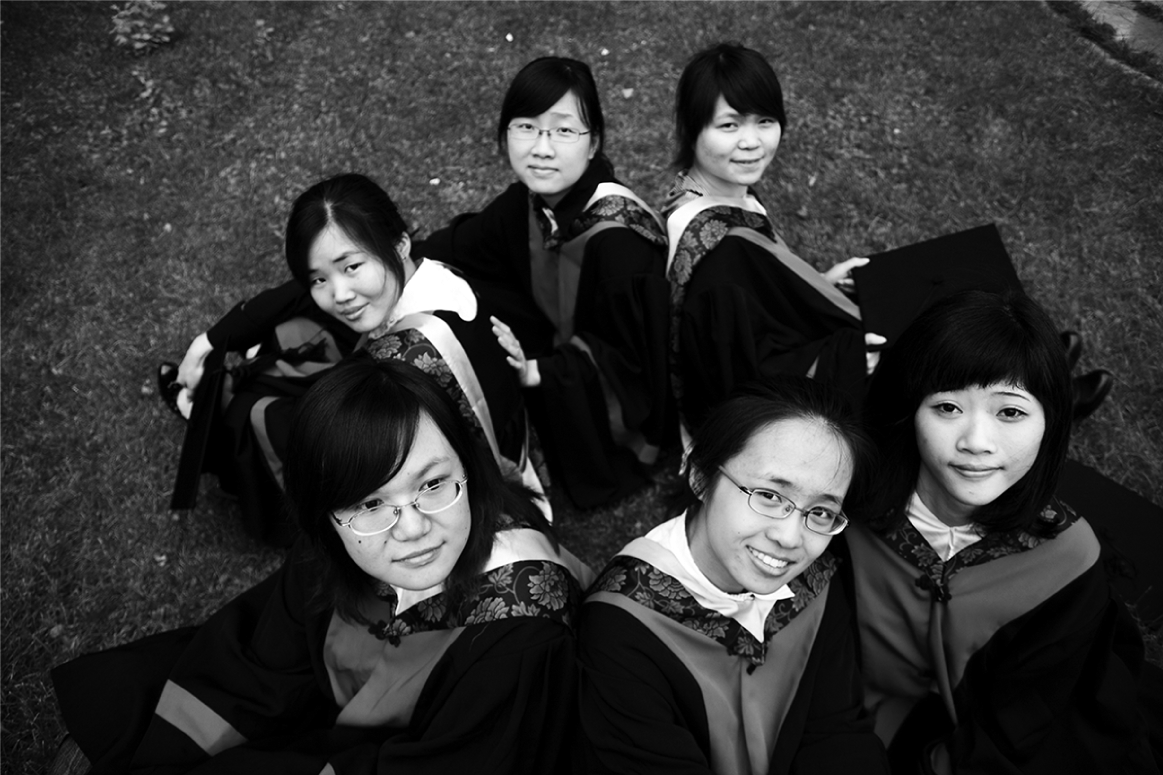
Engineering students celebrate their graduation in Beijing.
Kan Wu, Flickr Creative Commons
American educators and parents often say children are unique, with different innate abilities. This belief is aptly reflected in the country’s system of tracking and curriculum differentiation. often starting from young ages. This can give some students choices and flexibility, but it can also be a disservice to other students, especially the disadvantaged, lacking in family and community resources. For example, Jeannie Oake’s U.S. research has shown that Black, Latino, and low-income students are systematically perceived by their teachers as lacking the ability to handle demanding coursework, so they’re disproportionately assigned to low-level tracks. Oake has also shown that this system puts the burden of advocacy on parents, but those with less education and fewer resources are far less likely to engage in this kind of appeal on behalf of their child. The effect is particularly damaging in subjects such as math and science, in which knowledge is cumulative and often sequential. Students from disadvantaged backgrounds often fall behind early and never catch up.
In China, students at the same grade level are expected to learn similar material. The curriculum holds most students to a common standard, which is often quite challenging. If students struggle, they will have to work harder to catch up, but they will have the help of teachers and parents, all of whom expect the student to achieve. The high standardization of the curriculum results in a concomitant emphasis on standardized testing—Chinese colleges and universities rely almost exclusively on test scores from college entrance examinations to inform their admissions. In recent years, China has attempted to introduce new initiatives that take other talent factors into account, but they are small-scale, and scholars and the public are highly skeptical, fearing connections and corruption could compromise the merit system. Their skepticism has deep historical and cultural roots. China can even claim the world’s oldest standardized tests: the Imperial Examination System (IES), used for selecting government officials for 1,300 years (605-1905 CE), over many dynasties. To some extent, testing is the Chinese government’s way of ensuring justice and equity in talent selection, an imperative that has grown more important as economic inequality increases and the modern public decries corruption in the economic system.
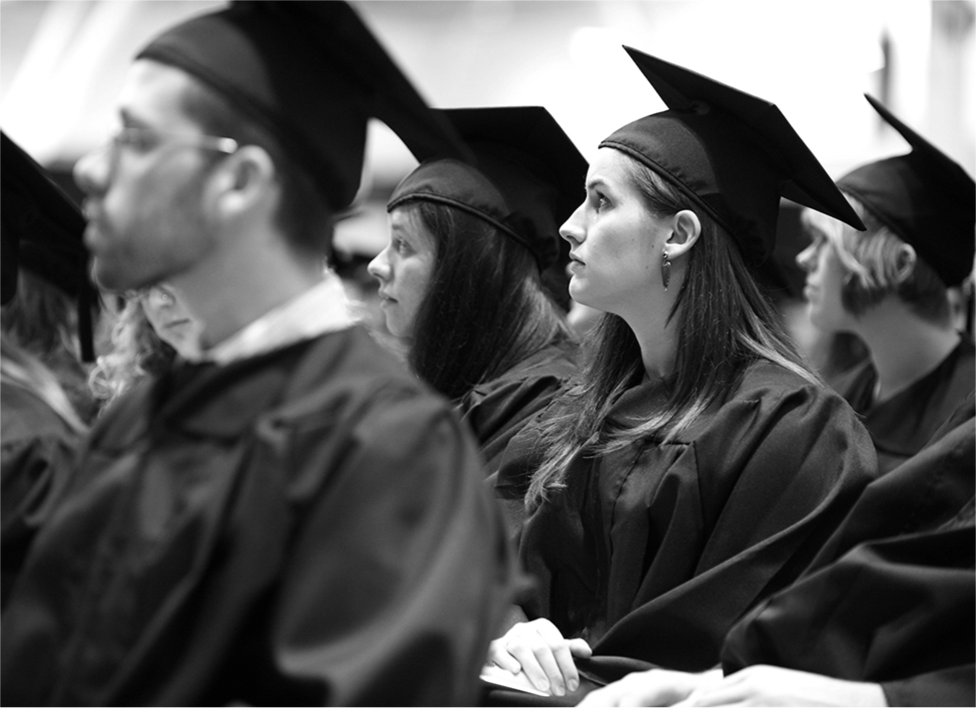
Students at a Boston, MA graduation ceremony.
U.S. Department of Education photo
American college admissions, on the other hand, adopt so-called holistic admission principles, and consider standardized test scores as only one factor (albeit an important one) in the whole package of students’ application files. The diminishing role of standardized testing reflects the value placed on individualized admissions in the U.S. As Mitchell Stevens shows in his book Creating a Class, elite colleges employ a form of “individualized admission” that relies heavily on the storytelling of individual applicants. However, this individualized admission process is contingent upon the ability and resources of individual students and their families to tell the student’s story. Upper middle-class children more often provide sufficient materials and craft compelling stories than lower-class children. Long-standing inequities resulting from tracking and other early educational practices coalesce into an invisible class bias in the college admissions system.
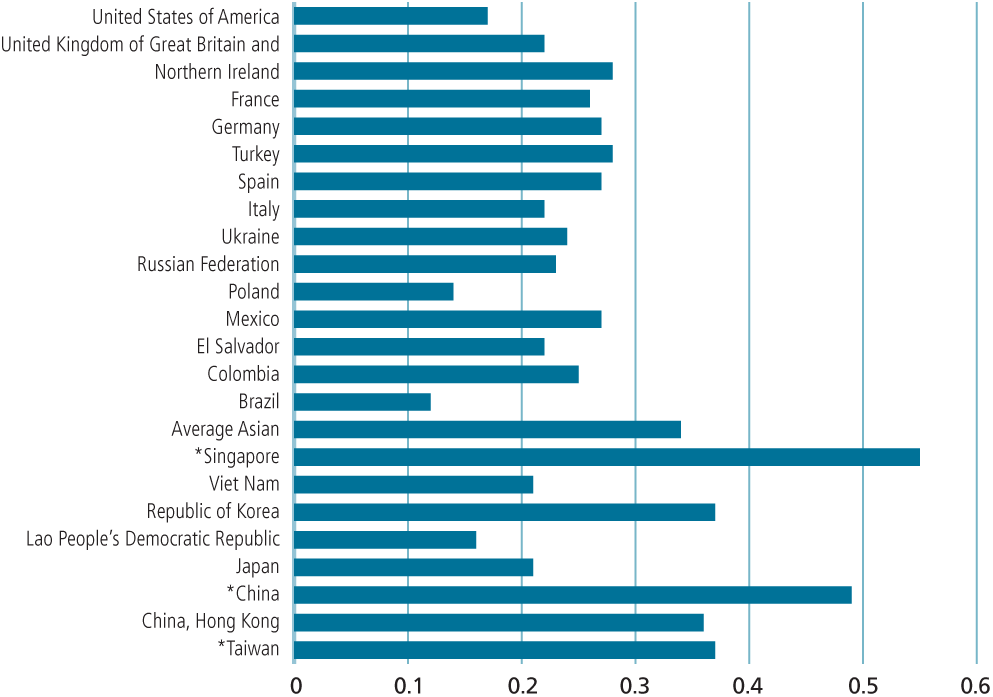
Proportion of College Graduates in STEM Majors by Country (2005)
Source: UNESCO and NSF (data for those countries with * is from NSF).
Ability versus Effort
Chinese and American parents also hold different beliefs, on the whole, regarding what drives learning. Research shows that Chinese people, including parents and teachers, believe in effort over innate ability, while American educators and parents believe in innate ability over effort. Educators and parents in the West tend to have a fixed view of talent and to attribute achievement accordingly. This belief difference is particularly consequential in the study of math and science. While the American public holds math and science in high regard, they think these fields are only for a few people who are intrinsically good at math. That sentiment could help us understand why so few American students earn degrees in a STEM field (see Figure 1).
Education in China is informed by the idea that educators can—and should—teach individual students to reach common academic goals.
The American government has long seen the need to graduate more domestic students in science and engineering. In his 2011 State of the Union address, President Barack Obama stated, “We need to teach our kids that it’s not just the winner of the Super Bowl who deserves to be celebrated, but the winner of the science fair.” However, policy makers cannot solve this problem until they change the culture of math and science learning in the U.S. As recently as 2012, a professor of political science wrote an op-ed in the New York Times titled “Is Algebra Necessary?” It argued that algebra cost American students too much psychological pain. Indeed, Yong Zhao noted, in his book Catching Up or Leading the Way, that there is a negative association between self-confidence and math performance. In other words, math is a killer of confidence—one of the most prized attributes of American educators and parents. Inadvertently, American culture legitimizes a dislike of math.
By contrast, competence in math is valorized in China, and, more importantly, is expected of everyone, not just a few gifted minds. An old Chinese saying goes: “Mastering math, physics and chemistry, you are fearless wherever you go.” The cultural value attached to STEM subjects is, in part, driven by the government’s push toward industrialization and modernization. On the other hand, one-party rule still discourages and controls the debates on controversial historical and social issues. As a result, Chinese students and their parents tend to shy away from social science and the humanities. Not surprisingly, then, about half of the first degrees awarded in China are in STEM fields.
The U.S. and Chinese education systems go to extremes in distinct ways; a more balanced approach would improve both.
Interestingly, among Chinese students in STEM fields, many hail from impoverished rural areas. The standardization of the curriculum and the belief in effort have helped alleviate the disadvantages associated with family backgrounds. This stands in sharp contrast to racial minorities and low-income students in the U.S., who are far less likely to major in STEM fields than other American students. In the U.S., these disadvantaged students are often put in low-ability tracks with non-challenging curricula. Even if they are able to enter college, they are woefully unprepared for demanding college math and science coursework. Poor and rural students in China, by contrast, are disadvantaged, mainly in terms of cultural capital, which reduces their chances of excelling in fields such as humanities, arts, or foreign languages.
The push toward math and science has mixed consequences. Embedded in a social context that considers performance in the “hard sciences” the main measure of intelligence and the surest means of success, those who cannot excel are vulnerable to enormous insecurity and even peer ridicule, teacher contempt, and parental disappointment. During my interviews with Chinese students studying in American universities, some recalled how critical their high school math teachers had been and how hurt they’d felt. Despite her resentment toward her learning experiences in China, one respondent felt the math coursework at colleges here in the U.S was incredibly easy for her, in part because of the foundations laid down by her Chinese schooling. She was reluctant, but acknowledged that “the past hurt and efforts seem to pay off now.”
The Two Disconnects
Much of the debate over differences between Chinese and U.S. education focuses on elementary and secondary schooling. But there are remarkable differences in postsecondary schooling as well. Simply put, American universities require much more effort than secondary schools, while Chinese universities demand less from their students than the schools kids attend in the pre-college years.
The disconnect in the U.S. manifests in a lack of preparation for college. The National Center for Education Statistics reports that 60% of students in two-year colleges enroll in at least one remedial, non-credit course to prepare them for college. At four-year colleges, 20% of first-year students are in remedial courses. Why are so many students unprepared for college? Generally, lax high schools are the answer. The National Survey of College Freshmen shows less than one-third of first-year college students report having done more than six hours of homework a week in high school. Yet an increasing number of them get high grades. In other words, lax high school standards and grade inflation make American high school kids think that education is fairly easy. However, nothing is further from the truth when it comes to college. The disconnect contributes to the U.S.’s astounding college dropout rate: over 50%. American college freshmen are, on the whole, unprepared for academic rigor.
In China, an opposite pattern emerges: Chinese students are overwhelmingly hardworking before college, largely to prepare for standardized Gaokao college admissions testing (
During my interviews with Chinese international students in the U.S., one female student’s description of her learning experience illuminated the distinct disconnects between China and the U.S.:
“I really envy my friends studying in Chinese universities now. They live such a relaxed and carefree life. They do not have homework or papers to write. College is like heaven for them after hard work in high school. But I am unfortunate, because I went to Chinese high schools which were like hell, and now American university. I have to work every day here.”
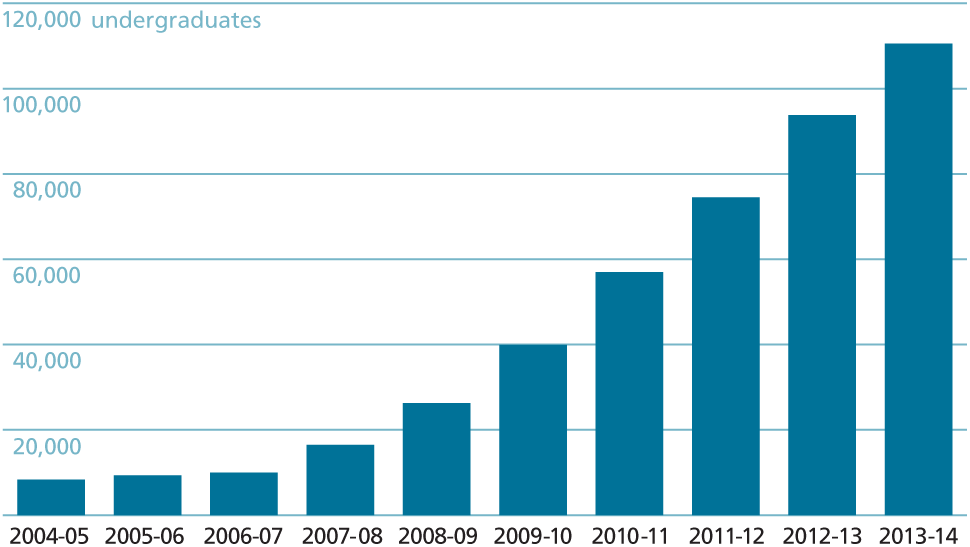
The Dramatic Increase in Chinese Undergraduate Students in American Universities, 2001-2012
Source: Institute of International Education Open Door Report
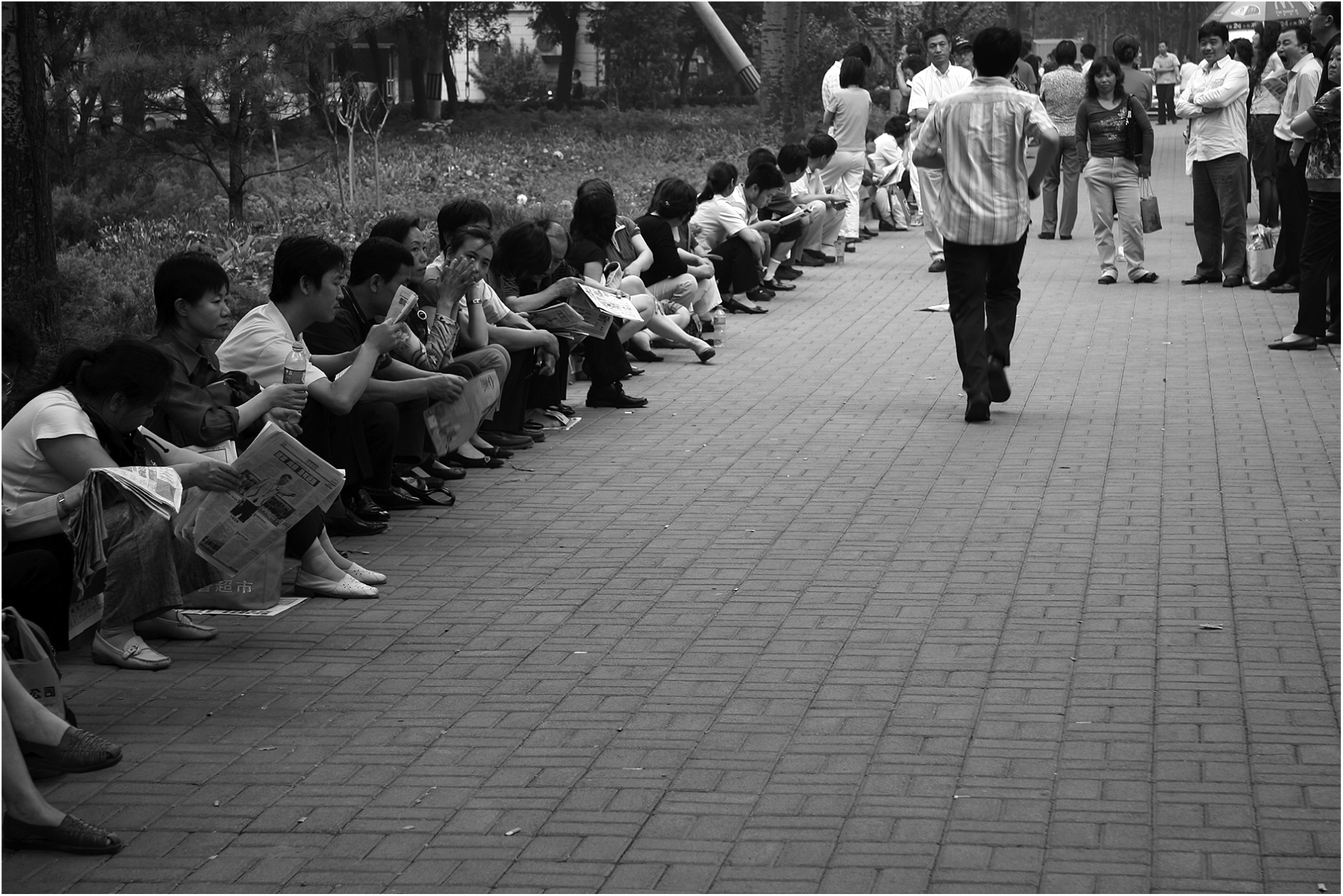
Parents in China wait for their children to finish the college entrance exams.
Ernie via Flickr Creative Commons
Perhaps this is exactly why her parents sent her to study at an American university: They want her to be challenged. If that’s not possible in China, then she can enjoy a rigorous U.S. college experience. The number of Chinese undergraduates in American universities has increased by an annual rate of 40% over the past five years. In roughly the same period, the number of Chinese students taking the Gaokao admissions test for Chinese universities has declined by 13%, partly because Chinese students are opting for overseas colleges (see Figure 2).
The U.S. and Chinese education systems go to extremes in distinct ways; neither is ideal. Yet, people on both sides of the Pacific tend to fall into the belief trap that the grass is greener on the far shore. A more balanced approach would improve each system. For example, recent educational reforms in China have attempted to reduce academic burdens during the pre-college years by restricting after-hours tutoring, and, in some instances, banning weekend cram sessions in public schools. Chinese educators and middle-class parents actively look toward the West, notably the creative and enjoyable American way of learning. There are also signs that the American education system is trying to adopt elements from China. For example, the common core standard is the latest effort to learn from countries like China, where education is more standardized. Although the jury is still out whether this is the right step for American education, learning from other countries and striving towards a balanced approach is laudable and promising.