




Abstract
Standardized tests were introduced to U.S. higher education as systematic, neutral measures of students’ intellect. Over time, they became central gatekeeping tools in the college admissions process. However, these tests have faced growing criticism for reinforcing inequality and privileging structurally advantaged students, leading many colleges to eliminate them as admissions requirements. In this study, we extend insights from institutional theory and the study of higher education to develop a novel theory of how the potential diversity benefits of test-optional admissions are contingent upon institutional definitions of merit and competing financial priorities. More specifically, we argue that admissions offices’ claims regarding which criteria are most important to thinking about and evaluating merit can shape the outcomes of test-optional policies in systematic ways. Using data from several sources, including the National Center for Education Statistics’ Integrated Postsecondary Education System and the College Board’s Annual Survey of Colleges, we find that, while eliminating requirements generally leads to an increase in enrollment of underrepresented minority students, this effect is significantly reduced at institutions that continue to strongly value quantitative academic metrics in evaluations of merit. Moreover, when alternative institutional priorities such as financial pressures rise, diversity increases from test-optional policies tend to decline. These findings are especially salient in 2025, as institutions face mounting legal and political restrictions on diversity-related practices. Our findings suggest that the impact of policies like test-optional admissions—once viewed as viable alternatives to race-conscious practices—may be limited unless accompanied by shifts in how institutions define and reward merit.
Higher education plays a vital role in promoting socioeconomic mobility in the United States, serving as a pathway for individuals to improve their socioeconomic standing (Chetty, Deming, and Friedman 2023; Thomas and Zhang 2005). Consequently, broadening access at critical points of entry, such as college admissions, is a central concern for scholars studying labor market and educational stratification as well as for many policymakers (see, e.g., Domina, Penner, and Penner 2017; Stainback, Tomaskovic-Devey, and Skaggs 2010; U.S. Department of Education 2016). One focus of these efforts is ensuring that talented students from all racial and ethnic backgrounds have equitable opportunities to pursue higher education, particularly in light of long-standing critiques that admissions processes at colleges and universities perpetuate inequality (Bowman and Bastedo 2009; Espenshade, Chung, and Walling 2004; Hearn and Rosinger 2014; Karabel 2006). Well aware of universities’ image as “bastions of privilege” (Bowen, Kurzweil, and Tobin 2005:95), university leaders have tried to diversify their campuses over the past several decades (Alon and Tienda 2007; Rosinger, Ford, and Choi 2021) and have touted the cultivation of a diverse student population as consistent with organizational values and a source of intellectual strength (Berrey 2011; Liu 2011; Stevens 2009; Warikoo 2019).
Recent federal policy shifts have introduced substantial challenges to the cultivation of student diversity by restricting or outright prohibiting a variety of practices related to diversity, equity, and inclusion in higher education (see Cavanagh 2025; Otterman, Hartocollis, and Goldstein 2025). Even before this, however, key initiatives such as race-conscious admissions were challenged in courts and even banned in some states, leading universities to explore alternative approaches to reducing barriers and broadening access to a wide range of student groups (Dumas-Hines, Cochran, and Williams 2001; Hirschman and Berrey 2017; Liptak 2023; Rosinger et al. 2021; Saul 2024).
Among the practices universities have adopted to broaden access, “test-optional” admissions has received particular attention. This approach eliminates the requirement that applicants submit scores from standardized tests such as the SAT and ACT. First developed in the 1920s, the SAT was originally intended to promote a merit-based system centered on universalistic criteria, as a measure of intellect and a counter to the status-driven process that had largely governed college admissions up to that point (Lemann 1999). However, beginning in the 1980s and gaining momentum in recent years, critics have charged that standardized tests are powerful drivers of inequality that undermine the meritocratic ideals they were meant to uphold (e.g., Crouse and Trusheim 1988; Reeves and Halikias 2017; Soares 2011). Accordingly, many colleges eliminated standardized testing requirements with an expressed goal of fostering diversity 1 —even before the Covid pandemic forced many schools to temporarily suspend testing requirements due to lack of student access to testing facilities.
Despite the rhetoric and actions of many colleges, scholarly research on the effects of dropping testing requirements on student diversity has been mixed. For example, in a study of approximately 100 private colleges that eliminated testing requirements between 2005 and 2016, Bennett (2022) found that going test-optional was associated with a significant increase in enrollment of Pell Grant recipients, women, and first-time students from underrepresented racial/ethnic backgrounds. However, analyzing a sample of 180 selective liberal arts colleges, Belasco, Rosinger, and Hearn (2015) concluded that test-optional admissions policies had a non-significant effect on racial and economic diversity, instead increasing the number of applications and the college’s perceived selectivity. Individual universities that adopted test-optional policies during the Covid pandemic have also announced diverging outcomes. Some, such as the University of Michigan, have remained committed to test-optional policies, which they assert have led to “an increase in applications from students from all backgrounds.” 2 Others, such as Dartmouth, have announced a return to testing, finding that test scores “are significantly predictive of academic success,” and “test-optional policies do not necessarily increase the proportion of less-advantaged students in the applicant pool.” 3
Why have some universities that implemented test-optional admissions policies experienced increases in student body diversity, while others did not? We explore this question by considering how the claims made by admissions offices about which criteria are most important to evaluating merit shape the outcomes of test-optional policies. In the United States, meritocracy is widely regarded as a fair and legitimate principle for selection (Castilla and Benard 2010; Karabel 2006; Lemann 1999; Warikoo 2019). But far from a singular principle, “merit” can be defined and measured in diverse ways (Bastedo et al. 2018; Rosinger et al. 2021; Taylor, Rosinger, and Ford 2024). For example, some colleges largely conceive of and evaluate merit in terms of a student’s academic achievements. At other schools, judgments of merit may be more “holistic” and involve a student’s demonstrated leadership and commitment to extracurricular activities. At still other schools, admissions offices consider character and community involvement to be key components of merit.
In our study, we focus on differences in the importance that universities report placing on various admissions criteria, as these reflect the kinds of students desired and valued at their institutions. As Posselt (2020:152) observes, “criteria for admissions reflect priorities, and priorities reflect values.” Empirically, we use universities’ survey responses regarding the value they ascribe to different admissions criteria (e.g., leadership, high-school GPA, community contributions). These self-reported values may not capture every nuance of how admissions officers evaluate applicants, but they do reflect what colleges wish to convey, both to themselves and relevant others (e.g., applicants, parents, admissions counselors, and other colleges), about how they evaluate merit (Taylor et al. 2024). None of the claimed admissions values we study center on student diversity. We propose that differences in these claimed values may nonetheless influence how test-optional policies affect diversity by changing the relative emphasis placed on different kinds of achievements and experiences.
We also consider the role of competing material interests, which may affect whether a university continues to prioritize the goals that drove test-optional implementation. University leadership must concern themselves not only with student diversity, but also factors such as student success, financial viability, and institutional status and reputation (Askin and Bothner 2016; Castilla and Poskanzer 2022; Espenshade and Radford 2009; Stevens 2009). Balancing the demands put forth by different stakeholders requires continuous rebalancing of priorities, such that practices implemented to achieve certain goals may become less important when other needs are pressing. Building on this idea, we propose that when universities experience performance declines in other domains, admissions offices’ attention to the diversity-related aims of test-optional policies may be limited, reducing the policy’s effect on enrollment of underrepresented minority students.
To test these ideas, we examine a large sample of private and public nonprofit colleges and universities, for which we have yearly data on basic institutional characteristics, tuition, student enrollments, demographics, and admissions- and graduation-related outcomes. We find that, in general, eliminating testing requirements leads to an increase in the percentage of underrepresented minority students enrolled. However, this pattern differs depending on how much a college continues to value quantitative metrics of academic achievement, such as standardized test scores and class rank. Colleges that report highly valuing these criteria experience a smaller (largely non-significant) change in the percent of underrepresented minority students, relative to colleges that do not. We further find that, when competing institutional priorities become more salient, the effect of test-optional admissions policies weakens. Overall, our findings have important implications not only for the field of higher education, but also for work in institutional and organizational theory.
Eliminating Standardized Tests and Diversity Outcomes
Since the 1950s, the use of standardized test scores in U.S. college and university admissions has become widespread (Hoxby 2009). Once testing requirements were firmly entrenched, however, concerns that standardized test scores encode structural and systematic racial and income-based inequities grew. Students from low-income and minority backgrounds consistently score lower than their more-privileged counterparts on these tests (Atkinson and Geiser 2009; Dixon-Roman, Everson, and Mcardle 2013; Grodsky, Warren, and Felts 2008; Sackett et al. 2012). Accordingly, throughout the latter decades of the twentieth century and into the early twenty-first century, a broad mix of academics, activists, and policymakers have critiqued standardized tests as either biased in their content or reflecting and exacerbating existing inequalities in access to high-quality secondary schools and private test-prep classes. Some critics have also questioned the power of standardized tests to predict students’ performance in college, particularly for underrepresented ethnic groups (e.g., Crouse and Trusheim 1988; Rothstein 2004; Zwick and Himelfarb 2011). As Atkinson and Geiser (2009:666) observe: Far from promoting equity and access in college admissions, we found that—compared with traditional indicators of academic achievement—the SAT had a more adverse impact on low-income and minority applicants. The SAT was more closely correlated than other indicators with socioeconomic status and so tended to diminish the chances of admission for underrepresented minority applicants, who come disproportionately from lower socioeconomic backgrounds.
Amid this ongoing criticism, many colleges and universities have eliminated test requirements in admissions, instead making submission optional for applicants. 4 One commonly offered rationale for doing so is that going test-optional will increase diversity. By reducing a barrier that disproportionately affects applicants from underrepresented groups, proponents argue that these students will feel more encouraged to apply to colleges that may have previously seemed out of reach. Applicants from underrepresented groups should then become more competitive in the admissions process, leading to a more diverse student body on campus. Given the mixed evidence presented earlier on this issue, the validity of this argument remains an empirical question.
Some proponents of retaining standardized tests in the admissions process argue that they provide a critical opportunity for students who lack other means to showcase their abilities (e.g., Leonhardt 2024). Others point out that deemphasizing tests could increase reliance on alternative measures of merit, such as extracurricular participation or rigor of coursework, which may also reflect disparities in access to opportunities (an issue we will expand on later). Overall, however, considering the significant challenges standardized tests pose for underrepresented students, we predict that eliminating their use in admissions decisions will generally contribute to a more diverse student body.
Hypothesis 1: Eliminating standardized test requirements in admissions will increase enrolled student body diversity.
Variation in Approaches to Evaluating Applicant Merit
Our first hypothesis outlines the general expectation expressed by many academics, activists, and university leaders. However, empirical studies (e.g., Belasco et al. 2015; Bennett 2022; Saboe and Terrizzi 2019), as well as experiences noted at several individual colleges, have been mixed in terms of the effects on student diversity. An institutionally-informed approach to understanding why realized outcomes may diverge from original intentions considers how the local context affects the way formal policies or practices are implemented within organizations (e.g., Ansari, Fiss, and Zajac 2010; Fiss, Kennedy, and Davis 2012). When organizations adopt a new practice, they ground its interpretation within the values and norms governing behavior locally (Boxenbaum and Battilana 2005; Kraatz, Flores, and Chandler 2020). The perceived validity of a practice, and thus the extensiveness and nature of implementation efforts, will likely vary across different organizations or even organizational subunits as a result (Jacqueminet 2020).
Kraatz and colleagues (2020) observe that organizational leaders often promote desired values and embed them into organizational practices and policies as a deliberate strategy to shape organizational norms, guide decision-making, and influence members’ behavior (Cannella, Finkelstein, and Hambrick 2008; Hambrick and Mason 1984; Kraatz, Ventresca, and Deng 2010). If adopted and embedded within organizational decision-making and culture, these promoted values will likely influence how new practices are implemented. We contribute to existing work on the role of values in practice implementation by examining how organizational claims about merit can produce different enrollment outcomes under test-optional admissions.
A number of qualitative studies have shed light on college admissions officers and the values that infuse their decision-making (e.g., Bastedo et al. 2018; Duffy and Goldberg 1997; Posselt 2016; Stevens 2009). Such accounts suggest that admissions officers’ evaluations of applicant merit often center heavily on academic achievement and intellectual excellence. These dimensions can be assessed through metrics such as high-school GPA, class rank, and standardized test scores—criteria that have been fundamental to defining who deserves membership within educational institutions (Bowen and Bok 1998; Espenshade and Radford 2009). Test scores, in particular, have historically been valued within academic culture as indicators of intelligence, potential, and worthiness (Karabel 2006; Lemann 1999; Posselt 2016). The cultural resonance of an academically-focused view of merit, as well as the convenience and allure of seemingly objective, quantifiable measures of academic achievement (Espeland and Sauder 2007), make this a predominant cultural frame within college admissions (Alon and Tienda 2007; Espenshade and Radford 2009; Rosinger et al. 2021; Taylor et al. 2024).
Many colleges and universities, however, have broadened this narrowly focused definition of merit to encompass nonacademic dimensions, such as extracurricular activities, community service, and leadership roles (Furuta 2017; Killgore 2009; Rosinger et al. 2021; Taylor et al. 2024). Initially, in the early twentieth century, this holistic approach was used to exclude applicants from high-achieving groups deemed socially undesirable (Karabel 2006). 5 In later decades, admissions offices turned to a holistic approach with the expressed goal of adopting a more individualized, less formula-driven approach to selecting a college class (Bastedo et al. 2018; Furuta 2017). Personal qualities and character, as well as a candidate’s potential for contributing to the campus community, may also be considered in holistic judgments of merit—particularly at small, elite schools that need to make especially fine-grained decisions among many qualified applicants (Stevens 2009). But holistic admissions approaches have been adopted not only by highly selective colleges, but also by a broad range of institutions seeking to value diverse life experiences and skill sets.
Proponents of holistic approaches often argue that expanding the criteria for assessing candidates can broaden access for students from a variety of backgrounds, who may lack the structural opportunities (e.g., access to test prep and advanced placement classes) that would enable them to stand out on the basis of academic criteria alone. Admissions officers adopting a holistic approach often aim to contextualize applicants’ achievements and experiences through consideration of family and school environments, taking into account inequalities in the opportunities available (Bastedo et al. 2018; Bastedo et al. 2022). However, research focusing on highly selective institutions has found that holistic approaches often advantage privileged students who have greater resources to cultivate extracurricular achievements and demonstrate “fit” with elite institutions, reinforcing existing inequalities rather than mitigating them (Chetty et al. 2023; Rosinger et al. 2021). Perhaps not surprisingly, given their multifaceted nature, holistic approaches differ substantially in the relative weights different institutions place on different dimensions and the extent to which context is considered (Bastedo et al. 2018). Overall, there appears to be considerable heterogeneity in what motivates universities to use holistic approaches and how they apply them.
Elimination of Testing Requirements and Different Approaches to Evaluating Merit
The criteria that define merit are likely to have a pervasive influence on the diversity of the students who enroll in a college. As Blair-Loy and Cech (2022:31) argue: While the definitions of merit stemming from professional cultures are generally accepted as objective judgments of competence and expertise, they are not necessarily neutral or benign. . . . [D]efinitions of merit within professional cultures reproduce inequality because they infuse gender, racial/ethnic, and LGBTQ biases into the yardsticks along which professional competence and worthiness are measured.
A view of merit that strongly centers traditional metrics of academic achievement can unintentionally create conditions that reflect and sustain historical inequalities. Studies show that underrepresented minorities tend to score lower on traditional academic metrics, which reflects existing structural inequalities in access to educational resources and opportunities. As noted earlier, much of this research focuses on standardized test scores, but researchers have also found similar patterns for academic GPA, rigor of secondary-school record, and class rank (Klugman 2013; Lucas, Molina, and Towey 2020; Nitardy et al. 2015; Riegle-Crumb and Grodsky 2010; Souto-Maior and Shroff 2024; Zwick and Green 2007).
Admissions officers are unquestionably aware that reliance on traditional metrics tends to replicate inequalities. Yet, these shared, long-held assumptions about academic achievement often shape decisions even as admissions officers may regard them with ambivalence. How can this be the case? One potential answer lies in the deep embedding of traditional notions of academic achievement in academic culture. Admitting students who bring diverse and valuable nonacademic experiences but perform lower along academic metrics may be unconsciously viewed as trading off traditional achievement (a deeply ingrained cultural value) with alternative and less deeply ingrained logics (Posselt 2016). The intense competition that occurs among selective colleges over underrepresented-minority applicants who excel along traditional metrics is a reflection of this implicit trade-off (Bowen and Bok 1998; Bowen et al. 2005).
A related factor is the decreased sense of risk that comes with selecting students who fit traditional standards of achievement (Posselt 2016). Admissions officers often hold an implicit model for a “typical” student who is likely to matriculate and succeed on their campus—a model that tends to privilege White affluent students. Such students are often presumed to have the academic aptitude to complete the required curriculum and to be more likely to enroll if admitted—thereby boosting yield rates, which tend to be higher among White students relative to Black and Hispanic students, and enhancing colleges’ reputation and financial stability (Espenshade and Radford 2009). There is also the undeniable fact that quantifiable academic metrics facilitate decision-making by providing clearer dimensions for comparison, making the process more “efficient” overall. The result, in many cases, likely amounts to what Stevens (2009:143), in his study of the admission process at a liberal arts college, observed to be “the uncanny way in which organizational routines worked at cross-purposes with the diversity everyone said they desired.”
Thus, while the elimination of testing requirements could theoretically trigger changes to the process and outcomes of applicant evaluation, little may actually change in terms of the types of students who are deemed worthy of acceptance among colleges that continue to publicly espouse admissions criteria that center around test scores and other metrics reflecting academic achievement. In such cases, we expect continued prioritization of traditional academic criteria in admissions decisions, weakening the positive effect of test-optional policies on student diversity.
Claimed values may further affect student body diversity by influencing the behaviors of prospective applicants. Students often consult college websites and other sources of information to learn about a school and its admissions requirements. This information can shape students’ understanding of what characteristics a school values in an applicant, which is likely to influence their sense of their own admissions chances. This information does not always align in a straightforward way with a school’s formal policy regarding testing requirements. For example, this 2023 excerpt from the University of Chicago’s website illustrates how colleges that eliminate testing requirements (as University of Chicago did in 2018) can still highly value standardized test scores in the admissions process: These tests can provide valuable information about a student which we and other colleges will consider alongside the other elements in a student’s application. We encourage students to take standardized tests, like the SAT and ACT, and to share your scores with us if you think that they are reflective of your ability and potential. Given that many of our peers do require testing, we anticipate that the vast majority of students will continue to take tests and may still submit their test scores to UChicago.
6
This statement illustrates how some test-optional schools may, on one hand, signal a commitment to increasing diversity and offering flexibility by eliminating testing requirements, while on the other hand, continue to emphasize the value of test scores. As a result, students with lower scores or who have not taken standardized tests may infer that their chances of admissions are slim, leading them not to apply. Given demographic differences in average test scores, such signals may have a differential effect, resulting in an applicant pool that includes fewer students from underrepresented groups. More broadly, colleges that express a high value placed on quantifiable academic metrics may unintentionally signal a narrowly-focused process for evaluating merit that discourages students from underrepresented backgrounds from applying. These signals likely reinforce the idea that excellence along traditional academic criteria is a baseline requirement for admission to selective colleges (Stevens 2009).
Overall, the values claimed by admissions offices could shape the outcomes of test-optional practices through affecting both admissions officers’ decision-making processes and the composition of the applicant pool. We thus expect that removal of testing requirements will be less likely to result in significant change in the diversity of the incoming student body when a college espouses a strongly academic approach to evaluating merit. We thus propose the following:
Hypothesis 2: The increase in underrepresented minority students that results from elimination of standardized testing requirements will be reduced among colleges that report placing a high value on traditional academic metrics of achievement.
We next consider how elimination of testing requirements might shape student diversity among colleges whose admissions offices espouse a broader holistic approach. In general, it is difficult to predict how growing reliance on factors other than test scores will affect students from historically underrepresented groups. Emphasis on holistic criteria often favors privileged students, who have greater cultural capital, opportunities, and resources to demonstrate their excellence in ways that such colleges value (Chetty et al. 2023; Jayakumar and Page 2021; Rosinger et al. 2021; Stevens 2009). Giving more weight to factors such as extracurricular activities and special talents may unintentionally lead to greater disadvantage for students who lack the resources to bolster their attractiveness on these dimensions. Moreover, variants of holistic admissions emphasize the “fit” between a student and the institution (Bastedo et al. 2018), an ambiguous and subjective factor that tends to reproduce existing inequalities (Rivera 2012). Consistent with the idea that holistic approaches may not help underrepresented groups, Rosinger and colleagues (2021) found no significant association between the proportion of underrepresented minority students on a college’s campus and the school’s emphasis on factors such as extracurriculars, talent, and character in admissions.
On the other hand, removing testing requirements may signal a deeper commitment to broader definitions of individual merit. Their removal could increase applicant diversity by signaling to students that a broader range of achievements will be valued in the evaluation process and by allowing admissions officers greater flexibility in their assessments of merit. Furthermore, many colleges that take a holistic approach to admissions aim to consider the broader socioeconomic context in which students were raised and the set of opportunities available to them, as well as barriers they have faced (Bastedo et al. 2018). Although studies suggest information on context can be relatively difficult to glean from a student’s application (Bastedo and Bowman 2017; Gaertner and Hart 2013), efforts to take these factors into consideration may still increase the attractiveness of students from underrepresented groups to some extent, as achievements that might be considered ordinary for higher-SES applicants could be seen as extraordinary for students in a less resource-rich high-school environment. Although these varied factors may work to some degree at cross-purposes, on balance, we expect the following:
Hypothesis 3: The increase in underrepresented minority students that results from elimination of standardized testing requirements will be strengthened among colleges that report placing a high value on holistic criteria in applicant evaluations.
Finally, consideration of how the local organizational context shapes the effect of eliminating testing requirements on student diversity also requires attention to a college’s broader institutional priorities. The admissions process is designed to meet multiple goals, of which diversity is only one (Castilla and Poskanzer 2022). As Espenshade and Radford (2009:74–75) argue: All college admissions officers strive to maintain at least three institutional priorities, often in this order: (1) enrolling sufficient numbers of students to meet bottom-line budget targets, (2) having students of sufficient quality, and (3) ensuring variety and diversity among the student body.
Stevens (2009) similarly observes admissions decisions to be multifaceted, involving not only identifying applicants who excel along the dimensions valued by the college when defining individual merit, but also considerations of finances, institutional status, overall student diversity and community, and the interests of constituents such as alumni and donors. These divergent priorities might take greater precedence in the wake of a university’s decision to eliminate test requirements, leading to heterogeneity in outcomes. Accordingly, some studies suggest that colleges that drop testing requirements may not see diversity increase, but may instead experience growth in application counts—allowing them to improve their selectivity metrics and thereby increase their rankings in publications such as U.S. News and World Report (Belasco et al. 2015; Saboe and Terrizzi 2019).
It is possible that admissions officers who face strong pressure to prioritize financial or enrollment-related performance or to strategically boost reported test scores for use in institutional rankings may be less likely or able to prioritize diversity-related concerns when eliminating testing requirements (Belasco et al. 2015). Pressures to maintain a high graduation rate could also affect the extent to which test scores factor into admissions decisions. For colleges with salient alternative goals (e.g., overcoming revenue or student performance deficits), we might expect less of a change in student body diversity as a result of eliminating testing requirements. We thus expect alternative institutional priorities, such as financial, budgetary, and student performance pressures, to also play a hand in producing heterogenous outcomes associated with test-optional admissions policies. In general, the greater the pressures to meet alternative goals, the weaker the expected effect of eliminating standardized testing requirements on the enrollments of underrepresented minority students.
Hypothesis 4: The increase in underrepresented minority students that results from elimination of standardized testing requirements will be reduced among colleges facing strong institutional pressures (on factors other than diversity).
Data and Methods
To examine how claimed admissions values shape the outcomes of eliminating testing requirements, we analyze a broad sample of public and private four-year degree-granting colleges and universities in the United States between 2003 and 2019. 7 These institutions vary in terms of their values, as well as whether and when they discontinued testing requirements. We take a variety of steps to address possible underlying differences among schools that eliminate testing requirements, compared to those that do not.
Our main analyses focus on the period before both the Covid-19 pandemic and the May 2020 killing of George Floyd, which sparked nationwide protests, corporate diversity pledges, and increased public pressure on colleges to increase racial diversity. These events likely affected colleges’ decision-making and operations as well as students’ enrollment choices in unanticipated and interrelated ways that make it challenging to isolate the distinct effect of eliminating testing requirements. During the time period of our investigation, the demographic composition of many U.S. college campuses changed substantially, as did their admissions practices with respect to standardized testing. The percentage of students identifying as White decreased from 68.3 to 52.9 percent from 2002 to 2020, while the percentage of students identifying as an underrepresented minority (Black, Hispanic, or American Indian) increased from 19.0 to 28.1 percent, and the percentage of students identifying as Asian increased slightly from 6.2 to 8.5 percent. 8
Our dataset draws from several different sources. We collected yearly survey information related to each college’s basic institutional characteristics, application-related metrics, tuition, and student enrollments, demographics, and outcomes from the National Center for Education Statistics’ Integrated Postsecondary Education Data System (IPEDS; NCES 2002–2021). Completion of the IPEDS survey is mandatory for all postsecondary institutions that are eligible to participate in any federal student financial assistance program (NCES 2019). In the NCES dataset, during the time period under investigation, 1,622 colleges have basic information on enrollment and tuition. We also collected national rankings of colleges and universities from U.S. News and World Report’s (USNWR) annual undergraduate rankings.
We collected information about test score admissions requirements (i.e., whether standardized tests must be submitted as part of a student’s application) from the IPEDS data. We also gathered information about colleges and universities that do not require standardized test scores in admissions through the National Center for Fair and Open Testing (http://www.fairtest.org). We used this information to cross-check the year of elimination of testing requirements. In the case of disagreement, one of the primary researchers searched for press releases through Factiva and online Google searches and information listed on college websites to determine the year of testing requirement elimination.
Figure 1 shows the count of colleges and universities not requiring standardized test scores with applications from 2000 to 2021. As this figure indicates, there was a general and gradually increasing trend toward eliminating testing requirements until Covid affected applications for students attending college for the first time in Fall 2021 (i.e., students applying in the 2020 admissions cycle)—at which point the number of schools without testing requirements jumped dramatically due to difficulties students encountered in taking the standardized tests during the Covid pandemic. We exclude from our analyses 19 colleges that eliminated standardized testing requirements prior to 2002 (the start of our study’s timeframe).
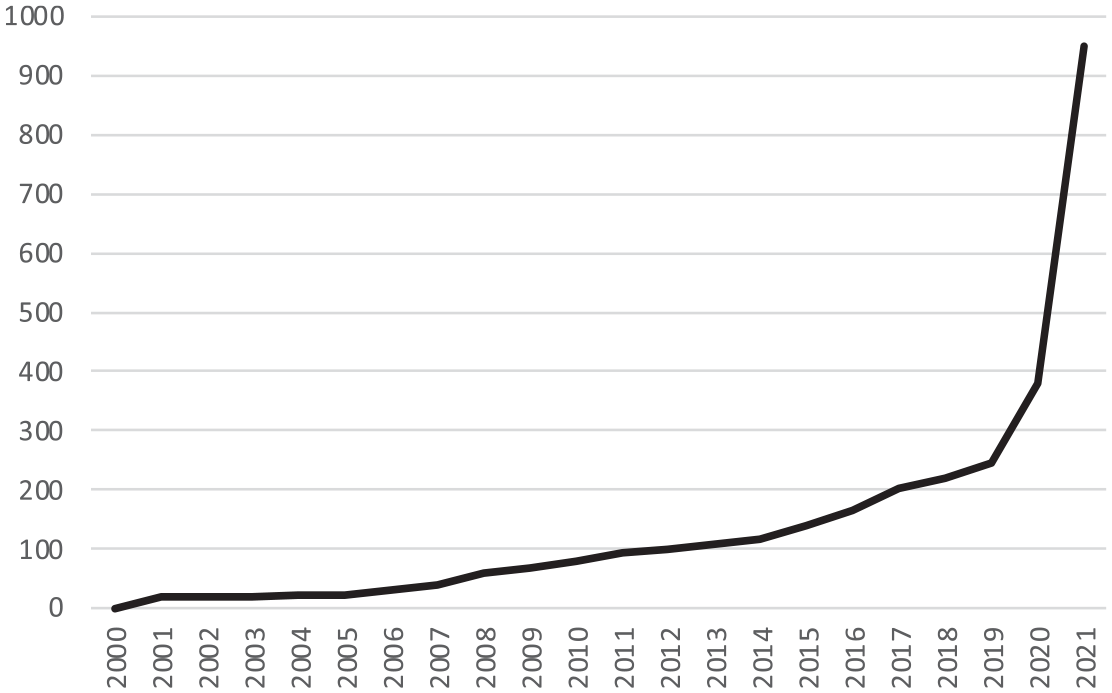
Count of Colleges Not Requiring Standardized Tests for Admissions
Lastly, we collected information on the value colleges report placing on different admissions criteria, reported through the College Board’s Annual Survey of Colleges (ASC), from 2002 through 2019. Each year, colleges are asked to report the importance of different criteria using a four-point scale: “very important” (1), “important” (2), “considered” (3), and “not considered” (4). We spoke with 12 current and former college admissions officers to gain insight into the process of reporting admissions criteria as well as for general background research. Admissions officers noted that, while institutional research offices within universities are often responsible for completing and submitting survey requests, they typically obtain data on admissions practices from admissions officers. Interviewees also noted that someone “with responsibility” in admissions typically signs off on the survey responses. In small schools, this might be the director of admissions; in larger schools, a staff member might fill in survey responses that a director or associate dean reviews. One reason colleges and universities are likely to exercise care in responding to this survey is that Petersen’s, the College Board, and U.S. News and World Report share this information in their publications.
The ASC survey data are missing for a number of our college-year observations. In the NCES dataset, 75 colleges did not provide sufficient admissions criteria information and were dropped entirely. For cases in which colleges did not report admissions criteria in a given year and the criteria values for the years immediately prior to and after the missing period were equivalent (e.g., “extracurricular activities” were reported as “important” both before and after the missing values), we filled in the missing values with the values shared before and after the missing period. With this conservative imputation of admissions data, roughly 8 percent of institution-year observations still had missing admissions criteria; those institution-years were dropped from our analyses. A logit regression suggests private colleges, with lower total student enrollment, higher yield rates (percentage of admitted students who enroll in a college), and that are not ranked by USNWR are more likely to have missing ASC data. Caution should thus be exercised in generalizing our results to small, private, less selective institutions.
Our final dataset is an unbalanced panel of 1,528 colleges. Within this dataset, 217 colleges (14.2 percent) eliminated standardized testing requirements during the time period of our study. Analyzing the drivers of test-optional policy adoption, Furuta (2017) finds that liberal arts colleges and less selective institutions were more likely to go test-optional, as were schools with lower yield rates and higher percentages of out-of-state students. Using logit regressions, we find similar patterns—liberal arts and private colleges that were less selective (higher acceptance rate) and had lower yield rates were more likely to adopt test-optional policies (p < 0.05).
Colleges’ Claimed Admissions Values
We first examine patterns in colleges’ claimed admissions priorities based on the self-reported importance rankings from the ACS survey. Table 1 summarizes the distribution of these rankings across colleges in our dataset. Colleges generally place strong emphasis on academic factors in admissions decisions. On a 1 to 4 scale (where 1 indicates “very important”), measures such as GPA, rigor of secondary-school record, and standardized test scores consistently rank between 1 and 2, underscoring their central role in admissions decisions. Class rank is somewhat less important (mean of 2.4), which may reflect the declining use of this metric in high schools. These findings align with qualitative accounts emphasizing the dominance of academic achievement in admissions processes.
College Board Admissions Decision Criteria
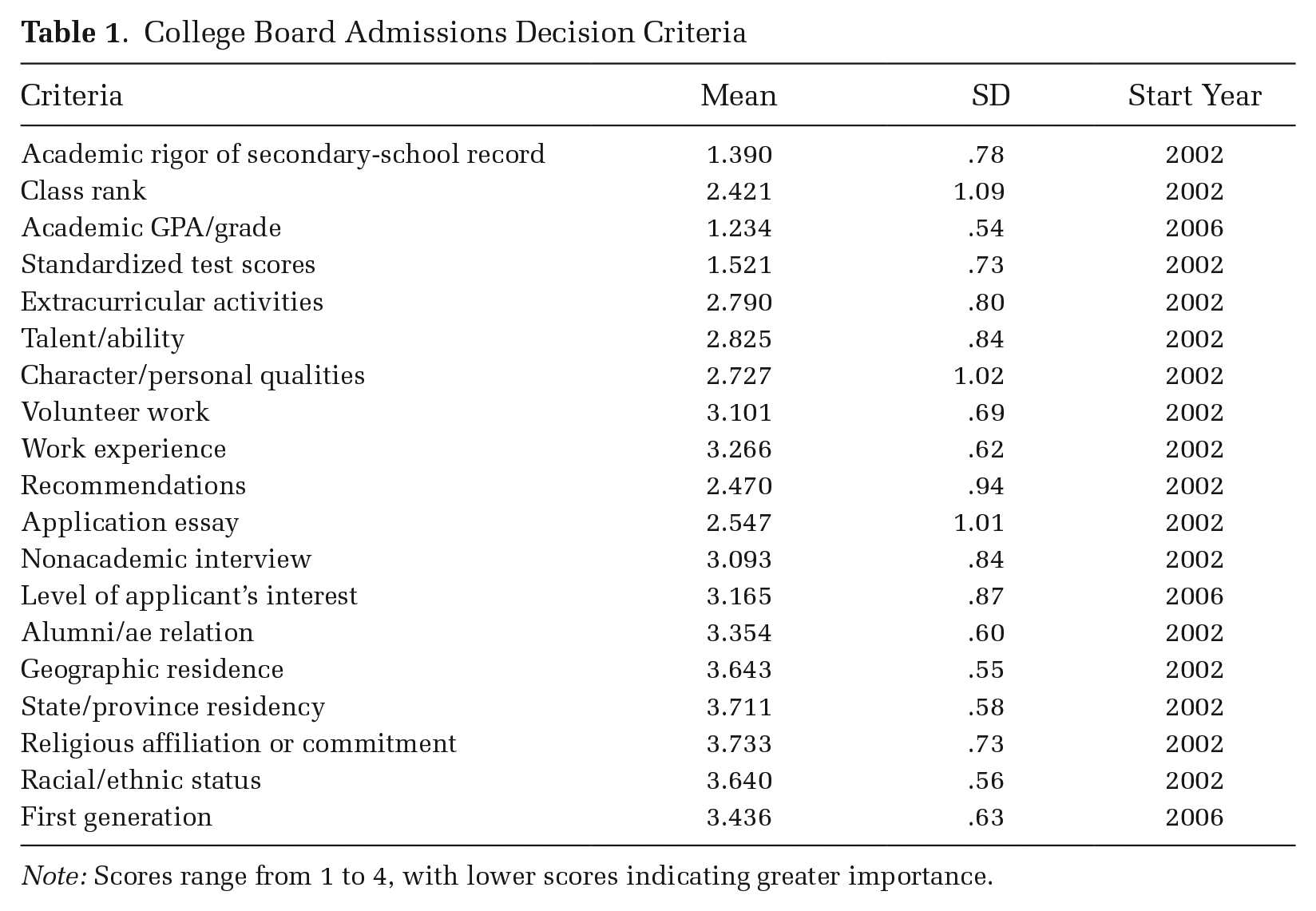
Note: Scores range from 1 to 4, with lower scores indicating greater importance.
In contrast, nonacademic dimensions frequently referenced in literature on holistic admissions, such as extracurricular activities, talent/ability, character/personal qualities, and work or volunteer experience (e.g., Coleman and Keith 2018; Furuta 2017; Hossler et al. 2019; Zwick 2019), generally rank lower in importance, with means between 2.7 and 3.2 (“considered”). Other factors included in holistic review processes related to applicant personality and character (e.g., recommendations, essays, and interviews) (Bastedo et al. 2022; Rosinger et al. 2021; Taylor et al. 2024), also show moderate importance (2.4 and 3.1). Ascribed-status factors (alumni relations, geographic residence, state/province residency, religious affiliation, racial/ethnic status, and first-generation status) are among the least important (3 to 4, “considered” to “not considered”).
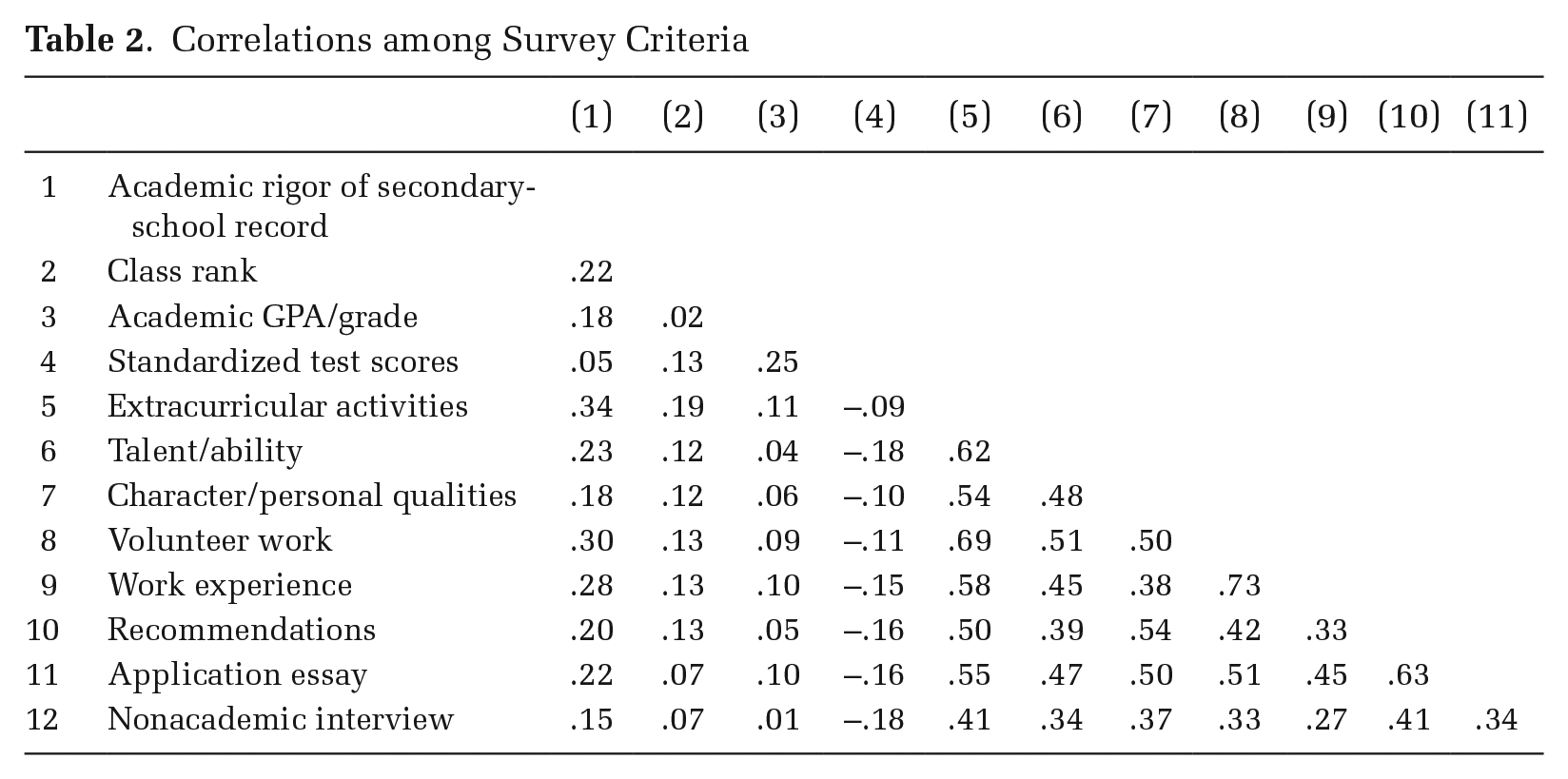
Correlations among these criteria (presented in Table 2) reveal striking differences between academic and nonacademic measures. Nonacademic factors are highly interrelated, with a Cronbach’s alpha of 0.87 indicating they align as a cohesive construct. Of these measures, only dropping interview as an item results in a slight increase in alpha to 0.88. Factor analysis confirms a single latent factor (eigenvalue = 3.89), allowing the creation of a single holistic composite index based on extracurricular activities, talent/ability, character/personal qualities, volunteer work, work experience, recommendations, and essay (interview is excluded) using the alpha command in Stata 17.0. Academic criteria, by contrast, show low internal consistency (Cronbach’s alpha ~0.40), indicating that academic dimensions do not represent a unified concept in admissions. As a result, we analyze standardized test scores, rigor, and class rank separately in our main analyses (we cannot include GPA in our analyses, given its near-universal importance).
Correlations among Survey Criteria
The admissions criteria prioritized by colleges often varies with institutional characteristics. For example, Taylor and colleagues (2024) find that private research universities and liberal arts colleges tend to emphasize nonacademic criteria more than other types of institutions, and colleges with higher application volumes focus on quantitative academic measures like standardized test scores. Our analyses (based on random-effects regressions) show that private, liberal arts colleges that charge higher tuition, rank higher in USNWR, and have higher yield rates emphasize nonacademic factors more, whereas schools with higher application volumes focus more on academic dimensions. As we explain below, we use several techniques, including creating a balanced sample along key covariates through Coarsened Exact Matching (CEM) and specifying fixed effects at the college level, to reduce potential confounding bias and better isolate the effects of differences in admissions criteria.
Changes in the self-reported importance of admissions criteria within colleges tend to occur modestly over time. Annually, roughly 15.6 percent of colleges adjust their emphasis on academic criteria, and 19.2 percent adjust nonacademic criteria. As might be expected, when testing requirements are eliminated, survey responses show greater shift in admissions priorities: 63.2 percent revised the reported importance of at least one academic criterion, with 56.7 percent specifically adjusting the importance of standardized test scores. On average, test-optional colleges decreased the importance of test scores (from a mean of 2.17 to a mean of 2.54, p < 0.001) and, to a lesser extent, class rank (from a mean of 2.48 to a mean of 2.52, p < 0.05). Other academic dimensions, such as GPA and course rigor, saw no significant changes. Among these colleges, 39 percent also adjusted the importance of nonacademic criteria.
It is important to note that even after eliminating testing requirements, many colleges continue to value test scores. Of the colleges that eliminated testing requirements, 8 percent still consider test scores “very important,” 29 percent view them as “important,” and 59 percent report they are “considered.” This suggests that, although test scores are not required, submitted scores may influence admissions in many test-optional colleges. Regression analyses suggest that test-optional colleges with a stronger STEM focus and higher application volumes still assign greater importance to standardized test scores; other factors, like public/private status, acceptance rate, and yield rate, show no clear patterns.
Measures
Dependent variable
Our main outcome of interest is the enrollment of first-time, full-time students identifying as an underrepresented minority (i.e., Black, Hispanic, or Native American) (Belasco et al. 2015). Ideally, we would also measure the number of underrepresented minority students who applied to and were admitted to different colleges, as candidates’ decisions about where to apply and where to attend, conditional on acceptance, are important factors shaping enrollments. Unfortunately, this information is not available through IPEDS or other national datasets, to our knowledge. We measure the presence of underrepresented minority students as the percentage of total first-time, full-time enrolled students who identify as Black, Hispanic, or Native American (Belasco et al. 2015).
Independent variables
Our independent variable is an indicator of whether colleges eliminated the requirement to submit standardized testing scores in applications (1 = college eliminated testing requirements; 0 otherwise). As we describe below, our empirical approach will examine whether the effect of eliminating testing requirements varies for colleges depending on the importance they place on different admissions criteria as well as the salience of other institutional priorities. Our approach takes into account our earlier observation that, while it is possible to create a composite index for the holistic conception that coheres conceptually and empirically, it is not possible to create something comparable for the academic conception of merit. Thus, we specify models that include both the holistic composite index and the three separate academic criteria, and each of their interactions with test-optional admissions policies. This approach allows us to consider the importance attributed to holistic and academic dimensions simultaneously, while acknowledging the lack of cohesiveness among the discrete academic dimensions.
Our measures of alternative institutional constraints facing admissions officers are constructed based on several college-level covariates. One set of measures focuses on budgetary restrictions and financial needs that may shape which applicants are admitted. Based on IPEDS data, we construct a measure indicating whether a college experienced finance- or budget-related losses for each of the following metrics over the two years leading up to the elimination of testing requirements: application counts, total full-time student enrollment, and total revenues. If a college experienced a decline along each of these performance metrics from two years prior to the first time of testing requirement elimination, the school was assigned a value of 1 for the measure, and 0 otherwise. We constructed similar performance-decline metrics for four-year student graduation rates and average reported SAT scores based on the IPEDS data, as both reflect broader institutional pressures to prioritize students’ academic performance and degree attainment.
Control variables
We also include a number of college-level covariates based on IPEDS data that may influence admission and enrollment decisions shaping the composition of student campuses. We control for the total number of full-time students enrolled at a college (ln) and application volume (ln), as colleges handling larger volumes of students may have greater capacity for broad recruitment efforts and programs designed to attract and support minority students. 9 We include the acceptance rate (percentage of students who apply to a college who are accepted), which reflects the selectivity of a college and could affect colleges’ ability to change student composition through diversity-related initiatives (Espenshade and Radford 2009). We also control for yield rates, which reflect the ability of colleges to convert admittances to enrollment and enact intended changes to student composition (Espenshade and Radford 2009; Hoxby and Avery 2012). Colleges may attempt to increase student diversity through strategies aimed at providing information and support to (and thereby increasing yield rates among) underrepresented student groups. We control for a school’s first-year tuition (ln), as a higher cost may negatively affect the enrollment of underrepresented minority students (Bennett 2022; Hoxby and Turner 2015; Nguyen, Kramer, and Evans 2019).
We control for the lagged proportion of undergraduate degrees granted by each college that were in STEM majors, as the representation of disciplines that emphasize quantitative skills may shape the value placed on test scores (Posselt 2016). We calculated this measure by collecting annual IPEDS data on undergraduate degrees conferred by major, and then matching majors to the U.S. Department of Homeland Security’s STEM Designated Degree Program List. 10 We also control for a college’s position in the USNWR rankings, as another measure of selectivity that could affect colleges’ ability to alter the diversity of their student body (Askin and Bothner 2016; Bowman and Bastedo 2009). USNWR ranks a subset of colleges, assigning them to one of four rankings tiers. We treat all unassigned colleges in a given year as a member of the fifth “lowest” ranking tier (Chu 2021).
Finally, we use bridged-race population estimates from the U.S. Census Bureau and the National Center for Health Statistics, 11 which provide consistent and comparable population estimates across racial and ethnic categories, to measure demographic shifts in the regions colleges are located within. These estimates allows us to control for regional increases in underrepresented minority populations, which may boost underrepresented minority student enrollment at proximate higher-education institutions. We constructed yearly lagged measures of the proportion of 18- to 24-year-olds identifying as Black, Hispanic, or Native American at the state and county levels for each college in our sample. To contextualize socioeconomic conditions, we also incorporate county-level data on median household income from the National Historical Geographic Information System (Manson et al. 2024). To improve interpretability, household income is scaled by dividing by 1,000.
Analytic Approach
For our empirical analyses, we first present models that establish a baseline understanding of college characteristics (including claimed admissions criteria) that shape the racial/ethnic composition of incoming first-year classes. Although not our main analytic focus, this provides context for our subsequent examination of how the elimination of testing requirements may interact with institutional values and priorities to affect the presence of underrepresented minorities on college campuses.
We then turn to our main focus: examining how eliminating testing requirements shapes the percentage of enrolled students who identify as underrepresented minorities. To do this, we must create a reasonable counterfactual of what the racial/ethnic composition of incoming first-year classes would have looked like if colleges that eliminated testing requirements had instead maintained them. One important step toward creating this counterfactual is addressing general differences between the sample of colleges that chose to eliminate standardized testing requirements versus those that did not. Accordingly, we created a matched sample in which colleges that eliminated testing requirements during the time period were balanced along a set of key observable covariates with colleges that did not. Note that this cannot guarantee the sample of colleges that eliminated testing requirements are equivalent to the “control” sample that did not, but it aims to ensure the samples are not significantly different from one another along observable characteristics. We matched colleges based on the following covariates: college-level total count of full-time students enrolled (ln), acceptance rate, yield rate, proportion of undergraduate degrees granted in STEM majors, liberal arts school (0/1), public or private institution, and year, using k:k coarsened exact matching (the cem package in Stata 17; see Iacus, King, and Porro 2012). 12
Table 3 provides descriptive statistics for the (1) full sample of colleges in our dataset and the (2) matched sample. The set of colleges in our models decreases from 1,528 to 952; the count of colleges that eliminated testing requirements remains 217. Essentially, the matching decreases the set of colleges in the “control” sample (colleges that never eliminated testing requirements during the time period under investigation) to a smaller sample that is comparable to the set of colleges that eliminated testing requirements along key observable covariates. A comparison of means suggests public and non–liberal arts colleges/universities are more likely to be excluded from the matched sample. 13 In general, these institutions did not eliminate testing requirements to the same extent that smaller, private liberal arts colleges did during the time period studied, and thus we cannot estimate a reliable comparison of what would have happened for these schools. While these differences highlight limits to the generalizability of our findings, the matched sample ensures better comparability between institutions that adopted and did not adopt test-optional policies during the study period. In post hoc analyses, we explore the extent to which our findings hold across different institutional types, including public and non–liberal arts colleges and universities.
Balance Tables for Full and Matched Samples
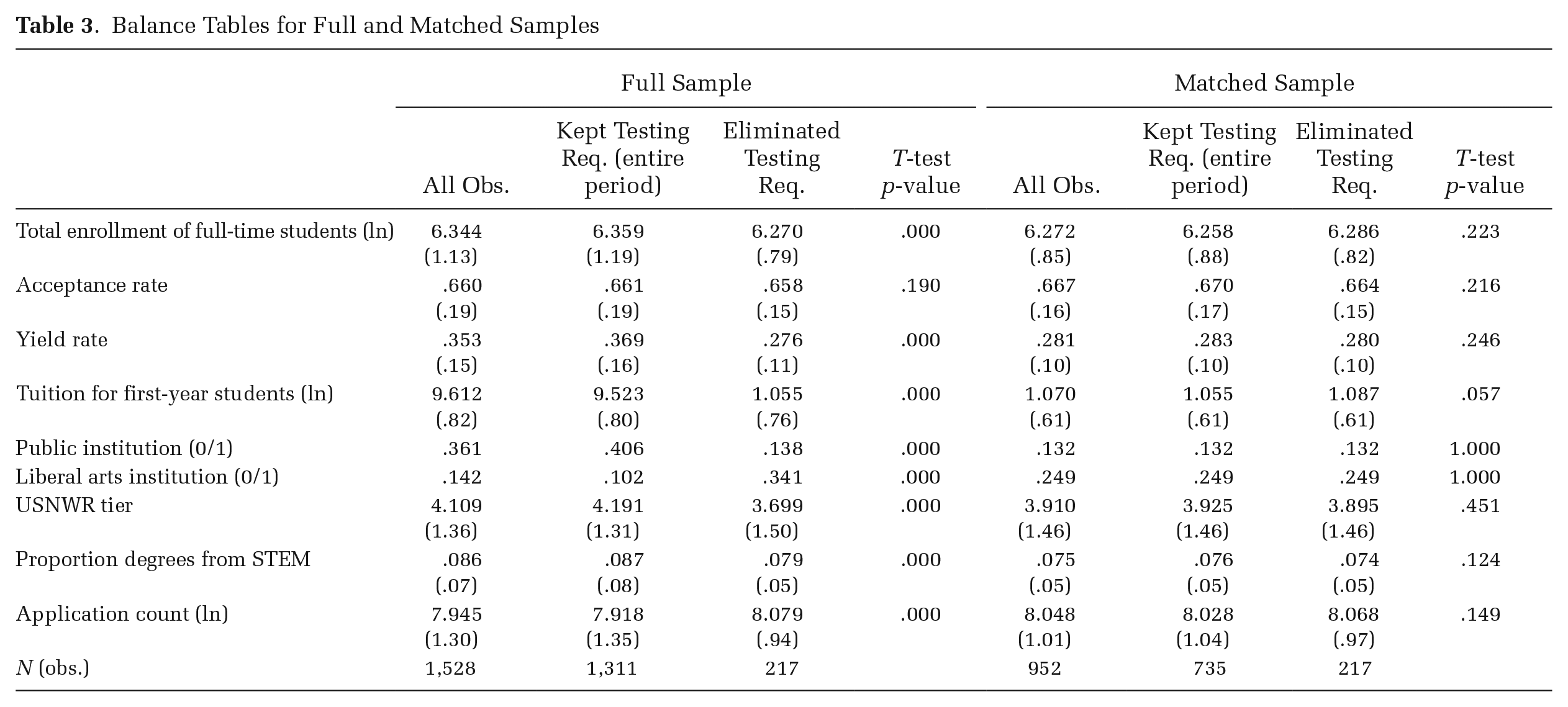
As Table 3 shows, matching allows us to achieve balance along observable covariates for colleges that eliminated testing requirements and colleges that did not (at the p < 0.05 level). To adjust for any residual imbalance, we continue to include these covariates in our models. Main results are not sensitive to the inclusion or exclusion of covariates and are consistent with models conducted on the full sample of 1,528 colleges.
To measure the effect of eliminating testing requirements on the enrollment of underrepresented student minorities, we adopt a difference-in-differences (DiD) approach designed to compare changes in outcomes over time between a group of subjects affected by an intervention of interest (in our case, the elimination of testing requirements) versus a control group for our matched sample. One commonly used model specification is a generalized version of the traditional DiD set-up that allows staggered treatment timing (to incorporate the different timing of testing requirement elimination for different colleges in our sample) and includes both fixed effects to control for time-invariant characteristics of different groups and time-specific effects to control for common temporal trends affecting all groups (Goodman-Bacon 2021).
In recent years, however, a number of methodological papers have identified potential bias when using the generalized fixed-effects approach to estimate heterogeneous treatment effects over time (e.g., Callaway and Sant’Anna 2021; de Chaisemartin and D’Haultfœuille 2020; Goodman-Bacon 2021), including the method’s use of already-treated units as controls for newly-treated units (which could lead to dynamic treatment effects that are not properly accounted for). Scholars have proposed alternative DiD frameworks designed to reduce bias in the case of staggered treatment timing (for reviews, see de Chaisemartin and D’Haultfœuille 2023; Roth et al. 2023). Accordingly, in our main analyses, we use the framework developed by de Chaisemartin and D’Haultfœuille (2020), which allows one to incorporate the effect of time-varying covariates on the outcome variable within a fixed-effects staggered DiD set-up. Their general specification in the case of staggered binary treatment is represented as follows:

for group g at time t, where Y references the outcome variable,
The parallel trends assumption of DiD analysis posits that, in the absence of treatment, treatment and control groups would have experienced the same trend in outcomes over time; the absence of any systematic trends in the outcome between treatment and control groups in the pre-treatment period helps support this key assumption. In our matched sample, we do not observe systematic differences between colleges that eliminated testing requirements versus those that did not in terms of enrollment trends prior to the elimination of testing requirements. This similarity strengthens the case for attributing post-treatment effects to the removal of testing requirements.
We use the did_multiplegt Stata package (de Chaisemartin, d’Haultfoeuille, and Guyonvarch 2019) for our estimation. This package allows one to specify intensity of treatment, but admissions values do not equate with a stronger or weaker treatment. Instead, we create and estimate the average treatment effect for different subsets of colleges based on their self-reported importance placed on specific criteria at the time of eliminating testing requirements.
Results
Table 4 shows fixed- and random-effects models estimating the effects of key control variables and claimed admissions criteria on the percentage of first-time enrolled students who identify as underrepresented minorities. These models, which do not include test-optional adoption, shed light on how different claimed values and other institutional factors relate to student body diversity. We present estimates for both the full and matched samples of colleges. In all models, we see a negative association between value placed on holistic criteria and minority student enrollment (p < 0.01). This finding is consistent with the idea that holistic criteria generally favor privileged students (Chetty et al. 2023; Jayakumar and Page 2021; Rosinger et al. 2021; Stevens 2009), and it suggests that admissions officers’ efforts to contextualize students’ opportunities and challenges during holistic review may not even the playing field. We also see a negative association between value placed on standardized test scores and the presence of underrepresented minority students (p < 0.001), consistent with the idea that emphasis on standardized test scores disadvantages underrepresented minority students.
Effects of Key Control Variables and Claimed Admissions Criteria on the Enrollment of Underrepresented Minority Students
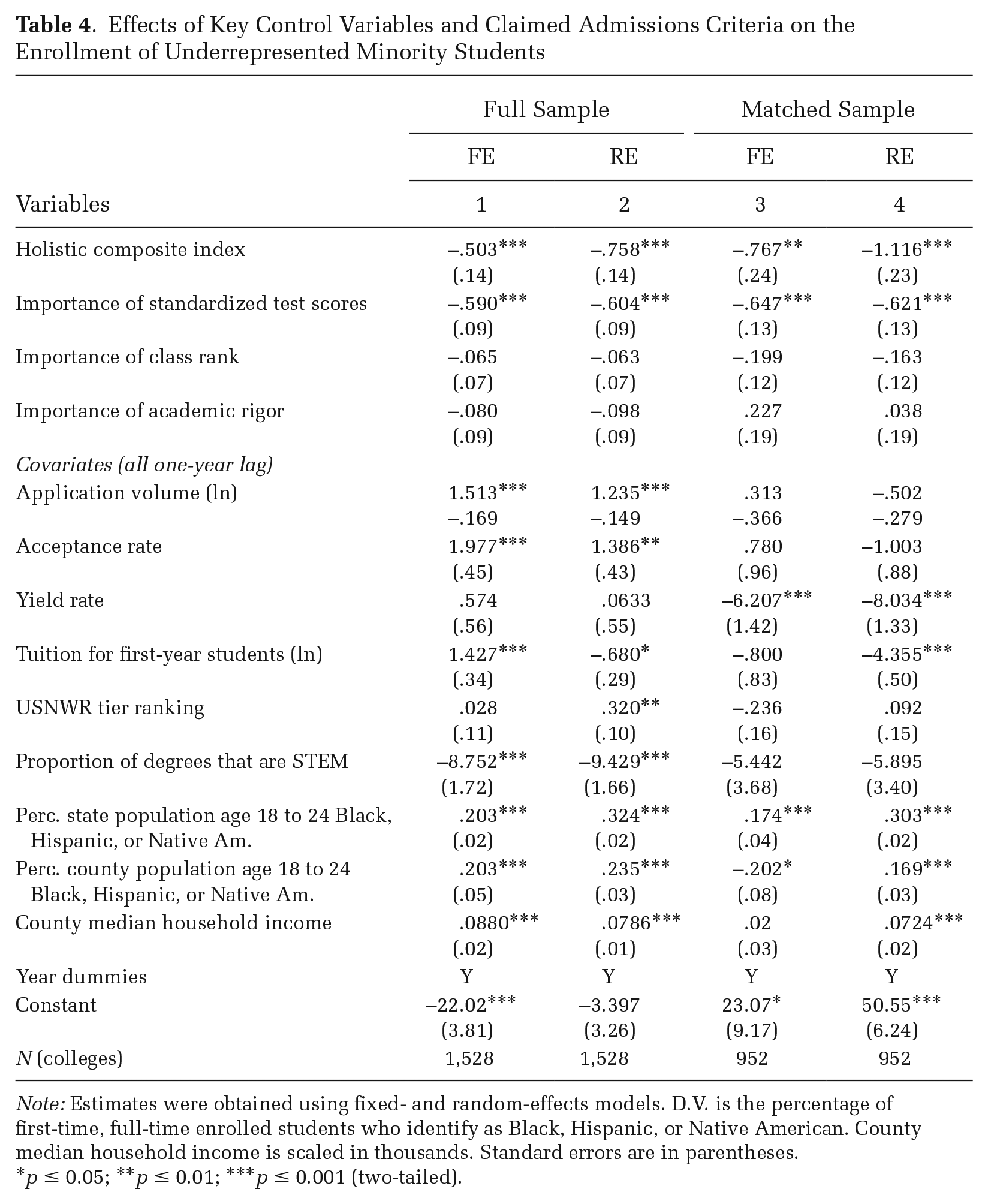
Note: Estimates were obtained using fixed- and random-effects models. D.V. is the percentage of first-time, full-time enrolled students who identify as Black, Hispanic, or Native American. County median household income is scaled in thousands. Standard errors are in parentheses.
p ≤ 0.05; **p ≤ 0.01; ***p ≤ 0.001 (two-tailed).
In the full sample, we find that increases in application volume and acceptance rates are associated with a higher percentage of Black, Hispanic, and Native American students enrolled for the first time at a college. Increases in application volumes or acceptance rates may indicate stronger and broader outreach efforts, allowing colleges to admit a larger number (and thus percentage) of students from underrepresented backgrounds. Results also show that as colleges become more STEM-focused (with a higher proportion of STEM degrees), the percentage of students from underrepresented backgrounds decreases. This decrease may be due to several factors, including the historical underrepresentation and perceived lack of support of minority students in STEM fields and greater focus of such colleges on academic test scores in admissions. In the random-effects models, we also find that higher county-level median household income, as well as higher proportions of 18- to 24-year-olds who identify as Black, Hispanic, or Native American at the state and county levels, increase Black, Hispanic, and Native American student enrollment. Finally, while the matched sample shows a negative effect of yield rate, this must be interpreted with caution given the matching was performed on yield rate and other control variables (and thus could potentially reflect overfitting).
We next model the effects of eliminating testing requirements using the DiD methodology developed by de Chaisemartin and D’Haultfœuille (2020). In Figures 2a to 2d, we model the trajectories for percentage of underrepresented student enrollment for colleges that eliminate testing requirements versus those that do not during the years directly preceding and following the elimination event. Figure 2a plots estimates for all schools in our matched sample. This panel shows a significant boost the first three years of eliminating testing requirements (t = 0 is the first year of testing requirement elimination), supporting Hypothesis 1.
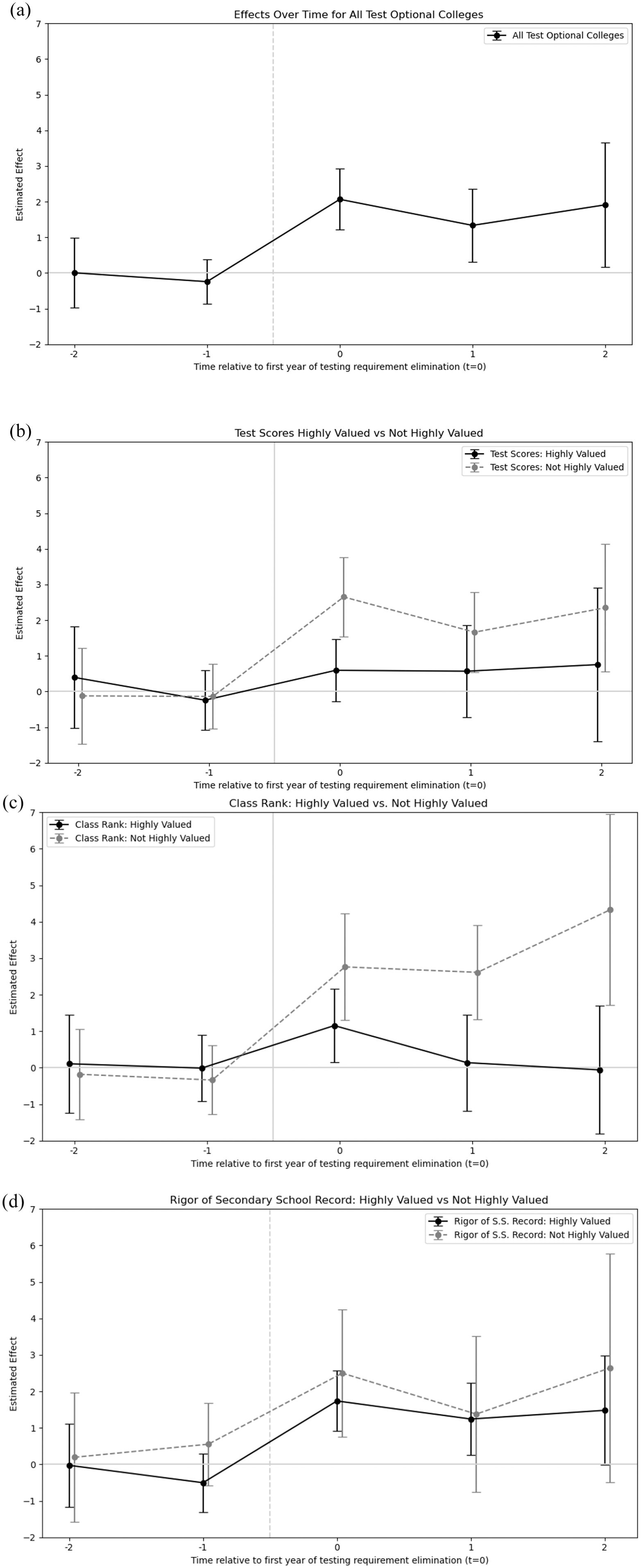
Lags and Leads Models Predicting Enrollment of Students from Underrepresented Groups Over Time: Comparing Colleges According to Value Placed on Academic Criteria
Figures 2b, 2c, and 2d examine how the effect of test-optional adoption varies by the emphasis placed on various academic criteria in the admissions process. In Figure 2b, we compare trajectories of colleges that report highly valuing standardized test scores (i.e., reporting test scores to be “important” or “very important”) versus not highly valuing test scores at the time of eliminating testing requirements. Colleges that report highly valuing test scores show no significant increase (95 percent confidence level) in percentage of underrepresented minority students enrolled during the three years following the policy change. In contrast, colleges that do not report highly valuing test scores exhibit statistically significant increases each of the three years following testing elimination, with an estimated 2.27 percentage-point increase in underrepresented minority students (based on the weighted average for the three years). The most pronounced difference between the two groups occurs in the first year of policy implementation (two-tailed z-test, p = 0.005), but the difference becomes non-significant at the p = 0.05 level for subsequent years.
Figure 2c maps trajectories for colleges based on whether they reported highly valuing class rank or not at the time of eliminating testing requirements. Both groups experience a significant increase in percentage of underrepresented minority students enrolled during the first year following the policy change. Colleges that did not highly value class rank experienced a 2.76 percent increase, compared to a smaller 1.16 percent increase among colleges that did highly value class rank—a difference that is marginally significant (p-value = 0.07). Over the next two years, these trajectories diverge further (p < 0.01). Colleges that do not report highly valuing class rank continue to see growth in underrepresented minority student enrollment, while the effect for colleges that report highly valuing class rank diminishes and becomes statistically indistinguishable from zero.
In Figure 2d, we compare trajectories for colleges that report highly valuing rigor of secondary-school record versus not highly valuing it. Both groups show a significant and similarly sized boost in percentage of underrepresented minority students during the first year following the policy change. Tests of differences in means for each of the three years show non-significant differences (p-values > 0.40).
Overall, among the academic criteria, we find support for Hypothesis 2 (the increase in minority enrollment will be reduced among colleges that report a high value placed on traditional metrics of academic achievement) when we focus on test scores and class rank. We do not see any evidence of a significant difference in enrollment patterns based on reported value placed on rigor of secondary-school record.
To further probe these findings, we explore how emphasis on test scores or class rank shapes the effect of test-optional policies among different types of institutions (e.g., public, private, highly selective). 14 This analysis is aimed at determining whether our overall results are driven by a particular institution type. Given the size of these subsamples, however, caution should be exercised in inferring definitive conclusions from these patterns. Figure 3a shows the estimated effects of eliminating test requirements, for schools that place a high value on test scores versus those that do not, by institution type. While the pattern in each subsample is similar to the overall results, the effects are most pronounced within liberal arts institutions and institutions that are not highly selective. The other institutional types, although following the same overall trend, exhibit more muted differences.
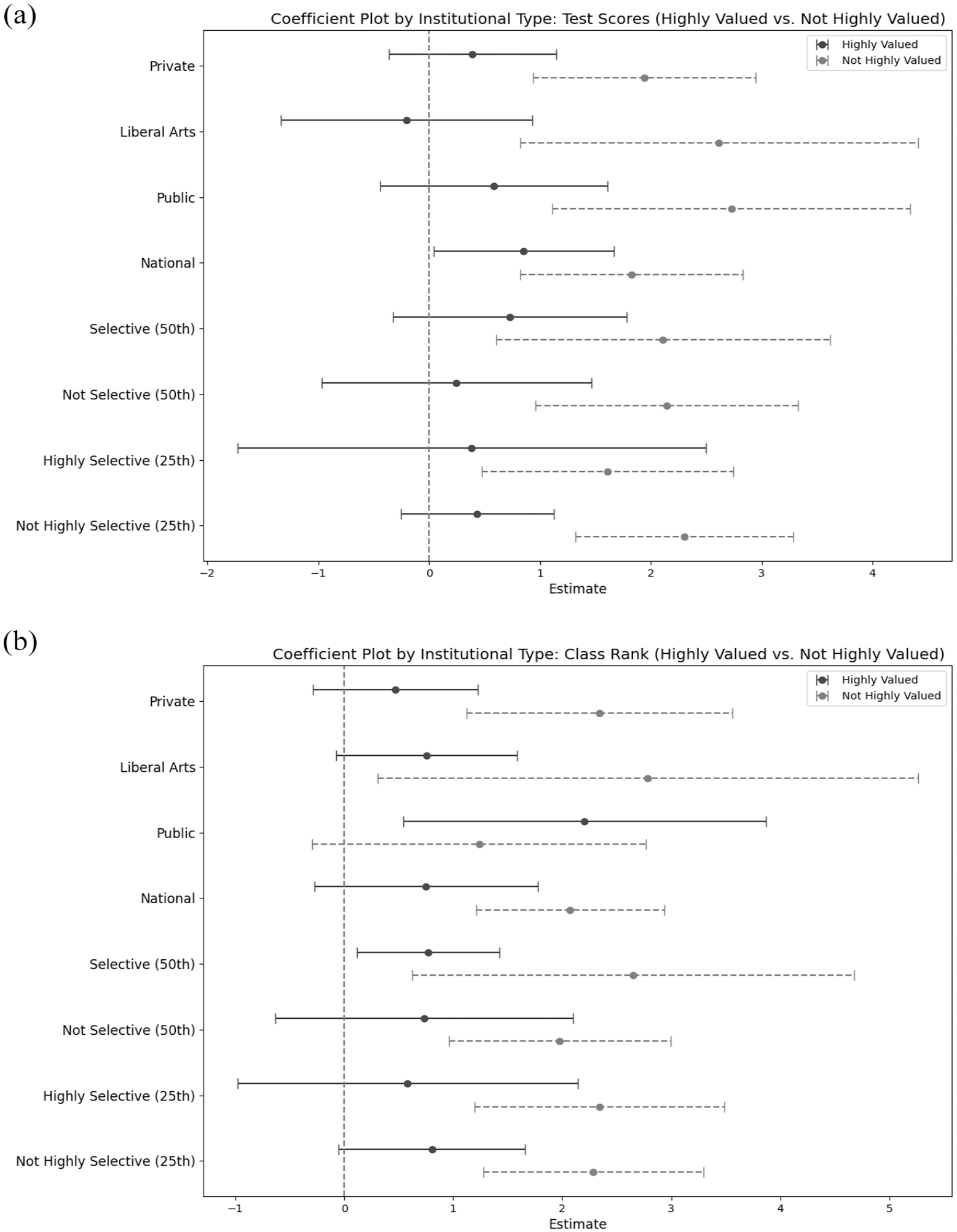
Effects of Eliminating Testing Requirements by Institutional Type
The findings from our subsample analyses examining the effect of test-optional policies in conjunction with placing high value on class rank (versus not) (see Figure 3b) are less orderly. For most institutional types, placing high value on class rank reduces the diversity effect of test-optional policies, although confidence intervals are largely overlapping. However, public institutions do not follow this pattern: there is little discernible difference in estimates between public institutions that highly value class rank versus those that do not. This should be interpreted with caution, as public institutions were the least likely to eliminate testing requirements. Overall, these findings are broadly consistent with our main results, particularly when it comes to the claimed value placed on standardized test scores.
We now turn to Hypothesis 3, which predicted that the effect of test-optional policies would be heightened at colleges and universities using a holistic approach to admissions. Figure 4 presents trajectories for subsets of test-optional colleges categorized as having above- versus below-average scores along the holistic criteria index. Both groups experience an increase (95 percent confidence interval) in underrepresented minority student enrollment during the first year following the policy change. However, the estimated effects are not statistically different (p-values > 0.40) between colleges that score high versus low on the holistic criteria index in the first three years, as reflected in the overlapping confidence intervals.
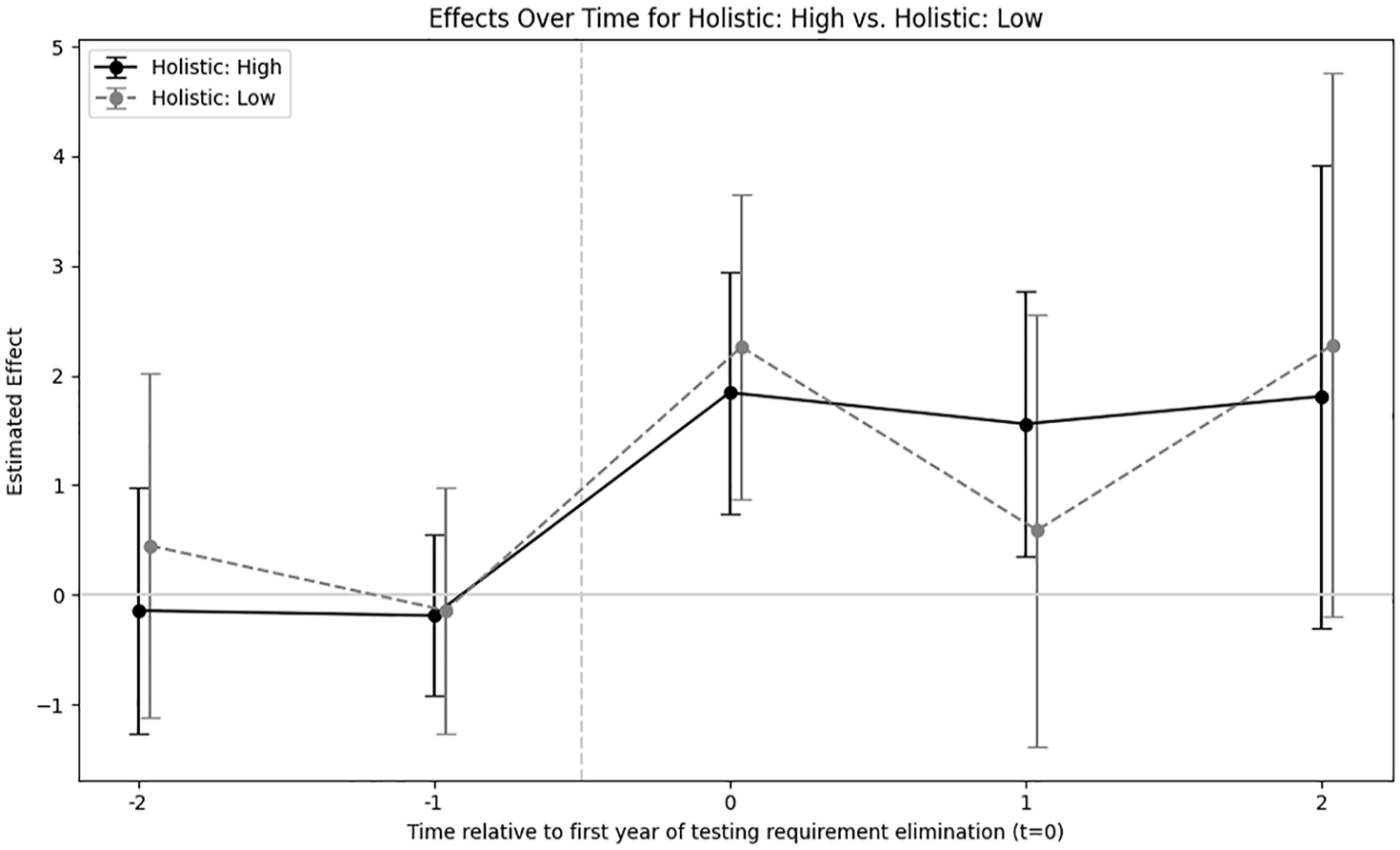
Lags and Leads Models Predicting Enrollment of Students from Underrepresented Groups Over Time by Value Placed on Holistic Criteria
Overall, these findings suggest that eliminating standardized test scores generally leads to a boost in student body diversity (supporting Hypothesis 1). However, a higher reported value placed on standardized test scores or class rank diminishes the positive effect of testing requirement elimination on minority student enrollment (consistent with Hypothesis 2). In contrast, a greater focus on holistic assessment does not significantly enhance the effect (contrary to Hypothesis 3).
The negative main effects of emphasizing standardized test scores and holistic orientation, shown in Table 4, also merit consideration in the overall assessment of how reported admissions values may affect student body diversity. Specifically, placing higher value on standardized test scores in admissions decisions tends to reduce the enrollment of underrepresented minority students and further counteracts the diversity increases associated with testing requirement elimination. Additionally, while a stronger holistic orientation is generally associated with a lower percentage of underrepresented minority students on campus, holistic-admissions colleges that eliminate testing requirements do see some improvement in underrepresented student enrollment. However, we find no evidence that the effect of testing requirement elimination varies based on a college’s holistic orientation.
Exploring the Relevance of Different Institutional Priorities
We next consider the influence of alternative institutional priorities on the relationship between elimination of testing requirements and student diversity. We first investigate whether the effect of test-optional adoption on underrepresented minority student enrollments may vary depending on the broader institutional pressures a college faces. Similar to the previous analysis, we split colleges that eliminated testing requirements into subsets based on whether or not they experienced a performance loss along each metric. As Figure 5 shows, colleges that did not experience performance declines along each of these metrics showed a significant positive effect of eliminating testing requirements (three-year ATEs varying between 1.63 and 2.47 percent; all significant at the 95 percent confidence level). While colleges that experienced a performance decline along each of these performance metrics had smaller three-year ATEs, only the differences in estimates between (1) colleges that reported a decrease in total enrollment versus colleges that did not (p-value of z-test is 0.007), and (2) colleges that reported a decrease in total revenue versus colleges that did not (p-value of z-test is 0.024), are statistically significant.
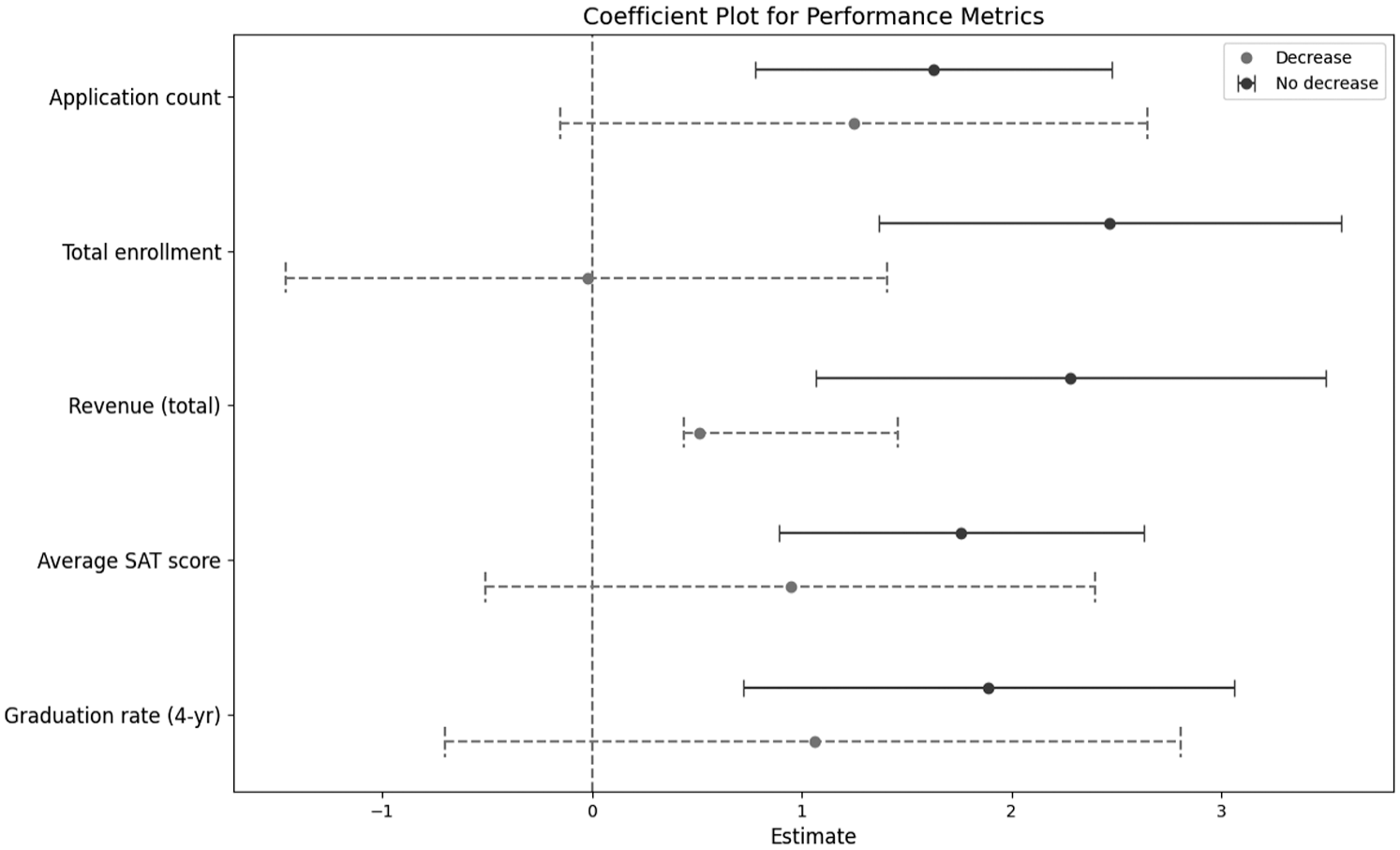
Three-Year ATE Estimates of the Effect of Eliminating Testing Requirements for Different Subsets of Colleges Based on Performance Two Years Prior to Eliminating Testing Requirements
Overall, these findings suggest that colleges experiencing significant financial or enrollment-related pressures in the period leading up to testing requirement elimination are less likely to realize a significant increase in minority student representation as a result of this policy change (supporting Hypothesis 4). One inference is that these alternative institutional pressures shift admissions officers’ attention toward competing goals, such as meeting budgetary needs or maintaining institutional status (Castilla and Poskanzer 2022; Espenshade and Radford 2009; Stevens 2009), as they adapt to a test-optional admission process. These institutional pressure effects underscore the broader challenge identified earlier: the competing priorities inherent in admissions decisions often lead to trade-offs that can dilute any diversity increases associated with eliminating testing requirements. In such cases, the elimination of testing requirements may serve other institutional objectives yet fail to increase diversity meaningfully.
Differential Commitments to and Motives for Eliminating Testing Requirements
A final issue we consider is the tension between eliminating testing requirements and continuing to emphasize their value in admissions decisions. Colleges that drop testing requirements but still report a high value placed on standardized scores may be sending mixed signals—expressing a commitment to diversity while maintaining the belief that test scores indicate which students belong and will succeed at their institutions. In this last post hoc section, we explore whether this stance manifests in observable ways, potentially reflecting a weaker commitment to eliminating testing requirements. This, in turn, may partially explain the reduced diversity increases associated with this approach.
We begin by examining changes in the proportion of enrolled students who submitted test scores to each college, using annual data from College Board surveys. When colleges eliminate testing requirements, it is reasonable to expect a decline in the proportion of applicants submitting test scores. However, if these colleges continue to emphasize the value of standardized test scores, students may perceive this as a “mixed position” and expect that not submitting scores could still harm their chances of admission despite their optional status. Furthermore, admissions officers at these institutions may continue to weigh submitted test scores in their decisions. As a result, we expect a higher percentage of enrolled students at these colleges will have submitted standardized test scores with their applications.
Using the de Chaisemartin and D’Haultfœuille (2020) DiD method, we estimate separate models to assess the effect of eliminating testing requirements on the proportion of enrolled students who submitted test scores. We compare colleges that highly value standardized test scores at the time of adopting test-optional policies against those that do not. For colleges that do not report highly valuing test scores, the proportion of enrolled submitting scores drops significantly with the elimination of testing requirements (three-year ATE is −20.12 percent). In contrast, colleges that continue to report placing a high value on test scores see a much smaller decline (−5.89 percent; p-value of difference in means is < 0.001). This suggests that when colleges maintain a strong emphasis on standardized test scores despite eliminating the requirement, students perceive little change in admissions expectations and will continue to submit scores at relatively high rates. Because students from low-income households (among whom Black and Hispanic students are disproportionately represented) are less likely than their higher-income counterparts to take and submit standardized tests (Miller 2023), this dynamic likely contributes to smaller increases in student diversity observed at colleges that continue to value test scores in admissions decisions.
A related question is whether colleges that eliminate standardized testing requirements, yet continue to self-report a high value placed on test scores, are more likely to reinstate those requirements later on. If so, this pattern would support the idea that the values admissions offices claim to prioritize—especially regarding different components of the applicant file—shape how admissions officers implement test-optional admissions practices. These values may shape whether test-optional policies are viewed as advancing or hindering admissions goals and, in turn, whether such policies become lasting changes or temporary experiments. To examine this question, we collected data on policy changes with respect to testing requirements from Fairtest.org up to May 30, 2024, focusing on the 917 colleges that did not require testing for applications submitted in Fall 2020. Because only a small set of colleges (19 in total) had reinstated testing requirements by Spring 2024, this analysis should be regarded as exploratory.
The sample consists of one observation per college, with institutions assigned a value of 1 if they reinstated testing requirements (and 0 otherwise). Using a logit model to estimate the likelihood of reinstating testing requirements (Appendix Table A1), we find that colleges reporting a high value placed on test scores were more likely to reinstate testing requirements (p < 0.05). We also find that colleges with higher yield rates were more likely to reinstate testing, possibly because they feel less pressure to attract applicants and can reintroduce testing without risking significant declines in enrollment. Although exploratory, this analysis, combined with our earlier findings, suggests that colleges that highly value standardized test scores while not requiring them occupy an intermediate, or more ambivalent, stance in terms of their commitment to test-optional policies. As a result, these schools may be less likely to realize diversity increases and more likely to move away from test-optional policies.
An additional consideration is whether the set of colleges that highly value standardized test scores at the time of going test-optional are also those facing enrollment or financial pressures. If so, this could indicate that these institutions may be more motivated by strategic concerns than a desire to broaden access and increase diversity. To explore this, we conducted a series of chi-square tests to examine whether colleges that prioritized standardized test scores at the time of adopting test-optional policies were more likely to have experienced declines in five institutional pressure dimensions: application volume, total enrollment, total revenue, average SAT score, and four-year graduation rate.
Only one of these dimensions—application volume—shows a non-random distribution. Colleges that eliminated testing requirements while continuing to emphasize test scores were significantly more likely to have experienced a recent drop in application volume (p = 0.043). Overall, this suggests that enrollment and financial pressures, while relevant for some institutions, are not the primary drivers of our main results.
Discussion
Prior research examining the impact of test-optional admissions policies on student-body diversity has yielded mixed results, and individual institutions have reported similarly varied experiences. The underlying sources of this heterogeneity are not well understood, hindering the ability of colleges and universities to anticipate the likely outcomes of their decisions regarding the use of standardized tests in the admissions process, such as whether to adopt, maintain, or abandon test-optional admissions policies. Gaining a more systematic understanding of how and why the impact of test-optional admissions policies varies across institutions is important, given that colleges and universities continue to navigate complex decisions in this area.
In this article, we proposed a set of theoretically-grounded sources of potential variation in outcomes following test-optional adoption. Recognizing that organizational outcomes are the result of formal policies, structures, and practices, as well as informal values and competing institutional priorities, we predicted that the consequences of eliminating testing requirements would vary depending on the admissions criteria a university prioritizes, and whether a university is facing other pressures. We tested our predictions on a college-and-university sample that is both broader (including public and private four-year colleges as well as colleges of varying levels of selectivity) and spans a longer timeframe relative to prior work on this topic (Belasco et al. 2015; Bennett 2022; Saboe and Terrizzi 2019).
Overall, we find that, on average, eliminating testing requirements increases student body diversity. However, there are significant differences depending on how strongly a college continues to value traditional academic criteria in defining merit. Colleges that report highly valuing test scores and class rank experience a smaller change in the enrollment of underrepresented minority students following the elimination of testing requirements relative to colleges that do not.
While holistic approaches to admissions do not appear to shape the effect of testing requirement elimination, we find that this approach is associated with a lower percentage of underrepresented minority students. This reduced diversity may reflect contrasting facets of a holistic approach. On the one hand, de-emphasizing test scores can remove a key barrier for students from underrepresented groups, allowing a greater diversity of students to be competitive in the admissions process. On the other hand, greater value placed on admission criteria such as essays, recommendations, and extracurriculars appears to work against student diversity outcomes, in part because these measures confer an outsized advantage on students from more privileged backgrounds who have access to the experiences, guidance, and presentation styles admissions officers tend to reward. Finally, we found that the presence of competing material pressures—namely, an institution’s recent losses in enrollment or revenues—weakened the positive effect of test-optional admissions policies on the enrollment of underrepresented minority students.
One question these findings bring up is: why do colleges that highly value standardized test scores in their admissions criteria move toward test-optional admission policies? Our analyses reveal that colleges that highly value test scores yet nonetheless choose to go test-optional are no more likely to have experienced declines in total enrollment, total revenue, average SAT score, or four-year graduation rate—factors that one might expect to drive their decisions. However, when schools did experience pressures around enrollment or revenue loss, the decision to go test-optional yields reduced diversity. It is important to recognize that colleges and universities, like most complex organizations, face multiple competing pressures. Diversity may be a key goal, but admissions officers also must consider how their decisions affect financial outcomes, enrollment, rankings, and student success (Askin and Bothner 2016; Castilla and Poskanzer 2022; Espenshade and Radford 2009; Stevens 2009). Actions aimed at responding to each of these competing pressures individually may work at cross-purposes with one another (Kraatz et al. 2010). As a result, although some institutions may adopt test-optional admissions policies with the aim of broadening access for underrepresented minority groups, the actual impact of these policies on student diversity appears to depend on existing admissions values and institutional priorities. These competing pressures and extant values, which may be difficult to shift, shape the way the practice of eliminating testing requirements is enacted, leading to overall heterogeneity in outcomes.
Institutional theory has long emphasized how rationalized myths and institutional pressures can lead to gaps between formal policy and practice (i.e., decoupling), particularly in highly institutionalized fields like education (DiMaggio and Powell 1983; Meyer and Rowan 1977). In many cases, policies are often adopted even as the link between their adoption and intended outcomes are opaque (Bromley and Powell 2012:489). Diversity practices often fall into this category of institutional myth, as stakeholder pressures have prompted the widespread adoption of unproven policies and programs, many of which have ultimately failed to produce the desired results (Dobbin, Kim, and Kalev 2011; Dobbin, Schrage, and Kalev 2015). The implementation of these practices is also shaped by underlying cultural values that inform and infuse decision-making. Colleges may commit to diversity, but the persistent value placed on traditional academic criteria—particularly criteria that are easy to quantify—may unintentionally undermine these goals (Stevens 2009). As a result, admissions officers may inadvertently perpetuate the inequalities that such policies aim to reduce.
For administrators and policymakers interested in broadening college and university access, our findings highlight the importance of attending to formal policy changes that remove barriers, as well as the critical task of reshaping the informal organization—its values, beliefs, and norms. This takeaway echoes a guiding principle for leading organizational change; namely, that alterations to an organization’s formal policies and structures must be accompanied by concomitant shifts in the informal organization (Kellogg 2011; Kotter and Cohen 2012). Altering a formal policy can signal a shift in organizational values, prompting a change in the way the organization operates. Often, however, additional work is needed to embed such a change deeply into the organization. Our findings show that colleges that continue to place high value on standardized test scores—despite no longer requiring their submission—tend to see less change in key enrollment patterns. This includes smaller increases in underrepresented minority enrollment and relatively stable rates of enrolled students who submitted test scores. These patterns suggest that deeper cultural change in such cases remains limited. The greater tendency to reverse this policy among such colleges further indicates the challenges institutions face in aligning stated policies with underlying values.
Beyond their direct application within higher education, our results are pertinent to research on diversity management in organizations more generally. As a tactic for cultivating diversity in organizations, practices such as using standardized tests in college admissions are akin to the use of job testing among business and not-for-profit organizations in hiring. While it seems plausible that the standardized and objective nature of testing could reduce discrimination, discretion in determining who must be tested, and what constitutes an acceptable score, leave room for bias. Prior empirical research is consistent with this latter possibility. Analyzing the effects of job testing in 800 large, private employers over a nearly 30-year span, researchers found that job testing was negatively associated with managerial diversity (Dobbin et al. 2015). This finding suggests that removing testing requirements in employment contexts could help increase diversity, similar to what occurred when universities went test-optional.
Finally, our findings highlight the complexity of the environmental and institutional pressures that organizations face today, as they seek to meet a variety of distinct goals. Colleges and universities are asked to produce employable students, to serve as a route for mobility, to remain financially viable, to produce innovative research, and so on. In seeking to meet diversity goals in the latter decades of the twentieth century, a number of colleges and universities adopted race-sensitive admissions criteria; these polices faced court challenges and state bans and eventually were deemed unconstitutional by the U.S. Supreme Court in 2023 (Liptak 2023; Rosinger et al. 2021). Moreover, recent political and legal challenges to diversity, equity, and inclusion initiatives at universities, including explicit federal bans on programs and practices designed to increase student racial diversity (see Cavanagh 2025; Otterman et al. 2025; U.S. Department of Education 2025), have further complicated institutional efforts to ensure equitable access to higher education.
These legal and political challenges have led institutions to scale back race-conscious programs beyond admissions, affecting less historically contested practices such as minority-targeted outreach, mentorship, and financial aid programs (Dale 2025; Kim 2025; Patel and Otterman 2024), which universities had increasingly adopted in an effort to handle challenges to race-conscious practices (Bowen and Bok 1998; Dumas-Hines et al. 2001; Hirschman and Berrey 2017; Stevens 2009). Although test-optional admissions policies may once have been viewed as a less-contested means by which universities could lower barriers to higher-education access, these policies were highlighted in a February 2025 federal “Dear Colleague” letter as potentially unlawful, depending on the intent behind adoption (U.S. Department of Education 2025). Our analysis suggests predictable effects on student body diversity that could follow from the reinstatement of testing requirements.
As with any study, this research is subject to limitations. Colleges that eliminate testing requirements likely differ from those that do not. While it is important to consider whether and how unobservable differences may affect our results, we believe this issue is somewhat mitigated given our more focused interest in how organizational values and pressures moderate the effects of testing requirement elimination. It is not obvious, for example, that organizations that eliminate testing requirements and maintain a traditional academic conception of merit necessarily value diversity less or are less favorably inclined toward applicants from underrepresented groups. As we mentioned above, there are many reasons why conceptions of merit that focus on academic metrics might persist. Nonetheless, future research may be able to develop more granular measures that can help address this concern.
A second limitation centers around generalizability of our findings. Our findings add to a set of studies that have produced mixed results with respect to the overall effects of test-optional policies on the diversity of student enrollment. Comparing prior research on test-optional policies is challenging due to differences in college/university samples and timeframes. For instance, Bennett (2022) finds a positive diversity effect at private institutions (2005 to 2016), and Sweitzer, Blalock, and Sharma (2018) report a similar effect in liberal arts schools (1999 to 2014). Conversely, Belasco and colleagues (2015) find no effect among selective liberal arts colleges (1992 to 2010). We tested our predictions on a college-and-university sample that is both broader (including public and private four-year colleges as well as colleges of varying levels of selectivity) and spans a longer timeframe relative to prior work on this topic (Belasco et al. 2015; Bennett 2022; Saboe and Terrizzi 2019). Our data allow for subsample comparisons (Figure 3) that show consistency with these studies. For example, liberal arts schools and private institutions that place low value on test scores tend to see diversity increases from test-optional policies, aligning with Sweitzer and colleagues (2018) and Bennett (2022). More generally, divergence between studies may also stem from shifts in external pressures, as many institutions in our sample adopted test-optional policies later (2015 to 2019). Ultimately, test-optional effects likely depend on broader societal factors, including regulatory, cultural, and economic influences.
Finally, an important avenue for future research is unpacking the relationship between test-optional admissions practices and admissions versus enrollment decisions. To our knowledge, admissions data that capture the racial/ethnic backgrounds of applicants, as well as admitted students (distinct from enrolled students), for a broad set of colleges are not systematically available. The data we collected and analyzed pertain to enrollment numbers. Thus, we are not able to determine how much of the change in student body composition associated with the elimination of testing requirements is driven by shifts in the types of students who apply to a university versus changes in admissions officers’ decision-making processes, or even changes in student enrollment decisions. One recent study analyzed applications and admissions data for a small set of highly selective public and private colleges (Chetty et al. 2023), but test-optional policies were not a focus of that study. A broader study of enrollment patterns would provide a more nuanced picture of how differences in applicant pools and admissions decisions across institutions contribute to the changing composition of today’s colleges.
Footnotes
Appendix
Logit Regression Estimating Likelihood of Reinstating Testing Requirements Post-Covid
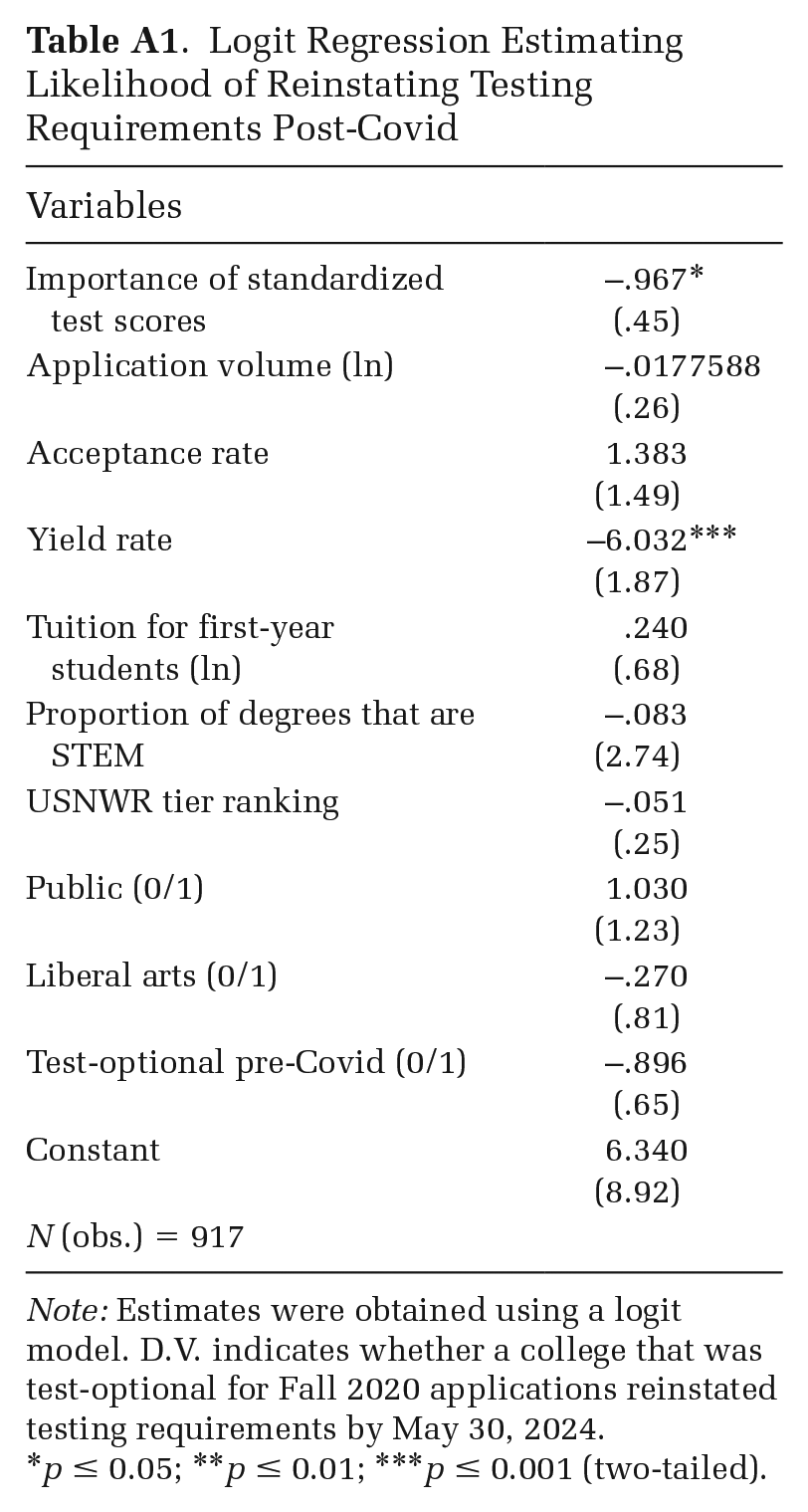
| Variables | |
|---|---|
| Importance of standardized test scores | –.967*
(.45) |
| Application volume (ln) | –.0177588 (.26) |
| Acceptance rate | 1.383 (1.49) |
| Yield rate | –6.032***
(1.87) |
| Tuition for first-year students (ln) | .240 (.68) |
| Proportion of degrees that are STEM | –.083 (2.74) |
| USNWR tier ranking | –.051 (.25) |
| Public (0/1) | 1.030 (1.23) |
| Liberal arts (0/1) | –.270 (.81) |
| Test-optional pre-Covid (0/1) | –.896 (.65) |
| Constant | 6.340 (8.92) |
| N (obs.) = 917 |
Note: Estimates were obtained using a logit model. D.V. indicates whether a college that was test-optional for Fall 2020 applications reinstated testing requirements by May 30, 2024.
p ≤ 0.05; **p ≤ 0.01; ***p ≤ 0.001 (two-tailed).
Acknowledgements
We are grateful to Beth Bechky, Christopher Bennett, Patricia Bromley, Gina Dokko, Özgecan Koçak, Matthew Kraatz, and Mitchell Stevens, and seminar participants at the University of Wisconsin–Madison, the University of Hong Kong, Columbia University, HEC Paris, and the Culture Connect Conference at UC-Berkeley for their helpful comments and suggestions on earlier drafts of this work.
