



Abstract
Sociologist Thomas J. Linneman explores trends of support for marijuana legalization in the United States.
Keywords
This past spring, a Girl Scout made national news for selling her cookies outside a medical marijuana dispensary. While some adult members of the Girl Scouts were not amused by this tactic, the nature of the news coverage was revealing. The tenor of the coverage smacked not of “reefer madness” paranoia, but rather amazement at the girl’s entrepreneurial ingenuity. Indeed, we seem to be entering a new age of marijuana acceptance.
While I’ll claim indifference to marijuana itself, I cannot help but marvel at the skyrocketing support for its legalization. Typically, when public opinion shifts, it does so gradually. Support for marijuana legalization is an exception to this rule. Twenty years ago, only High Times readers (and a few others) favored legalization. Currently, nearly half of all Americans support it. Legislatively, a floodgate is opening. During the latest election cycle, two states (Colorado and Washington) approved legalization, and state-regulated sale of marijuana has begun. What factors converged to get us to this point? To develop some potential answers, I turned to the General Social Survey (GSS), which has been asking a single question regarding marijuana legalization for nearly 40 years.
Twenty years ago, only High Times readers (and a few others) favored marijuana legalization. Currently, nearly half of all Americans support it.
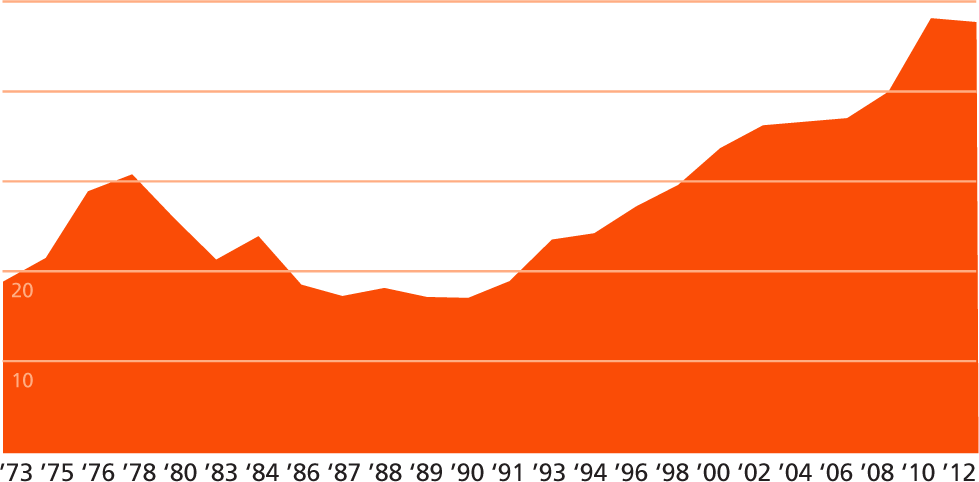
The GSS is one of the most longstanding and respected surveys of Americans’ opinions on a wide variety of social issues. GSS researchers began collecting data in 1972, and very shortly thereafter started asking this question: “Do you think the use of marijuana should be made legal or not?” Given that it was the 1970s, the GSS researchers gave the resulting variable the name grass. The first chart on page 72 illustrates the general opinion trend.
Support for “grass” climbed throughout the 1970s, peaking at nearly a third of the respondents. As the 1980s began, support diminished, sinking to a low of 17 percent in the 1990 GSS. Support then quickly grew to its current point of nearly 48 percent. This up-down trend differs from that of most other social issues, for which support typically grows in a linear fashion. Could the decline in support occur again? I say no, for reasons I describe below.
Image from Flickr|Ian Sane

Support for Marijuana Legalization
Source: GSS
Support for Marijuana Legalization by Political Views
Source: GSS
A Broadening of Support
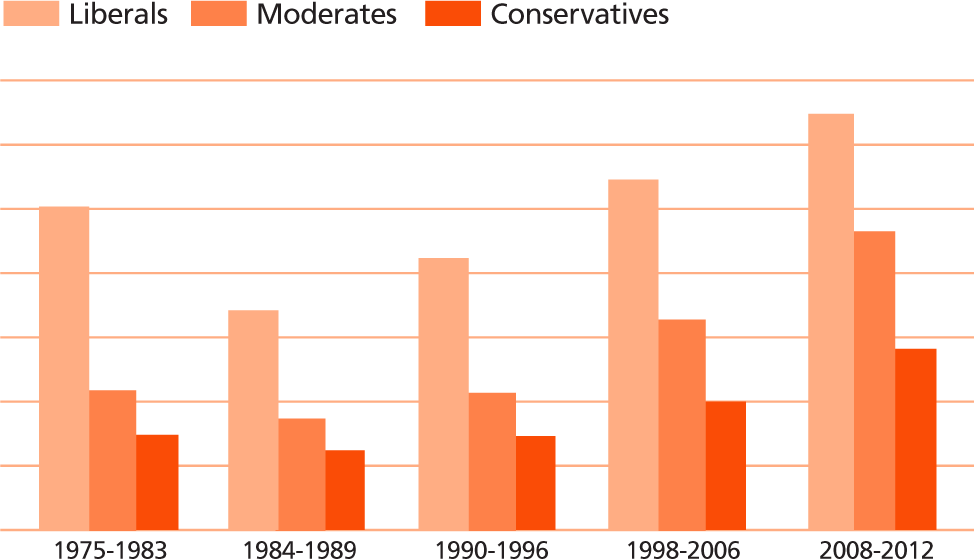
Support for legalization is climbing, but it is important to realize that it is climbing in particular ways among particular groups. The charts illustrate this. A chart on this page (see above, right) shows how support has changed over time among three groups, as measured by the basic GSS political views variable: liberals, moderates, and conservatives.
Sixty-two percent of liberals aged 18 to 31 support legalization, 60 percent of liberals aged 32 to 43 support, support is at 71 percent among liberals aged 44 to 58, and 66 percent among liberals aged 59 and older.
The first year that the GSS included both the GRASS variable and the political views variable was 1975. In the early years, the vast majority of support for legalization came from liberals. Few moderates and conservatives favored legalization. Then, liberals’ declining support significantly contributed to the overall decline illustrated in the chart above, left. In recent years, not only has liberals’ support climbed, moderate support has also increased. Whereas these grouped differed by 29 percent in the early years, they now differ by only 18 percent. And nearly a third of conservatives also support legalization in recent years. Support, then, is no longer reliant only on the liberal members of the U.S. public.
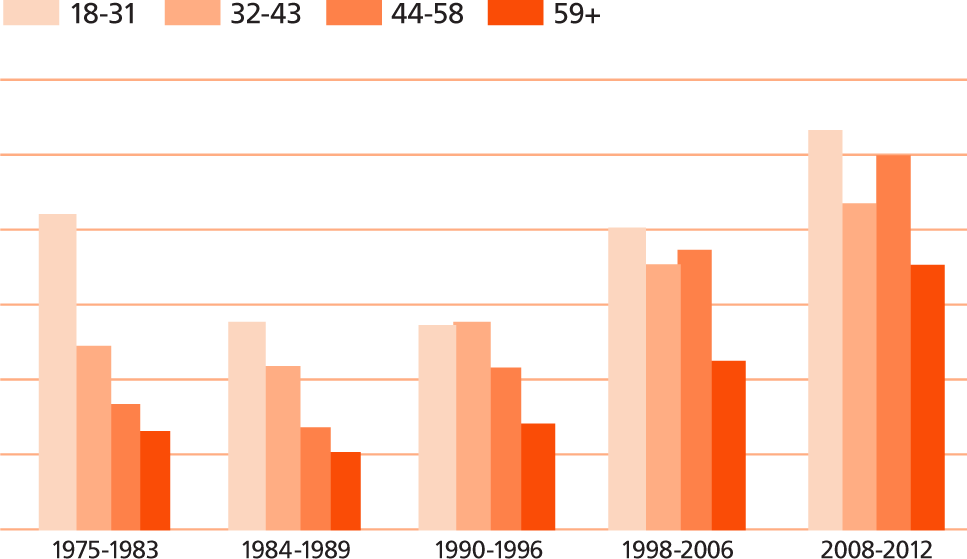
The same is true of age, as the chart on the next page shows. To create this chart, I divided the GSS respondents into quartiles by creating age groupings that each contained roughly a quarter of the respondents.
In the early years, most of the support for legalization came from the younger age groups (those crazy kids!). In contrast, ever since the nadir of 1990, older age groups have supported legalization at levels similar to that of the youngest respondents. Even among the oldest age group, over a third of the respondents now favor legalization. When one combines political views and age, an even more interesting story emerges: older liberals support legalization at the same level or even more so than younger liberals. Sixty-two percent of liberals aged 18 to 31 support legalization, 60 percent of liberals aged 32 to 43 support, support is at 71 percent among liberals aged 44 to 58, and 66 percent among liberals aged 59 and older. Perhaps the rise in support among older groups in recent years is a cohort effect: young people who favored legalization in the 1970s are now in older age groups forty years later. Given that the GSS is not longitudinal, we have no way of knowing from these data if specific individuals have changed their opinions over time. However, it is clear that support for legalization is no longer reliant on a single generation.
It’s My Body, I‘ll Do What I Want
Another reason support for marijuana may be here to stay is that it seems that these opinions have become part of a larger belief that control of one’s own body is a human right. While marijuana concerns what one puts into one’s body, other important social issues concern the body as well: abortion (who controls women’s bodies?), euthanasia (should people be allowed to let their own bodies die?), and sex (should we legislate what people do with their bodies in their own bedrooms?). To examine this possibility, I cross-tabulated support for marijuana legalization with these related GSS questions: abortion (“it should be possible for a woman to obtain a legal abortion if she wants it for any reason”), euthanasia (“when a person has a disease that cannot be cured, doctors should be allowed by law to end the patient’s life by some painless means if the patient and his family request it”), premarital sex (“a man and a woman who have sex relations before marriage is not wrong at all”), and homosexuality (“sexual relations between two adults of the same sex is not wrong at all”). The chart on this page (see above, right) illustrates what I found.
Support for Marijuana Legalization By Age
Source: GSS
Support for Body-Related Issues
Source: GSS
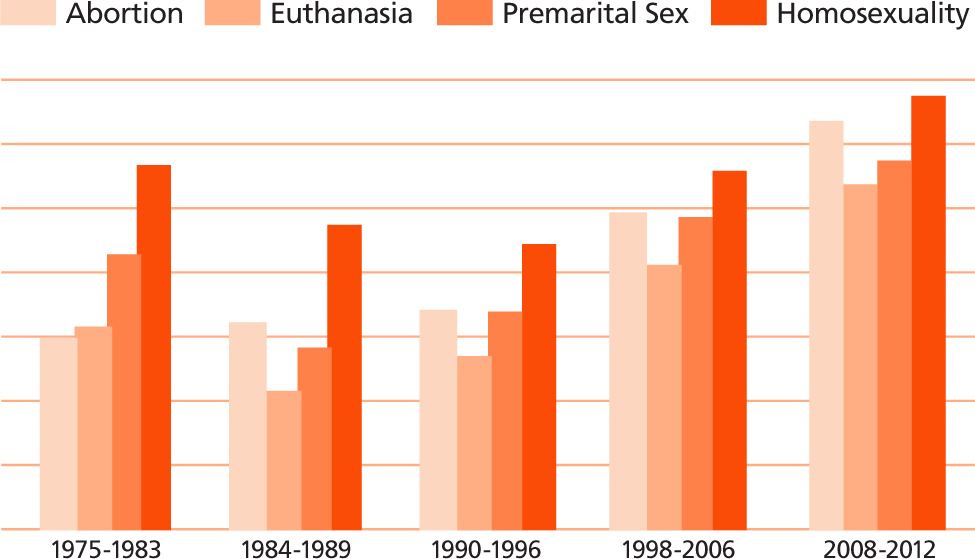
The bars represent the percentage of respondents who support each issue and marijuana legalization. For example, in the early years, among those who supported a woman’s right to abortion, only 40 percent supported marijuana legalization. Currently, 64 percent of those who support a woman’s right to abortion also support marijuana legalization. The other social issues follow the same trend: support for these other social issues and marijuana legalization is now more likely to occur together. It seems that people may be viewing marijuana use as one of a series of body-related behaviors over which they feel people should have control. This is yet another sign that support for legalization is likely to be permanent.
High Time for New Data
Though opinions have shifted significantly, we must keep in mind that a slim majority of GSS respondents still believe marijuana should remain illegal, and support for legalization did not rise between 2010 and 2012. Even though popular culture increasingly treats marijuana as a harmless pastime, many Americans remain skeptical of the drug. Though the days of “reefer madness” may be far behind us, many Americans still fear the potential gateway effect marijuana is reputed to have. Sociologists must keep a very close eye on Colorado and Washington State and carefully measure the effects of legalization over the next few years. Only with new data will we be able to make fully informed decisions regarding the possibility of legalization in other states.
Currently, 64 percent of those who support a woman’s right to abortion also support marijuana legalization.