




Abstract
Marijuana use among U.S. college students is the highest since the mid-1980s. Because knowledge about marijuana and confidence in the knowledge are related to changing marijuana laws and marijuana-related messages ubiquitous in college students’ information environment, we examined their relationships with use. The Structural Equation Modeling method was used to analyze the relationships using survey responses from 249 college students in an adult-use marijuana legal state. Marijuana health knowledge was related to less use, and law knowledge was related to more use. Both relationships were mediated by perceived risk. Confidence in knowledge was related to more use directly as well as indirectly via lower peer disapproval and lower perceived risk. Among various marijuana message channels, peers were the most influential, contributing to lower health knowledge and higher confidence in knowledge.
Marijuana use among U.S. college students is the highest in more than three decades (Schulenberg et al., 2019). More college students initiate the substance (Miech et al., 2017), and problematic use is also on the rise in the age group (Hasin et al., 2015). Marijuana legalization has been indicated as a contributing factor (Kerr et al., 2017; Miller et al., 2017; Parnes et al., 2018). However, we know little about how marijuana legalization, a macro policy change, is related to rising marijuana use, individual behaviors. The signaling hypothesis (Miech et al., 2015) turned a spotlight on marijuana message exposure as a potential risk factor. News coverage of marijuana has become more favorable in recent decades (e.g., McGinty et al., 2016), and pro-marijuana messages have been circulating heavily on the internet (e.g., Bierut et al., 2017). However, the mechanism connecting the ubiquitous pro-marijuana messages and marijuana use remains unknown.
To date, a few studies reported that more accurate knowledge of new marijuana laws (MK-L) was related to more use (Brooks-Russell et al., 2017; Bull et al., 2017; Park, Yun, et al., 2022; Roppolo et al., 2019), whereas accurate knowledge of marijuana health effects (MK-H) was related to less use (Kruger et al., 2020; Park et al., 2022b). Also observed was more marijuana use among college students with higher confidence in marijuana knowledge (CMK), a meta-cognition about knowledge (Park et al., 2022a). This is an important construct because prior work has established that confidence in knowledge is often misaligned with one's objectively measured knowledge (Kruger & Dunning, 1999). The association between CMK and marijuana use has been found among adolescents as well (Parker & Stone, 2014). Further, a recent study added that marijuana-related messages from certain communication channels contribute to more accurate knowledge while other channels contribute to higher CMK (Park et al., 2020a).
Based on these studies, we tested a psychological process model in which knowledge and confidence in knowledge connect marijuana message exposure and use. Given the well-documented relationship of marijuana use with perceived risk (Parker & Anthony, 2018) and the importance of peers in college students’ marijuana use (Pinchevsky et al., 2012), perceived risk and peer disapproval were also included in the model. By testing this model (see Appendix A, online-only material), we aimed to shed light on the psychological mechanism behind college students’ increasing marijuana use in the changing regulatory environment.
Marijuana Knowledge and Confidence in Knowledge as Risk/Protective Factors
For decades, the knowledge-attitude-practice (KAP) model has served as a framework to understand people's health behaviors and a tool to engineer perceptual and behavioral changes for better health (Tamir et al., 2001). Indeed, the field of health education is premised on the idea that knowledge promotes healthy behaviors (Kenkel, 1991; Sigelman et al., 2003).
Still, the connection between knowledge and health behavior has been less than reliable (e.g., Happell et al., 2014; Rubin et al., 1989) and it was even more so for health risk behaviors. In one study, higher scores on a sub-type of knowledge—estimates of the odds of risk—were associated with more risk behaviors (Cook & Bellis, 2001). Also, more accurate birth control knowledge predicted higher sexual activity and pregnancy rates among adolescent girls (Jaccard et al., 2005). The overall ineffectiveness of knowledge-based programs in reducing drug use also cast doubt on the utility of knowledge in drug intervention (Faggiano et al., 2008).
Outside the context of school-based drug interventions, we have only a limited understanding of how much people know about marijuana and whether the knowledge affects their use. With the rapid expansion of marijuana decriminalization and legalization in the U.S. (National Conference of State Legislatures, N.D.), however, knowledge might play a more important role than before. In communities where adult use became legal, people were frustrated with the lack of accessible, science-based information about the health effects of use (Jarlenski et al., 2016; Mason et al., 2015). Instead, pro-marijuana messages from social media, the internet, and peers filled the information vacuum, and studies have linked exposure to such messages to increased use among adolescents and emerging adults (Cabrera-Nguyen et al., 2016; Martinez & Lewis, 2016; Roditis et al., 2016). On the flip side, two studies provide preliminary support for the idea that accurate knowledge could be a protective factor. Among marijuana conference attendees most of whom were using marijuana more than once a week, more accurate knowledge of marijuana health risks was associated with less frequent use (Kruger et al., 2020). Higher knowledge among college students was also related to lower current use and future use intention (Park et al., 2022a).
To reconcile the positive relationship between knowledge and risk behaviors found in the earlier studies (Cook & Bellis, 2001; Jaccard et al., 2005) and the negative relationship between knowledge and marijuana use in the recent two studies (Kruger et al., 2020; Park et al., 2022a), one may need to consider the function of knowledge in the different contexts. Certain types of knowledge about risk behaviors might indicate one's openness toward the behaviors rather than an enhanced understanding. For example, the higher birth control knowledge of the girls who later reported higher sexual activity and pregnancy rates (Jaccard et al., 2005) might indicate their interest in sex more than their understanding of human reproduction science.
In marijuana research, a few studies suggest that MK-L might have a similar utility. Among Colorado teens, users exhibited higher MK-L and lower MK-H than non-users (Bull et al., 2017). In surveys conducted to evaluate a marijuana public information campaign in Colorado, marijuana users had exhibited higher MK-L than non-users at the baseline. Subsequently, post-campaign gains in MK-L were driven by the increased MK-L of non-users (Brooks-Russell et al., 2017). These trends engender speculation that people who are either already using marijuana or interested in use might pay closer attention to the new laws and become more knowledgeable about them. Similarly, MK-H may indicate people's objective knowledge of the health effects of marijuana use as well as their willingness to accept the information as true.
Unlike this nuanced relationship between knowledge and use, the relationship between confidence in knowledge – a meta-cognition about one's knowledge in a specific domain – and marijuana use is straightforward. Confidence in knowledge was a predictor of many risk behaviors (National Safety Council, n.d.). The relationship was also confirmed in two studies that specifically examined marijuana use: Confidence in drug knowledge was positively correlated with marijuana use among 18 to 19-year-olds (Parker & Stone, 2014) and higher CMK predicted marijuana use among college students (Park et al., 2022a).
Among the limited number of studies that reported on the relationship between marijuana knowledge and use, even fewer studies included a marijuana-related attitude(s) in the investigation. From a survey of adolescents in California, Roditis et al. (2016) found that social acceptability of use among close friends as well as exposure to pro-marijuana messages on social media increased the odds of using marijuana while perceived risk decreased it. In Colorado, teen users, in comparison to non-users, exhibited lower perceived risk alongside MK-L and lower MK-H (Bull et al., 2017). Also in Colorado, English-speaking Latinos had higher MK-L, lower MK-H, and lower perceived risk than Spanish-speaking Latinos (Roppolo et al., 2019). Among college students, attitudes toward marijuana use mediated the relationship between marijuana information seeking from media sources and intention to use, although peer norms did not (Martinez & Lewis, 2016).
Whereas these studies suggested that marijuana knowledge and use are also likely to be associated with social norms and perceived risk, one study directly examined perceived risk and peer approval as potential mediators between knowledge and use (Park et al., 2022a). The results showed that higher knowledge was associated with less use via higher perceived risk, but not via peer approval.
Marijuana Message Channels, Knowledge, and Confidence in Knowledge
Due to the restrictions in research placed by the federal prohibition of marijuana in the U.S., it is difficult to obtain conclusive evidence concerning the health effects of marijuana use. Consequently, public discussions about the findings often ended with uncertainty, leaving the public confused and vulnerable to misinformation (e.g., Eisenberg et al., 2019). On the other hand, marijuana legalization activists and business interests have seized the opportunities by filling the void with messages promoting their respective agendas (Quinton, 2018; Warner, 2016).
A handful of studies that focused on American young adults’ use of marijuana message channels converged on a few findings. First, peers and the internet were used more than any other channels (Cheng et al., 2017; Lewis et al., 2016). Second, in using the channels, young people were more likely to run into marijuana-related messages passively (i.e., “information scanning”) than to pursue them actively and purposefully (i.e., “information seeking”) (Cheng et al., 2017; Lewis et al., 2016; Lewis et al., 2017; Park et al., 2020a). Third, healthcare providers constituted the most trusted yet the least utilized channels (Cheng et al., 2017; Popova et al., 2017).
On the other hand, the relationships between various marijuana message channels and marijuana-related perceptions and behaviors are yet to be settled. In one study, information seeking from the media and interpersonal sources were both significantly correlated with CMK and marijuana use (Lewis et al., 2017). When researchers controlled some demographic variables and common risk factors, media channels were related to intention to use, whereas interpersonal channels were not (Martinez & Lewis, 2016).
However, the dichotomy of interpersonal vis-à-vis media channels was not based on any theoretical or empirical basis. Hence, a group of researchers took a different approach and identified four groups of marijuana message sources based on how college students used them (Park et al., 2020a). According to their factor analysis results, doctors, schools, and the government were loaded on one dimension–hence named “science/education sources”— and all three sources had consistently high factor loadings (> .71). Friends, the internet, social media, and news media constituted another factor—hence named “peer/media sources”—, although the factor loadings were more varied, ranging between .62 and .81. Parents and siblings did not load on either dimension.
When the researchers subsequently examined the relationships between the four marijuana message sources and knowledge, peer/media sources were negatively and education/science sources were positively related to MM-H. Peer/media sources, along with parents, were also linked to higher CMK. MK-L was not associated with any of the examined sources (Park et al., 2020a).
The Current Study
The literature review provided bases to build a marijuana communication model. In this model, three relationships were of primary interest: MK-H and use, MK-L and use, and CMK and use. Existing evidence suggested that MK-H might be related to less use (Kruger et al., 2020), whereas MK-L might be related to more use (Roppolo et al., 2019). However, the previous studies employed simple zero-order correlation analysis or no statistical test at all. Hence, the relationships between MK-H and use as well as MK-L and use were formally tested here. Additionally, the relationships were expected to be mediated by perceived risk, as suggested by the KAP model and illustrated in an earlier study (Park et al., 2022a).
H1a. Higher knowledge about the health effects of marijuana is related to less marijuana use among college students. H1b. The negative relationship between marijuana health knowledge and use is mediated by perceived risk. H2a. Higher knowledge of marijuana laws is related to more marijuana use among college students. H2b. The positive relationship between marijuana law knowledge and use is mediated by perceived risk.
Unlike the relationships between knowledge and use, support for the positive relationship between CMK and use was solid. Yet to be tested was whether perceived risk mediates the relationship between CMK and use. A research question was posed.
H3a. Higher confidence in marijuana knowledge is related to more marijuana use among college students. RQ1. Is the positive relationship between confidence in marijuana knowledge and marijuana use mediated by perceived risk?
Due to the scarcity of research and inconsistent groupings of the communication channels in previous studies (Lewis et al., 2017; Park et al., 2020a), a research question rather than a hypothesis was generated to explore the relationships among marijuana message channels and MK-H, MK-L, CMK, perceived risk, and use. In this model, doctors, schools, and the government were combined as one channel because they solidly loaded on one factor in a previous study (Park et al., 2020a) and consonantly convey evidence-based content. On the other hand, friends, the internet, social media, and news media were kept as separate channels because their factor loadings were not as clear (Park et al., 2020a) and their marijuana-related content is more heterogeneous as demonstrated in content analysis studies (Park & Holody, 2018).
RQ2. How are marijuana message channels related to marijuana health and law knowledge, confidence in marijuana knowledge, perceived risk, and use?
Methods
Data Collection Procedure
An internet survey was conducted in the fall of 2019 at a university in an adult-use legal state. Because we were primarily concerned about marijuana information exposure and use of people under 21 years of age, we identified lower-level introductory classes in various disciplines and recruited students. Among 319 students recruited, 257 (81%) took the survey. Among them, six responses containing many missing answers and two responses from those aged 25 or older were excluded, resulting in 249 responses. This study was approved by the university's institutional review board.
Sample
The students’ age ranged between 18 and 23 (M = 18.45, S.D. = .84). Slightly more than half of the students were non-Hispanic White (n = 133, 53%), comparable to their percentage (58%) in the entire student body on the campus. Hispanic (n = 45, 18%) and Asian (n = 24, 10%) were the most common minority groups. A substantial number of students identified themselves as mixed race (n = 38, 15%). Compared to their share (53%) in the student population, women were overrepresented (n = 192, 77%).
Measures
Marijuana Message Scanning
An existing scale (Lewis et al., 2017) was modified to capture marijuana message scanning from nine channels (e.g., “How frequently have you come across information about marijuana from XXX when you were not actively looking for it?”). Answers were obtained on a five-point scale, ranging from Never to All the time. Marijuana message scanning from each channel was used as a single-item measure. The only exception was marijuana message scanning from doctors/other healthcare professionals, schools/teachers, and government public health agencies. Because these channels reliably convey evidence-based curated information, i.e., high face validity, and answers to the three questions showed an acceptable level of reliability (Cronbach's
Confidence in Marijuana Knowledge (CMK)
An existing 6-item scale (Park et al., 2022a) was used to assess people's confidence in their knowledge of marijuana concerning these aspects: different types of marijuana products; how to use marijuana; the effects of marijuana use on physical and psychological health; marijuana laws and regulations; the impact of marijuana use on you and your peers’ college experience; social debates about marijuana legalization (e.g., “How confident are you with your understanding of XXX?”). Answers were obtained on a 5-point scale, ranging from No confidence at all to Complete confidence. The scale showed high reliability (Cronbach's
Marijuana Health Knowledge (Mk-H)
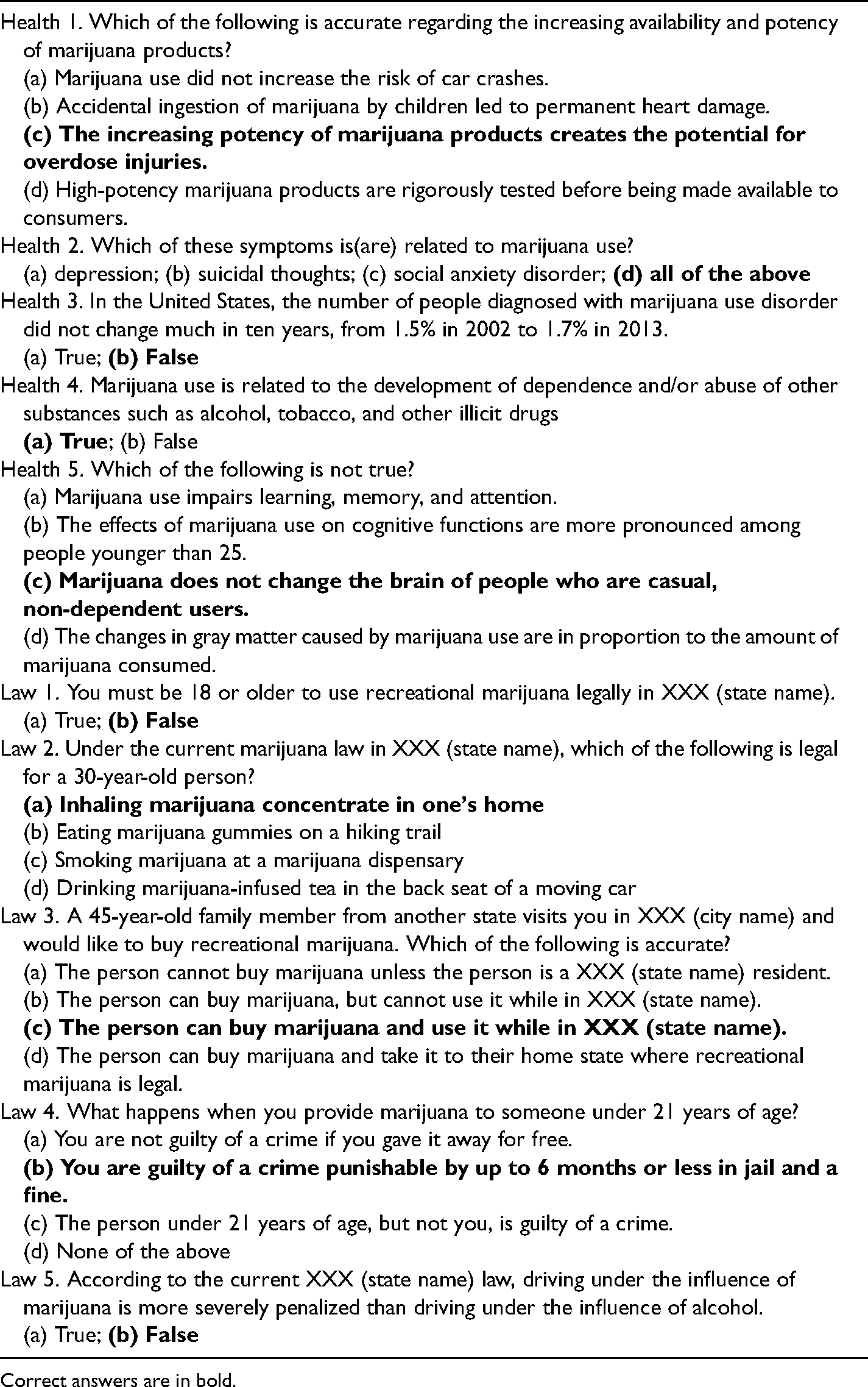
An existing 5-item measure (Park et al., 2020b) was used. The number of correct answers became the composite score (M = 3.16, SD = 1.27). See Appendix B for the five questions and refer to the cited article for further details.
Marijuana Law Knowledge (Mk-L)
An existing 5-item measure (Park et al., 2020b) was used. The number of correct answers became the composite score (M = 3.24, SD = 1.24). See Appendix B for the five questions and refer to the cited article for further details.
Perceived Risk
A 3-item measure (Schulenberg et al., 2019) asked how much the participant thought people risk harming themselves physically or in other ways if they tried marijuana once or twice/used marijuana occasionally/used marijuana regularly. Answers were obtained on a 5-point scale, ranging from No risk to Great risk. The three scores generated high reliability (Cronbach's
Peer Disapproval
A 4-item marijuana injunctive norm scale (Neighbors et al., 2008) was adapted to assess the approval of “other students on campus” instead of “close friends” in the original scale. The questions asked how much other students on campus would disapprove or approve if someone abstained from marijuana/tried marijuana/used marijuana occasionally/used marijuana regularly. Answers were obtained on a 5-point scale, ranging from Strongly approve to Strongly disapprove. Because one item about peers’ approval of abstention decreased the reliability of the scale significantly, only the remaining three measures were averaged to indicate peer disapproval (Cronbach's
Marijuana Use
A 3-item measure (Schulenberg et al., 2019) asked how many occasions, if any, the participant had used marijuana during the last 30 days/during the last 12 months/in lifetime. Answers were obtained on a 5-point scale, ranging from 0 occasion to 40 or more occasions. The three measures generated a high reliability score (Cronbach's
Data Analysis
Structural Equation Modeling (SEM) was used to test the proposed model using the lavaan package in R software (Rosseel, 2012). The model consisted of paths between (1) marijuana message scanning from peers, parents, siblings, internet, news media, social media, and education/science channels, (2) MK-H, MK-L, and CMK, (3) perceived risk and peer disapproval, and (4) marijuana use. The paths between MK-H and CMK, MK-L and CMK, and perceived risk and peer disapproval were also specified. One of the three measures of marijuana use—frequency of marijuana use during the past 30 days–was highly skewed and thus log-transformed before the analysis. Age and gender were controlled.
The model goodness of fit was evaluated by the comparative fit index (CFI), the root-mean-square error of approximation (RMSEA), and the standardized root mean square residual (SRMR). The model, including both latent variables with indicators and overall conceptual relationships, is presented in Figure 1. Only significant relationships are illustrated.
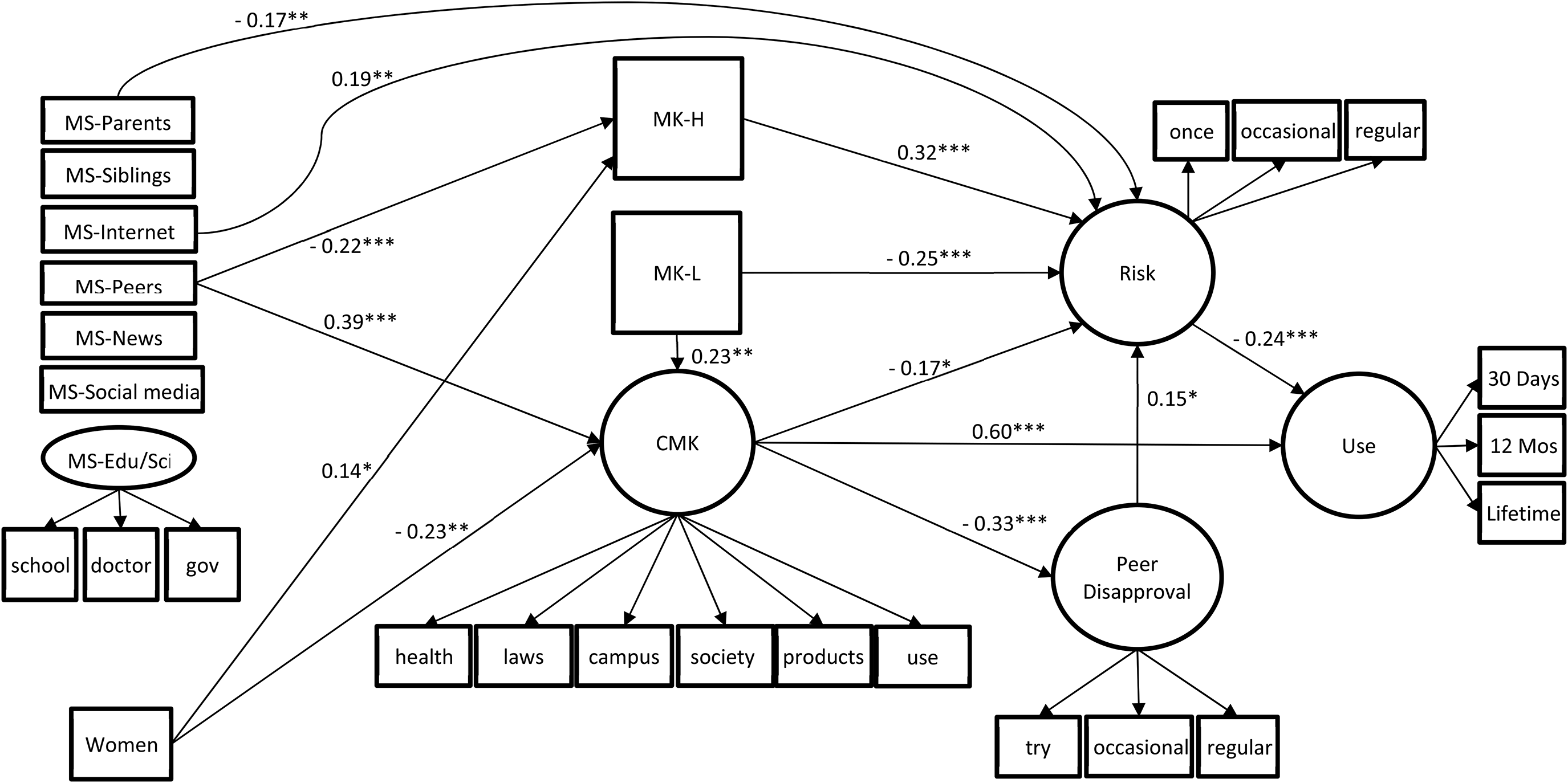
Marijuana message scanning from various channels, health knowledge (MK-H), law knowledge (MK-L), confidence in knowledge (CMK), perceived risk, and peer disapproval as predictors of college students’ marijuana use. a Only statistically significant paths are shown.
Results
The bivariate associations between the variables included in the SEM are presented in Table 1. Message scanning from the seven channels were all positively correlated with one another. Among the seven channels, parents, siblings, the internet, and peers were negatively related to MK-H. Only information scanning from siblings was associated with MK-L, and the relationship was positive. CMK was positively related to all channels, except for news media. CMK was also positively associated with MK-L but not related to MK-H. Perceived risk was negatively associated with message scanning from parents and peers, MK-L, and CMK, while positively associated with MK-H. Peer disapproval was negatively associated with message scanning from parents, siblings, peers, social media, and CMK. Perceived risk was the only variable positively associated with peer disapproval. Except for the news media and education/science channels, all message channels were positively correlated with use. Use was also positively related to MK-L and CMK. MK-H, perceived risk, and peer disapproval were negatively associated with use. Age was negatively, and gender (being women) was positively associated with perceived risk. Additionally, gender was negatively correlated with CMK and use.
Correlation matrix for variables in the structural equation model
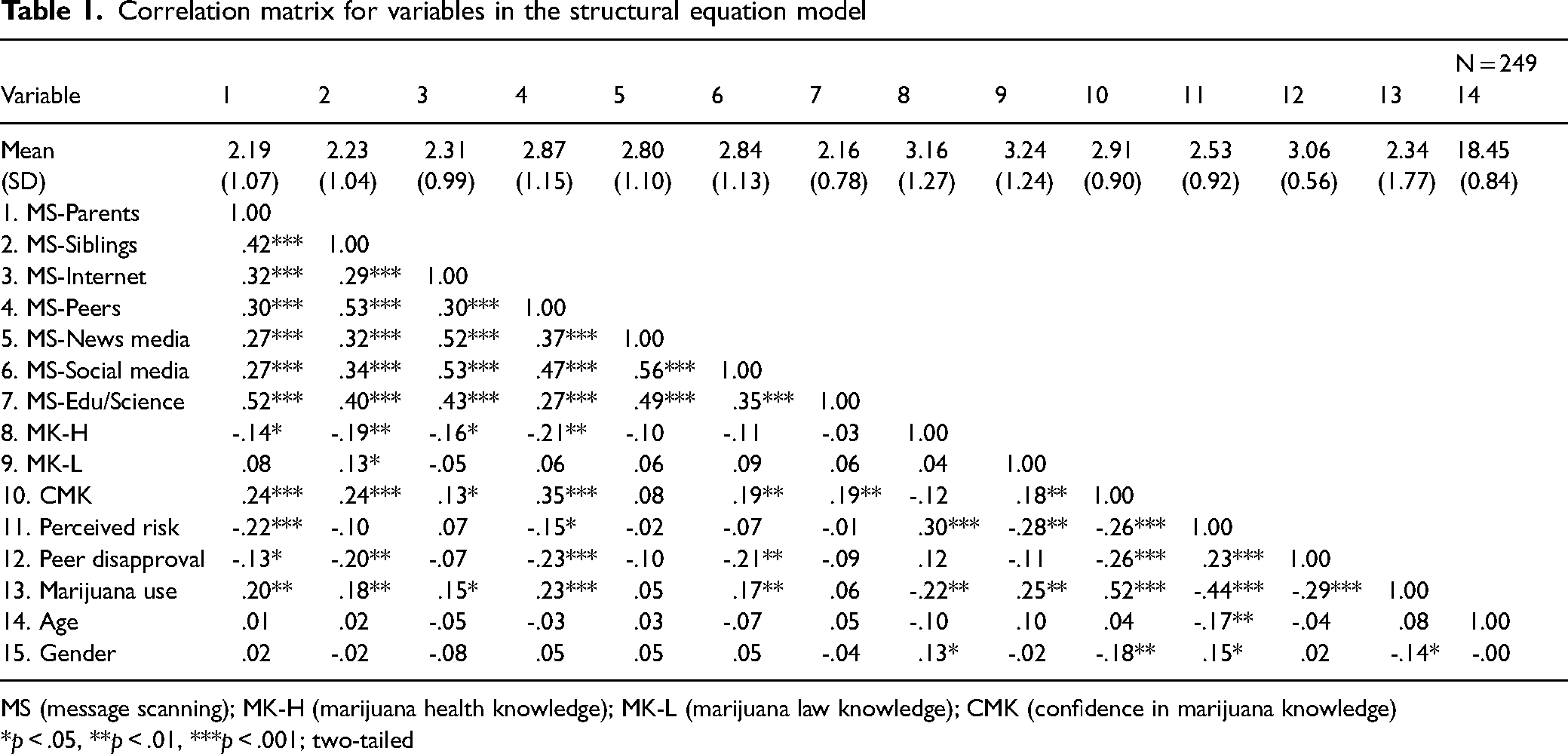
MS (message scanning); MK-H (marijuana health knowledge); MK-L (marijuana law knowledge); CMK (confidence in marijuana knowledge)
*p < .05, **p < .01, ***p < .001; two-tailed
The SEM generated a good fit: X2 (313, N = 237) = 526.86, p < .001, CFI = .933, RMSEA = .053, SRMR = .067. In the model, the nature of the relationships among MK-H, MK-L, CMK, perceived risk, peer disapproval, and use was all as expected (see Figure 1).
H1a and H1b predicted that higher MK-H would be related to less marijuana use via elevated perceived risk. The SEM results supported both hypotheses. Higher MK-H was linked to higher perceived risk (
H2a predicted that higher MK-L would be related to more marijuana use. The SEM identified four pathways connecting MK-L and use, supporting H2a. One of them connected MK-L to lower perceived risk (
H3a predicting a positive relationship between CMK and marijuana use was also supported. CMK was related to more use directly (
RQ2 probed the relationships between marijuana message scanning and MK-H, MK-L, CMK, perceived risk, and use. Of the seven channels examined here, three were related to other variables. First, marijuana message scanning from peers was linked to lower MK-H (
Discussion
The most notable findings of this study involve CMK. We replicated the positive relationship between CMK and marijuana use (Park et al., 2022a). At the same time, the association was much stronger in the current study, which could be attributed to the use of SEM, a statistical method that controls for other variables in the model. In addition, CMK played a central role in the psychological process by connecting peers and MK-L to perceived risk and peer disapproval. The negative relationship between CMK and peer disapproval was not predicted by the research hypotheses and there is no previous study that could describe the psychological mechanism. Based on the fact that the direct relationship between marijuana messages from peers and peer disapproval observed in the zero-order correlation analysis was completely mediated by CMK, we speculate that messages from peers decreased peer disapproval primarily through increasing CMK. In other words, college students did not directly generalize their peers’ permissive utterances regarding marijuana to other students on campus. Instead, exposure to peers’ permissive utterances led them to conjecture permissive attitudes of other students on campus by increasing their CMK. Because CMK is related to MK-L, it also has a unique potential to advance our understanding of college students’ marijuana use in the rapidly changing marijuana regulatory environment.
Also noteworthy are the disparate roles of MK-H and MK-L. In a previous study (Park et al., 2022a), MK encompassing both health knowledge and law knowledge was positively related to perceived risk but not associated with CMK. When examined separately, MK-H increased perceived risk whereas MK-L decreased it. In addition, MK-H had a direct negative relationship with peers; No message channel was related to MK-L. Further, MK-L was directly related to CMK whereas MK-H was not. These almost opposite relationships of the two knowledge variables with other risk/protective factors support our speculation that different types of knowledge about a risk behavior might play different—sometimes even opposing—roles. High MK-L itself cannot be harmful. For some people, however, it might indicate the presence of other risk factors.
The results reaffirmed that perceived risk and peer disapproval are predictors of college students’ marijuana use. In particular, perceived risk played a central role by mediating use and MK-H, MK-L, CMK, and peer disapproval. Perceived risk also mediated the relationships between marijuana message scanning from peers, parents, and the internet and use. On the other hand, the lack of a direct relationship between peer disapproval, defined as disapproval of other students on campus rather than disapproval of close friends, and marijuana use was inconsistent with a previous study (Park et al., 2022a). There are a few possible explanations. First, the regression analysis in the previous study did not examine the direct relationship of peer disapproval with either perceived risk or CMK, and hence the model might have been underspecified. Second, the current study employed a three-item measure of peer disapproval whereas the previous study employed a single-item measure. Third, the conceptual models of the two studies included different sets of variables. We tested two additional SEMs, one without peer disapproval and the other using a single measure. Neither model yielded better model goodness of fit than our current model.
The examination of the marijuana message channels highlighted the importance of peers. Having marijuana-using peers is a risk factor for college students through increased access to the drug offered by their peers (Pinchevsky et al., 2012). The current findings illuminate two possible mechanisms involving knowledge and confidence in knowledge: peers provide misinformation about the health effects while bolstering CMK. Future interventions could counter the negative peer influences by specifically targeting MK-H and CMK.
The positive relationship between the internet and perceived risk was unexpected. Because the internet is so vast, it might mean different things to different people. Nevertheless, the current finding suggests that internet search engines do not necessarily feed their users with marijuana misinformation. The significant relationship between the internet and perceived risk, in the absence of parallel relationships between news media and perceived risk or between social media and perceived risk, also reaffirms the need to consider the three channels separately and continue to investigate their content and their relationships with other key variables.
Although it might seem counterintuitive to some, the negative relationship between parents and perceived risk has an empirical basis: Children of former or current marijuana users are at higher risk of use (Epstein et al., 2020). In our data, marijuana-using parents may have influenced their college-age children, either verbally or through their actions, to believe that marijuana use carries a low risk.
The lack of other relationships between the marijuana message channels and MK-H and MK-L also warrants some discussion. None of the examined channels increased MK-H, highlighting the need for educational efforts directly targeting college students. Public health authorities also need to provide accurate and easy-to-understand health-related information to parents, the news media, schools, and healthcare providers. The complete absence of any relationship between the examined channels and law knowledge, on the other hand, is puzzling and deserves further investigation.
This study has several limitations. First, the data were collected from a convenience sample of students in one university. Although the theoretical model achieved sound goodness of fit with a modest sample size, replication with a larger dataset is desired. Second, we need to clarify the definitions of various marijuana message channels and better understand how young people use them before examining their relationships with other risk/protective factors. Third, the cross-sectional nature of data prohibits an inference of causality. Acknowledging that a reverse relationship between message channels and use is possible (i.e., marijuana users, compared with non-users, receive more information from peers), we tested various alternative models with switched the temporal orders. However, all model fit indicators, i.e., X2, CFI, RMSEA, and SRMR, of the alternative models were worse compared to the reported model. In the end, the relationship is most likely to have reciprocal component where they may mutually reinforce each other. As the next step, longitudinal studies are needed to establish the time order. Future research focusing on the time order will also help identify the optimal intervention points.
Footnotes
Declaration of conflicting interests
The authors declared no potential conflicts of interest with respect to the research, authorship, and/or publication of this article.
Funding
The authors received no financial support for the research, authorship, and/or publication of this article.

Author Biographies
Appendix A. A conceptual model including marijuana message channels,health knowledge (MK-H),law knowledge (MK-L),confidence in knowledge (CMK),perceived risk,and peer disapproval as predictors of college students’ marijuana use (online only material).
Appendix B. Marijuana Health and Law Knowledge Measures (Online Only Material)
| Health 1. Which of the following is accurate regarding the increasing availability and potency of marijuana products? (a) Marijuana use did not increase the risk of car crashes. (b) Accidental ingestion of marijuana by children led to permanent heart damage. (d) High-potency marijuana products are rigorously tested before being made available to consumers. |
| Health 2. Which of these symptoms is(are) related to marijuana use? (a) depression; (b) suicidal thoughts; (c) social anxiety disorder; |
| Health 3. In the United States, the number of people diagnosed with marijuana use disorder did not change much in ten years, from 1.5% in 2002 to 1.7% in 2013. (a) True; |
| Health 4. Marijuana use is related to the development of dependence and/or abuse of other substances such as alcohol, tobacco, and other illicit drugs |
| Health 5. Which of the following is not true? (a) Marijuana use impairs learning, memory, and attention. (b) The effects of marijuana use on cognitive functions are more pronounced among people younger than 25. (d) The changes in gray matter caused by marijuana use are in proportion to the amount of marijuana consumed. |
| Law 1. You must be 18 or older to use recreational marijuana legally in XXX (state name). (a) True; |
| Law 2. Under the current marijuana law in XXX (state name), which of the following is legal for a 30-year-old person? (b) Eating marijuana gummies on a hiking trail (c) Smoking marijuana at a marijuana dispensary (d) Drinking marijuana-infused tea in the back seat of a moving car |
| Law 3. A 45-year-old family member from another state visits you in XXX (city name) and would like to buy recreational marijuana. Which of the following is accurate? (a) The person cannot buy marijuana unless the person is a XXX (state name) resident. (b) The person can buy marijuana, but cannot use it while in XXX (state name). (d) The person can buy marijuana and take it to their home state where recreational marijuana is legal. |
| Law 4. What happens when you provide marijuana to someone under 21 years of age? (a) You are not guilty of a crime if you gave it away for free. (c) The person under 21 years of age, but not you, is guilty of a crime. (d) None of the above |
| Law 5. According to the current XXX (state name) law, driving under the influence of marijuana is more severely penalized than driving under the influence of alcohol. (a) True; |
Correct answers are in bold.