




Abstract
Analyzing the media coverage of the 2013 Brazil protests, sociologist Katherine Jensen uncovers that violence against white women became the rallying cry for popular political action, while black mobilization was depoliticized as violent chaos and violence against blacks was ignored.

The sensation of being tear-gassed is akin to drowning. A few minutes before the tear gas hits, one protester yells, “I’m not leaving here!” Other protesters chant, “Courage! Courage! Courage!” Then the gas comes. The physical need for oxygen is overwhelming.
The 300,000 of us gathered in front of Rio de Janeiro’s City Hall have no option but to flee. As the crowd disperses, people circulate vinegar in an attempt to mitigate the effects of the gas. While I breathe through the vinegar-soaked scarf wrapped around my mouth, my eyes feel no reprieve. I search for an escape. Protesters struggle to awaken their fallen companions; others shield their eyes and mouths using the Brazilian flags they carry. More gas soon comes, followed by rubber bullets.
This photo of Giuliana Vallone after a 2013 protest in São Paulo went viral, garnering international attention.
Diego Zanchetta | Estadão Conteúdo
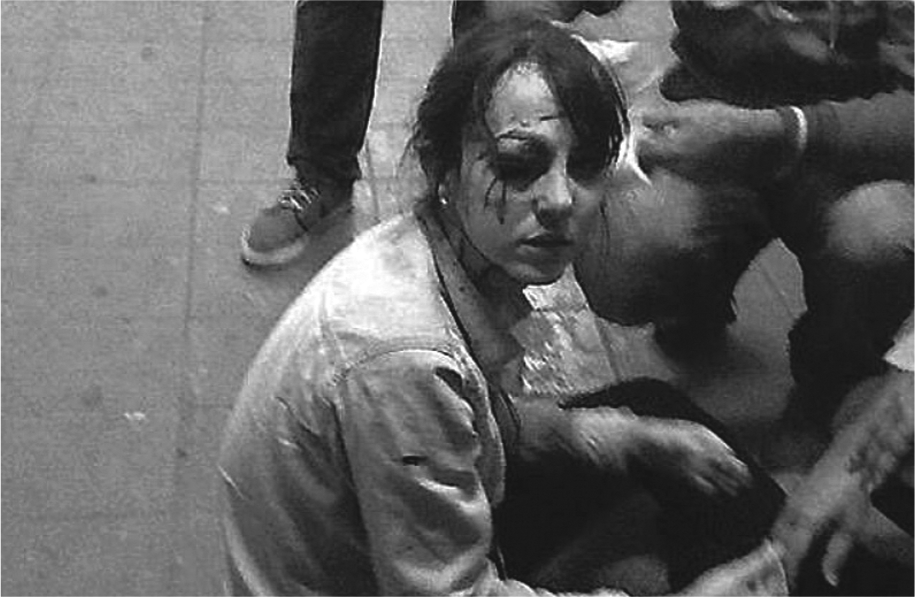
In São Paulo last June, military police shot white journalist Giuliana Vallone in the eye with a rubber bullet during a street protest. Media outlets and organizations like Amnesty International quickly denounced the police’s “excessive use of force,” including its indiscriminate use of tear gas and rubber bullets.
A photo of Vallone, hunched over, sitting on a São Paulo sidewalk, with her eye swollen and dripping blood, soon gained wide media attention. The popular Brazilian news magazine Época published the photo, stating: “even those who do not identify with the original cause [of the protests] become indignant with exhibitions of brutality and police incompetence.” The photo appeared on posters and flyers with the caption “we will not forget” under Vallone’s bruised, swollen face. Within a week, a YouTube video of Vallone after the attack attracted over a million views.
The police violence against Vallone caused, in sociologist James M. Jasper’s term, a “moral shock”: an unexpected, emotionally jarring event that led to moral outrage, and spurred the growth of a social movement. The Brazil protests were limited in scale—until images and videos of police repression spread through media and social networks.
Since 2012, I have been researching race and the asylum process in Rio de Janeiro. I was there again conducting fieldwork when the protests began. As a white American woman, during the first week of protests I remained distant; I did not want to voyeuristically intrude into mobilizations born largely from national frustrations. Then, like many others, I was stirred to join the demonstrations. While participating in the protests, I also monitored their domestic and international coverage in magazines, newspapers, the local news, and social media.
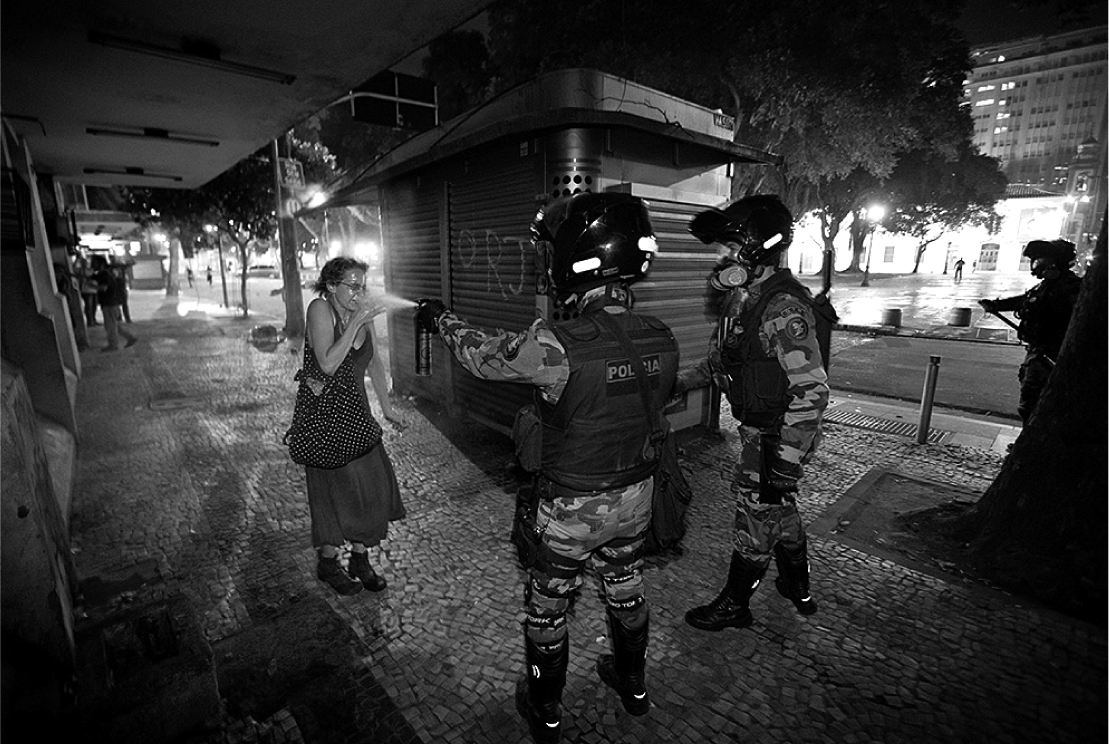
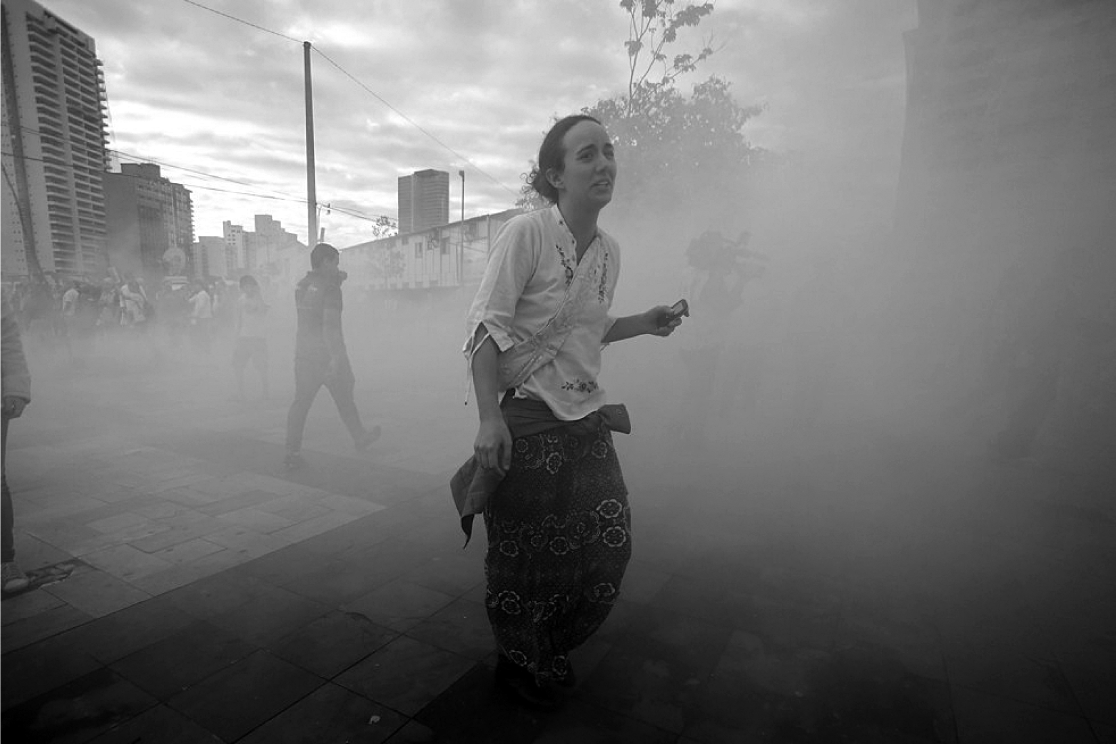
As I followed the coverage, I saw that photos of white female victims began to dominate. A picture of a black police officer hitting a white Brazilian woman with a baton appeared on the cover of ISTOÉ magazine; inside, a picture of another white woman, holding her left hand to her forehead, with a bloody face, appeared. In its coverage of the protest, The New York Times ran a front-page photograph of a white Brazilian woman wincing from the pepper spray stream that soaks her face.
Images of white Brazilian women hit by rubber bullets, batons, and pepper spray were omnipresent, suggesting that an attack on the white female body was an attack on all Brazilians. White women were pictured as passive subjects in need of protection, innocent bystanders who were simply caught in the crossfire.
One of the movement’s chants was “the people awoke!” It was among the largest and most resonant mass mobilizations since the dictatorship’s end in 1985.
By beginning with my own and other white females’ experiences of police repression, I have echoed that uneven media coverage. In covering the protests, mass media emphasized white women and erased black Brazilians. Discussions of the racial inequality plaguing Brazil were similarly absent. Shortly after the protest, Época reported on the reasons why Brazilians went to the street; none of the 13 individuals featured in the article were black. Brazil’s leading news magazine, Veja, similarly profiled 119 Brazilian protesters from eight cities; only one, 19-year-old Bianca Pereira from Rio, was black. Yet a photo of a black male protester appeared, in the same Veja article, under the heading: “the organizers of chaos.”
In media depictions of the 2013 protests, violence against white female bodies became the rallying cry for popular political action, black mobilization was depoliticized as violent chaos, and violence against blacks was ignored.
Imagining Black Chaos
Media representations play an active role in shaping how we understand and give meaning to contentious politics. As sociologist Stuart Hall suggested, media portrayals do not just represent or distort social events—they constitute them.
Images of black activists in the Brazil protests tended to portray them as violent.
AP Photo/Victor R. Caivano
AP Photo/Felipe Dana
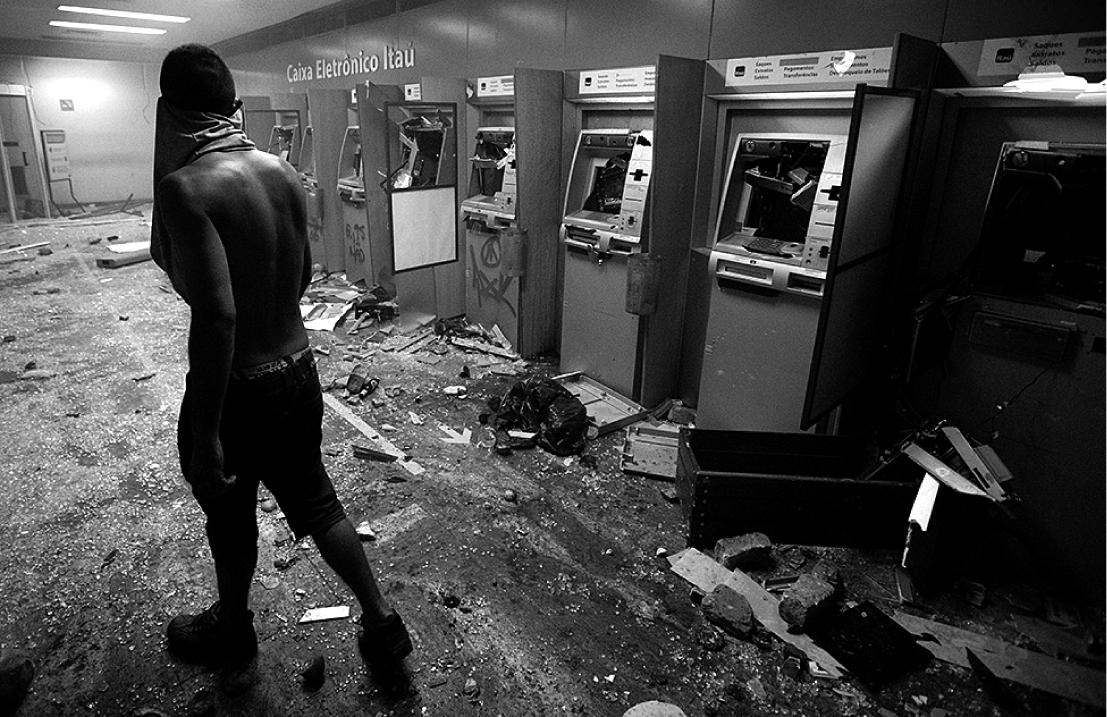
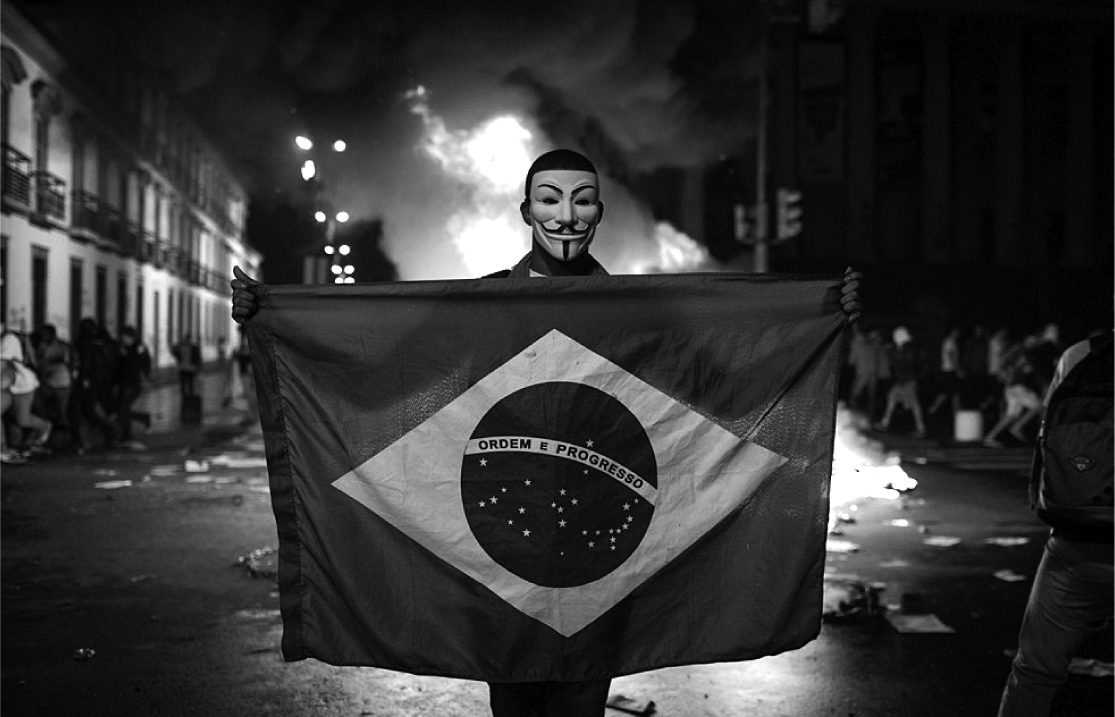
Throughout the June 2013 protests, media outlets branded black male Brazilians as instigators of violent chaos, and rarely covered police repression of nonwhite protesters. A Washington Post report on June 18 included two photos of white women suffering from the effects of tear gas and pepper spray. The two images of black men, in contrast, showed one with an “Anonymous” Guy Fawkes mask in front of a burning barricade, and the other in front of a row of vandalized ATMs.
The day after, Veja’s coverage of police repression showed white female victims only; the two images of black men pictured them standing in front of a vandalized bank and a bonfire. None of these four black male protesters were actually depicted engaging in any illicit act, yet the photographs’ framing associated black youths with vandalism. The photos of black male protesters worked to generate a very different type of indignation, marking nonwhite men as a threat to the peace and efficacy of the movement.
Images of white Brazilian women hit by rubber bullets, batons, and pepper spray were omnipresent, suggesting that an attack on the white female body is an attack on all Brazilians.
Media accounts framed black male protesters not as citizens engaging in their civil right to protest but—in the words of Brazilian journalist Elio Gaspari—“violent troublemakers” who “[should not] be mistaken for protesters.” In the left-wing Brazilian newspaper Brasil de Fato, Mário Augusto Jacobskind similarly wrote, “the media…prefers to criminalize the protests… For that, it focuses on the actions of groups that have nothing to do with the demonstrations.” Journalists portrayed the supposed instigators of crime and vandalism, the “counterfeit” demonstrators, as young men, typically black and brown.
Media reports also delegitimized black political action by focusing on the destruction of property and by calling it violence. “Rio has been the site of some of the most violent demonstrations, with attacks on shops and government offices,” reported the Wall Street Journal. Within this context, acts of “vandalism” (of spaces from which marginalized youths have historically been excluded) were depoliticized as senseless acts of violence.
In the streets, white protesters also rebuked nonwhite protesters. I frequently saw the chants of “without violence” and “without vandalism” launched at black and brown men. One night, I watched a crowd of thousands of people heckle a lone black male protester for attempting to attach a political poster to a downtown statue. They jeered at him, gesturing thumbs down in unison, as many flashed green lasers into his eyes, making it impossible for him to climb down. A white man wearing an orange clown wig climbed up the statue to confront him. The black protester narrowly escaped.
The same protesters whom I watched carry Brazilian flags, declaring “the people awoke,” assumed that the young black man was vandalizing public patrimony and—unlike them—engaged in illegitimate modes of protest that tarnished the movement.
Earlier, black activists had met at that very statue as a rallying point, holding posters and sharing inspirational words over a megaphone. Because—in tragic irony—that downtown statue is a monument to Zumbi dos Palmares, a historic black Brazilian resistance leader. The statue serves as a symbol of the fight against racial prejudice. Yet it is frequently vandalized. In June 2011, vandals painted the statue’s head white and at the base wrote racist phrases like “out monkeys” and “damned invaders.”
Roots of the Protests
The June 2013 demonstrations marked an unexpected and extraordinary moment in Brazilian history. To many, it signaled a national awakening. Before this wave of protests, an observer wrote, Brazil suffered from “profound apathy,” and was “incapable of mobilizing itself to defend its interests and face its problems.” The movement’s most iconic chant was “the people awoke!” According to The New York Times, it was among “the largest and most resonant” mass mobilizations since the dictatorship’s end in 1985.
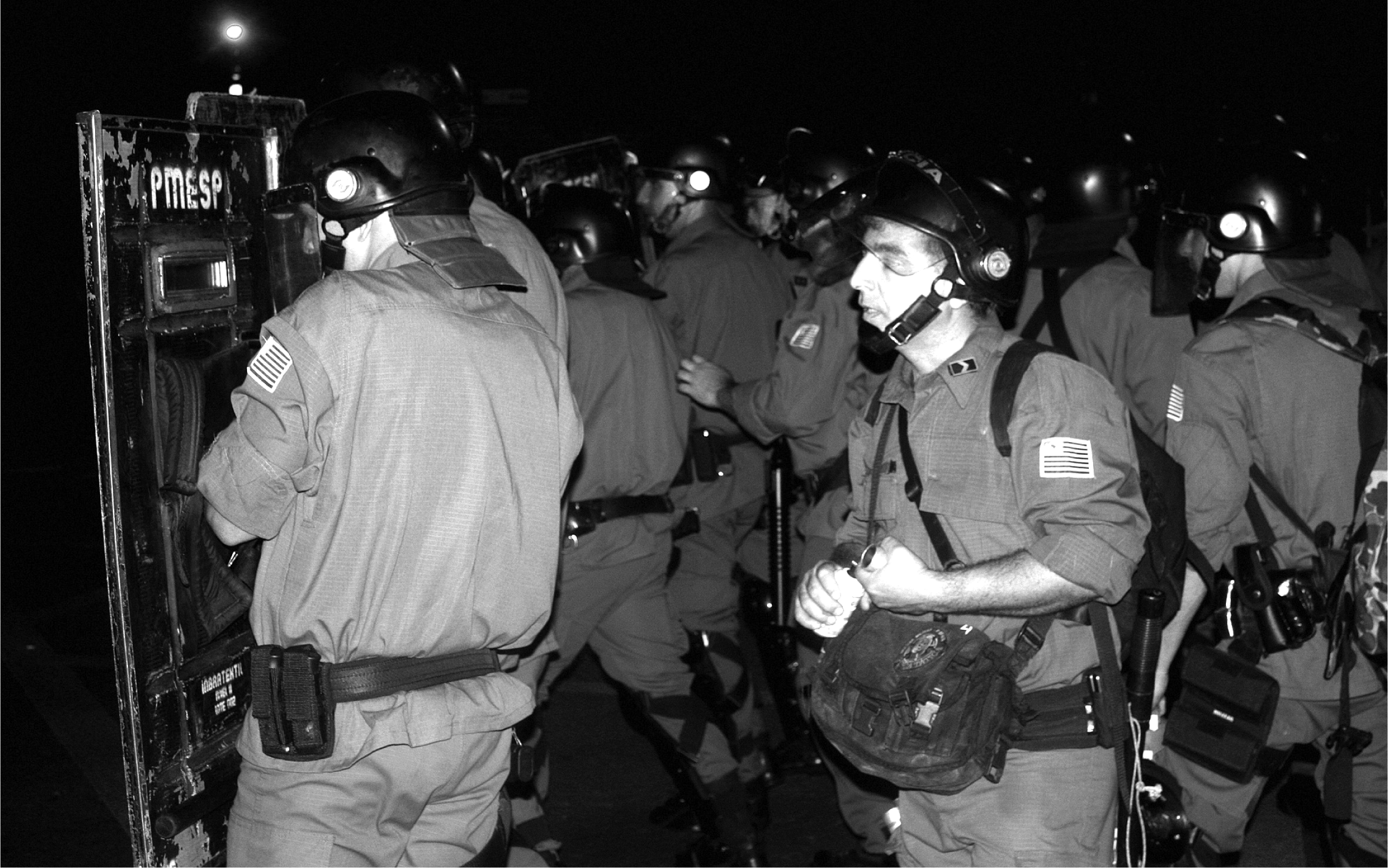
Military police in riot gear try to control last year’s São Paulo protests.
Danny Factory
While media outlets and white Brazil shouted, “the people awoke!” black Brazilian protesters carried signs stating “blacks never slept!” They contested the “national awakening” narrative, insisting that black Brazilians have always known the injustices of their country.
The protests appeared amid widely heralded economic growth and uneven economic development. In spite of impressive social policies in recent years, and a significant expansion of the middle class, Brazil remains one of the most unequal countries in the world.
Social programs have ameliorated some poverty but have had little effect on racial disparities. In 2008 the gap between white and Afro-Brazilian college enrollment was twice as big as it was two decades earlier, according to historian George Reid Andrews. The average monthly income of whites is almost double that of Afro-Brazilians, while 71 percent of those living in extreme poverty are Afro-Brazilian, according to the 2010 census.
In anticipation of mega-events such the 2014 World Cup and the 2016 Summer Olympics, the country is spending exorbitant sums of money. According to The Economist, as of June 2013, Brazil had already spent three times as much for the World Cup as the last host nation, South Africa.
Rio’s residents have been particularly affected by government efforts to reshape Brazil’s image in preparation for the games. The city is undergoing massive urban redevelopment, sporting event infrastructure, and transportation projects. In the name of these public projects, 11,000 families have been threatened with eviction, and over 3,000 had already been evicted by May 2013. In cruel irony, the city has evicted favela (shantytown) residents, resettling some families 20 to 30 kilometers outside the city’s center, for infrastructural investments that they, the most marginalized, will not benefit from.
Even though Brazilians pay some the highest taxes of any “developing” country in the world, the country suffers from corruption and abysmal social services. A government decision to nationally increase public transportation fares amidst outrageous mega-event spending was, in the words of one activist, the last straw, a última gota de agua.
It is these inequalities that drove people into the streets to demand better healthcare and education, affordable (if not free) public transit, and the end of corruption. Some protesters carried signs stating “I want health care and education on FIFA’s standards” and “we don’t need the World Cup.”
While Afro-Brazilians demanded these same things, they also called for the incorporation of African and Afro-Brazilian history into the school curriculum. They demanded the demilitarization of police forces. And they protested against what they called “the extermination of black youth.” They chanted: “I am not butt, I am not chest! The black woman calls for respect!”; “The police kills black!”; and “Come, come, come to the street against racism!”
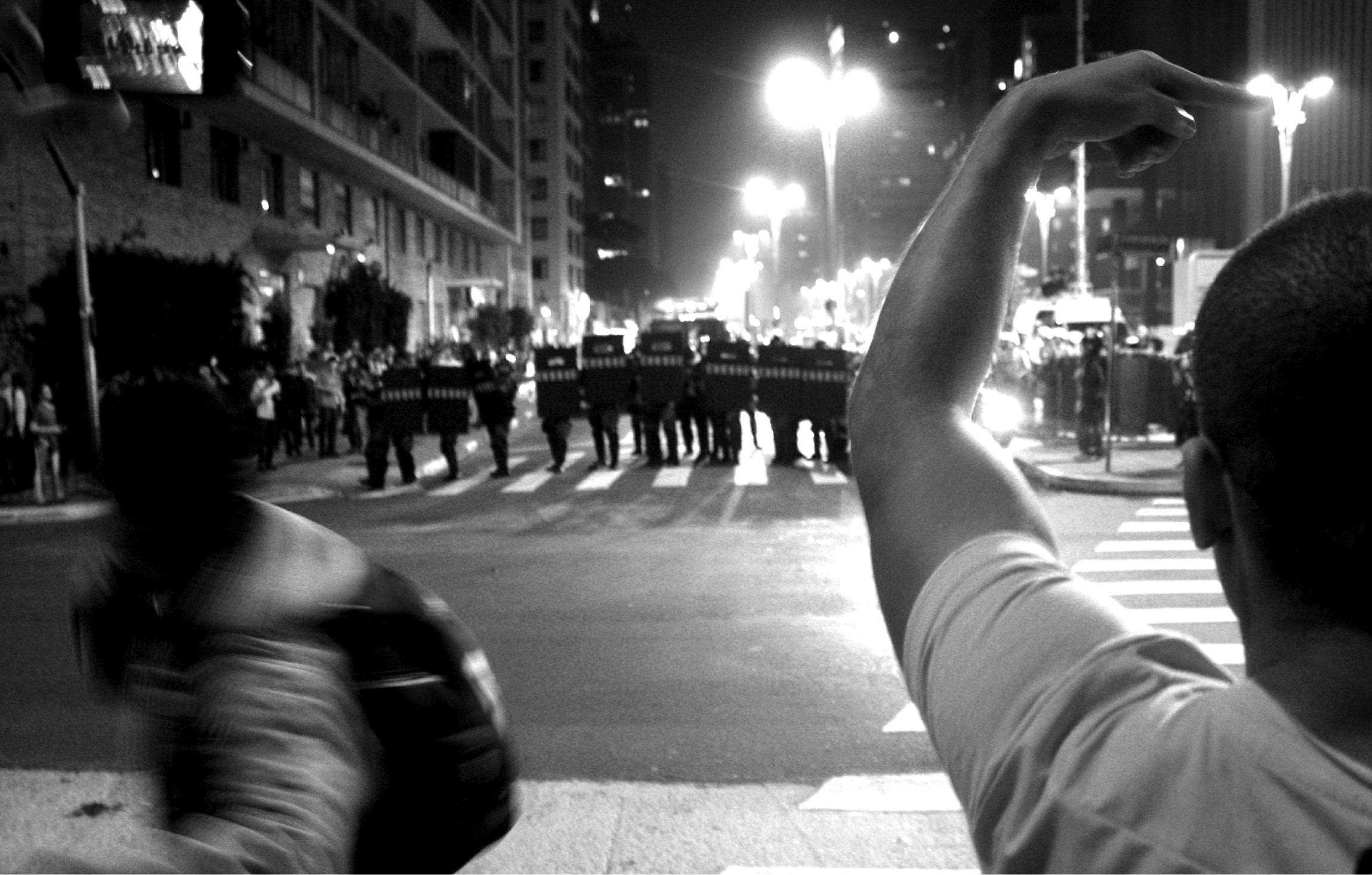
Protestors and police stand off, minutes before military police tear-gassed and fired rubber bullets into crowd.
Danny Factory
More than Tear Gas
In Brazil, the police repression of white protesters was highly unexpected. In an interview with TV Folha, the journalist Giuliana Vallone said, “I saw him [the police officer] aiming at me, but I never imagined that he would actually fire…I was doing my job, I’m a woman, in the end you wouldn’t imagine that an armed, uniformed guy would shoot at your face.” As Isabel Hilton wrote in the New Statesman, the police “unwisely did to these children of the middle classes what they routinely do to criminals, or those guilty of no crime worse than poverty: they took off their badges and beat them up.”
As sociologist Stuart Hall has suggested, media portrayals do not just represent or distort social events—they constitute them.
The police repression white middle-class Brazilians experienced during the June 2013 protests paled in comparison to the police violence black Brazilians experience with chilling regularity. According to a 2010 report by the Brazilian Institute of Geography and Statistics (IBGE), blacks are the primary victims of aggression by police officers. In a 1999 study, social scientists Michael Mitchell and Charles Wood showed that pretos, the Brazilian social category for the darkest persons of African descent, were 2.4 times more likely to suffer police abuse than any other racial group, even while controlling for a variety of socioeconomic factors.
A 2005 BBC investigation concluded: “Hundreds, possibly thousands of people are shot by police every year in Brazil…The authorities say it is mainly criminals caught in military-style raids on drug gangs but according to a former senior official, new evidence suggest that many of the shootings are cold-blooded executions conducted by the police.” Five years later, a UN Special Rapporteur wrote: “citizens, especially residents of favelas, remain hostage to violence from gangs, militias and the police” and “extrajudicial killings remain widespread.”
This differential treatment persisted in the recent wave of protests. On June 24, unsanctioned military police action by the BOPE Special Forces, in a Rio community in the Complexo da Maré, left at least nine residents dead. The deadly raid followed a peaceful demonstration in the neighboring area of Bonsucesso. In the words of Patricia Vianna, representative of the NGO Redes da Maré, “The gunshots in the demonstrations that occur in the Southern Zone and the Center [of Rio] are of rubber. Here in the favela, they are not.”
When domestic and international media outlets covered the Maré killings, they highlighted the fact that only two of the dead did not have criminal records. Sources described the victims as gang members and drug traffickers, unquestioningly accepting police claims, even though there remains great uncertainty regarding the reasoning for the police raid or its high death toll.
These and other press photos depicted white protestors as innocent victims.
AP Photo/Victor R. Caivano
Miguel Schincariol/AFP
A Maré resident and activist who was interviewed in the newspaper Brasil de Fato, told a reporter: “In the favela, we don’t have the right to demonstrate. We don’t have the right to life…The middle class can demonstrate, and us?” She condemned a media commentator for saying that “firearms are for territories like the favelas.” She also denounced governor Sérgio Cabral for saying, in 2007, that the women of the favelas are “factories to produce criminals.” The vandal, she charged, is the state.
A march in response to the Maré massacre rallied almost 5,000 people, and subsequent protests made reference to these deaths. But the Maré killings failed to spark the same level of mass indignation and media coverage—both in Brazil and internationally—as the rubber bullet that struck journalist Vallone or the pepper spraying of another white woman, Liv Oliveira. While the racial identities of the Maré victims are unknown, statistics regarding the confluence of race and class in Brazil, particularly with regard to socio-spatial relegation to Rio’s favelas, has left little doubt in many people’s minds.
According to the Institute for Applied Economic Research (IPEA), almost 60 percent of Rio’s favela residents are black, while the richer zones of the city are only seven percent black. In the words of one protest sign I saw in Rio on June 27, “I am black, woman, young, from Maré…don’t kill me, please!!!” Another black protester’s sign, from a demonstration before the Maré massacre, has even greater poignancy after: “Why do the rubber bullets against white skin move [people] more than the real bullets that kill the black population everyday?”
Failing Black Brazil
Brazil’s decision to host the 2014 World Cup and 2016 Olympics has exacerbated persisting inequalities and societal frustrations within the country. Many observers expect the protests to continue. Racism in media coverage of these protests is likely to influence how authorities and others respond to any violence, and how the boundaries of legitimate political action are defined.
Media reports exalted the “the people awoke” narrative, lauding the rising popular political consciousness in the country. They framed whites as legitimate protesters, and white women in particular as the unjust victims of police repression. Portrayals of injured white female bodies drew international attention and national indignation.
At the same time, this coverage denied black Brazilians the right to protest. It branded black male participants as vandals whose own experiences of police repression were of little interest; black female protesters did not even exist. By making black citizens invisible, media coverage failed to discuss the social forces that create and maintain racial inequality in Brazil. Meanwhile, the real bullets continue.