




Abstract
In the spring of 2020, the Black Lives Matter protests shook the Western world. Spreading from the USA, demonstrations diffused globally, especially to Europe, calling out racism in its different forms. Emotions ran high and were pivotal in igniting protests. The role of emotion in social movements has received renewed scholarly attention during the last decades. It plays an important role at every stage of protest, but few studies have traced its part in individuals’ shifting engagement over time. This study examines the role of emotion during the global wave of Black Lives Matter protests. Based on retrospective interviews with 38 participants in Black Lives Matter demonstrations in Norway, we identify the role of emotion before, during and after their participation. Our findings help explain how individual patterns of participation develop in the course of a wave of protest, and also provide insights into the consequences of the recent Black Lives Matter protests in Europe.
Keywords
Introduction
Throughout the western world, ethnic minority groups’ frustration and anger over racism was at the core of mobilization for the Black Lives Matter (BLM) protest wave. Similar emotions have sparked anti-racist protest for decades and will probably continue to do so in the future – and it is not particular for these protests. In fact, all kinds of politics and protests are filled with emotions (Marcus, 2000). Some lose hope and withdraw from political participation all together, while others are mobilized by a mixture of hate and fear of a perceived enemy. The demonization of enemy groups fuels powerful emotions, including hatred, fear, suspicion and indignation (Jasper, 1998).
Few activities are more overtly emotional than social movement mobilization and protest, but emotions did not become the object of systematic analysis by social movement scholars until the last two decades (Goodwin et al., 2000). Social movement groups and organizers use their power, resources and creativity to turn individual grievances and emotions into collective demands and create opportunities to act upon them (Van Troost et al., 2013). More broadly, emotion is not only part of people’s responses to events but, in the form of affective attachments, also shapes the goals they pursue (Jasper, 1998). For example, when a feeling such as frustration guides pathways for action, individual emotion can be translated into collective action (Woods et al., 2012). In this way, emotions provide motivation and goals for social protest (Aminzade and McAdam, 2001).
Emotion can transform people previously uninterested in politics into defiant protestors; it can make disengaged activists re-engage, and make engaged protestors change the issues they prioritize. These changes often take place during protest waves. Three features are found in these waves of protests: they are characterized by a strong ‘expansion of contention’ across social groups and sectors, which transcend the narrow boundaries of policy fields, and often cross national borders. Second, there is invariably a ‘transformation of contention’, involving changes in the repertoires of protest, strategies, alliance structures or identities. Lastly, most waves of protest come to an end through some form of ‘movement contraction’ (Koopmans, 2004: 22).
In this study, we explore the role of emotion in trajectories of political engagement for participants in the Black Lives Matter (BLM) protests that erupted in Norway in June 2020. Using qualitative interviews with young, mainly Black, participants in the BLM protests, we examine the role of emotion before, during and after the demonstrations. We seek to capture how it influenced individual mobilization and demobilization at different stages of the protest wave. Our study thus contributes both to a better understanding of the BLM protests in Europe and to the growing area of scholarship that emphasizes the part played by emotion in social movements, particularly as regards individuals’ entry into and exit out of movements.
Black Lives Matter
The killing of George Floyd in May 2020 triggered a global diffusion of the BLM movement, which manifested as protests involving extensive numbers of participants. The three co-founders of the BLM organization initially created the hashtag #blacklivesmatter as an online community to help combat anti-Black racism across the world, but in 2013 they turned it into an organization, following police officer George Zimmerman’s acquittal after shooting Trayvon Martin dead. BLM thereafter evolved into a movement against anti-Black racism that demanded redress for injustice perpetrated against Black citizens by US law enforcement (Lebron, 2017).
There is a growing body of research on BLM (e.g. Carney, 2016; Ince et al., 2017; Yang, 2016), but so far studies based on primary data have mainly dealt with the period prior to May 2020 (but see e.g. DalCortivo and Oursler, 2021, Dave et al., 2000; Dynel and Poppi, 2021; Milman et al., 2021). The worldwide protests that took place then differed from those in previous years, in that BLM gained a wider geographic spread and the frequency and size of protests increased (despite the ongoing pandemic) (Kowalewski, 2021). Importantly, in 2020, BLM took different forms outside the USA. In Europe, the protests and their contexts were very different from the original ones. As in the UK, BLM protests in Norway peaked in May–June 2020 and were directed against domestic forms of ethnic discrimination, hate speech related to skin colour and general racism. Numerous cities across the country saw demonstrations ranging from 15,000 protestors in the capital (Oslo) to a few hundred in smaller cities. The protest events proceeded peacefully and never involved any violent counterdemonstrations such as those the USA and the UK witnessed in the same period.
At the height of the protests there was a widespread feeling of success and possible change, but only a few months later this had turned to more mixed feelings about the prospects of the movement. The British Prime Minister, Boris Johnson, announced an inquiry into racial inequality, but was also criticized for saying that the UK was not a racist country. In Norway, no major legal or other institutional changes followed in the wake of the protests. While some of the most committed BLM protesters continued to organize small-scale protests and made several approaches towards the public and politicians, the movement soon disappeared from the mass media and public debate both in the UK and Norway, as it did in most other European countries.
Norway has a history of violent right-wing extremist attacks, which may have contributed to the perception that racism is a problem of the extremist few, while the most widespread everyday forms of subtle racialization and racism have remained largely unattended (McIntosh, 2015). Researchers have revealed ethnic discrimination in the labour market (Midtbøen, 2016), by the police (Solhjell et al., 2019) and the majority of reported hate speech are related to ethnicity (Fladmoe et al., 2019). At the same time, the number of Norwegians who think ethnic discrimination occurs on a large scale has tripled from 2013 to 2019, from 9% to 32% (Brekke et al., 2020) revealing a growing awareness of this topic in the general public. Widespread public discussions about racism in Norway have still been rare and challenging to raise (Gullestad, 2004). This changed dramatically during the BLM protest wave, where public discussion and news coverage of racism massively increased.
Social Movements and Emotion
The sociology of emotions appeared in the 1970s. In a comprehensive attempt at synthesizing the work of Goffman, Durkheim and contemporary sociology of emotions, Collins (2004) emphasizes that interaction rituals produce emotional energy. People are drawn towards rituals, and acquire the energy that is produced in these interactions. His definition of rituals as ‘a mechanism of mutually focused emotion and attention producing a momentarily shared reality, which thereby generates solidarity and symbols of group membership’ (Collins, 2004: 7) is a particularly good fit for social protest such as demonstrations. They create what Durkheim describes as a ‘collective effervescence’ that draws people into participation (Gould, 2002). Similarly, Collins’ emphasis on how successful rituals fill individuals with emotional energy, while failed rituals drain it, can help understand shifting political engagement over time.
During the last 25 years, the role of emotion has received increasing attention from social movement scholars (Turner and Stets, 2005). Greater attention to the emotional dynamics of social movements came in the wake of the broader ‘cultural turn’ in the social sciences (White et al., 1999). While emotion accompanies politics and protest and plays an important part in mobilization, it does not make protestors irrational (Emirbayer and Goldberg, 2005). The controversial early crowd theories of the 1950s and 1960s (Hoffer, 1951) saw emotion as coming directly from irrational crowds, as something detached from people’s own lives and goals, and as influenced primarily by what is happening in their immediate surroundings (Goodwin and Jasper, 2006). Responding to this line of research, scholars began to view activists as rational and little room was left for their emotions (Ferree, 1992). The dominant resource mobilization and political process theorists of this time usually defined rationality in contrast to, and as incompatible with, emotionality, and thus overlooked powerful sources of collective action (Goodwin et al., 2000).
Emotions ‘constitute the bodily manifestation of the importance that an event in the natural or social world has for a subject’, which means emotion is a ‘bodily consciousness that signals and indicates this importance’ and thereby regulates the relationships that an individual has with the surrounding world (Bericat, 2016: 493). The nature of emotions is relational because they emerge, attain their meaning and are experienced in and through social relations (Burkitt, 2014). They are also at the core of collective action: a great deal of politics and protest is about group solidarities that are motivated by affects (Schmitt, 1976/1932). Individual emotions are not only related to personal life experiences, but also to what happens within the social groups they belong to and identify with (Yzerbyt et al., 2003).
Ceaseless ‘emotion work’ is also necessary for the development and sustainment of movements over time, for example through generation, management and negotiation of feelings such as anger, pride and shame (Gould, 2002, 2009). Emotions can change across situations and time depending on the individual’s expectations in a situation; their active social identity at any one moment; and their identification with other persons or groups (Bericat, 2016: 493). Emotional lives are dynamic processes in which emotions interact and change in intensity over time. The concept of an ‘emotion chain’, similar to Collins’ (2004) ‘interaction ritual chain’, has been suggested to emphasize the importance of exploring the temporal structures of emotions and their relationship with subsequent behavior (Williamson, 2011: 68). Scholars have also traced different routes into participation in collective protest (Stürmer and Simon, 2009), ‘trajectories of participation’ that represent individuals’ pathways of engagement in a social movement (Corrigall-Brown, 2011), and how engagement impacts the lives of participants (Fillieule and Neveu, 2019).
We use the term emotion to describe the consciously experienced feelings (e.g. fear, hope or pessimism) that protest participants described in interviews. Emotions are not the only factor driving social movement mobilization and demobilization, but they play a crucial role and can help explain individuals’ trajectories in and out of movements and protest participation. Few studies have followed the ‘emotional trajectories’ throughout individuals’ involvement in protest activity (Woods et al., 2012: 567), and there is a need for knowledge about the various forms of individual demobilization that lead to the decline of social movements (Fillieule, 2015). We thus explore the role of emotions in our interviewees’ individual pathways of mobilization and demobilization during different stages of one wave of protest. Emotions play a key role at every stage. Some of them help explain why individuals join protest events, while others are generated by engaging in them and might impact both the affective ties between fellow protestors and feelings towards institutions, people and practices outside the movement.
Methods
The data consist of 38 in-depth interviews carried out in Norway with young people (between 16 and 33) who engaged in the BLM protests that started in June 2020. Political participation in these protests was our main research topic and hence protest participation was a primary selection criterion. We mainly sought young Black people but included other ethnic minority groups and a few white protestors so that the sample included all groups that participated in the protests. Participants were recruited by approaching individuals who had posted about participating in protests on social media, by online announcements encouraging people to contact us and by utilizing informal social networks. Interviews were conducted between September 2020 and January 2021 and lasted an average of 1.5 hours.
The sample is diverse in terms of the participants’ occupation, level and type of education, and interest in politics (see Table 1).
Participants’ gender, age and background.
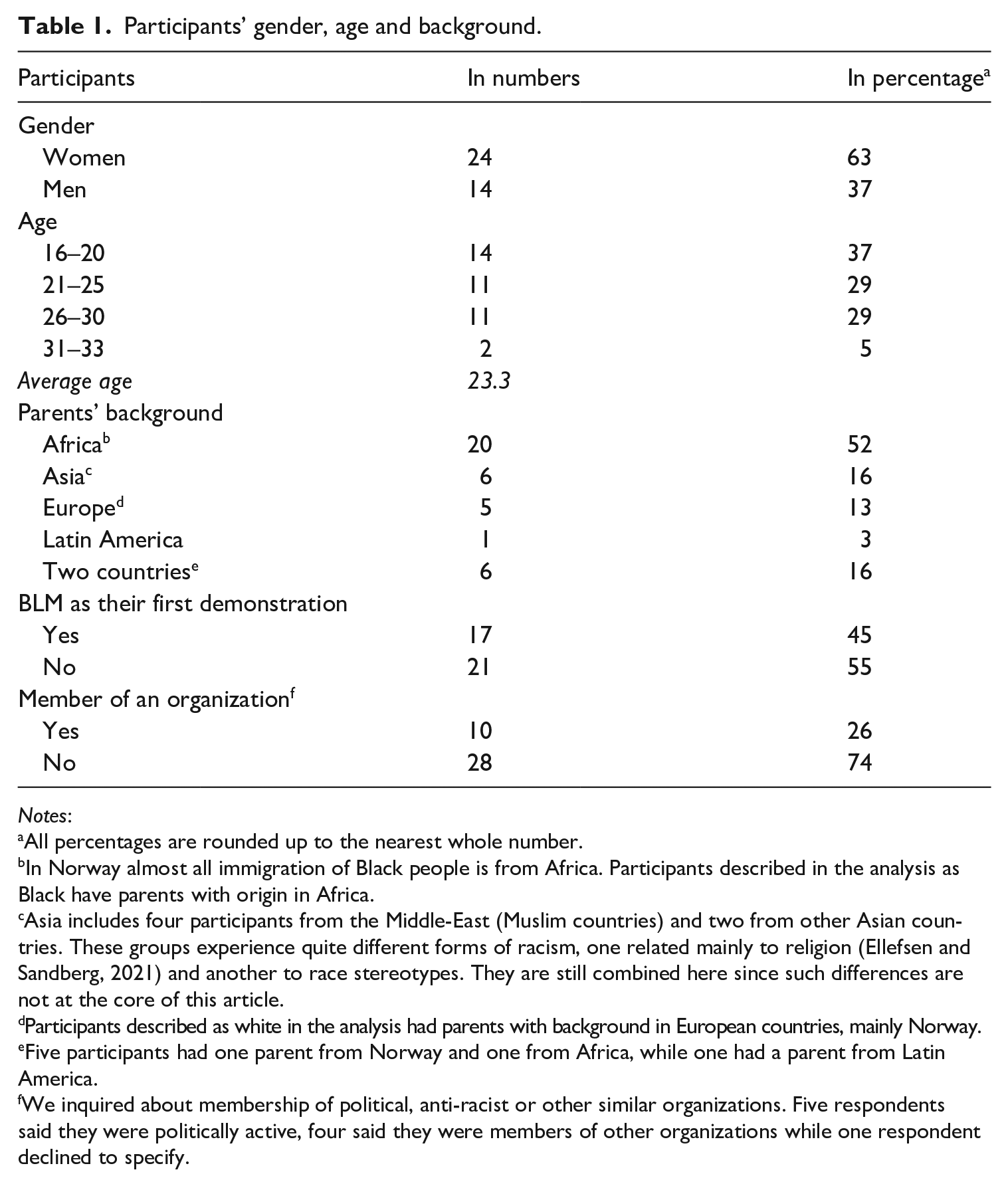
Notes:
All percentages are rounded up to the nearest whole number.
In Norway almost all immigration of Black people is from Africa. Participants described in the analysis as Black have parents with origin in Africa.
Asia includes four participants from the Middle-East (Muslim countries) and two from other Asian countries. These groups experience quite different forms of racism, one related mainly to religion (Ellefsen and Sandberg, 2021) and another to race stereotypes. They are still combined here since such differences are not at the core of this article.
Participants described as white in the analysis had parents with background in European countries, mainly Norway.
Five participants had one parent from Norway and one from Africa, while one had a parent from Latin America.
We inquired about membership of political, anti-racist or other similar organizations. Five respondents said they were politically active, four said they were members of other organizations while one respondent declined to specify.
One reason why the emotions of protest are hard to study is that they are often repressed, both in theoretical models and by protestors who ‘tend to be ambivalent about them’ (Goodwin et al., 2000: 79). Interviews were thus designed to capture motivations for and experience of protest participation that related to emotions. We invited participants to show us their photos of the protests to encourage them to recollect and revive moods and feelings. Questions were designed to elicit descriptions of emotions felt before, during and after participation in the main demonstrations at the peak of the protest wave. The interviews were retrospective, which is somewhat problematic when studying emotions. It is difficult to know how much of the feelings experienced can be recollected or relived, and descriptions of earlier feelings will always be shaped by a person’s current emotions, situation and world view.
Emotions were identified and coded using NVivo software, following the principle of inductive thematic analysis (Braun and Clarke, 2008). We sought to identify the key emotions at play before, during and after protest participation. The same temporal distinction is also used to present findings in the analysis.
Political Engagement in BLM over Time
Our analysis captures emotions and emotional dynamics important for an individual’s engagement in the course of three phases of the BLM protests: the initial one prior to demonstrations, the peak – marked by the big June demonstrations – and the final phase when the intensity of collective mobilization subsided.
Emotions before the Demonstration
Two emotional dynamics stand out as particularly important for mobilization to the BLM demonstrations: feelings of change-in-the-making and emotional associations with personal experiences of racism. These feelings triggered hope, provided motivation and connected the transnational mobilization to the national context.
Feelings That Change Was on Its Way
Most participants had seen the video of George Floyd’s murder, but only a few pointed to this as triggering emotional reactions that motivated their engagement with BLM. For most interviewees, seeing such images from the USA had become ‘normalized’ to the extent that they no longer reacted with surprise and shock. For some, the images also seemed far removed from their own lives and local surroundings. Instead, the first emotional dynamic that stood out as being crucial for mobilizing participants was the excitement generated by the mobilization itself. Hakim (24, Black) put it this way: These things have come in waves before. You have shootings in the US every year, there’s a lot of talk about it, but then nothing happens. [. . .] But this time I felt that now there is actually a real wave coming, this time something is happening. That’s one of the reasons why I supported it. I thought, ‘now’s the time to make a difference’.
The transnational BLM protests gave Hakim and others the emotional energy that fuelled hope, enthusiasm and their subsequent mobilization. In social movement research, relatively little is known about what persuades people to participate in social protest ‘before movement organizations with strategic recruiting pitches have been established’ (Polletta, 2006: 28). But our study clearly shows the importance of emotions for people’s motivation. Charifa (31, Black) for example, first thought ‘ok, same old story’ when she saw news about massive protests in the USA, but when she realized that the protests were reverberating all over Europe, she felt ‘there was real change in the air’: We thought ‘this is our chance’, now we must go out and roar, take advantage of the opportunity and say, ‘enough is enough’. This time it reached everyone, not only the minorities, and that made it emotionally really intense for me.
When they realized that the wave of mobilization was coming closer, and spreading beyond the ethnic minority population, many participants felt a surge in their motivation to engage. Data also show that people with diverse ethnic minority backgrounds were motivated by the fact that BLM was seen as representing a broad opposition to racism, beyond anti-Black racism.
Like more than half the interviewees (see Table 1), Ella (25, Black) had never taken part in a demonstration before. She said that ‘it felt as if something was burning. That we had to do this now.’ The sight of a growing wave of protest that was gaining widespread attention in the news and social media created a feeling that something extraordinary was unfolding – something in which even young people who had not engaged in protest before felt they had to take part.
The widespread visibility of the BLM protests in the media created an intense social climate that contributed to this sense of obligation to engage. This was coupled with a widespread ‘rhetoric of change’ (Gamson and Meyer, 1996), which spurred social mobilization, and increased and intensified the emotional dynamics that were crucial for mobilizing participation. Such dynamics were probably also important for mobilizing many young people who were not members of or engaged in political organizations. Rather than emotions triggered by the ‘moral shock’ of an unexpected event (Jasper and Poulsen, 1995), it was feelings sparked by witnessing political mobilization itself that triggered participation. The most important factor was mobilization close to home, in Europe and particularly in Norway.
Emotional Connections with Personal Experiences
The national or local context was also important for the second emotional dynamic of mobilization we observed in the interviews. Participation was closely linked to a ‘translation’ of the core issues of the US-based BLM movement to the local context. This made the issues easier to relate to and increased people’s sense of BLM’s importance to their own lives. Semira (27, Black) said, ‘the murder of George Floyd was just the start of so much else’. She was particularly impacted by and readily related to the personal experiences of racism linked with BLM that were frequently shared on social media: ‘I recognized this from my own life, I am dark-skinned. So of course, this is something I will stand up and fight for.’ All but two of the ethnic minority participants reported they had experienced or witnessed racism and most stated that this was important for their mobilization.
For individual emotions to be turned into collective action, a shared reference point needs to be articulated – one that can be invested with ‘communal emotional significance’ (Woods et al., 2012: 571). Common experiences and social identities based on ethnicity or shared values often assist such processes. Aaron (18, Black), connected protests in the USA to his own experiences of racism: The worst incident was when I was about eight to 10 years old. I was going home from school with some friends and we saw a dog, right? So, we asked, ‘Is that a Rottweiler?’ And the guy replied, ‘Yes’, and then I said, ‘But aren’t they illegal in Norway?’ He then replied, ‘Yes, and niggers too.’
1
Right to the face of a 10-year-old. That incident stuck with me. So, when George Floyd happened and the protests started, I remembered that incident and I thought, ‘I’m going!’
Gould (2009) argues that emotional habitus is the bridge between emotion and political action, and that engagement with a social movement can transform an individual’s interpretation of past events and the emotional response it triggers. The BLM protests de-individualized negative experiences and reframed them, so they were no longer personal troubles but expressions of racism. Benjamin (33, Black) emphasized that he had no experience of police violence, but even so had several negative experiences with the police: I know how scary and threatening it can be to have a group of police against you, you feel their energy, and they’re not there to protect you, to put it that way. It’s distressing. And that made me feel particularly strongly about what happened to Floyd. I know the police too well, because of the colour of my skin.
His anger towards the police was bolstered and got a more explicit political direction by participation in the BLM movement (see also Gould, 2002). Similarly, the experiences of the family of Hawa (24, Black) made the BLM agenda resonate with her, and the demonstrations gave her an opportunity to oppose racism: This is close to my heart, everyone in my family has experienced racism. My little brother is a football player, and he gets it a lot. And in my job as a nurse, there’s a lot, especially among the older ones, they can be really racist. We grew up in a small place, with a lot of racism, so this has influenced me a lot. So, whether or not we should go on the protests was never in question. It was for our rights . . . my rights.
For white participants, motivations to demonstrate were different. Malene (25, white), had friends and family members who had experienced racism, and for her ‘going to the demonstration was in solidarity with them’.
BLM created affective bonds, collective identities and hence emotional energy (Collins, 2004) by connecting personal experiences of racism with those of a much larger social movement. These new collective identities are a ‘chief product of mobilization’ for participants in movements (Melucci, 1995: 45). The new identities went beyond Black youths to include people of Middle Eastern and Asian origin, and sometimes white protestors. The driving force was a strongly felt desire to do something to counter the racism experienced by themselves or friends and acquaintances (Wang et al., 2021). For those with an ethnic minority background, taking part in protests was a way to counter the discrimination and marginalization they faced, while for those with a majority population background, it was a way to show sympathy and solidarity. Feelings of hope and inspiration were part of this, and they spurred participants’ mobilization, but there was also underlying anger and frustration. This mix of negative and positive feelings mobilized participants to engage in BLM protests.
Emotions during the Demonstrations
Feelings of hope and inspiration were intensified in the demonstrations, but were still accompanied by continuous anger. During demonstrations these emotions culminated in something akin to ecstasy, which involved both expressions of emotions and emotional experiences. There was also a sense of relief due to the absence of confrontation with the police.
A Culmination of Hope and Anger
The major demonstrations organized in many cities in June 2020 marked the peak of the BLM protests in Norway, as they did all over Europe. While emotions are clearly important for early mobilization and organization, they ‘are even more obvious in the ongoing activities of the movements’ as movements and protest events are themselves ‘a distinct setting in which emotions can be created or reinforced’ (Jasper, 1998: 417). Certain positive emotions were shared and described as important by almost all participants, and these feelings made the demonstrations endure as powerful positive memories. Malaya (19, Asian) described her participation in the demonstration as a profound experience: It was the boiling point! I would say. And because it was my first protest, it was my boiling point too. I was very angry and very motivated, and I wanted to do something to get heard. [. . .] There was a kind of unity in the air, we were going to stand here together, fighting for a greater cause. It was very motivating!
Bilal (27, Black) said he thought it was good to see people mobilizing in London and around the world, but when it came to his own home country it was something special: ‘But then it happened in Norway! and I thought about all the things I had experienced and how racism had affected my life.’ Watching demonstrations on TV is very different from taking part in one. The most prevalent positive emotion during demonstrations was the strong sense of community and solidarity between demonstrators. Malene (25, white) said: There was a feeling that a lot of people were getting an outlet for something that had been there for a long time. They got a chance to express it. It was obvious that it was important both politically and emotionally, both personally and for one’s children and friends [. . .] So it was redeeming in a way.
The great racial diversity of participants was also mentioned by some participants as creating strong positive emotions, and adding to the feeling that the event was making a difference. Being part of a large crowd demonstrating under a shared banner aroused strong feelings of hope. Collective identity theory is sometimes used to describe the sense of solidarity between members of a protest event or social movement, which creates bonds of trust, loyalty and affection (Goodwin et al., 2000).
As in the build-up to the demonstrations, other emotions were also present, such as frustration and anger, especially among the participants who had personal experiences of racism. Bishaaro (21, Black) had never been on a demonstration before, and described a mixture of feelings: It was really emotionally laden, it was. Because there are so many feelings and so much sadness, a lot. Emotions generally, kind of. Anger was a huge part of it too, actually. A big part of me was just angry. To be able to scream and chant became an outlet for anger. Really. And then I felt the community. Like we’re together in this. It was really unique. [. . .] I don’t know how to explain it, it was really powerful.
Strong emotions often come with something that is hard to put into words. They transcend what can be described and can therefore be difficult to study. Emotions are nonetheless crucial to understanding social mobilization. They are associated with rational acts just as much as with irrational ones, with positive experiences just as much as with negative ones, and they ‘mediate between the individual and the social world, without being reducible to either’ (Goodwin et al., 2000: 78). Being part of a big, successful demonstration inspired a sense of empowerment, and was an opportunity to vent frustration. Bilal (27, Black) for example, said ‘there were a lot of feelings, back and forth, anger, sadness, a feeling of guilt’. As pointed out by Gould (2002), social movements can help their participants counter and negotiate feelings of shame. Bilal continued: There was a guy in front of me, and then they stopped, and he cried. That made the most impression. You could see it, how painful it was. When you have experienced it [racism] yourself, you could feel it too.
Underlying the general feeling of community and solidarity, there was a potential conflict between demonstrators who had experienced racism and those who had not. For some, demonstrations provided an outlet for emotions accumulated over years, while for others they were mainly an arena for showing solidarity.
The combination of positive and negative emotions seems to be a key factor behind the emotional energy participants experienced. Aaron (18, Black) described the BLM demonstration as an ecstatic and memorable experience, but also one that brought a lot of repressed frustration to the surface: ‘You could hear the frustration in the demonstrators’ voices’, he said. Hope is often the positive pole of what James Jasper terms ‘moral batteries’, which have a combination of positive and negative emotions that, ‘through their contrast, help energize action’ (Jasper, 2011: 291). Similarly, anger over personal experiences of racism, was fortified and transmuted through the social movement’s emotion work (Gould, 2009). The combination of positive and negative feelings that mobilized the participants, became stronger and took a more distinct and explicit direction when they partook in the BLM demonstrations.
A Feeling of Relief
Another emotion that arose during the demonstration was relief. Contrary to widespread fears that there would be an eruption of violence, the demonstrations proceeded peacefully, without violent escalation or conflict with the police. Bishaaro (21, Black) described how the tension felt prior to the demonstration lessened as the event progressed: It was like a kettle about to boil [. . .] We just waited for that day to come, but there was also this feeling of fear. Because, what if the police said, ‘you’re going against the Corona regulations, we’re gonna break this up’? And then people would get angry, aggressive, violent. Things like that. [. . .] But fortunately, it ended beautifully. The police just stood there and watched us. There was no confrontation, No head-to-head with them at all, really. I passed a police officer, and she chanted with us. That’s a good feeling, right?
Many felt they were taking a risk in going on the demonstrations, partly because of what they had seen in news reports from other countries and partly because they would be breaking COVID-19 regulations. Participating despite the risks involved can reinforce a feeling of moral and emotional strength.
Street demonstrations are a ritual and form of physical face-to-face interaction that generates strong emotional energy (Collins, 2004). Participants ‘share awareness of one another, a focus of attention, and a mood’ (Goodwin and Jasper, 2006: 628). In the BLM demonstrations there was hope and community, but also anger and frustration. These feelings came together in a buzz, creating a strong – and for most participants – uniquely intense emotional experience. This pitch of hope and anger was combined with a sense of relief that there was no confrontation with the police, which meant that, for participants, the experience of the demonstrations was generally positive.
Emotions after the Demonstrations
Being part of big demonstrations has been shown to arouse strong emotions that might influence an individual’s future involvement in protest and activism (Van Troost et al., 2013). We distinguish between continued positive engagement, which was the dominant emotion after the demonstrations, and feelings of disappointment and frustration that things were not changing.
Disappointment and Fading Engagement
For some participants who had been optimistic and full of hope and enthusiasm at the start of the protests, emotions changed after the peak passed. Disappointment with the lack of results was the most important reason for hesitance about continuing engagement in BLM and anti-racist activism. Thus, the initial optimism of Charifa (31, Black) became harder to maintain once the wave of protest ebbed: And then, someone like me, fuck it [laughs], who thinks that because BLM happened last summer, then overnight, you would not experience discrimination in the labour market any more. ‘Did you really believe that Charifa?’, someone asked, and I answered that I did. And I now realize that I’d been naive.
Aaron (18, Black) compared anti-racism work to the Sisyphus myth: This man pushes a stone up onto a mountain every day. But every time it is on the top of the mountain it falls down again. Then he has to get it again, day in and day out. This is what it feels like. [. . .] There’s no end.
Reflecting on the demonstrations, some also expressed the view that actions other than demonstrations were necessary. Leyla (29, Asian) said ‘you can’t just tell people to come and demonstrate, that doesn’t solve the problem’. Abdul (24, Black) had similar reservations: I would have gone again, of course, but I would have asked more questions. It is important to come together as one big group, but what is most important for me is solutions and results. That things get fixed. [. . .] Like legislation, reform, policy decisions, something on paper, a law. Something more than a demonstration that is forgotten a year later.
Research on social movement demobilization points to lack of success, together with stigmatization by mainstream society and long hours, as reasons for individuals’ defection. These factors are associated with emotions such as embarrassment, frustration and disappointment (Jasper, 1998). Maria (20, Asian) for example, said that the intensity of her engagement eventually became tiresome: ‘I never let myself leave that modus, and then it got really tiring.’ Several participants talked about the fatigue and exhaustion that resulted from their engagement, which for some became all-consuming during the protests. As Collins (2004) emphasizes, failed interaction rituals drain emotional energy. A high level of engagement was also unsustainable or challenging to maintain emotionally over time in addition to duties related to work, family and other aspects of everyday life.
The BLM protests of early summer 2020 in Norway and elsewhere in Europe peaked and waned faster than most other social movement mobilizations. An important question is what role emotions play in continued engagement or demobilization. Some emotions keep people involved, while others drive them away, and the feelings that help explain people’s entry into a movement might also explain their exit out of it (Jasper, 1998). Excessive optimism for example, can explain both mobilization and also the disappointment that follows when it is realized that not much has changed. Similarly, anger and frustration can mobilize (Gould, 2009), and then demobilize and result in cynicism about politics and a feeling that engagement leads nowhere.
Continued Positive Feelings
For most participants however, the motivation and empowerment they felt when taking part in the demonstrations stayed and led to a continuation of engagement in BLM and similar political issues. The sense of confidence and agency that comes with protest often goes on to inspire further protest (Jasper, 2011). Liban (26, Black) reflected on the demonstration and its immediate aftermath with joy: ‘I was happy. Because everything went well, and I just thought “wow, when is the next demo!”’
Stephanie (26, Black) also described how participation in BLM ignited a spark of political engagement, even though she was reluctant to take part in more demonstrations. The BLM protest was the first demonstration she had been on: ‘I’m not so good at engaging in politics, and stuff that happens, but this [BLM] means something. It means something for me, it did something to me. It was important.’ For Stephanie, it ‘elevated a pride in an identity’ (Gould, 2002: 191). Yanelle (17, Black) had a similar background of non-engagement and said that it worked as a ‘reality check’ for her and changed her views about political engagement. Even among the participants who did not participate in further protests, several described how engagement in BLM had changed their political consciousness.
Many participants said they were inspired by their participation in the demonstrations. Emotions shape how movements pursue their goals, and people’s emotions are often transformed by movements and their participation in them (Goodwin et al., 2000; Gould, 2009). For those with no prior involvement in protest, the BLM demonstrations triggered a personal transformation that could lead to further engagement. Hawa (24, Black) described strong emotions and a new ‘flame’ within her, both before and during the demonstration, one that ‘continued to glow’, as she put it. When asked how she felt about it several months after the demonstrations she replied: It’s a mix of feelings. It’s still something that goes on after everything we did this summer. We have seen a lot of change, at least here. [. . .] We made an anti-racist group, we’ve been in the newspaper and on TV. A lot of things have got better. It’s motivating. We didn’t just talk this summer, a lot happened after that, and a lot must still be done.
Participation in BLM gave Hawa confidence that her actions would actually make a difference. Such confidence (Barbalet, 1998) and pride (Gould, 2009) is crucial to all collectives and strategic action. Participation in the mobilization also changed her in other ways. Before the BLM protests, she did not think too much about racism: ‘but now it’s different. It’s not ok for you to talk to me like that, insult me, or be racist. So, I stand up for myself more than I used to.’ Similarly, Semira (27, Black) said, ‘it was a revelation for me [. . .] I will not let people step on me anymore’.
The longer-term changes interviewees described following mobilization included resisting everyday encounters with prejudice and racism, being better informed about racism and getting involved in collective anti-racism and activism generally. For some, the continuing positive feelings associated with the mobilization were combined with a sense of nostalgia. Maya (19, Black) looked back to the BLM demonstration and said she ‘never got that feeling again, the one I had during those days, really’. The demonstrations and peak of the protests stood out emotionally, even for participants who reported continued engagement in the movement.
A demonstration can be an arena for living moments of liberation and joy, and because these feelings are ordinarily absent from our daily lives, demonstrations can be personally transformative (Routledge and Simons, 1995). Big demonstrations that attract widespread participation and attention ‘produce both external and internal effects, allowing activists to communicate political messages, while generating deeply felt emotions and political identities’ (Juris, 2008: 66), but how long these emotions and identities last varies.
Concluding Discussion
Our study captures the emotional trajectories of individual political engagement over time, by explicating the role of emotions in shifting the level and type of engagement across different stages of a protest wave. The build-up to the BLM demonstrations involved feelings and emotional experiences that motivated protest participation, new or enhanced emotions resulted from taking part in demonstrations, and the demonstrations were themselves an arena for expressing emotion. This reflects the difference between the social nature of emotions (e.g. their social origin and impact on future action) and the emotional nature of social reality (e.g. the emotional impact of certain social interactions) (Bericat, 2016). Emotions motivated certain actions and also resulted from participation in collective action during the BLM wave of protest. Both positive and negative feelings (such as hope and anger), were combined in the demonstrators’ motivation for participating and in the emotions (such as pride and fatigue) that resulted from that participation.
An important question raised by scholars and social movement activists alike is what outcomes protest actually brings about. In comparison to the protests in the USA, the Norwegian demonstrations were less directed at specific persons or institutions. As in many other European countries, demands were oriented towards racism generally, with calls for more engagement, commitment and action against both structural racism and particular instances of it, but with few specific demands for wider institutional changes or state responses. There were few concrete political results of the BLM protests in terms of institutional change, or changes in the police or justice system related to ethnicity and race. Nonetheless, the 2020 BLM protests still had an important cultural impact on the general public’s attention to and understanding of racism, often because of the widespread dissemination in news media of stories about racism. The protests also had a strong impact on those who engaged in them.
These outcomes of BLM are in line with findings from studies of other social movements (Fillieule and Neveu, 2019; Gould, 2002, 2009; McAdam, 1989). While movements rarely achieve their aim of radical social change, they may still have important cultural consequences for society through consciousness-raising that affects norms and discourses. More specifically, the BLM wave seemed to lower people’s threshold for publicly disclosing the victimization and discrimination they had experienced, as can be seen also in the global #MeToo movement. Even when there are few consequences for society in general, engagement in a social movement can have transformative effects on individuals, as demonstrated above and in the Fridays for Future climate protests (Parth et al., 2020).
It is more common for protestors to follow an ‘episodic and intermittent trajectory of engagement in contentious politics’ than to maintain persistent engagement (Corrigall-Brown, 2011: 40). Even so, almost all participants in this study had powerful and important memories of the demonstrations: taking part had changed the way they viewed politics and their personal experiences of racism, and they were proud of having participated. Strong emotional experiences leave a mark, sometimes one that is ‘enduring and which conditions the future disposition of the subject’ (Bericat, 2016: 493). If previous participation leaves protestors with positive feelings, their threshold for future engagement is also likely to be lower than that of those who are left with more negative or mixed feelings. It can also spark other forms of political and social engagement.
Besides fortifying a sense of collective agency when people act together (Robnett, 1997), the emotional experience of participating in protest can help turn deactivating emotions into activating ones, for example, by replacing shame and resignation, which cripple action, with pride and confidence, which encourage it (Goodwin and Jasper, 2006). An important emotional reward for having been part of a social protest and for continued identification with the movement, is the sense of pride it can give (Gould, 2002). In the USA, for example, many Black civil rights protestors gained dignity in their lives through struggle for equal rights and making their voices heard (Bell, 1992). Some of the greatest emotional rewards of movement participation are dignity and self-worth (Goodwin and Jasper, 2006).
Our study shows the importance of emotions for both mobilization and demobilization over time, and how emotions are embedded in, and exist alongside strategic considerations. Feelings and political interest may pull in the same direction, and reinforce each other, as is evident in our study and in those of other social movements – and this makes emotions of prime importance for political sociological studies of social protests.
To sum up, we find that emotions played a crucial role before, during and after the BLM protests in 2020. Feelings that change was imminent were combined with emotional associations with people’s own experiences, creating powerful feelings of hope and anger. These moral batteries (Jasper, 2011) powered the demonstrations, creating an intense emotional buzz, combined with a feeling of relief because there was no confrontation with the police. The demonstrations were an overwhelmingly positive experience for participants. The BLM protests created lasting changes both individually (increased political engagement and sense of pride) and culturally (putting racism higher on the public agenda and removing stigma) that will remain also after the protest wave waned. In this way it may also contribute to further mobilization and protest against racism in the future.
Footnotes
Acknowledgements
We are grateful for the extensive work of Azin Banafsheh in conducting and transcribing interviews for this study. We would also like to thank Maja Vestad for her assistance, especially with transcribing interviews. The study was part of the ‘Radicalization and Resistance’ research project at the University of Oslo (https://bit.ly/radicalization-resistance).
Funding
The authors disclosed receipt of the following financial support for the research, authorship and/or publication of this article: this study was supported by the Norwegian Research Council: [grant 259541].
