




Abstract
Professional athletes increasingly use their popularity to speak out about political topics off and on the field. However, only few studies explore how audiences react to political speech in elite sports. Existing research has tended to focus on very few high-profile cases, usually in the United States, such as Colin Kaepernick's anthem protest. Going beyond single cases, this paper investigates factors that systematically influence public support for elite athletes’ political activism. We integrated a vignette experiment into a survey of the German population (N = 1002). Using multi-level regression models, we analyze how public support for athlete's political acts varies with political topics, the specific political action carried out as well as the local reference of the issue in question. Moreover, we also compare the level of public support for political actions between athletes and non-athlete celebrities. Findings indicate that support is subject to conditions: Athletes receive more support when their critique refers to political topics abroad (as opposed to domestic topics) and when non-disruptive actions are chosen, for example, expressions of opinion instead of boycotts. The specific message has the strongest influence on support: actions and statements that express a progressive political claim for stricter environmental protection receive more support compared to a rather conservative claim for border security. Findings add to the state of knowledge by showing which forms of political activism meet with broad acceptance and which are likely to polarize audiences.
Introduction
When elite athletes use their popularity to raise their voice to address political issues or social injustice, scholars speak of “athlete activism”. Political activism in general refers to all forms of behavior that advocate for a political claim or challenge existing social norms (Norris, 2002). Activism often uses a broad repertoire of behaviors that go beyond what a society defines as institutionalized politics (such as voting or starting a petition) and include marches, sit-ins, boycotts, and similar “unconventional” acts of civil disobedience (Martin, 2007). In this paper, we define athlete activism as any political expression of athletes on and off the playing field that challenge the ideology of sport as an unpolitical space. Some scholars argue that we are currently witnessing a new era of athlete activism (Cooky and Antunovic, 2020) which resonates with increased interest from the social sciences of sport (Boykoff, 2017; Cooper et al., 2019; Magrath, 2022; Schmidt et al., 2019). So far however, most of this research on athlete activism analyzes US American athletes’ claims for racial justice.
In the United States, this rising attention towards athlete's activism started when Colin Kaepernick, the former quarterback of the San Francisco 49ers, kneeled during the national anthem in 2016 to protest against racism and police brutality against Black US American citizens and to commit himself to the Black Lives Matter movement (Lewis, 2016). Many athletes and teams joined Kaepernick's anthem protest: Players from the National Football League, from college football teams as well as the National Basketball Association, amongst others, protested during the national anthem, either by kneeling, holding their fists in the air or similar gestures. Several teams, including some of the Women's National Basketball Association, protested with shirts stating “Black Lives Matter” or “Change Starts with Us” (Cooky and Antunovic, 2020). Tennis player Naomi Osaka and Formula 1 driver Lewis Hamilton also supported the Black Lives Matter movement by wearing respective facemasks.
In addition, the number of female athletes speaking out against sexism and gender inequality in sports and society is also rising. For instance, tennis player Venus Williams published a letter in the Vogue magazine in March 2021 criticizing unequal pay in tennis and sexism in sports. The Norwegian women's beach handball team wore shorts during a match in July 2021 to protest against the prescribed sexist uniform rules with double standards for male and female players (Gross, 2021). Similarly, German female gymnasts wore ankle-length unitards at the Olympic Games in Tokyo 2021 to encourage female athletes to set an example against sexualized dress codes in women's sports (Sportschau, 2021).
Other German athletes also received high visibility with political statements and actions. During the 2021 Union of European Football Associations (UEFA) EURO championship in soccer, Manuel Neuer, the goal keeper of the German national soccer team, wore a rainbow-colored captain's armband during two matches as a sign for diversity and against the discrimination of sexual minorities. As this armband did not correspond with the official armband required by UEFA, Neuer's case received much public interest. In the run-up to the 2022 FIFA World Cup, the German football team and the German Football Association (DFB) engaged in campaigns like “Human rights for all” and “One love”, meant as a critique of political conditions in the hosting country Qatar. Some German media demanded even more substantial political actions during the World Cup that may have violated FIFA regulations and possibly led to sanctions against the DFB. Hence, before the 2022 World Cup, there was arguably more debate about the politics surrounding the tournament than there was about football, and the DFB had the difficult task to articulate a credible position in view of different expectations of their stakeholders. Beyond such high-profile single campaigns, there are also new organizations emerging like the independent German athlete association “Athleten Deutschland” (https://athleten-deutschland.org/en/). Founded 2017 to demand a voice for athletes in all issues related to elite sports policies, this organization is another expression of athletes exerting political advocacy. These various examples illustrate the breadth of political actions athletes have recently taken up. Despite this increase in political speech by athletes, relatively little is known about what sport audiences and the public overall think of athletes using their platforms in this way.
Although some examples of political involvement of athletes seem to find approval by a wider public, approval from the public is by no means a given. Perhaps most prominently, Colin Kaepernick was accused of being anti-American and portrayed as a “traitor” by some media (Boykoff and Carrington, 2020). TV ratings of football teams that engaged in the kneeling protests declined in regions with a higher share of Republican voters (Watanabe et al., 2019). In Germany, former national soccer players Mesut Özil and Ilkay Gündogan, both of whom are German citizens of Turkish descent, were publicly criticized in 2018 for posing for a photograph with Turkish president Erdogan—from the politically left for seemingly aligning with an autocratic ruler, and from the right for an alleged lack of “German values.” After a weeklong controversy, Özil declared his resignation from the national soccer team. Hence, political involvement can also be received critically or polarize the sports audience.
Data on public opinion and support for political activism in elite sport, in particular outside the US, is rare and, where available, usually related to only a few specific highly visible cases. Anecdotal evidence suggests that some forms of athlete activism receive support, while others—as in the case of Mesut Özil—are widely disapproved, so that generalizable conclusions on the level of public support that politically engaged athletes receive are hard to draw. This paper thus investigates the level and the determinants of public support for athlete activism beyond individual cases and by employing a methodology that allows for systematic analyses and conclusions. Based on the representative data of the German population and a novel vignette design, we analyze a central, but largely unexplored research question: How does the level of public support for athlete activism vary between different forms and types of political activism? Answering this question helps to assess which forms of athlete activism are widely supported, rejected, or controversially received in Germany and helps to predict which public responses athletes have to face when taking a political stance.
Public support for athlete activism
Previous studies on the public support for athlete activism investigated mainly individual characteristics of audience members that influence whether a person supports or disapproves specific political action within the realm of sport (e.g. Allison et al., 2022; Meier et al., 2023; Mudrick et al., 2019; Mueller, 2021). These accounts demonstrate that political identities and ideologies matter. For instance, White Americans and people with conservative standpoints accepted anthem protests in the US to a lower degree compared to Black Americans and people of color (Allison et al., 2022; Mueller, 2021). Moreover, in the case of the US anthem protests, the level of support was higher in younger age groups (Allison et al., 2022).
Although personal attitudes and socio-demographic variables matter, the amount of support an athlete receives for political activism is certainly also influenced by characteristics of the protest itself. In the present study, we investigate different parameters that potentially shape the level of support for political activism: (a) the person expressing political opinion; (b) the specific type of political activism; (c) the political issue at stake; and (d) its local reference. We elaborate on these assumptions in the following sections, drawing on theories and concepts from research on social movements and political mobilization.
The acting person: Athletes as activists
Occasionally, activist athletes are criticized for their alleged lack of expertise in the respective political fields, requested to stick to their sports and thus preserve what has been described as sports “apolitical nature” (e.g. Schmidt et al., 2019). Although the idea of sport as an apolitical space has been increasingly criticized (Cooper et al., 2019), it continues to resonate widely in society. Schmidt and colleagues (2019) suggest that many US citizens support the idea of sports as an apolitical space: In their analysis of the comments on Colin Kaepernick's and Megan Rapinoe's Facebook pages following their anthem protests, some comments specifically addressed that both athletes are not in the position of making political statements. Research of the #BoycottRams hashtag and respective social media discourses that emerged after football players of the St Louis Rams performed the “Do not shoot”-gesture also suggests that many people perceive sport events as inappropriate venues for activism (Sanderson et al., 2016). According to Kaufman (2008), the notion of separating sports and politics demands from athletes to keep their social and political attitudes largely for themselves. Yet, survey results from the US context also show that elite sport is not per se apolitical but associated with nationalistic, militaristic and capitalist values (Knoester and Davis, 2022).
The idea of separating sports and politics is often justified with preventing sports from political instrumentalization, that is, the abuse of sports for spreading political ideologies (Filzmaier, 2004). At least in Germany, this is a highly sensitive topic in view of the country's history with the totalitarian Nazi regime and the 1936 Olympic Games. The so-called “Nazi-Games” serve as a textbook example for political instrumentalization of sport, as they were used for a propagandistic showcase of the German Reich and its economic and social revival under Hitler's regime (e.g. Boykoff, 2017; Filzmaier, 2004). The experience of politicized sport during the Nazi era subsequently gave rise to the dictum of strict separation of sport and politics, which then prevailed for decades (Balbier, 2006). Only recently have political statements in sport been interpreted more positively as an expression of mature and responsible athletes.
In contrast, musicians, actors, or authors may receive less critique for political involvement. Some genres, such as punk rock or rap, are strongly tied to sub- and counter-cultures that espouse specific and oftentimes oppositional political values and lifestyles (Bennett et al., 1993). Even in pop music culture, some fans seem to consider it entirely appropriate for popstars to express their political views in public (Driessen, 2022). Hence, public support may differ depending on the celebrity performing the protest. Specifically, political involvement of athletes may meet more skepticism in the public than political actions carried out by non-athlete celebrities, such as musicians, given that sports and politics are traditionally perceived as much more separated.
Hypothesis 1: Athletes receive less support for political actions when compared to non-athlete celebrities.
Forms of political action: From symbolic to confrontational
Various forms of political protest have become increasingly accepted within Western societies since the 1960s (e.g. Inglehart, 1997; Kaase and Marsh, 1979). Citizens perceive participation in protests no longer as extremism but as part of a legitimate repertoire of political action within democratic societies (Norris, 2002). However, the literature on the acceptance of political protests still suggests that the level of support for a protest claim varies with regard to the particular form of the protest. Hutter and Teune (2012) distinguish four general types of protests that either use appealing, demonstrative, confrontational, or violent actions and thus represent ascending degrees of “non-conventionality.” While moderate forms of protest are widely accepted, more disruptive forms of protest continue to remain stigmatized (della Porta, 1999; Hall et al., 1986). The acceptance of protests is generally higher when protestors adopt a logic of strategic non-violence (Stephan and Chenoweth, 2008; Thomas and Louis, 2014) and make use of normative protest tactics that respect the dominant social and legal order (Wright et al., 1990). What people classify as “normative” thus depends on a society's democratic rules and institutionalized opportunity structures for political participation. In Germany, for instance, climate activists of the “Last Generation”-movement have employed the tactic of gluing themselves to roads to block traffic since 2022, which has provoked outraged reactions from citizens and politicians alike. These actions and the negative reception they have received illustrate where the fine line between normative and non-normative protest tactics currently lies in a rather liberal country like Germany.
What follows from these considerations is that sport audiences as well will likely distinguish between different forms of athletes’ political activism. Typical examples for appealing actions are open letters and other public statements, such as the letter addressing gender inequality published by Venus Williams in Vogue. Demonstrative protest forms use symbols, marches, and gestures as expressions of political standpoints. Examples from the realm of sport are the anthem protest or the use of rainbow-colored captain's armbands, as described in the introduction. Boycotts, occupations, or strikes are examples of confrontational protests that interrupt the progress of sporting events. Although more rarely used, examples of athletes boycotting a sporting event for political reasons do exist, such as the Australian national cricket team who refused to play against Afghanistan in January 2023 because of the treatment of women and girls by the Taliban regime. Darnell (2012) describes that athletes might have to face negative consequences when choosing more disruptive forms of activism. Mudrick and colleagues (2019) support this statement by presenting that even when political attitudes between the athlete and a survey respondent are congruent, negative reactions occur when confrontational forms of activism are chosen. Thus, a public statement or a demonstrative act, such as wearing a rainbow armband, should be met with more public support compared to calling for a boycott.
Hypothesis 2: Less disruptive forms of athlete activism receive greater support compared to more disruptive forms of protest.
The political issue: Speaking out for progressive or conservative policies
Some athletes or sport organizations frame messages with reference to universal values, for example, non-discrimination or human rights, so that respective claims appear almost “apolitical.” Within the scope of the present paper, these messages are less relevant as they are almost unanimously accepted. More important are those actions and messages that are potentially controversial, or at least not supported by all political groups and factions. Kaepernick's anthem protest, for instance, triggered contrasting reactions among US citizens. While in 2020 public opinion polls indicated that two thirds of US Americans supported the “Black Lives Matter” movement in general (Pew Research Center, 2020), only 56% found the anthem protest appropriate, while 42% reject kneeling during the national anthem as a form of protest (Maese and Guskin, 2020). In line with these findings, Knoester and colleagues’ (2022) large representative survey shows that a majority supported athletes’ overall right to engage in political protest during the playing of the anthem. In contrast, Mueller (2021) makes use of a list experiment to show that a small majority of Americans disapproved the anthem protest but that a fair proportion within this group are “hidden critics,” who conceal their disapproval when asked directly about it. These findings not only indicate that the political claim and the form of protest both influence the level of public support, but also that certain political claims have the potential to polarize the public or provoke open or hidden rejection.
With regard to the contemporary political discourse in Germany, the monthly German “Deutschland Trend” opinion polls show that Germans consider climate protection and immigration as the most important issues. Political claims for climate protection and openness for refugees and immigrants—although controversially debated—generally receive more approval than disapproval in the German public. For instance, 69% of Germans support accepting refugees into the country, while 19% oppose such policies and 13% are undecided (Gerhards et al., 2016). Likewise, 44% believe that measures against climate change are not far-reaching enough, whereas 27% criticize these measures for being too strict and 18% regard them as appropriate (Ehni, 2023). Although not an absolute proof positive, as these data reflect very specific time points, they still suggest that progressive claims—that is, claims for faster change towards ecological sustainability as well as more openness for immigration and ethnic diversity—potentially receive higher levels of support. This general picture of public support should also apply when athletes become politically involved.
Hypothesis 3a: The level of support is higher for athlete activism that makes a progressive claim (e.g. for climate protection) compared to activism that revolves around conservative issues (e.g. border security to restrict immigration).
Ideological agreement: Correspondence between athletes’ and respondents’ opinions
The support for more overtly political forms of athlete activism may also depend on the ideological standpoint of the person who is receiving the message as well as their demographic characteristics. Approval of the anthem protest was higher, for instance, among American people of color compared to White Americans as well as among supporters of the Democratic Party compared to Republicans (Maese and Guskin, 2020; Mueller, 2021), suggesting that personal concerns and group affiliation shape support. Similarly, Knoester et al. (2022) found that those identifying as White, as Christian, or as affiliated with the military were more likely to oppose athletes’ right to protest during the national anthem. TV ratings of football teams that engaged in the kneeling protests declined in regions with a higher share of Republican voters (Watanabe et al., 2019). Hence, political ideologies influence the support of athlete activism. According to balance theory (Heider, 1958), individuals strive to maintain a sense of consistency regarding their views and values and should be more inclined to support claims consistent with their own ideology. With regard to athletes’ activism, support should then depend on whether an athlete's political message is compatible with a person's own beliefs (Mudrick et al., 2019). Scholars often measure political ideologies on a spectrum from “left” to “right,” whereby “left” aligns with progressive policies and “right” with conservative policies. The left-right scale is often considered to reflect the most important ideological dimension in politics (Piurko et al., 2011). Hence, it can be hypothesized that people support claims that correspond with their own ideological standpoint on the left-right scale.
Hypothesis 3b: Support for a progressive claim is higher when a person's political position is more on the left side of the ideological spectrum and support for a conservative claim is higher when a person's political position is more on the right side.
The local reference: Critique of domestic policies or of foreign states
A further distinction between different forms of athlete activism refers to the local reference point of the political claim. Such a reference can be the athlete's home country (as in the case of American athletes challenging racism in the US) or a foreign country (as in the case of German athletes and sports journalists highlighting human rights issues in Qatar). Although there is hardly any research on this distinction, we believe in its relevance with regard to the audiences’ acceptance of political statements. Social identity theory (Tajfel and Turner, 1986) posits that individuals not only have a personal identity but also a social identity derived from self-categorization into collectives. A consequence of social identities is that individuals hold more favorable attitudes toward their own group (in-group favoritism) and less favorable attitudes towards other groups (out-group derogation) (Hewstone et al., 2002). One particularly strong reference point for building a social identity is the nation.
A strong identification with the nation leads individuals to perceive politics and current affairs through a national lens and with a national bias. Accordingly, interpreting the world through such national lenses likely contributes to judging one's own nation and their societal and political conditions generally more favorably than foreign nations. In addition, these individuals may cling more strongly to positive narratives about their own country and reject negative information (Martinovic et al., 2021). In line with these findings, critique of societal or political conditions are more likely perceived as a provocation or threat if it refers to grievances in or against one's own country. Particularly, in-group members who criticize the national in-group often meet strong derogation, known as the “black sheep-effect” (Marques et al., 1992). Given that in-group members are motivated to sustain a positive image of the in-group, criticism of political issues of any kind that specifically refer to the in-group threaten this positive image and may therefore receive less support. Hence, theoretical considerations and research findings both suggest that the critique of the same political issue could meet higher levels of public support when the local reference is a foreign country instead of the person's home country.
Hypothesis 4: Athlete activism that criticizes foreign countries receives more support from Germans than activism that criticizes the same issue in Germany.
Methods
Study design and data collection
This study uses a vignette design to assess the level of public support for different types of athlete activism. The vignettes (fully described below) were included into a large-scale representative survey of the German population (14+ years). We included older youths (14–17 years) not only because this age group makes up a relevant proportion of sports consumers but also because they represent a politically very active generation in Germany that, for instance, is helping to shape the “Fridays for Future” protests. The survey was conducted together with Forsa, a German company specialized in public opinion polling that has a good reputation with large-scale social science projects such as the German Longitudinal Election Study (Roßteutscher et al., 2019) or the German Internet Panel (Blom et al., 2015). Forsa maintains a representative panel for Germany usable for computer-assisted web interviewing (CAWI), where questions can be answered on computers, tablets, or mobile phones. Online survey formats are particularly well suited for vignette studies because they allow respondents to read the vignette texts by themselves on the screen and because the sequence of the vignettes can be randomly varied. Data collection took place in May 2022. All respondents gave their written consent to be contacted for this study and participated voluntarily. The study was approved by the ethics committee of the University of Münster.
Sample
Forsa's recruitment procedure for online studies is based on prior telephone surveys with random digit dialing to assure that all individuals with a telephone connection (landline or mobile) have an equal chance to be included. The individuals randomly approached once by telephone are then asked about their willingness to participate in online studies. The sample thus consists of a random selection of people with Internet access who are willing to receive questionnaires online. Self-selection into the panel is impossible. The resulting raw sample (N = 1002) is a fair representation of the German population ≥14 years with regard to age, gender, and residency (i.e. East and West Germany) (Table 1). However, higher educated individuals (German “Abitur,” corresponding to ISCED level IV, see UNESCO, 2012) were overrepresented in the raw data (with 46%) and individuals with a lower educational degree (corresponding to ISCED level II) underrepresented (with 24%). We corrected this bias by including weights in all statistical analyses that adjust the sample to the educational level of the population, known from official German census data.
Comparison of the raw sample (unweighted) with official census data.
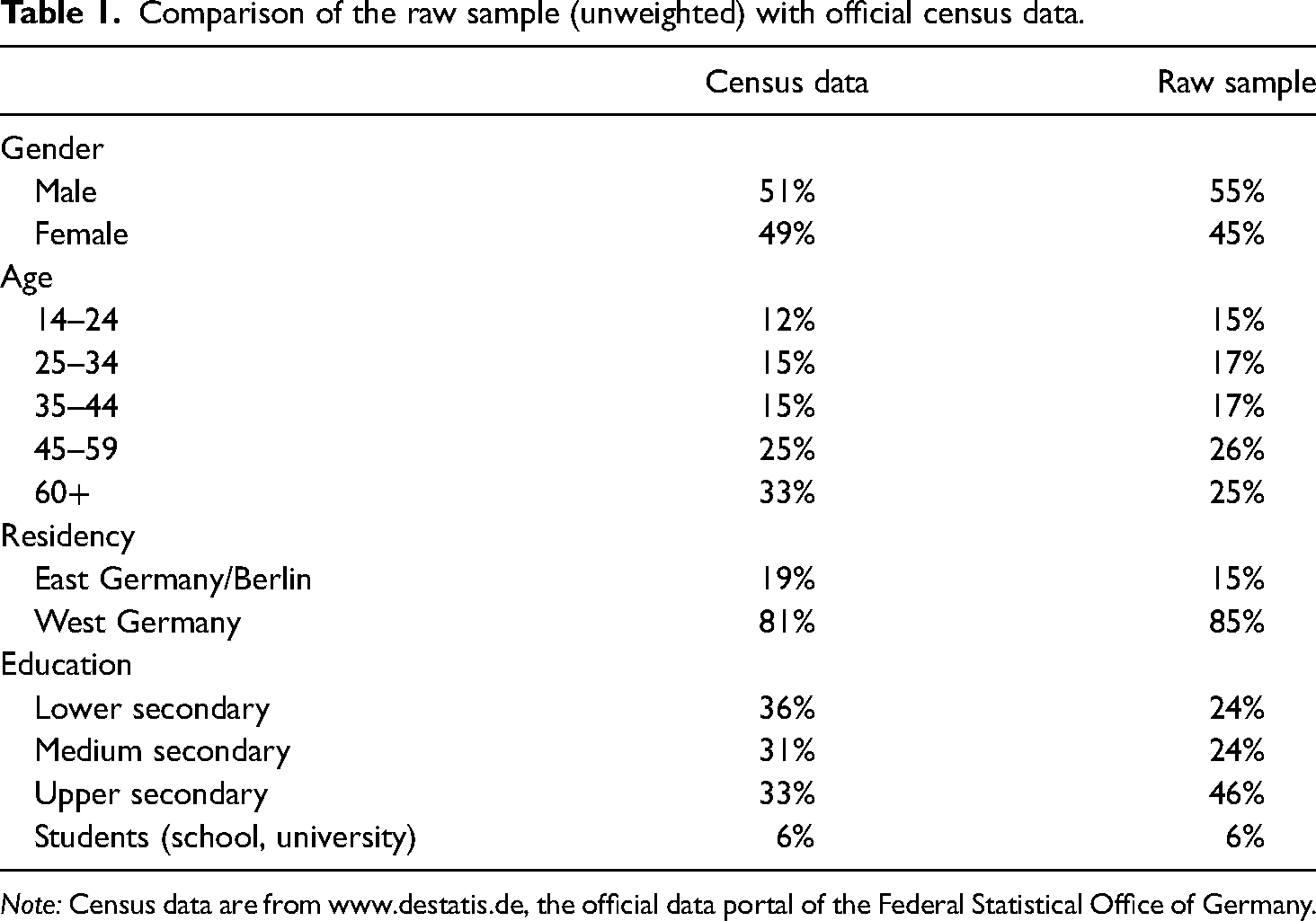
Note: Census data are from www.destatis.de, the official data portal of the Federal Statistical Office of Germany.
Vignettes
Vignette analyses are a special type of experiment embedded in large-scale social surveys (Alves and Rossi, 1978; Auspurg and Hinz, 2014). Vignettes are usually short descriptions of situations, objects, or people. They include a fixed number of descriptors (i.e. the vignette dimensions), considered relevant for the specific research question at stake. These vignette factors can have different values and the vignettes vary systematically in these values. All vignettes together constitute the vignette population, which ideally contains all possible combinations of values of the vignette dimensions. Survey participants then evaluate a number of different vignettes. The systematic variation of the vignette values allows estimating the influence that each value and factor have on the participants’ judgments.
This study uses a vignette design to manipulate four important characteristics of athlete activism. These factors include (a) the person (athlete vs. musician), (b) the form of political action and its disruptive capacity (appealing, demonstrative vs. confrontational actions), (c) the ideological nature of the political claim (progressive vs. conservative), and (d) the local reference of the claim (domestic vs. foreign problem). For each vignette, we asked the respondents if they would support the form of activism described in the vignette. The answer categories ranged from 1 = “I am not supporting this at all” to 5 = “I am completely supporting this.” Table 2 shows sample vignettes and illustrates the construction principles of the vignettes.
Vignette design and exemplary vignette texts.
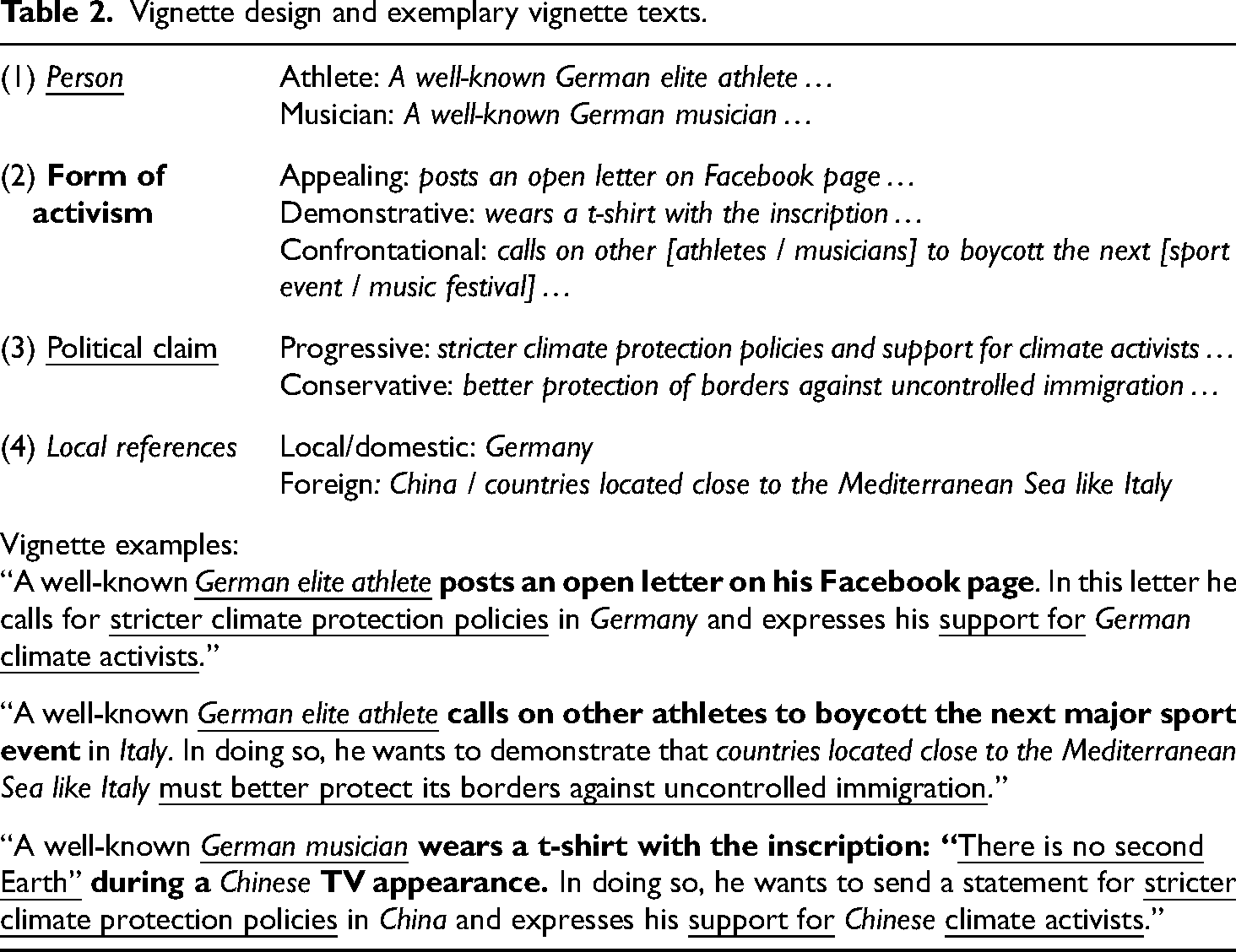
The combination of all four factors (2 × 3 × 2 × 2) results in a vignette population of 24 vignettes. We created four vignette sets with equally distributed vignette dimensions (block confounded factorial design; BCF design). Each vignette set consisted of six vignettes with balanced factor values so that each respondent faced each value at least once and all factor values were measured equally often. This leads to a data set with N = 6012 vignette ratings coming from 1002 respondents. The BCF design guarantees that data exhaust the entire vignette population and allows calculating the most relevant interaction effects (Su and Steiner, 2020). Figure 1 shows which vignettes were assigned to each vignette set.
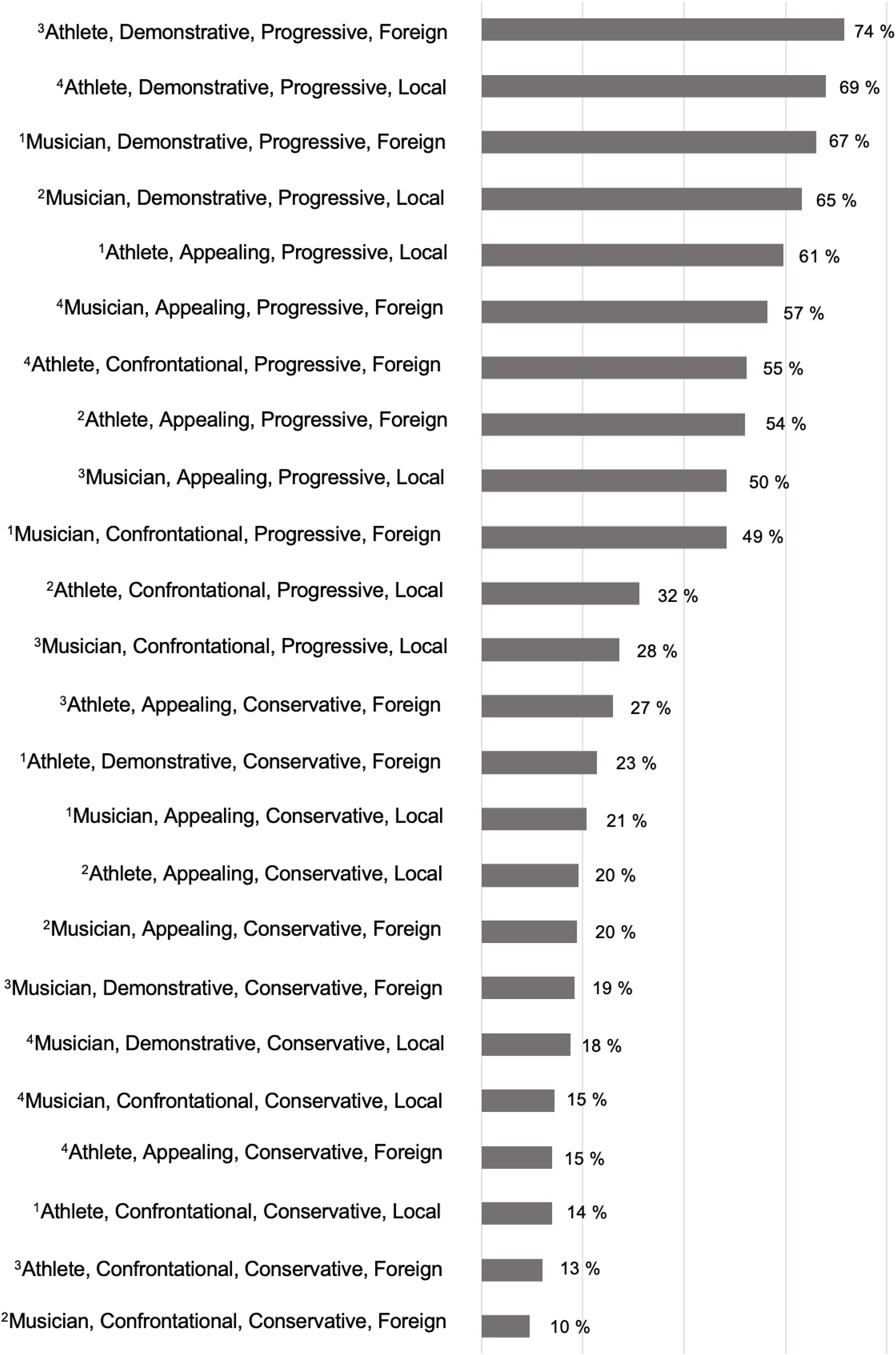
Level of support for the political activism vignettes.
Personal characteristics
Support of athlete activism is very likely not only influenced by the political action itself, but also by personal and sociodemographic characteristics of the respondent.
Political orientations
We assume that political orientation and engagement matter for the judgement of athletes’ activism. Hence, participants were first asked to position themselves on an ideological left-right scale ranging from 1 = “left” to 10 = “right” to indicate their basic political orientation (M = 4.68; SD = 1.6). Second, we asked participants about their previous involvement in different political actions. Those actions included (a) signing a petition, (b) attending an authorized demonstration, (c) commenting on a political social media post, (d) participating in a strike, and (e) taking part in a boycott. Respondents were asked for each action, whether they had already participated in such a political action (= 3), can imagine to participate in the future (= 2), or would never participate in such an action (= 1). The mean score was used as an indicator for respondents’ political involvement (M = 2.17; SD = 0.55; Cronbachs α = .72).
Interest in sports and music
We further assume that the respondents’ interest in sport and music can affect the support of athletes or musicians’ activism. A person's interest in sport is measured with three items: (a) the regular consumption of sportscasts in the media, (b) the spending of money for sportscasts, such as pay TV subscriptions, and (c) the attendance of live sporting events. Likewise, we capture the interest in music with (a) the regular consumption of music, (b) the spending of money on music streaming services, and (c) the attendance of live music events such as concerts and festivals. Participants could use answer categories ranging from 1 = “not true at all” to 5 = “completely true.” The mean score of these variables is used as a measure for interest in sports (M = 2.13; SD = 1.03; α = .76) and music (M = 3.07; SD = 0.94; α = .54).
Socio-demographic variables include the respondent's age (in years), gender (female vs. male), immigrant status (first-/second-generation migrants vs. non-migrants), and formal education, measured by the respondent's highest educational degree (lower secondary/ISCED II, medium secondary/ISCED III, higher secondary/ISCED IV, and tertiary academic degrees/ISCED VI and VII). We assigned students to the group corresponding with the expected degree of their current educational track.
Analytical approach
We apply a multi-level (ML) regression model to test our hypotheses. The ML model accounts for the nested structure of the data. The dependent variable is the support for the political actions described in the vignettes. To explain differences in the level of support, we use predictors at the vignette level (Level 1, referring to within-person variance) and at the personal level (Level 2, referring to between-person variance). Level 1-predictors include the four vignette factors described above, each represented by dummy variables. Level 2-predictors include the two measures of political orientation, sporting and musical interest as well as the sociodemographic variables. The ML model also allows for testing cross level-interactions. In this regard, we explored all two-way interactions but report only significant interactions (p < .05). Following a stepwise approach, we built the ML regression model in three steps: (a) only with Level 1-predictors, (b) with Level 1 and Level 2-predictors, and (c) with significant cross-level interactions. As we applied a BCF design, the vignette set was also included and thus controlled in all models. The statistical analyses are conducted with IBM SPSS 28.
Results
Descriptive results
Figure 1 shows the support levels for each of the 24 vignettes. The highest level of support (74%) receives the vignette that refers to a well-known German elite athlete wearing a t-shirt with the inscription “There is no second Earth” during a Chinese TV appearance to send a statement for stricter climate protection policies in China. In contrast, the vignette that received the least support (10%) refers to a well-known German musician calling for a boycott of the next music festival in Italy to demonstrate for stricter border protection in countries located at the Mediterranean Sea. Overall, we find high variation of support levels, indicating that the characteristics of the political action itself shape the support for athlete activism in Germany.
Multi-level regression models
Based on a random-intercept-only model (data not reported here), we can assign 72% of the total variance to vignette characteristics (Level 1, within persons) and the remaining 28% to personal characteristics (Level 2, between persons). These results buttress our general notion that not only personal orientations matter for the support of celebrities political actions, but also the characteristics of the political action at stake.
The results of the first ML regression model show that the four factors included in our vignette approach all contribute to the explanation of public support (Table 3, M1): Political activism performed by athletes receives significantly more public support compared to similar actions performed by musicians (b = 0.121; p < .001). This contradicts Hypothesis 1 and the idea that the public expects more political neutrality and restraint from athletes and therefore supports their claims to a lesser degree. Furthermore, the form of the protest influences the level of support (Hypothesis 2). Compared with a public appeal published as an open letter on Facebook, the symbolic protest of wearing a shirt with a political slogan receives significantly more public support (b = 0.186; p < .001). Vignettes that describe a boycott as a protest form receive significantly lower levels of support compared to an open letter (b = −0.386; p < .001). Hence, the more disruptive protest form of a boycott meets the highest level of rejection. Concerning the political issue (Hypothesis 3a), vignettes that relate to the claim of climate protection are significantly more supported compared to conservative claims for border security (b = 1.275; p < .001). Although we expected this effect, its size is still remarkable. Finally, the local reference of the protest shapes the level of support (Hypothesis 4): Criticism directed at foreign countries finds more support than critique of domestic policies and issues (b = 0.102; p < .01).
Public support of athlete activism.
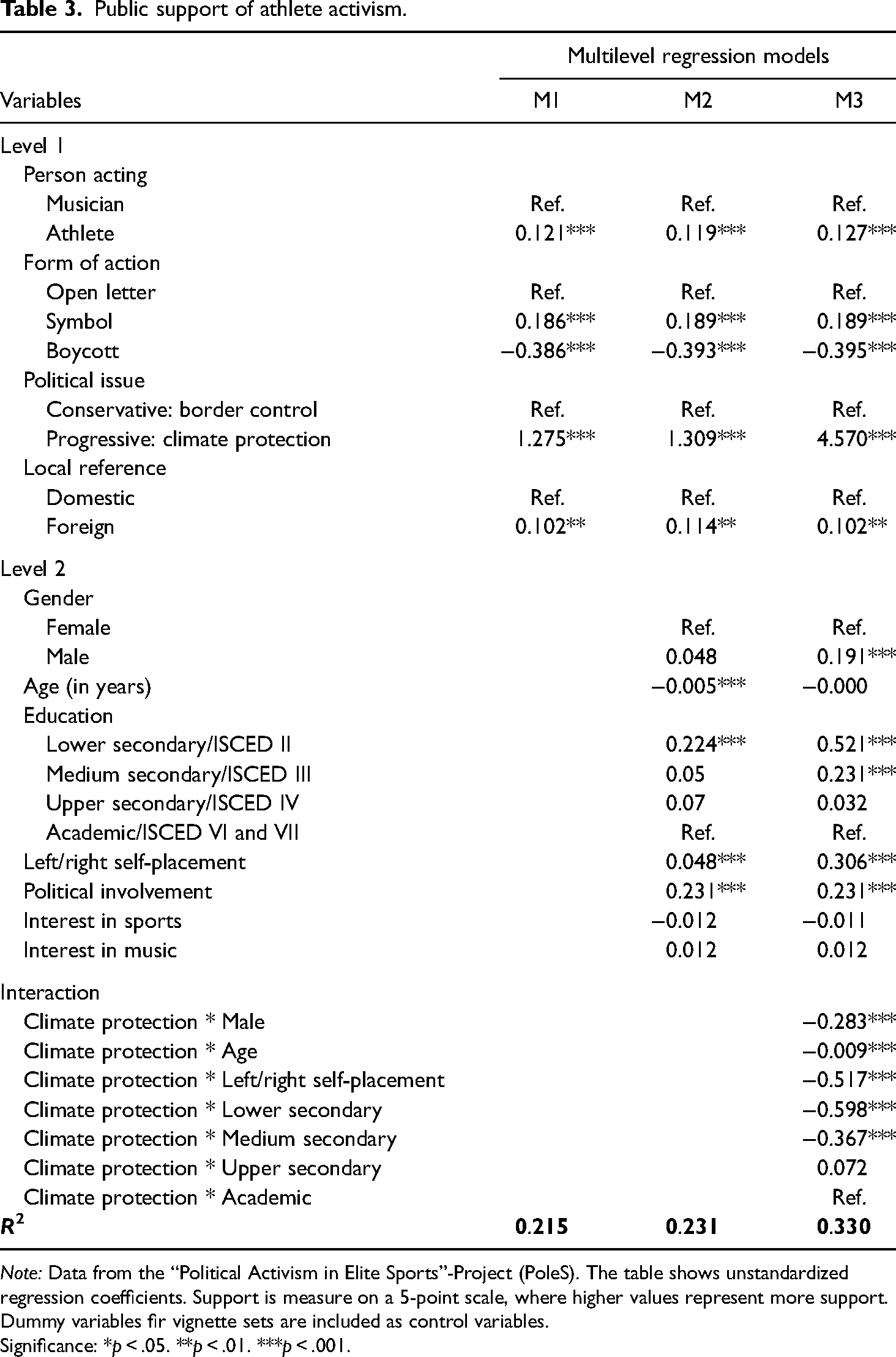
Note: Data from the “Political Activism in Elite Sports”-Project (PoleS). The table shows unstandardized regression coefficients. Support is measure on a 5-point scale, where higher values represent more support. Dummy variables fir vignette sets are included as control variables. Significance: *p < .05. **p < .01. ***p < .001.
The second model additionally includes personal and sociodemographic variables (Table 3, M2). While the effects sizes of the variables at the vignette level hardly change, the personal variables add to the model's explanatory power by increasing R2 from .215 to .231. Respondents who place themselves more to the right on the political left-right scale support political activism to a higher degree (b = 0.048; p < .001). At first glance, this effect may come as a surprise, but further elaboration in the third model shows that the higher overall support for athlete activism from right-leaning individuals is mainly due to the fact that this group also supports the conservative claim for border control—a claim that is strongly rejected by left-leaning respondents. Moreover, respondents who are more involved in political actions and protests by themselves support celebrities’ activism significantly more than less involved respondents (b = 0.231; p < .001). A person's interest in sporting and musical events has no significant influence on the level of support for activism. With regard to sociodemographic variables, age, and education matter, while the gender effect is insignificant. Specifically, with increasing age, the level of support for political actions dwindles significantly (b = −0.005; p < .001). Regarding education, a significant effect was revealed for people with lower secondary education, who show more support for activism compared to academics (b = 0.224; p < .001).
The third model includes all significant cross level-interactions (Table 3, M3), which increase R2 to .330. All cross level-effects refer to the political issue (Level 1), which interacts with gender, age, education, and the ideological left-right scale (Level 2). The model shows that ideologically right-leaning respondents (b = −0.517; p < .001), males (b = −0.283; p < .001), and older participants (b = −0.009; p < .001) all support the pro climate vignette to a lesser degree. This is in line with our assumption about ideological correspondence between an athlete's claim and a respondent's political values (Hypothesis 3b). The level of education also interacts with the addressed political topic, as people with lower education (b = −0.598; p < .001) and medium education levels (b = −0.367; p < .001) support climate protection to a lesser degree compared to academics. Including the interaction effects in Model 3 leads to an increase of the main effect for the political issue variable (b = 4.570; p < .001), which suggests that climate protection finds much more support than border control. However, the main effect now estimates the level of support only for young, female, left-leaning academics, as main effects and interaction effects always need to be interpreted in their specific combination.
Discussion
To our knowledge, this study is the first examination of public support for athlete activism in Germany with a vignette design. This design allows for causal and more generalizable conclusions about why some forms of athlete activism find high approval and support, while others meet with disapproval and criticism. Therefore, the study adds to the state of scholarly knowledge, which is largely informed by case studies on a few high-profile athletes (e.g. Galily, 2019; Schmidt et al., 2019). Our findings indicate that protest characteristics have a strong influence on the level of public support. Characteristics of the protest are more important than personal characteristics of the respondent. Simply put, people do not generally support or reject activism, but their reaction depends on who is protesting, how, for what, and where.
All of the four factors examined at the vignette level prove to be of relevance. Our findings show that athlete activism finds more support in the German public than activism carried out by popular musicians, which contradicts our initial assumption (Hypothesis 1). Thus, findings do not support the popular argument that “sport and politics don’t mix” (Kaufman, 2008; Sanderson et al., 2016). In fact, many Germans are seemingly no longer convinced that sport and politics are separate spheres and athletes should be as politically reserved as possible. Results further show that less disruptive forms of athlete activism, such as public appeals and symbolic actions, receive higher levels of support compared confrontational forms of protest, such as calls for boycott (Hypothesis 2). This finding aligns with political science research on protest strategies of social movements (della Porta, 1999; Thomas and Louis, 2014). Particularly, the high level of support for symbolic actions could also indicate that people have become used to this form of protest, as it is quite common in sport (e.g. kneeling during the anthem or wearing an armband with a political slogan). Generally, German's support of advocacy for more climate protection was substantially higher than their support for stricter border control (Hypothesis 3a). Both issues have been highly politicized for years (Hutter, 2014). Calls for strict and fast environmental protection measures exemplify a progressive political claim whereas rejection of immigration, calls for border security and “law and order” resemble a proto-typical conservative claim (Schwartz et al., 2014). However, since our vignettes only focused on two political issues, we remain cautious with regard to generalizations about whether athletes taking progressive stances are more accepted than those speaking out for conservative positions across the board. The higher support for the progressive vignette in our study over the conservative one may ultimately thus be more reflective of overall support for climate protection and of rejection of anti-immigrant measures among respondents rather than more generalized support for progressive activism in sports. On the other hand, an alternative interpretation of these findings may be that sport—though often construed as “apolitical”—is simultaneously regularly regarded as an inherently “good force” in society that supposedly furthers positive societal developments. As such, statements about climate protection or inclusion—and, conversely, stronger opposition to exclusionary policies—may correspond with the sentiments of this “Great Sport Myth” (Coakley, 2015) and may thus find more positive resonance among respondents. Finally, activism that criticizes foreign countries receives more support from Germans compared to activism that criticizes the same political issue in Germany (Hypothesis 4). Although the survey did not assess a respondent's national identification, the finding that criticism of domestic conditions is regarded less acceptable is in line with theorizing on intergroup bias in favor of a person's in-group (Hewstone et al., 2002).
Personal characteristics of the participants also matter. Age is associated with the level of support for athlete activism with older respondents showing less support, particularly for the progressive topic of climate protection, compared to younger ones. This finding supports Allison et al. (2022), who also found a negative link between age and the acceptance of the anthem protest in the US. The cross-level interactions further show that gender and education have an influence, especially for the support of progressive issues. In this regard, males and individuals with lower educational degrees show significantly less support for celebrities’ climate protection claims. In addition, progressive claims find more support among respondents who self-position more to the left on the left-right scale, while this group strongly rejects claims for border control (Hypothesis 3b). Unsurprisingly and in line with balance theory (Heider, 1958), people support activism that is in line with their own political beliefs and reject claims that contradict their own opinions. Finally, politically involved respondents, that is, those who participate in political actions themselves, are also more prone to support athlete activism.
Somewhat unexpected is the finding that the interest in and consumption of sport (or of music) does not affect the support of activism. Assuming that any kind of political activism distracts from the “real” purpose of sports (or music) because it opens up a side stage, one might also have thought that sports or music fans would be more critical of political actions. However, this is not the case. The core audience (of sport or music) does not evaluate political activism differently than the general population. This stands in contrast to findings from US research on protests during the playing of the anthem, where identifying as a sports fan was correlated with stronger opposition to athletes’ right to protest (Knoester et al. 2022). Hence, in this context, the specificity of a country's (sports) culture may figure in. For instance, a substantial proportion of US adults believe that sports teach love for the country and instills respect for the military (Knoester and Davis, 2022), values that are not closely associated with sport in Germany.
Our findings come with scientific and practical implications. In times of “new contentious politics” in Germany (Hutter and Weisskircher, 2022) various social movements from populist right (e.g. “Pegida”) to moderate and radical environmentalists (e.g. “Fridays for Future” and “Last Generation”) are mobilizing for their agendas. In this context, actions and statements from popular athletes may receive a wider societal echo and following, so that athletes have a substantial mobilizing potential for social movements, social change and protest politics (Cooper et al., 2019; Norris, 2002). Practically, however, this study also shows that although the German public accepts athletes as activists, this acceptance is conditional. Athletes, who align with mainstream politics, criticize issues abroad and use appealing and symbolic protest forms are likely to meet positive public reactions. Negative reactions are more likely when they take a stance for unpopular, conservative issues or choose confrontational protest forms. In such cases, athletes must prepare for backlash.
Moreover, athlete activism may turn out as a problem for the international governing bodies of sport. Assuming that audiences in different countries perceive different political issues as salient, support different policies, and have a shared preference that criticism should not address their own country, any form of political activism is likely to delight some spectators and, at the same time, irritate others. The same protesting athlete can thus be perceived as a progressive activist in one country and as a provocateur in another. Hence, activism can polarize audiences, which is a consequence international sport organizations supposedly want to avoid.
With regard to methods, the present paper applied a vignette paradigm rarely used in sport sociology. However, this method combines the strength of representative large-scale surveys that allow for generalized conclusions with the strength of experimental designs that allow for causal conclusions. This method is always useful when individual evaluations relate to certain dimensions of the evaluated issue. There are many other questions beyond the topic pursued here, where similar vignette designs can possibly provide novel insight.
Besides the strengths of this study, we also want to emphasize some limitations. Vignette designs are guided by theoretical considerations about the most relevant factors that may structure individual reactions to a certain subject. Although we can justify our decision to focus on certain factors, this does not mean that other factors are irrelevant. Additional factors of potential relevance are the protesting athlete's gender or whether athletes carry out protests on or off the playing field. Hence, it is possible to expand the vignette population applied here with additional factors. Moreover, the list of issues that we included is limited and the left/progressive vs. right/conservative distinction does not capture fully the space of political ideologies. Moreover, we seem to have included a conservative topic that has far fewer supporters than the progressive topic. This does not necessarily mean that Germans are predominantly progressive but rather that the selection of right-leaning or conservative topics for the vignettes can still be improved. In addition, it remains a bit speculative why Germans have low levels of support for criticism that addresses issues in Germany. This could either be an indication of “double standards” (as we argued) that serve to maintain a positive image of one's own country, or—alternatively—be reflective of the fact that problems are (perceived to be) greater or more pressing in some foreign countries and the political ways of dealing with these problems less credible and convincing. A more detailed examination of both interpretations could be a worthwhile endeavor for future studies. With regard to the sample, online surveys can only reach respondents with access to the internet—currently, this is 94% of the adult German population (Federal Statistical Office of Germany, 2023). This bias toward internet users may have contributed to the fact that less educated individuals were somewhat underrepresented in the raw data.
Overall, the present study has shown that athletes are widely accepted in Germany as political activists, at least as much as other celebrities. On the one hand, the relatively high acceptance of athletes using their platform to speak out politically may be lamented by some as a symptom of sports losing its character as an “escape” from real-world issues. On the other hand, however, this development may be interpreted more optimistically as an expression of sports audiences accepting athletes as more than mere sportsmen and sportswomen but as individuals that have something to say about social issues. However, public approval relates strongly to protest characteristics. As long as athletes use non-disruptive protest forms and advocate for issues that are not very controversial their actions are accepted by the public as well as by followers of media sports. In contrast, making strong claims for controversial issues may trigger backlash. Hence, athletes’ activism also has a potential for polarization: Germans often support one type of political action (in line with their own political beliefs), while rejecting another. It remains an open question whether there is enough political tolerance to accept dissenting opinions expressed by athletes. However, this is exactly what people would have to do if they demand for politically mature athletes who articulate their political convictions publicly.
Footnotes
Declaration of conflicting interests
The authors declared no potential conflicts of interest with respect to the research, authorship, and/or publication of this article.
Ethical approval
The ethics committee of the University of Münster approved this study.
Funding
The authors received no financial support for the research, authorship, and/or publication of this article.
