



Abstract
To be visible and recognized in public life, marginalized gropus must speak up and speak out. As they articulate a collective voice through protest, these groups lay claim to belonging and enrich democracy, an institution that frequently excluses them. The case of LGBTIQ activism in India demonstrates that protest is the realization of political agency.
In the last 10-15 years, there has been a surge of protests around the world, spanning from Budapest to Beirut and from Seoul to Sao Paulo. Through protest, ordinary people challenge the status quo and the powerful structures maintaining it. They advocate for positive social change on issues such as increasing access to nutritious food and clean water, improving healthcare, fostering civic peace, and advancing environmental protections. They demand justice, often in opposition to elected representatives. Although protests frequently advocate for specific changes in public understanding or policy, these mobilizations also play a broader role in the democratic process by allowing people to be heard: protest is the realization of political agency. For marginalized groups, mobilizing through protest can often be more meaningful than other forms of civic participation, such as casting a ballot in elections or participating in formal partisan organizations.
These political eruptions raise profound questions about the meaning and purpose of democracy, revealing a key tension. On the one hand, mainstream media and politicians frequently frame protestors as opportunistic troublemakers who threaten due process—even democracy itself. On the other, protest is sometimes the only viable option for marginalized groups seeking to raise awareness of a pressing social issue. In this essay, I draw on my field research on LGBTIQ activism in India to argue that protest allows minority groups to represent themselves on their own terms, to express a voice defined not by stigma or suppression but by collective agency and pride. In doing so, such groups strengthen the core pillars upholding democracy— namely, they participate in public life and represent themselves with and to others.
It is worth noting that representative democracies often exclude some groups, yet they are built on principles, like freedom of association and freedom of speech, that ensure individuals and groups can express themselves and their identities freely. It is no surprise, then, that protests thrive in democracies but atrophy in authoritarian regimes with limited or no civil society.
The perspectives of LGBTIQ activists in India provide valuable insights into how protest can enrich democracy. Much ink has been spilled attempting to define and understand what democracy is; I need not re-tread this familiar ground here. Suffice it to say, the essence of democracy is voice, the capacity to give an account of oneself, to be heard. People need to feel that they are able to participate in public life and that they are able to represent themselves. The problem is that electoral democracy, as a procedure to aggregate individual interests, is built on realizing the wants and needs of the majority. As a result, marginalized groups such as queer people, Indigenous groups, Roma, and refugees, amongst others, may find themselves actively silenced.
the value of voice
Exercising voice in the public sphere is crucial in the development of solidarity and group identity formation within marginalized groups. It also has the capacity to enhance their visibility and recognition in broader society, potentially enabling them to educate others. Even so, when marginalized people do speak up and make demands, their demands are typically dismissed as irrelevant or insignificant precisely because their voice challenges powerholders in society. In this respect, the articulation of voice by marginalized groups should be understood as an achievement in its own right—and one that we should not assume or take for granted.
Mumbai Pride, 2019.
Courtesy Aidan McGarry
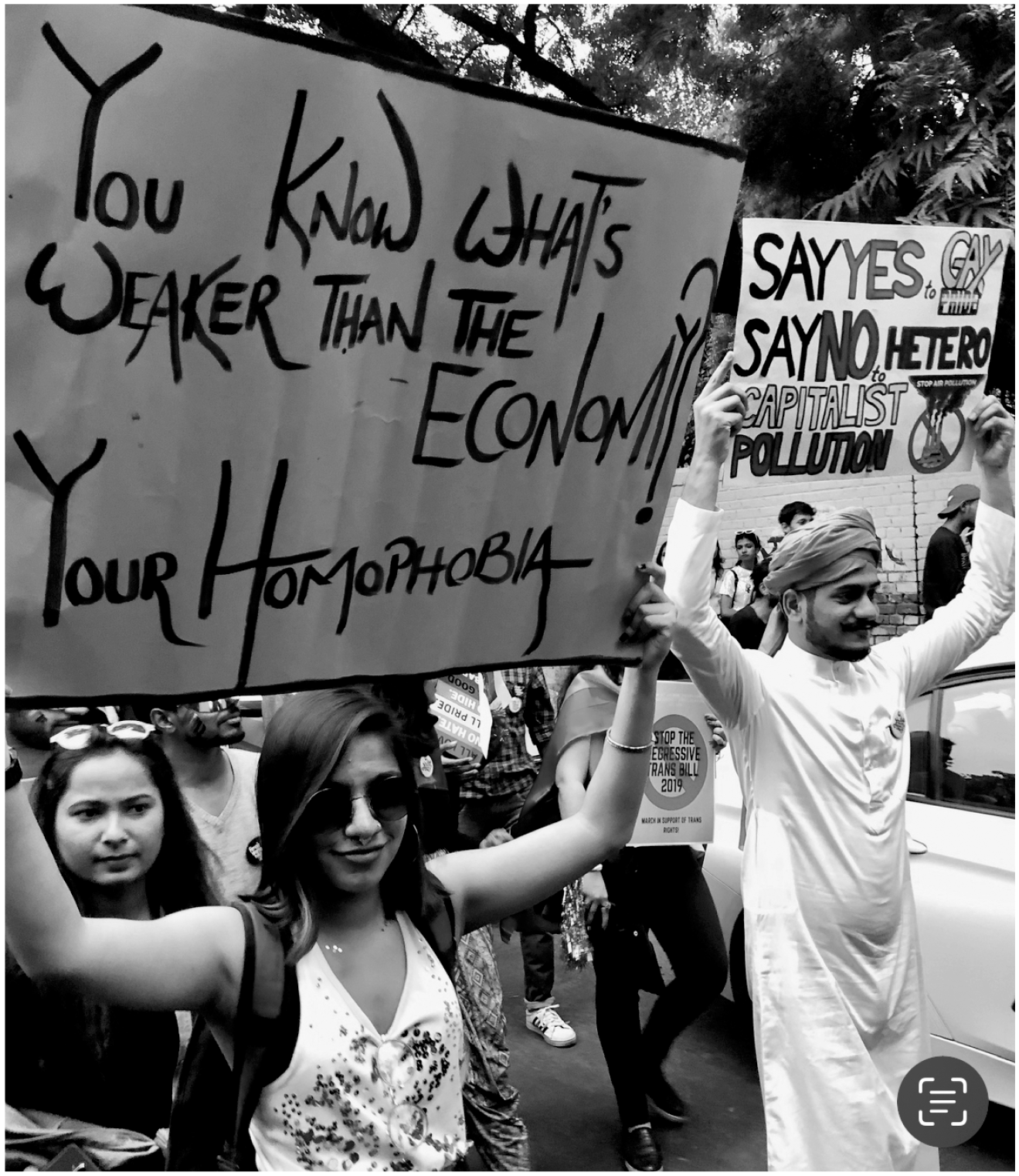
On the relationship between democracy and voice, the words of African American poet Audre Lorde are particularly salient. She holds that speaking up and speaking out by marginalized people reclaims voice as an instrument of control. It challenges the imposition of silence and the assumption of acquiescence. As Lorde argues, "I have come to believe over and over again that what is most important to me must be spoken, made verbal and shared, even at the risk of having it bruised or misunderstood. That the speaking profits me, beyond any other effect." She warns against staying silent, as inaction fosters fear and is ultimately a betrayal to oneself: "What I regretted most were my silences… my silences had not protected me. Your silence will not protect you."
Considered from this perspective, the true power of voice lies in the speaker’s capacity to challenge dominant ideas and practices. While not without risks, speaking up and speaking out affirms the agency of the speaker and signifies a claim to belonging within wider society. As we will see in the case of queer activism in India, the expression of voice is consequential not only for those who hear it, but for the speakers, in whom it can foster individual and collective identity development.
voice as representation
Akhil (a pseudonym) is a young activist from Mumbai. I think of him as a sort of "gay Gandhi." He is passionate and outspoken about the rights of LGBTIQ people. We developed a relationship over the course of my fieldwork as Akhil in took me to his workplace and invited me to worship at his temple. One day, I asked Akhil why he became an LGBTIQ activist, and he proceeded to tell me an incredible story about protest and voice.
In 2013, Akhil explained, the Supreme Court of India had disappointed millions of LGBTIQ people when it announced its decision to uphold Section 377, a law criminalizing homosexuality. There had been a sense that the moment had finally come, that Section 377 would be struck down, but this was not to be, at least not for another five years. Expressing their frustration with this significant legislative setback, prominent queer activists in India began speaking to the international media, in English. Akhil realized that someone needed to speak to regional and local TV in local languages to spread the message and control the narrative within India. In other words, he recognized that changing the law would require speaking to ordinary Indian people to change their minds. On the day of the Supreme Court’s disappointing decision in 2013, he ended up appearing on one local TV channel after another, from 11 am to 8 pm. The experience of speaking local dialects on the TV news reinforced Akhil’s conviction that it was important to engage with the majority directly, to use his voice to share his experience and communicate what the ruling meant for him as a gay man.
That night, Akhil recounted, he took a "slow" train to his hometown, just over an hour’s ride from the center of Mumbai. As its nickname suggests, this train makes stops at every station along the busy commuter route to the city’s periphery. Akhil explained, "It was a crowded evening train in a second-class compartment, and I stood up and started talking about how today’s judgement was wrong and how I—as an Indian, born in India—my rights had been taken away. Rights given by the Indian constitution had been taken away by the Supreme Court. And by the time I reached my hometown, I had done about three or four compartments. I had changed compartments at different stops, and I made the speech again and again." The passengers’ outward responses were mixed. Some were clearly listening, while others looked away, ostensibly ignoring his monologue. Akhil didn’t buy it. He told me he was sure they were listening, too—after all, he was talking about sexual rights and relationships in a public setting.
Energized by his own action, Akhil decided that if he really wanted to make an impact on society, he needed to take a leap of faith. The very next day he resigned from his job and hit the road to communicate to the Indian public how Section 377 infringed on his rights: "I wanted to reach out to villages, to smaller towns and rural areas of my country, to different areas which do not speak English." He continued, "I decided that I needed to speak about the same thing in the regional language. I had 80,000 rupees ($960 USD) in my bank account that day. I stayed at the shadiest places for six months. I did around 500 public talks like that in Gujarat, Rajasthan, Uttar Pradesh, Bihar, Delhi and Bangalore."
As Akhil traveled around the northwest of India for six months, giving public talks across five states, he adjusted his language to suit his audience. "In Gujarat, I will speak Gujarati," Akhil explained, "In Rajasthan or Utter Pradesh, I will speak Hindi. If I am in Maharashtra, I will speak Marathi." Just as he had done on the day the Section 377 decision was announced, Akhil would often stand up in a train or bus (he always took the cheapest, slowest transport, as this provided the most opportunities to reach fellow passengers) or local food market to speak to people. He would begin by saying, "I have something to share," in the regional language and then continue, "I am gay, and my rights are being taken away by the Supreme Court of India."
His speeches always ended with the same questions: Did his fellow Indians think it fair that the punishment that he would receive for being with the person he loved would be equivalent to the punishment for murder or rape—ten years to life imprisonment, according to the current law? Did they think he deserved this punishment just because the person he loved happened to share his gender?
Akhil’s mission to advocate for the rights of queer people and contest how they were being treated as second-class citizens led him across the country of India. He wanted his voice to be heard by people who didn’t speak English, who may not even have known what it meant to be gay. He wanted to connect directly with ordinary Indians and appeal to their intuitive sense of justice. "I did not want it to be this fancy gay rights activist who complains that rights are missing. I wanted to reach out to the public and be direct." Here, Akhil demonstrates his understanding of the power of his voice as a medium to connect with fellow humans, share knowledge, and represent the experience of a silenced group. To the best of my knowledge, nobody else was doing this work, at least not in India.
The reality of being LGBTIQ in India is represented to the majority through Akhil’s singular protest. It ruptures the status quo, as those listening to Akhil sharing his experience are confronted with the reality of queer people’s existence. They have little choice but to engage with this message, even if they find the subject uncomfortable. This is only possible because Ankil gives an account of himself and, in doing so, speaks as (rather than speaks for) the queer community in India.
voice as participation
India is a particularly complex and interesting place to study LGBTIQ rights because it maintained an antiquated British colonial law criminalizing homosexuality, Section 377 of the Indian Penal Code, until very recently—2018. The law’s eventual repeal was hailed as the largest ever single intervention in LGBTIQ emancipation, as it applied to one of the largest populations in one of the largest democracies in the world. The repeal was seismic.
As an LGBTIQ activist and scholar of social movements and protest, I was keen to understand the impact of this ruling on India’s LGBTIQ/queer community. My hunch was that it would lead to increased confidence and visibility of the community, and I expected this to manifest at Pride celebrations, the most visible and public manifestations of queer identity and voice. LGBTIQ people in India are incredibly diverse with a wide array of identities including hijras (a third gender) and kothis (feminine cis-males) alongside, and sometimes overlapping with, lesbian, gay, bisexual, trans, intersex, and queer individuals. In annual Pride events, queer people come together and lay claim to their demos, assert visibility, and articulate voice.
Protest is the realization of political agency.
I attended the first Pride event in India after the repeal of Section 377, which was held in India’s modern metropolis, Mumbai, in February 2019. I returned later that year to attend Pride in the capital, Delhi where in addition to attending the Pride parades, I attended various cultural events and parties as well as more solemn occasions including a candlelight vigil at Trans Day of Remembrance.
Delhi Pride, 2019.
Courtesy Aidan McGarry
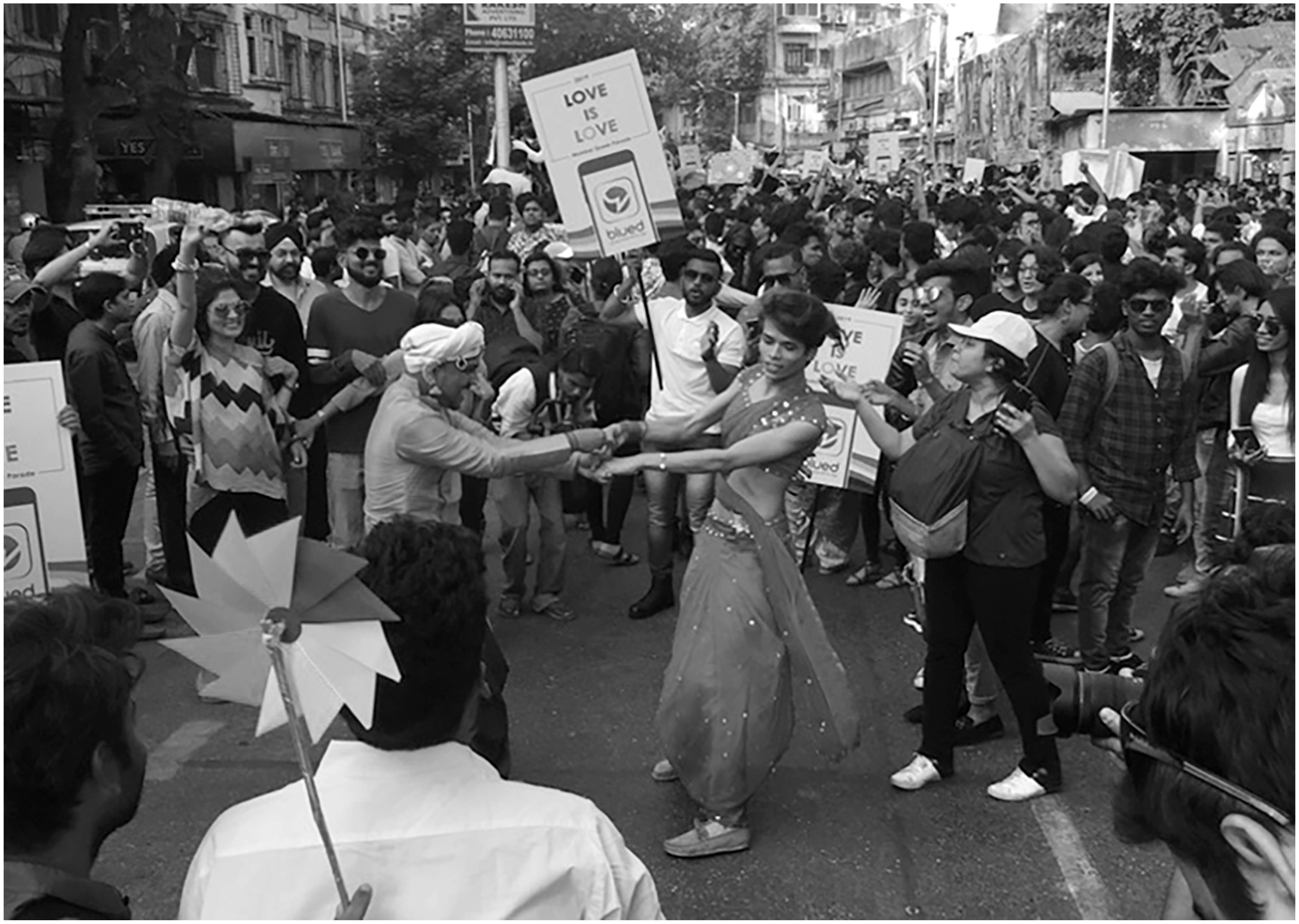
Voice is articulated through queer Pride parades. It is the one time of year when queer visibility and participation in the public sphere is claimed and celebrated. Consider the following scene: a colorful and diverse group of 20,000 LGBTIQ Indians and allies gather in the center of Mumbai on a Saturday afternoon in November 2019 for Queer Azaadi Pride (Azaadi means freedom in Hindi and Urdu). It the largest queer Pride in India’s history, and the mood is both jubilant and defiant. Rainbow flags fly, drum music pulses through bustling downtown Mumbai. The crowd marches, sings, and dances, chanting slogans of love and acceptance. Participants carry placards proclaiming messages that are both brilliantly amusing and sharply political: "Of course I dress well, I didn’t spend all that time in the closet for nothing!" "You’re Not Transphobic, You’re Just an Asshole," and "Casteism is a Queer Issue." Political voice expressed through Pride helps to challenge the voices of oppression that keep queer people marginal, silent, and ashamed.
Akhil affirms the collective and political dimension to Pride. "Pride, anywhere in the world, is a political statement in my understanding because what you are doing is coming out onto the street and saying, ’Hey, I exist.’ Pride, at its core, is political." What Akhil understands as political is the capacity to gather and participate collectively in a public arena and say that one exists. As a pride participant named Ramya puts it, "Pride is political because existence as queer is a political act. If you choose to exist, your existence becomes resistance. Fighting erasure, fighting the narrative you don’t exist, and you choose not to accept it." Political voice expressed through Pride helps to challenge the voices of oppression that keep queer people marginal, silent, and ashamed.
The Pride organizers are keen to be as visible as possible. Significantly, and symbolically, participants gathered at Gowalia Tank (known as August Kranti Maidan), where Gandhi began his famous "Quit India" movement against the British in 1942. Not all the participants at Pride are queer; many straight allies also march to show their support. The 2019 Pride parade in Mumbai winds through busy residential and shopping districts in the Lamington Road area with thousands of people lining the streets, watching and sometimes recording the procession of people chanting, singing, dancing, waving, holding up placards and flags, and holding hands with their friends and lovers. The carnivalesque performance of Pride does not disappoint those curious bystanders. Participants dress up in dramatic, colorful outfits, make noise, and subvert norms of sexuality and gender.
In explaining her motivation for marching at Pride, Ramya says she refuses to invisible: "I wanted to find a sense of belonging, to find my people. Attending Pride felt like I was stepping out of the closet, shedding the skin of who I was, to find my authentic self." As queers, we must repeatedly "come out" throughout our lives to our friends, families, co-workers, and strangers. For some, these are traumatic experiences, while for others, they can be cathartic, bringing a sense of relief and self-actualization.
Queer people come out as gay, lesbian, queer, non-binary, hijra, and so on for many reasons, including our own happiness and mental well-being. Coming out can also be a reflexive act of community-building, signifying belonging with others by participating in public and civic life. Additionally, those of us who have come out often do so not only for ourselves, but also for others, especially those who are unable to come out. There are tolerant and progressive people in contemporary society, but the reality is that coming out is fraught with danger, as queer people in India and elsewhere are routinely stigmatized and persecuted. It is vital to appreciate that there are social conditions that make it difficult or unsafe to come out, especially for women. For example, a lesbian coming out in a small town in India could put herself in grave danger. Therefore, it is all the more important that, as Mumbai Pride organizer Bishimber told me, "Those of us who can afford to come out […] should come out."
There is thus a clear interplay between individual and collective participation realized through Pride parades. Participants take up public space declaring not only "I exist" but "we exist," that queer people are a part of the wider society.
reclaiming democracy
Protest enriches democracy by reminding us of its ultimate purpose: to allow individuals and groups to represent themselves and fully participate in the public sphere. This democratizing function of protest is especially true for communities routinely marginalized and silenced, such as LGBTIQ people in India. My tone in this essay is intended to be hopeful without being naive. The reality is that protest cannot solve all problems facing marginalized groups. Even so, the act of protest can have a significant, positive impact on those who engage in it, fostering belonging and community-building. It also signals to the majority that marginalized groups exist—and refuse to stay silent.
Ultimately, the expression of voice enables individuals to realize agency in a way that formal democratic processes, such as episodic voting, do not. Voice reveals knowledge and experiences that would otherwise remain hidden. It requires participation, it enables representation. In the cases of Akhil’s solo pilgrimage and queer Pride in Mumbai, we witness a reclaiming of the essence of democracy.
recommended resources
Judith Butler. 2015. Notes Towards a Performative Theory of Assembly. Cambridge, MA: Harvard University Press. One of the world’s most important living philosophers advances a clear argument on the relationship between protest, public space, and collective assembly, helping us to make sense of diverse forms of street protest.
Adriana Cavarero. 2005. For More than One Voice: Towards a Philosophy of Vocal Expression. Redwood City, CA: Stanford University Press. This theoretical book develops a keen understanding of the power of voice and the meaning of vocal expression.
Audre Lorde. 1977. "The Translation of Silence into Language and Action," Sinister Wisdom 6: Secrets. This short, powerful must-read lucidly explains why we must speak up and speak out, no matter the cost.
Aidan McGarry. 2024. Political Voice: Protest, Democracy, and Marginalized Groups. Oxford: Oxford University Press. A theoretically and empirically rich discussion of the relationship between protest and democracy, this book places voice at the heart of the debate.
Gayatri Spivak. 1988. "Can the Subaltern Speak?" In Cary Nelson and Lawrence Grossberg (eds.), Marxism and the Interpretation of Culture. Basingstoke, UK: Macmillan. A key text for those interested in post-colonialism, decoloniality, and subaltern studies, this book chapter centers the agency of marginalized people.