




Abstract
“American Sentimentalism and the Production of Global Citizens” looks at recent trends in the globalization of U.S. higher education through the lens of sentimentalism to expose three dangers: the linking of a certain kind of productivity with global citizenship; the division of the world into global citizens and global subjects; and the illusion that awareness and enthusiasm are sufficient for social change. Social scientist Ron Krabill calls for international education policies that embrace radical reciprocity to overcome these dangers.
Keywords
Try this experiment: Go to your college’s or university’s home page and look for the mission statement. Odds are high that you’ll find at least one reference—whether explicit or implicit—to the institution’s promise to “produce global citizens.” While this goal has become widespread, even a truism, in higher education, the particular construction of this concept is relatively new. Historically, study abroad and a global education were understood as the purview of elite students, with the primary goal of developing more complete, worldly, and successful individuals. When “developing citizenship” was expressed as a goal of higher education, such citizenship was understood as national rather than international in scope.
The production of global citizens as a goal of higher education arises from a particular mix of mediating factors in the late twentieth and early twenty-first centuries, many of which fall under that ever-amorphous phenomenon of globalization: international monetary configurations oriented toward global business success; rapidly expanding (yet pervasively shallow) media focus on world problems such as global health, human rights, natural disasters, and poverty; the rise of online learning opportunities across national borders; more international students studying within the United States and more competition for U.S. higher education institutions from abroad; and the decreasing costs of international travel for U.S.-based students, to name but a few. One consequence of these shifts toward a global perspective is a much more widespread expectation that some form of international education be a part of every U.S. student’s experience.
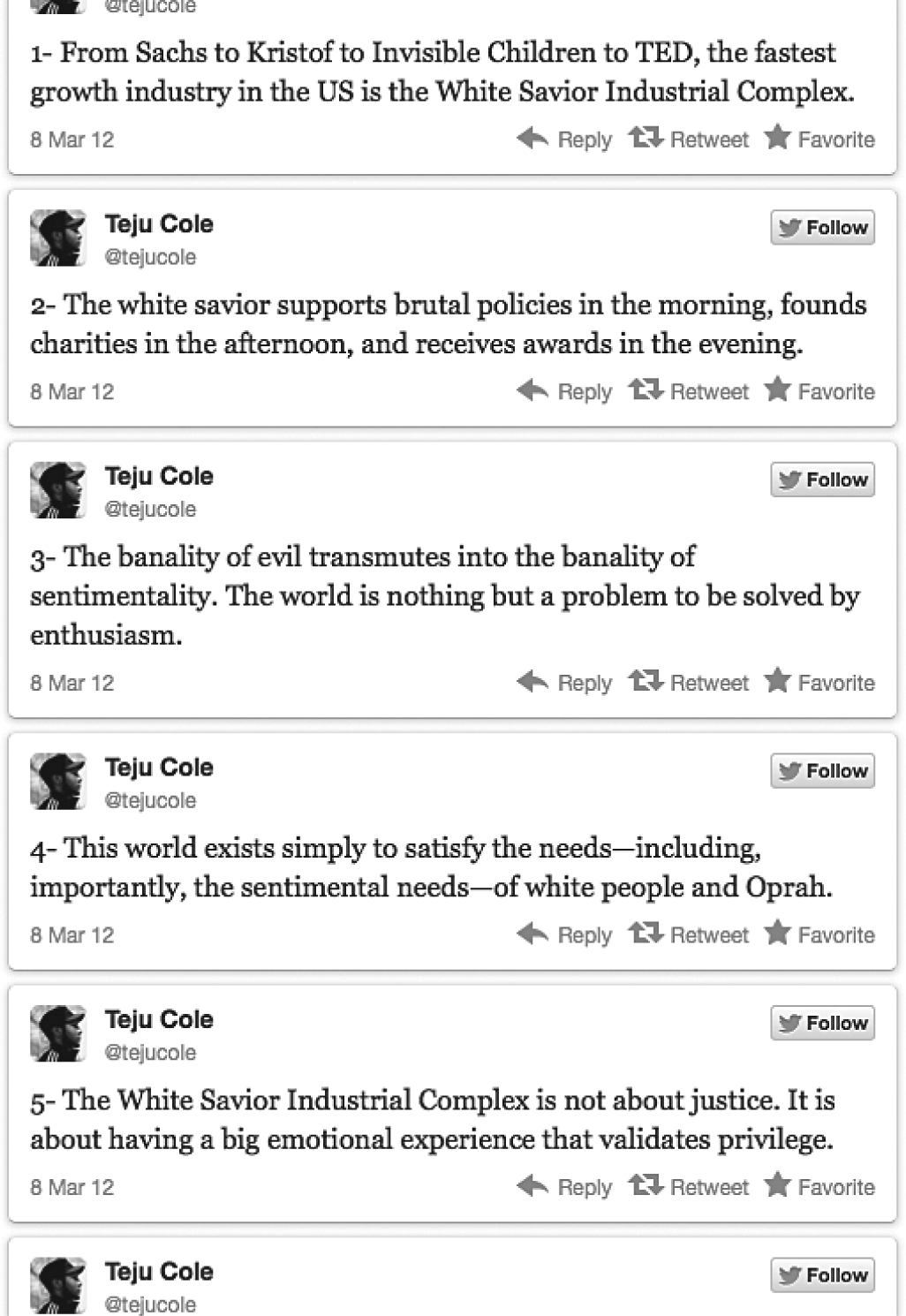
“The White Savior Industrial Complex is not about justice. It is about having a big emotional experience that validates privilege.”
Invisible Children founders Bobby Bailey, Laren Poole, and Jason Russell with members of the Sudan People’s Liberation Army on the Sudan-Congo border in 2008
Glenna Gordon

There are many reasons to applaud the trend toward “globalizing” U.S. education. Extending study abroad opportunities beyond elite students or institutions, and to locations that push students beyond their economic, physical and cultural comfort zones, are significant achievements in their own right. Likewise, increasing students’ sense of the necessity to understand and be accountable for global issues is a noteworthy humanistic endeavor. In a country where shockingly few national legislators have spent time outside of the United States or even possess passports, and where adults and students alike have disturbingly limited knowledge of basic global geography, the internationalization of higher education is a good thing. Right?
What are some of the unintended cultural consequences of these programs? American sentimentalism can be seen as one such outcome and the concept provides a lens that clarifies the dangers of these trends without necessarily dismissing the benefits. Sentimentalism—emotion-based claims to moral superiority and as justification for one’s actions—has a long track record in literary and cultural history, but it entered the public eye most recently and forcefully in the debate around the Kony 2012 video that went viral with over 100 million views since March 2012. This debate was especially evident in writer Teju Cole’s scathing critique of the video on Twitter. The Atlantic magazine subsequently reprinted Cole’s seven tweets under the title of “The White Savior Industrial Complex.” In this elaborated version Cole notes, “I deeply respect American sentimentality, the way one respects a wounded hippo. You must keep an eye on it, for you know it is deadly.”
Author Teju Cole’s tweets are critical of the KONY 2012 campaign and what it represents.
Cole’s American sentimentalism-based critique of Kony 2012 applies well to the idea of global citizenship as it has been deployed in the rhetoric of higher education. This is more than an accidental parallelism. The filmmakers behind Kony 2012—with its claim to help child combatants by making the Lord’s Resistance Army leader Joseph Kony “famous” through social (and other) media—have utilized college campuses as a primary speaking and recruiting grounds for their organization, Invisible Children. Both critiques and defense of the film center on questions of generational differences in engaging social media and politics. So the connections are not incidental between Kony 2012, larger mediated perceptions of global issues, and the expectation that international experience, particularly one that includes some element of “helping” those whose supposedly-exotic country one is visiting or learning about, be part of a U.S. student’s education. Both efforts rely on sentimentalism as the driving motivational force for social engagement.
U.S.-based students become global citizens, while residents of the Global South become subjects of a global world order.
According to two of Cole’s tweets, “The banality of evil transmutes into the banality of sentimentality. The world is nothing but a problem to be solved by enthusiasm.…The White Savior Industrial Complex is not about justice. It is about having a big emotional experience that validates privilege.” Transnational communications networks have helped amplify the illusion that the expression of such enthusiasm—whether via social media or other information and communication technologies (ICTs)—has substantive positive material impacts beyond the big emotional experience of the enthusiast. The lens of American sentimentalism reveals some of the dangers of framing the internationalization of higher education in terms of the production of global citizens.
Like Kony 2012, global citizenship practices in contemporary universities reflect the assumption that awareness of global problems is a sufficient goal in itself. Behind this assumption is another, unspoken one: if people become aware of horrifying injustice, then they will take action and the injustice will stop. This is the same assumption that underpinned much of the early work in human rights. However, as contemporary human rights workers have become excruciatingly aware, changing people’s consciousness alone is not enough. As sociologists might put it, awareness is a necessary, but not sufficient, condition for social change. Ironically, increased access to mediated images of issues around the world seems to have increased many people’s faith in their own global awareness as sufficient, even while cynicism regarding mass media (and news media in particular) has simultaneously skyrocketed.
While seasoned human rights workers and sociologists understand that a change in consciousness does not automatically lead to social change, American sentimentalism invites consumers of global citizenship campaigns back to the belief in this simple causal connection. Indeed, the ideal of global citizenship as often produced in U.S. higher education prioritizes the awareness-raising and good intentions of some (U.S.-based students) over the impact of those practices on others. An additional underlying assumption is at work here: U.S. students (and professors) inherently have the power—often conferred by some combination of access to disposable income and social media—to solve global problems, unlike those whom they are helping, who then come to be understood merely as victims or as actors playing minor roles in the drama of the student’s global education. This dynamic replicates the dual nature of colonial and postcolonial government that scholar Mahmood Mamdani outlined in his influential book, Citizen and Subject, while extending it to a global scale: U.S.-based students become global citizens, while residents of the Global South become subjects of a global world order in which they are seen as lacking agency.
Universities suggest that simply being aware of global problems is sufficient.
The production of “global citizens” also resonates with another common discourse in the United States: “becoming a productive citizen.” The implication of this phrasing is that a citizen who engages in political, cultural, and especially economic systems in the way that s/he is “supposed” to, is more of a citizen, a better citizen, than one who is unproductive. The radical, the unemployed, the hippy, the disabled, the punk, the undocumented thus become less deserving of civil, perhaps even human, rights. Expanded to a global scale, such a discourse of global citizenship allows, to paraphrase Cole, the validation of privilege side-by-side with the big emotional experience of becoming a global citizen.
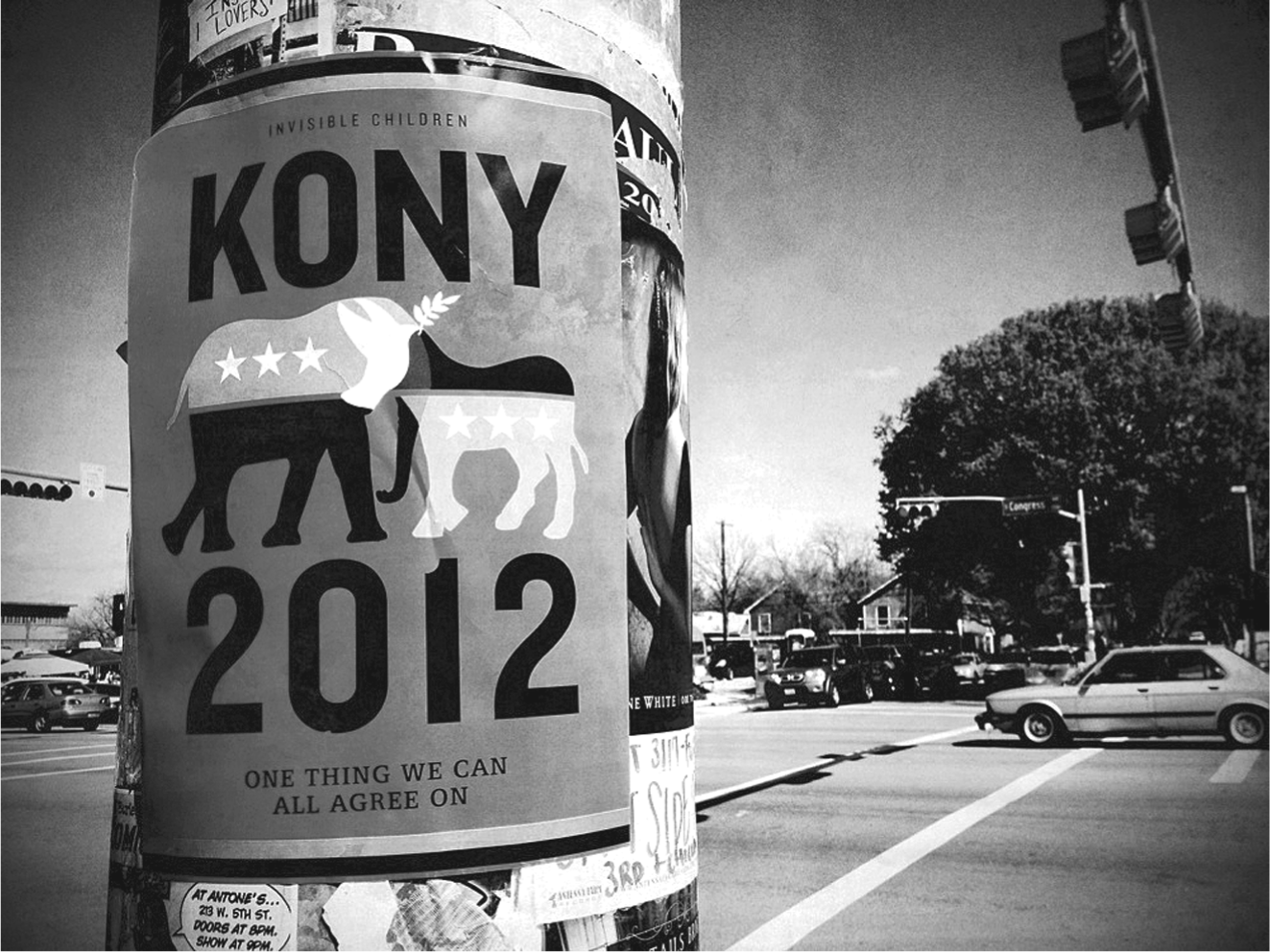
To date, 3,590,161 people have pledged “to make Kony famous” by participating in campaigns like “Cover the Night,” above.
Robert Raines
Like sentimentalism itself, all of these dangers—the linking of productivity with citizenship; the division of the world into global citizens and global subjects; and the illusion that awareness and enthusiasm are sufficient for social change—display as many continuities as disruptions with their historical precedents. In the late 1960s, social critic Ivan Illich famously told students preparing for service work in Mexico that he admired their commitment and good intentions, but that they nonetheless were hypocrites if they continued. His speech, “To Hell with Good Intentions,” has become standard reading for students preparing for service-learning experiences as part of higher education, particularly in economically underdeveloped communities both locally and in the Global South. Yet while awareness of Illich’s message has spread, the fundamental dynamics of the internationalization of education remain much the same.
To take seriously Illich’s accusation of hypocrisy, higher education needs to rethink how it produces global citizens, challenging the assumptions of American sentimentalism that are deeply embedded within it. Turning toward international education policies of radical reciprocity provide one route forward. In order to achieve this, higher education would have to abandon its superficial invocations of global citizenship in favor of a deep engagement with the substantive, material, political and philosophical meanings of citizenship on a global scale. Such a process would deprive its students of the self-satisfied big emotional experience of an exotic adventure in helping others, in favor of a relentlessly self-reflexive engagement with the realities of global inequality, the politics of that inequality, and our varying individual and collective responsibilities within them.