




Abstract
Introduction:
With the endorsement and support of the ABSA International Council and the Prevention, Preparedness and Response (P2R) Academy of The University of Texas Health Science Center at Houston (UTHealth) School of Public Health, a survey to characterize the work settings in which biosafety professionals operate was conducted. The survey was the first of a planned series of 10 solicitations in support of an overarching “Biosafety Analytics Initiative,” the goal of which is to identify commonalities, trends, possible benchmarking opportunities, and professional training needs.
Methods:
The survey was developed, tested, and then distributed electronically for a 3-week period between May 29 and June 19, 2019.
Results:
A total of 228 ABSA International members completed responses (15.6% of total membership). The results of the survey indicate that 59.7% of the total membership respondents conduct operations in the public or private academic setting, but when separated by domestic vs international respondents, 38% of the international respondents operate in government (nonacademic) settings. The bulk of biosafety activities were reported as providing support to BSL-1 and BSL-2 laboratories, with more than 90% of respondents indicating that they support work with risk group 1 and 2 organisms. Approximately 60% of the biosafety programs responding reported being organizationally aligned within institutional Environmental Health & Safety programs.
Conclusion:
The results of this survey serve as a foundation for current and future ABSA International priorities regarding professional development, recruitment, and training opportunities.
Successful biosafety programs function largely in the realm of prevention, so on a good day, “nothing bad happens” (eg, laboratory exposures, injuries, spills, etc). A recurrent challenge for practicing biosafety professionals is the ability to demonstrate and articulate the needs and resources that are necessary to support a successful oversight program.
Feedback from a series of preconference Professional Development Courses provided during the ABSA International Annual Biosafety and Biosecurity Conference has made it abundantly clear that the assembly of biosafety program analytic data is a critical need for the profession so that practicing professionals can demonstrate the resources needed for program support. At this time, no other source of comprehensive benchmarking data of this kind is known to exist.
A formal proposal describing the notion of a “Biosafety Analytics Initiative” was made to the ABSA International Council in Albuquerque, New Mexico, during the 60th Annual Biosafety and Biosecurity Conference in October 2018. The ABSA International Council agreed to both endorse the effort and circulate the proposed surveys using the association’s membership e-mail distribution list. The University of Texas School of Public Health’s Prevention, Preparedness and Response (P2R) Academy agreed to help create the surveys, collect and analyze the data, and report the findings back to the membership via publications in Applied Biosafety and platform presentations at both ABSA International conferences and affiliate symposia.
Following the proposed order of the 10 envisioned analytic surveys 4 (Table 1), a brief survey focusing on biosafety work settings was crafted and then pilot tested by a panel of biosafety practitioner volunteers from the Southern Biosafety Association (an ABSA International affiliate). Upon refinement of the survey based on feedback from this test group, the questions were formatted into an online survey instrument using Qualtrics Research Core (Qualtrics, Provo, Utah) and electronically distributed to the ABSA International membership via e-mail directly from the ABSA International administrative office.
Biosafety Program Analytics Survey Themes and Importance to Profession.
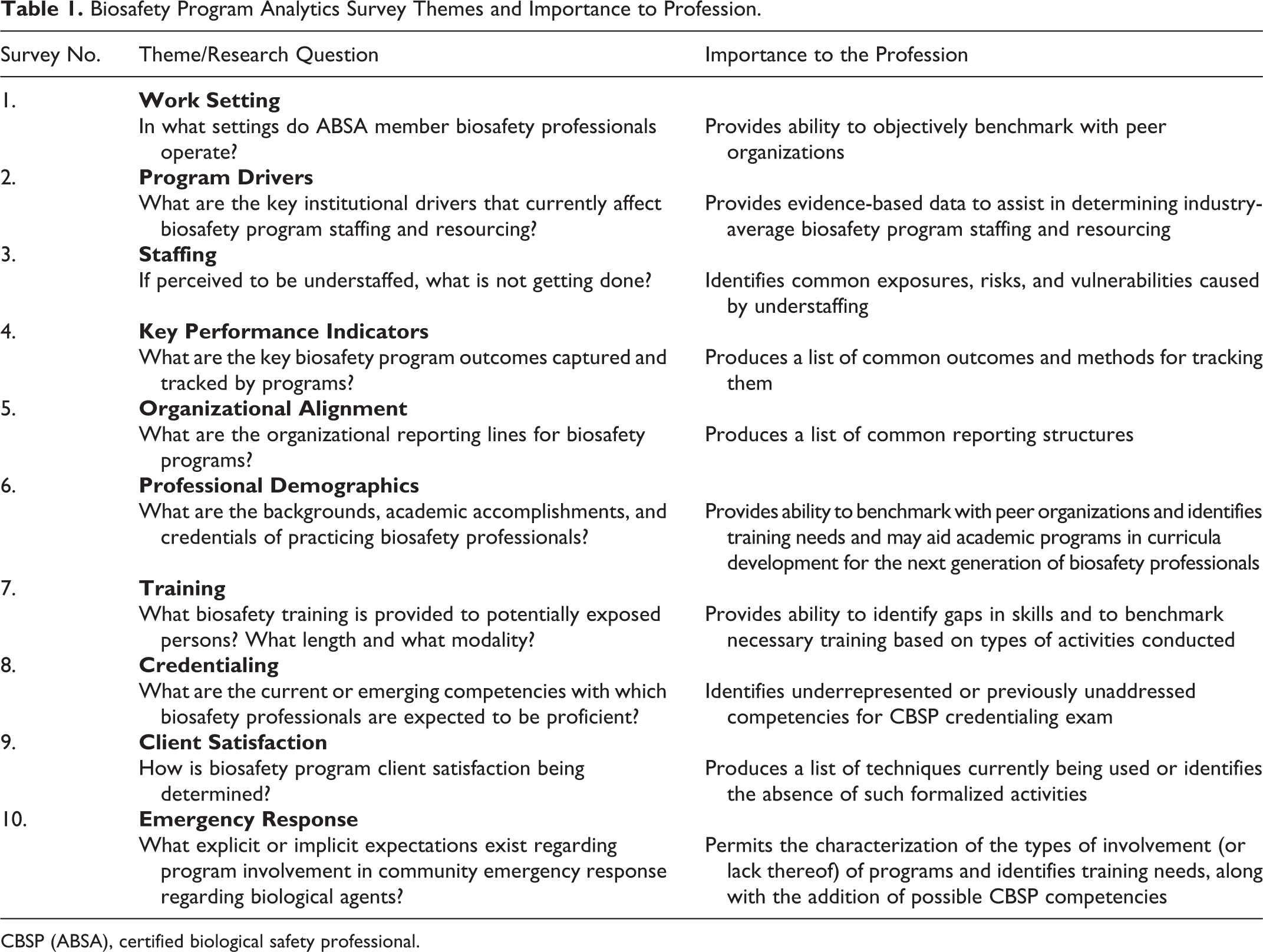
CBSP (ABSA), certified biological safety professional.
Research Objectives and Aims
The objective of this first survey was to intentionally characterize the work settings in which biosafety professionals operate, to include the following:
In what work settings do biosafety professionals operate? What is their job title and to whom do they organizationally report? For the work that is overseen by these biosafety professionals, what level of risk are researchers at these institutions encountering? What risk groups of biological agents are worked with at their institution and in what types of facilities?
Methods
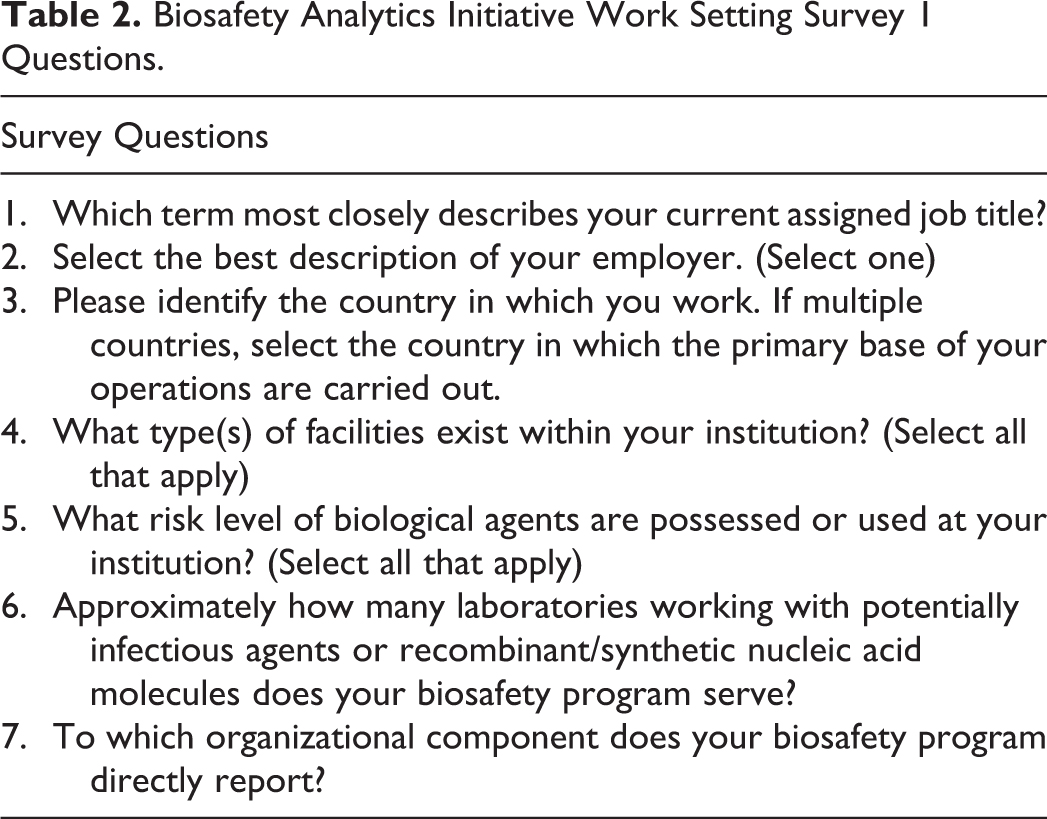
The survey instrument comprised an informed consent acknowledgment section followed by 7 questions intended to ascertain biosafety professionals’ work settings and a general characterization of their work setting (Table 2). The survey questions and associated informed consent verbiage were reviewed and approved by The University of Texas Health Science Center at Houston’s Institutional Review Board under protocol number HSC-GEN-18-0853.
Biosafety Analytics Initiative Work Setting Survey 1 Questions.
Study Design and Setting
This study was a cross-sectional survey of individuals working as biosafety professionals. ABSA International distributed an e-mail notice to the association membership (1460 individuals at the time the survey was conducted) that included a description of the project objectives, a link to the survey, and a request to participate. The survey was conducted over a 3-week period, between May 29 and June 19, 2019, in an electronic format via Qualtrics Research Core. After the original e-mail solicitation on May 29, a follow-up e-mail was sent by the ABSA International administrative office on June 12, 2019, to the membership to serve as a reminder to the membership to complete the study.
Study Participants
Study subjects working in the biosafety field, whether full- or part-time, and who were current members of ABSA International with association dues paid in full (which is a requirement to be on ABSA International’s membership e-mail distribution list) were eligible to participate in this study. Responses from individuals who identified themselves as “vendor/manufacturer” as their work setting were not included in the initial analysis given the objectives of this first survey.
Data Analysis
Data collection for this study was achieved by compiling the results of the electronic survey from the Qualtrics database and transferring this information into a Microsoft Excel (Microsoft, Redmond, Washington) spreadsheet. The data were assembled, resolved for discrepancies, and operationalized by the authors for full analysis. Analysis was conducted using descriptive statistics.
Results
Over the 3-week active period for the online survey, 266 individuals began the survey, of whom 228 (85.7%) responded to all questions. This participation rate of completed surveys represents 15.6% of the recorded membership for ABSA International at the time of the survey. Of the remaining 38 respondents, 3 declined the informed consent, 20 consented to the survey but did not respond to all questions, and 15 opened the survey and subsequently closed the survey after responding to only the informed consent question. Responses from partially completed surveys were excluded from the analysis. No respondents met the exclusion criteria of employment by a vendor or manufacturer, so no responses were discarded based on this criterion.
Of the 228 completed responses, 59.7% reported working in a public or private academic institution. When the assembled data are separated by domestic (United States, n = 193) and foreign (non–United States, n = 35 representing 19 countries), fewer foreign respondents indicated conducting operations in public or private academic settings (28.6%) while 37.1% operate in government, nonacademic settings. This finding suggests that training and outreach activities for ABSA International’s international partners may need to be tailored accordingly.
The most commonly reported facilities, by type, at respondents’ institutions (Figure 2) were BSL-2 labs (97.4%), BSL-1 labs (85.1%), ABSL-2 facilities (77.6%), ABSL-1 facilities (73.2%), and BSL-3 labs (68.0%). The least commonly reported facilities were BSL-4 labs (4.8%), BSL-3-Ag facilities (3.9%), ABSL-4 facilities (3.5%), arthropod containment level 4 facilities (1.8%), and plant BSL-4 facilities (0.4%).
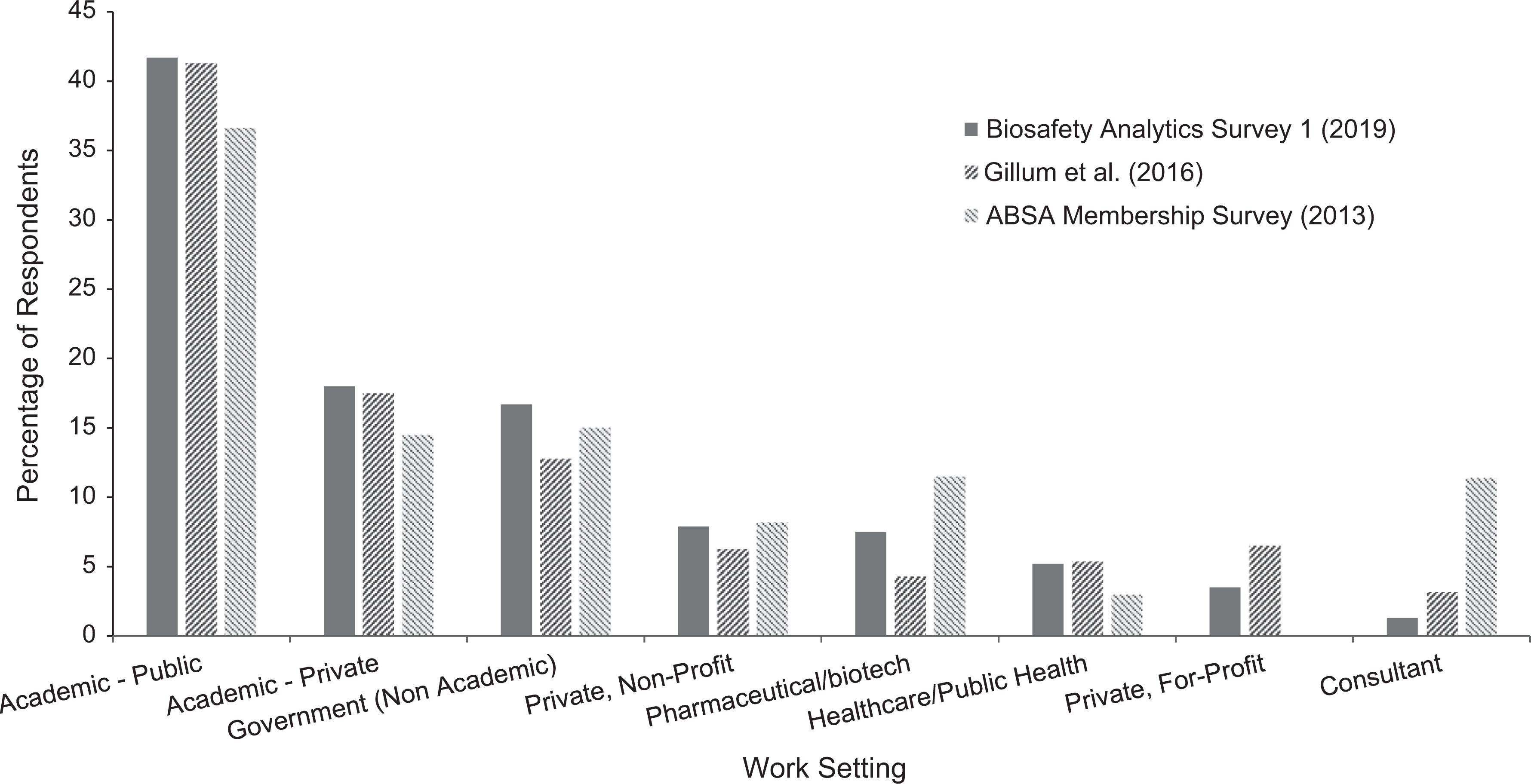
Comparison of biosafety professionals’ work settings: responses from biosafety analytics, Gillum et al, 2 and ABSA International membership surveys.
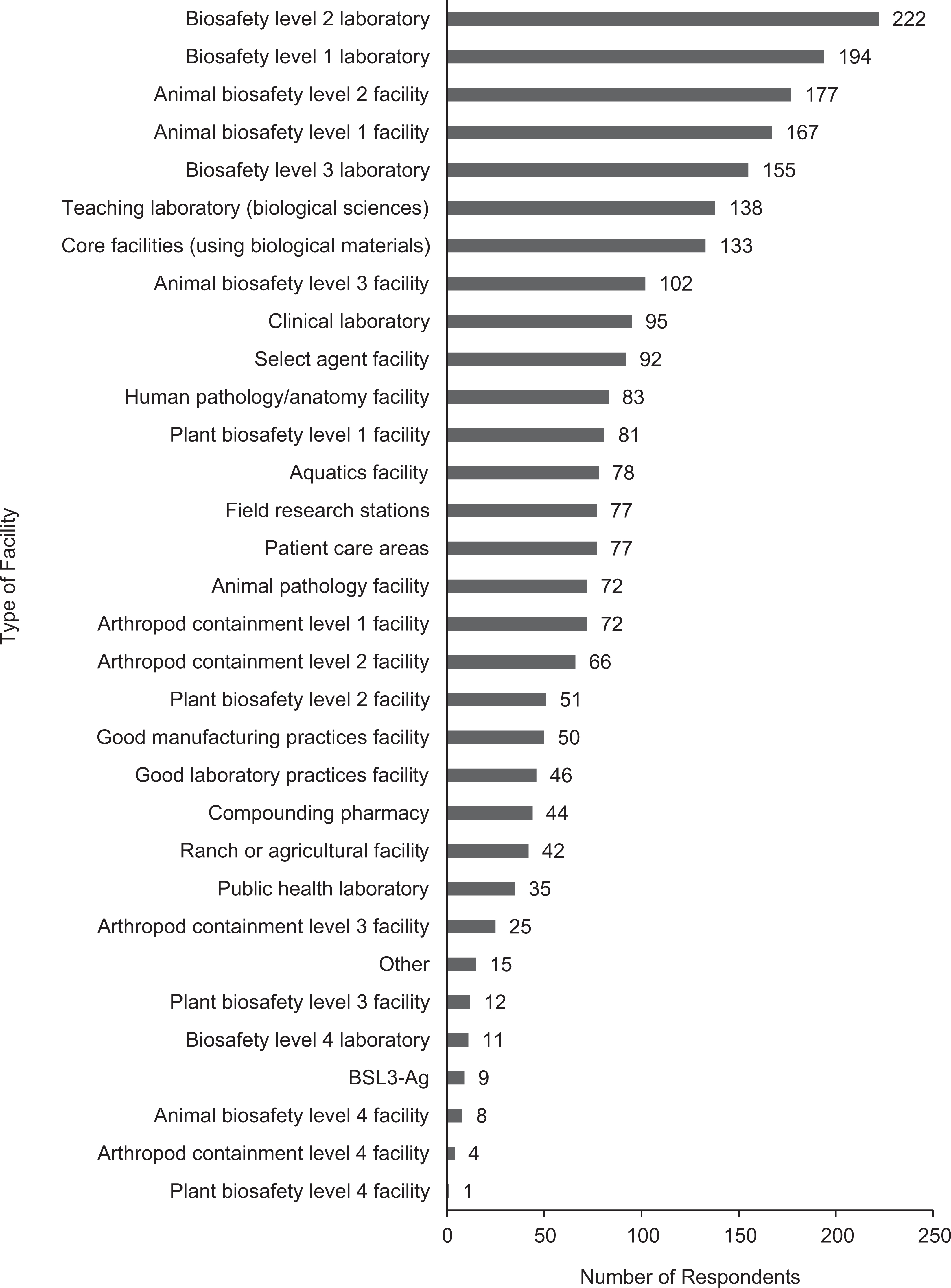
Survey responses indicating facility type at institution.
Risk group 2 organisms were reportedly possessed or used by 94.3% of institutions. This was followed by risk group 1 (90.4%), risk group 3 (70.2%), and risk group 4 (7.9%) organisms.
The majority of biosafety programs reported serving between 10 and 1000 laboratories that handle infectious agents or recombinant or synthetic nucleic acid molecules. The results were nearly evenly distributed between programs serving 10 to 100 labs (33.3%) and 101 to 1000 labs (33.8%). Programs serving fewer than 10 labs made up 18% of responses, followed by 8.3% serving 1001 to 2500 labs and 0.4% serving 5000+ labs. An additional 5.3% of respondents indicated that they did not know the number of labs served by their program.
Ninety-two respondents (40.4%) indicated involvement with the oversight of select agent or toxin laboratories. Interestingly, of the respondents involved in oversight of select agent or toxin laboratories, 59.8% indicated public academic as their work setting and 15.2% as private academic work setting, totaling 75% of the total reported select agent or toxin activity.
The majority of the reported job titles of the respondents were categorized as “biosafety officer/program manager” (50.4%) and “biosafety specialists/support staff” (14.5%). Other responses included “director/department head” (12.7%) and “EHS professional” (10.1%). Most of the biosafety programs reported as being organizationally aligned under the institutional environmental health and safety department (59.6%), followed by Research Administration (21.1%) and “other” (11.4%) such as department chairs, lab managers, or health ministers (for foreign respondents).
Discussion
While biosafety practitioners may conduct operations in a wide variety of settings, it is interesting to note that the results of this survey indicate that 59.7% of the respondents operate in the public or private academic setting. While the previous professional experience in the academic and research setting of those practitioners who do not currently work in this setting was not measured, this experience is also likely to be a significant influencer across the entire profession. This suggests that professional development opportunities focused on how university research operate is necessary to help ensure biosafety professionals understand the challenges faced by the research faculty they support. Training on how biosafety programs can be implemented in ways that do not impede, but rather augment, instruction and/or research and discovery (which arguably leads to an improved overall culture of safety) should also be considered.
Our data obtained on work setting coincide with the data collected by the ABSA International membership survey conducted in 2013 (51% in academic setting) 1 and the Gillum et al 2 credentials survey (58.8% in academic setting), which are displayed in Figure 1. These findings are important because this information can assist in the strategic development of training and education needs for the profession. It is interesting to note that not only do a majority of the practicing professionals conduct operations in the academic setting, but it is likely that most of the practitioners working in other nonacademic settings had their genesis in the academic setting during their professional preparation, underscoring the notion of the importance of an intimate understanding of how this setting frames the entire profession and the tailoring of professional development training with this in mind.
The data describing work setting, collected as part of this survey, have a significant impact on possible biosafety program benchmarking going forward. For example, in a future survey, we wish to ascertain biosafety program staffing levels and resourcing, but it is clear now that the practicing profession is not homogeneous with regard to working environment, and some accommodations in study design will be needed. An option being actively explored internally is the notion of a pull-down screen in a subsequent web-based survey that allows participants to identify their work setting by North American Industrial Classification (NAICS) code or its international equivalent. This would facilitate subanalysis of the data in a standardized way by industry setting.
Since 59.6% of the respondents indicated the organizational alignment of their biosafety program to be within an environmental health and safety department, training offerings focused on health and safety aspects that impinge upon other specialties, such as chemical safety, fire safety, radiation safety, and so forth, would seem prudent. This is not to suggest that each biosafety professional needs to be an expert in these other fields, but some degree of cross-knowledge can lead to improved and streamlined services to the customers being served (eg, during the performance of comprehensive laboratory safety surveys by a biosafety professional).
The data obtained on the type of facilities supported by the respondents indicated the most frequently reported types of the facilities overseen are BSL-1, BSL-2, ABSL-1, ABSL-2, and BSL-3 facilities (Figure 2). While these data are not entirely surprising, they do highlight the need for continued offerings of biosafety and biosecurity training curricula for the ABSA International constituents that focus on these containment levels. Although more specialized training is clearly necessary for unique or high-risk research facility oversight, the target audience for these specialized trainings appears to be much smaller. These data could help ABSA International prioritize the types and frequency of trainings offered through the organization at its various events throughout the year and via its webinar platform.
It is likely that the types of facilities as well as the number of labs served by a given biosafety program will be 2 of the major factors influencing their staffing and resource needs, which we intend to study in later surveys.
There were some interesting differences between foreign respondents and the overall pool of responses such as the distribution of work settings and the number of labs served by biosafety programs. The government, nonacademic setting was indicated nearly twice as often and the academic setting nearly half as often. Foreign respondents also tended to work in biosafety programs at smaller institutions, with 37.1% serving fewer than 10 labs and 31.4% serving 10 to 100 labs. This suggests that the training needs of ABSA International’s non-US members will likely differ from that of its US-based members.
Of the respondents who indicated that their biosafety program does support select agent work (n = 92), 75% of them operate in the academic setting and 14% operate in government. This is in contrast to a recent Government Accountability Office report showing 49% of registered select agent BSL-3 and BSL-4 laboratories in the government sector, with only 35% in academia. 3 This may indicate that our sample population is not representative of select agent programs in the United States, and this topic may be worthy of further exploration. Nonetheless, these data provide ABSA International with guidance on training and collaborative opportunities for the membership specifically tailored for select agents and toxins.
This first survey did have some recognized weaknesses to consider when designing future Biosafety Analytics Initiative surveys. First, the ability for respondents to submit the survey without responding to all questions likely led to a number of the incomplete responses that were excluded from analysis. Sixty percent of partial responses had all but 1 question answered. Future surveys will require all questions to be answered before the survey can be submitted. Second, we did not account for differences in terminology that may be used by some respondents outside of the United States (eg, the use of containment level in the United Kingdom and Canada rather than biosafety level when describing laboratory facilities). Another weakness may have been that what makes a “laboratory” was not defined. This could be interpreted in multiple ways, as either the total of laboratory spaces under a single PI (principal investigator) or as an individual room that is used by 1 or more research groups. This ambiguity may have been partially responsible for 5% of participants indicating “I don’t know” when asked how many labs their biosafety program serves.
Conclusion
The data obtained from this first survey provide valuable feedback to the ABSA International community by characterizing the work settings in which biosafety professionals typically operate. This information serves as a benchmark for biosafety professionals to reference for biosafety program development and maintenance at their respective institutions. These data also create a foundation for which the subsequent Biosafety Analytics Initiative surveys will be created and shaped, the next of which will focus on biosafety program drivers that affect staffing and resourcing levels.
Footnotes
Acknowledgments
We thank all the members of The University of Texas Health Science Center at Houston’s Biological Safety Program staff for their assistance with the development and refinement of the survey tool, the analysis of the data, and the preparation of this manuscript. We also thank all of the ABSA International members who took time from their very busy schedules to participate in this survey effort.
Declaration of Conflicting Interests
The authors declared no potential conflicts of interest with respect to the research, authorship, and/or publication of this article.
Disclaimer
The UTHealth SPH P2R Academy is supported by the National Institute of Environmental Health Sciences of the National Institutes of Health under Award Number U45ES019360. The content is solely the responsibility of the authors and does not necessarily represent the official views of the National Institutes of Health.
Ethical Approval Statement
The survey questions and associated informed consent verbiage were reviewed and approved by The University of Texas Health Science Center at Houston’s Institutional Review Board under protocol number HSC-GEN-18-0853.
Statement of Human and Animal Rights
Not applicable to this study.
Statement of Informed Consent
All participants were provided with an informed consent statement at the beginning of the survey and asked to click “yes” that they accepted to consent and proceed with the survey.
Funding
The authors received no financial support for the research, authorship, and/or publication of this article.