




Abstract

Introduction
A primary function of the biosafety profession is to ensure that students, workers, and the public are protected from exposures to potentially infectious agents as well as recombinant or synthetic nucleic acid molecules encountered in the laboratory setting. This means that biosafety programs, when successful, function largely in the realm of prevention. However, like other disciplines within the health and safety profession, no standard model currently exists for how biosafety programs should be administratively aligned, organized, built, or maintained, and with limited formal benchmarking data to provide guidance to organizations in different industries on appropriate biosafety program size, makeup, or necessary resources, comparisons are often meaningless. This situation presents a significant challenge for practicing biosafety professionals, many of whom are classically trained in the life sciences but few of whom have been trained in quantifying and articulating the value of prevention.
Through our involvement with the delivery of repeated professional development courses on biosafety program management at the ABSA International annual conferences and other professional development fora on biosafety topics, we have observed the following 3 “true-isms” arise consistently during discussions:
Because successful biosafety programs function largely in the realm of prevention, programs need to be especially adept at objectively demonstrating the amount of resources needed to “make nothing happen,” such as preventing injuries, exposures, laboratory-associated infections, or noncompliance. The administrative leadership to which a biosafety program reports must understand and advocate the importance of measuring and understanding information to properly manage it. Administrators frequently compare to peer organizations when making key decisions.
To address these 3 issues, the Prevention, Preparedness and Response (P2 R) Academy, housed within The University of Texas Health Science Center at Houston (UTHealth) School of Public Health (SPH), in conjunction with ABSA International, is launching a Biosafety Program Analytics Initiative in 2018. We deliberately chose the term analytics for this project because the formal definition of this term is “the method of logical analysis,” as opposed to merely relying on professional judgment or hearsay. 1 The P2 R Academy is serving as a partner in this activity because it is an organization dedicated to the advancement of the health and safety professions through the dissemination of scientifically sound education, training, and research. Moreover, the UTHealth School of Public Health has conducted several benchmarking research projects related to environmental health and safety programs in cooperation with the Campus Safety, Health, Environment Management Association (CSHEMA), and we intend to leverage the knowledge gained from these efforts to the benefit of the biosafety profession in particular. 2 Our collaboration within the UTHealth School of Public Health also includes additional benchmarking efforts related to health and safety disciplines, including security staffing for hospitals to assist in the management of workplace violence risks 3 and radiation protection programs. 4
In October 2017, representatives from the P2 R Academy presented to the ABSA International Council a unique summary of program needs that was created by assembling the recurring themes discussed (and debated) during years of delivering professional development training courses. We believe these program needs are significant because they were identified by biosafety professionals time and time again over many years. The ABSA International Council agreed and allowed us to propose a joint path forward to address the identified needs and gaps. At that meeting, the ABSA International Council voted to concur with the proposal. 5
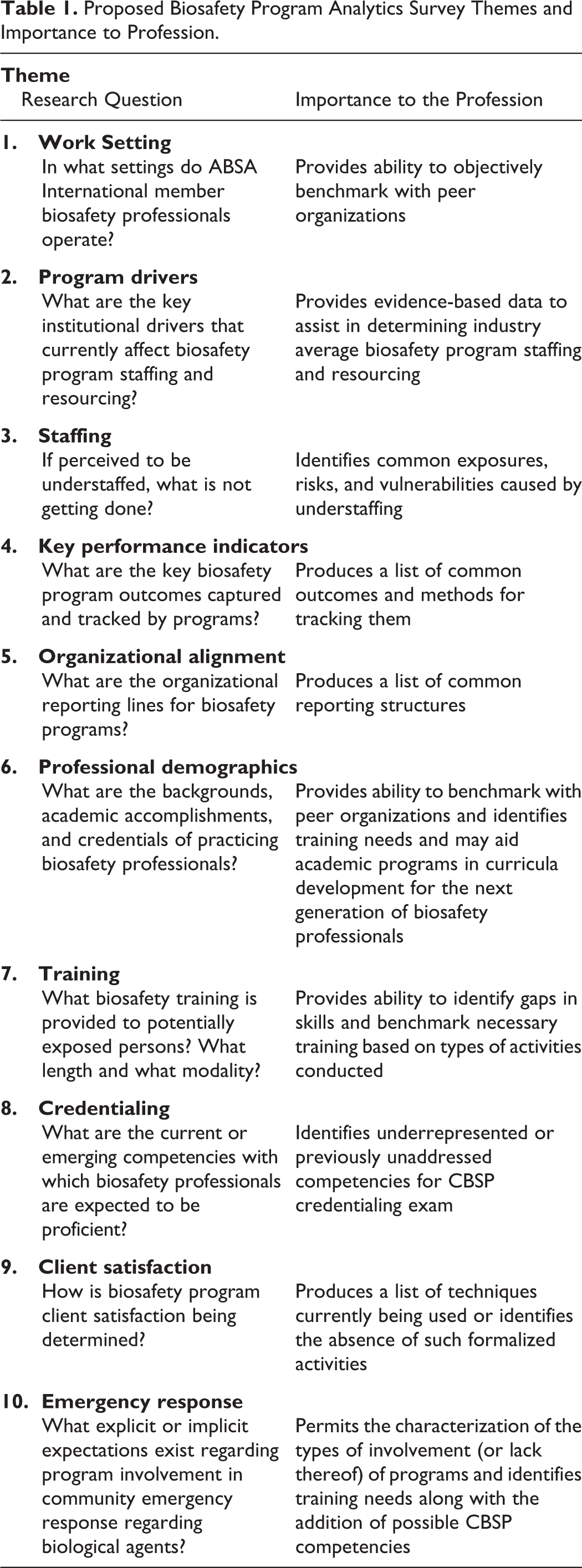
The overarching idea of this initiative is to methodically collect data directly from the ABSA International membership through a series of short online surveys. The effort will be similar to the project undertaken by Gillum et al, 6 who sought to characterize the qualifications and salaries of practicing biosafety professionals. Our project, however, is intended to expand benchmarking measures for biosafety programs to utilize as a means of comparison to peer organizations. Furthermore, we envision a series of themed surveys with grouped questions to obtain targeted programmatic information. These data will in turn guide us as we characterize the attributes of typical biosafety programs. We developed the initial theme categories based on research questions stemming from course feedback provided by practicing biosafety professionals during formal (eg, course evaluation surveys) and informal (eg, emails or phone calls made after a course) mechanisms. The survey themes are shown in Table 1.
Proposed Biosafety Program Analytics Survey Themes and Importance to Profession.
Methods
Data Collection
Our team will leverage their extensive expertise in biosafety, data collection, and analysis to develop 2 themed surveys each calendar year with each survey consisting of about 8 to 10 questions. The goal is for the respondent to spend no more than 10 minutes taking a single survey. Prior to distribution, each survey instrument will be field tested by requesting biosafety professionals from the Southern Biosafety Association, an ABSA International affiliate, to volunteer to take and critique the survey instrument. Once refined, the survey link will be distributed via an email to the ABSA International membership by the ASBA International administrative office.
We will use Qualtrics Research Core (Qualtrics, Provo, UT), an online survey platform with analysis tools, to collect responses. Each survey will include an introduction that contains instructions regarding completion, assurances of confidentiality, and an informed consent acknowledgment to participate in the project. Each survey will remain open for 30 days, and a single reminder will be sent 15 days after the initial announcement.
Prior to embarking on this project, we will request review and approval from the Institutional Review Board at The University of Texas Health Science Center at Houston. We will also request review and approval of the instructions, informed consent document, and each survey instrument.
Analysis
Our team will assemble and summarize the data from each survey round into a set of descriptive statistics. We will use multiple regression analysis to identify possible relationships between predictive (independent) variables and a dependent variable, such as industry average levels of biosafety program staffing. At this time, we assume the regression residuals will have a normal distribution, an assumption we will verify by producing a histogram and/or a normal probability plot of the residuals.
One potential limitation is a lack of sufficient statistical power in some of the variables so as to be able to determine whether an identified relationship is statistically significant. Even so, these findings may lead to refinement of future surveys to focus on certain areas or aspects of the biosafety profession.
Expected Results and Dissemination
It is our expectation that the results of these surveys will provide insight into current biosafety program resourcing levels for various work settings. These findings also serve as a launch point to begin characterizing the sorts of activities carried out by these programs and will likely result in the development of guidance documents, needed training courses, or services that could be provided by ABSA International.
We will share project findings through a series of articles published in Applied Biosafety and presentations or professional development courses at the ABSA International Annual Biological Safety Conference. The work required to conceptualize, prepare the surveys, and analyze the findings aligns with Certified Biological Safety Professional (CBSP) exam domains 45: “Advise on occupational health programs for persons working with biological materials”; 47: “Organize and implement institutional biosafety compliance programs and audit their effectiveness”; 48: “Institute, evaluate and document biosafety training”; and 52: “Develop recommended biosafety policies.” Accordingly, a formal request will be made for the approval of certification maintenance credit to be recognized for the performance of this service to the profession. Depending on the feedback we receive from the membership, we may also pursue publishing the complete series of articles as a compilation in a special anthology edition for ABSA International. Such an edition would be useful, convenient, and of interest to the profession and aspiring biosafety professionals.
Importance of Membership Participation and Feedback
For this initiative to be successful, active participation on the part of the ASBA International membership is crucial. Only when data are received from the wide variety of work settings represented by the professional organization can we begin to characterize aspects in an evidenced-based manner for the benefit of all. We encourage all members to actively participate in the project as the results will benefit the entire profession. It is our hope that in partnering with ABSA International on this project, including having ABSA International distribute each survey to the membership, we will increase the visibility of this project and bolster participation.
Summary
Biosafety programs, when successful, function largely in the realm of prevention, but as a profession, we lack evidence-based analysis that speaks to the amount of resources necessary to “make nothing happen.” Through the systematic collection of key data from practicing professionals, we will expand the availability of meaningful benchmarking measures for biosafety programs so more informed comparisons can be made and critical insights gained.
Footnotes
Authors’ Note
Prevention, Preparedness and Response (P2 R) Academy, housed within The (SPH), The University of Texas Health Science Center at Houston School of Public Health Prevention, Preparedness and Response (P2 R) Academy is supported by the National Institute of Environmental Health Sciences of the National Institutes of Health under Award Number U45ES019360. The content is solely the responsibility of the authors and does not necessarily represent the official views of the National Institutes of Health.
Acknowledgments
The authors would like to thank the ABSA International Council for their willingness to participate in this initiative to build on the body of knowledge for the biosafety profession. Additional acknowledgment is warranted for the following individuals who have helped develop the ideas and content for the Biosafety Analytics Initiative: Dr Brett Haltiwanger, CBSP; Dr Shalaka Kotkar, CBSP; Dr Chad Austin; and Dr Christopher Singh.
Declaration of Conflicting Interests
The authors declared no potential conflicts of interest with respect to the research, authorship, and/or publication of this article.
Funding
The authors disclosed the following financial support for the research, authorship, and/or publication of this article: The authors received salary support from National Institute of Health, funding agency National Institute of Environmental Health Sciences, Award No. UH4ES027055, the Biosafety and Infectious Disease Training Initiative.