



Abstract
Reusable plastic safety glasses are commonly used in workplace environments to provide eye protection to users. When multiple individuals use a pair of safety glasses, there is the potential for transmission of commensal pathogenic organisms. Chemical decontamination methods are one intervention to prevent transmission between users but require time and effort for each pair of glasses. Another option is the use of ultraviolet (UV) light for decontamination of safety glasses after each use. A germicidal UV light decontamination cabinet was tested for its efficacy in routine decontamination of reusable plastic safety glasses using Staphylococcus aureus as an indicator organism. A statistically significant reduction of contamination was seen (P < .05), dependent on both location of the glasses within the cabinet and location of contamination on individual glasses. The use of a UV cabinet is recommended as an effective and convenient option for reduction of microbial contamination of plastic safety glasses between uses.
Keywords
Environmental contamination plays a key role in the transmission of pathogenic microorganisms in the workplace. Personal protective equipment (PPE), such as eye protection, may serve as a fomite in workplaces, especially laboratory spaces. Costs associated with providing eye protection for laboratory and workspace visitor results in the reuse of safety glasses, which may lead to lateral transmission of pathogens between individuals.
Safety glasses may represent a potential infectious source of pathogens, such as strains of methicillin-resistant Staphylococcus aureus that can persist up to 7 months on environmental surfaces. 1 S aureus contamination may cause some users to develop conjunctivitis or skin infection. 2 Between 2000 and 2005, The Surveillance Network (TSN) collected data about clinically significant bacterial infections from more than 200 hospitals in the United States. 3 The sources of the data collected by the TSN database, community, government, and university hospitals meeting national certification standards yield a nationally representative sample of hospitals in the United States. The reporting hospital laboratories met the national certification standards of the Clinical Laboratory Standards Institute and conducted testing of active infections regardless of source, on site. 3 They also provide a representative sample of clinically significant infections. These data indicate that S aureus was isolated from ocular infections an average of 2330 times annually, representing a concurrent 2.5% annual increase in base-rate methicillin resistance among the isolates. 3
Larson et al 4 surveyed the amount of aerobic bacterial contamination on the hands of members of the general population, both before and after handwashing. They found that the mean log count of organisms prior to handwashing was 5.72 log10 colony-forming units (cfu) and 5.69 log10 cfu after handwashing. Out of 224 individuals tested in the United States, 41 (18.5%) were found to have S aureus contamination on their hands before and after handwashing. Analysis of those individuals, after handwashing, determined that handwashing had no statistically significant effect on the reduction of the S aureus contamination of the hands. 4
Ultraviolet (UV) light is used in a variety of applications on university campuses, including student health clinics for diagnostic procedures and sanitation, and in teaching and research laboratories for sample analysis and decontamination of equipment. 5 UV decontamination is also used in biosafety cabinets, food in the food-processing industry, and wastewater treatment. 6
The electromagnetic spectrum is divided into 3 general categories: (1) ultraviolet C (UVC), (2) ultraviolet B (UVB), and (3) ultraviolet A (UVA). The specific wavelengths of UV light responsible for germicidal activity is UVC, between 100 and 280 nm, with a peak effective wavelength at 265 nm. Of the solar UV radiation reaching the earth, 95% is UVA and 5% is UVB. UVC does not reach the Earth’s surface because it is completely absorbed by ozone, molecular oxygen, and water vapor in the upper atmosphere. 7
One method of generating UV light for disinfection is the use of mercury vapor lamps. Low-pressure mercury vapor lamps emit radiant energy between 250 and 260 nm with a UVC efficiency of about 38% to 95%, whereas amalgam or medium-pressure mercury vapor lamps provide higher intensities of UV energy between 250 and 350 nm with a UVC efficiency around 7% to 15%. The effectiveness of UV depends on the length of exposure, UV intensity and wavelength, the presence of particles that can protect the microorganisms from UV, and a microorganism’s ability to withstand UV during its exposure. 6
Potential limitations on the use of UV irradiation for decontamination of safety glasses exist. The maximum effect for decontaminating microbial loads on surfaces is achieved at a wavelength of 254 nm, with targeted microorganisms directly exposed to the UVC band of light to facilitate cell penetration and the formation of adducts between adjacent pyrimidines, which effectively inhibit replication and transcription. 6 The unstable bonds between uracil and cytosine in RNA, as well as thymine and cytosine in DNA, eventually cause an unstable conformational change in the molecule. Many surfaces on 3-dimensional objects, like safety glasses, are not perfectly perpendicular to the UVC source, which could lead to those surfaces not receiving adequate wavelengths for decontamination. However, this cabinet uses reflective materials on the front and walls to allow UV light waves to reflect and contact more areas of the glasses.
UV light devices and commercial services offering use of UV light for decontamination are readily available in the marketplace. In this study, the efficacy of a commercially available UV light “sterilization” cabinet was investigated for decontaminating plastic safety glasses artificially contaminated with S aureus, a cause of bacterial eye infections shown to be resistant to UV decontamination. 8 It has been shown that a dose of 2.25 mJ/cm2 UVC results in a 1-log reduction in the population of a methicillin-resistant wild-type S aureus. 9 In addition, Meunier et al 10 reported that the D10 value for S aureus can range from 1.3 to 4 mJ/cm2, depending on the strain. D10 is a value that describes the ability of a decontaminating agent to reduce a microbial population 1 log10 under standard conditions of time, temperature, and concentration or dose.
The cabinet evaluated in this article (Figure 1) is a wall-mounted fixture measuring 30 × 30 × 12 inches constructed of 22-gauge stainless steel and operates on a standard 110-volt current. Internally, the cabinet has 5 plastic-coated, nonreflective wire shelves, equally spaced from the top to the bottom, that accommodate 8 pairs of safety glasses each. The UV light source in the cabinet is a single 18-inch bipin low-pressure mercury vapor, 15-watt, T8 germicidal UVC fluorescent tube with a stated effective service life of 9000 hours. The bulb produces 4.9 watts at a 253.7-nm wavelength. 11
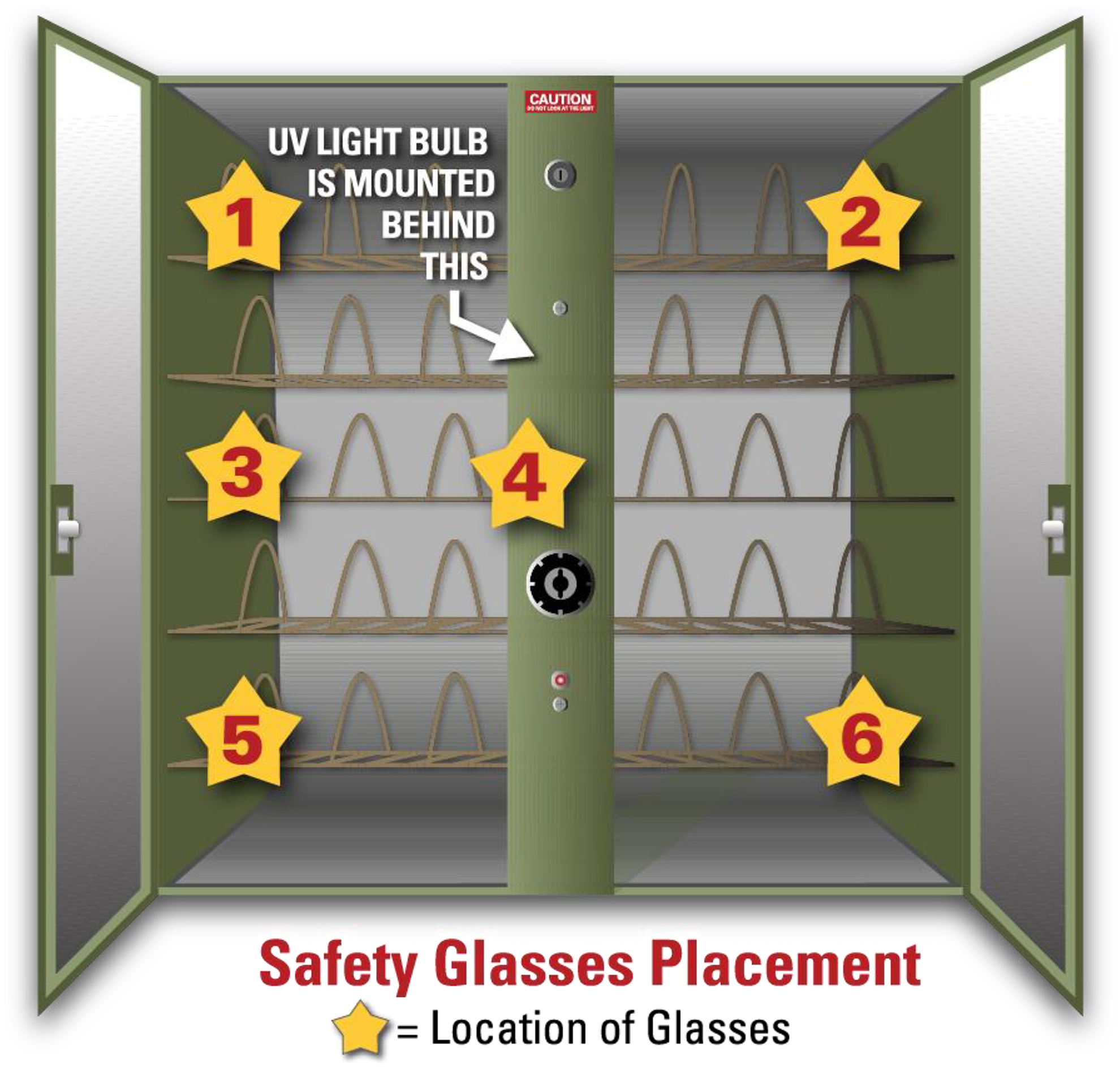
Ultraviolet (UV) cabinet and placement of safety glasses. Glasses were placed in the cabinet at the 6 starred locations.
The cabinet has 2 front-opening top-to-bottom doors, a rotary-style analog timer with a maximum setting of 15 minutes, a front-facing “in-use” light, and a lock to prevent opening during a decontamination cycle. Reflective surfaces are on the back wall, floor, and ceiling walls and on the inside of the doors. When the cabinet is at capacity with safety glasses, the distance between the leading edge of the safety glasses and the UV lamp varies from 7.5 to 30 cm.
S aureus (ATCC 29213) was used as the test organism and is a standard International Organization for Standardization (ISO) quality control culture for susceptibility disc testing, susceptibility testing, and a quality control strain for many commercial product testing products. 12 S aureus is a gram-positive, coccal-shaped bacterium that is frequently found in the human nose, in the respiratory tract, and on the skin. 13 It is often catalase and nitrate reduction positive and is a facultative anaerobe that can be grown without oxygen. S aureus is not always pathogenic; it is recognized as a commensal bacterium inhabiting human skin, nasal passages, and the human gastrointestinal tract. 13 It is also a common cause of skin and soft tissue infections and abscesses, endocarditis, bacteremia, sepsis, osteomyelitis, respiratory tract infections such as sinusitis, and food poisoning. 14
Methods
The S aureus isolate was inoculated into 300 mL of tryptic soy broth (TSB) (BD BBL, Sparks, Maryland) and incubated for 24 hours at 37°C. The cultures were harvested by centrifugation. The supernatant was removed, and 30 mL of buffered peptone water (Hardy Diagnostics, Santa Maria, California) was added to resuspend the pellet.
Inoculation
Six pairs of safety glasses were individually surface inoculated by dipping a sterile cotton swab into the harvested culture and wiping the inoculum onto the surface. Figure 2 shows the placement of the inoculum on each pair of safety glasses. Circles were drawn at each inoculation location on each pair of glasses so application and recovery was consistent run to run. Inoculum was allowed to dry for at least 10 minutes.
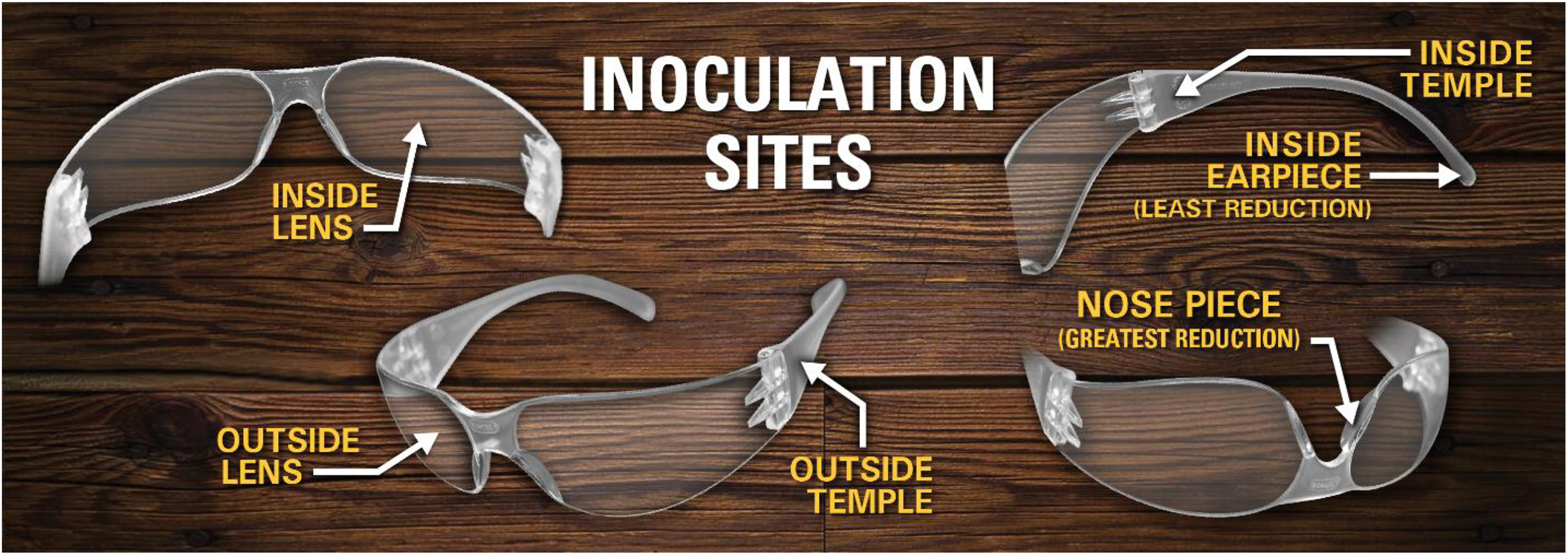
Inoculation sites on the safety glasses. Safety glasses were inoculated at 6 locations with Staphylococcus aureus.
One pair of safety glasses was similarly inoculated and set aside without UV treatment to serve as the experimental positive control.
Disinfection of Glasses
The 6 inoculated safety glasses were placed in the cabinet as indicated in Figure 1. Glasses were new in the box when used and decontaminated with 70% ethanol with a minimum of 10 minutes of contact time between repetitions. The glasses were positioned so that the lenses faced the nearest reflective mirror. The glasses at position 4 were placed with the lenses facing to the left.
The cabinet was operated for a standard cycle of 15 minutes, the maximum possible setting for the analog timer on the cabinet, for all repetitions during the testing.
Enumeration of Bacteria
After UV treatment, 1 sterile cotton swab moistened in buffered peptone water was vigorously scrubbed on a single inoculated area on a pair of safety glasses and immediately placed in a sterile tube containing 9 mL of buffered peptone water for transport to the laboratory. This sampling procedure was repeated for each of the 6 inoculated locations on each of the 6 pairs of inoculated safety glasses and 1 control pair. Enumeration of recovered bacteria from all glasses was done by a serial dilution spread plate method using a nonselective medium, trypticase soy agar (TSA) (BD BBL), and a selective medium, Baird-Parker agar (with egg yolk tellurite supplement) (BPA) (BD BBL); incubating plates at 37°C for 24 hours; and counting colonies.
Statistical Analysis
The statistical analysis of the data was performed using SigmaStat 4.0 (Systat Software, San Jose, California). The method of analysis was analysis of variance (ANOVA), which is appropriate for data where the interest is to compare differences of means among more than 2 groups. In the analysis, ANOVA was used to compare the amount of variation between the groups with the amount of variation within the groups with the positive control glasses used to normalize the experimental glasses data for microbial loss due to drying.
The simulations were performed using @RISK 7.0 (Palisade Corporation, Ithaca, New York). @RISK is a statistical software package and MS Excel (Microsoft, Richmond, Washington) plugin package that performs risk analyses using Monte Carlo simulation. @RISK calculates potential outcomes from the data set model. A Monte Carlo simulation constructs probability distributions of the possible outcomes from the data of a particular experiment. The probability distribution quantitatively assesses the level of risk associated with a decision and allows us to select the decision that provides the best balance of benefit against risk. The typical result of a Monte Carlo simulation is a histogram of the simulated outcomes. The histogram can be analyzed to get probabilities of different outcomes occurring. 15
In analyzing the data from this experiment, the simulations were run using an initial contamination range of 1 cell to 50 cells, with a median value of 10 cells and the calculated median log reduction from our data of 1.8, with the 25% and 75% values (1 log and 2.5 log) as anchors for the distribution. The simulation was run through 1000 iterations with 5 independent replications. Based on this output, the 15-minute UV light treatment would result in a “0” (undetectable population) on the glasses 96.8% of the time, with a maximum estimated surviving population of 2.6 cells.
Additional simulations were run with initial populations of S aureus between 0, 1.5, and 2.5 log10 cfu using a triangle distribution (<1, 31, and 316 cfu), and the reductions of 0.8, 1.8 and 3.1 log10 were determined from the lab data, using a triangle distribution. The triangle distribution operates with the 2 legs of the triangle anchored at the upper and lower bounds, with the peak in the middle value. The computer randomly picks a value from the distribution, but it is weighted toward the center value. The simulation was run 1000 times with 2 replications. Ninety-nine percent of the time, the result would be <10 cfu surviving, and 95% of the time, the result would be <3.3 cfu surviving.
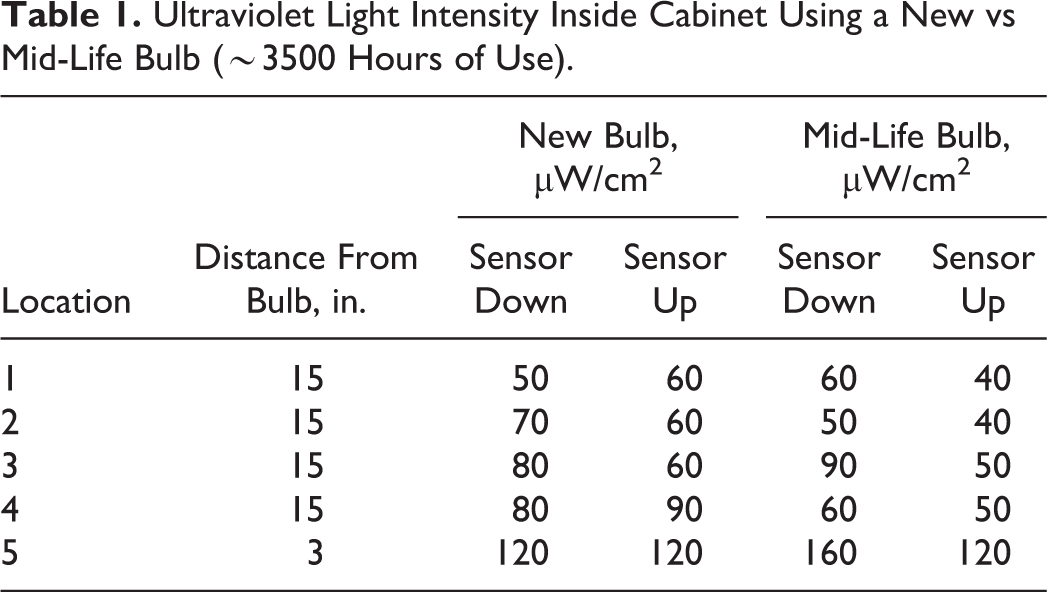
UV light intensity at multiple locations within the cabinet was measured using a Spectroline Digital UV Meter, Model DM-254 N (Spectronics Corporation, Westbury, New York). This meter has an accuracy of ±5% with reference to National Bureau of Standards. The intensity was measured at each glasses’ location with the sensor facing toward the ceiling (sensor up) of the cabinet and then facing toward the floor (sensor down) of the cabinet (Figure 3). This measurement represents the minimum intensity the glasses would experience. UV intensity ranged from 40 μW/cm2 in the top corners of the cabinet to 120 μW/cm2 directly in front of the UV bulb in the center of the cabinet (Table 1).
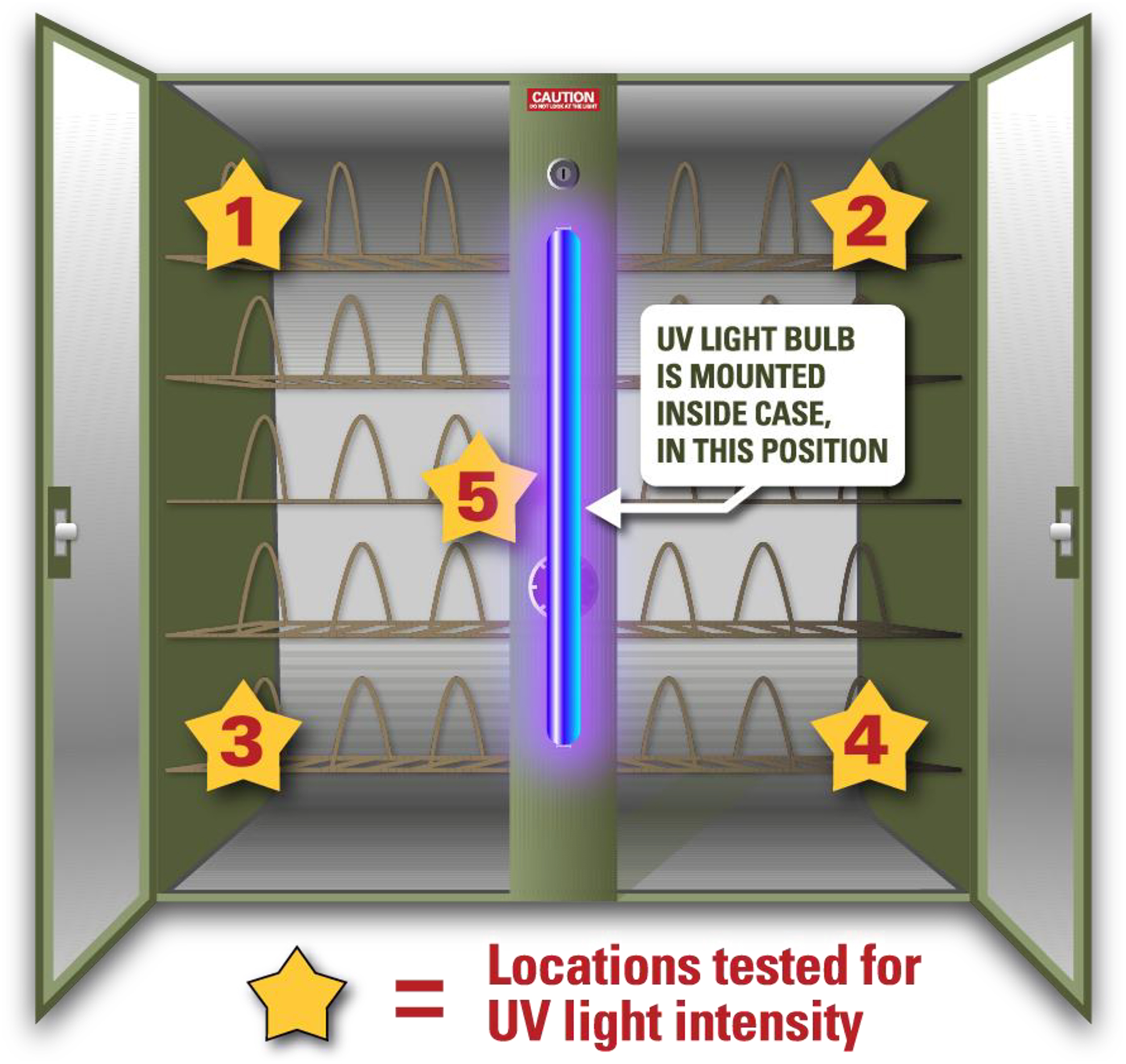
Locations tested for ultraviolet (UV) light intensity. UV light intensity was tested in 5 locations in the cabinet with the sensor facing toward the ceiling (sensor up) of the cabinet and then facing toward the floor (sensor down) of the cabinet.
Ultraviolet Light Intensity Inside Cabinet Using a New vs Mid-Life Bulb (∼3500 Hours of Use).
The UVC dose delivered within the cabinet was determined using the equation UV Dose = I × T, where intensity (I) is measured in milliwatts per centimeter squared (mW/cm2) and time is measured in seconds. In this experiment, all exposure repetitions were 900 seconds (15 minutes). Based on this calculation, the UVC dose within the cabinet varied from ∼3.6 × 10⁷ μW/cm2 for glasses at position 1 using a bulb in the middle of its lifecycle (∼3500 hours of use) to ∼1.08 × 10⁸ μW/cm2 for glasses in position 5.
Results
A significant difference (P < .001) was found between the numbers of organisms on UV-treated glasses vs control glasses (Table 2). The median value for all locations on the untreated safety glasses in the cabinet and for the controls was 6.9 log10, while the median value for the treated samples was 4.5 log10 (for this type of analysis, we round to 1 significant digit). The overall difference is 6.9 – 4.5 or a log reduction of 2.4.
Number of Organisms Recovered From Treated vs Control Safety Glasses.
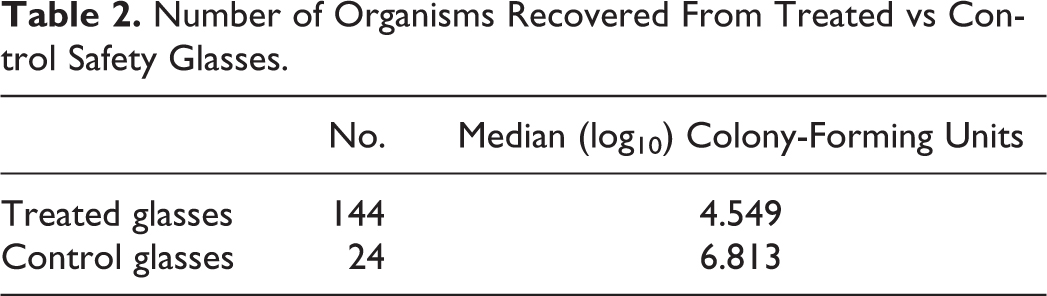
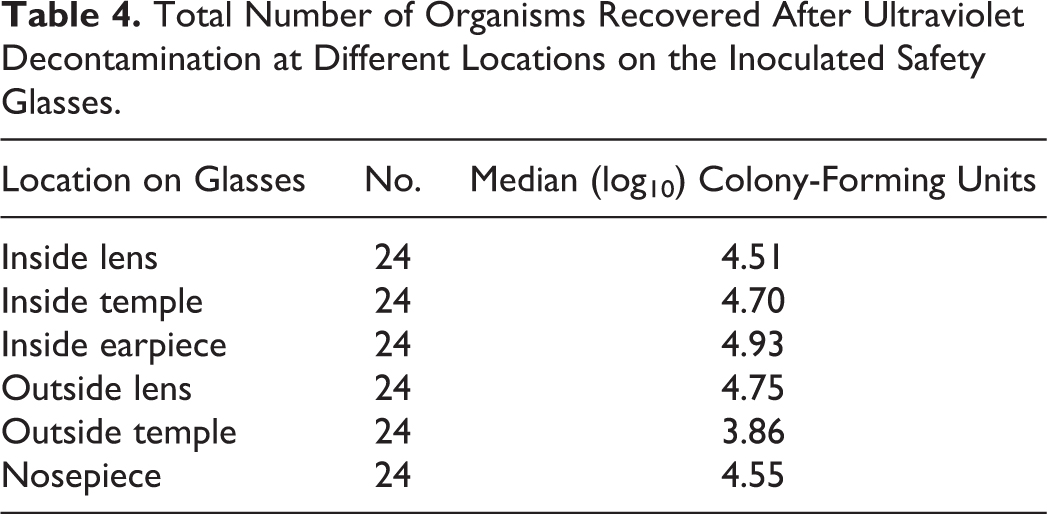
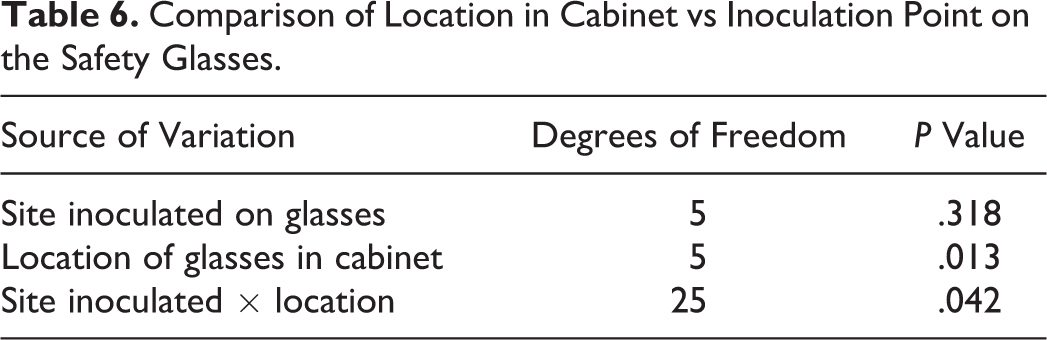
There was no significant difference (P = .82) between the populations recovered from inoculated, untreated glasses using either nonselective TSA agar or selective BPA agar (Table 3). There was no significant difference (P = .318) between the number of organisms enumerated from any of the inoculated surface locations after UV decontamination (Table 4). There was no significant difference (P = .104) in recovery of organisms between locations of the treated glasses within the cabinet (Table 5). There was a significant interaction (P = .013) between location of the glasses in the cabinet and inoculation point on the glasses (Table 6). The greatest reductions were on the nosepiece of the glasses at location 6 in the cabinet (3.43 log10 cfu). The least reduction was on the inside earpiece at location 5 in the cabinet (0.28 log10 cfu) (Figure 2).
Comparison of Recovery of Organisms From TSA vs BPA.
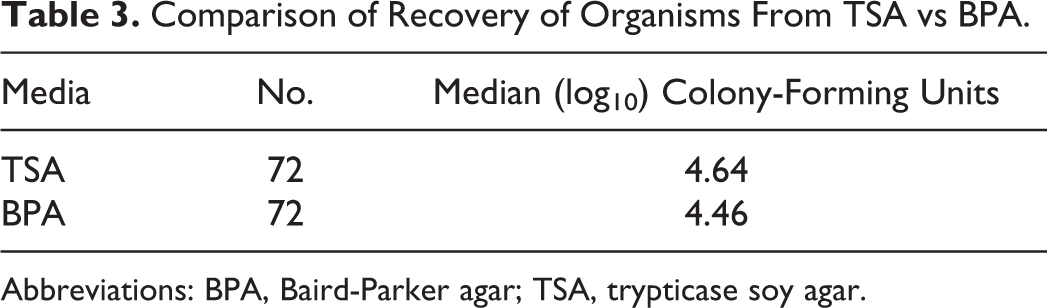
Abbreviations: BPA, Baird-Parker agar; TSA, trypticase soy agar.
Total Number of Organisms Recovered After Ultraviolet Decontamination at Different Locations on the Inoculated Safety Glasses.
Total Number of Organisms Recovered From All the Sites on a Pair of Safety Glasses After Ultraviolet Decontamination at Different Locations Within the Cabinet.a
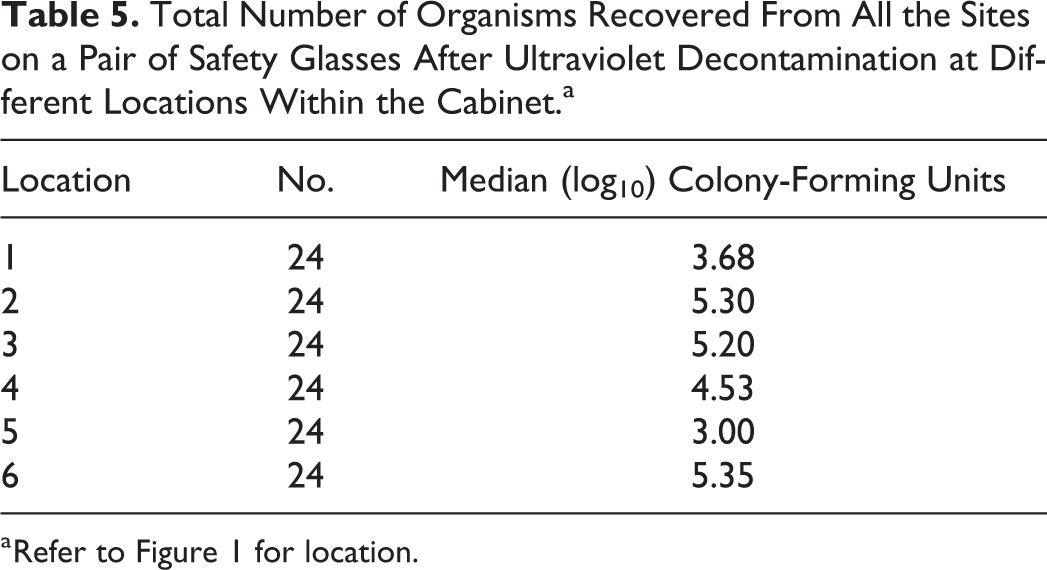
Refer to Figure 1 for location.
Comparison of Location in Cabinet vs Inoculation Point on the Safety Glasses.
Discussion
The efficacy of UV light for decontamination can be affected by a number of factors such as distance from the UV source, humidity, and temperature. Humidity above 70% and operating temperatures outside the optimum range of 77°F to 80°F may enhance the survivability of microorganisms exposed to UV light. 16 In general, a UV source lamp in an aged cabinet may continue to appear to be functioning properly throughout the entirety of its life. However, the intensity of UV light being emitted decreases over time. 17 The effectiveness of disinfection using UVC light is dependent on direct exposure of the surfaces where the microorganisms reside to the UVC light. Consequently, devices and environments where the design incorporates obstacles that block UVC result in incomplete disinfection. Distance has a profound effect on the efficacy of UV light. As the distance from the source of UV light increases, the strength of the UV light decreases. For point sources, the decrease in UV light effectiveness follows the inverse square rule. Consequently, doubling the distance of a contaminated surface from the UV light will reduce the effectiveness by 75% compared to effectiveness at the original reference point. 18 However, the data in Table 1 show that the cabinet overcomes this potential limitation of UVC through the use of a linear bulb UV source and the interior of the cabinet engineered with reflective surfaces to enhance effectiveness by reflected UVC.
There are multiple methods available for the decontamination of eye protection between uses such as chemical inactivation or treatment with UV light. Chemical inactivation requires active time and effort for each pair of glasses. Chemical decontamination involves the use of potentially hazardous materials, the need for disposal of hazardous waste, rinsing the glasses after decontamination, and the risk of exposure to the chemicals during the process. Ultraviolet light may be a more convenient option. Once a UV light decontamination cabinet is installed, the time commitment is physically cleaning glasses of any gross contamination that would block UVC prior to placing them in the cabinet and starting a cycle; there will be less chemical waste to dispose of, no rinsing of the glasses, and no waiting for the glasses to dry.
From an employee or student protection perspective, improperly maintained UVC devices could present an exposure risk that could lead to damage to eyes, burns, and permanent damage to skin and may increase risk of skin cancer. In the United States, the Occupational Safety and Health Administration (OSHA) nonionizing radiation standard does not include sound or radio waves or visible, infrared, or ultraviolet light. Consequently, OSHA employee exposure limits to ultraviolet radiation do not currently exist. 19 However, the American Conference of Governmental Industrial Hygienists (ACGIH) has set threshold limit values (TLVs) for UV radiation in the spectrum between 180 and 400 nm. The ACGIH defines a TLV as the amount of a substance or physical agent that a worker can be safely exposed to, day after day throughout his or her life, without suffering adverse effects. TLVs apply to exposure of a worker’s skin or eye. According to ACGIH, the TLV for UV light in the band between 255 and 260 nm is 5.8 × 10² to 4.6 × 10² mJ/m2. 20
Any method used to decontaminate safety glasses comes with inherent risks. To help mitigate the risks, the cabinet used in this study employs mitigation devices to reduce the risk of injury, including a front-facing “in-use” light and a key-lock system to prevent opening during a decontamination cycle. Administrative controls were also put in place. Standard operating procedures were developed that explained the proper method of operation of the cabinet and the hazards of UV light exposure, defined required personal protective equipment to be worn during use, set periodic maintenance schedules for the cabinet and the UV bulb, and outlined a procedure for the disposal of used UV bulbs. However, other equipment that uses UVC light as a decontamination source must be evaluated to ensure injury does not occur to the user.
Decreasing S aureus contamination by 2.4 logs should eliminate enough organisms on the glasses so they no longer carry the minimum infectious dose to cause conjunctivitis. According to research by McCormick et al, 21 105 cfu of S aureus, injected into rabbit conjunctivas, caused conjunctivitis in 1 of 5 strains used. To have sufficient organisms survive to cause an infection after UV light treatment, the glasses would need a minimum starting population of 107 organisms. For the strains of S aureus that did not cause conjunctivitis in the McCormick et al 21 experiment, the number of organisms may need to be even higher. The large number of S aureus would be unlikely on the skin and hands of humans. 4
In the cabinet tested in this study, the exposure of all contaminated surfaces to either direct or reflected UVC from the source, including those contaminated surfaces shadowed by either the cabinet rack system or the glasses themselves, was enhanced by the placement of reflective surfaces within the cabinet. As a result, 15-minute UVC irradiation of surfaces artificially contaminated with S aureus resulted in residual populations of organisms far below the recognized infective dose. Simulations using the data acquired in the experiment resulted in 99% confidence that residual populations of S aureus would be less than the infective dose. With proper cabinet maintenance, utilization of verified standard operating procedures, and removal of any visible contamination from the safety glasses prior to disinfection cycles, the cabinet is capable of reducing bacterial contamination.
The scope of this project was limited to bacterial contamination of plastic safety glasses. Additional research to determine the ability of the cabinet to reduce or eliminate viral or parasitic contamination on reusable safety glasses would be needed to expand the range of utility of the cabinet. Evaluation of the cabinet for decontamination of other items of small laboratory equipment may also prove useful.
Conclusion
The UV cabinet evaluated during this study can be an effective and convenient option for the reduction of bacterial contamination of plastic safety glasses between uses. A statistically significant reduction of bacterial contamination was seen, dependent on both location of the glasses within the cabinet and location of the contamination on individual glasses.
Footnotes
Acknowledgments
The authors wish to acknowledge Dr. James Dickson, Steve Neibuhr, Kristina Larson, and Kankani Vithanage Ganeshi Bhagya whose assistance was indispensable.
Declaration of Conflicting Interests
The authors declared no potential conflicts of interest with respect to the research, authorship, and/or publication of this article.
Funding
The authors received no financial support for the research, authorship, and/or publication of this article.
Prior Presentation
Portions of the data contained herein were included in a poster presentation at the 60th Annual Biological Safety Conference, October 13-18, 2017 in Albuquerque, NM.