



Abstract
This research examines credentialing for the biosafety profession. There are many anecdotes regarding the importance of becoming a Registered Biosafety Professional or a Certified Biological Safety Professional. However, there are few data to support the rationale to expend the time and effort to obtain these credentials. This research examines several criteria to determine if there are incentives for individuals in the biosafety profession to obtain either credential. The significance of a person’s sex, as it relates to salary and biosafety credentials, is also assessed in this research.
Keywords
Individuals in the biosafety profession have an opportunity to formally acknowledge and validate their expertise and experience. There are 2 primary forms of credentialing for members of the American Biological Safety Association (ABSA) International. The first is for one to attain the status of an Registered Biosafety Professional (RBP), and the second is to achieve the recognition of a Certified Biological Safety Professional (CBSP). A person with an RBP or CBSP meets the criteria established by the Credentialing Evaluation Board of ABSA International. Specifically, someone with an RBP has documented academic education or specialized training in relevant biological risk management disciplines and a minimum of 5 years of comprehensive experience in managing an inclusive biological safety program. 1 A person with a CBSP (1) is required to pass a written examination developed by ABSA International and administered by the National Registry of Certified Microbiologists and (2) meets the educational and work experience criteria established by the Credentialing Evaluation Board. 2
The need for having credentialed biosafety professionals has been highlighted in several government findings. In one example, the University of California’s Center for Laboratory Safety 3 issued a report in 2016 regarding the University of Hawaii’s hydrogen/oxygen explosion, which stressed the importance of hiring “highly qualified individuals” for safety positions. In an example involving exposure to Brucella at Texas A&M University, the US Government Accountability Office found that the biosafety officer “had no training in biosafety but was an industrial hygienist by education and experience.”4(p15) The report issued by the US Department of Health and Human Services 5 noted the Trans-federal Task Force on “Optimizing Biosafety and Biocontainment Oversight” made the recommendation that biological safety officers at high- and maximum-containment research facilities be credentialed. In yet another example, the 2014 report of the Federal Experts Security Advisory Panel states that credentialing programs demonstrate that an individual has “the necessary level of expertise to provide effective oversight of work with all biohazardous materials.”6(p20)
As of October 2016, there were 1450 members of ABSA International. Of these, approximately 30% (n = 429) have either an RBP or a CBSP: 247 (17%), an RBP; 96, a CBSP (7%); and 86, both (6%). In 2015, there were 59 new applications for an RBP (38 approved and 21 denied) and 21 for a CBSP (18 approved and 3 denied). A 5-year history of RBP and CBSP applications and approvals are included in Figures 1 and 2 (D Wang, personal communication, October 10, 2016).
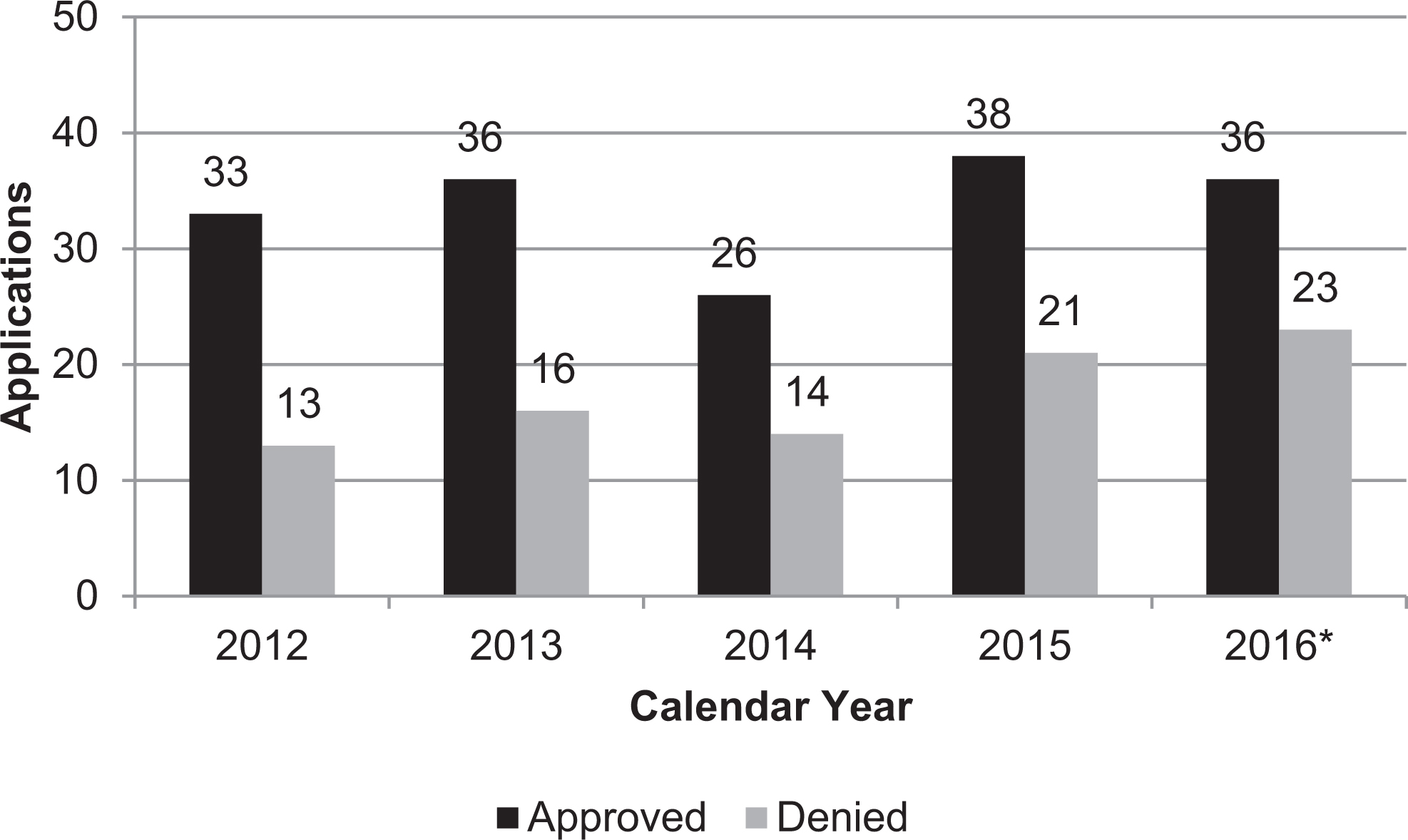
Number of Registered Biosafety Professional applications from 2011 to 2016. *Information through October 5, 2016.
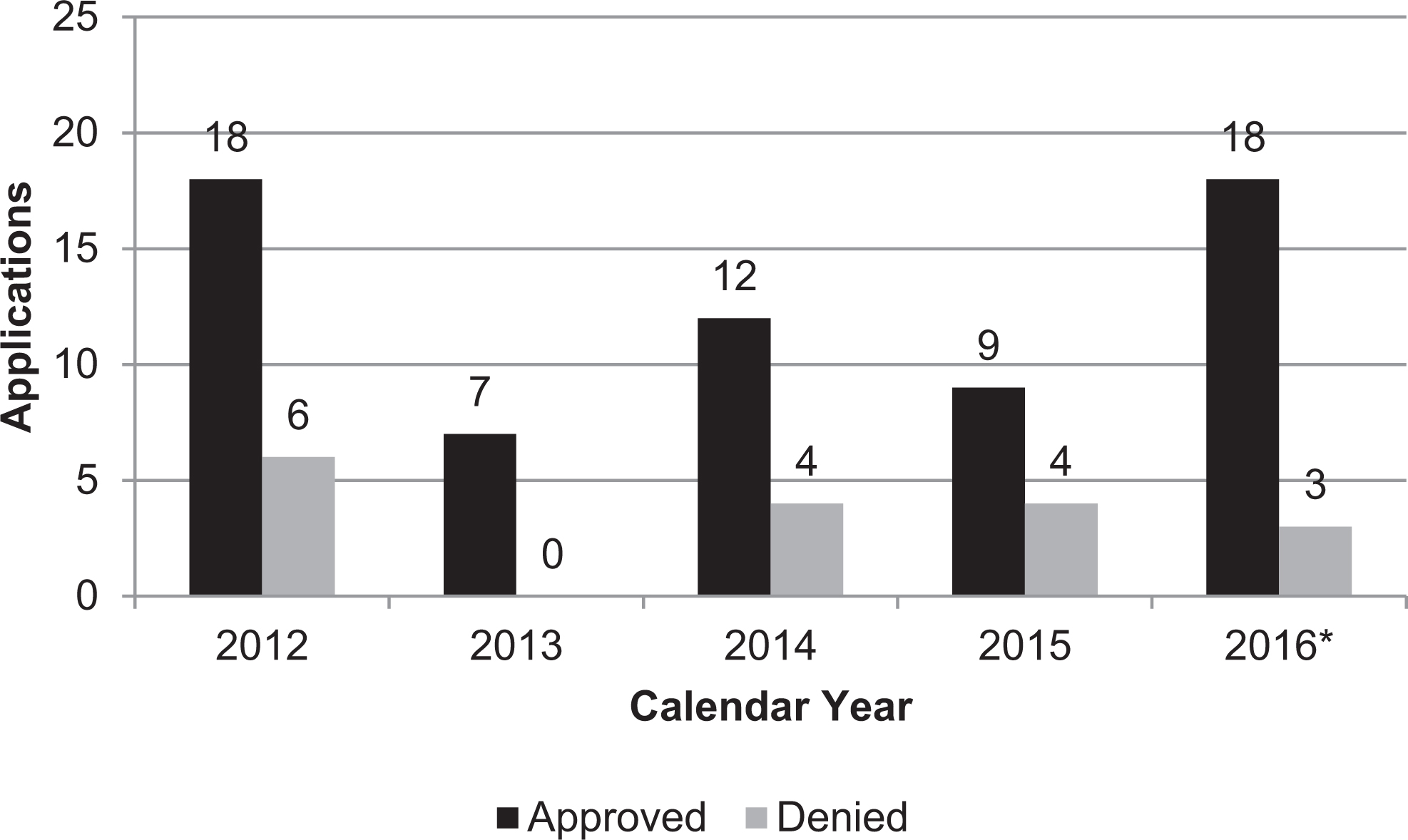
Number of Certified Biological Safety Professional applications from 2011 to 2016. *Information through October 5, 2016.
Research Project
Previous research has examined extensive demographic details of biological safety professionals.7,8 One area that has remained elusive in the research is an assessment of professional credentials and sex. To address this demographic, the following hypotheses were analyzed:
Hypothesis 1 (H1): Individuals holding both an RBP and a CBSP will report a higher salary than those with only an RBP or a CBSP, and they will report a higher salary versus individuals with no biosafety credentials. Hypothesis 2 (H2): Female biosafety professionals will hold a greater number of biosafety credentials than males. Hypothesis 3 (H3): Female biosafety professionals with an RBP, CBSP, or both will earn less money than males with the same credentials. Research Question (RQ): Are there differences in salary and types of biosafety credentials for each sex?
The hypotheses and RQ were examined by performing an analytic survey of those working in the biosafety profession. The aim in performing this research is to continue to extend the depth and scope of information that supports biosafety professionals in their daily work environment.
Method
Procedure
A 42-question survey was sent to 1727 people listed as Institutional Biosafety Committee contacts in accordance with the National Institutes of Health’s Office of Science Policy, as well as those associated with ABSA International. The survey was optional and voluntary, and it complied with all institutional policies related to human subjects research. The Institutional Review Board at Arizona State University (1306009323) approved the research.
Participants
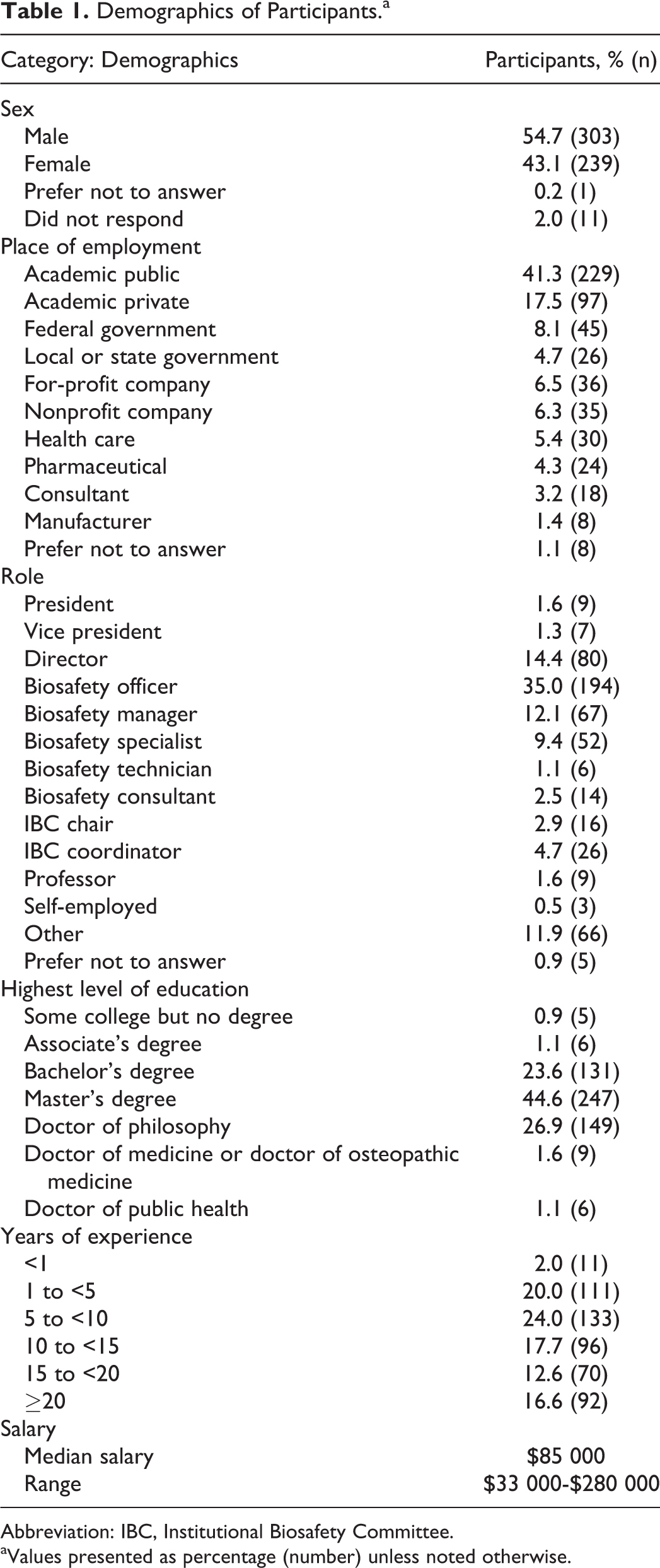
There were 825 participants in the survey. However, for this research, only those working full-time in the United States were included, which left 554 participants. This ensured analytic control over moderating factors regarding salary data, such as monetary conversion rates and full- versus part-time status. Details on the participants are included in Table 1.
Demographics of Participants.a
Abbreviation: IBC, Institutional Biosafety Committee.
Values presented as percentage (number) unless noted otherwise.
Measures
The following questions specific to this study were included in the survey: “In your current position, do you have responsibilities for biosafety?” (response choices were yes, no, and I prefer not to answer) and “In which country do you work?” “Which of the following categories best describes your place of employment?” “Which of the following best describes your role?” (response choices are included in Table 1).
Additional questions included percentage of time spent performing biosafety duties, number of direct reports, number of biosafety inspections performed, years of experience, highest level of education, number and type of credentials, data entry responsibilities, age, sex, salary negotiation, time off from work, select agent programs, and other related questions. Participants were also asked to include the state and country in which they work. This information identified the right-to-work states.
Data Analysis
Analysis of variance (ANOVA) was utilized on H1 and H3 as well as RQ to compare differences among ≥3 groups. For H2, independent t tests were applied to examine the differences between 2 groups (ie, males and females). For the hypotheses and RQ, alpha was set at .05 to determine which factors influence salary.
Results
H1 predicted that biosafety professionals holding both RBP and CBSP credentials will report a higher salary than those with only an RBP or a CBSP and will report a higher salary versus individuals with no credentials. The Levene test was not significant, F(3, 508) = 1.66, P = .18, indicating that the assumption of homogeneity of variance was met. The results of a 1-way ANOVA indicated a significant difference, F(3, 508) = 3.61, P < .05, among those with no credentials (M = $86 572.64, SD = 37 301.85), a CBSP only (M = $104 423.32, SD = 26 192.49), both an RBP and a CBSP (M = $105 410.06, SD = 26 164.35), and an RBP only (M = $104 895.71, SD = 115 875.15). Given the directional nature of the hypothesis, a planned contrast was executed per the –4, 1, 2, and 1 for people with no credentials, CBSP only, RBP and CBSP, and RBP only, respectively. The contrast coefficients were significant, t(508) = 2.8, P < .001, revealing that biosafety professionals with both credentials have higher salaries than those who have only an RBP or a CBSP, who in turn have higher salaries than those with no credentials. Therefore, H1 was supported.
H2 predicted that female biosafety professionals will hold a greater number of credentials than males. The Levene test was not significant, F(540) = 2.13, P = .15, indicating that the assumption of homogeneity of variance was met. The results of an independent samples t test indicated no significant differences between males and females and number of credentials, t(540) = 0.07, P > .05. Therefore, H2 was not supported.
H3 predicted that female biosafety professionals with an RBP or a CBSP would earn less than males with the same credentials. The Levene test was not significant, F(5, 174) = 1.09, P = .37, indicating that the assumption of homogeneity of variance was met. The results of a 1-way ANOVA did not indicate a significant difference, F(5, 174) = 0.67, P > .05. Given the directional nature of the hypothesis, a planned contrast was executed per the salary results from the prior RQ: –1, 1, –2, 2, –3, and 3 were utilized for females with the CBSP only (M = $102 827.76, SD = 24 503.89), males with CBSP only (M = $106 718.44, SD = 29 633.99), females with both (M = $99 209.57, SD = 23 654.286), males with both (M = $117 502.91, SD = 28 950.13), females with RBP only (M = $91 807.27, SD = 32 651.52), and males with RBP (M = $119 691.35, SD = 165 265.70), respectively. The contrast coefficients were not significant, t(174) = 1.44, P = .07, revealing no differences in salary for females with the same credentials as males. Therefore, H3 was not supported.
RQ asked if there were differences between salary and types of credentials for each sex. Two ANOVAs were run, 1 for males and 1 for females. Regarding females, the Levene test was not significant, F(3, 287) = 1.01, P = .39, indicating that the assumption of homogeneity of variance was met. The results of a 1-way ANOVA indicated a significant difference, F(3, 287) = 6.40, P < .001. Post hoc tests were run via Tukey, a more conservative test: Results revealed that the significant differences were (1) between females who had no credentials (M = $81 254.66, SD = 30 305.74) and those who had the CBSP only (M = $102 827.76, SD = 24 503.89) and (2) between those with no credentials and those with both the RBP and the CBSP (M = $99 209.57, SD = 23 654.286); no other significant differences were found for RBP only (M = $91 807.27, SD = 32 651.52). For females, having the CBSP credential or having both the CBSP and the RBP resulted in a higher salary. Regarding males, the Levene test was not significant, F(3, 215) = 1.24, P = .30, indicating that the assumption of homogeneity of variance was met. The results of a 1-way ANOVA indicated no significant differences in salary for males by type of credential, F(3, 215) = 1.17, P > .05: no credentials (M = $94 674.96, SD = 44 529.00), CBSP only (M = $106 718.44, SD = 29 633.99), both RBP and CBSP (M = $117 502.91, SD = 28 950.13), and RBP only (M = $119 691.35, SD = 165 265.70). Thus, differences in salary and type of credentials vary only for females as opposed to males.
Discussion
This research demonstrates the benefits of obtaining a biosafety credential for both women and men. H1 shows that a person without a biosafety credential may be able to increase his or her salary approximately $18 000 by obtaining an RBP and about another $1000 with a CBSP (see Figure 3). H2 states that female biosafety professionals will hold a greater number of biosafety credentials than males. While not supported statistically, the results demonstrate that women have a similar number of biosafety credentials as men (see Figure 4). While H3 was also not supported statistically, the research indicates that women in the field may be able to increase their salary by obtaining RBP and CBSP credentials (see Figure 5). Interestingly, the RQ demonstrates a greater benefit for women than men to obtain an RBP and a CBSP. For women without a biosafety credential, the results show that obtaining an RBP may increase salary by >$10 500 and obtaining a CBSP may be able to increase a salary by >$21 500. The RQ also shows that men may not see as large of an increase in salary for obtaining a biosafety credential.
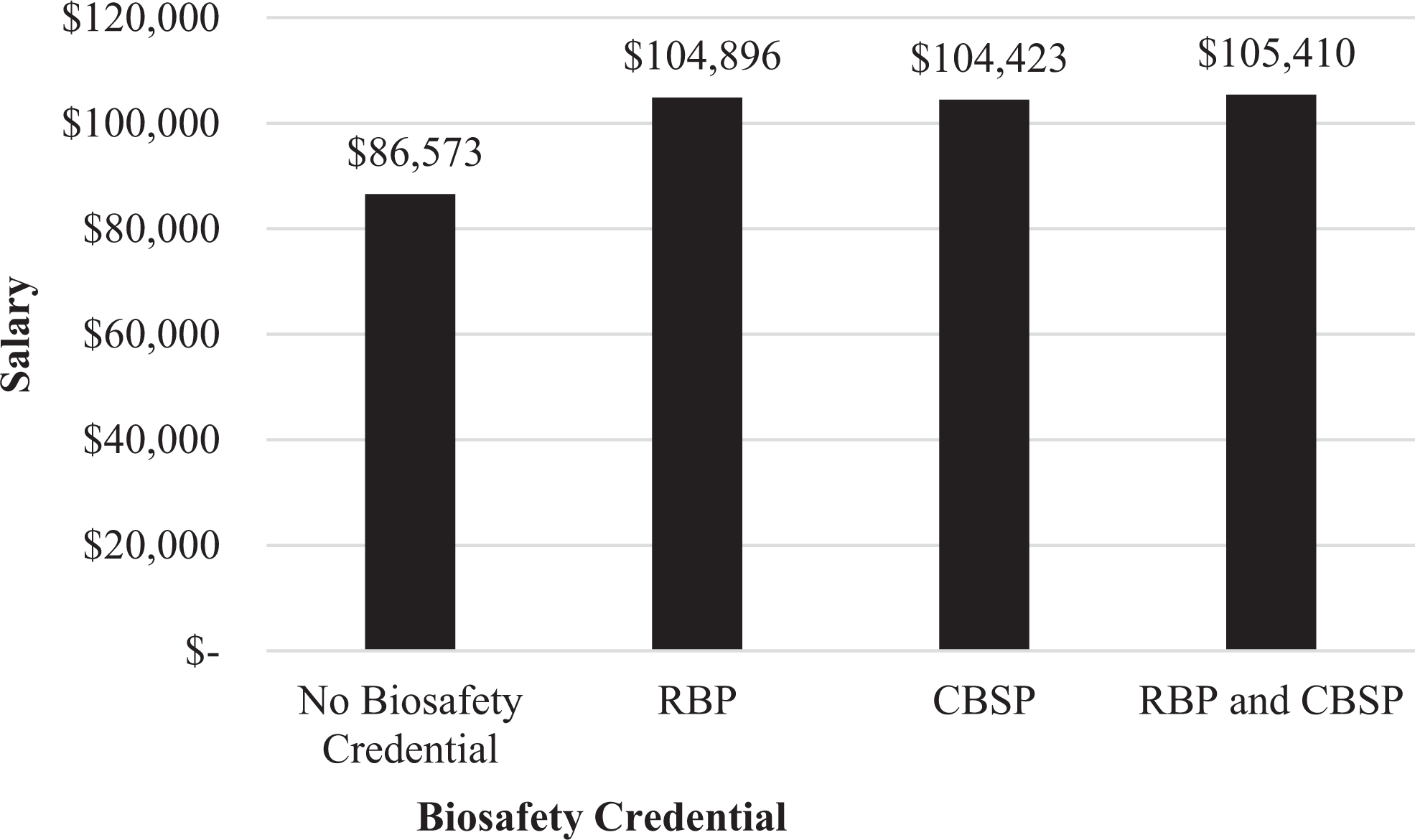
Average salaries for biosafety professionals by Registered Biosafety Professional (RBP) and Certified Biological Safety Professional (CBSP) credential.
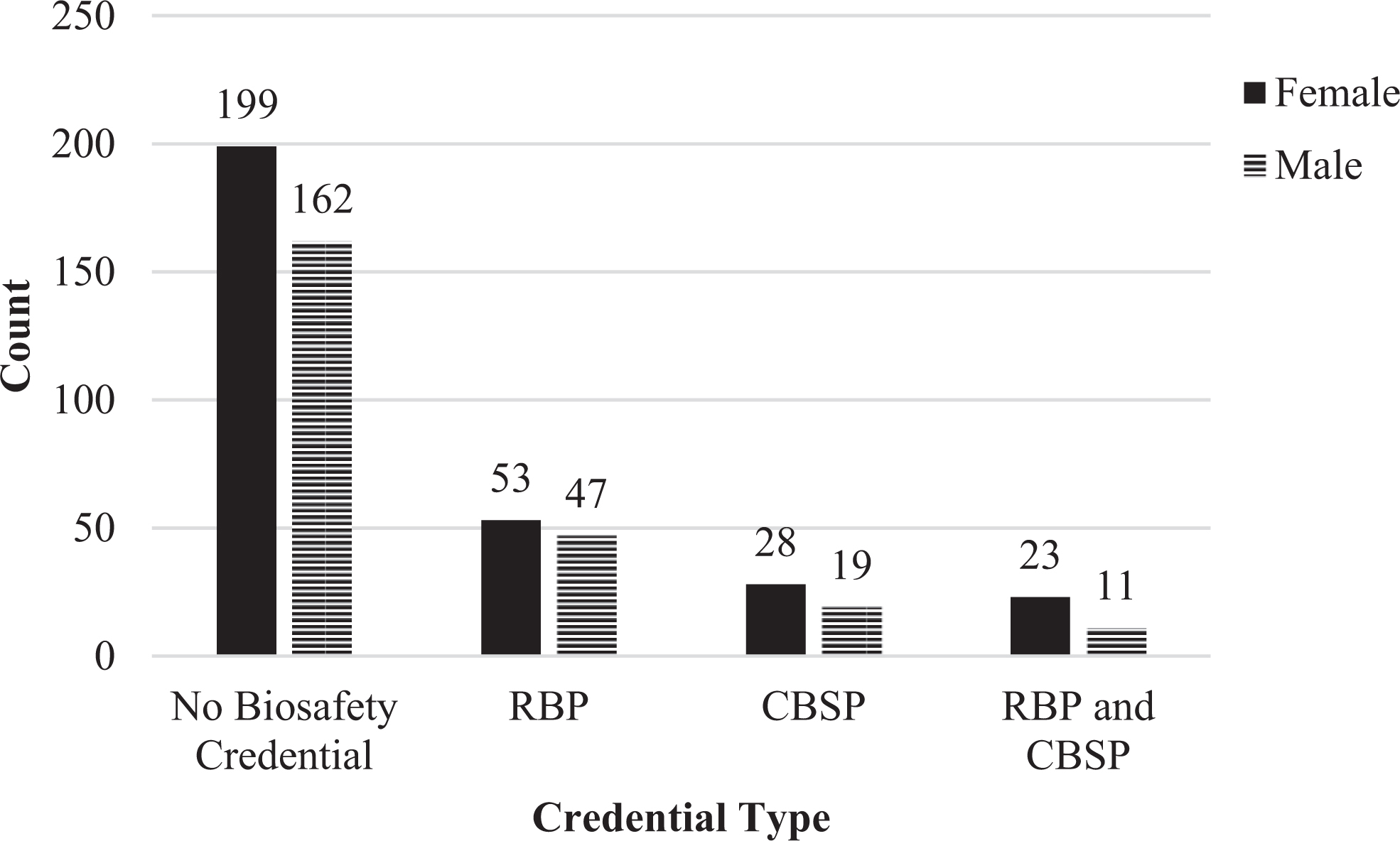
Number of biosafety professionals with Registered Biosafety Professional (RBP) and Certified Biological Safety Professional (CBSP) credential by sex.
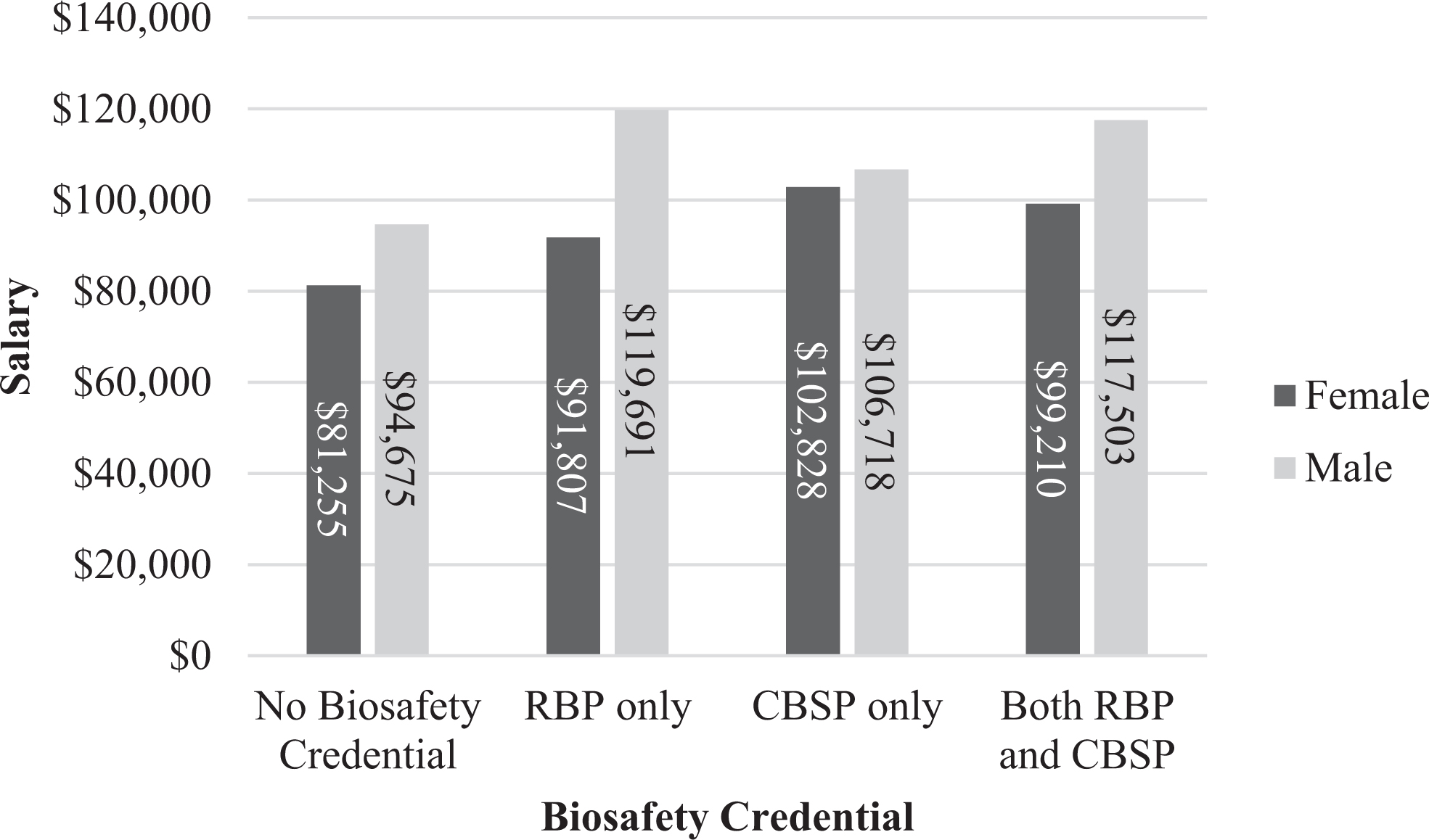
Average salaries for biosafety professionals by credential and sex. RBP, Registered Biosafety Professional; CBSP, Certified Biological Safety Professional.
It is important to consider that credentialing is just 1 variable that may influence a person’s salary. Previous research published in Applied Biosafety 7,8 provides several factors that influence the salaries of biosafety professionals. For example, to obtain an RBP or a CBSP, one must work a minimum number of years performing biosafety duties before she or he is eligible to apply for the credential (or sit for the examination). As such, some of the salary differences between the noncredentialed biosafety staff and those who are credentialed could be years of experience. Similarly, the level of education that an individual has obtained has also been shown to make a difference in salaries. Other factors that may influence salary is whether one attends professional development opportunities, such as special trainings, fellowships, workshops, and comprehensive biosafety courses. Future research is needed to examine the factors that affect the salary of biosafety professionals.
Conclusion
Biosafety credentialing demonstrates that an individual has a long-term commitment to promoting best practices in biorisk management (which includes the biosafety and biosecurity disciplines), ensuring the health and wellness of laboratory personnel, and protecting the community and environment. Obtaining an RBP and a CBSP signals to employers and colleagues that one is dedicated to his or her profession and is interested in sharing one’s knowledge and expertise with others. The RBP and CBSP credentials may also be required to obtain a certain job, to validate education and job experience, to obtain a higher salary, and to be considered an expert in the fields of biosafety and biosecurity. As this research also demonstrates, there is a clear financial incentive for one to obtain an RBP or CBSP credential. However, the salary benefit is much greater for women.
Footnotes
Acknowledgments
We gratefully acknowledge the support of the members of the ABSA International Credentialing Evaluation Board and the Credentialing Maintenance Board for their assistance with this research. We also thank Leon Igras, Emma Frow, Lynn Crystal, Jackie Murrill, Giorgio Scarpellini, Chantelle Miller, Rebecca Caruso, Kathryn Harris, and Debra Sharpe for their continued support of this project.
Declaration of Conflicting Interests
The author(s) declared no potential conflicts of interest with respect to the research, authorship, and/or publication of this article.
Funding
The author(s) received no financial support for the research, authorship, and/or publication of this article.