



Abstract
Introduction:
Traditional Chinese medicine (TCM) is a traditional treatment based on herbal medicines and holistic healing. It has resulted in both favorable and unfavorable patient outcomes when used to treat cancer. Cancer patients frequently depend on second opinions and folk remedies. In this case, we report the case of TCM inducing repeated moderate liver injury and delay for chemotherapy.
Case presentation:
A 59-year-old woman was diagnosed with lung cancer and conducted surgery a month ago. She went to a TCM specialty clinic expecting a complete cure for the lung cancer, to improve her physical condition, and to enhance her immunity. She received the TCM formulas hanshirento, zenshikunshito, and ninjin’yoeito. After starting these medicines, she felt severe fatigue but continued them for approximately 2 weeks, After discontinuing the medicine, her fatigue was improved. She was admitted to our hospital for adjuvant chemotherapy. On admission, laboratory tests revealed moderate liver injury (AST: 705 U/L, ALT: 1091 U/L). In view of her medication history, the laboratory tests, and her lifestyle history, we thought that moderate liver injury was caused by TCM, employing the Roussel Uclaf Causality Assessment Method (RUCAM).
Discussion:
TCM are known to be metabolized by the resident bacteria in the small intestine, but the specific metabolic processes are not well understood. Cancer patients sometimes try TCM from their own research to stay healthy. However, as with our case, TCM rarely induces liver injury, which is not well known to TCM users. Medical staffs need to be vigilant with their drug histories, including TCM, if patients have liver injuries.
Keywords
Introduction
Traditional Chinese medicine (TCM) is a traditional treatment approach based on herbal medicines and holistic healing that has resulted in both favorable and unfavorable outcomes when used in patients with cancer. 1 When diagnosed with cancer, patients frequently depend on and seek second opinions and folk remedies. Here, we report the case of a patient with lung cancer who had a repeated history of TCM-induced moderate liver injury. We obtained informed consent from the patient for publication of this case, which is recorded in her medical record.
Results
Case Presentation with Liver Injury Caused by Traditional Chinese Medicine
A 59-year-old woman underwent surgery in January 2020, 2 months following a diagnosis of lung cancer (pT2aN1M0, stage IIB, adenocarcinoma). Approximately 1 month postoperatively, she attended a TCM specialty clinic seeking a complete cure for her lung cancer, improvement in her physical condition, and immunity enhancement. She received TCM comprising hanshirento, zenshikunshito, and ninjin’yoeito (ren-shen-yang-ying-tang), containing scutellariae barbatae herba (12 g/day), elfvingia (8 g/day), semen coicis (6 g/day), poria (4 g/day), angelicae acutilobae radix (4 g/day), atractylodis rhizoma (4 g/day), and rehmannia radix (4 g/day) and others.
She felt severely fatigued after starting treatment but continued treatment for approximately 2 weeks. After discontinuation of the course of TCM, her fatigue symptoms improved (Figure 1). In March 2020, she was admitted to Showa University Hospital for cisplatin and vinorelbine-based adjuvant chemotherapy. Her laboratory test results on admission indicated moderate liver injury (aspartate aminotransferase [AST], 705 U/L; alanine transaminase [ALT], 1091 U/L; total bilirubin [T-bil], 1.6 mg/dL; lactate dehydrogenase [LDH], 436 U/L; alkaline phosphatase [ALP], 604 U/L; gamma-glutamyltransferase [γ-GTP], 492 U/L; prothrombin time, >100%; activated partial thromboplastin time, 34.4 seconds; and albumin, 4.2 g/dL). Her postoperative day 20 test results had been within the normal ranges on January 27, 2020 (AST, 28 U/L; ALT, 23 U/L; T-bil, 0.6 mg/dL; LDH, 201 U/L; ALP, 159 U/L; and γ-GTP, 59 U/L). The patient denied consuming wild game meat or having traveled abroad, and there had been no change to her concomitant medications (levothyroxine, 50 µg/day; atorvastatin, 5 mg/day). Test results for hepatitis B, hepatitis C, and Epstein-Barr virus infection were negative. Adjuvant chemotherapy was postponed until her liver test results improved. On day 12 of hospitalization, her liver test results had improved, and she was discharged from the hospital without undergoing chemotherapy.

Patient’s clinical course.
Case Presentation 12 Months Prior to the Admission—Repeated History for Liver Injury Caused by Traditional Chinese Medicine
We found repeated history for liver injury caused by TCM approximately 12 months prior to admission (Figure 2) and 10 years earlier (details unknown) in a post-admission patient interview. Our patient developed hearing impairment in December 2018. She was administered mecobalamin (1500 µg/day), adenosine triphosphate disodium hydrate (300 mg/day), and saireito (chai-ling-tang) (9 g/day) by her primary physician. Approximately 3 weeks later, she experienced fever and respiratory distress and was admitted to our hospital for treatment of suspected pulmonary and liver injury. During the course of her hospitalization, she was administered methylprednisolone (1 g/day) for 3 days and prednisolone (60 mg/day) thereafter. Her pulmonary dysfunction improved with steroid and antimicrobial therapy. Her liver test also improved, and she was subsequently discharged. Steroid therapy was continued until April 2019. We considered saireito (chai-ling-tang) as the cause of her liver injury based on her clinical course and drug history.
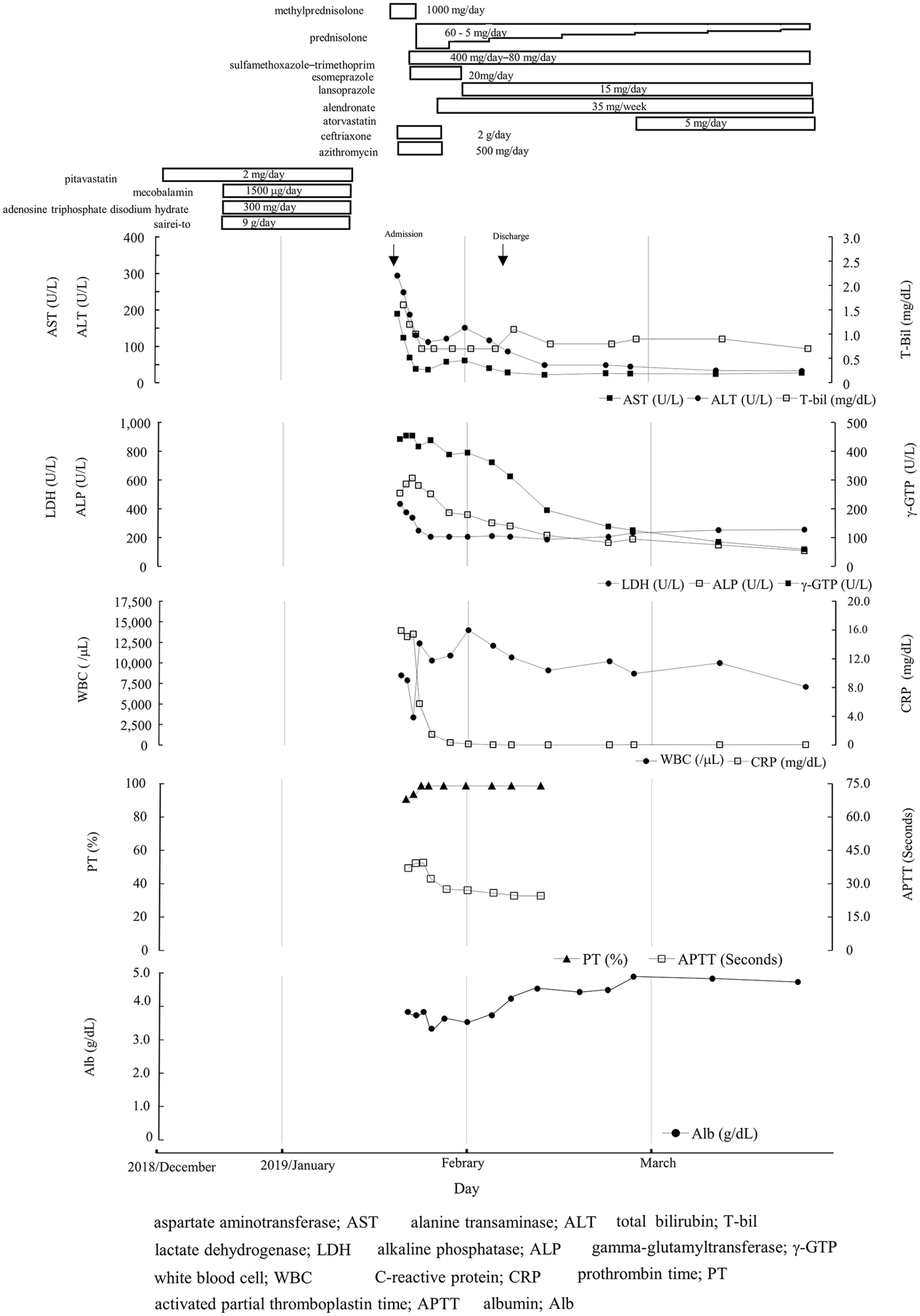
Patient’s clinical course of liver injury 1 year prior to the admission.
Probable Causality for Repeated Liver Injury of Traditional Chinese Medicine
We diagnosed TCM-induced liver injury based on her medication history (Table 1, Figures 1 and 2), laboratory test results, and lifestyle history. In addition, we retrospectively used the Roussel Uclaf Causality Assessment Method and identified hanshirento (score, 6 points), zenshikunshito (score, 6 points), ninjin’yoeito (ren-shen-yang-ying-tang; score, 8 points), and saireito (chai-ling-tang; score, 8 points) as probable causes for her liver injury 2 (Table 1). The corresponding components of the TCMs were poria, glycyrrhizae radix, ginseng radix, and cinnamomi cortex.
List of the Herbal Constituents of the Administered Drugs.

Abbreviation: RUCAM, Roussel Uclaf Causality Assessment Method.
Discussion
Approximately 9% of drug-induced liver injuries reported in the United States have been found to be due to TCM or dietary supplements. 3 We used the Pharmaceuticals and Medical Devices Agency’s Japanese adverse events spontaneous reporting system (JADER) database to investigate the contents of TCMs for poria, glycyrrhizae radix, ginseng radix, and cinnamomi cortex. In 2019, 357 adverse events have been reported related for 43 TCMs that containing atleast 1 candidate constituent such as hanshirento, zenshikunshito, ninjin’yoeito (ren-shen-yang-ying-tang), and saireito (chai-ling-tang). We used the terms “liver disease, unspecified (ICD10: K769)” or “drug-induced liver disorder (ICD10: K719)” to identify adverse events related to liver injury. We found that in 2019, 43 liver-related adverse events due to 21 TCMs had been reported. Therefore, close monitoring is required for TCM-induced adverse events such as liver injury.
TCM has a long-established history of use. TCM compounds are metabolized by resident bacteria in the small intestine; however, the specific metabolic processes are not well understood. 4 These unknown compounds and their metabolic pathways may account for the observed adverse events and require further in vitro study. Our patient had been taking atorvastatin for atleast 1 year before this episode. Concurrent use of TCMs and statins has been suggested to cause drug-drug interactions in rats 5 ; further, it may have a synergistic effect on liver function derangement. 6 In addition, inadequate quality control may result in hepatotoxic adulterants being mixed into TCMs. 7 Our patient’s liver toxicity may have been an indirect result of inadequate quality control of TCM compounds.
Patients with cancer sometimes self-medicate using TCM to stay healthy. In rare cases, such as the 1 reported here, TCM may induce liver injury; however, this is often not known to TCM users. Healthcare professionals need to be vigilant about the drug history, including TCM use, of patients with liver injury.
Footnotes
Declaration of Conflicting Interests
The author(s) declared no potential conflicts of interest with respect to the research, authorship, and/or publication of this article.
Funding
The author(s) received no financial support for the research, authorship, and/or publication of this article.
