



Abstract
This meta-analysis evaluates the clinical evidence for the addition of traditional medicines (TMs) to oxaliplatin-based regimens for colorectal cancer (CRC) in terms of tumor response rate (TRR). Eight electronic databases were searched for randomized controlled trials of oxaliplatin-based chemotherapy combined with TMs compared to the same oxaliplatin-based regimen. Data on TRR from 42 randomized controlled trials were analyzed using Review Manager 5.1. Studies were conducted in China or Japan. Publication bias was not evident. The meta-analyses suggest that the combination of the TMs with oxaliplatin-based regimens increased TRR in the palliative treatment of CRC (risk ratio [RR] 1.31 [1.20-1.42], I2 = 0%). Benefits were evident for both injection products (RR 1.36 [1.18-1.57], I2 = 0%) and orally administered TMs (RR 1.27 [1.15-1.41], I2 = 0%). Further sensitivity analysis of specific plant-based TMs found that Paeonia, Curcuma, and Sophora produced consistently higher contributions to the RR results. Compounds in each of these TMs have shown growth-inhibitory effects in CRC cell-line studies. Specific combinations of TMs appeared to produce higher contributions to TRR than the TMs individually. Notable among these was the combination of Hedyotis, Astragalus, and Scutellaria.
Keywords
Introduction
According to the World Health Organization Cancer Report, in 2012 there were 1.4 million new cases and 694 000 deaths from colorectal cancer (CRC) worldwide. 1 In terms of incidence, CRC is the third most common cancer in men and the second in women. CRC is the fourth most common cancer in developed regions and the fifth most common cancer in less developed regions. Compared with the 2010 study, CRC had increased in both incidence rate and mortality. 1
Chemotherapy is the primary therapy for CRC in the palliative setting. 2 Oxaliplatin combined with 5-fluorouracil (5-FU)/leucovorin (LV), referred to as FOLFOX, is standard first-line chemotherapy in the palliative setting for advanced CRC. 3 Oxaliplatin combined with oral capecitabine, which converts to 5-FU in the body, is referred to as XELOX. 4 Capecitabine was found to be as effective as intravenous 5-FU/LV.5,6
Natural products have been the source of a number of cancer drugs and continue to play a role in drug discovery programs. 7 Traditional medicines (TMs) based on natural products are used by a considerable proportion of cancer patients, often in combination with conventional therapies.8 -11 A number of compounds contained in plants possess pro-apoptotic actions, which may assist in the prevention or suppression of tumor growth and/or enhance cytotoxic effects of chemotherapeutic agents.12 -15
In China, chemotherapy may be combined with TMs with the aim of reducing the side effects of the chemotherapy and/or inhibiting tumor growth. 16 A meta-analysis of TMs combined with FOLFOX4 found that the TMs conferred benefits to advanced CRC patients in terms of tumor response rate (TRR), quality of life, and some adverse events, when compared to FOLFOX4 alone. In addition, this study reported that experimental studies of the TMs most frequently used in the clinical trials had shown evidence of bioactivities of relevance to cancer therapy and should be considered for further research. 17 The interventions included in the review by Chen et al 17 were primarily of multicomponent TMs. Although it is likely that the frequent TMs in the multicomponent formula were contributors to the pooled outcomes, it is possible that other lower frequency TMs may be of research interest, particularly with regard to their effect on TRR, which is the most frequently reported primary outcome in cancer trials. 18 In addition, one reason for using multi-ingredient TMs is the concept of synergetic action, so it is possible that certain combinations of TMs may be more effective than these TMs individually. 19
In this study, we aimed to identify which TMs, and which combinations of TMs, were associated with elevated TRRs in clinical trials of CRC. We conducted a meta-analysis of randomized controlled trials of TMs combined with oxaliplatin regimens for CRC in order to select TMs for further clinical and experimental research regarding their effects on tumor growth.
Method
Eight databases were searched from their inceptions to November 2013: PubMed, EMBASE, Cochrane CENTRAL, CINAHL, Science Direct, PsycINFO, China Academic Journals (CNKI), and Chinese Science and Technology Journals (CQVIP). Search terms were grouped as follows: (a) Disorder: colorectal cancer and related terms; (b) Intervention: herbal medicine, complementary medicine, traditional medicine, and related terms; and (c) Study type: controlled trial, randomized and related terms (see Supplement 1 for PubMed terms; all supplementary materials are available online at http://ict.sagepub.com/content/by/supplemental-data). Reference lists in reviews and clinical studies and additional Chinese language journals were hand-searched separately.
Studies included in meta-analyses were randomized controlled trials that employed oxaliplatin regimens combined with a TM intervention in the test arm and the same oxaliplatin regimen in the control arm that provided data on TRR, regardless of blinding with no restrictions on language or publication year. Test interventions were TMs in any form, including extracts, by any administration route. All participants had been diagnosed based on pathology tests with CRC at different stages and all had received palliative treatment. Tumor response criteria were complete response (CR), partial response (PR), stable disease (SD), and progressive disease (PD). CR plus PR were included in data pooling as TRR.20,21
Data extraction and risk of bias assessments were conducted by 2 reviewers independently (MC and IZ) with mediation by AZ or BM. Review Manager (RevMan) 5.1 was used for meta-analysis. Methods were based on Cochrane Handbook 5.1.0. 22 Risk ratio (RR) with 95% confidence interval (95% CI) using a fixed effect model was used unless there was evidence of moderate heterogeneity. Proportion of heterogeneity was measured using I2. Sensitivity tests were conducted when I2 ≥ 50%. Studies with zero events were included to avoid overestimation of effect. 23 When the same outcome was reported by more than 10 studies, publication bias was assessed using a funnel plot. 22
Subgroup analyses were planned based on the method of administration of the TM. Further sensitivity analyses were planned for studies of multi-ingredient orally administered TM interventions that contained the same plants. We reasoned that if a particular TM plant possessed tumor inhibitory properties, this would be reflected in the pooled TRR outcomes of the group of studies that used TM interventions containing this plant. In the case of the most frequently used plant-based TMs, we expected that the TRRs of the studies that included these plants would tend toward the pooled result of all studies whereas the less frequently used plants would be distributed above and below the result of the total pool. Therefore, by investigating the pooled TRRs of groups of studies that had plant-based TMs in common, we could identify plants that showed potential for further research.
First, analyses were undertaken for each plant-based TM that was present in 2 or more TM interventions. Then combinations of TMs were assessed as pairs, triplets, and higher level combinations to determine which combinations of TMs produced greater or lesser changes in TRR. The following multilevel procedure was used:
Pooled TRRs were calculated for each group of studies that contained the same TM. These were listed in descending order and any significant results were noted.
Pairs of TMs that were present in 2 or more studies were identified. The pooled RRs were calculated, listed in descending order, and any significant results were noted.
The same procedure was conducted for groups of 3, 4, and more TMs as the data set allowed. This produced a matrix of results for RR, 95% CI, heterogeneity, and sample size.
In assessing the TM combinations, only actual combinations were included. For example, although the pairing of TM1 with TM2 may appear possible, all the TM interventions that contain TM1 + TM2 may also include TM3. Therefore, the RR of this group is actually due to the combination of the 3 TMs and there is no independent contribution from the pair TM1 + TM2. Therefore, only the group TM1 + TM2 + TM3 was included in the RR results matrix.
The following criteria were used to identify promising TMs: (a) significantly increased RR relative to controls and lack of important heterogeneity (I2 not greater than 30%); and (b) consistent RR results at multiple levels of combination. When combinations of TMs showed RRs higher than those of the TMs separately, these were identified as possible examples of a synergistic effect.
Results
Database searches located 2648 potentially relevant citations, and 54 additional studies were identified from reference lists and print journals. Following screening, 88 studies were considered and the 42 studies of TM combined with oxaliplatin regimen versus the same oxaliplatin regimen alone that reported TRR were included in meta-analyses (Figure 1). These 42 studies enrolled 3070 assessable participants with 1613 in the test groups and 1457 in the controls. All studies were published from 2005 to 2013. Forty-one studies were conducted in China and one in Japan. 24 Participant characteristics, interventions, and outcome measurements are summarized in Table 1. Thirty-one studies used the TMs orally. Eleven studies employed commercially available TM injections. Oxaliplatin regimens included the following: 5-FU plus LV combined with oxaliplatin (FOLFOX) in 39 studies, or the combination of oxaliplatin and capecitabine (XELOX) in 3 studies. Dosages and schedules are recorded in Table 1.

Flow diagram of the search and selection process of randomized controlled trials (RCTs) of oxaliplatin regimens combined with traditional medicine (TM) for colorectal cancer (CRC).
Characteristics of Randomized Controlled Trials of Traditional Medicines (TMs) Combined With Oxaliplatin-Based Regimens for Colorectal Cancer (CRC).
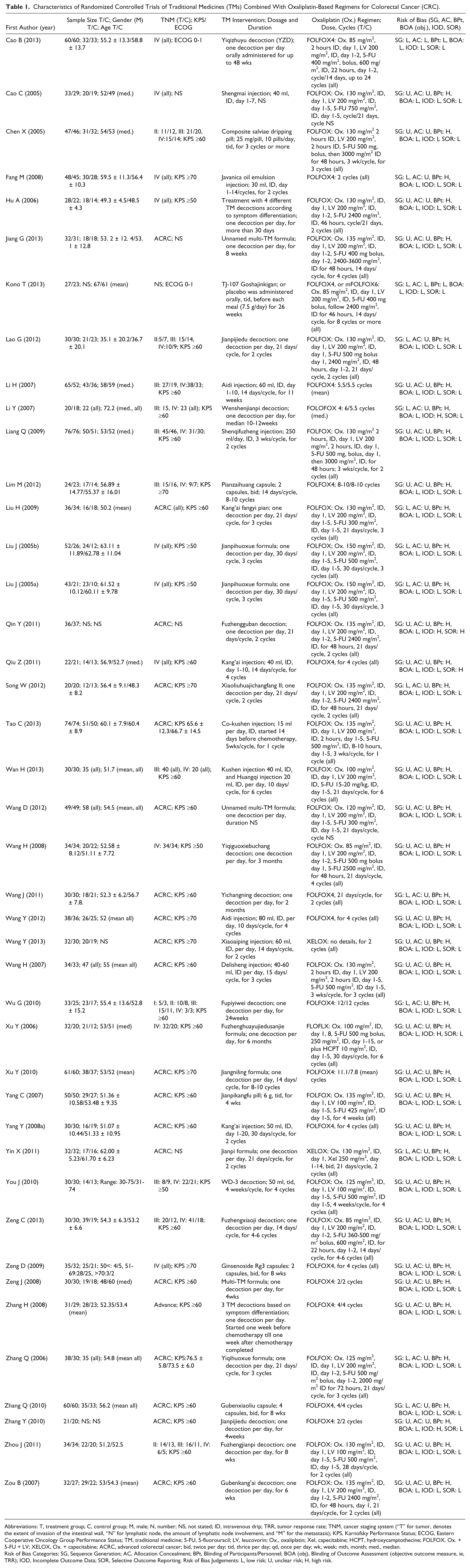
Abbreviations: T, treatment group; C, control group; M, male; N, number; NS, not stated; ID, intravenous drip; TRR, tumor response rate; TNM, cancer staging system (“T” for tumor, denotes the extent of invasion of the intestinal wall, “N” for lymphatic node, the amount of lymphatic node involvement, and “M” for the metastasis); KPS, Karnofsky Performance Status; ECOG, Eastern Cooperative Oncology Group Performance Status; TM, traditional medicine; 5-FU, 5-fluorouracil; LV, leucovorin; Ox., oxaliplatin; Xel, capecitabine; HCPT, hydroxycamptothecine; FOLFOX, Ox. + 5-FU + LV; XELOX, Ox. + capecitabine; ACRC, advanced colorectal cancer; bid, twice per day; tid, thrice per day; qd, once per day; wk, week; mth, month; med., median.
Risk of Bias Categories: SG, Sequence Generation; AC, Allocation Concealment; BPt, Blinding of Participants/Personnel; BOA (obj), Blinding of Outcome Assessment (objective outcome measure, ie, TRR); IOD, Incomplete Outcome Data; SOR, Selective Outcome Reporting. Risk of Bias Judgements: L, low risk; U, unclear risk; H, high risk.
Methodological Assessment
All studies stated the use of randomization. Fifteen studies (35.7%) described a proper method of sequence generation (SG), so risk of bias was judged as “low.” Two studies24,25 described allocation concealment (AC), used blinding of participants (BPt) and a placebo control for the TM, so these were judged “low risk” for these domains. The other studies did not describe procedures for AC, so were judged “unclear risk” for AC and “high risk” for BPt since the participants would know they were receiving an additional therapy. Blinding of outcome assessors (BOA) for TRR was not mentioned. Blinding of participants is difficult to achieve in cancer trials. 18 Since TRR is an objective outcome that is measured by radiologists and laboratory pathologists, it was unlikely to have been influenced by any lack of blinding so this domain was assessed as “low risk” (Table 1).
Four studies reported the numbers of participants who dropped out during the trial or were lost to follow-up,26 -29 but reasons were not given and these missing data were not treated as “intent to treat.” So these were judged as “high risk” of attrition bias. Studies that had the same numbers of participants at inception as in the outcome reports were judged as “low risk” of incomplete outcome data (IOD). Only Kono et al had published a study protocol. 24 When the objectives and outcome measures stated in the method section were all reported in the results section, the study was judged as “low risk” of selective outcome reporting (SOR; Table 1). The 42 studies showed symmetry for TRR in the funnel plot, suggesting the risk of publication bias was low (Supplementary Figure 1).
Meta-Analysis of Tumor Response
The World Health Organization solid tumor response criteria were used to evaluate TRR in 35 studies, and 6 studies used the RECIST criteria (Table 1). As these use similar categories, 30 data could be pooled for all studies. Meta-analyses were conducted for CR and TRR. When RR is more than +1 (IV model, fixed, 95% CI), it favors the test group. Meta-analyses were performed for the following groups: Total (42 studies); Non-oral (injection) group (11 studies), and Oral administration group (31 studies).
Total Group
In the 42 studies (n = 3070), the test groups showed significantly improved TRR (RR 1.31 [1.20-1.42], I2 = 0%; Figure 2). CR was significantly higher compared to controls (RR 1.80 [1.28-2.51], I2 = 0%). A sensitivity analysis of the 15 studies judged low risk of bias for SG showed a significant increase in TRR (RR 1.24 [1.07, 1.42], I2 = 0%).

Forest plot of meta-analysis of tumor response rate (TRR) of TM plus oxaliplatin-based regimen versus oxaliplatin-based regimen.
Non-Oral Group
Ten different injection products were tested in 11 studies (n = 938; Table 1). There were significant improvements for TRR (RR 1.36 [1.18-1.57], I2 = 0%) and CR (RR 1.91 [1.11-3.27], I2 = 0%) compared to controls (Figure 2). The TRR funnel plot was symmetric (Supplementary Figure 1). When each product was analyzed separately, Shenqi injection (n = 1) 31 showed significantly improved TRR compared to control. The others showed trends but not significance (Figure 2).
Oral Administration Group
In 31 studies (n = 2145), TMs were administered orally as decoctions, capsules, or tablets. Two studies by the same author used the same multi-ingredient TM.32,33 The pooled TRR showed significant improvement (RR 1.27 [1.15-1.41], I2 = 0%; Figure 2). CR improved significantly (RR 1.61 [1.03-2.52], I2 = 0%).
Effects of Plant-Based Ingredients in the Oral Administration Group
The multi-ingredient TM formulae tended to differ in name but there was considerable similarity in their main ingredients (Table 1). In order to identify the most comparable subgroups of studies in terms of the TM interventions used and to select TMs for further research, we undertook a series of planned sensitivity analyses based on the presence of the same ingredients in the TM interventions.
The effects on TRR of the TM plants used in multiple studies are reported at the level of the single TM, pair of TMs, and groups of 3 or more TMs. Since the aim was to select TMs for further research, only TMs with significant RR results for tumor response that were equal or greater than the pooled RR are reported in the text. In Table 2, all significant RR results (excluding those with heterogeneity >30%) are rank-ordered according to descending RR.
Effects of Specific Orally Administered Traditional Medicines (TMs) on Tumor Response: Single TMs and Combinations.

Abbreviations: RR, risk ratio for tumor response; 95% CI, 95% confidence interval; No. Part., number of participants; I2%, measure of heterogeneity.
Level 1: Single TMs
All TM plant ingredients (n = 87) in the formulae were recorded in a spreadsheet. The number of TMs per formula averaged 12 and ranged from 2 to 25. Thirty-one out of 87 TMs were used in 2 or more formulae. For TMs, the full botanical names are given in the first instance together with the plant part used, the Chinese name in pin yin, and plant family. Thereafter, the name is shortened to the genus only.
The most frequently used TMs were the following: Atractylodes macrocephala Koidz. root [bai zhu] Asteraceae (n = 23); Coix lacryma-jobi L. seed [yi ren] Gramineae (n = 19); Poria cocos (Schw) Wolf sclerotium [fu ling] Polyporaceae (n = 19); Astragalus membranaceus (Fisch.) Bge. root [huang qi] Fabaceae (n = 18); Codonopsis pilosula (Franch.). Nannf. root [dang shen] Campanulaceae (n = 17); Curcuma zedoaria (Berg.) Rosc. or C phaeocaulis Val. rhizome [e zhu] Zingiberaceae (n = 11); Hedyotis diffusa Willd. aerial parts [she she cao] Rubiaceae (n = 10); Scutellaria barbata D. Don. aerial parts [ban zhi lian] Labiatae (n = 9); and Pinellia ternata (Thunb.) Breit. tuber [ban xia] Araceae (n = 7).
The TRRs of the group of studies that included each particular TM were calculated. The RRs were sorted from high to low, significant RRs were identified (n = 25), and groups with moderate heterogeneity (I2 > 30%) were excluded (n = 8), leaving 17 different TMs in the following analyses (Table 2). The pooled RR results were divided into 3 groups: (a) RR significant and greater or equal to the RR of the total pool (ie, 1.27); (b) RR significant but less than the total pool; and (c) not significant (not reported).
The first group, in descending order of RR, included 10 TMs: Sanguisorba officinalis L. root [di yu] Rosaceae (n = 3); Coptis chinensis Franch. root [huang lian] Ranunculaceae (n = 3); Aucklandia lappa Decne. root [mu xiang] Asteraceae (n = 5); Sophora flavescens Ait. root [ku shen] Fabaceae (n = 5); Paeonia lactiflora Pall. or P veitchii Lynch. root [chi shao] Ranunculaceae (n = 5); Akebia quinata (Thunb.) Decne. fruit [ba yue zha] Lardizabalaceae (n = 5); Sparganium stoloniferum Buch.-Hamil. root [san leng] Sparganiaceae (n = 6); Curcuma (n = 11); Citrus reticulata Blanco peel [chen pi] Rutaceae (n = 6); and Pinellia (n = 7; Table 2).
In the second group, the following 7 TMs showed significant RRs that were slightly lower than the RR of the pool: Coix, Hedyotis, Astragalus, Scutellaria, Atractylodes, Poria, and Codonopsis (Table 2). The frequency of each TM was plotted against the RR to explore any relationships. It was evident that the higher frequency TMs tended to be closer the RR of the pool while the lower frequency TMs showed a broader distribution above and below the pool (Supplementary Figure 2). Nonsignificant TMs had frequencies of 6 or less and all TMs excluded due to heterogeneity had frequencies of 2 or 3. Therefore, all the higher frequency TMs remained in the analysis.
Level 2: Pairs of TMs
TMs (n = 17) that showed significant RR results were paired with other TMs from groups 1 or 2 above. The 4 pairs that showed RRs that were above or equal to the total pool, in descending order of RR, were the following: Sophora + Aucklandia (n = 3), Sparganium + Curcuma (n = 6), Paeonia + Astragalus (n = 4), and Codonopsis + Citrus (n = 6). A further 12 pairs were significant but had RRs lower than the total for the pool (Table 2).
Level 3: Combinations of 3 TMs
The significant pairs from level 2 were combined with other TMs that showed significant RRs at level 1. The 5 triplets that showed RR values above or equal to the total pool, in descending order of RR, were the following: Sophora + Curcuma + Paeonia (n = 4), Sophora + Astragalus + Scutellaria (n = 4), Curcuma + Astragalus + Hedyotis (n = 5), Pinellia + Poria + Coix (n = 7), and Astragalus + Hedyotis + Scutellaria (n = 6). An additional 11 triplets showed significant RRs that were lower than the total for the pool (Table 2).
Level 4: Combinations of 4 TMs
The significant combinations from level 3 were combined into groups of four. Six combinations showed RRs above or equal to the total pool: Sophora + Paeonia + Sparganium + Curcuma (n = 3), Astragalus + Hedyotis + Aucklandia + Scutellaria (n = 3), Sophora + Scutellaria + Hedyotis + Astragalus (n = 3), Astragalus + Codonopsis + Citrus + Hedyotis (n = 4), Curcuma + Astragalus + Scutellaria + Codonopsis (n = 5), and Pinellia + Coix + Atractylodes + Poria (n = 6). An additional 2 combinations showed significant RRs that were lower than the pool total (Table 2).
Level 5: Combinations of 5 TMs
The significant combinations from level 4 were combined into groups of five. Four combinations showed RRs equal or higher than the pool: Sanguisorba + Coptis + Sophora + Paeonia + Curcuma (n = 3), Sophora + Scutellaria + Aucklandia + Astragalus + Hedyotis (n = 2), Codonopsis + Scutellaria + Citrus + Hedyotis + Astragalus (n = 3), and Curcuma + Codonopsis + Hedyotis + Scutellaria + Astragalus (n = 4; Table 2).
Level 6: Combinations of 6 or More TMs
The significant combinations from level 5 were further combined. There were 2 combinations of 6 TMs. One showed an RR higher than the pool: Sophora + Curcuma + Scutellaria + Astragalus + Codonopsis + Paeonia (n = 3); and the other was equal to the pool: Sparganium + Curcuma + Hedyotis + Astragalus + Scutellaria + Codonopsis (n = 3). There were no combinations of 7 TMs, and there was one combination of 8 which showed an RR equal to the pool: Paeonia + Curcuma + Hedyotis + Sophora + Sparganium + Codonopsis + Astragalus + Scutellaria (n = 2; Table 2).
TMs With Consistent Results at Multiple Levels
Combinations of up to 8 TMs produced RR results that were equal or higher than the total for the pool. Seven TMs appeared at all levels: Astragalus, Codonopsis, Scutellaria, Hedyotis, Sophora, Curcuma, and Paeonia. Of these, Sophora, Curcuma, and Paeonia showed significant TRR results that were equal or higher than the total for the pool at each level.
Potential Synergistic Effects of TMs
Three TM pairs showed higher RRs as pairs than for the TMs singly: Sophora + Aucklandia, Coix + Poria, and Astragalus + Hedyotis (Table 2). Of these, the first pair also had an RR higher than the pool.
Three TM triplets showed potential synergistic effects: Astragalus + Hedyotis + Scutellaria, Astragalus + Codonopsis + Scutellaria, and Codonopsis + Hedyotis + Scutellaria. Of these, the RR of the first triplet was also higher than the pool.
The combination Sophora + Paeonia + Sparganium + Curcuma showed an increased RR as a group, compared to the pooled results of the single TMs but there was important heterogeneity (I2 = 38%). The group Sanguisorba + Coptis + Sophora + Paeonia + Curcuma had an RR that was equal or superior to the single TMs.
Discussion
All 42 included studies employed oxaliplatin regimens in the test and control groups. These are currently first-line chemotherapy regimens for CRC in the palliative setting, so the results of these meta-analyses are of direct clinical relevance. The heterogeneity of meta-analyses was zero for the TRR and CR results, and publication bias was not evident. The pooled data indicate the addition of the TMs significantly improved TRR when compared to oxaliplatin regimens alone. Benefits were evident in the subgroups for injections and orally administered TMs (Figure 2). These results were consistent with a previous article that focused on FOLFOX-4 and included a number of the same studies. 17 As discussed in that article, blinding is difficult in cancer trials and weaknesses in study design may have biased outcomes in favor of the combined treatment. Regarding the question of how the TMs may act, Chen et al 17 discussed the effects of the 6 TMs that most frequently appeared in the formulae: Astragalus, Atractylodes, Poria, Coix, Sophora, and Panax ginseng C.A. Mey. In experimental studies, these TMs had been reported to possess antiproliferative and other properties, which may have accounted for the effects reported in the clinical trials. 17
In this article, the most frequently used plants were similar—Atractylodes, Coix, Poria, and Astragalus; however, some TM interventions may not have aimed at improving TRR, and may have been focused on improving outcomes relating to adverse effects of chemotherapy and/or improving quality of life. Therefore, some TMs would not be expected to make individual contributions to the TRR results. To explore the contribution of each individual TM to the meta-analysis results for TRR, we used sensitivity analyses of the subgroups of studies that contained the same plants to investigate whether any particular plants were associated with elevated RRs.
With regard to selecting the most promising TMs for further research, it was evident that many TMs showed significant RRs either singly or in combination with other TMs. For example, Coptis and Sanguisorba appeared the most promising at level 1 based on their individual RRs (Table 2), but these TMs were infrequent overall and did not appear at each level so they could not show consistent results at multiple levels. In contrast, Sophora, Paeonia, and Curcuma all appeared at 7 levels of combination with RRs that were significant and equal or above the pool at each level, without heterogeneity and based on sample sizes of 400 participants or more; hence, they showed consistent benefit and were selected as promising for further research. Nevertheless, this does not mean that Coptis and Sanguisorba and other plants with high RRs show no promise. It is notable that there were no significant negative RRs for any of the TMs or their combinations, which suggests that the TMs were not inhibiting the actions of the chemotherapy.
The results suggest synergistic actions for some TM combinations. Hedyotis, Astragalus, and Scutellaria all appeared frequently in the formulae and each has been reported to inhibit CRC in vitro and in vivo.34 -36 These TMs showed significant RRs but all were slightly lower than the pool as singles. However, these TMs showed higher RRs in combinations at levels 3 to 6, and all are in the final group of 8 TMs. These results suggest that this grouping should also be subject to further research to explore potential synergistic effects between these plants and their compounds on tumor response as well as their effects when combined with oxaliplatin.
An advantage of this approach to the identification of TMs for further research is that it is based on the contributions of the individual TMs to tumor response rather than on their frequency in formulae. This sensitivity analysis procedure allows identification of TM plants that appear at relatively low frequencies within the total data set. Had frequency been used as the criterion for selection, Atractylodes, Poria, and Astragalus would have been identified but Sophora, Paeonia, and Curcuma may have been missed. Conversely, a limitation to this method for selecting TMs and TM combinations is that the data set provides a restricted number of actual TM combinations at each level. Therefore, all the possible combinations cannot be assessed. Also, as the levels increase, the number of significant combinations declines and so does the number of studies from which the data are derived. Consequently, the procedures used will remove very low frequency TMs from the data set.
It should be noted that the RR results cannot provide direct comparisons between TMs in terms of efficacy since the pooled data are based on multiple studies that used multi-ingredient interventions. Consequently, Sophora, Paeonia, and Curcuma cannot be considered more effective than the other TMs that showed significant RRs. Rather, these TMs showed consistent benefits in terms of TRR based on multiple clinical studies and multiple combinations. In addition, these 3 TMs have all shown evidence of antitumor activity in experimental studies.
Actions of Paeonia (chi shao)
The TM chi shao can be derived from the roots of Paeonia lactiflora and Paeonia veitchii, both of which can contain paeonol and paeoniflorin.37,38 In human colon cancer LoVo cells, paeonol blocked cell cycle at the G1 to S transition and induced apoptosis. 39 In HT-29 cells, paeonol inhibited proliferation 40 and showed a synergetic antiproliferative effect when combined with 5-FU. 41 In human esophageal adenocarcinoma cells, paeonol showed a dose-dependent growth-inhibitory effect, and this effect was synergistic when combined with cisplatin. 42 Paeonol appears to influence multidrug resistance. It showed reversal of resistance in a paclitaxel-resistant human breast cancer cell line 43 and reversed endoplasmic reticulum (ER) stress-induced resistance to doxorubicin in human hepatocellular carcinoma cells. 44 Paeoniflorin has shown growth-inhibitory, pro-apoptotic effects in human cervical cancer HeLa cells 45 as well as anti-inflammatory effects in a colitis model 46 and in human umbilical vein endothelial cells. 47
The combination of extracts of Paeonia and Astragalus were found to synergistically induce the expression of leukotriene B4-12-hydroxydehydrogenase (LTB4DH) in a dose- and time-dependent manner leading to cell-cycle arrest in HepG2 cells by controlling the leukotriene B4 pathway. 48 Although this combination has not been investigated in colon cancer, the leukotriene B4 pathway plays an important role in the proliferation of colon cancer cells. 49
Actions of Curcuma (e zhu)
The official sources of e zhu are Curcuma wenyujin Y. H. Chen et C. Ling, C. phaeocaulis Val., and C. kwangsiensis S. G. Lee et C. F. Liang, 50 but older sources use the name C. zedoaria Roscoe. 51 The rhizomes contain multiple aromatic compounds including elemenes and nonvolatile compounds such as curcumins. 50
Curcumin has been investigated in multiple cancer cell-lines. 52 In human colon cancer HT-29 and HCT-15 cells it dose-dependently inhibited proliferation 53 and induced apoptosis in colorectal carcinoma HCT116 cells and human CRC LoVo Cells.52,54 A study of curcumin combined with FOLFOX in 2 colon cancer cell-lines (HCT-116 and HT-29) reported a synergistic growth-inhibitory effect, which appeared to involve the EGFR and IGF-1R growth factor pathways. 55
Delta-elemene was found to dose- and time-dependently induce apoptosis in colorectal adenocarcinoma (DLD-1) cells. 56 Beta-elemene has shown growth-inhibitory activity in multiple cancer cell-lines including CCL-222 and CCL-225 colon carcinoma cells. 57 In colo205 colorectal adenocarcinoma cells, it also increased cisplatin cytotoxicity. 58 Beta-elemene exhibits low toxicity in normal cells, having much weaker anti-proliferative effects in normal human lung fibroblast CCD-19Lu cells, human bronchial epithelial NL20 cells, and human ovary epithelial IOSE-397 cells compared to the corresponding cancer cell-lines. 50
Actions of Sophora (ku shen)
The dried roots of Sophora flavescens Aiton. contain a number of alkaloids, including matrine, oxymatrine, sophoridine, and sophocarpine, and flavonoids such as kurarinone. 59 It is traditionally used to treat solid tumors and inflammatory diseases. 60 Since 1992, products containing total Sophora alkaloids, oxymatrine and matrine, have been approved by the Chinese State Food and Drug Administration for the treatment of various types of solid tumors. 61
In human colon cancer HT 29 cells, Xiao et al reported that a range of ethanol and aqueous extracts of Sophora roots inhibited cell growth in vitro. 62 In a model of cancer cachexia, sophocarpine and matrine both reduced cachexia symptoms in BALB/c mice inoculated with colon26 adenocarcinoma cells and suppressed the expression of the pro-inflammatory cytokines TNF-a and IL-6. 63
Huang et al reported that matrine dose-dependently inhibited human colon cancer HT29 cell proliferation by promoting apoptosis. 64 Chang et al also reported that matrine inhibited proliferation of HT29 cells. Matrine appeared to activate caspase-3 and caspase-9 and release cytochrome-c to induce apoptosis. 65 In human colon cancer LoVo cells, Zhang et al reported that matrine inhibited proliferation in a time- and dose-dependent manner. They found the mechanisms of action of matrine were via inducing cell cycle arrest at the G1 phase by downregulation of cyclin D1 and upregulation of p27 and p21. Apoptosis was induced by reduction of the Bcl-2/Bax ratio and caspase-9 activation. Matrine was reported to have an upstream effect on these proteins by inactivating Akt. 66
In a mouse model using transplanted colon tumor SW480 cells, sophoridine reduced tumor weight and volume and reduced expression of p53 and VEGF. 67 In xenografts of SW480 cells in mice, Liang et al reported that sophoridine inhibited tumor growth with no apparent toxicity, and in an SW480 cell-line study its action was via caspase-9, caspase-3, caspase-7, and PARP. 68
Matrine and oxymatrine have shown synergistic effects with different anticancer agents. 69 Matrine showed synergistic effects when combined with celecoxib, trichostatin A, and rosiglitazone against proliferation and VEGF expression in MDA-MB-231 breast cancer cells 70 and enhanced the activity of trichostatin A in human non–small cell lung cancer A549 cells. 71 In a transplanted human gastric cancer SGC-7901 model in nude mice, the inhibitory effect of matrine combined with 5-FU was greater than either compound used individually, without increasing bone marrow inhibition. 72
In a study that compared the antitumor activities of total Sophora alkaloids (KS-As) and flavonoids (KS-Fs), Sun et al reported higher growth inhibitory effects for KS-Fs, and for kurarinone in particular, than for KS-As in multiple cancer cell-lines including human CRC CaCo-2 cells. There was little effect on the peripheral blood cell numbers in normal mice treated with KS-Fs. KS-Fs also enhanced the cytotoxicity of Taxol and Adriamycin. 60
Conclusions
The meta-analyses suggest that the combination of the TMs with oxaliplatin-based regimens significantly increased TRR in the palliative treatment of CRC. Benefits were evident for both injection products and orally administered TMs. Detailed sensitivity analyses of specific plant-based TMs found that Paeonia, Curcuma, and Sophora produced consistent contributions to the TRR results. Compounds in each of these TMs have shown growth-inhibitory effects in CRC cell-lines. There were no instances of TMs reducing the TRR of the chemotherapy. Specific combinations of TMs appear to produce higher contributions to TRR than the TMs individually. Notable among these is the combination of Hedyotis, Astragalus, and Scutellaria. Further studies are required to investigate the effects of the TMs identified in this study and the possible synergistic effects of the TM combinations.
Footnotes
Declaration of Conflicting Interests
The author(s) declared no potential conflicts of interest with respect to the research, authorship, and/or publication of this article.
Funding
The author(s) disclosed receipt of the following financial support for the research, authorship, and/or publication of this article: The project is funded by the China-Australia International Research Centre for Chinese Medicine (CAIRCCM), a joint initiative of RMIT University, Australia, and the Guangdong Provincial Academy of Chinese Medical Sciences, China. Menghua Chen is supported by an Australian Postgraduate Award at RMIT University, Australia.
References
Supplementary Material
Please find the following supplemental material available below.
For Open Access articles published under a Creative Commons License, all supplemental material carries the same license as the article it is associated with.
For non-Open Access articles published, all supplemental material carries a non-exclusive license, and permission requests for re-use of supplemental material or any part of supplemental material shall be sent directly to the copyright owner as specified in the copyright notice associated with the article.
