



Abstract
Background
Dementia-friendly community has been promoted in Macao since 2016. There is no study investigating the understanding of nor attitudes towards dementia among public contact staff in Macao. This study aimed to (i) understand the level of knowledge of dementia, (ii) examine the attitudes towards people living with dementia, and (iii) explore the associated factors of the willingness to help people with dementia symptoms among police officers, bank officers, bus drivers, and building superintendents.
Methods
A cross-sectional survey was conducted between January and May 2019 using a structured questionnaire.
Results
A total of 351 valid questionnaires were received. Building superintendents had more knowledge while police officers and bank officers had more positive attitudes. All practitioners were more willing to help people with dementia symptoms when they were on official duty. Participants who had more knowledge about dementia were associated with a higher willingness to help people with dementia symptoms.
Significance Statement
• Public contact staff have insufficient knowledge of dementia. • Public contact staff hold neutral but paternalistic attitudes towards dementia. • Public contact staff are more willing to help a person with dementia symptoms when on official duty.
Introduction
People living with dementia are expected to increase globally according to the latest prediction, and the growth in the Asia Pacific region will be attributed to population ageing. 1 It is estimated that over six thousand people are currently living with dementia in Macao, and the population of people living with dementia will be expected to grow as the local population continues to age, with the estimation of over one thousand new cases per year. 2 Hence, the Macao dementia policy was introduced in 2016 3 as an action taken by the Macao SAR Government to establish a service network for dementia care. 4
According to official data, the diagnosis rate of dementia in Macao was 51.5% in 2018, 4 implying there could be a number of undiagnosed people living with dementia in the communities. In the absence of a formal diagnosis, people living with dementia cannot receive appropriate public healthcare and social support. With the launch of the dementia policy, dementia has gained more attention from social sectors, and more medical and social services have been developed in response to the needs of people living with dementia and their family carers. However, most of the dementia services were subsidised by the government, resulting in slower service development. The situation is particularly noticeable during the COVID-19 pandemic, when dementia care has not been the public health priority, resulting in a reduction in medical and social services for dementia. 5
People living with dementia in the communities are at a high risk of social exclusion, 6 which can expedite the time of becoming socially disabled.7,8 In order to support people living with dementia to age in place and participate in the communities as long as possible, the establishment of dementia-friendly communities (DFC) was proposed and endorsed by many countries.9-11 Along with the dementia policy, the government of Macao includes a ten-year strategic plan to create a DFC, in which a dementia friendly community alliance has been promoted and has been joined by over one hundred organisations. 12 The building of a DFC is aimed to maintain the social engagement of people living with dementia and to support them to continue to live in the community. In order to succeed, the construction of certain elements is necessary; based on Alzheimer’s Disease International’s 10 suggestions, a DFC constitutes people, communities, organisations, and partnerships. The alliance of Macao has received organisation endorsements, establishing partnership networks. Nonetheless, we lack information regarding the social environment of the communities where people living with dementia reside; for instance, we currently do not know how staff from the DFC alliance organisations perceive dementia and people living with dementia.
Existing literature is largely related to the knowledge of and attitudes towards dementia among healthcare professionals, students, and older adults in Macao.13-15 However, building a DFC involves efforts from multiple sectors. 16 Novak et al. 17 suggested that people with customer-facing roles should be highlighted in the building of DFC. Shanley et al. 18 defined staff who have the job description of direct contact with the general public as “public contact staff”, which include bank officers, police officers, receptionists, bus drivers, waiters/waitresses, and so forth. Sun et al. 19 evaluated the knowledge and beliefs of dementia of police officers, as well as their self-perceived competence in providing assistance to people living with dementia in an urban area. However, the willingness to help was not addressed in the study. Another survey conducted in the United Kingdom (U.K.) 20 revealed that three-quarters of the general public participants were likely to help a confused person, and about one-third were likely to help a shouting person. Based on the studies discussed above, research targeting public contact staff is limited.
This study adopted the definition of public contact staff which includes police officers, bank officers, bus drivers, and building superintendents as target participants because these occupations are closely related to the daily life of older adults living in communities. Building superintendents refer to workers who are responsible for security work in residential buildings, including communicating with residents and managing the visitor registry. Since public contact staff is a vital part of building a DFC, and considering the current lack of understanding of the willingness to help people living with dementia among public contact staff, this study aimed to fill the gap by investigating how public contact staff understand dementia and their attitudes towards dementia, as well as their willingness to help people with dementia symptoms.
Methods
Study Design and Participants
A cross-sectional survey was conducted in this study. Police officers, bank officers, bus drivers, and building superintendents were considered as potential participants as they often encountered people living with dementia, diagnosed or not, in the communities. Individuals were eligible if they 1) were working in the four abovementioned occupations by the time data collection was implemented; 2) were Macao residents; 3) had not attended any dementia-related trainings; 4) were able to understand and read Cantonese or Mandarin; 5) were able to understand and give informed consent. Individuals who were not able to communicate due to hearing impairment or individuals affected by mental illnesses were excluded.
Recruitment and Data Collection
People who were police officers, bank officers, bus drivers, and building superintendents were the target population in the current study. Invitation letters stating the purpose of the study, a link to the survey platform, and contact information of the research team were sent to a bank, a transport company, and a property management company, requesting them to distribute the questionnaire to employees, the research team had emphasised the non-mandatory nature of the study in the invitation. In-person explanation was available if necessary. Police officers were recruited prior to an internal training session on dementia. Participants were all voluntary and the data were collected with anonymity and confidentiality. Data were collected from January to May 2019.
Measurements and Instrument
A structured questionnaire was developed which included four sections.
Socio-Demographic Information
This section included gender, age, education level, occupation, whether the participants had cared for people living with dementia, and whether participants’ family members or friends had lived with dementia.
Knowledge of Dementia
Referencing the British Social Attitudes survey, 20 the Dementia Knowledge Scale (DKS) was employed, the scale contained 18 true/false items concerning symptoms and risk factors subscales to assess knowledge about dementia. Permission to use DKS was gained from the authors. The Chinese version of DKS was tested in a pilot study in Macao. In the pilot study, the Content Validity Index of the Chinese version of DKS was .93, the Cronbach’s α coefficient was .74 and .84 for the symptoms and risk factors subscale respectively, and the Cronbach’s α coefficient was .74 and .72 in this study. Each item scored one point for the correct answer and zero point for the wrong answer. The total score ranged from 0 to 18, a higher total score suggested better knowledge.
Attitudes Towards Dementia
The attitudes sections employed the Scale of Attitudes towards People with Dementia and their Care (APDC). APDC was originally developed by the Northern Ireland Life and Times Survey, 21 then translated into Chinese by Wu et al. 22 and adapted in Macao. The Chinese version of APDC contained 9 items and consisted of two factors (interaction and care), each item ranged from 1 (strongly agree) to 5 (strongly disagree). The total score ranged from 9 to 45, a higher score indicated more positive attitudes. The Cronbach’s α coefficient was .72 in this study.
Willingness to Help People With Dementia Symptoms
In order to assess the intention of helping behaviour towards people living with dementia, situational questions were adapted from Marcinkiewicz and Reid 20 ’s survey. The research team employed those questions under two situations: 1) general situations and 2) on official duty, where a person was found confused and shouting. Each of the four questions was presented with five options: (1) definitely would, (2) probably would, (3) do not know, (4) probably would not, (5) definitely would not.
Statistical Analysis
Microsoft Office Excel 2013 was used for inputting data from the paper questionnaires, and for raw data coding. IBM SPSS Statistics (version 22) was used for data manipulation and statistical analysis. Univariate analyses were performed to summarise the socio-demographic characteristics, levels of knowledge and attitudes towards dementia among participants. One-way ANOVA was performed to evaluate whether differences appeared amidst occupation groups. Levene’s test was conducted to assess the homogeneity of variances prior to one-way ANOVA. Multiple logistic regression analyses were performed to investigate factors associated with helping people with dementia symptoms when participants were on official duty. The statistical significance level of all analyses was set at p-value < .05.
Results
Participant Characteristics
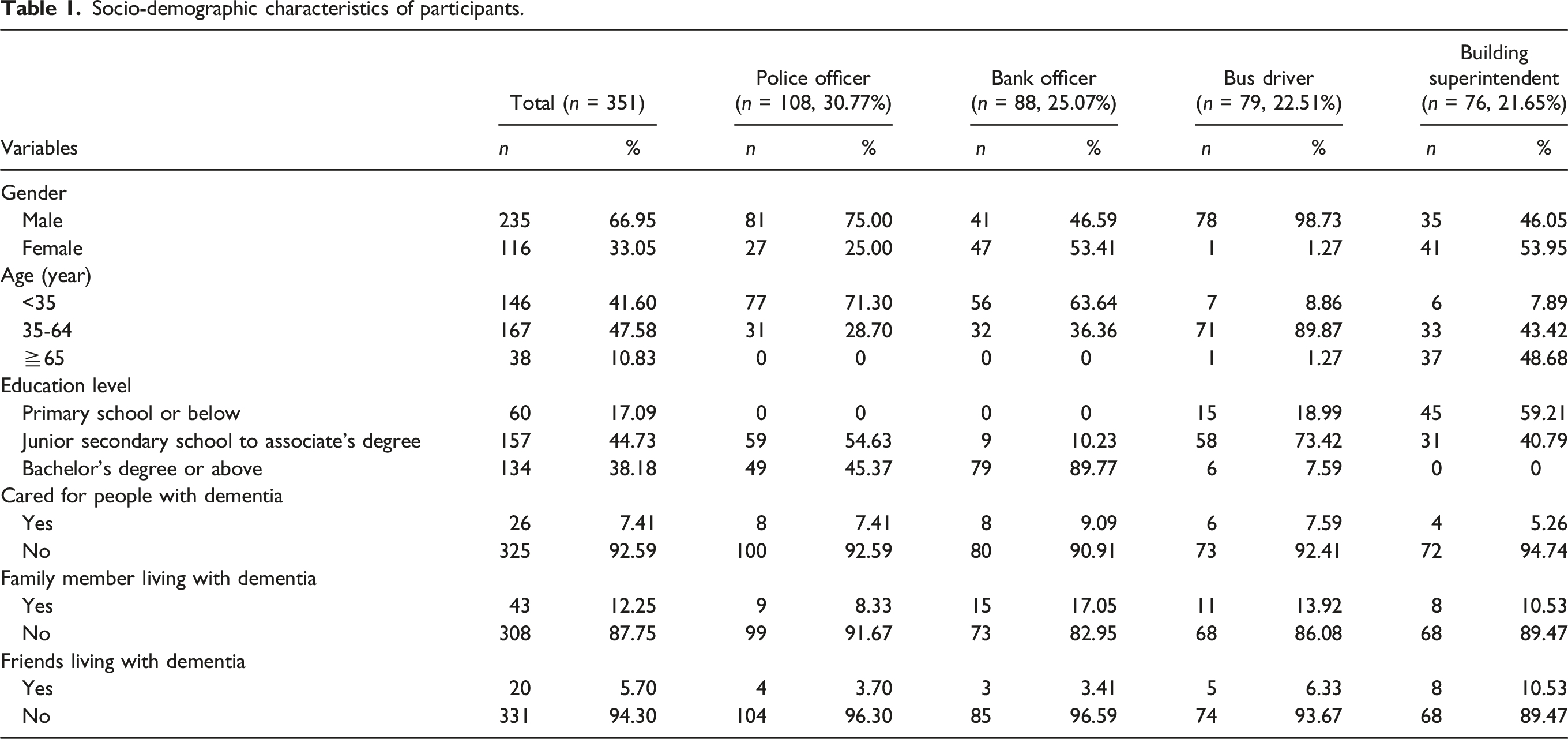
Socio-demographic characteristics of participants.
Knowledge of Dementia
Comparisons of results of DKS and APDC between four occupation practitioners (n = 351).

Homogeneity of variance was assumed, Scheffe method was used as a post-hoc comparison.
SD = standard deviation.
Attitudes Towards Dementia
Participants were neutral in overall attitudes, and the results consistently showed more positive attitudes in the interaction factor and less positive in the care factor among four occupation practitioners. The mean score of APDC was 28.33 (SD = 4.79), police officers and bank officers scored higher than bus drivers and building superintendents (F = 9.50, p < .001). While there was no difference between occupation practitioners in the interaction factor, the results of the care factor revealed that the attitude was more positive among police officers and bank officers than bus drivers and building superintendents (F = 19.99, p < .001) (Table 2).
Willingness to Help People With Dementia Symptoms
Results of the willingness to help people with dementia symptoms (n = 351).

Factors Associated With Helping People With Dementia Symptoms
Multiple logistic regression analyses of factors associated with helping people with dementia symptoms (on official duty) (n = 351).

Variable not included in the model due to 0 sample size in the sub-group.
*p < .05, **p < .01, ***p < .001.
Discussion
This study investigated the knowledge of and attitudes towards dementia among four types of public contact staff, as well as their willingness to help people with dementia symptoms. Practitioners, including police officers, bank officers, bus drivers, and building superintendents, had a moderate level of knowledge of symptoms and low level of knowledge of risk factors relating to dementia. Practitioners held neutral attitudes towards people living with dementia; they were more positive about to interact with people living with dementia, but less positive to care for people living with dementia. In general, building superintendents and bus drivers scored higher in the knowledge of dementia, while police officers and bank officers had more positive attitudes towards dementia.
Since the launch of the dementia policy and DFC campaign in Macao in 2016, progress has been made to introduce knowledge about dementia to the public, as well as to develop medical and social services. However, this study revealed that practitioners among the four occupations had insufficient knowledge regarding risk factors of dementia. Practitioners in this study had a relatively lower level of knowledge when compared with the findings of previous researches conducted in Macao.13-15 The insufficient knowledge of symptoms of dementia among practitioners reflected the need for more proactive and targeted education, especially about the knowledge of genetic predisposition, and the relationship of dementia with diabetes and obesity, which are more than just the manifestation of symptoms.
On the other hand, the results regarding participants’ attitudes indicated that participants held paternalistic and stigmatising attitudes towards people living with dementia, similar to a survey in Northern Ireland. 21 Researchers argued that such care approach would deprive the autonomy of people living with dementia, and resulted in capabilities declination.23,24 Results regarding participants' attitudes towards people living with dementia in this study advised efforts are needed to promote interaction skills and the concept of human rights in dementia care. 25
Regarding the willingness to help people with dementia symptoms, results of this study showed that a high proportion of practitioners were willing to help people with dementia symptoms, which shared similarities with a British survey. 20 Todd and Watts 26 examined the willingness to help people living with dementia with challenging behaviours among 51 nurses and psychologists in the U.K., the response was also highly positive. The results of this study showed that practitioners had higher possibility to help when on official duty, and the score of DKS was associated with the willingness to help people with dementia symptoms when they were on duty. This suggested that dementia-friendly training in the workplace could play an important role in fulfilling the responsibility of organisations in DFC, especially when only a small proportion of practitioners in this study had previous experiences interacting with people living with dementia. People living with dementia often exhibit behavioural symptoms,27,28 such socially inappropriate behaviours can be distressing for both people living with dementia and their family carers,29,30 and environmental factors may contribute to the behavioural symptoms. 31 In order to avoid embarrassment during community participation, people living with dementia and their family carers might withdraw from the society, resulting in social isolation. Therefore, the building of DFC is important for people living with dementia and family carers to maintain social participation.
Police officers and building superintendents were found to have a higher willingness to help when they were on duty, this result might be due to the nature of their job in assisting people, whereas helping people is not a job requirement for bank officers and bus drivers, hence the lower willingness of helping. In the absence of clear responsibilities, the exploration of approaches to reinforce the role of bank officers and bus drivers in DFC is needed. The willingness to help people with dementia symptoms was lower when practitioners were off duty across all four occupations, which implied that public education is needed.
The results of inadequate knowledge and the less positive attitudes reflect a need for public education improvement. To improve knowledge, we first need to raise awareness among the public, social marketing strategies, such as endorsement from local opinion leaders in communities can be applied to raise public awareness. When a sufficient level of awareness is established, knowledge related to dementia prevention and early symptoms detection can be promoted more effectively. 32 The research team also proposed that the campaign of DFC should focus on knowledge improvement as well as social environment building. To this end, Pittinsky et al. 33 proposed the concept of positive attitudes; it stated that to prevent negative attitudes and stigma towards racial minority groups, positive attitudes need to be promoted. Kinney et al. 34 adapted this concept to the field of dementia; by promoting positive attitudes among the general public, it requires a shift from information giving to fostering proactive behaviours. Diversified interventions have been proven effective,35,36 such as students interacting with artists living with dementia. These interventions might also help to cultivate positive attitudes of public contact staff towards people living with dementia. Nevertheless, the involvement of community organisations is pivotal in order to successfully build a DFC. As Heward et al. 37 and Novak et al. 17 suggested, DFC building requires not only involvement from people living with dementia but also organisation commitment. Organisation commitments, including awareness training and time investment, are difficult for organisations to devote to if they do not acknowledge the value of DFC. Findings of this study reflected that effort is needed from the Macao government and community organisations in improving the understanding of and attitudes towards dementia among the population of public contact staff. Community organisations from the DFC alliance should commit to start dementia campaigns and official guidelines should be developed for different occupations, in order to strengthen the role of organisations in DFC and staff's ability to interact with people living with dementia.
There are some limitations in the current study. Since this was a cross-sectional design, it could not determine the causal relationships between participants characteristics, knowledge, attitudes and willingness to help. In addition, since the convenient sampling method was employed to recruit participants, generalisability of the findings was limited. The voluntary participation in this study might lead to a potential reporting bias, and the result of the willingness to help people with dementia symptoms might also be overestimated due to social desirability. Lastly, future studies may further explore if cultivating positive attitudes of public contact staff towards dementia could affect behavioural changes.
Conclusion
This study found that the understanding of dementia was insufficient among police officers, bank officers, bus drivers, and building superintendents in Macao. Participants held neutral but paternalistic attitudes towards people living with dementia. There is a need to promote positive attitudes towards people living with dementia among practitioners of the service sector. Moreover, practitioners were found to be more willing to help people with dementia symptoms while they were on duty, implying that the service sector is an important force in DFC building. Since a large number of people living with dementia are living in the communities, we believe that public contact staff have a vital role in DFC building. As a result, efforts should be made in policy making to emphasise the importance of DFC, and to ensure involvement from different stakeholders to secure the sustainability of DFC.
Abbreviations
dementia-friendly communities
Coronavirus Disease 2019
the Government of Macao Special Administrative Region
Dementia Knowledge Scale
Scale of Attitudes towards People with Dementia and their Care
Footnotes
Acknowledgments
The authors would like to thank all participants, organisations and interviewers for their participation in this research.
Declaration of Conflicting Interests
The author(s) declared no potential conflicts of interest with respect to the research, authorship, and/or publication of this article.
Funding
The author(s) disclosed receipt of the following financial support for the research, authorship, and/or publication of this article: This research received funding from the Social Welfare Bureau of Government of Special Administration Region of Macao, China (Reference number: 053/DSS-ESPC/2018).
Ethical approval
Ethical approval was obtained from the Research Management and Development Department of Kiang Wu Nursing College of Macau (Reference number: 2017OCT02). Informed consent was obtained from all the participants. It was also made explicit that participants could stop at any time during responding questionnaire.
