




Abstract
Objective:
This study aims to explore the experiences of the carers of people living with dementia while receiving various clinical dementia services in Macao.
Methods:
A qualitative approach using Van Manen’s phenomenological method was adopted to explore the experiences of the carers of people living with dementia who have been receiving various clinical dementia services in Macao. Data was obtained by face-to-face interviews with 30 purposively selected participants, and then thematic analysis was used.
Results:
Two categories related to the experiences of the carers have emerged: (1) The empathetic care as family members, consisting of themes of the caring service of doctors and nurses as warm and nuanced as family members, and the good rapport between nurses and people living with dementia; and (2) Multidisciplinary medical service team, covering themes of supporting the carers gain more knowledge, professional services of medical disciplines, and less waiting time for medical consultation. The categories capture that the carers are satisfied with the friendly attitudes and professional services of medical multidisciplines while they have been receiving various clinical dementia services in Macao.
Conclusion:
The phenomenological study can offer innovatively, a deeper understanding of the experiences of the carers of people living with dementia who have been receiving various clinical dementia services in Macao and capture the carers’ satisfactions with the friendly attitudes and professional services of medical multidisciplines, and then will be utilized in designing effective initiatives to improve the practice for clinical dementia services in Macao.
Introduction
Dementia is a significant chronic neurodegenerative condition that mostly affects older people. 1 The number of people living with dementia is expected to increase from an estimated 55 million people in 2019 to 139 million by 2050, as more people live longer. 2 Macao is a Special Administrative Region (SAR) of China with a local population of 568,700, of which older people aged 65 years and above accounted for 17.6% and life expectancy at birth was 83.1 years in 2024. 3 There are about 4000 people living with dementia in Macao SAR. Also, age is the major risk factor for dementia, and it is expected that the number of people living with dementia will be increasing rapidly. 4 Responding to the challenges, the Macao SAR Government announced the Macao Dementia Policy in 2016 and established the Dementia Working Group, the cognitive assessment network among Health Centers, Dementia Medical Center, and Dementia Support Center. All of these services have been striving to provide a seamless network between medical services and community care. The clinical dementia services encompass memory clinic, nursing consultation, health education, dementia care planning course, and cognitive stimulation therapy, in order to achieve early prevention, early detection, early diagnosis, early treatment and early support for people living with dementia and their carers. These initiatives demonstrate that the Macao SAR Government has taken great strides in establishing a seamless network of clinical dementia services, which have been recognized and highly praised by Alzheimer’s Disease International in 2018 as a positive model globally. 5
The users’ satisfaction surveys have been undertaken annually since 2017, including the carers of people living with dementia who have been receiving various clinical dementia services in Macao SAR. However, all the surveys have been conducted by the method of basic descriptive analysis with simple data only, such as the percentage of items. Previous studies based on the satisfaction surveys have not examined the experiences of the carers of people living with dementia who have been receiving various clinical dementia services in Macao SAR. Understanding the carers’ experiences is fundamental in designing effective initiatives to improve the practice for various clinical dementia services. 6 There is a need for a thorough exploration of the experiences of the carers of people living with dementia who have been receiving various clinical dementia services in Macao. Therefore, the objective of this study is to explore the experiences of the carers of people living with dementia who have been receiving various clinical dementia services in Macao SAR.
Methods
Research design
A qualitative approach using Van Manen’s phenomenological method was employed in the study to explore the experiences of carers of people living with dementia who have been receiving various clinical dementia services in Macao SAR. Data were collected from the carers of people living with dementia from various clinical dementia services, including the memory clinic, nursing consultation, health education, dementia care planning course, and cognitive stimulation therapy in Macao SAR. The reporting of this study conforms to SRQR guidelines. 7
Inclusion criteria
The inclusion criteria were: The primary carers of people living with dementia who have been receiving various clinical dementia services, including the memory clinic, nursing consultation, health education, dementia care planning course, and cognitive stimulation therapy in Macao SAR. These individuals are collectively referred to as “the Carers” in this study. A purposive approach to sampling was adopted to achieve a variety of indications and clinical circumstances: The sample of the Carers of people living with dementia who have received more services and less services, who hold higher satisfaction and less satisfaction, and who have experienced longer periods of illness and shorter periods of illness. Exclusion criteria included individuals who were unable to understand information about the research project or declined to sign written informed consent forms. The sampling strategy is determined by the exploratory nature of the study, and none of the potential participants declined to participate. A purposive sampling approach has been used, involving a process of screening and enrolling of participants, continued until repetition of the salient points (themes) was reached; this is the point at which saturation is deemed achieved.8,9
Data collection
Using the semi-structured open-ended interview guide, the researcher conducted the in-depth interview to identify the issues and common thoughts of the Carers that related to their experiences while receiving clinical dementia services in Macao SAR.
Narrative method
Van Manen’s phenomenological method, 9 a dynamic interplay among research activities, has offered an appropriate scientific and rigorous method, and for this reason, it has been adopted in this study. The researcher (as principal instrument) has collected narratives from participants through in-depth interviewing, designed to provide rich qualitative data that illuminated the dysphoria of the participants and illustrated the details of the participants’ circumstances that related to their thoughts and mood. An extensive knowledge base, which has been developed through the practice over 35 years, involving the service of older people and the community, gives the researcher a solid foundation to conduct this study. To facilitate the in-depth interviewing, an open-ended interview guide with six prompt questions that reflected literature on dementia services and care for older persons has been developed (see Table 1). These prompt questions ensured the areas of interest were addressed systematically, but not necessarily in sequence, as for a more structured interview. The first question, “How do you feel about the general health conditions of the older person living with dementia you are caring for?” is a general question to open up the interview. Other questions focus on services, attitudes, and events that have occurred during the various clinical dementia services in Macao SAR. A prompt question can be responded to discursively. Participants have been encouraged to do most of the talking and to tell what the experience was like in their own words. The researcher will focus on points of clarification and elaboration. After the participants have described their experiences, and no further clarification is needed, the interview is considered completed.
The interview guide with rationale for the questions.

Analysis
Recorded interviews have been transcribed verbatim by the researcher, and the text has been coded reflecting Van Manen’s suggestions to elicit concepts related to space, body, time, and relations with others. 10 Using the approaches outlined, categories and themes to understand the experiences of the Carers in Macao SAR have been developed.
Assuring rigor
Reliability and validity of qualitative data have been addressed by procedures suggested by Lincoln and Guba. 9 The following criteria have been used to establish trustworthiness of the qualitative data: (1) Credibility is demonstrated through the following strategies: Each interviewee has been invited to discuss the preliminary analysis with the researcher to check for any misinterpretation. In addition, two researchers experienced in qualitative research have independently reviewed the transcripts and commented on data analysis. A consequence of this procedure is a refinement of themes and coding; (2) Transferability is referred to the generalizability of inquiry. In the study, the researcher has continued enrolling participants until repetition of the salient points (themes) is reached; this is the point at which saturation has been achieved; (3) Dependability requires that the principal researcher should be responsible for ensuring that the process of research is logical, traceable and clearly documented; (4) Confirmability involves all members of the research team confirmed that interpretations of the findings are clearly derived from the data.
Ethical aspect
This study has followed the guidelines of the Helsinki Declaration, 11 and it is approved by the Medical Ethical Committee of the Centro Hospitalar Conde de São Januário, the Government of Macao SAR, China, on 17th March 2021 (IRB number: 0014/MEC/N/ 2021). All participants have signed written informed consent forms prior to being interviewed. Participants have been informed about the purpose of the study, the nature of the data that would be collected, and the potential implications of publication. Confidentiality has been maintained, and any identifying information has been appropriately anonymized to protect the privacy of the participants. Pseudonyms have been used when referring to participants. Written consent permission for the publication of the research findings has been obtained from all participants included in this study.
Results
There were 30 participants who had been approached between April and November 2021 until the point at which saturation was deemed achieved, among whom four carers of people living with dementia who had received memory clinic service (13.3%), eight carers received nursing consultation service (26.7%), five carers received health education service (16.7%), six carers received dementia care planning course service (20.0%), and seven carers received cognitive stimulation therapy (23.3%). The time for each interview ranged from 21 min to 71 min, with a mean of 36 min. Over half of the participants (56.7%, n = 17) were children/children-in-law of people living with dementia, spouses (36.7%, n = 11), and 6.6% were relatives (n = 2). Most of the participants were female (63.3%, n = 19). This is summarized in Table 2.
Participants’ demographics.

Categories and themes identified
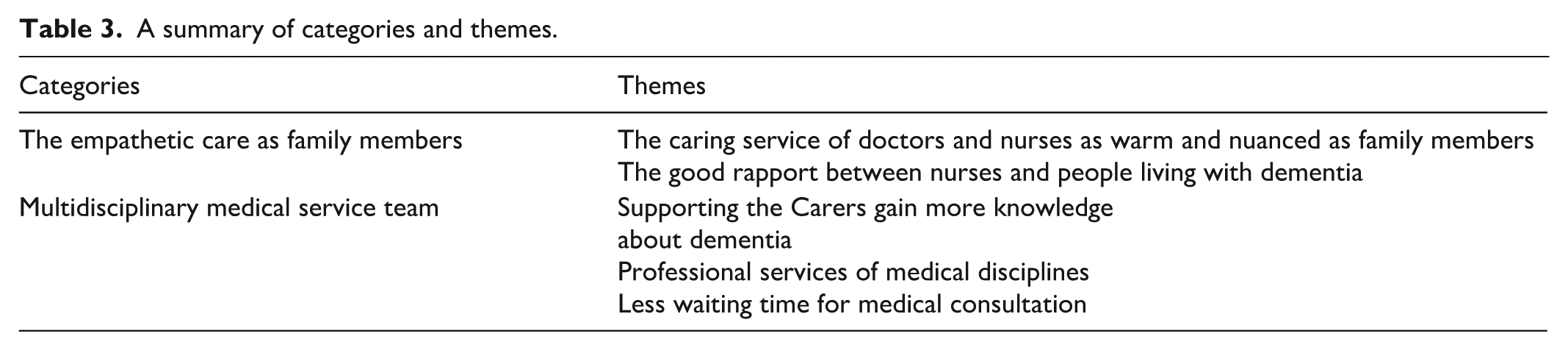
Using Van Manen’s phenomenological approaches, the qualitative data has been clustered into two categories: (1) The empathetic care as family members, consisting of themes of the caring service of doctors and nurses as warm and nuanced as family members, and the good rapport between nurses and people living with dementia; and (2) Multidisciplinary medical service team, covering themes of supporting the Carers gain more knowledge about dementia, professional services of medical disciplines, and less waiting time for medical consultation. These categories and their corresponding themes have been summarized in Table 3.
A summary of categories and themes.
Category 1: The empathetic care as family members
Taking care of older persons living with dementia is strongly advocated in Confucian philosophy and traditional Chinese culture, which has been merged into a key focus of Macao dementia-friendly community. Person-centered-care principle is the service priority when medical professionals are providing services to older people living with dementia and their carers. The Carers feel trusted and cared for by medical disciplines as family members or close friends. “The empathetic care as family members” category consists of themes of the caring service of doctors and nurses as warm and nuanced as family members, and the good rapport between nurses and people living with dementia.
The theme of ‘the caring service of doctors and nurses as warm and nuanced as family members’ has reflected that The Carers felt trusted and cared from the medical disciplines, as harmonious as family members. This phenomenon has been identified as “warm and attentive service”, “harmony”, “trusted”, or “be treated as family members” The following are some real narratives from the Carers. For example, it has been described by the husband of Gramma F1, a user of the cognitive stimulation therapy: The nurses at Dementia Medical Center at CHCSJ are very warm and attentive and make my wife feel being treated as a family member. That is warm, trusted, and harmonised. We have talked everything with the nurses and they have been attentive and nice to my wife.
The son of Gramma F2 also feels the nurses’ sweet care for his mother while attending the cognitive stimulation therapy: My mom is very comfortable to stay with the nurses and is keen to talk with them. Their sweet care can touch my mom. The nurses always follow her hands by hands to do exercises together. Their attitudes always make her comfortable.
The wife of Mr. M1 who is an introvert person, and a user of memory clinic, has expressed the warm care of the doctors at the memory clinic as family members: The doctors at CHCSJ always have good service attitude, so sweet and warm. The doctors are attentive and treat my husband very well, always greet him, as family members.
The theme of “the good rapport between nurses and people living with dementia” focuses on the close and interrelated relationship between nurses and older people living with dementia while they were undergoing various clinical dementia services, which has been described by the daughter of Gramma F3, who has received nursing consultation service: The nurses are very nice and my mom enjoys staying with them. They have built up a very close relationship as a friend. My mom is eager and happy to go to see the nurses and join the activities specially arranged for her, such as Mahjong, with other older people.
The daughter of Gramma F4 has also expressed that her mother has built up a trusted relationship with the nurses and enjoyed the cognitive stimulation therapy: My mom is very happy to see the nurses and really appreciates their profession and trust. The nurses always praise my mom’s proper dressing and beautiful hand-writing, and make my mom feel very blissful. The nurses have showed real care about my mom and arranged many suitable training activities for her.
The wife of well-educated Mr. M2, a user of the memory clinic, also appreciates the individualized interaction by the nurses: The nurses know he is good at hand-writing and then always let him do some hand-writing while he is waiting to see a doctor. We feel the nurses are with a good and attentive service attitude and communicate well with us. They always teach me how to take care of my husband.
Category 2: Multidisciplinary medical service team
Prioritizing in Macao Dementia Policy, Macao Dementia Medical Center has been providing various clinical dementia services, including the memory clinic, nursing consultation, health education, dementia care planning course, and cognitive stimulation therapy in Macao SAR. The Carers appreciate and feel benefited from the professional services provided by the multi-disciplines, including geriatricians, neurologists, specialty nurses, pharmacists, occupational therapists, physiotherapists, and social workers. The category of “multidisciplinary medical service team” refers to the themes of supporting the Carers to gain more knowledge about dementia, professional services of medical disciplines, and shorter waiting times for medical consultation.
The theme of “supporting the Carers gain more knowledge about dementia” indicates that Carers and people living with dementia can learn plenty of knowledge from the various clinical dementia services, such as understanding common symptoms of dementia, caring and accompanying skills with the people living with dementia. Such a theme has been described by the son-in-law of Gramma F5, living with dementia, who has participated in the dementia care planning course: The course helps me know more about dementia and understand my mother-in-law more about her symptoms. For example, her agitation is caused by dementia disease. I learn from the medical professionals how to cope with her poor attitude and behaviour now. We try to make her happy and safe.
In addition, the daughter of Gramma F4, living with dementia, a user of cognitive stimulation therapy, has perceived “confident” in taking care of her mother and can “communicate well” with her after being involved in the cognitive stimulation therapy course: I have learned what the symptoms of dementia are, how to stay with her, and how to manage her unstable emotions etc., from the course. Now, I know that I should not be scared by her illusion. I will support my mom in exercising whatever she can do and her concentration, as I have learned in the cognitive stimulation therapy course.
It appears interesting that the wife of Mr. M3, the user of the health education service, has recognized how to take care of her husband and maintain her own health at the same time: I have learned a lot about caring for my husband from the course. I know my husband is with a poor memory, and then I try to help him quit drinking alcohol. I always keep one empty bottle which I show him by saying that he has already drank so he will give up when he appears addictive to alcohol. Moreover, the knowledge I have learned not only helps my husband recover soon but also benefits myself. I have learned that the healthy body is good for my memory, and so I begin to swim regularly.
The theme of “professional services of medical disciplines” has demonstrated the acknowledgment and appreciation of the Carers for the professional services provided by the medical multidisciplines at Macao Dementia Medical Center, including geriatricians, neurologists, specialty nurses, pharmacists, occupational therapists, physiotherapists, and social workers, etc., who provided the person-centered one-stop professional services. Below quotation is the narrative of the wife of Mr. M4, a user of the cognitive stimulation therapy course: The doctors and the nurses are very professional as they have explained all the questions we have raised. The nurses are attentive and have fulfilled our requirements. The nurses have carefully prepared many instruments in the course, such as Mahjong, chess, and poker cards, that we used to play in our childhood. My husband is pleased to play them.
The nephew of Gramma F6, a user of the dementia care planning course, also praises the one-stop professional services offered by Macao Dementia Medical Center: The doctors have explained the symptoms of dementia to us in detail and then have prescribed some helpful medications...... The nurses are very nice and cordial and make us feel safe. . .. . . The occupational therapists are very professional in using some photos to help recall her memory. . .. . . The physical therapists demonstrate the finger exercises with her together. . .. . . The pharmacists always tell us about the effects and side-effects of the medications. . .. . . The social workers have introduced the social support resources in community and informed us of the vacancy of service in the day-care centres if available.
The wife of Mr. M1 has also expressed her appreciation for the professional services rendered by the doctors and the social worker: So far the doctors at CHCSJ have been very nice and professional. They have explained the blood test reports to us comprehensively. . .. . . The social worker from Social Welfare Bureau is working here. She has collected all the relevant information about my husband and my family and then instructed us how to apply for the Personal Emergency Response Service and the equipment of bathroom, and other resources in the community.
The theme of “less waiting time for medical consultation” indicates that the suspected persons with dementia who have been referred from the Health Centers or other outpatient departments can see the geriatricians at Macao Dementia Medical Center more efficiently, through the organized assessment network and dual referral system with all the Health Centers throughout Macao SAR. According to the description of the daughter of Gramma F7, a user of the memory clinic, she has expressed that her mother can see the geriatricians at Macao Dementia Medical Center shortly through the dual referral system with the Health Center: My mom has undergone a cognitive assessment at the Health Center with poor memory identified, and then she has been referred to the memory clinic at CHCSJ. The waiting time for medical consultation is speedy, and not too long.
The speedy experience has also been reported by the daughter of Gramma F8, a user of the memory clinic: The cardiac doctor has told my mom that she should see the geriatrician at Dementia Medical Center. It is so speedy to see the doctor at Dementia Medical Center with a referral letter that I feel the waiting time becomes shorter.
However, there still exist imperfections in the services, related to the dementia care planning course, which is described by the daughter of Gramma F3 with a relatively low education level: My mom has not been well educated, as other old persons, to understand the complex knowledge taught in the dementia care planning course. For example, the name and side-effect of medications. Moreover, the course lasts all morning, which is too long for her!
Gramma F5’s son-in-law has also reported his bad feelings: The complex knowledge taught by some doctors in dementia care planning course is too professional and my mom-in-law could not understand well, even me too.
Daughter of Mr. M7, the user of the dementia care planning course, has complained about the nurse’s gruff performance while her aged father underwent the cognitive assessment: My 90-year-old father becomes more frustrated when the nurse just asks one question after another question without a relaxed atmosphere. My father is too old to handle this embarrassed situation when the nurse conducts mechanically the cognitive assessment and my father really doesn’t know how to response properly. My aged father needs some respect and confidence.
Discussion
The data reveals a wealth of information about the experiences of the Carers and reflects the narratives of the participants’ perspectives on related themes. The two qualitative categories of the empathetic care, as family members and the multidisciplinary medical service team, have been generated from the findings of the present study to illustrate the experiences of the Carers in Macao SAR.
The empathy of medical professionals means the competency to take on the perspective of people living with dementia and their carers, to understand, feel, and with best efforts to share and respond to their experiences while receiving various clinical services. The person-centered care principle is the service priority when medical professionals are taking care of older people living with dementia and their carers. There is a positive correlation between medical professionals’ empathy level and patients’ overall satisfaction. 12 The empathy level of medical professionals has been found to relate significantly to their service attitude toward the patients. 13 The findings of the existing study indicate a positive outcome that the medical professionals at Macao Dementia Medical Center have prioritized the person-centered-care principle while providing high-quality services to older people living with dementia and their carers. These high-quality services encompass memory clinic, nursing consultation, health education, dementia care planning course, and cognitive stimulation therapy in Macao SAR. The medical professionals care for people living with dementia and their carers in the scope of trusting relationships and good interactions, which have allowed people living with dementia and their carers to feel the empathetic care as harmonious as family members. The findings derived from previous studies pertinent to the spirit of empathy of medical professionals have manifested the philosophy of person-centered-care service principle. 14 Previous studies have also demonstrated the medical professionals’ empathy acting as an effective bio-psycho-social intervention, which can improve the satisfaction and relationship with the patients and carers.15–17 The findings of this study also align closely with previous studies’ emphasis on empathetic care relationships and suggest further guidelines in developing more comprehensive, holistic support frameworks that address both clinical and community-based needs for people living with dementia and their carers. 18 The findings of this qualitative study can align with high satisfaction levels, consistently at 90% or higher, being reported in previous investigations at Macao Dementia Medical Center since 2017. The integration of these qualitative results with the prior quantitative findings can provide a thorough comprehension of the high-quality standards of various clinical services in the Macao Dementia Medical Center.
Dementia is a chronic neurodegenerative disease with loss of memory, problem-solving and other cognitive abilities that are severe enough to impact the daily life of older people. 19 Taking care of older persons living with dementia by family members, who are most likely to be adult children, spouses and/or other relatives, is a traditional Chinese moral value which is advocated in Confucian philosophy and traditional Chinese culture. 20 A local study in Macao SAR has indicated there is a greater proportion of persons with dementia who are living with their family members (75.9%), more than double compared to those in Australia (36.1%). 21 This implies the significant demands for the sustainable support for the family carers, according to Macao Dementia Policy, that has been launched in 2016 as the 27th territories with national dementia plan globally and aligned with WHO Global Action Plan on the Public Health Response to Dementia 2017–2025. 5 The category of multidisciplinary medical service team, emerged from this qualitative study, has covered the themes of supporting the Carers gain more knowledge about dementia, professional services of medical disciplines, and less waiting time for medical consultation. Macao Dementia Policy has been striving to provide a seamless network between medical services and community care, aiming to achieve early prevention, early detection, early diagnosis, early treatment and early support for people living with dementia and their carers. Such clinical dementia services have been provided by the medical multidisciplines at Macao Dementia Medical Center, including geriatricians, neurologists, specialty nurses, pharmacists, occupational therapists, physiotherapists, and social workers with whose efforts, the person-centered one-stop professional services were successfully undertaken. The one-stop professional services cover medical diagnosis and treatment, cognitive stimulation training, education for people living with dementia and their carers, pharmaceutical guidance, community-care resources referral, etc. 5 Most people living with dementia and their carers who have received various clinical dementia services in Macao SAR reported that the multidisciplinary services are professional and informative.
Relevance to future research
The findings of this study have several implications for future research. First, it has advanced the current understanding and knowledge of the experiences of the Carers in Macao SAR. The cultural context and education level of Chinese older persons living with dementia and their carers should be considered and evaluated in designing future effective initiatives to improve the practice of clinical dementia services. Second, the use of narrative methods to collect qualitative data, where participants are given the opportunity to talk about their mood and their lives, has demonstrated that at least in Macao SAR, Chinese carers are capable to reflect on and articulating their experiences under the research context.
Limitations
There are some notable limitations of this study. Firstly, given that data has been collected in a face-to-face interview format, participants might have been prone to social desirability bias, e.g., pleasing the interviewer. Secondly, participants have been aware that this study sought to explore the experiences of the Carers. Therefore, participants who were interested in or comfortable with the themes might have been more inclined to join the study. Finally, the sample size is comparatively small, and some factors might not have been experienced by the 30 participants; there is a need for further exploration into the range and breadth of the factors.
Conclusion
The phenomenological study can offer, innovatively, a deeper understanding of the experiences of the Carers in Macao SAR and capture the Carers’ satisfaction with the friendly attitudes and professional services of medical multi-disciplines in Macao SAR. Using Van Manen’s phenomenological approaches, the qualitative data has been clustered into two categories: 1) The empathetic care as family members, consisting of themes of the caring service of doctors and nurses as warm and nuanced as family members, and the good rapport between nurses and people living with dementia; and 2) Multidisciplinary medical service team, covering themes of supporting the Carers gain more knowledge about dementia, professional services of medical disciplines, and less waiting time for medical consultation. The phenomenological study approach can allow a more complete picture to be captured and produce a fully grounded interpretative research approach, providing an improved understanding of the experiences of the Carers, which then will be utilized in designing more effective initiatives to improve the practice for clinical dementia services in Macao SAR.
Footnotes
Acknowledgements
The authors would like to acknowledge the contributions of all the interviewees who participated in this study for offering their time and sharing their valuable insights.

Ethical considerations
Ethical approval is obtained through the Medical Ethical Committee of the Centro Hospitalar Conde de São Januário, the Government of Macao SAR, China, on 17th March 2021 (IRB number: 0014/MEC/N/2021).
Consent to participate
All participants have received and signed written informed consent forms prior to being interviewed.
Author contributions
Sio Mui Wong contributed to the conception of this study and approved the final version of the article; Wen Zeng drafted the article, revised it critically and interpreted the data; Iek Long Lo made a substantial contribution to the conception and design of this work and approved the version of the article to be published.
Funding
The authors disclosed receipt of the following financial support for the research, authorship, and/or publication of this article: The research is funded by the Health Bureau, the Government of Macao Special Administrative Region, China (FG number: 0001/CATD/ADJM/P/2021).
Declaration of conflicting interests
The authors declare no potential conflicts of interest with respect to the research, authorship, and publication of this article.
Data availability statement
De-identified data used in the analyses presented in this paper are available from the corresponding author upon request and upon approval of the Health Bureau, the Government of Macao SAR, China.