



Abstract
Background:
Recently, the Chinese Verbal Learning Test (ChVLT) was developed to assess episodic memory in Chinese speakers. The goal of this analysis was to determine whether memory consolidation as measured by the ChVLT was specifically associated with hippocampal volume in patients with cognitive impairment.
Methods:
We administered the ChVLT to 22 Chinese-speaking patients with mild cognitive impairment and 9 patients with dementia and obtained hippocampal and cortical volumes from T1-weighted magnetic resonance imaging.
Results:
Linear regression revealed that hippocampal volume explained 9.9% of the variance in delayed memory (P = .018) after controlling for the effects of age, education, immediate recall after the last learning trial, overall level of cognitive impairment, and volumes of other cortical regions.
conclusion:
These results indicate that the ChVLT is specifically correlated with hippocampal volume, supporting its utility for detecting hippocampal disease and monitoring hippocampal state over time.
Background
Hippocampal injury is common to a variety of neurological contexts, including hypoxic–ischemic injury, epilepsy, infection, and neurodegenerative disease. 1 -3 Because of this, a major focus of current research is on the development of efficient methods for assessing the state of the hippocampus. 4 Although many of these studies utilize brain imaging, cost and other factors limit the utility of imaging as a large-scale screening tool. Thus, research has also continued to highlight the importance of cognitive testing, in particular episodic memory tasks, in the assessment of older individuals. Indeed, even in large imaging studies, neuropsychological performance is still one of the strongest predictors of cognitive decline in people at risk of dementia. 5 -7
From a world health perspective, a current limitation of dementia research is that the majority of studies have been conducted on English-speaking people. This is beginning to change, and one aspect of that change is the development of new testing instruments in other languages. 8 -11 Among the many languages that need to be considered, Chinese is very important, as it is spoken by about 1197 million of the world’s population. 12 Recently, the Chinese Verbal Learning Test (ChVLT) was developed to assess episodic memory in Chinese speakers. Early studies in Taiwan have shown that the test differentiates patients with Alzheimer’s disease (AD) and mild cognitive impairment (MCI) from cognitively normal controls. 13,14 Because of the importance of evaluating hippocampal state, the test was developed with elements designed to separate aspects of memory performance that depend on the hippocampus from those that are influenced by other cortical and subcortical brain regions. 13 A prior study using a similar memory task in English showed that hippocampal volume in AD is specifically correlated with delayed memory performance, even after immediate recall is taken into account. 15 If the ChVLT was demonstrated to have a similar relationship, its value as a tool for detecting early hippocampal involvement and for tracking hippocampal state over time would be enhanced.
The goal of this study was to determine whether hippocampal volume specifically correlates with retention over a delay in the ChVLT. Memory performance depends not only on the ability to retain information but also on the efficiency and depth of initial encoding. 16 Therefore to demonstrate that hippocampal volume specifically correlates with retention, it is necessary to control for initial acquisition of information and potential brain structures that might contribute to encoding.
Methods
Participants
The study included 31 Chinese Americans with MCI (n = 22) or dementia (n = 9 including 8 with AD and 1 with frontotemporal dementia, criteria given subsequently) who were consecutively recruited from among enrollees in University of California San Francisco’s (UCSF) Alzheimer’s disease research center. Recruitment and evaluation of Chinese Americans for this program have been described in detail. 17 Briefly, participants are recruited from a variety of sources, but most patients with cognitive impairment are referred from community health providers. The study enrolls people with any level of English proficiency including bilingual Chinese/English and monolingual Chinese. The language for cognitive testing is determined based on the language the participant typically speaks at home. For this study, we enrolled all participants with the targeted diagnoses who were tested in 1 of the 2 common Chinese dialects, Mandarin and Cantonese, and had structural magnetic resonance imaging (MRI) using our current imaging protocol. All images are reviewed for quality and motion artifact immediately after acquisition and repeated if possible and reviewed again prior to being processed for analysis. Images with high levels of artifact (ringing and distortions of anatomy) are noted in the database. Participants with a large degree of motion artifact on imaging were excluded from the study.
General Clinical Evaluation
The clinical evaluation includes a complete medical history and examination, neuropsychological testing, and concurrent history from a knowledgeable informant to provide ancillary information about the participant’s level of functioning. Clinical diagnosis is established at a consensus conference where the results of these evaluations are reviewed. Diagnosis of MCI required a history either from the participant or from their informant (or both) of persistent cognitive impairment representing a significant decline from the patient’s baseline level of functioning or significant impairment on neuropsychological testing in more than 2 tests in the same cognitive domain. 18 If only the patient or informant reported a decline in cognition, then performance that was 1.5 standard deviations below normal on a cognitive task was required for a diagnosis of MCI. We did not require a formal neuropsychological cutoff score for MCI if both the informant and the patient reported deterioration in cognition. Alzheimer’s disease and FTD were diagnosed according to the established criteria. 19,20 The cognitive testing includes the Chinese version of the Cognitive Abilities Screening Instrument (CASI-C), which provides a broad assessment of memory, language, visual-spatial, and some frontal/executive functions and is useful as a measure of generalized cognitive impairment. 21
Chinese Version of the Verbal Learning Test
The ChVLT consists of nine 2-character nouns repeatedly presented orally over 4 learning trials, with immediate repetition of as many of the items as possible after each reading. Recall is assessed after a 30-second delay (preceded by a backward counting task) and a 10-minute delay. 13 The words are grouped into 3 categories, fruits, clothing, and transportation. The 10-minute recall trial is followed by a yes/no forced choice recognition task using the 9 target words and 18 distractor words (cued and recognition data were not analyzed here).
Structural MRI Acquisition
Magnetic resonance imaging scans were obtained on a 3.0-Tesla Siemens (Siemens, Iselin, New Jersey) TIM Trio scanner equipped with a 12-channel head coil located at the UCSF Neuroscience Imaging Center. Whole brain images were acquired using volumetric magnetization prepared rapid gradient-echo sequence (MPRAGE; repetition time/echo time/inversion time = 2300/2.98/900 ms, α = 9°, field of view 240 × 256 mm, 1 × 1 mm).
Image Processing
The T1 MPRAGE structural MR images were analyzed using the FreeSurfer 5.1 image analysis suite running on a Linux Ubunti 12.04 LTS operating system. FreeSurfer is documented at http://surfer.nmr.mgh.harvard.edu. The software has been validated and described in detail by previous publications. 22 -24 Briefly, FreeSurfer is a surface-based structural MRI analysis tool that segments white matter and tessellates gray and white matter surface. 25 The procedure involves the removal of nonrelevant tissue using a hybrid watershed/surface deformation procedure 24 and intensity normalization, 26 followed by automated Talairach transformation and volumetric segmentation of cortical and subcortical gray and white matter, subcortical limbic structures, ventricles, and basal ganglia. 27-28 Freesurfer differences in automated versus manual determination of hippocampal volumes, as well as application in patients with cognitive complaints, have been compared before. 29 -32 After processing through FreeSurfer version 5.1, each T1 image was individually reviewed for accuracy of white and gray matter segmentation. Inaccuracies in white matter segmentation and pial surfaces were manually corrected using the built-in editing packages of FreeSurfer, and then reprocessed to calculate final volumetric measures. FreeSurfer parcellation of the hippocampus of patients with largest and smallest hippocampal volume in the cohort is depicted in Figure 1.
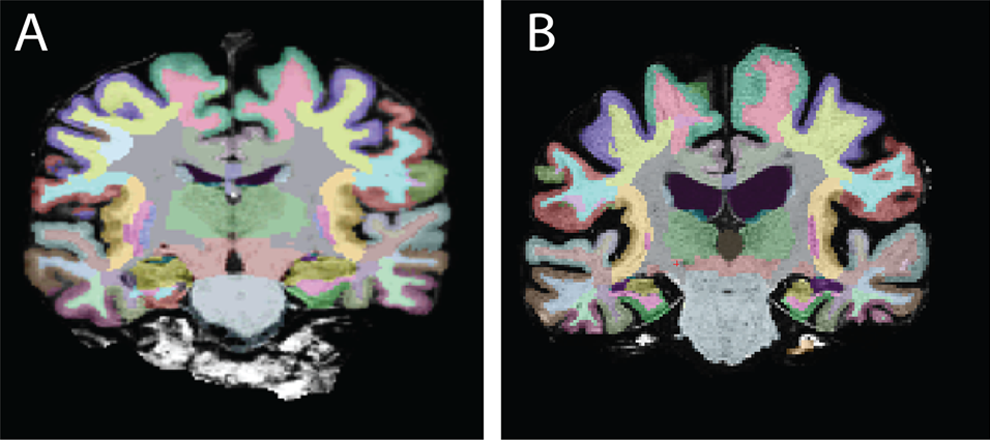
FreeSurfer parcellation map overlay of coronal images of patient with largest hippocampus (A) and smallest hippocampus (B).
Variable Selection and Statistical Analysis
Based on prior studies examining the relationship between hippocampal volumes and performance on a list-learning task, 15 we hypothesized that hippocampal volume would be most specifically related to memory consolidation, defined as retention of previously encoded material over a delay. To test this hypothesis, we constructed a linear regression model using the 10-minute recall performance as the dependent variable and hippocampal volume as the targeted predictor variable. As the dependent variable, 10-minute recall performance appeared skewed on examination (skewness = −0.7418), a Blom transformation was performed, 33 with a resulting skewness of −0.14. Skewness-Kurtosis test posttransformation revealed probability of sample skewness (P = .71) and an adjusted chi-square test probability (P = .19), not rejecting null hypothesis of normality. The number of words encoded after the fourth learning trial (trial 4) was included as a covariate to control for initial encoding, thereby further isolating the consolidation aspect of memory. Age, level of education (in years), and CASI score to control for overall level of cognitive impairment were also included. Because prior studies have found that verbal memory is more dependent on left than right hippocampal function, 1 we only used left hippocampal volume. Finally, to ensure that we were identifying contributions to memory that were specific to the hippocampus and independent of contributions from other brain structures, we included the summed volumes across both hemispheres for a number of brain regions. Because most of the patients were in the AD spectrum, we included cortical regions previously identified in AD including the inferior parietal, supramarginal, posterior cingulate, precuneus, middle temporal, inferior temporal, entorhinal, parahippocampal, fusiform, and middle frontal cortical regions. 34 Statistical analysis was performed using Stata version 11 (StataCorp LP, College Station, Texas). All participants signed informed consent, and the protocol was approved by the UCSF Committee on Human Research.
Results
Demographic and cognitive testing data for the group are presented in Table 1. The mean age in the group was 72.37 years and the mean level of education was 14 years. The mean CASI score was 76.5 of 100 for the 9 patients with dementia and 95.6 for the 22 patients with MCI. Based on education-specific cutoffs, 4 patients with dementia and none of the patients with MCI were impaired on the CASI. The mean number of words recalled at the last learning trial on the ChVLT was 4.7 (range 0 to 7) for the patients with dementia and 8.1 (range 5 to 9) for the patients with MCI. The mean number of words recalled at the 10-minute delay was 2.4 (range 0 to 6) for the patients with dementia and 7.1 (range 1-9) for the patients with MCI.
Demographic and Performance Data for Participants.
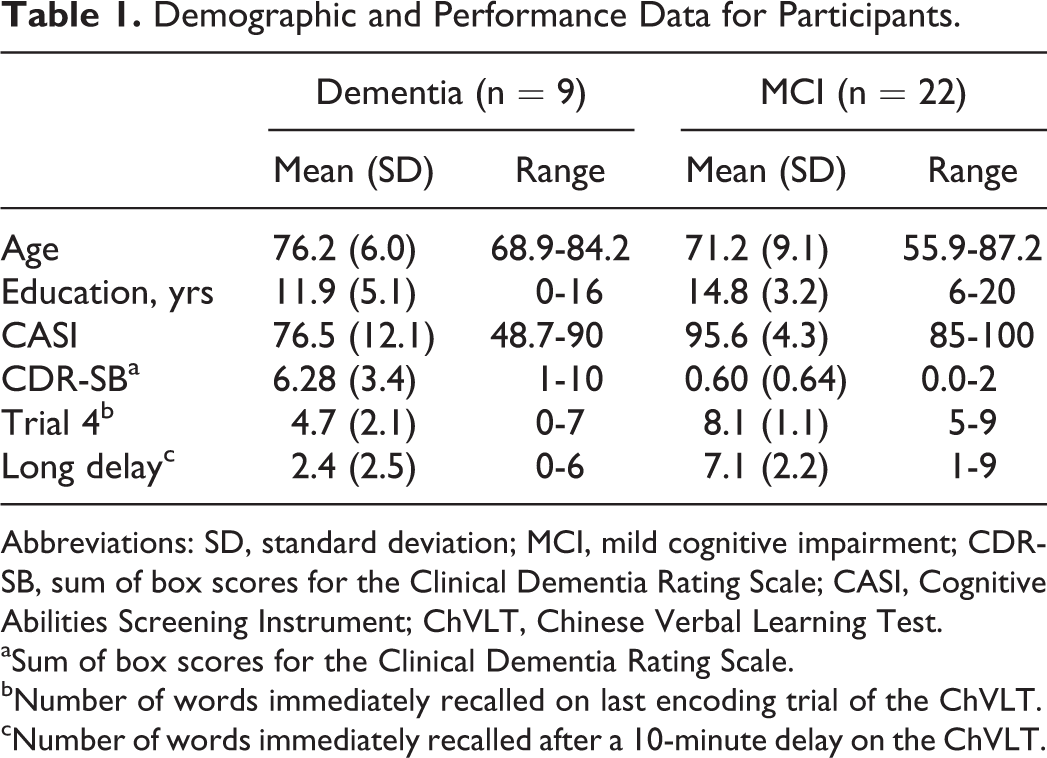
Abbreviations: SD, standard deviation; MCI, mild cognitive impairment; CDR-SB, sum of box scores for the Clinical Dementia Rating Scale; CASI, Cognitive Abilities Screening Instrument; ChVLT, Chinese Verbal Learning Test.
aSum of box scores for the Clinical Dementia Rating Scale.
bNumber of words immediately recalled on last encoding trial of the ChVLT.
cNumber of words immediately recalled after a 10-minute delay on the ChVLT.
The regression model including number of words recalled on ChVLT trial 4, CASI score, age, education, and the summed cortical volume was a significant predictor of ChVLT 10-minute delay score (R 2 = .5503, F 6,24 = 4.89, P = .0021), with the strongest predictors in the model being age (coefficient of −0.019, 95% confidence interval [CI95] −0.052-0.012, P = .210) and performance at trial 4 (coefficient of 0.20, CI95 0.001-0.399, P = .049). The predictive value of the model increased with the addition of left hippocampal volume (R 2 = .6494, F 7,23 = 6.09, P = .0004, change in R 2 of .0991, P = .002). Thus, left hippocampal volume contributed an additional 9.9% of the variance in ChVLT 10-minute delay score compared with a model that did not include hippocampal volume. The coefficient for left hippocampal volume in the full model was 0.000687 (CI95 0.000129-0.001244, P = .018). In the model that included hippocampus, the effect of recall at trial 4 was also significant (coefficient of 0.193, CI95 0.013-0.373, P = .036) but not the effect of age (coefficient of 0.0004, CI95 −0.0329-0.0337, P = .981). In both models, neither summed cortical volume nor education was a significant predictor of 10-minute delay score. Relative weights of individual regressors in each of the 2 models are shown in Table 2. Figure 2 depicts the relationship between left hippocampal volume and 10-minute delay score.
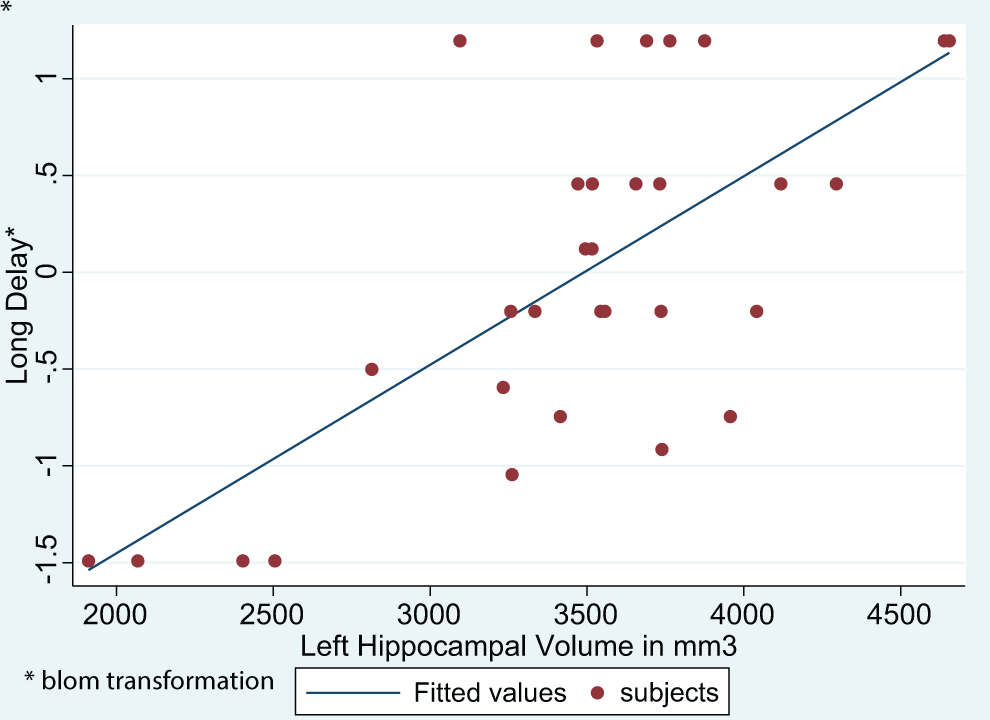
Relationship between 10 minute delay score and left hippocampal volume.
Relative Weights of Regressors in 2 Models.
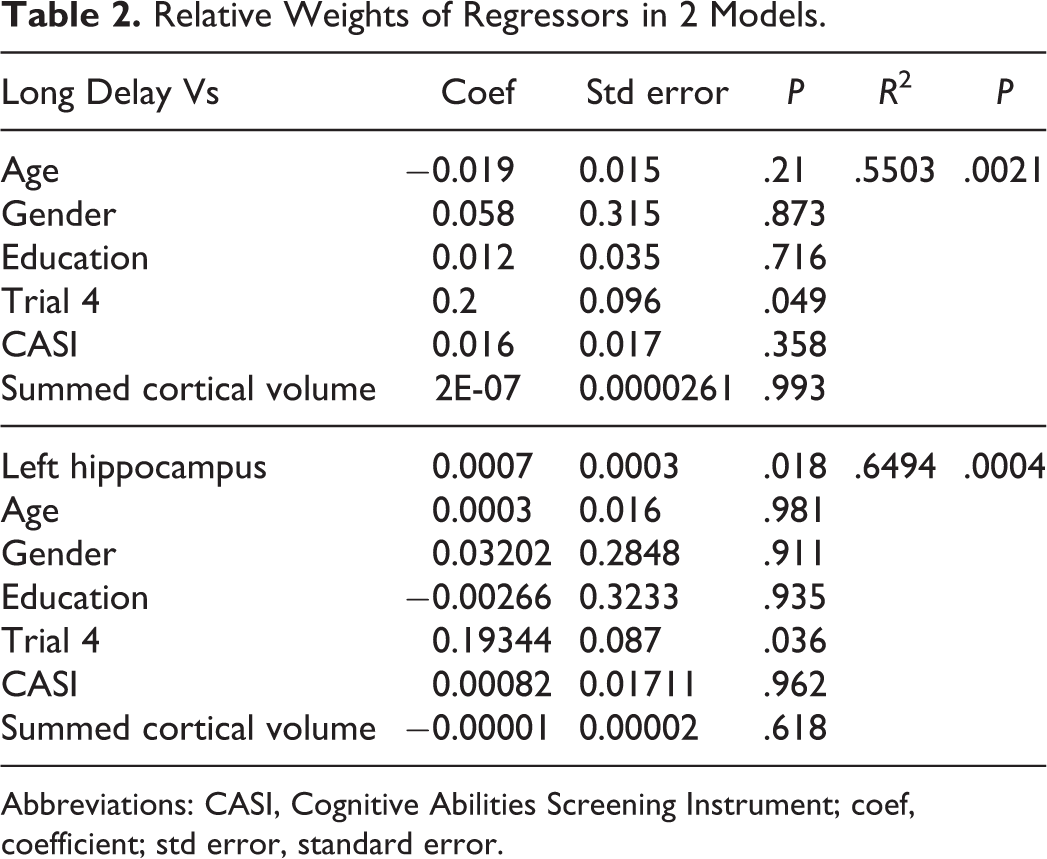
Abbreviations: CASI, Cognitive Abilities Screening Instrument; coef, coefficient; std error, standard error.
Discussion
As predicted based on similar studies in English-speaking patients, 15 the ChVLT is sensitive to the specific hippocampal contribution to delayed memory abilities, even after controlling for age, education level, initial encoding, and contributions of other cortical brain regions. This is also consistent with prior studies in humans and animals indicating that the role of the hippocampus in memory is relatively specific to the consolidation of new memories. 35,36 The estimate of the size of the hippocampal contribution, about 9.9% of variability in delayed memory, is similar to the estimate obtained in the prior study, which used a similar statistical model and came up with an estimate of 7.6%. This suggests that the ChVLT, like the English language tests after which it is modeled, 37 is sensitive to hippocampal state.
Although the small sample size is a limitation of this study, it should be noted that a previous study using a similar memory task in English speakers was able to demonstrate correlations between memory retention and hippocampal volume in a similar sized cohort (n = 37). 15 Thus, our study can be considered a replication of a prior finding in a different language, which supports the generalizability of the finding.
As diagnosis of neurodegenerative disease moves into earlier phases, it will be necessary to rely more heavily on tests sensitive to the functions of brain regions involved early in the course of these diseases. The current results suggest that the ChVLT is a good choice for detecting hippocampal changes and monitoring the state of the hippocampus over time in Chinese-speaking individuals. Additional Chinese-specific psychometric tests that correlate with brain function should be explored and may help in early diagnosis of AD in this large population and reduce the frequency of costly screening images.
Footnotes
Declaration of Conflicting Interests
The authors declared no potential conflicts of interest with respect to the research, authorship, and/or publication of this article.
Funding
The authors disclosed receipt of the following financial support for the research, authorship, and/or publication of this article: This work was supported by NIH/NIA Grant P50 AG023501 and The Hillblom Network Program.