




Abstract
Purpose:
We examined print advertisements for Alzheimer’s disease drugs published in journals and magazines between January 2008 and February 2012, using an informational versus transformational theoretical framework to identify objective and persuasive features.
Methods:
In 29 unique advertisements, we used qualitative methods to code and interpret identifying information, charts, benefit and side effect language, and persuasive appeals embedded in graphics and narratives.
Results:
Most elements contained a mixture of informational and transformational features. Charts were used infrequently, but when they did appear the accompanying text often exaggerated the data. Benefit statements covered an array of symptoms, drug properties, and caregiver issues. Side effect statements often used positive persuasive appeals. Graphics and narrative features emphasized positive emotions and outcomes.
Implications:
We found subtle and sophisticated attempts both to educate and to persuade readers. It is important for consumers and prescribing physicians to read print advertisements critically so that they can make informed treatment choices.
Introduction
Pharmaceutical companies spent $4.7 billion on direct-to-consumer (DTC) advertising in 2009, nearly a 4-fold increase from a decade earlier. 1 On one hand DTC advertising can educate consumers about diseases and their treatment, on the other hand advertising can contribute to increased demand for drugs, a potentially inappropriate increase in actual prescriptions, and the spread of inaccurate or misunderstood drug or disease information. 2 Previous studies have evaluated DTC advertisements for other diseases such as cancer, 3 depression, 4 and arthritis, 5 but few have examined drugs indicated for Alzheimer’s disease (AD). Currently there are 4 drugs approved by the Food and Drug Administration (FDA) for the treatment of AD, 6 3 of which are available in generic form (a fifth drug, Tacrine, is also approved but rarely prescribed). Given the growing prevalence of AD, the limited effectiveness of current treatments, and the major research efforts underway to develop new drugs, it is important to understand how dementia drugs are marketed to consumers and physicians. In this study, we use qualitative methods to evaluate print advertisements for current FDA-approved drugs for the treatment of AD.
Researchers in several disciplines, including psychology, psychiatry, communication, and marketing, have evaluated pharmaceutical advertisements, examining their impact on prescribers 7 and consumers. 2 Other researchers have concentrated on the content of advertisements, identifying both explicit and implicit elements designed to persuade. 8 For instance, one recent study of a public awareness campaign for AD found that manipulating implicit features of an advertisement affected viewers’ ratings of the content. 9 As a set, these studies suggest that advertisements incorporate multiple and varied techniques to inform and persuade viewers. We are aware of only 2 studies, however, which have examined advertisements specifically for AD drugs. Sauer and Howard 10 surveyed geriatricians’ attitudes toward advertisements for cholinesterase inhibitors, finding that physicians thought the advertisements made unrealistic claims about AD, exaggerated the efficacy of the drugs, and in turn made physicians less likely to prescribe. Another study found that consumers rated AD drug advertisements as more valuable and easier to comprehend than advertisements for weight loss treatments. 11 Consumers were also more likely to rate the AD advertisements as informative and more likely to rate the weight loss advertisements as persuasive, which the authors presume led to more positive ratings overall for the AD advertisements. Despite these preliminary findings, to date there has been no investigation of either the content or the persuasive strategies employed in AD drug advertisements, a gap the current study aims to fill.
For our study, we employed a theoretical framework that focuses complementary aspects of print advertisements, informational and transformational features. 12 Informational features of advertisements include factual claims about the drug and the disease. These claims usually include benefit and side effect information; background information about the drug such as dosage, indication, and financial incentives as well as details about disease symptoms, course, and prognosis. In contrast, transformational features of advertisements involve implicit emotional appeals that attempt to create an association between the product and the particular psychological responses in the viewer. These appeals usually employ persuasive techniques that highlight abstract qualities of the drug. For example, an advertisement might list disease symptoms and drug benefits (informational features) and also include an image of an older woman reading to her grandchild (a transformational feature). The image does not provide explicit information about the disease or treatment but rather evokes a desired thought or feeling and therefore invites the viewer to form a personal connection to the product. Similarly, Petty, Cacioppo, and Schumann 13 proposed a theoretical framework consisting of central and peripheral routes to persuasion, in which a consumer might weigh the potential benefits and drawbacks of information presented in an advertisement (central route) or associate elements of an advertisement with a positive or negative cue (peripheral route). Both informational and transformational features, as well as central and peripheral techniques, are meant to influence readers, although they work through different mechanisms, and it is their interaction that presumably results in changes in attitudes and behaviors. 5
In the current study, we undertook a qualitative analysis of linguistic and visual features in print advertisements for AD drugs. Our first goal was to provide comprehensive descriptive information about the content and features of dementia medication advertisements. Our second goal was to examine persuasive techniques and narrative appeals in the advertisements to determine the extent to which informational and transformational tactics appear in each advertisement element.
Methods
Materials
To collect advertisements targeted toward medical professionals, we searched general neurology journals (Annals of Neurology, Archives of Neurology, and Neurology) and AD-specific journals (Alzheimer Disease and Associated Disorders, Alzheimer’s & Dementia). We selected general neurology journals that publish pharmaceutical advertisements and have high impact factors 14 (all above 7.5). To select AD-specific journals, we identified the 2 highest impact journals focusing on AD, which publish pharmaceutical advertisements (2.811 and 6.373, respectively). Bound volumes between January 2008 and February 2012 were reviewed by hand.
To collect advertisements from popular magazines and additional journals, we used an advertising database, AdPharm (www.adpharm.net), which archives published pharmaceutical advertisements. The AdPharm database includes high circulation magazines such as Woman’s Day, Reader’s Digest, and Ladies’ Home Journal; newspapers such as The Philadelphia Inquirer and the Richmond Times-Dispatch; and general medical journals including Journal of the American Medical Association and American Family Physician, ensuring a wide and diverse audience. In that database, we used the search terms “Alzheimer’s disease” and “dementia” as well as the brand names and generic names of all FDA-approved drugs indicated for the treatment of AD.
In bound journals, we identified 99 advertisements, of which 11 were unique. In the AdPharm database, we collected an additional 18 unique advertisements that appeared in both journals and magazines from the same time period. Among the final 29 unique advertisements, 20 appeared in journals and 9 appeared in popular magazines (see Appendix A for a complete list of advertisements, their source, and year of publication). The advertisements marketed 5 drugs, including donepezil (13 advertisements), rivastigmine (7 advertisements), memantine (7 advertisements), galantamine (1 advertisement), and a generic version of donepezil (1 advertisement).
Coding and Analyses
We developed a coding scheme (available upon request from the authors) based on a previously published content analysis of print advertisements for depression drugs. 4 Our coding scheme was designed to identify informational and transformational features within 5 major categories outlined here and summarized with examples in Table 1. First, we recorded identifying product information such as the drug name, advertisement source/sources, date/dates of publication, and number of pages. Second, we characterized the data charts used in the advertisements. Third, we evaluated the language used to describe benefits and side effects and developed subcategories described below and outlined in Table 2. Fourth, we characterized images, including the presence of patients, family members, and doctors as well as their activities. Finally, we identified narrative features not captured by any of the above-mentioned categories.
Coding Categories and Examples.
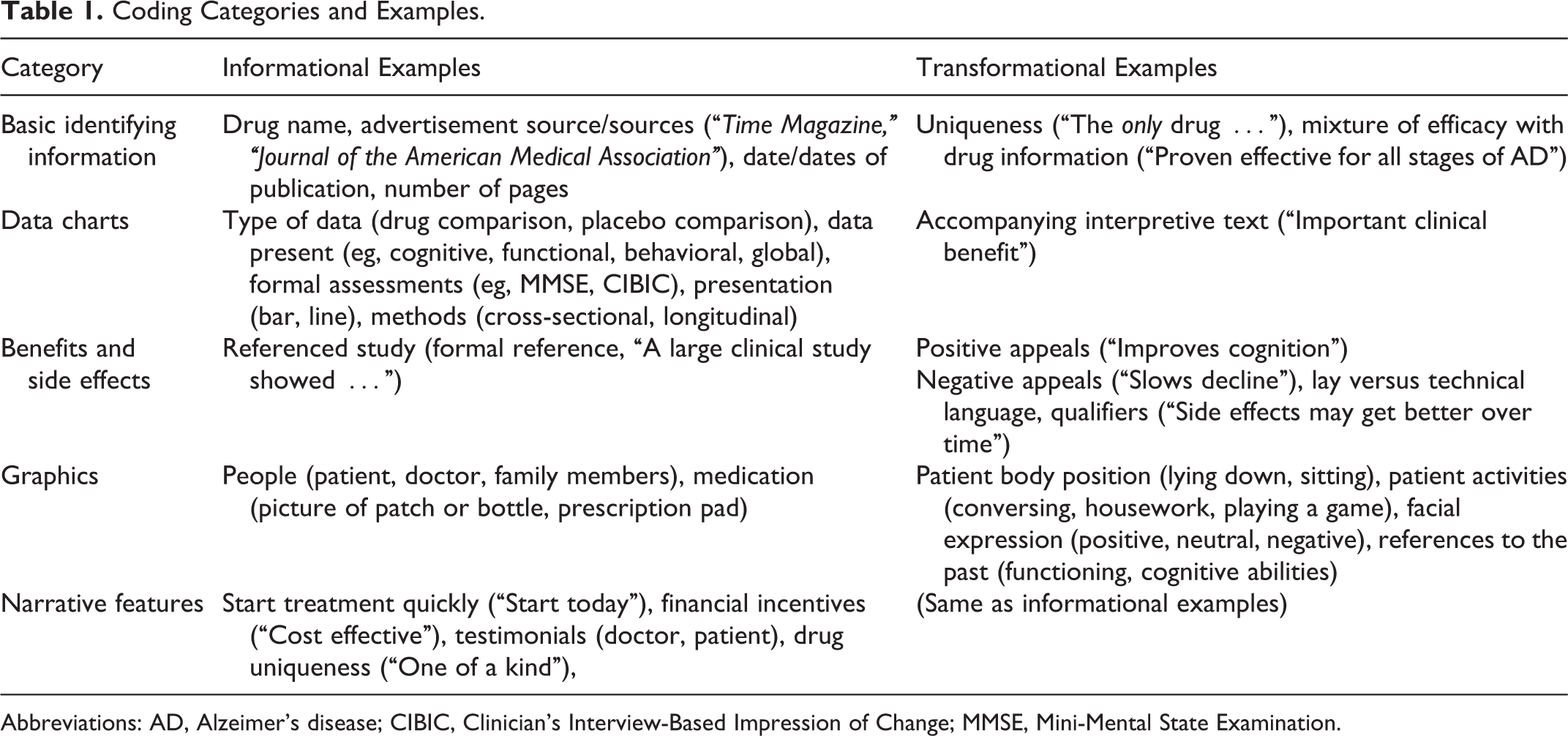
Abbreviations: AD, Alzeimer’s disease; CIBIC, Clinician’s Interview-Based Impression of Change; MMSE, Mini-Mental State Examination.
Categories and Examples of Benefits and Side Effects.
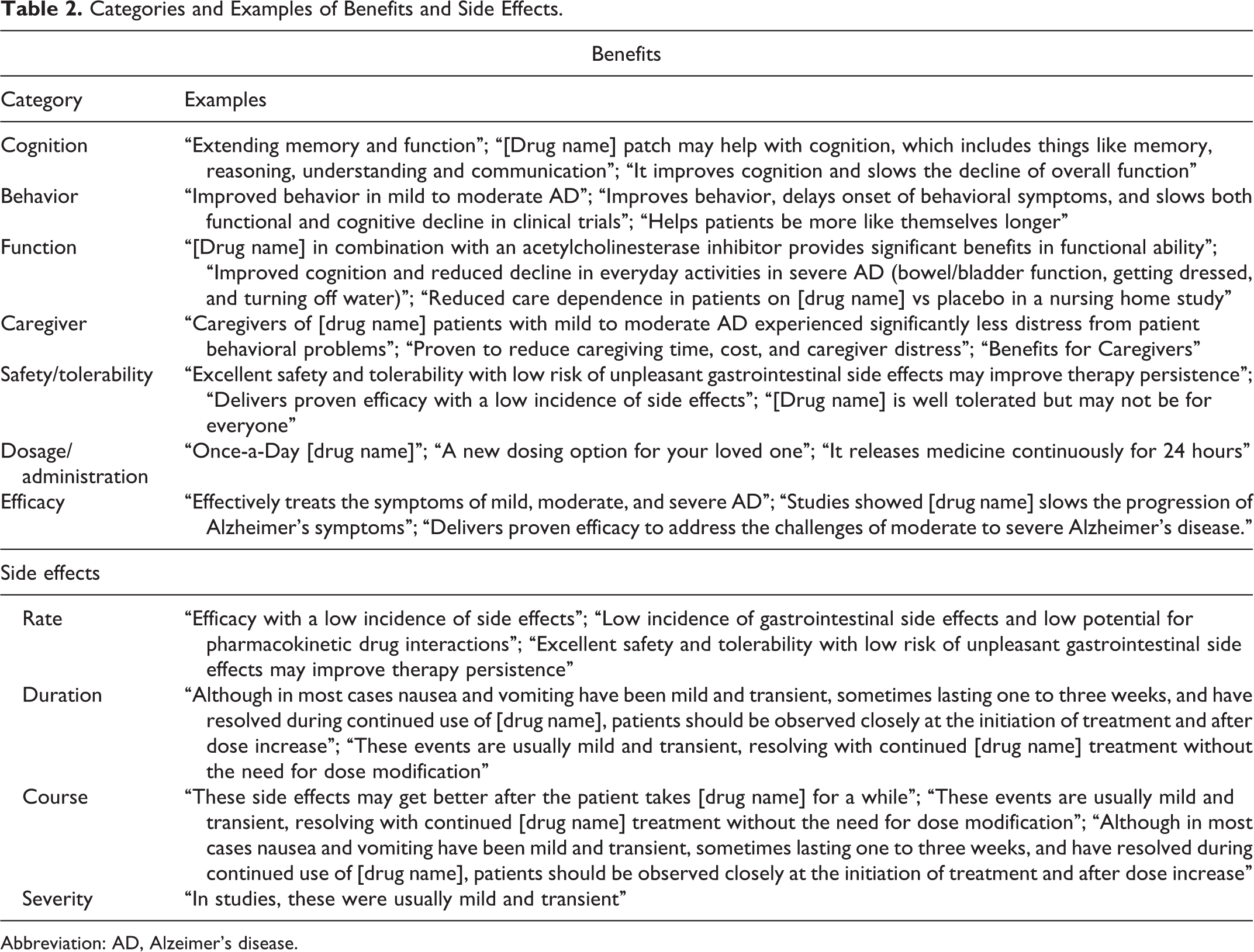
Abbreviation: AD, Alzeimer’s disease.
Three judges, including 2 undergraduate research assistants (male and female, both 20 years old) and a graduate student in clinical psychology (27-year-old male), independently evaluated each advertisement. For training purposes, the judges coded and achieved consensus on 1 advertisement during a group training session. The judges then independently coded 2 additional advertisements and achieved consensus during group meetings. These 3 training advertisements on AD drugs were not included in the final sample. To code advertisements for the sample, the judges first independently coded each advertisement and then met to achieve consensus.
To collect statements regarding drug benefits and side effects, the authors extracted verbatim text from the advertisements and independently reviewed each statement and generated mutually exclusive categories. The authors then met to achieve consensus on categorization. Benefit statements were categorized according to domain (eg, cognitive), and side effects were categorized according to minimizing statements in order to capture transformational features (see Table 2 for categories and examples). We did not classify side effect statements into categories because their presence is mandated by FDA guidelines, and this study is not an analysis of whether appropriate side effects were included.
Results
Basic Drug Features
Most advertisements provided several objective or informational features about the drug, including their FDA-approved indication (mild, moderate, or severe AD), dosage specifications, financial information, and methods to contact the company to obtain more information. In addition, we found transformational features embedded in informational features. For example, many advertisers attempted to distinguish their drug from others by referring explicitly to the indication (eg, “The only monotherapy approved for all stages of AD [emphasis added].” “The only therapy indicated for both mild to moderate Alzheimer’s dementia and mild to moderate Parkinson’s disease dementia [emphasis added].”). Other advertisements included drug indication statements in which persuasive appeals were embedded (eg, “Proven effective for all stages of AD [emphasis added].”). One advertisement claimed that starting treatment with a particular drug would help patients transition to a generic brand in the future, citing a patent expiration date. Advertisements also reassured readers that the drugs would be covered by insurance benefits (eg, “Available on over 90% of commercial health plan and Medicare Part D formularies.”) or that the patients were eligible for discounts (eg, “30 day free trial offer.”). More than one-third of the advertisements introduced a sense of urgency by advising patients to begin treatment quickly (eg, “Treat today.” “Ask the doctor today.”).
Charts
Only 2 advertisements, both targeting medical professionals, included charts, so the results should be interpreted cautiously. These advertisements contained a mixture of informational elements, such as data from drug efficacy studies, and transformational elements, including interpretive statements about the data and chart elements designed to highlight particular outcomes. For example, 1 chart presented data comparing 2 drug dosages, with adjacent boldface text indicating that patients were evaluated on a “primary efficacy variable of change in global function” (ie, the Clinician’s Interview-Based Impression of Change [CIBIC]). However, smaller, not boldface text accompanying the chart indicated that differences across dosages were not statistically significant. A second chart in the same advertisement indicated that patients taking a higher dose of the drug scored significantly better on the Severe Impairment Battery (SIB), a measure of cognition, than patients taking a lower dose, although the viewer would need to examine the y-axis of the chart closely to learn that the difference separating the 2 groups was small (2 points out of 100). Finally, the 2 charts, showing nonsignificant CIBIC and significant SIB data, were summarized with large, boldface text indicating that “ …patients on [drug name] experienced important clinical benefit on both measures.”
In an advertisement for a different drug, a chart depicted differences between placebo and drug groups on a measure of functioning, the Clinical Global Impression of Change. Although the scaling of the chart depicted what appeared to be a substantial difference between the drug and the placebo groups, the data reflect a 1% improvement in the drug group and a 3% decline in the placebo group after a 24-week randomized trial. The prominent text summarizing the chart, however, indicated that the drug “offers improvement in overall functioning” and has “significant benefits.”
Linguistic Features of Benefits and Side Effect Statements
Statements about benefits touched on 3 topics: drug, caregiver, and symptoms. Statements about drug features conveyed ideas about safety (eg, “[drug name] is well tolerated but may not be for everyone.”) and convenient dosage options (e.g., “Once-a-day.”). Caregiver benefits described reduced psychosocial and financial impact (eg, “Proven to reduce caregiving time, cost, and caregiver distress.”). Text about symptom benefits appeared in each advertisement and described the restoration of previous abilities or functioning (eg, “It improves cognition.” “Proven benefits in cognition.”). Just over half of the advertisements claimed that the drugs were “extending” or “improving” symptoms affected by AD. Other statements promised slower decline in cognition, functioning, or behavioral symptoms (eg, “Slows the decline of overall function.” “May delay the onset of behavioral symptoms.”). In addition, benefit statements included both positive (eg,“Improves cognition”) and negative (eg, “Slows decline”) appeals, sometimes in the same advertisement. In each drug benefit category, both informational and transformational advertisement techniques were present.
The language used to describe benefits also differed according to the advertisement source (medical journal or popular magazine). Advertisements designed for medical professionals used technical terms to describe benefits (eg, “efficacy”; “tolerability”), whereas advertisements designed for lay people used more general words (eg, “The drug ‘may help’”). There were, however, notable exceptions to this pattern. Some advertisements targeting medical professionals employed lay language, and others intended for the general public described the drug and its benefits using technical terms. For instance, an advertisement published in People magazine announced “a new dosing option for your loved one.” The large header text gave the brand name as well as technical information not traditionally featured in consumer advertising.
In contrast to benefit statements, almost all side effect statements included qualifiers, employed technical language, and framed the potential adverse event in positive terms. For example, many advertisements claimed that side effects were “usually mild and transient [emphasis added].” One series of advertisements for a drug claimed that side effects “may get better after the patient takes [drug name] for a while [emphasis added].” Most side effect statements were presented using technical terms (eg, “Should be used with caution under conditions that raise urine pH.” “Has the potential to increase gastric acid secretion.”). These technical statements were present in both journals and popular media advertisements. Similarly, other side effect statements presented risks using quantitative information, such as side effect rates between the advertised drug and a placebo (eg, “Nausea [10% vs. 6%”]). In both benefit and side effect text, advertisers informed consumers about drug features, caregiver effects, disease symptoms, and side effects, while simultaneously employing persuasive tactics such as positive and negative framing, qualifying language, and strategic use of technical and lay terms.
Images and Narrative Features
The majority of advertisements used graphics to convey a narrative about companionship, affection, and positive affect. Most (72%) images included what appeared to be family members together: people with AD and their spouses, adult children, and, less often, grandchildren. People with presumed dementia were surrounded by family, conversing, or were helped with a task such as playing a musical instrument or board game. In addition, family members were shown comforting or displaying affection toward the people with presumed AD, hugging or touching them on the shoulder or back. Most of the advertisements depicting family interactions employed positive emotional appeals. Fewer advertisements used negative persuasive appeals, as when individuals with presumed AD were shown alone or were characterized as distant or lost, with negative facial expressions.
Transformational features were also evident in the advertisement text. Several advertisements used the voice of a presumed family member in a form of testimonial (eg, “Mom started on it right away. I’m so glad she did.”). One narrative included the daughter of a person with presumed AD offering technical and diagnostic information, effectively blending informational and transformational appeals (eg, “It improves cognition and slows the decline of overall function.” “[The doctor] explained that her increasing forgetfulness, along with other symptoms, like repeating herself and having difficulty with everyday tasks, were signs of Alzheimer’s.”). Other advertisements indicated that family members wished to help their spouse or parent with treatment (eg, “I want to give to the woman who always gave to me.”). One series of advertisements included rich narratives delivered by adult children and spouses, expressing a desire to “give back to the woman who taught me to savor every moment” or wanting to “give to the man who taught me a sense of harmony.” Finally, also common were statements that encouraged a proactive approach and ambiguous benefits if a drug were prescribed (eg, “He gave it his all, you can help him.”).
Discussion
In this study, we reviewed recent print advertisements for AD medications in order to provide a comprehensive analysis of how AD medications are portrayed in popular magazines and medical journals. We found that many elements in the advertisements mix informational and transformational features, providing facts while at the same time attempting to persuade viewers of the value of using a drug. Persuasive strategies combine—in individual advertisements and often within the same elements—facts and emotional appeals. Pechman and Stewart 15 present evidence that so-called rational advertisements often elicit affective responses in viewers and emotional advertisements often contain factual drug information, and findings from this study suggest that advertisements for AD drugs include similarly multilayered messages.
In our sample, most advertisements provide basic identifying information about a drug, such as indication and dosage specifications. This basic information helps a viewer decide how relevant an advertisement is to their own or someone else’s health status or, in the case of physicians, the patients they treat. Within these informational features, however, are subtle transformational features as well. For example, when an advertisement states “Effectively treats the symptoms of mild, moderate, and severe AD,” a statement about drug indication is couched in text emphasizing efficacy. Informational statements also address a range of patient and physician concerns related to drug administration, course, and affordability, yet at the same time they employ persuasive techniques to induce the viewer to act. Previous research16–18 has found that basic drug information in advertisements has some educational value for consumers, yet the relative contribution of informational and transformational persuasive tactics to consumer learning is unclear. Our finding that even basic drug information combines drug facts with persuasive techniques suggests that it might be productive for future research to pair content analyses with assessments of what consumers learn from advertisements and how that changes their behavior.
Although our sample included only 2 advertisements containing data charts, we reviewed them because they exemplify the tension between informational and transformational content. These advertisements present the AD drugs in a positive light even if chart data do not favor their use. Although charts can be used to convey data and evidence of effectiveness (presumably objective, informational elements), their appearance in advertisements also adds an air of scientific legitimacy (a transformational intention), even when the data are not convincingly in favor of a drug’s use. For example, one advertisement claiming “important clinical benefit” in cognition and function referenced a randomized control trial 19 designed, conducted, analyzed, and written by the pharmaceutical company. Moreover, this study indicated that individuals with moderate to severe AD gained only 2 points out of 100 on the SIB measure of cognition, experienced no functional improvement, and reported a significantly greater number of treatment-related adverse events when compared to a control group on a lower dose of the same medication. The inclusion of data charts and research citations lends a superficial air of objective empiricism, even if consumers and clinicians are not likely to have the knowledge or time to interpret them carefully.
A similar overlap of informational and transformational strategies is evident in the linguistic features of benefit and side effect statements. Although statements about drug benefits may seem on their face to be purely informational, they often contain language designed to persuade the viewer to seek out a product.2,4,16 Benefit statements include positive (eg, “Improves”) and negative (eg, “Slows decline”) persuasive appeals. Although one study 16 found that positive appeals are employed in the large majority of advertisements for many drugs, their use in AD is notable, given its neurodegenerative course. Benefit statements that utilize technical terms (eg, “Efficacy”, “Statistically significant benefit”) might lend scientific legitimacy to advertisements published in popular media. Conversely, advertisements targeting physicians that employ lay terms to describe drug benefits (eg, “You can help him.”) seem designed to spark an emotional reaction while presenting objective drug and disease information.
In contrast, side effect statements tend to minimize potential impact using qualifying language such as “may get better,” “usually mild,” and “resolving with continued treatment.” Another strategy is to present information in quantitative terms, which may be more confusing to viewers than a simple statement about risks. In their sample of drug advertisements from 10 magazines, Woloshin and colleagues 8 found that many risk statements contained quantitative data, whereas benefit statements were written in general lay language. The authors recommended that the FDA mandate a standardized presentation of benefits and risks, thereby minimizing any marketing strategy that pharmaceutical companies may use. Schwartz, Woloshin, and Welch 20 later tested this premise in an experimental trial comparing the use of a standardized drug box, listing benefits and side effects in a clear manner, with a standard drug summary section that appears in current advertisements. Consumers exposed to the drug box, even though it contained some quantitative information, were better able to evaluate the drug than those given a standard advertisement. In summary, our review of benefit and side effect language suggests that advertisements for AD drugs amplify benefits and minimize side effects through the use of transformational advertising techniques.
Finally, we examined narrative features of the advertisements in images and text, both of which used emotional appeals to evoke a positive psychological response in the viewer, promoting a drug’s use. Images in AD advertisements of older adults and presumably their intergenerational family, touching, conversing, and caring help to comprise a warm, positive narrative for a family’s experience with AD. Likewise, advertising text sends the message that family members have expertise and experience with AD drugs, are satisfied with their performance, and feel an obligation to seek out treatments proactively (eg, “Alzheimer’s isn’t waiting, I wasn’t going to wait either.”). These first-person phrases convey immediacy and action, despite how vague they are about the disease process and the hypothetical patient’s status. In both graphics and text, advertisements evoke nostalgia, intimacy, and obligation, encouraging viewers to believe that getting someone a drug fulfills an intergenerational, spousal, or professional compact. There is some evidence that these kinds of persuasive techniques may be effective in guiding behavior. One review 21 found that persuasive appeals might be more effective in older adults in particular, given the physical and cognitive changes associated with aging, which may increase the salience of narrative text and images using negative persuasive techniques.
Although our study is the first, to our knowledge, to examine the content of advertisements for AD drugs, several limitations should be noted. The AdPharm database from which we obtained several advertisements only reports the first publication date of advertisements, so we do not know how often they appeared in print and therefore cannot be certain of their reach and impact. The sample included a relatively small number of advertisements, coded by necessity with a qualitative approach, and those methodological realities should be considered. We also focused on drugs for the treatment of AD, and our results may not generalize to other classes of drugs. Finally, our study did not examine the actual effects of the marketing strategies on consumers and physicians. Future studies could use experimental methods to examine how patients, caregivers, and physicians view and interpret advertisements for AD drugs to understand how people with the disease respond to advertisements and how advertisements affect treatment choices.
Conclusion
As pharmaceutical companies and research scientists intensify their efforts to develop treatments of AD, it is important for consumers and clinicians to be aware of how these treatments are marketed, since the ultimate goal of advertisements is to influence prescription patterns. Drug advertisements can help educate consumers and may even encourage active discussion between patients and their clinicians. 17 However, drug advertisements are advertisements with a sales and marketing intent as well. All elements of print advertisements—text and images, data charts, benefit and side effect statements—are designed by sophisticated marketing teams to accomplish one goal: encourage prescribing. Consumers and clinicians should be aware of advertising strategies in order to be critical viewers and informed advocates for themselves and their patients. By understanding drug and disease claims made by advertisers, consumers will be better able to communicate with physicians about treatment options and will have more realistic expectations for the efficacy of AD drugs. Similarly, physicians will be better prepared to communicate effectively with their patients and make informed, collaborative treatment decisions.
Footnotes
Appendix A
Declaration of Conflicting Interests
The authors declared no potential conflicts of interest with respect to the research, authorship, and/or publication of this article.
Funding
The authors received no financial support for the research, authorship, and/or publication of this article.