




Abstract
X-ray repair cross complementary group gene is one of the most studied candidate gene involved in different types of cancers. Studies have shown that X-ray repair cross complementary genes are significantly associated with increased risk of breast cancer in females. Moreover, studies have revealed that X-ray repair cross complementary gene polymorphism significantly varies between and within different ethnic groups globally. The present case–control study was aimed to investigate the association of X-ray repair cross complementary 1A (Arg194Trp) and X-ray repair cross complementary 3 (Thr241Met) polymorphism with the risk of breast cancer in females from northeastern region of India. The present case–control study includes histopathologically confirmed and newly diagnosed 464 cases with breast cancer and 534 apparently healthy neighborhood community controls. Information on sociodemographic factors and putative risk factors were collected from each study participant by conducting face-to-face interviews. Genotyping of X-ray repair cross complementary 1A (Arg194Trp) and X-ray repair cross complementary 3 (Thr241Met) was carried out by polymerase chain reaction-restriction fragment length polymorphism. For statistical analysis, both univariate and multivariate logistic regression analyses were performed. We also performed stratified analysis to find out the association of X-ray repair cross complementary genes with the risk of breast cancer stratified based on menstrual status. This study revealed that tryptophan allele (R/W-W/W genotype) in X-ray repair cross complementary 1A (Arg194Trp) gene significantly increased the risk of breast cancer (adjusted odds ratio = 1.44, 95% confidence interval = 1.06-1.97, P < .05 for R/W-W/W genotype). Moreover, it was found that tryptophan allele (W/W genotype) at codon 194 of X-ray repair cross complementary 1A (Arg194Trp) gene significantly increased the risk of breast cancer in premenopausal females (crude odds ratio = 1.66, 95% confidence interval = 1.11-2.46, P < .05 for R/W-W/W genotype). The present study did not reveal any significant association of X-ray repair cross complementary 3 (Thr241Met) polymorphism with the risk of breast cancer. The present study has explored that X-ray repair cross complementary 1A (Arg194Trp) gene polymorphism is significantly associated with the increased risk of breast cancer in premenopausal females from northeastern region of India which may be beneficial for prognostic purposes.
Keywords
Introduction
X-ray repair cross complementary group (XRCC) gene is one of the most studied candidate gene involved in different types of cancers. 1 –4 XRCC genes are involved in base excision repair (BER) and single-strand break in damaged DNA in human genome. 1 –5 Molecular epidemiological studies have shown that XRCC genes are significantly associated with lung cancer, 6 –9 oral cancer, 10 bladder cancer, 11 –13 ovarian cancer, 14,15 esophageal cancer, 16 and gastric cancer. 17 –23 Moreover, studies have revealed that XRCC gene polymorphism is highly variable in different ethnic populations. 24 –28
Studies have shown that defect in DNA repair mechanism is significantly associated with the increased risk of breast cancer (BC) in females. 29 Molecular epidemiological studies have been carried out globally to investigate the association of DNA repair mechanism genes with the risk of BC in females from different ethnicity. 30 Studies have revealed that polymorphisms in XRCC1A (Arg194Trp) and XRCC 3 (Thr241Met) genes are significantly associated with the increased risk of BC in different ethnic populations, though the results are inconsistent which may be due to environmental factors, ethnocultural variations, and/or variations in linkage disequilibrium of these 2 genes, namely, XRCC1A and XRCC3. 24,29,31 –41
In India, BC is an emerging public health concern. 42 Thus, identification of epidemiological and genetic factors significantly associated with the increased or decreased risk of BC in females from different ethnic groups of India is at utmost need to combat this disease at the earliest. 43 In recent years, Population Based Cancer Registry (PBCR) data of India have reported high number of BC cases in females from northeast (NE) region of India. 43,44 The PBCR data have shown incidence of BC in females of NE region varies from 7.2 per 100 000 populations in Tripura to 30 per 100 000 populations in Aizawl and Kamrup districts. 43 Molecular epidemiological studies have revealed that mutations and/or polymorphisms in tumor suppressor genes, DNA repair mechanism genes, and innate immune pathway genes are significantly associated with the increased risk of BC in females from NE region of India. 45,46 Our earlier study has found that 22-base pair deletion in promoter region of TLR2 gene significantly increased the risk of BC in females from NE region of India carrying proline allele at codon 72 of their TP53 gene. 47 Thus, to elucidate the association of DNA repair mechanism genes with the risk of BC in females from this region, the present case–control study was carried out in 4 different states of NE region, India, namely, Assam, Meghalaya, Tripura, and Mizoram. The present molecular epidemiological study was aimed to investigate the association of XRCC1A (Arg194Trp) and XRCC3 (Thr241Met) polymorphism with the risk of BC in females from NE region which may be beneficial for prognostic purposes.
Materials and Methods
Ethics Statement
This study has been approved by the institutional ethics committee of Regional Medical Research Centre, Indian Council of Medical Research–NE Region, Dibrugarh, Assam (RMRC/Dib/IEC(Human)/2008-09/3243 dated February 19, 2009). All the participants, both cases and controls, provided their written informed consent to be included in this study.
Study Participants and Specimen Collection
This case–control study, conducted from 2010 to 2014, included females from 4 states of NE region of India, namely, Assam, Meghalaya, Mizoram, and Tripura. All 464 BC cases were confirmed by histopathological analysis and all were newly diagnosed. Patients with severe clinical symptoms, patients with recurrent cancer, patients too old to be interviewed, and patients refused to be interviewed were excluded from this study. Five hundred thirty-four neighborhood controls, that is, apparently healthy female participants, were selected by organizing community surveys from the neighborhood of cases. Exclusion criteria for selecting controls were females not willing to participate in the study or having any other type of disease or have undergone blood transfusion in the last 1 year. Information on sociodemographic factors, anthropogenic measurements, and other putative risk factors was collected from the cases and controls by face-to-face interviews, and information gathered was recorded in a predesigned questionnaire. Peripheral whole blood was collected from each study participant in EDTA-containing vials and stored at −80C until analyzed. Breast tissue biopsy samples were immediately fixed in neutral-buffered formalin and kept for 48 hours. Subsequently, the fixed breast tissue samples were thoroughly washed in 70% ethanol, dehydrated in graded series of ethanol, cleaned in xylene, and embedded in paraplast (Sigma St. Louis, MO, USA) for further histological and immunohistochemical analyses.
Genotyping of XRCC1A (Arg194Trp) and XRCC3 (Thr241Met) Polymorphisms
Isolation of DNA for genotyping was carried out by using Qiagen DNeasy(R) Blood kit, and amplification and identification of XRCC1A (Arg194Trp) and XRCC3 (Thr241Met) genes were performed using the following primer sequences: 5′-GCC CCG TCC CAG GTA-3′ (forward), 5′-AGC CCC AAG ACC CTT CAC T-3′ (reverse) for XRCC1A (Arg194Trp) and 5′-GGT CGA GTG ACA GTC CAA AC-3′ (forward), and 5′-TGC AAC GGC TGA GGG TCT T-3′ (reverse) for XRCC3 (Thr241Met) gene, respectively. Genotyping of XRCC1A and XRCC3 was carried out by polymerase chain reaction–based restriction fragment length polymorphism (PCR-RFLP) as described by Zhang et al. 48 In brief, PCR was performed with 100 ng of genomic DNA using 12.50 µL GoTaq Hot Start master mix (2x; Promega, Madison, WI, USA) with 9.0 µL nuclease-free water (Promega), 0.50 µL 25 mmol/L magnesium chloride (Promega), and 10 pmol 0.5 µL of each forward and reverse primers. Polymerase chain reaction was carried out using GeneAmp PCR system 9700 (Applied Biosystem, USA). The PCR conditions were initial denaturation at 95°C for 2 minutes followed by 32 cycles at 95°C for 0.5 seconds, 63°C for 0.5 seconds, and 72°C for 60 seconds for XRCC1A (Arg194Trp) and 95°C for 0.5 seconds, 65°C for 0.5 seconds, and 72°C for 60 seconds for XRCC3 (Thr241Met) gene followed by at 72°C for 10 minutes for both the primers. The amplified products were subjected to MspI (New England Biolabs, Beverly, Massachusetts) and NlaIII (New England Biolabs) restriction enzyme digestion for XRCC1A (Arg194Trp) and XRCC3 (Thr241Met) genes, respectively, in a 7.50 µL reaction mixture containing restriction endonuclease and reaction buffer following the manufacturer’s protocol. The reaction mixture was incubated at 37°C for 16 hours. The restriction-digested products were then resolved on polyacrylamide gel electrophoresis for XRCC1A (Arg194Trp) and on 3% agarose gel for XRCC3 (Thr241Met) genotyping, respectively. Gels were stained with ethidium bromide and visualized in ultraviolet light. The PCR-RFLP products were further confirmed by Lab Chip (Caliper Life Sciences Inc, Waltham, Massachusetts).
Statistical Analysis
Univariate and multivariate logistic regression analyses were performed by using SPSS version 17.0 (SPSS Inc, Chicago, Illinois). A P value <.05 was taken as statistically significant. Initially, we carried out univariate logistic regression analysis where a single putative risk factor was analyzed to determine the crude odds ratio (OR) and 95% confidence interval (CI). The multiple logistic regression analysis was performed adjusted for age, region, menstrual status, marital status, betel nut chewing, tobacco smoking or chewing, alcohol consumption, dry fish and dry meat, and bamboo shoots consumption. We also carried out stratified analysis where the study population was stratified into 2 groups, based on their menopausal status: group 1 participants were premenopausal females, whereas group 2 consisted of postmenopausal females from NE region of India. Before performing association study, the Hardy-Weinberg equilibrium (HWE) for any deviation from expected allele frequencies was tested by using χ2 test.
Results
Patient Characteristics
The study comprised of 464 histopathologically confirmed newly diagnosed BC cases and 534 apparently healthy neighborhood community control samples collected from adjacent regions from where cases were obtained. Demographic features of both cases and controls are presented in Table 1.
Demographic Features of Study Population.

Abbreviations: BC, breast cancer; SD, standard deviation.
Test for HWE
Before carrying out association studies with genotypic data, control results were tested for HWE. Both XRCC1A (Arg194Tryp) and XRCC3 (Thr241Met) polymorphisms in control samples did not deviate from HWE (P = .114 for XRCC1A [Arg194Trp] gene and P = .250 for XRCC3 [Thr241Met] gene).
Association of XRCC1A (Arg194Trp) Polymorphisms With the Risk of BC in Females From NE Region of India
To investigate the association of XRCC1A (Arg194Tryp) polymorphism with the increased risks of BC, both univariate and multivariate logistic regression analyses were carried out. Multivariate logistic regression analysis was performed after adjustment of age, region, menstrual status, marital status, betel nut chewing, tobacco smoking, alcohol consumption, dry fish, dry meat, and bamboo shoots consumption habit. Univariate logistic regression analysis has revealed that tryptophan allele (R/W-W/W genotype) in XRCC1A (Arg194Trp) gene significantly increased the risk of BC in females from NE region of India (crude OR = 1.31, 95% CI = 1.02-1.70, P < .05; Table 2), whereas multivariate logistic regression analysis after adjustment of age, region, menstrual status, marital status, betel nut chewing, tobacco smoking, alcohol consumption, dry fish, dry meat, and bamboo shoots consumption habit has revealed that tryptophan allele in XRCC1A genotype increased the risk of BC 1.44-fold (adjusted OR = 1.44, 95% CI = 1.06-1.97, P < .05 for R/W-W/W genotype; Table 2).
Association of XRCC1A (Arg194Trp) Polymorphism With the Risk of Breast Cancer in Females From NE Region of India.

Abbreviations: AOR, adjusted OR, adjusted for age, region, marital status, menopausal status, betel nut chewing, tobacco smoking, alcohol consumption, dry fish, dry meat, and bamboo shoots consumption habit; CI, confidence interval; NE, northeast; OR, odds ratio; R, arginine; W, tryptophan; XRCC, X-ray repair cross complementary.
aStatistically significant at P < .05.
Moreover, to find out the association of XRCC1A (Arg194Trp) genotype with the risk of BC, we carried out stratified logistic regression analysis. For stratified analysis, the study population was divided into 2 strata: strata 1 comprised of premenopausal females, whereas strata 2 comprised of postmenopausal females. After stratification based on menopausal status of study population, univariate logistic regression analysis and multivariate logistic regression analysis adjusted for age, region, menstrual status, marital status, betel nut chewing, tobacco smoking, alcohol consumption, dry fish, dry meat, and bamboo shoots consumption habit were carried out. Multivariate logistic regression analysis of stratified data set has shown that tryptophan allele (R/W-W/W genotype) in XRCC1A (Arg194Trp) gene significantly increased the risk of BC in premenopausal females (crude OR = 1.66, 95% CI = 1.11-2.46, p<0.05 for R/W-W/W genotype) from NE region of India (Table 3).
Association of XRCC1A (Arg194Trp) Polymorphism With Risk of Breast Cancer in Females From NE Region of India Stratified on the Basis of Menopausal Status.

Abbreviations: AOR, adjusted OR, adjusted for age, region, marital status, menopausal status, betel nut chewing, tobacco smoking, alcohol consumption, dry fish, dry meat, and bamboo shoots consumption habit; CI, confidence interval; NE, northeast; OR, odds ratio; R, arginine; W, tryptophan; XRCC, X-ray repair cross complementary.
aStatistically significant at P < .05.
Association of XRCC3 (Thr241Met) Polymorphism With Risk of BC in Females From NE Region, India
To investigate the association of XRCC3 (Thr241Met) genotype with the risk of BC in females from NE region of India, both univariate and multivariate logistic regression analyses after adjusting for age, region, menstrual status, marital status, betel nut chewing, tobacco smoking, alcohol consumption, dry fish, dry meat, and bamboo shoots consumption habit were carried out. Both univariate and multivariate logistic regression analyses have revealed no significant association of XRCC3 (Thr241Met) genotype with the risk of BC (Table 4).
Association of XRCC3 (Thr241Met) Polymorphism With Risk of Breast Cancer in Females From NE Region of India.a

Abbreviations: AOR, adjusted OR, adjusted for age, region, marital status, menopausal status, betel nut chewing, tobacco smoking, alcohol consumption, dry fish, dry meat and bamboo shoots consumption habit; CI, confidence interval; M, methionine; NE, northeast; OR, odds ratio; T, threonine; XRCC, X-ray repair cross complementary.
aStatistically significant at P < .05.
Moreover, to find out the association of XRCC3 (Thr241Met) gene polymorphism with risk of BC in premenopausal and postmenopausal females in NE region of India, we carried out stratified logistic regression analysis by stratifying the study population into 2 groups, namely, group 1 for premenopausal females and group 2 for postmenopausal females. After stratification, both univariate logistic regression analysis and multivariate logistic regression analysis adjusted for age, region, menstrual status, marital status, betel nut chewing, tobacco smoking, alcohol consumption, dry fish, dry meat, and bamboo shoots consumption habit were carried out. Both univariate and adjusted multivariate logistic regression analyses of stratified data set revealed no significant association of XRCC3 (Thr241Met) gene with the risk of BC (Table 5).
Association of XRCC3 (Thr241Met) Polymorphism With Risk of Breast Cancer in Females From NE Region of India Stratified on the Basis of Menopausal Status.a
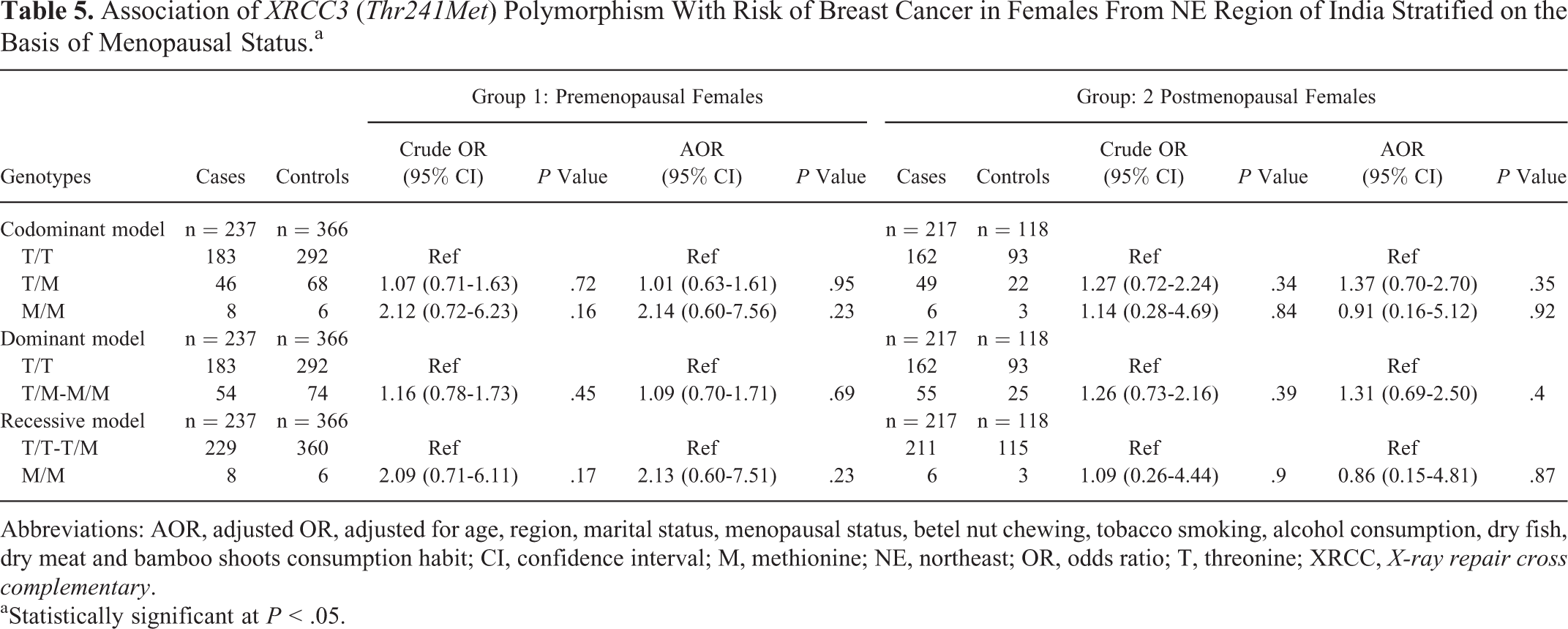
Abbreviations: AOR, adjusted OR, adjusted for age, region, marital status, menopausal status, betel nut chewing, tobacco smoking, alcohol consumption, dry fish, dry meat and bamboo shoots consumption habit; CI, confidence interval; M, methionine; NE, northeast; OR, odds ratio; T, threonine; XRCC, X-ray repair cross complementary.
aStatistically significant at P < .05.
Discussion
XRCC genes are commonly known for their involvement in BER mechanisms in small DNA lesions generally induced by oxidative stress. 25 Defects in DNA repair mechanisms have been found to be significantly associated with increased risk of BC. 29 Molecular epidemiological studies have revealed that polymorphisms in DNA repair mechanism genes are significantly associated with the increased or decreased risk of BC in different ethnic populations. 49,50 The present study was carried out to investigate the association of 2 most studied candidate genes of DNA repair mechanism, namely, XRCC1A (Arg194Trp) and XRCC3 (Thr241Met), with the risk of BC in females from NE region of India.
Epidemiological studies have shown that reproductive status of females is significantly associated with the risk of BC. 51 Endocrinological studies have revealed that alternations from male to female sex hormone ratio, that is, from androgen to estrogen conversion, high rate of androgen biosynthesis, and low circulatory estrogen level, are significantly associated with the increased risk of BC in females at different menstrual phase. 52 It has been found that high concentration of circulating estradiol is significantly protective in the onset of BC. 53 However, both clinical and epidemiological studies did not reveal yet how low estrogen synthesis promotes early onset of BC in premenopausal females. 54 It is postulated that genetic alternation in metabolic and/or inflammatory genes, tumor suppressor genes, and DNA repair mechanism genes in tumor microenvironment of breast may be important determinant to develop BC in females. 51,54
Studies have shown that reproductive factors and food habit significantly increased the risk of BC in females by modulating cellular oxidative stress. 55 Molecular epidemiological studies have shown that polymorphisms in DNA repair pathway-associated genes may produce altered protein product which can modulate tumorigenesis and its transformation toward carcinogenesis in breast tissue. 56 Studies from NE region of India have shown that reproductive status and food habits are significantly associated with the increased risk of BC in females in this region. 57 Moreover, epidemiological studies have shown that betel nut chewing significantly increase the risk of BC in females from NE region. 46 Biochemical studies have revealed that betel nuts are mainly composed of different types of alkaloids, such as arecoline, arecaidine, guvacine, and guvacoline, which effectively bind with the DNA after being nitrated and may produce DNA adducts 58 and thus significantly associated with the increased risk of BC in females. 59,60 Molecular epidemiological studies have postulated that tobacco smoke–derived carcinogens can modulate the expression of DNA repair mechanism pathway genes. 30 Experimental studies have suggested that tobacco smoke contain polycyclic aromatic hydrocarbons (PAHs), aromatic amines, and nitrosamines which cross the alveolar membrane in the lung tissue and after conjugation with lipoproteins carried to the breast epithelium via circulation, 61 where these carcinogenic chemicals induce DNA adducts. 62 Epidemiological studies have shown significant association between smoking and the increased risk of BC among postmenopausal females. 33 Similarly, studies have shown that ethanol consumption significantly stimulates the cell proliferation by altering the expression of transcription factors associated with the ER signaling pathway in females. 63,64 Biochemical studies have shown that heterocyclic amines present in dried fish and fried meat act as strong carcinogens. 65 In NE region of India, people from different ethnic groups consume dry fish and dry meat either regularly or occasionally. 66 Studies have shown that dry fish and dry meat consumption significantly associated with the increased risk of cancers in NE region. 67 Keeping these in view, it is hypothesized that betel nut chewing, tobacco smoking and/or chewing, alcohol, dry fish, and dry meat consumption act as putative risk factors for tumorigenesis in females from NE region of India. 68 In the present study, to investigate the association of XRCC1A (Arg194Trp) and XRCC3 (Thr241Met) polymorphisms with the increased risk of BC in females from NE region of India, we performed multivariate logistic regression analysis making adjustment of age, region, menstrual status, marital status, betel nut chewing, tobacco chewing and/or smoking, alcohol, dry fish, and dry meat consumption habits.
Molecular epidemiological studies have shown that Arg/Trp (R/W) allele in XRCC1A (Arg194Trp) gene is significantly associated with the increased risk of BC in perimenopausal females, aged between 45 and 54 years. 69 Moreover, studies have revealed that protein product of XRCC1A (Arg194Trp) gene is associated with the regulation of protein–protein interactions in ADPRT and DNA polymerase β. 3,25 It has been found that sequence alternation in XRCC1A (Arg194Trp) gene encodes a twisted gene product capable to modulate cellular innate DNA repair mechanism and thus increase the risk of oncogenesis. 70 –73 Molecular epidemiological studies have revealed significant association of XRCC1 polymorphism with the increased risk of BC in females, although the results are inconsistent in different ethnic populations globally 38,39,41,74 (Figure 1). Our present case–control study has shown that tryptophan allele (R/W-W/W genotype) in XRCC1A (Arg194Trp) gene significantly increased the risk of BC 1.44-fold (adjusted OR = 1.44, 95% CI 1.06-1.97, P < .05). This study has also revealed that W/W genotype in XRCC1A (Arg194Trp) gene significantly increased the risk of BC 2.48-fold (OR = 2.48, 95% CI 1.08-5.69, P < .05) in premenopausal females from NE region of India (Table 3).

Association of XRCC1A (Arg194Trp) polymorphism with the increased risk of breast cancer (BC) and its comparison with our present case–control study. Comparative analysis of association between XRCC1A (Arg194Trp) polymorphism and the risk of BC in different ethnic populations globally.
XRCC3 gene encodes a protein, related to the member of Rad 51 family, responsible for homologous recombination repair of DNA double-strand break. 75,76 Studies have shown that single base pair substitution in the exon number 7 of the XRCC3 gene, commonly known as codon 241, may influence the enzyme function of DNA repair mechanism and thus causes DNA damage. In vitro studies have shown that XRCC3 gene knockout cells are highly sensitive to DNA damaging agents. 77 Molecular epidemiological studies have revealed that XRCC3 Thr241Met polymorphism may alter DNA repair capacity and significantly influence the susceptibility to carcinogens (Figure 2). Studies have found significant association between XRCC3 polymorphism and increased risk of colon cancer, 78,79 gastric cancer, 22,23 bladder cancer, 13 thyroid cancer, 80 renal cell carcinoma, 81 and lung cancer. 82,83 Moreover, studies have shown that methionine allele (M/M genotype) in XRCC3 (Thr241Met) gene significantly increased the risk of BC. 72,73,84 –87 However, studies also have found no association of XRCC3 (Thr241Met) gene with the risk of BC and thus compelled to hypothesize that ethnic variation also persists between XRCC3 (Thr241Met) polymorphism and the risk of BC in females. 38,40,88 –90 However, It has been assumed that XRCC3 (Thr241Met) is an important candidate gene in tumorigenesis. 91 Thus, to investigate the association of XRCC3 (Thr241Met) polymorphism with the increased risk of BC in females from NE region of India, we carried out both univariate and multivariate logistic regression analyses after adjustment for reproductive factors and food habits. Moreover, to find out the association between XRCC3 polymorphism and the risk of BC in females, we stratified our study population into premenopausal and postmenopausal strata. However, the present case–control study did not reveal any significant association of XRCC3 (Thr241Met) polymorphism with the risk of BC in females from NE region of India (Table 5).

Association of XRCC3 (Thr241Met) polymorphism with the increased risk of breast cancer (BC) and its comparison with our present case–control study. Comparative analysis of association between XRCC3 (Thr241Met) polymorphism and the risk of BC in different ethnic populations globally.
In the present case–control study, we did not perform follow-up study of patients with BC to investigate the association of XRCC1A (Arg194Trp) and XRCC3 (Thr241Met) polymorphisms with the anticancer treatment regime due to logistic issues. Moreover, we were also unable to explore the expressional profiling of these 2 genes due to limited resources. Thus, the primary limitations of this study are cross-sectional design instead of longitudinal design and unavailability of expressional profiling data of XRCC1A and XRCC3 genes, respectively.
Conclusion
The present study has revealed that XRCC1A (Arg194Trp) polymorphism is significantly associated with the increased risk of BC in females from NE region of India. Moreover, this study has shown that tryptophan allele in XRCC1A (Arg194Trp) gene significantly increased the risk of BC 2.48-fold in premenopausal females. However, the present study did not reveal any significant association of XRCC3 (Thr241Met) polymorphism with the risk of BC. Future studies with larger sample size and with more single-nucleotide polymorphisms related to DNA repair mechanism of human genome are required to elucidate the association of DNA repair mechanism genes with the risk of BC in females from NE region of India.
Footnotes
Abbreviations
Acknowledgments
The authors would like to thank all study participants for their cooperation.
Declaration of Conflicting Interests
The author(s) declared no potential conflicts of interest with respect to the research, authorship, and/or publication of this article.
Funding
The author(s) disclosed receipt of the following financial support for the research, authorship, and/or publication of this article: This work was supported by the Indian Council of Medical Research (ICMR), India.