




Abstract
Introduction
Cancer, a leading cause of global deaths, is a group of diseases caused by uncontrolled growth and spread of abnormal cells. 1 In developed and developing countries, cancer cases have been increasing gradually, the most common types being breast, lung, colon, rectal, and prostate cancers. 2 Nearly one-third of cancer deaths are attributed to smoking, BMI, alcohol consumption, inadequate consumption of fruits and vegetables, and lack of physical activity.2,3 Cancer-causing infections, such as HPV and hepatitis, account for approximately 30% of cases in low- and middle-income countries. 3 In 2020, approximately 19.3 million new cases and 10 million cancer-related deaths were reported, and these figures are expected to increase in the next few decades.1,3–4 Over the past decades, cancer treatment options have expanded; however, only a few patients can access and afford these options. Therefore, enhancing the affordability and personalization of cancer treatment is necessary. 5 Early cancer detection increases the possibility of treatment and recovery. 3 As a complex disease, the development and growth of cancer involve numerous microscopic and macroscopic changes in cell morphology that remain to be completely understood. 5 Recently, machine learning (ML) techniques, such as deep neural networks, have attracted attention to assist cancer diagnosis and treatment.6,7
Artificial intelligence (AI), a branch of computer science, has advanced significantly in various fields, including healthcare, medicine, and biomedical research.8,9 AI enables computers with decision-making and logical reasoning to solve complex and novel problems. 7 Furthermore, deep learning (DL) is a ubiquitous and widely used sub-discipline of ML. Its infrastructure is a powerful framework leveraging transformation and graph technologies to construct complex multilayered learning models. In ML algorithms, the data quality is directly related to the degree of learning and generalization of the models. Thus, most studies have implemented feature engineering and extraction methods.8,9 DL has been used to simulate the human brain processes for designing models that can extract essential features from raw and cleaned data.10,11 Deep convolutional networks with a multilayer architecture have been designed to extract low-level features in the initial layers, whereas higher-level features are extracted in the subsequent layers as the model is fed with data. 11 This field has wide applications in various scientific and technical areas, such as data mining, medical diagnosis, computer vision, and natural language processing.7,12
Generally, ML uses linear algebra for data processing using matrix data as the input. 9 Advancements in these technologies have rendered classical computing limited, owing to its architecture of bits and classical algorithms. However, quantum computing potentially overcomes these limitations using quantum bits or qubits. 13 It is a novel field that combines computer science, mathematics, and physics to build quantum computers (QCs). 14 Contrary to bits, qubits can possess values of 0, 1, or a superposition of both, thus enabling the parallel-processing of massive matrix data.13,14 Quantum computing is based on the principles of quantum physics, which governs the behavior of matter at the molecular and subatomic levels, and propounds that particles can exhibit wave- and particle-like characteristics. 15
Compared to classical computers, QCs can perform certain calculations exponentially faster because they can simultaneously exist in multiple states through superposition, which is accomplished using quantum parallelism. 13 Using QCs, the performance of routine tasks is seldom faster or slower than that using conventional computing. However, the time period that classical computers require to solve specific problems remains to be determined. QCs can solve similar problems rapidly and with less storage space by employing specific quantum algorithms. However, this does not imply that all tasks must be transferred to QCs.
Quantum computing has various applications in cryptography, healthcare, and AI. 15 Applying ML algorithms based on the principles of quantum computing has created a new field called quantum machine learning (QML), 16 which has significantly advanced classical ML applications (Figure 1). Furthermore, QCs may solve problems beyond the capabilities of the most powerful classical supercomputers. 17 For instance, Grover & Shor's algorithms have demonstrated quadratic and exponential speed-up in exploring unstructured databases and solving integer factorization problems.16,18

Hybrid quantum convolutional neural networks architecture.
To enhance the speed and efficiency of ML relative to its classical computer counterparts, QML examines the designing and implementation of quantum software. 19 QML uses quantum algorithms as part of its implementation, potentially outperforming classical ML algorithms for specific problems.17,19 Various QML algorithms have been proposed, such as quantum reinforcement learning (QRL), quantum principal component analysis, quantum support vector machines (QSVM), and quantum neural networks (QNN). 20 Particularly, QRL performs excellently in quantum simulators (QS). In a QRL algorithm, a quantum agent interacts with the environment and receives rewards for its actions, and the model maximizes the number of rewards received. 21 Theoretically, QRL may achieve exponential performance speed-up compared to its classical counterpart. 21 Quantum approximate optimization algorithm and quantum gradient descent are 2 renowned examples of quantum enhanced optimization algorithms used in QNNs, such as quantum Boltzmann machines (QBM). 16 Quantum computing can advantageously harness the power of quantum entanglement, quantum superposition, and quantum coherence. These fundamental quantum phenomena pave the way for a novel information processing approach, potentially outperforming classical DL models.16,20
AI has advanced significantly to mitigate the increasing prevalence of cancer and facilitate its prevention and early detection. Combining quantum computing with AI can herald a new era in data processing and digitization. This study provides a fundamental overview of the oncological applications of QML in healthcare. As a burgeoning interdisciplinary field, it is the first to catalog and synthesize scientific developments systematically.
Methods
This study employed a systematic search strategy designed based on previous studies and the criteria established by authors. We considered all articles that used quantum computing and ML in oncology. In March 2023, an electronic search was performed to obtain these articles using 5 search engines, that is, PubMed, Scopus, ISI Web of Sciences, IEEE, and Cochrane, without a time filter. A combination of terms, including “quantum,” “deep learning,” “machine learning,” “oncology,” and “cancer” was used to build the search strategy. The format of this search is as follows: (“Oncology”) AND (“Deep learning” OR “Machine learning”) AND (“Oncology” OR “Cancer”).
The inclusion and exclusion criteria for the selected articles were carefully defined. For inclusion, the article must satisfy the following conditions: (i) Investigating the oncological applications of quantum computing and ML, which includes articles concerning QCs and QSs, and those based on algorithms inspired by quantum physics. (ii) The articles should be written in English. For the review, we considered complete articles with full content available, complying with the aforementioned criteria.
Articles were excluded from the review if they satisfied at least 1 of the following criteria: (i) pertaining to diseases other than cancer; (ii) published in languages other than English; (iii) conference papers; (iv) focused solely on Quantum Computing or ML without considering their applications; and (v) classified as review articles, meta-analyses, letters to the editor, or books. Figure 2 shows the preferred reporting items for systematic reviews and meta-analyses (PRISMA) flow diagram visualizing the selection of articles for review.

Flow diagram of the identification and selection process following the preferred reporting items for systematic reviews and meta-analyses (PRISMA) guidelines.
Data Collection
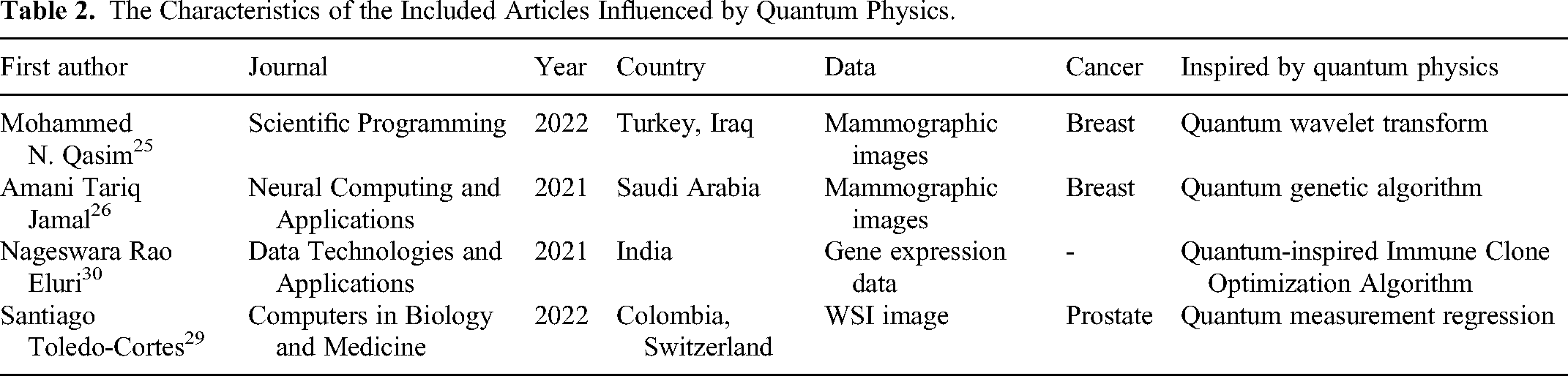
The data extraction procedure followed a predetermined template. The assembled dataset included various informative elements, such as the title of the article, authorship, journal source, country of origin, year of publication, important data attributes, the particular type of cancer under consideration, and insights into the use of QML algorithms. Additionally, important facets of the articles are noted, including their primary goals, theoretical frameworks, findings, remarks, and limitations. This thorough data extraction procedure simplified performing a structured analysis of the reviewed articles. Data collection was performed independently by the first author, and in case of discrepancies, the corresponding author was consulted. The extracted data elements are summarized in Tables 1 and 2.
The Characteristics of the Included Articles That Implemented Quantum Computing.

The Characteristics of the Included Articles Influenced by Quantum Physics.
Results
After performing an initial search in the 4 databases, 258 articles were identified. This study included 9 articles after screening the titles and abstracts and examining the methods and findings (Figure 2). For analytical clarity, the included studies were divided into 2 groups. As shown in Table 1, the first group, which consists of 5 entries, includes articles that utilized QML methodologies for predictive modeling. As shown in Table 2, the second group, which consists of 4 entries, focuses on articles that attempt to develop or implement various QML algorithms. This division simplifies the organization of the articles’ goals and content for their presentation and discussion.
The analysis of the collected data indicated that most articles were published in the last 2 years (2021 and 2022). Considering that a time filter was not included in the systematic search, these results indicate the nascency of this field of study. Additionally, the frequency of articles based on country of origin was examined. Research teams from the United Arab Emirates, the United States of America, and India published the most significant articles.
The included articles primarily focused on breast cancer (5 articles),22–26 lung cancer (2 articles),27,28 and prostate cancer (1 article). 29 The datasets included imaging, genomic, or clinical data. Image and genomic datasets were used the most, containing 523–26,29 and 327,28,30 articles, respectively. All articles focused on breast cancer used image data to feed the model. Imaging data for breast cancer included medical mammography, ultrasound, and microscopic whole-slide imaging (WSI). Two articles27,28 on lung cancer used genomic, biological, and clinical data. An article 29 on prostate cancer benefited from WSI microscopic imaging. To implement algorithms in medical image processing, the prevalent approaches include noise reduction, filtering, edge detection, and mass detection of cancerous tumors.
The objectives of the articles listed in Table 1 are cancer diagnosis, identification, and screening. The 3 articles in Table 123,27,28 used Qiskit and PennyLane QSs, benefiting from IBM and D-Wave QCs. Additionally, the quantum physics theory was used to improve QML algorithms. Among the 4 articles listed in Table 2, 1 25 described a method for noise reduction and accurate mass segmentation in mammography images using a wavelet transform filter and morphological image operations based on the atrous pyramid convolutional neural network (APCNN) DL model. Another article 26 employed the quantum genetic algorithm to solve the multilevel threshold problem. In 1 article, 31 the quantum-inspired immune clone optimization (QICO) algorithm based on the quantum computing theory was used to select the optimal feature for classifying cancer data. Furthermore, the quantum physics-based quantum measurement regression (QMR) algorithm 30 was used to improve the interpretability of results, and the entered articles were analyzed separately (Table 3).
The 5 Key Sections of The Included Articles.
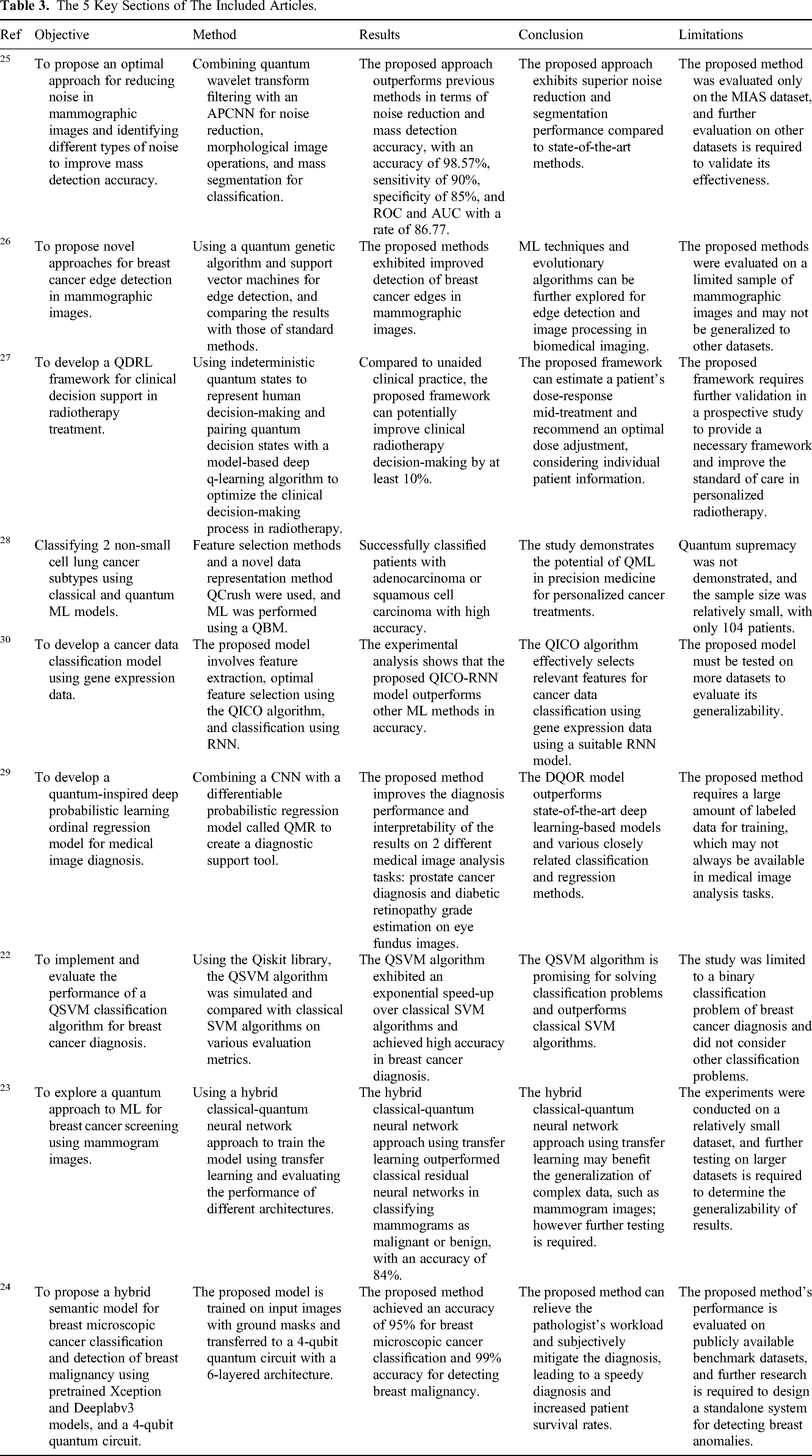
Several studies have proposed novel methods for image processing (segmentation and classification) and optimization by introducing techniques, such as quantum wavelet transform filters, 25 quantum genetic algorithms, 26 QICO, 28 and deep quantum ordinal regressions. 30 These methods combine classical ML algorithms, such as convolutional neural networks (CNN) and recurrent neural networks (RNN), with techniques inspired by quantum physics to improve performance.
A hybrid quantum-classical approach was used in 3 articles23,24,27 on cancer screening and classification. Utilizing the classical and QC resources, this approach offers better robustness and scalability than the classical or quantum methods. These studies combined the computational advantages of QC with classical algorithms to increase the overall performance and efficiency.
Other studies focused on developing quantum-based frameworks for clinical decision support, such as the quantum deep reinforcement learning (QDRL) framework for radiation therapy 27 and quantum SVM classification algorithms. 22
The proposed methods demonstrate improved performance in various areas of oncology. For instance, 1 article 27 exhibited noise reduction and better mass detection accuracy than previous methods, whereas 2 articles22,25 demonstrated increased edge detection performance and classification accuracy, respectively. Two articles presented the potential of quantum-based frameworks to improve radiotherapy decision-making and the classification of non-small cell lung cancer subtypes.22,23
Article 31 demonstrates that the QICO-based feature selection model outperforms other discovery-based models, and the optimized RNN achieves better results than other ML methods.
The DQOR model 29 was evaluated for prostate cancer diagnosis and diabetic retinopathy grade assessment, exhibiting improved diagnostic performance compared to DL-based models. Article 24 compares various SVM classification algorithms for breast cancer detection and highlights the superior performances of quantum SVMs. Finally, article 26 used pretrained Xception and Deeplabv3 models to propose a hybrid semantic model for breast cancer classification and malignancy detection, achieving remarkable accuracy (95% accuracy for classification and 99% for diagnosis).
Compared to the traditional methods, these articles combined the classical ML methods with quantum-physics-inspired techniques to improve performance metrics, such as accuracy, precision, recall, and F1-score.
Discussion
Technology-driven innovation refers to shifts in the combined working of new and old technological operations and their acceptance and adaptation in a market. 32 In the post-digital era, 33 the convergence of Industry 4.0 technologies will give rise to new applications. Industry 4.0 is expected to undergo a revolution due to quantum technology, which relies on probabilities instead of binary bits and promises significant innovation. 34 A few companies, such as IBM, Google, IonQ, and Honeywell, are prepared to provide cloud services for commercial access to quantum technology via Microsoft or Amazon web services (AWS)-based infrastructures. QCs are not expected to replace personal computers in the near future. However, startups leveraging cloud-based quantum-computing services to address important issues, particularly in healthcare, have emerged. 34
A QC is a physical device using the principles of quantum physics to perform computational tasks. However, these devices are still in the primitive stages of development and are widely unavailable. Currently, quantum devices have distinct hardware, which includes superconductors, trapped ions, topological qubits, photons, nitrogen-vacancy (NV) centers, and neutral atoms. 35 Contrastingly, a QS is a software program simulating the behavior of QC on a classical computer. Simulators can be used to test and develop quantum algorithms, study the behavior of QC, and explore the quantum-computing capabilities of QCs. 35 Qiskit 36 & PennyLane 37 emulators were used in 3 of the included articles.
Hybrid quantum-classical computing is a computing paradigm combining the strengths of quantum and classical computing to solve complex problems. 38 However, quantum computing is currently limited in the number and quality of qubits, rendering it difficult to perform large-scale calculations. Thus, classical computers complement QC by completing parts of the calculations that are more suitable for classical algorithms. According to 1 article, 23 some studies performed hyperparameter tuning and model training on simulators, ultimately using QCs to test the created model, owing to the limitations in the number of QC cloud devices and qubits.
The QSVM algorithm 22 is a quantum version of the linear classifier SVM. However, the QBM algorithm 28 is a quantum version of a neural network (Boltzmann machine) based on the probabilistic method of Gibbs sampling for learning. Compared to classical SVM, QSVM facilitates an exponential speed-up but is limited to linear classification. QBM can represent complex and nonlinear relationships; however, it is difficult to train and currently limited to small datasets.
Image processing for circuit-based quantum models has witnessed exciting developments, such as dimension reduction, feature extraction, and image edge extraction. 23 The approach proposed byQasim et al 25 is based on the findings of Mari et al, 39 wherein a quantum method was used to assist breast cancer screening. Mammography images were classified using the quantum transfer learning (QTL) method, which is advantageous in reducing training time, improving performance, enhancing generalization, and the possibility of accessing the latest pretrained models. Furthermore, QTL is applicable in diagnosing COVID-19 and breast cancer using medical images (CT, mammography, and ultrasound). 40
The study 27 indicated minor differences between QDRL models using simulators and those using IBMQ, which can be attributed to 2 factors. First, the simulator lacks machine errors, including quantum decoherence errors, which introduce higher noise representative of human decision-making processes. Second, the decision selection mechanism in QDRL + simulator models differs from that in QDRL + IBMQ quantum models owing to the physical limitations of the quantum circuit design, which is shorter than the coherence length of a quantum processor.
QWT-APCNN, a hybrid of quantum wavelet transform filtering and APCNN, was assessed against existing techniques using metrics, such as the peak signal-to-noise ratio, mean-squared error, and accuracy of detection for mass area recognition. Compared with state-of-the-art techniques, the proposed method performs better at segmenting and reducing noise. 25
Based on quantum physics, another article 29 used a QMR to increase the interpretability of an ML model. Interpretability and explainability are critical aspects of any ML model because they aid in comprehending the model's decision-making process and entrusting its predictions. These 2 factors are essential for applying ML in healthcare. Compared to QML models, the classical ML models have better interpretation and explanation capabilities. However, QML is nascent and expected to improve with its development. 41
QML faces challenges related to software and hardware. 42 To take advantage of quantum algorithms, the hardware must be practical. Incorporating interface components, such as qRAM, is crucial to transform the classical data into a quantum mechanical form. 43 Quantum algorithms are limited to the following main issues: input, output, cost, and benchmarking. 42
QML can handle various data modalities. Traditional ML techniques face challenges in processing and integrating large and diverse datasets, such as those from genomics, epigenomics, transcriptomics, and imaging data. 43 However, owing to their innate superposition and entanglement properties, QCs may process enormous amounts of information concurrently. Therefore, combining and analyzing various data sources in novel ways may be possible, thereby improving prediction accuracy and precision. 43 The accuracy of patient outcome predictions can be enhanced by analyzing large and matched datasets and developing state-of-the-art sample processing technologies.
The research 44 highlights the possibility that QNNs may outperform their classical counterparts in terms of training speed and data classification accuracy. These instances demonstrate the transformative potential of quantum computing in data processing and analysis, highlighting the significance of its incorporation in medical research. Despite their inherent uncertainties, this study emphasizes the growing viability of implementing QCs to advance medical sciences. Therefore, superior analytical tools may be developed to address challenging medical problems. 45
Conclusion
The aforementioned studies demonstrate the vast potential of QML in oncology, as validated by the findings of this study. Using QML techniques, significant advancements have been made in cancer diagnosis and treatment planning. Future research should explore the integration of quantum computing and ML and the development of novel algorithms and frameworks. Owing to the developments in quantum computing, the oncological application of QML may advance patient care and clinical results. Furthermore, it is preferable to establish the rules for implementing QML algorithms in healthcare. Utilizing the power of quantum computing and ML may realize the full potential of personalized cancer care.
However, research opportunities for QML algorithms are virtually limited. Large quantities of quantum bits and data will aid the improvement and advancement of quantum technology. Hence, various data-encoding techniques should be investigated for applying QML to human healthcare issues.
Footnotes
Abbreviations
Acknowledgments

Declaration of Conflicting Interests
The author(s) declared no potential conflicts of interest with respect to the research, authorship, and/or publication of this article.
Funding
The author(s) disclosed receipt of the following financial support for the research, authorship, and/or publication of this article: This study was supported by Shahid Beheshti University of Medical Sciences, which contributed financial support.