




Abstract
Objectives:
Increasing number of studies has focused on studying the relationship between glutathione S-transferase T1 polymorphism and children acute leukemia, among which discrepancies have risen. The aim of this study is to provide a more exact assessment of glutathione S-transferase T1 polymorphism and children acute leukemia among certain Chinese population.
Methods:
Studies were identified using PubMed, Springer Link, Ovid, Chinese Wanfang Data Knowledge Service Platform, Chinese National Knowledge Infrastructure and Chinese Biology Medicine from beginning to July 2018. The strength of association was quantified by pooling odds ratios and 95% confidence intervals using fixed-effect or random-effect model according to the heterogeneity.
Results:
Overall, a positive relationship was found in null genotype of glutathione S-transferase T1 polymorphism on the risk of childhood acute leukemia among all Chinese populations (odds ratios: 1.52; 95% confidence intervals = 1.19-1.94). Similarly, consistent results were found in subgroup of Southern China (odds ratios: 1.48; 95% confidence intervals: 1.08-2.02), Northern China (odds ratios: 1.59; 95% confidence intervals: 1.09-2.33), acute lymphoblastic leukemia (odds ratios: 1.61; 95% confidence intervals: 1.19-2.17), “age > 18 years” (odds ratios: 1.59; 95% confidence intervals: 1.09-2.33), “age < 18 years” (odds ratios: 1.48; 95% confidence intervals: 1.08-2.02), and population-based studies (odds ratios: 1.60; 95% confidence intervals: 1.16-2.20).
Conclusions:
Collectively, finding from the current study indicated that GSTT1 null polymorphism may be susceptible on childhood acute leukemia among Chinese.
Introduction
Childhood hematological malignancies include most common cancers in children, of which, leukemia is the one of the most common cancers, accounting for about one-third of all childhood cancers. 1 -3 There are 2 main types of acute leukemia in children, which includes acute lymphoblastic leukemia (ALL) and acute myeloid leukemia (AML). In China, an increased incidence of ALL in children was found year by year since the middle of the last century. Thirty per every 1 000 000 children were diagnosed as ALL each year. 4 However, the cause of leukemia is complex, which is generally thought to be the result of environmental and genetic risk factors, as well as genetic-environment interactions, has not been widely determined. 5,6 Among the candidate gene polymorphisms, glutathione S-transferase T1 (GSTT1) has been studied as an important genetic variant for childhood acute leukemia. In 1997, Chen et al first reported the linkage between GSTT1 polymorphism and incidence of childhood acute leukemia among both black and white children. 7 Subsequently, abundant numbers of studies were conducted about GSTT1 null variant and the risk of childhood acute leukemia among various populations. However, the exact relationship of them is still rarely understood. Whether the association differs among people from different race backgrounds was still unclear. Thus, the current meta-analysis was performed aimed to explore an exact association of GSTT1 null genotype and children acute leukemia risk based on included Chinese population.
Materials and Methods
Search Strategy and Selection Criteria
This study was carried out under the guidelines of the PRISMA group. 8 Search scopes included articles from PubMed, Springer Link, Ovid, Chinese Wanfang Data Knowledge Service Platform, Chinese National Knowledge Infrastructure, and Chinese Biology Medicine databases published until July 2018. The search keywords were (glutathione S-transferase T1 or GSTT1) and (leukemia or leucocythemia) and (polymorphism or variant) and (child or children). All the language was acceptable. We included all the suitable studies. References of identified studies were also manually screened to search any omitted articles. The inclusion criteria were: (1) studies with case-control design which evaluated the association between GSTT1 null variant and children acute leukemia; (2) studies with a sufficient genotypes data in cases and controls; (3) Chinese populations; (4) we only included the article with most complete data if detected duplicate studies or overlapping populations. Reviews, letter to the editor, case report, and editorial article were included in this search.
Data Extraction
Based on the inclusion criteria, 2 reviewers independently extracted the data of interest, including first author’s name, publication year, geographical areas, sources of control, the types of leukemia, sample size, age, gender, and available data about genotype from participants. All the case-control studies were stratified to hospital-based (HB) and population-based (PB) studies. In this meta-analysis, the quality of individual studies was assessed according to the 9-star Newcastle–Ottawa Scale. 9
Statistical Analysis
Pooled odds ratios (ORs) with 95% confidence intervals (95% CIs) were calculated to assess the relationship of GSTT1-null allele and children acute leukemia risk. The Z test was adopted to explore the significance of the pooled OR. Regarding potential heterogeneity among studies, which assessed by Cochran Q-statistic, we defined significant heterogeneity at the levels P < .10. A random-effects model was used on the overall analysis when significant heterogeneity was observed; otherwise, a fixed-effects model was adopted. Subgroup analyses were conducted by geographical areas (Northern China and Southern China), subtype of acute leukemia (ALL, AML, and acute nonlymphoblastic leukemia [ANLL]), age of controls (<18 years and >18 years) and sources of control source (HB or PB). Sensitivity analysis was performed by comparing the overall results from 2 different effects model. The funnel plot was used to assess potential publication bias and the Egger test was applied to evaluate the funnel plot asymmetry. Statistical analysis was conducted by Stata version 12.0 (StataCorp LP, College Station, Texas).
Results
Characteristics of Included Articles
Figure 1 illustrated the flow chart of inclusion of exclusion process. Sixty-five records were identified about the relationship of GSTT1 polymorphisms and children acute leukemia risk. According to the selection criteria, 7 studies 10 -16 were suitable and the remaining was removed. The publication year of all included articles ranged from 2003 to 2013. Totally, 439 children acute leukemia cases and 511 controls were used for the current study. Four of the included studies were PB studies. Types of leukemia included ALL, AML, and ANLL. The description of each study is provided in Table 1.

Flow diagram of the literature search.
Characteristics of Studies Included in the Meta-Analysis.

Abbreviations: ALL, acute lymphoblastic leukemia; AML, acute myeloid leukemia; ANLL, acute non-lymphoblastic leukemia; PB, population-based; HB, hospital-based; case age/control age, median age or range of age (year).
Meta-Analysis
Table 2 shows the results of GSTT1 polymorphism and childhood acute leukemia risk. We detected no obvious heterogeneity overall. We found a positive relation on childhood acute leukemia risk with the null genotype of GSTT1 polymorphism in all included Chinese populations (ORs: 1.52; 95%CI: 1.19-1.94; Figure 2). When conducted the subgroup analysis by geographic areas, similar results were found in Southern China (ORs: 1.48; 95% CI: 1.08-2.02) and Northern China (ORs: 1.59; 95% CI: 1.09-2.33). Furthermore, we only found a significant association in the group of ALL (ORs: 1.61; 95% CI: 1.19-2.17), but not in AML, when we stratified by subtype of acute leukemia. Meanwhile, the hierarchical analysis by age was also done, and we obtained consistent results in the group of “age >18 years” (ORs: 1.59; 95% CI: 1.09-2.33) and “age < 18 years” (ORs: 1.48; 95% CI: 1.08-2.02). At last, the positive association was only discovered in PB studies (ORs: 1.60; 95% CI: 1.16-2.20), not in HB studies when we conducted the analysis by sources of control (Table 2).
Association of the GSTT1 Polymorphism and Children Acute Leukemia Susceptibility.

Abbreviations: CI, confidence interval; OR, odds ratio.
The bold-face values means the significant results.

The forest plots on the association between GSTT1 polymorphism and children acute leukemia susceptibility (fixed-effects model).
Sensitivity Analysis and Publication Bias Diagnosis
Sensitivity analysis which described in the methods was performed, obtaining a consistent result in fixed-effect model and random-effect model. All the significantly pooled ORs were not changed. Therefore, the results in our study were stable (Table 2). The Begg funnel plot and Egger test were used to evaluate the publication bias in this meta-analysis. As shown in Figure 3, the shape of the funnel plot did not reveal obvious asymmetry. Similarly, the Egger test indicated that there was no evidence of obvious publication bias in all the included studies (t = −0.34, P = .750, Figure 4).

Publication bias assessment with Begg funnel plot.
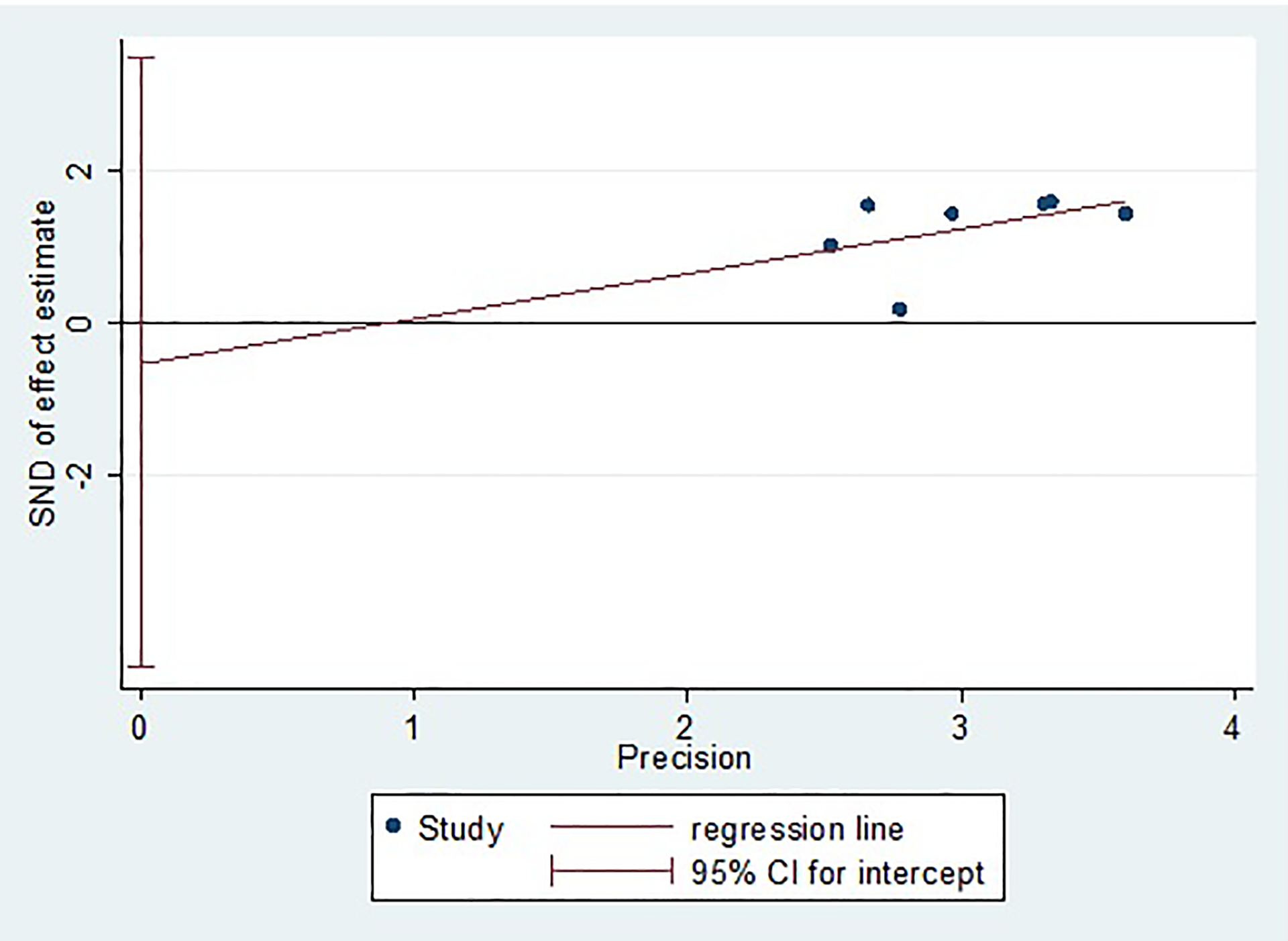
Egger’s linear regression.
Discussion
Previous articles have obtained an exact association about the GSTT1 null polymorphism and the risk of lung cancer, 17 esophageal cancer, 18 prostate cancer, 19 and so on. But, it still has controversy and uncertainty about the association of GSTT1 null variant on the risk of acute leukemia. Chen et al’s study on black and white children suggested that GST genotype plus some other unidentified factors, maybe a risk factor in the development of childhood ALL in American blacks. 7 Another meta-analysis concluded that Glutathione S-transferase M1 (GSTM1) null genotype could increase the risk of childhood acute leukemia in Chinese. 20 Moreover, several meta-analyses had been conducted about GSTT1G polymorphism on childhood acute leukemia risk. 21 -23 Evidences provided a related susceptibility to ALL in children with GCTT1 null variant among Asian populations. 21 -23 The discovered associations maybe differ among populations who were not in the same race backgrounds. Thus, this study aimed to clarify the potential relation about GSTT1 null genotype and acute leukemia risk in children among Chinese populations.
Our report comprised 7 published articles involving 439 children acute leukemia cases and 511 controls. Findings from the analysis indicated a positive association on the risk of acute leukemia in children with GSTT1 null variant. Subgroup analyses by geographic areas and age of controls gained a similar result in Southern China and Northern China populations, as well as in studies of “age > 18 years” and “age < 18 years.” Furthermore, it is assumed that the GST genotype frequency may differ between PB studies and HB studies. For this reason, we performed a subgroup analysis by source of controls. As a result, the ORs were not changed, except for HB case-control studies. As far as we know, HB controls who may have other disease cannot be representative of the general population. Therefore, it is more appropriate to use PB controls in case-control studies.
The acute leukemia type may be a confounding factor for the results, we therefore performed the subgroup analysis by acute leukemia type. The results suggested that the GSTT1 null variant may be associated with increased the risk of children ALL (fixed-effect ORs: 1.61; 95% Cis: 1.19-2.17), while no significance was detected among AML children in Chinese population, which was consistent with the previous meta-analyses. 21,24 However, meta-analysis published by Moulik et al. 24 have not searched Chinese databases, and those 2 meta-analyses 21,24 had included smaller participants than ours. All the results mentioned above further suggested a strongly association about GSTT1 variant on the risk of children acute leukemia in Chinese population.
Several limitations existed in our study should be attention. Firstly, due to those openly published studies in this meta-analysis, some nonpublished literature met the inclusion criteria may be missed. Secondly, the AML group had small participants when we conducted the subgroup analysis by acute leukemia type, thus, more studies are warranted to further assess the relation between GSTT1 variant and AML risk. Further studies with large sample sizes concerning distinctive clinical types are warranted to elucidate the association. Thirdly, due to the complex etiology of leukemia, the effect of any single gene might have a limited impact on leukemia risk than have been anticipated so far. Although the abovementioned limitations existed, our study had more advantages. Firstly, all the included studies had strictly followed the inclusion and exclusion criteria which we mentioned in the methods, so we can decrease the selection bias in our maximum degree. Secondly, our study is strengthened by exploring the influence of geographic area, age, and clinical type on the risk of children acute leukemia and GSTT1 polymorphism among Chinese populations. Thirdly, we compared the result from fixed-effect model with random-effect model for the sensitivity analysis to prove the reliability and stability of the current article. Therefore, all of these results in our study look more meaningful and significant for the future research.
To sum up, findings from the current study revealed that GSTT1 null polymorphism may be susceptible on childhood acute leukemia among Chinese populations. While some limitations exited in this article, more studies with large sample size are warranted to further confirm these results.
Footnotes
Authors’ Note
All data are included in the study.
Declaration of Conflicting Interests
The author(s) declared no potential conflicts of interest with respect to the research, authorship, and/or publication of this article.
Funding
The author(s) received no financial support for the research, authorship, and/or publication of this article.
