




Abstract
This study developed a biomimetic scale knitted fabric (BSKF) using aramid yarns, inspired by the natural structure of pangolin scales, to enhance the flexibility and impact resistance of protective textiles. The BSKF was fabricated via a double-needle bed high-speed computerized flat knitted machine, creating a double-layer three-dimensional fabric with a surface scale part and a basal layer. Two types were produced: BSKF without inter-weft yarn and BSKFW with inter-weft yarn insertion. Mechanical tests showed that both BSKF and BSKFW exhibited superior flexibility and distinct tensile failure behaviors. The BSKFW demonstrated enhanced structural stability and higher tensile stress in the weft direction due to the inter-weft yarn. Low-velocity impact tests revealed that BSKF had a threshold damage energy of 30J, with significant damage at the junction between the scale and base layers at higher energies. BSKFW exhibited reduced deformation and improved impact resistance compared to BSKF. Double-layer BSKF and BSKFW demonstrated even greater impact resistance, effectively distributing and dissipating impact energy. BSKF maintains the flexibility of protective textiles while enhancing their impact resistance. This study provides insights for the development of next-generation protective materials.
Introduction
With the occurrence of natural hazards, violent conflicts, accidental attacks and other incidents, people’s demand for protective products1–3 is increasing. Among them, flexible protective textile materials are favored by people because of their unique comfort 4 and flexibility. 5 With the emergence of high-performance fibers such as ultra-high molecular weight polyethylene, 6 carbon fiber 7 and aramid fiber, 8 flexible protective textiles have been rapidly developed. 9 To ensure protection, these high-performance fibers are often converted into multiple layers of fabric with different structures. 10 However, it reduces the flexibility and comfort of the fabric material itself,11,12 limiting its application development.13,14 Therefore, how to improve the performance of flexible protective equipment while maintaining its original flexible comfort is still a challenge.
In the contemporary era, bionics has become a powerful strategy in materials science,15–18 leading to the development of innovative protective textiles.19–21 Research has shown that the structures of natural armor, such as fish scales22,23 or insect exoskeletons,24,25 provide good models for designing impact-resistant materials.26,27 These biological structures have evolved to efficiently distribute and dissipate external shocks with minimal damage to the organism. 28 Drawing inspiration from these natural designs, the researchers developed a variety of protective textiles with scale structures.29,30 The common scale structure is to deposit the scales on the soft substrate by means of stitching, 31 bonding 32 and hot pressing,33,34 so as to improve the protection performance. However, such scale protective materials have problems such as poor flexibility 35 and scale separation 36 when impacted. Therefore, it is of great significance to develop a flexible and stable scale structure.
Inspired by the natural scale structure, this work developed an integrated bionic scale knitted fabric with excellent flexibility and impact resistance. Mimicking the pangolin’s unique scale structure, 37 individual scales are arranged in an imbricated pattern, featuring radiating grooves on their surfaces and serrated edges along their perimeters. Each scale is connected to the underlying tissue via collagen fibers extending from the dermal layer, forming a dynamic connective network that enables the scales, serrated edges, and layered arrangement to collectively dissipate external forces. This scale structure maintains tight alignment while allowing flexible deformation during coiling, adapting to defensive and locomotive requirements. In this design, the bionic scale-like knitted fabric with stable structure is prepared using aramid yarns. The low-velocity impact resistance of BSKF was analyzed by drop weight test and the failure mechanism was studied. The results of these tests will provide valuable insights into the fabric’s tensile properties, deformation behavior and overall impact resistance. The effects of fabric lamination on the energy absorption efficiency and impact resistance of BSKF were also discussed in this study, and the structural elements of BSKF with excellent properties were further understood. The introduction of inter-weft yarn into the fabric structure further enhances its impact resistance by providing additional reinforcement and stability. The purpose of this study is to promote the development of protective textiles by studying the impact resistance mechanism of aramid bionic fabric. By understanding the impact of BSKF’s structure on its performance, we can pave the way for the development of next-generation protective materials that offer greater safety and reliability.
Materials and methods
Materials
In this experiment, Untwisted aramid filament yarn including 930dtex and 660dtex (Yantai Taihe New Materials Co. Ltd., China) was used for knitted BSKF. The samples were fabricated by the double-needle bed high-speed computerized flat knitted machine (Longxing KSC-132, 14 gauge, Jiangsu Jin Long Technology Co. Ltd., China).
Preparation of scale fabric
Basic parameters of BSKF.


(a) Pangolin scale structure; (b) Process drawing of BSKF and BSKFW; (c) The front of scale part and back of basal layer; (d) Loop simulation model of BSKF and BSKFW.
Quasi-static tensile test
Quasi-static tensile test was performed in an electronic universal testing machine (E43.504, MTS, USA) with a maximum displacement of 1200 mm according to the GB/T3923.1-2013 standard. The BSKF and BSKFW was cut into samples that met the tensile test criteria. The sample width is 50 mm, the spacing length is 200 mm, and the drawing speed is 100 mm/min. In order to study the different failure behaviors in the warp and latitude, the longitudinal scale direction was defined as the Y direction, and the transverse vertical scale direction was defined as the X direction, and the BSKF and BSKFW were stretched with at least three parallel samples in each group. The experimental equipment and samples are shown in Figure 2. In addition, in order to highlight the advantages of the scale structure, CS was used as a contrast sample to test under the same experimental conditions. (a) Tensile test setup; (b) Test specimens.
Low-velocity drop tower impact test
Impact experiment was conducted using a drop weight set-up (SM7.302F-T, TSMT, China) with a maximum drop height of 1.5 m and a maximum impact energy of 300 J according to the ASTM D7136/ D7136M-15 standard. The impact load was measured through a piezoelectric load sensor with a maximum capacity of 88.9 kN. An anti-rebound installation was set for the purpose of preventing the second impact event. As shown in Figure 3, the 150 mm × 150 mm sample was placed on the designated position and clamped by a pneumatic fixture with a rectangular hole (125 mm × 75 mm). The diameter and length of the steel hemispherical impactor were 12 mm and 70 mm, and a mass of 0.167 kg. The low-velocity impact experiment mainly tested the impact process of monolayer BSKF, monolayer BSKFW, double-layer BSKF and double-layer BSKFW, and each group was repeated at least 3 times. All specimens were tested at room temperature 24 ± 2°C and relative humidity 60 ± 2%. Impact results are characterized by an optical camera. (a) Impact test setup; (b) Test specimens; (c) Schematic illustration of impact fixture.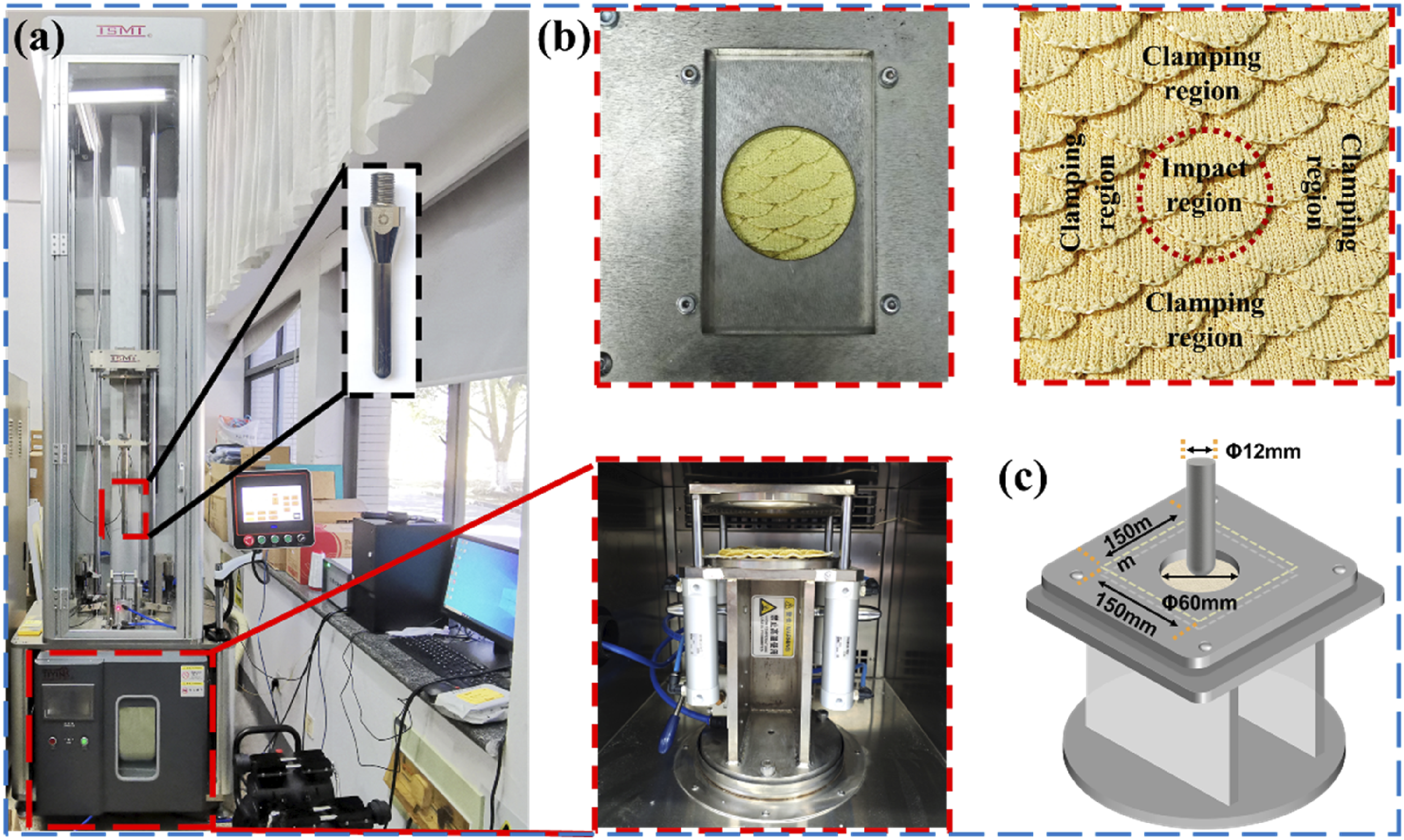
Results and discussion
Characterization of tensile property of BSKF
The BSKF fabric, woven using a computerized flat knitted machine equipped with a double needle bed, exhibits superior bending characteristics. As depicted in Figure 4, BSKF can be effortlessly manipulated into a variety of angles in both warp and weft direction. Notably, BSKF demonstrates an enhanced vertical drape due to the absence of inter-scale binding, allowing the fabric to hang naturally without the scales impeding each other. Conversely, the weft drape is somewhat compromised by the presence of inter-scale connections, which can restrict the fabric’s ability to bend in the weft direction. (a) Warp and weft bending of BSKF; (b) Warp and weft bending of BSKFW.
The bending performance of BSKFW is analogous to that of BSKF. Although the incorporation of inter-weft yarn threads contributes to the stabilization of the fabric structure along the weft axis, it concurrently impacts the weft drape of BSKFW to a certain degree. As evident in Figure 4(b), BSKFW exhibits a significant overhang angle in the weft direction. In summary, both BSKF and BSKFW possess commendable flexural drapability, preserving the inherent flexibility of knitted fabrics while simultaneously achieving a scale-like structure.
Further analysis of the tensile failure behavior of BSKF and BSKFW fabrics in warp and weft direction, as depicted in the tensile process Figure 5, reveals a complex interplay of structural features and mechanical responses. The tensile behavior of BSKF in both the Y and X directions can be delineated into four distinct stages: Quasi-static tensile fracture test: (a) Warp tensile test of BSKF; (b) Warp tensile test of BSKFW; (c) Weft tensile test of BSKF; (d) Weft tensile test of BSKFW; (e) Quasi-static tensile displacement-stress curve; (f) Tensile breaking strength of three samples.
Fabric deformation stage: Initially, the fabric undergoes deformation characterized by loop distortion without incurring damage. This phase is marked by the fabric’s extension in the direction of the applied load. As deformation progresses, the loops reach their elastic limit, setting the stage for subsequent failure mechanisms.
Loop failure stage: With the continued application of load, the bottom edge loops move at their limit, appear the failure cascade. This is a critical juncture where the fabric’s structural integrity begins to diminish.
Progressive rupture stage: Following the edge loop’s fracture, the connected loops undergo further rupture and detachment, culminating in the attainment of the maximum force value during the tensile process. This stage is indicative of the fabric’s peak load-bearing capacity.
Yarn dispersion and fabric failure: Ultimately, the dispersed yarns are extracted from the fabric matrix, with partial yarn breakage leading to the complete failure of the fabric. Throughout this process, the scale structure remains largely intact, with stress concentration occurring primarily at the base and the scale junctions. This localized stress distribution also explains the disparity in maximum tensile force values between the Y and X directions, with the latter exhibiting a higher value due to the collective contribution of the base and scale layers.
Differently, the tensile behavior in the X direction involves the simultaneous deformation of both the base and scale layers during the initial stage. Upon reaching the deformation limit, the loops interfacing the base and scale layers are the first to disengage and fracture. This is followed by a propagation of loop dissociation and fracture towards the fabric’s periphery, coincident with the peak tensile stress. It is noteworthy that the inter-weft yarns actively participate in the deformation and stretching process, culminating in a distinct peak during the second stage of BSKFW, which corresponds to the tensile fracture of the inter-weft yarns. The maximum tensile stress in the X direction surpasses that in the Y direction, attributable to the synergistic action of the base and scale layers.
In summary, the tensile fracture experiment of BSKF reveals a similar four-stage process for both warp and weft tensile fractures, albeit with a higher peak value for weft tensile fracture stress. This is attributed to the active participation of the scale layer during stretching. Scales disperse the tensile stress during the tensile process, thus avoiding stress concentration. Furthermore, the addition of inter-weft yarn enhances the transverse drawing process, indicating the importance of structural design in dictating the mechanical behavior of these fabrics. Compared to BSKF, CS exhibits lower fracture strength. Additionally, CS demonstrates similar elongation in the warp and weft directions, which is attributed to the absence of scale part that constrains deformation. This structural characteristic allows excessive deformation during stretching, leading to near-maximum loop deformation, yarn slippage, and eventual fracture. Such a highly deformable structure is unfavorable for impact protection.
Low-velocity impact resistance performance of BSKF
The low-velocity impact experiment was conducted to scrutinize the impact response of monolayer BSKF and double-layer BSKFW, with a particular focus on assessing the effect of inter-weft yarn on the low- velocity impact resistance of BSKF. The experimental results are observed through optical cameras and microscopes. Figures 6 and 7 depict the low-velocity impact outcomes for BSKF and BSKFW across an impact energy spectrum of 10J to 60J. As shown in Figure 6(a), at the lower energies of 10J and 20J, BSKF exhibits no significant damage, with the deformation area expanding and the fabric maintaining its structural integrity as the impact energy increases. Threshold damage is observed at an impact energy of 30J, where the fabric either sustains or succumbs to damage, signifying the boundary of its impact tolerance. The impact stress cannot be fully dispersed by the scale layer, and the hammer head presses the scales to an inclined state, causing the hammer head to contact the basal layer. For impact energies exceeding 30J, damage predominantly occurs at the junction between the scale layer and the base layer, characterized by yarn fracture and loop detachment, radiating from the point of impact to the edge. (a) 10-40J low-velocity impact topography of BSKF; (b) 40-60J low-velocity impact topography of BSKF; (c) BSKF low-velocity impact Position-Load curve; (d) BSKF low-velocity impact Position-Energy curve. (a) 10-40J low-velocity impact topography of BSKFW; (b) 40-60J low-velocity impact topography of BSKFW; (c) BSKFW low-velocity impact Position-Load curve; (d) BSKFW low-velocity impact Position-Energy curve.

At impact energies of 50J and above, shown in Figure 6(b), there is a notable increase in scale displacement and deformation, which propagates from the impact failure epicenter towards the base layer’s extremities. As the impact energy increased, the deformation of the scales further increased, causing the scales and the hammer to move towards the basal layer together at the impact point. However, the scales themselves did not damage, which increased the contact area between the hammer and the basal layer to a certain extent, and utilized energy dissipation. The impact failure pattern of BSKFW parallels that of BSKF; however, the inclusion of inter- weft yarn endows BSKFW with an enhanced structural stability, resulting in reduced deformation during impact compared to BSKF. Since the inter-weft yarns are continuously and parallel distributed in the basal layer, when the fabric is impacted, the inter-weft yarns contract towards the impact point and disperse the impact energy through deformation and movement. In addition, the inter-weft also plays a supporting role in the scale layer, enabling the scales to withstand more deformation. Figures 6 and 7 illustrate the impact displacement-stress curves and displacement-energy curves for BSKF and BSKFW at the aforementioned energy range. It is evident that BSKFW experiences a lower maximum displacement upon impact, indicating that the inter-weft aids in mitigating impact deformation and in stabilizing the fabric structure.
Furthermore, the displacement-energy curve reveals that fabric deformation is instrumental in energy absorption, owing to the substantial area of deformation and the increased energy absorption from yarn breakage and loop dispersion upon fabric damage. Before the failure of BSKF, the deformation and movement of the scale part first occurs. When the scale moves to the basal layer, the fabric is deformed as a whole. When the impact continues, the fabric reaches the maximum deformation and the loop is further deformed to detachment. In this process, the yarn breaks and the hammer head cross the fabric. The inter-weft yarn of BSKFW deforms and moves during the “scale movement” and “fabric deformation” stage. It dissipates impact energy better than BSKF. The inter-weft yarn could not continue to move after the fabric reaches the maximum deformation. Since the fabric crosses through the fabric, the inter-weft yarn would be driven by the hammer head toward the impact point without breaking. This observation underscores the significance of fabric design in optimizing energy absorption and damage resistance under low-velocity impact scenarios.
Figures 8 and 9 respectively present the low-velocity impact outcomes for double-layer BSKF and BSKFW under impact energies of 120J to 200J. Evidently, when subjected to these energies, the double-layer BSKF does not experience failure but undergoes varying degrees of deformation. The first layer of BSKF, which is in direct contact with the impactor, exhibits more significant deformation, with the protrusions expanding laterally as the impact energy increases. The second layer, not in direct contact with the impactor, deforms into a larger, smooth curved protrusion due to the distribution of force over a broader area. (a) 120-200J low-velocity impact topography of BSKF-D; (b) BSKF-D low-velocity impact Position-Load curve; (c) BSKF-D low-velocity impact Position-Energy curve. (a) 120-200J low-velocity impact topography of BSKFW-D; (b) BSKFW-D low-velocity impact Position-Load curve; (c) BSKFW-D low-velocity impact Position-Energy curve.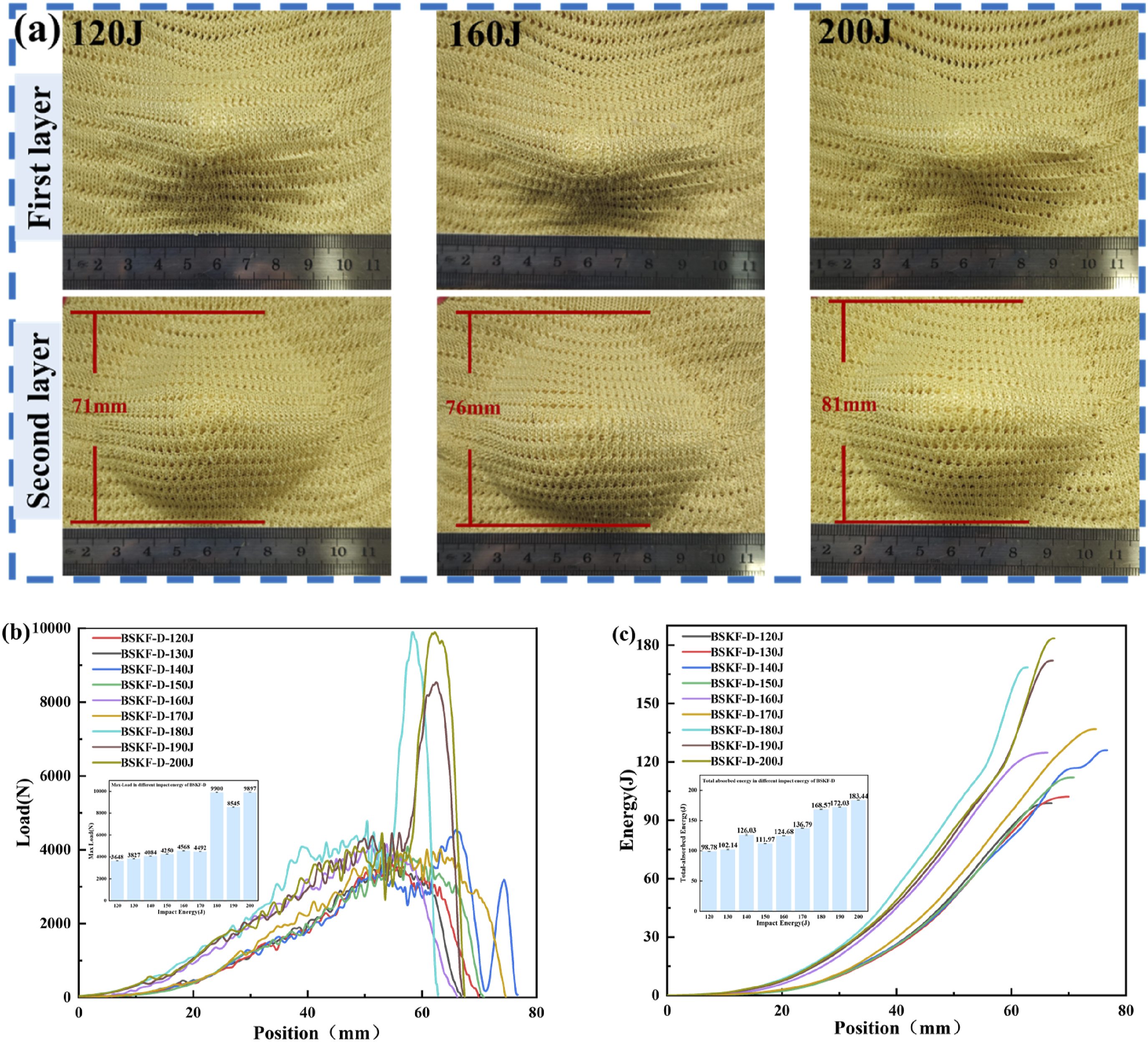

The enhanced impact resistance of double-layer BSKF is primarily attributed to the synergistic effect of its double layer construction. Upon impact on monolayer BSKF, damage typically occurs at the junction between the scale layer and the base layer, a vulnerability exacerbated by the high degree of freedom of the scales. This results in the impactor’s force being concentrated at the joint during monolayer impacts, preventing the full expression of the impact resistance of both the scale and base layers.
In contrast, during double-layer impacts, the lower layer of BSKF provides protection to the upper layer and offers robust support, mitigating the direct impact at the junction and allowing the BSKF to realize its full impact resistance potential. From the comparison of the deformation range of the second layer in Figures 8(a) and 9(a), it can be seen that the deformation range of BSKFW is smaller under the same impact energy. The presence of inter-weft yarns in BSKFW contributes to a reduction in fabric deformation and an increased capacity to withstand stress impacts through their inherent mobility and deformation. As observed, some inter-weft yarn threads protrude through the base layer, a consequence of their unrestrained movement and deformation not bound by other loops, leading to asynchronous deformation and a slight shrinkage of BSKFW, particularly noticeable in the first layer of BSKFW.
Figures 8 and 9 show the displacement-force and displacement-energy curves for double-layer BSKF and BSKFW under low-velocity impacts of 120J to 200J. It is noteworthy that at impact energies of 180J or above, BSKF exhibits a sudden increase in force value. This is attributed to the synergistic effect of the double-layer fabric, which makes the loops less susceptible to damage, leading to local yarn loosening or slipping and abrupt fluctuations in the force exerted by the impactor. BSKFW, however, does not display such a sharp increase, as the presence of filling yarns compacts the fabric, distributing the impact forces more evenly and resulting in a smoother change in force values.
Comparison of mechanical properties of different samples.

Conclusion
The study comprehensively explored the impact resistance of aramid-based BSKF fabrics under low-velocity impact conditions. Inspired by natural scaly structures, the BSKF effectively combines flexibility and strength, and the addition of inter-weft yarns further optimizes its performance. In low-velocity impact tests, BSKF fabrics demonstrate remarkable energy absorption capabilities through controlled deformation and recovery. The fabric’s unique layered structure enables efficient distribution of deformation, dissipating impact energy and reducing the risk of penetration. Further, the double-layer BSKF shows a significant improvement in mechanical properties, with its impact resistance more than doubling compared to the single-layer counterpart. This enhancement is mainly attributed to the synergistic effect between the layers, where the lower layer provides support to the upper layer, reducing stress concentration at the scale-base layer junction. The inter-weft yarns in BSKFW play a crucial role in stabilizing the fabric structure. Their presence leads to a reduction in deformation during low-velocity impacts, as evidenced by the lower maximum displacement in impact tests. This indicates that the inter-weft yarns contribute to better energy absorption and impact resistance by enhancing the fabric’s structural stability.
Overall, the biomimetic design and structural optimization of BSKF fabrics present significant potential for applications requiring high-level impact protection, it could be applied to scenarios that require both flexibility and high protection, such as flexible stab-proof clothing, sports protective gear, etc. Its bionic structure is suitable for dynamic impact environments (such as explosive debris, motion impact), where a multi-scale energy dissipation mechanism can reduce the risk of blunt injury to the wearer. Traditional woven or laminated aramid fabrics rely on homogeneous stacks or rigid composite structures, which have high modulus but sacrifice flexibility; BSKF simulates natural scale arrangement through a dynamically connected scale-basal layer network, maintaining fabric flexibility while dispersing impact energy through mechanisms such as scale tilt and substrate synergistic deformation. Future research could focus on further optimizing the fabric structure, exploring new reinforcement strategies, and evaluating the long-term durability of BSKF under repeated impact scenarios. This will contribute to the continuous improvement of protective textile materials and better meet the increasing demand for personal protection.
Footnotes
Acknowledgement
The authors acknowledge the financial support from the National Science Funds of China (52373058), and a Postgraduate Research & Practice Innovation Program of Jiangsu Province (KYCX24_2548).

Funding
The authors disclosed receipt of the following financial support for the research, authorship, and/or publication of this article: The authors acknowledge the financial support from the National Science Funds of China (52373058), and a Postgraduate Research & Practice Innovation Program of Jiangsu Province (KYCX24_2548).
Declaration of conflicting interests
The authors declared no potential conflicts of interest with respect to the research, authorship, and/or publication of this article.