




Abstract
This research shows how a small, low-profile monopole antenna was designed, built, and tested for performance in the medical field for Internet of Things applications. The suggested antenna is especially designed for integration into wearable and implantable medical devices, and it runs in the 2.45 GHz ISM (Industrial, Scientific, and Medical) frequency range. The antenna uses shorting pins and stub structures for improved impedance matching and downsizing. It is appropriate for biomedical applications with limited space since it is made on a flame-resistant FR4 substrate and has small dimensions of 22 mm × 15 mm × 1 mm. To evaluate the antenna’s performance, extensive computer simulations and experimental tests are carried out. The antenna has excellent impedance matching with a low return loss of −35 dB. In the 2.2–2.6 GHz frequency band, the gain and directivity are measured at 2.279 dB and 2.546 dBi, respectively. With a radiation efficiency of 80.27%, the design guarantees dependable wireless signal transmission. Testing the antenna in liquid phantoms that look like human tissue to make sure it works in real life proves that it is suitable for both in-body and on-body applications. In addition to standard antennas, this study looks at different types of biomedical antennas, such as circularly polarized in-body antennas for next-generation implants, Yagi antennas and SIW-based designs for wearable applications, and dipole antennas with polarization diversity for capsule endoscopy. The suggested antenna works well with Internet of Things-based medical monitoring devices, which makes sending real-time health data easier. It also offers a very sensitive, non-invasive, and affordable way to keep an eye on patients and make diagnoses. The experimental findings and manufactured prototypes show this antenna’s potential for smart implants, wireless medical telemetry, and real-time patient monitoring. This study improves connection in healthcare applications and advances wireless medical IoT technology by resolving current design issues.
Introduction
In the modern era, the healthcare industry has embraced the Internet of Things (IoT) as a transformative technology to enhance security and development. IoT has emerged as a critical tool for tracking and monitoring in the medical field, revolutionizing the way healthcare services are delivered. One of the key benefits of IoT in healthcare is its ability to streamline the administration of patient information. Through interconnected devices and systems, healthcare providers can securely access and manage patient data, leading to more efficient and accurate decision-making. The digitalization of hospitals further enhances this process by integrating electronic health records, scheduling systems, and medical equipment, creating a seamless flow of information.
Remote patient monitoring is another significant application of IoT in healthcare. It enables healthcare professionals to remotely track and monitor patients’ vital signs and health conditions in real-time. This technology eliminates the need for frequent hospital visits, particularly for patients with chronic diseases or those requiring continuous monitoring. IoT devices, such as wearables or implanted sensors, collect and transmit data to healthcare providers, who can then intervene promptly if any abnormalities or concerns arise. Furthermore, IoT plays a vital role in improving patient engagement and empowerment. Patients now have access to a wide range of connected devices and applications that allow them to actively participate in managing their health. These devices can monitor physical activity, track medication adherence, provide personalized health recommendations, and enable communication with healthcare providers.
The integration of IoT in the healthcare industry has resulted in significant cost savings and improved medical services. It optimizes resource utilization, reduces hospital readmissions, and enables early detection and intervention. Additionally, IoT-driven data analytics and artificial intelligence techniques enhance disease management and facilitate predictive healthcare, leading to better outcomes and personalized treatments. IoT in healthcare offers a smart and interconnected ecosystem that enhances the monitoring, management, and delivery of healthcare services. It empowers patients, improves efficiency, and fosters innovation, ultimately transforming the healthcare industry in the modern era.
The Internet of Things (IoT) is a diverse ecosystem that encompasses various components such as sensors, actuators, communication modules, batteries, and antennas. When choosing an antenna for an IoT application, several factors must be taken into account, including transmission power, operating frequency range, and available space. In the field of IoT-based medical applications, advanced antenna topologies are employed, such as phased array antennas, switching beam array antennas, and massive MIMO systems. These antennas enable seamless integration of radio frequency (RF) communication with IoT-connected devices. Printed antennas have gained popularity for IoT applications due to their cost-effectiveness, ease of fabrication, compact size, and low profile. However, designing antennas for healthcare-related IoT applications requires careful consideration of the device’s shape and size. The effectiveness of an antenna in wireless communication depends on three crucial connection properties, as well as its compatibility with the human body’s environment and the need for miniaturization.1–3 Figure 1 provides a visual representation of how an IoT-based antenna communicates patient physiological data securely to healthcare professionals through the internet. This connectivity enables remote monitoring and real-time data analysis, enhancing healthcare services and patient care. Medical IoT applications of proposed antenna.
This study effort examines the many techniques used to optimise the value of this study and discusses the antenna for medical telemetry applications. 4 The antenna exhibits a small form factor of 14 × 10.5 × 1.15 mm3, achieves high gain and efficiency, and offers a wide bandwidth of 9.8 GHz, making it a promising candidate for simultaneous data transmission/reception in 5G body-centric applications. 5 Two fabrication methods using nonwoven conductive fabrics and embroidery of conductive threads are detailed. The techniques offer flexibility, low-cost, and performance customization, making them suitable for integrating antennas seamlessly into clothing for unobtrusive monitoring 6 the design of a coplanar waveguide (CPW) fed Koch slot loop antenna with a tuning stub for wireless body-centric communication7,8 A novel microstrip patch textile antenna designed for wearable applications, including compatibility, flexible design, excellent performance at bending angles, human safety, miniaturization, and low power consumption, make it suitable for use in military jackets and other wearable devices. 9 The IEEE standard C95, titled “Safety Levels with Respect to Human Exposure to Radio Frequency Electromagnetic Fields, 3 kHz to 300 GHz,” provides guidelines for assessing and ensuring the safety of individuals exposed to radio frequency electromagnetic fields. 10 The on-body performance of two dual-band textile antennas and finds that a higher conductivity-based textile material with a large ground plane performs better on the body, showing only a 20% degradation in radiation efficiency compared to free-space levels.11–19
A dual-band electrically linked loop antenna is being developed for implantable applications, offering potential benefits for wireless communication within the body. 20 The shorting pin modifies surface current distribution in antennas, allowing for control over radiation pattern and impedance characteristics. It is a valuable tool in antenna design for optimizing performance. 21
The X-shaped printed monopole antenna is a popular choice for biotelemetry applications due to its inherent advantages. Its design consists of an X-shaped radiating element and a ground plane, which allows for compactness and ease of fabrication. Biotelemetry involves the wireless transmission of physiological data from implanted or wearable devices to external monitoring systems. 22 The use of flawed constructions in antenna design for implantable applications is a result of the trade-off between size reduction and maintaining suitable performance levels. 23 However, designing a miniaturised antenna for biomedical applications without impairing the antenna performance is rather difficult. The development of the combined notch, shorting pin, and stubs approach allows for the miniaturisation of the antenna and an improvement in radiation efficiency of 99.7%. The primary objective of this research is to create a tiny implanted antenna for communication in IoT-based biomedical devices.
To address the challenge of small size in medical implants, a suggestion is made to use a small, implantable wideband radiator for biotelemetry operating in the ISM band. The proposed radiator has overall dimensions of 10 mm by 15 mm by 0.8 mm, including the thickness of the substrate and superstrate. Coaxial feeding is employed, with inner and outer diameters of 1 mm and 1.5 mm, respectively. The design process begins by constructing a rectangular patch measuring 10 mm by 15 mm, with the coaxial feed located at position (2.5, 7). Additional rectangular patches with loop-like slots are then added, along with small loops and triangle cuts at the bottom right and top left corners of the rectangular patch. These modifications enable the antenna to achieve the desired small size. To evaluate the antenna’s performance, a tissue model consisting of Skin, Fat, Muscle, and Bone is used, along with a body equivalent fluid for quantification.24–26 The antenna demonstrates a fractional bandwidth of 54.7% in the ISM band, with a 10 dB bandwidth ranging from 1.66 GHz to 3 GHz. The radiation efficiency of the radiator is measured at 3.15%, and the simulated gain is 13.5 dBi.
The suggested antenna is a strong contender for biotelemetry applications that use implants because it has many advantages over current designs in terms of how well it uses radiation, its bandwidth, its gain, and its specific absorption rate (SAR). With a return loss of 35.00 dB and an average SAR of 302.6 W/kg over 1 g of tissue at 1 W of input power, the antenna promises to send signals clearly and with little energy loss. For medical implants, where patient safety and performance are critical, these qualities are essential. Miniaturization while preserving high efficiency and low SAR is one of the fundamental design problems for implantable antennas. In order to improve radiation efficiency and bandwidth without sacrificing safety, the suggested antenna optimizes its shape. Stable and dependable wireless communication is crucial for the transfer of medical data, and its enhanced gain guarantees this. This antenna is a viable option for upcoming biomedical applications as it provides a better balanced trade-off between size and performance than earlier studies. Its capacity to function efficiently within the intended frequency range further enhances its usefulness in actual medical situations. Overall, the idea makes implanted biotelemetry better by providing a better, more portable, and safer way for wireless communication to work inside the body.
Because fluids and structures interact very strongly, elastically mounted flexible membrane roofing that is exposed to flows can experience vibrations caused by vortices and may become unstable in the air. By looking at how structural vibrations affect flow dynamics, this study aims to find out how FSI works in a saddle-shaped membrane structure in laminar flows with different Reynolds numbers and wind directions. From the standpoint of the time and frequency domains, the aeroelastic properties of membrane structures were found, including statistics on displacement responses, oscillation frequency, and oscillation damping ratios. The particle image velocimetry system was used to see the flow characteristics at the same time, including the velocity vector, the intensity of the turbulence, and the development of vortices in space and time. To capture the key features of the flow, proper orthogonal decomposition (POD) was used to further break down the flow modes. We found three POD mode patterns, with the first mode being the most prevalent. It demonstrated that the gap between the shear layer and membrane surface would contract as the wind Reynolds number rose, causing the vortices to become closer in space and smaller in size. A higher FSI impact and an increase in vortex shedding frequency are the results of this development. As the vortex shedding frequency gets closer to the fundamental frequency of structures, the membrane’s vibration would change from turbulent buffeting to vortex-induced resonance. This type of vibration has a lock-in frequency, a large amplified displacement, and a negative aerodynamic damping ratio. 27
Performance comparison of proposed antenna with existing antennas.

Antenna design
The creation of a small, low-profile monopole antenna tailored for medical Internet of Things applications using the 2.45 GHz ISM band is what makes this study innovative. Traditional biomedical antennas often have problems with size limits, impedance mismatches, and performance loss in tissue settings. This design, on the other hand, uses stub structures and shorting pins to downsize without sacrificing efficiency. The antenna’s small size (22 mm × 15 mm × 1 mm) and high radiation efficiency (80.27%) guarantee dependable wireless connection for worn and implanted medical equipment. Its resilience is shown by rigorous computer simulations and liquid phantom testing, which makes it a promising option for smart implants, real-time health monitoring, and biomedical telemetry.
In addition, this research shows better electrical performance than current options. The antenna keeps its gain at 2.279 dB and its directivity at 2.546 dBi in the 2.2–2.6 GHz band. It also has a very low return loss of −35 dB, which makes impedance matching much better. This new design fixes problems that are happening with wearable and implanted antennas right now. These problems include limited size for implantable devices, orientation issues during capsule endoscopy, and antennas that deform when they are on the body. This study improves wireless healthcare technology by providing an inexpensive, high-sensitivity solution for medical IoT uses. This makes biological sensing and patient monitoring more accurate.
The advancement of integrated circuits (ICs) has revolutionized the development of intricate and highly interconnected micro medical devices. As the demand for less invasive surgical procedures increases, implantable medical devices (IMDs) have gained significant popularity. IMDs can be categorized based on their functionality and wide range of applications. The first category includes diagnostic devices that are used to assess various medical conditions. These IMDs incorporate sensors that interact with the human body to collect essential physiological data. They are equipped with a communication system that enables the transmission of collected data to external devices. Examples of such devices include electrocardiograms (ECGs), blood-glucose sensors, and temperature gauges. These small devices continuously monitor crucial biosignals in patients, providing valuable data for diagnosis and treatment.
The second category consists of implantable devices equipped with stimulators. These devices receive information from external devices, often managed by medical professionals, and use electrical stimulation to activate specific nerves. Common examples of stimulator-equipped devices include pacemakers, cardioverter defibrillators, functional electrical stimulators (FES), cochlear implants, and retinal implants. These devices play a vital role in managing and improving the functionality of the nervous system. The continuous development and miniaturization of IMDs have opened up new possibilities in the field of healthcare. These devices enable less invasive procedures, personalized treatments, and improved patient outcomes. The integration of advanced ICs and sensors into IMDs has paved the way for innovative and effective medical solutions.
In the medical industry, implantable communication devices are widely used for remote monitoring of various vital signs in patients. The primary objective is to monitor, record, and measure physiological processes such as heart rate and muscle activity. In recent years, the development of microstrip patch antennas for communication in the Medical Implant Communication Service (MICS) band has gained significant attention. This research focuses on evaluating the impact of various parameters such as shape, length, width, location of the substrate and superstrate, as well as their thicknesses, feed points, and ground points in the design of implantable antennas. The goal is to optimize the antenna performance for efficient communication in the MICS band.
One approach involves the construction of an implantable coplanar waveguide (CPW)-fed monopole antenna on a ceramic substrate with a high dielectric constant. This design achieves a 33.5% bandwidth, enabling effective transmission and reception of signals within the desired frequency range. Another approach is the development of a single-fed, small hybrid patch/slot implantable antenna. This antenna utilizes a meander slot and six open slots to achieve optimal size reduction and resonance frequency optimization. By incorporating these features, the antenna can operate efficiently within the target frequency range.
Additionally, high-frequency Planar Inverted-F Antennas (PIFA) are employed to achieve improved gain, decreased Specific Absorption Rate (SAR) values, a higher maximum allowable net input power level, and a reliable connection quality with external equipment. The research aims to enhance the performance and functionality of implantable antennas, enabling reliable and efficient communication with external devices. By optimizing various design parameters, these antennas contribute to improved data transmission, reduced electromagnetic radiation exposure, and enhanced overall performance in medical implant applications.
Many methods, such spiralizing the conductor’s structure, adding ground pins to the patch, or using substrate materials with a high dielectric constant, may be used to create smaller antennas. A few of the frequency ranges that have been authorised for use in medical implants are the MICS, ISM, and Med Radio bands. Biotelemetry applications most often employ the Medical Implant Communications Service (MICS band) 402–405 MHz out of these. Since this spectrum might be utilised for long-term medical implants, there is less radio wave interference in it. A biotelemetry implanted slot antenna that works in the MICS band (402–405 MHz) was created for this investigation. The current path on the patch may be lengthened, decreasing the antenna’s resonance frequency and, therefore, its size, by suitably mixing meander slots with square spiral slots. The suggested antenna offers benefits over conventional planar inverted-F antennas (PIFAs), including the ability to operate at a fixed frequency and a significant size reduction. It is also simple to tune to the required resonance frequency.
The healthcare industry is increasingly interested in antenna technology due to the rise of wireless body area networks (WBANs). WBAN-based proactive health management devices have the potential to greatly enhance individuals’ quality of life by addressing the lack of awareness and routine health checks. Antennas play a vital role as the most crucial component in wireless systems, enabling data transmission near the body and supporting medical diagnosis, rehabilitation, and biomedical telemetry. Wireless body antennas serve three distinct medical purposes, including efficient data transmission for biomedical telemetry.
Microwave imaging and magnetic resonance imaging (MRI) for diagnosis; and (iii) therapeutic radiofrequency thermal ablation for the treatment of cancer (tumour) and cardiovascular disease. There are several antennas with unique design specifications appropriate for various purposes that have been described in the literature. The medical industry is one of these applications. A few of the adjustments utilised to boost antenna performance include downsizing, bandwidth augmentation, reducing power coupling in human tissue, boosting directivity, choosing shape, and enhancing biocompatibility. Data transmission, illness detection, and disease treatment were the initial divisions of antenna utilisation in the survey. Data transmission antennas are further classified into three categories based on how they are linked to the human body: ingestible, on-body, and in-body antennas. A summary of design concerns and various literary devices used to get around application-based challenges has been given.
Before proceeding with the creation of the required antenna, a conventional patch antenna is typically designed using established equations. Design considerations include the desired operating frequency, substrate thickness, and dielectric constant. For medical applications in the 2.45 GHz band, the dimensions of a common patch antenna are determined. These dimensions typically involve a width of 15 mm and a length of 22 mm. These values are selected to ensure the antenna operates effectively within the desired frequency range.
In addition to size, other parameters such as substrate thickness and dielectric constant are carefully chosen to optimize antenna performance. The substrate thickness affects the radiation characteristics and impedance matching of the antenna, while the dielectric constant influences the speed of electromagnetic waves within the substrate. The design process takes into account these considerations to create a conventional patch antenna that meets the requirements for medical band communication. The antenna’s size, along with the selected substrate thickness and dielectric constant, contribute to its efficient operation within the specified frequency band.



The proposed implantable antenna for the IoT application has specific measurements of 22 mm × 15 mm x 1 mm. It is printed on a flame-resistant 4 substrate, which has a dielectric constant of 4.4 and a loss tangent of 0.0009. Figure 2 illustrates the developmental stages of the proposed antenna, showcasing its evolution and design process. To enhance the radiation performance, antenna 1 introduces an inverted L-shaped notch with dimensions L1 and W1 to the original antenna structure. The size of this notch significantly impacts the resonant frequency of antenna 2 due to the capacitive effect it introduces. Development steps of proposed antenna.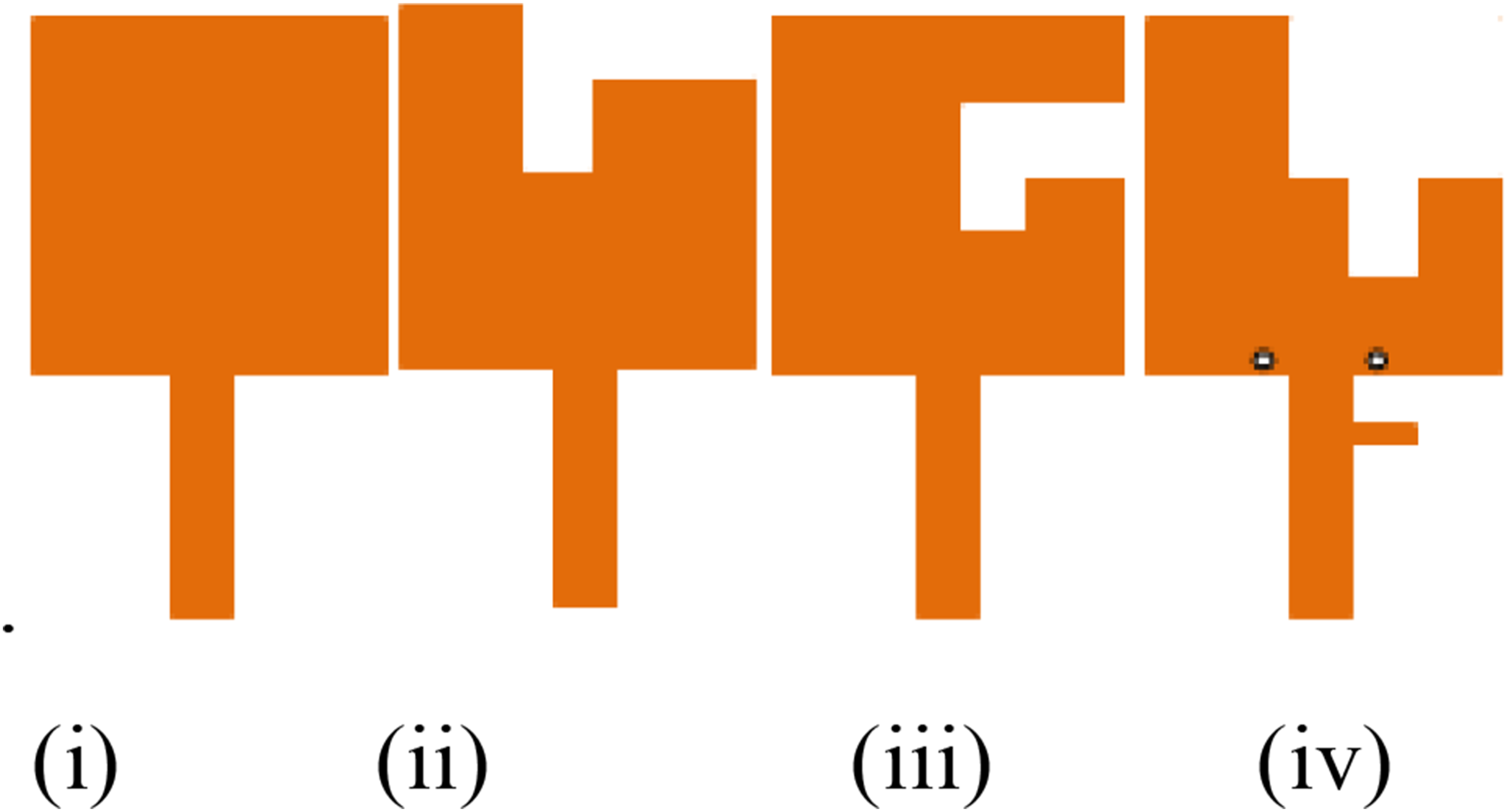
Optimized parameters of the proposed antenna.

Pins and stub loaded antenna
Figure 3(a) depicts the form of the patch antenna, which is enhanced with the inclusion of shorting pins to reduce its electrical size. The patch itself measures 22 mm by 15 mm, and the shorting pins have a radius of 0.5 mm. The feeding line width is 2.5 mm. A cross-sectional side view of the antenna is shown in Figure 3(b). Geometry of proposed antenna (a) top view (b) cross sectional sideview of the antenna.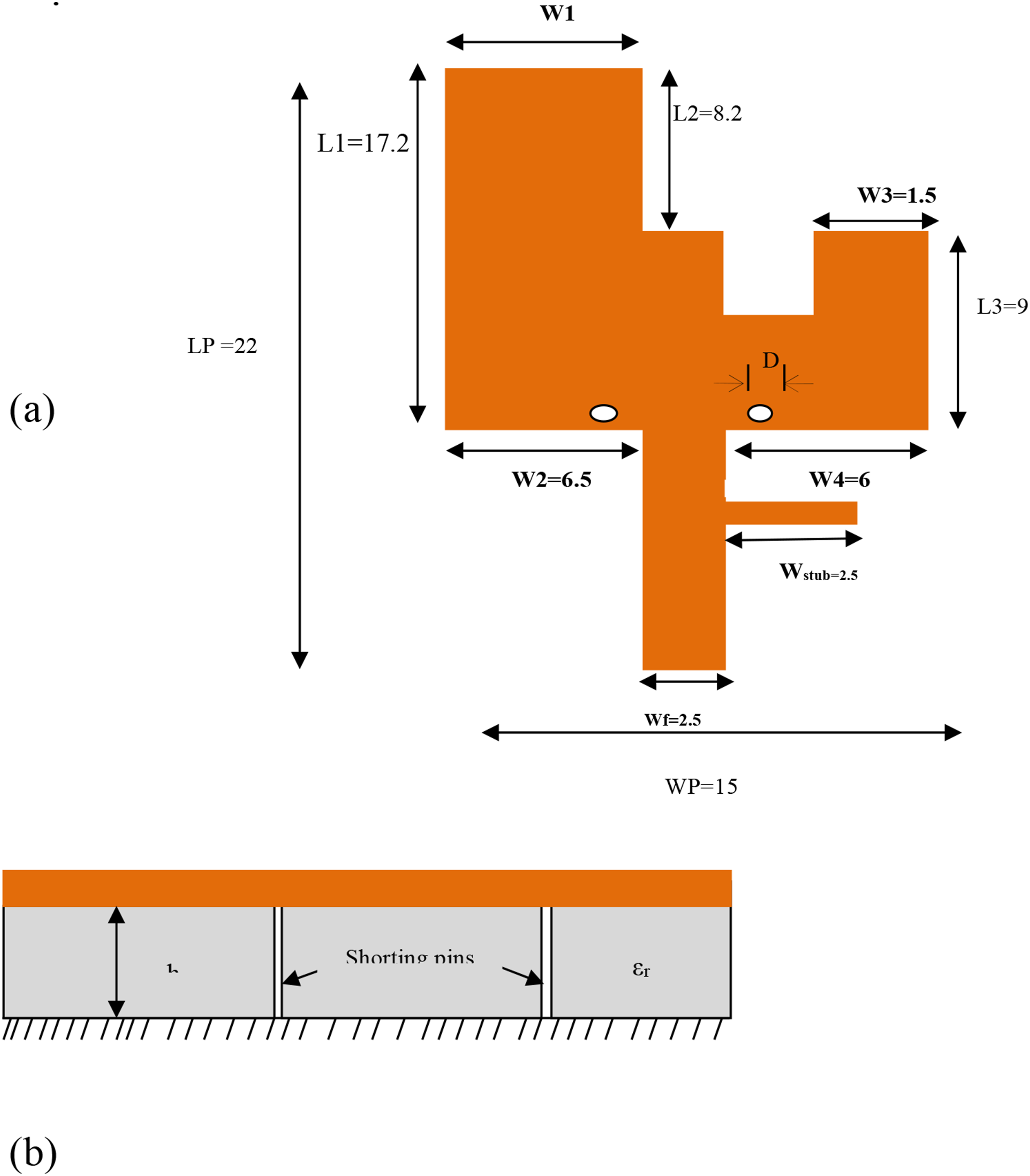
The shorting pins are strategically positioned at a distance “d” from the feeding point, located at the bottom end of the patch antenna. These pins play a crucial role in enhancing the propagation of surface current along the antenna structure. By providing a shorting action, the pins facilitate stronger and more efficient surface current flow. Additionally, the shorting pins contribute to improving the input impedance of the microstrip-edge-fed patch antenna. They enhance the current distribution along the feed’s edge, leading to a more favourable impedance matching with the feeding line. (Figure 4) Return loss characteristics of different antenna structures.
The given measurements are most likely in line with the building requirements of a flexible, implantable antenna that will be used for biotelemetry. These features determine the length and width of different parts of the antenna, like the main patch, feedline, stubs, and slots, which in turn affect its impedance matching, bandwidth, and radiation efficiency.
The primary patch measures 22 mm in length (LP) and 15 mm in width (WP). The parts L1 (17.2 mm) and W1 (6.5 mm) make up some of the radiating structure. L2 (8.2 mm) and W2 (6.5 mm) make up other parts that help tune the impedance. The feed width (Wf) of 2.5 mm ensures a suitable signal transfer from the transmission line. The gap distance (d) and stub width (Wstub) are other important factors in maximizing the antenna’s resonance frequency.
Carefully planning the antenna construction can achieve features like polarization diversity, return loss reduction, and bandwidth augmentation. The widths (W3, W4) and length (L3) of 9 mm influence resonance, which in turn influences the antenna’s effectiveness in biological settings. For worn or implanted medical devices, these dimensions aid in the design of an antenna that satisfies medical standards, guaranteeing steady wireless communication, a low specific absorption rate (SAR), and high radiation efficiency.
In order to regulate the resonance frequency, the stub is also loaded on an antenna. Figure 5 shows the stub loaded antenna’s construction. The antenna’s impedance matching affects the reflection coefficient. Impedance matching is made better by the addition of the stub to the antenna’s line feed. Return loss comparison of proposed antenna with and without stub.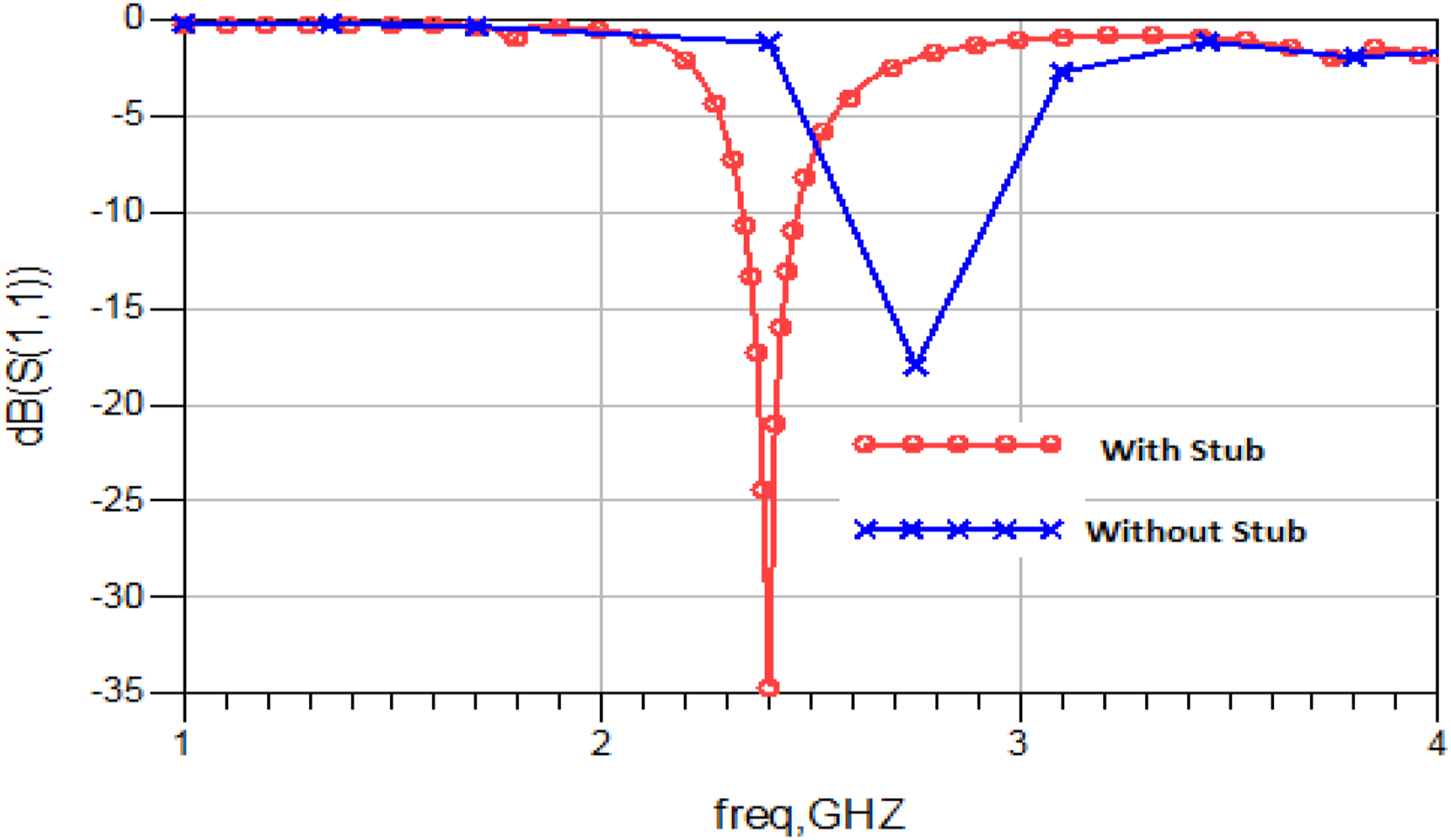
Results and discussion
This work develops and analyzes a flexible antenna based on liquid crystalline polymer (LCP) for wearable and implantable biotelemetry applications. Compared to traditional rigid antennas, the suggested antenna requires less space since it uses inductive loading and can be coiled into a cylindrical shape. Reliable signal transmission is ensured by the antenna’s omnidirectional radiation throughout the body at an operational frequency of 433 MHz. Researchers looked at how body position affected antenna performance and found that raising the arms caused the frequency to shift by 1.75 MHz and the gain to rise by 2 dB.
Designing a meandering slot cut dipole on a biocompatible material increased the bandwidth from 28.7% to 38.8%. This was accomplished by connecting the dipole’s central strip to a strip of varying lengths. We further extended the electric current by adding a parasitic strip, which introduced additional resonance modes. The impedance bandwidth grew as these freshly stimulated modes blended with the original mode. In order to maximize space use, a hole was inserted into the capsule construction to allow a camera and LEDs, while maintaining a constant distance between antenna slots reduced interference. The antenna operated in the ultra-wideband (UWB) range of 1.64 to 5.95 GHz to enable high-resolution, real-time imaging. We examined the performance of antennas printed on the capsule’s external and inner surfaces using a Rogers 5880 substrate. The efficiency of the inner-wall location was 24.4% greater than that of the outer-wall placement, despite the fact that both designs offered precise impedance matching. Because biological tissue is very conductive, the specific absorption rate (SAR) study showed that the outside wall’s SAR was 35 times higher than the inner wall’s. This supported the choice for internal placement to ensure patient safety.
The study also looked at how well the antenna dealt with common problems that come up with implanted wireless communications, like bit-error rate improvement, multipath fading reduction, and antenna orientation mismatch. Three open loops were included via holes on various layers in order to keep the axial ratio below 3 dB. Before being further assessed in a three-dimensional Gustav body model, the antenna design was first evaluated in a single-layer muscle phantom. To evaluate performance in the real world, the antenna was implanted at various depths in the stomach, colon, and small intestine. Reflection coefficients showed consistent performance in every implantation circumstance. A polarization variety strategy was employed to combat polarization deterioration brought on by passage through the digestive tract. The xy, yz, and xz planes all received the same amount of radiation from the antenna. Bending the meandering dipole antenna produced three orthogonal currents, improving polarization diversity and ensuring orientation insensitivity. We used pork mince for experimental validation and homogenous tissue models for simulation. The suggested design outperformed traditional linear and circular polarized capsule antennas while exhibiting low orientation sensitivity. Wearable antennas for ongoing health monitoring were also investigated in the research; these antennas were placed on the arms, legs, chest, head, and back, among other body areas. Vital indications, including heart rate, blood sugar, body temperature, and oxygen saturation, might be wirelessly sent thanks to these antennas. We used Advanced Design System (ADS) simulations to enhance the performance of these on-body antennas, thereby improving impedance matching and reducing return loss. Tests showed that adding a stub to the antenna structure cut the return loss to more than −30 dB at the ISM band resonance frequency. Furthermore, a dual inverted L-shaped notch deflected current flow, enabling resonance at 2.45 GHz.
Figure 6 shows the current distribution on the antenna surface, with blue regions indicating a mild distribution and red areas indicating a strong distribution. We further optimized the antenna performance by using slots and shorting pins to further optimize the current distribution along the patch’s edges. In short, this paper shows a high-tech conformal antenna design that improves polarization diversity, bandwidth, and efficiency for biotelemetry applications that are worn or implanted. The suggested antenna is a viable option for next-generation biomedical and endoscopic technologies, as it successfully strikes a compromise between compactness and high-performance wireless communication. Surface current distribution.
By incorporating a notch, a specific frequency range can be attenuated or suppressed, enabling precise control over the antenna’s resonant behavior. This helps in achieving a compact antenna size without compromising its performance. Additionally, the inclusion of shorting pins further aids in adjusting the resonant frequency. These pins act as electrical connections, altering the distribution of currents along the antenna, thereby shifting the resonant frequency to a desired value. By utilizing the notch and shorting pins, the antenna design achieves a balance between the desired resonant frequency and the physical size of the antenna. This allows for a more efficient and compact antenna, making it suitable for IoT applications where space constraints are a consideration.
Figures 7 and 8 illustrate the S11 characteristics of the antenna with widths W1 and W3, respectively. The return loss is measured for various antenna widths. It is observed that as the antenna width increases, the capacitive effect comes into play, causing the resonance frequency to shift higher than the cutoff frequency. This behavior indicates that the width of the antenna influences the resonance frequency. Table 3 presents the performance metrics for the antennas. In comparison to antennas I through III, antenna IV offers the advantage of adjustability, making it suitable for biological purposes. The specific performance metrics, such as gain, directivity, efficiency, and other relevant parameters, may be provided in Table 3 to highlight the strengths and capabilities of antenna IV in contrast to the other antennas. The adjustability feature of antenna IV makes it a versatile option for applications in the field of biology, allowing for potential customization and optimization based on specific biological requirements or scenarios. Left side width (W1) optimization. Right side width (W3) optimization. Performance comparision of all 4 antenna geometries.


Figure 9 presents a simulated antenna with a gain and directivity of 1.279 dB and 2.546 dB, respectively, at a frequency of 2.45 GHz. Considering that soft tissues constitute the majority of the human body, a modest gain is typically adequate for implanted applications. The directivity of the antenna plays a crucial role in achieving the highest efficiency, which is reflected in the provided value of 50.27%. The directivity is closely related to the antenna’s gain and determines the concentration of radiated energy in a specific direction. In the case of the recommended antenna, its directivity contributes significantly to its overall efficiency, ensuring efficient transmission and reception of signals in the desired direction. Gain (dotted red line) and directivity (dotted blue line) pattern.
The performance parameters of all the antennas are simulated and their comparison is shown in Table 3. (Figures 10 and 11) Measured (continuous blue curve) and simulated (dashed red curve) radiation pattern of proposed antenna in XY plane (a) co-polarization; (b) cross polarization. Measured (continuous blue curve) and simulated (dashed red curve) radiation pattern of proposed antenna in YZ plane (a) co-polarization; (b) cross polarization.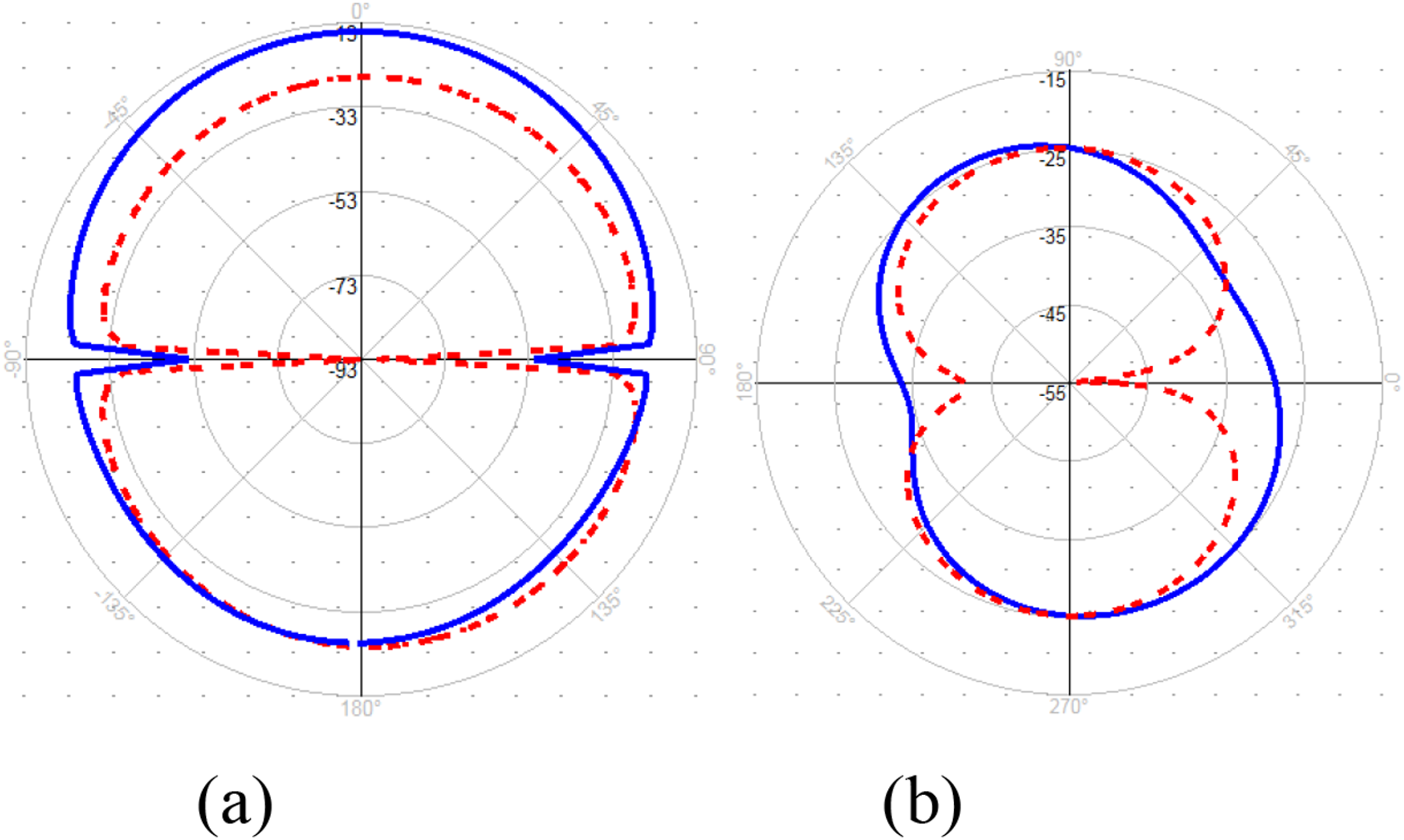

In the H-plane, the radiation pattern exhibits maximum radiation in an omni-directional manner. This means that the antenna radiates energy evenly in all directions within the H-plane. On the other hand, in the E-plane, the radiation pattern shows a maximum radiation pattern resembling the shape of an eight. This indicates that the antenna has stronger radiation in two perpendicular directions within the E-plane. The simulated and measured radiation patterns demonstrate that the radiation with the same polarization as the transmitted signal is higher compared to the radiation with a polarization orthogonal to the transmitted signal. This discrepancy in the radiation levels between co-polarization and cross-polarization indicates good isolation between the two, meaning that the antenna effectively minimizes unwanted cross-talk or interference from signals with orthogonal polarization. This characteristic of providing good isolation between co-polarization and cross-polarization is essential for achieving a reliable and efficient wireless communication system, as it helps to minimize interference and improve signal quality.
In this work, a small, highly effective implanted antenna that operates at 2.45 GHz in the ISM band is presented for use in medical Internet of Things applications. The suggested antenna is ideal for biological applications since it exhibits a gain of 1.279 dB, a directivity of 2.546 dB, and a radiation efficiency of 80.27%. Since soft tissues make up the majority of the human body, antennas used for implanted applications usually need a modest gain to guarantee effective communication. By directing radiated energy in a specific direction, the antenna’s directivity increases efficiency and helps create a stronger, more dependable signal within the body. The antenna’s radiating properties emphasize its efficacy even more. The antenna transmits energy evenly in all directions in the H-plane, a phenomenon known as omnidirectional radiation. For implanted applications, where signal transmission must be constant regardless of orientation, this is advantageous. On the other hand, the E-plane radiation pattern exhibits increased radiation in two perpendicular directions and bears a resemblance to the figure eight. When implanted within the body, these features lessen the possibility of signal loss by enhancing coverage and connection. The antenna’s appropriateness for wireless medical applications is confirmed by these radiation patterns. Another important thing about the design that was suggested is that it can cut down on interference by making sure that co-polarization and cross-polarization are clearly separated. When compared to radiation with an orthogonal polarization, the radiation with the same polarization as the transmitted signal is noticeably greater. This shows that the antenna successfully lowers undesired interference and crosstalk, which is essential for guaranteeing a dependable and clear wireless connection. Signal integrity must be maintained in wearable and implanted medical devices to prevent misunderstandings or data mistakes that might affect patient monitoring and diagnosis.
Antenna technology is important for thermal ablation, wireless body sensor networks, and capsule endoscopy because it makes procedures less invasive and cheaper. Different types of antennas, like circularly polarized patch antennas, substrate integrated waveguide (SIW) antennas, and Yagi antennas, are being looked into to meet different medical needs. With its shorting pins, twin inverted L-shaped slots, and small size (22 × 15 × 1 mm), the suggested antenna is ideal for small medical applications. It is a viable option for implanted medical devices because of these design features, which enhance impedance matching, lower return loss, and boost radiation efficiency. We test the antenna in liquid phantoms, which replicate the characteristics of real human tissues, to verify its performance. The antenna’s excellent operation in the 2.2–2.6 GHz frequency band is confirmed by both modeling and experimental observations. It’s potential for wireless medical telemetry, remote patient monitoring, and other healthcare applications is shown by the findings, which show its excellent efficiency and steady performance. This antenna marks a major development in medical IoT technology by resolving current design issues, guaranteeing dependable wireless communication for the next advancements in healthcare.
Rogers 5880 and Liquid Crystalline Polymer (LCP) are chosen as substrate materials for antennas that can be worn or implanted because they are biocompatible, flexible, and have low dielectric loss. Because of its extreme flexibility, LCP can adapt to the shape of the human body, which makes it perfect for tiny implanted devices. Both materials have low dielectric constants (LCP: ∼3.16, Rogers 5880: 2.2) and low loss tangents, which make sure that signals don’t get lost and that the materials work well for radiation. Additionally, in the high-moisture environment of the body, their minimal water absorption keeps performance from degrading. Rogers 5880 is appropriate for millimeter-wave and microwave applications because of its high-frequency stability. Because of these features, LCP and Rogers 5880 are the best choices for biomedical telemetry and wearable biosensor applications. The antennas will work well, have a wide bandwidth, and have low SAR.
Testing and validation
After the construction of the recommended antenna, an experimental study is conducted to verify the modeling results. The research takes place at the Bannari Amman Institute of Technology. Since direct measurements on the human body are not feasible, human tissue phantom liquid is employed as a substitute. The components used to create the liquid phantom include deionized water, NaCl salt, and cellulose. To evaluate the performance of the proposed antenna, a network analyzer is employed, and the measurement setup is depicted in Figure 12. The antenna is placed within a container filled with the liquid phantom, which mimics human flesh. This setup allows for the investigation of the S11 characteristics of the antenna. The experimental study aims to validate the performance and functionality of the recommended antenna under real-world conditions. By utilizing a liquid phantom that replicates human tissue, the study provides valuable insights into the antenna’s behavior and its effectiveness in practical scenarios. The same recommended antenna is used for measurements and computer simulations to verify the results. Figure 13 shows the S11 characteristics of simulation findings and phantom fluid from a human body. Excellent agreement can be shown between the results of the simulation and the measurements. Measurement setup model of proposed antenna in human tissue mimicking liquid phantom. Simulated and measured return loss characteristics of proposed antenna.

In the future, a person’s body may have an antenna that would wirelessly communicate medical data to the proper hospital doctor. Because constant patient physiological activity monitoring is required for Internet of Things (IoT) applications in the medical area, the recommended antenna is suitable for these applications. (Figure 14) S11 measurement of Fabricated proposed antenna.
For an intelligent implanted medical system to function, wireless communication between external hardware and implantable medical devices (IMDs) is required. Both therapeutic and diagnostic uses are possible for this sort of implanted device. The embedded software may be updated, operational parameters may be temporarily or permanently modified, the device status may be recorded, and the treatment history for medical implants may be tracked via the communication connection.
The use of low-frequency inductive coils for wireless links is a popular biotelemetric approach in implanted medical devices. However, this technology has limitations such as low data rates, limited communication range, and sensitivity to coil alignment. To overcome these drawbacks and improve communication quality, radio frequency (RF) communication with the right antenna design can be employed. Currently, there are designated frequency ranges for implanted antennas, including the Industrial, Scientific, and Medical (ISM) band (2.4–2.5 GHz), Medical Device Radio (MedRad) band (401–406 MHz), and Medical Implant Communications Service (MICS) band (402–405 MHz). Among these, the MICS band is particularly recommended for implanted medical devices due to its excellent compatibility with human tissue propagation at frequencies of 402–405 MHz.
However, the challenge in utilizing the MICS frequency spectrum lies in shrinking the antenna size. The long wavelength associated with this frequency range makes it impractical to use resonant-type antennas, which would require a length of 744 mm at 403 MHz in a vacuum. Antennas of the size l/2 or l/4 are also not feasible within this frequency range. Therefore, the technique of miniaturization becomes crucial in the design of MICS antennas. Efforts are focused on reducing the physical size of the antennas while maintaining their performance characteristics. Various miniaturization techniques such as compact antenna structures, novel materials, and innovative design approaches are explored to achieve smaller antenna sizes without compromising functionality.
By overcoming the size limitations in the MICS frequency range, it becomes possible to develop efficient and effective antennas for implanted medical devices. These antennas enable reliable RF communication, enhance data rates, extend communication range, and improve overall performance in biotelemetric applications.
We use standardized procedures to evaluate wearable and implantable antennas to ensure their effectiveness, safety, and compliance with legal requirements. Standards like IEEE 1528, IEC 62,209, and FCC 47 CFR Part 2.1093 spell out how to measure specific absorption rate (SAR), impedance matching, radiation efficiency, and bandwidth. In order to assess performance in biological tissue models, the assessment method starts with electromagnetic simulations using programs like ADS, HFSS and CST Microwave Studio. Biocompatible polymers, such as Rogers 5880 or liquid crystalline polymer (LCP), are used for fabrication. As part of experimental validation, anechoic chamber tests look at gain and radiation patterns and S-parameter measurements with a vector network analyzer (VNA) check for return loss and impedance matching. IEEE 1528 and IEC 62,209 say that phantom tissue models must be used for SAR measurements to make sure that patients are safe. These strict testing methods make sure that the antenna works reliably in medical settings by making sure it has good wireless communication, low SAR levels, and high radiation efficiency that meets industry standards.
Conclusion
Antenna design is an emerging technology that plays a crucial role in wireless connectivity for various applications. It offers the potential to wirelessly link body sensor nodes, serving as a safe and non-invasive diagnostic tool with high sensitivity. Additionally, antennas can be used in thermal ablation procedures, providing a minimally invasive, cost-effective, and straightforward method.
Numerous antenna types and their potential applications are studied in detail. The focus is on addressing major design issues to optimize performance. For capsule endoscopy, a dipole antenna with polarization diversity is found to be the most effective solution for resolving the orientation mismatch problem. On-body antennas require strong resistance to structural deformation and appropriate tissue separation. Two emerging wearable antenna options include Yagi antennas and Substrate Integrated Waveguide (SIW) technology. Circularly polarized in-body antennas with a small form factor are envisioned for upcoming implanted devices. Patch antennas are deemed suitable for implant applications. A specially designed implantable antenna, featuring twin inverted L-shaped slots, shorting pins, and reduced dimensions of 22 mm by 15 mm by 1 mm, is developed specifically for medical IoT applications. Computational and measured results confirm that the proposed antenna operates at 2.45 GHz (ISM Frequency), with slight variations due to the actual dielectric material used. It exhibits a high radiation efficiency of 50.27% and exceptional gain and directivity of 1.279 dB and 2.546 dB within the frequency range of 2.2–2.6 GHz. To assess its performance, the proposed antenna is tested in liquid phantoms that mimic human flesh. The results demonstrate its significant potential for wireless communication networks in biological applications. By overcoming existing limitations, this antenna design offers promising prospects for advancing wireless connectivity in medical IoT and other related fields.
Statements and declarations
Footnotes
Funding
The author(s) received no financial support for the research, authorship, and/or publication of this article.
Conflicting interests
The author(s) declared no potential conflicts of interest with respect to the research, authorship, and/or publication of this article.