




Abstract
Jute, an important natural fiber crop grown in Southeast Asia, particularly in India, Bangladesh, and Thailand, has received considerable attention because to its superior mechanical characteristics, high cellulose content, affordability, biodegradability, and benefits for the environment. The data obtained from Web of Science (WoS) and Scopus databases from 2004 to 2023, it explores publication trends, active authors, sources, institutions, and countries contributing to the scientific literature. The investigation uses bibliometric tools like Bibliometrix and VOS viewer to map the intellectual structure and research links. The findings show a steady increase in scholarly production, with a noteworthy high in 2022, highlighting growing awareness of jute’s potential as a sustainable substitute for synthetic materials. The finding shows the critical role that Indian contributors and organizations play in developing sustainability study results, as well as worldwide collaborations, especially with nations in South and Southeast Asia. This research illustrates the important of combining traditional knowledge with emerging technology like precision farming and artificial intelligence (AI) to deal with sustainability challenges. It also highlights weakness such a lack of interdisciplinary collaboration and financial support. These findings help to shape sustainable methods in jute agriculture, with implications for protecting the environment and social development.
Introduction
The current state of sustainability science in India’s jute farming highlights the crop’s critical importance in India’s agricultural system. Jute is a multipurpose, environmentally benign crop. Jute, a versatile and environmentally benign crop, has been an integral part of India’s agricultural methods for decades. 1 However, rising demand for jute products, together with changing environmental concerns and socioeconomic issues, necessitate a thorough review of the current condition of sustainable practices in the jute farm industry. Farmers are concerned about soil health, water management, and pesticide use, while policymakers and researchers are actively looking for ways to improve the resilience and sustainability of jute farming. 2
Initiatives to support sustainable jute farming practices have proliferated in the last few years. These initiatives cover a wide range of tactics, such as encouraging organic farming methods, effective water management, and the creation of environmentally friendly substitutes for conventional agrochemicals. 3 Furthermore, initiatives aimed at empowering and educating farmers have gained traction in an effort to raise public knowledge of sustainable methods. 4 Nevertheless, there are still issues that need to be resolved, such as the development of markets for jute that is produced sustainably, the requirement for novel technology, and the availability of funding for small-scale producers. For the present state of sustainability research in jute agriculture, striking a balance between economic viability and environmental responsibility remains a major problem. 5
Future prospects for sustainability science in India’s jute industry appear bright, provided different players work together to overcome current obstacles. Improvements in precision farming, agro-technology, and the incorporation of technological advances are anticipated to be critical in augmenting the sustainability of jute production. Moreover, studies on climate-smart practices, resilient jute types, and circular economy models will probably influence the industry’s future course. Collaboration among government agencies, research institutes, and commercial businesses is critical in developing a path for sustainable jute cultivation. 3 The blending of ancient wisdom with modern technology will be critical to finding a balance that benefits jute farmers, preserves the environment, and meets the growing need for sustainable raw materials in India and abroad.
India (mainly West Bengal) and Bangladesh share this lush geographical region.
6
China is also the world’s largest jute producer. Thailand, Burma, Pakistan, Nepal, and Bhutan all grow jute on a smaller scale. Jute is the second most widely produced natural bast fiber in the world, with an estimated annual production of 3.4 million tonnes. Jute cultivation in India is mostly limited to the country’s eastern and north-eastern regions. The Indian states of West Bengal, Odisha, Bihar, and Assam account for 98.41% of the jute-growing area. West Bengal alone contributes 71% of total raw jute production and 73.09% of the total area.
7
It is primarily grown in the West Bengal districts of Murshidabad, Nadia, North 24 Parganas, Cooch Behar, Hooghly, Malda, and Dakshin Dinajpur. India produced around 1080 thousand metric tons of jute-based items in the financial year 2021 shown in Figure 1. India produced around 1.24 million metric tons of jute-based items in the financial year 2023, as shown in Figure 1. There has been a general reduction over the last decade because of the cost-effectiveness of polypropylene packaging. For the fiscal year 2023, India produced about 1.24 million metric tons of jute products, showing a rise compared to the last year. Interestingly, the steep drop in production in 2010 was linked to traders holding excessive stock. As the world's biggest producer of natural fibres, India produces more than half of the world’s jute.
8
Production volume of jute goods in India from 2009 to 2023.
As the world’s focus shifts to sustainable development goals, understanding the complexities of jute agriculture in India becomes critical. This research study not only examines the current state of sustainability science in the context of jute farming, but also seeks to illuminate future options for promoting sustainable practices in this critical sector. The study attempts to contribute to the greater discourse about sustainable agriculture in India by integrating available research, identifying gaps in current methodologies, and proposing new alternatives.
In this study, we have attempted to respond to four important questions regarding jute research in India from the Scopus and WoS databases: 1. Which year are the most research publication on Indian jute literature? 2. Which are the most productive journals in India? 3. Which author received the most citations? 4. Which are the most productive affiliated institutions and countries on Indian jute research? The remaining of this work is divided into five sections. Section II describes the previous studies. Section III describes how the bibliographic information was collected and the methods have been used for analysis? Section IV summarizes and expresses the findings of the bibliographic analysis. Finally, section V concludes the paper with a brief discussions, conclusion, limitations and further study of Indian jute literature.
Related works
This study attempts to identify the research contributions of researchers related to jute bibliometric studies; no research work published on the present topic. In addition, there are several scholarly publications related to jute production, contribution, and marketing, particularly in India. 9 The environmental sustainability of jute agriculture has drawn focus due to its potential as an environmentally friendly replacement to synthetic products. Jute’s dual role in helping farmers both financially and environmentally by reducing reliance on plastics and sequestering carbon has been emphasized by research on the topic. 10 Studies also highlight the relevance of sustainable agricultural strategies, such as crop rotation and organic agriculture, in increasing jute yield while reducing degradation of the environment. 11 Despite its benefits, the use of sustainable methods in jute cultivation in India confronts considerable hurdles, such as restricted access to current agricultural techniques, insufficient regulatory backing, and shifting market demands. 12 Bibliometric investigations have showed a growing scholarly interest in the subject, with thematic clusters focused on soil health management, bio-composites, and circular economy concepts. 13
Future paths in environmentally friendly science for jute farming will prioritize innovation and multidisciplinary methods. Recent research recommends incorporating modern technologies such as precision agriculture, natural nanocomposites, and genetic engineering to increase jute production as well as sustainability. Scholars have additionally argued for more rigorous policy frameworks and collaborations among academics, industry, and government to encourage sustainable jute production methods. 14 Bibliometric patterns indicate an increased interest in life-cycle analyses and the use of jute as a sustainable material in a variety of industries, including packaging, construction, and transportation. To achieve long-term sustainability, further studies must address gaps in farmer knowledge, resource availability, and the socioeconomic consequences of adopting sustainable agriculture techniques. 15
Materials and methods
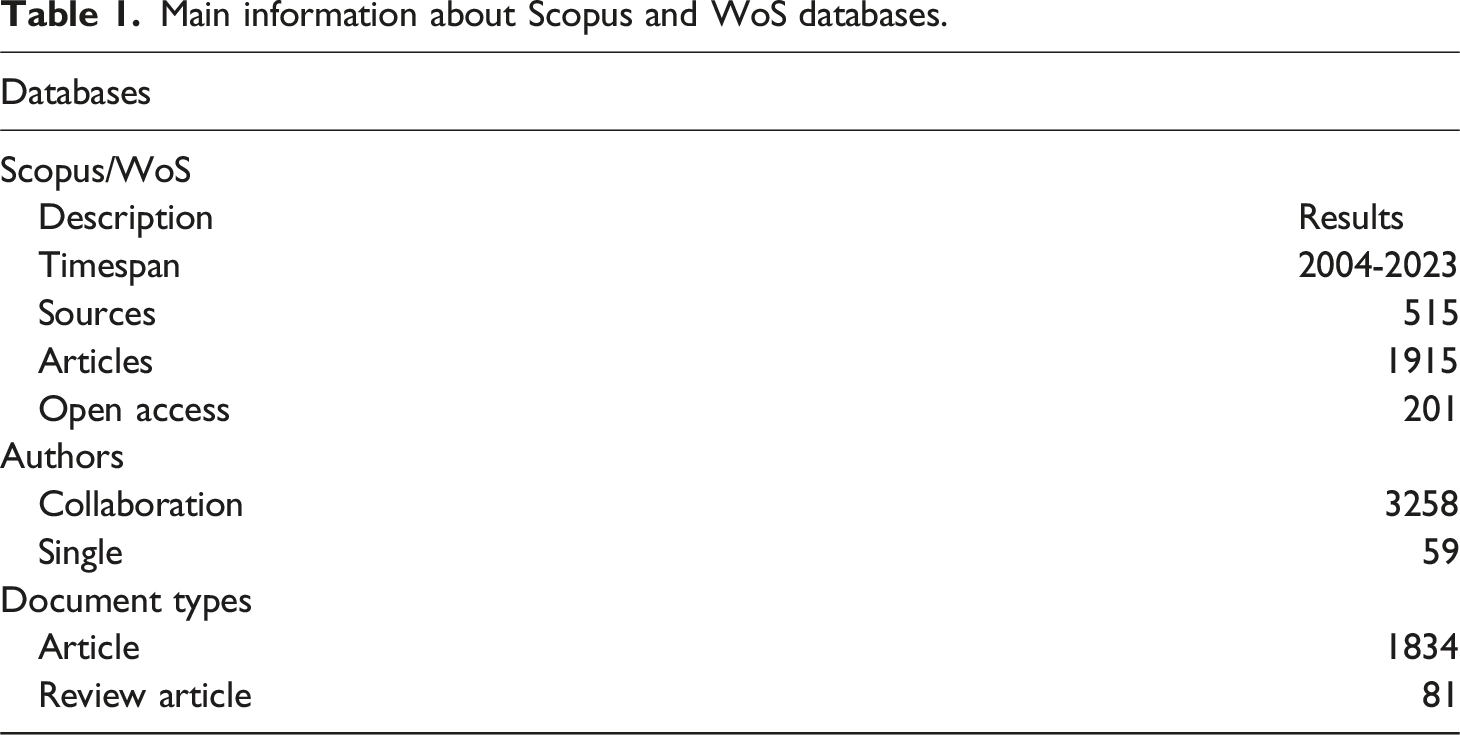
Main information about Scopus and WoS databases.
Quantity by year trend in scientific production literature of Indian jute.

TC Per Art.- Citations Per Article, TC Per Year- Citations Per Year.
Search query
We have adopted a Boolean search method. Although this method of retrieval has been criticized, it maintains control and transparency, which were important both during the construction of the query and the current purpose of the comparison. 19 WoS and Scopus provides two types of searches: basic and advanced, which allow for the creation of complicated and extensive search queries to achieve a high level of validity. The authors filtered the papers according to the relevance of the review objectives during the article search between 2004 and 2023.
Following the survey, selection, and analysis of the informational material, a metric study was conducted using bibliometric principles by bibliometric indicators of production, which entails analysis and/or quantification, such as author profiles; publication year; journals with the most publications; more productive Indian institutions, countries and so on. The most commonly found keywords defined by the authors were linked to each other.
20
The data shown in Figure 2, which describes the process for finding and choosing papers on the subject of environmental sustainability science of jute farming in India, can be divided into four steps: The procedure for identifying and selecting relevant articles.
Identification
Document scans in the Scopus (2164) and WoS (1308) databases yielded 3472 entries between 2004 and 2023, with a particular emphasis on the field of jute and fiber in India. Records from both databases were combined to create the original dataset.
Screening
The Bibliometrix R tool was used to find and eliminate 868 duplicate records, remaining 2604 unique records. Through the removal of redundancies, this procedure guaranteed the data sets integrity.
Eligibility
Further refining involved removing 670 records that were not classed as original articles or reviews, as well as 19 texts that were not published in English. The inclusion of excellent and pertinent scholarly literature was guaranteed by this stringent filtering procedure.
Inclusion
Following thorough screening and eligibility verification, 1915 articles were found to be appropriate for the bibliometric analysis. These documents served as the foundation for an analysis of sustainability science trends and directions pertaining to Indian jute farming.
Data tools
The bibliometric software, such Bibliometrix, used to perform bibliometric analysis.21,22 Annual growth of publications, types of documents, languages, nations, authors, institutions, journals, and citations were all included in the exported data. 23 The literature was also imported into the VOS viewer tool, which was used to build network visualization maps. Total Link Strength (TLS) was used to represent the strength of international research collaboration. TLS is calculated automatically by the VOS viewer when mapping the research activity of selected countries/nations. 24
Results
Quantity and citations by year on Indian jute literature
In recent years, the scientific literature has exhibited a remarkable increase in volume related to jute agriculture research. Numerous growth models have been established to analyze this acceleration. Data collected from two databases indicates that a total of 1915 research documents were produced between 2004 and 2023, as illustrated in Table 2. The patterns of publication in the field of environmental sustainability research, particularly in relation to jute agriculture in India, indicate a continuous rise in scholarly output. The number of publications notably increased from a modest 35 in 2004 to a peak of 255 in 2022. The proliferation of research underscores an increasing academic interest in the sustainable potential of jute, an environmentally friendly alternative to composites and plastics. The global initiative to confront environmental challenges and improve sustainable agricultural practices is reflected in the rise of research efforts since 2017, with annual publications surpassing 97 articles.
Future investigations might prioritize the integration of jute into circular economy strategies, seeking to bolster its economic viability through cutting-edge biotechnological solutions, and assessing its potential to lessen the impacts of climate change. These findings accentuate the significant role of jute agriculture in advancing India’s sustainability ambitions and contributing to the development of resilient global environments.
The average Mean TC Per Art. And Mean TC Per Year from 2004 to 2023 are provided in the table. Although Mean TC Per Art. Often varies over time, the years 2009 and 2013 have the greatest values, suggesting that these were years with particularly significant publications. It’s interesting to note that, despite recent drops in Mean TC Per Art., 2023 has the greatest Mean TC Per Year, indicating that current publications have gained citation traction rapidly.
Sources on Indian jute literature
Top 10 sources/journals based on the number of publications.

Pub- Publisher, P- Publications, C- Citations, H- H-index, G- G-index, Q- Quartile, SJR- Scimago Journal Ranking, IF- Impact Factor.
The journal Natural Fibers stands out as the foremost publication in the field, featuring 161 articles and a total of 3232 citations, underscoring its substantial role in advancing research on natural fibers, particularly jute. Its extensive and credible body of work is evidenced by an H-index of 31, reflecting its broad recognition within the academic community. The journal’s high citation and SJR score (0.602) highlight its effect on the field, which has an IF of 0.96. Following this, both the Journal of Reinforced Plastics and Composites and Polymer Composites make notable contributions to the exploration of materials related to jute fibers and their applications. These journals exhibit considerable influence based on both the quantity and quality of their contributions, as evidenced by their elevated citation counts and strong SJR and impact factor ratings, pointing to an increasing focus on the multidisciplinary integration of jute fibers with polymer composites and eco-friendly practices.
However, journals like the Journal of Industrial Textiles and the Indian Journal of Fibre & Textile Research represent new fields of study, particularly when it comes to Indian farming methods and sustainability. Although these sources contribute to the field, their influence may still be growing, and more focused research may come from these outlets, as indicated by the comparatively low citation counts and H-index in these sources (e.g., the Indian Journal of Fibre & Textile Research has 387 citations and an H-index of 10). Journals like the Journal of Polymer Materials and Fibers and Polymers tend to be more specialized, concentrating on specific applications and materials, which correlates with a lower citation count and impact factor. Additionally, the analysis reveals that some journals, such as the Journal of Industrial Textiles and the Journal of Applied Polymer Science, show a consistent level of influence, whereas others, including Man-Made Textiles in India, contribute less significantly, as indicated by their lower publishing and citation metrics.
Author’s productivity on Indian jute literature indexed in scopus and WoS
Authors ranked based on publications on Indian jute literature.

The strong citation counts and indexes of Sengupta S (44 articles) and Ray D (33 articles) demonstrate their steady contributions and show the scope and importance of their research. Other important contributors include Chattopadhyay S, Basu G, and Samanta A, whose papers have modest citation metrics and represent a mix of developing and established research in the subject.
The findings illustrate a dynamic research community with diverse levels of skill and engagement. Notable authors with high h- and g-indices, including Siengchin S and Roy A, signify impactful and well-regarded research that likely delves into new and multidisciplinary dimensions of jute agriculture. Conversely, researchers like Chattopadhyay S and Parsania P display the potential to broaden and diversify their research initiatives.
Co-authorship analysis of authors on Indian jute literature
This mapping was used by the VOS Viewer software method and was based on data from authors who had at least three documents in both databases. The color, the shape of the circle, the shape of the font, and the thickness of the connecting line indicate the strength of the relationship between the authors.
25
We used co-authorship network analysis to demonstrate the most significant authors in the field of Indian jute literature in Scopus and WoS databases, as it helps to identify a disciplinary structure. We selected a total of 125 authors out of 1758 authors who met the threshold of a minimum of two publications per author and the relationship among writers who contribute to the field of jute research. The list of 50 authors was chosen, and high-frequency terms taken from each publication record were used to map them into 50 clusters are shown in Figure 3. The author of Roy A found in the six cluster and has the highest documents published across 50 clusters. Co-authorship network visualization of authors on Indian jute-related publications.
Analysis of the co-authorship data demonstrates the emergence of scientific clusters in the research. Specifically, the foundational works of Roy AK and Chattopadhyay SN are situated in Cluster 6, while the nascent domains of sustainable development science, particularly in relation to jute agriculture in India, are represented in Cluster 34 with Sinha E. and Rout S. K. It is important to note that there are no interconnections among the authors in the context of Indian jute literature within these clusters.
Affiliated organizations on Indian jute literature
Top 10 most frequent affiliated organizations.

The role of institutions in sustainability research reveals its many dimensions, integrating agricultural innovation, materials engineering, and environmental stewardship. Groups like the ICAR-National Institute of Natural Fibre Engineering and Technology and the ICAR-Central Research Institute for Jute and Allied Fibres are working to position jute as a sustainable alternative to synthetic fibers. At the same time, universities like the University of Calcutta and Vellore Institute of Technology are enriching the discussion on the economic and environmental impacts of jute production with their influential research.
This study emphasizes the necessity of increased institutional cooperation in addressing global issues like plastic pollution, resource shortages, and climate change. Future studies can include jute manufacturing technology developments, farmer welfare regulations, and scalable approaches for introducing jute-based products into international markets. The paper offers a strategy for utilizing jute agriculture as a fundamental component of India’s sustainable development.
Countries of co-authorship on Indian jute literature
Analyzing research output of different countries of co-authorship.

Using bibliometric tools namely VOS viewer and a thesaurus file, the research revealed 79 countries, of which 31 were chosen for mapping (Figure 4). With a total of 115 links and a TLS of 521, the visualization produced 11 different clusters that showed the level of connection. Co-authorship network visualization of the country on Indian jute related publications.
The principal emphasis of this study is on India, which emerges as the most significant contributor in this field, evidenced by its publication of 1915 papers and the establishment of strong international connections. Thailand likewise has a high level of involvement, as evidenced by its 46 articles and expanding cooperation initiatives, especially with its neighbours in the region. Similarly, Saudi Arabia, with 45 publications and a notable link strength, demonstrates its interest in expanding agricultural scholarship through sustainability science, despite the fact that it does not cultivate jute.
India core contributor (Cluster 2 in green color)
As a key player in jute agriculture, India has made substantial contributions to research on sustainability. The nation has fostered strong collaborative relationships with countries like South Korea and Bangladesh, which underscores the importance of regional alliances in advancing scientific knowledge and examining the socioeconomic benefits of jute as a sustainable alternative to plastic materials.
Bangladesh with regional collaborator (Cluster 3 in blue color)
Bangladesh, the world’s second-biggest jute producer, has formed an important regional relationship with India, notably in clusters concentrating on common environmental issues and jute agriculture advancements. Bangladeshi scholars advance sustainable practices and investigate the socio-economic effects of jute production with eight articles, 274 citations, and a TLS of 15. This collaboration illustrates how these 2 South Asian countries prioritize sustainability in both the economy and the environment.
Saudi Arabia’ contributions (Cluster 1 in red color)
Saudi Arabia’s strong network of connections facilitates the establishment of collaborations with key research centers in nations like China and India, highlighting its essential significance. The nation’s commitment to sustainable agricultural practices resonates with global sustainability initiatives, particularly in promoting natural textiles such as jute and decreasing reliance on synthetic materials.
The detailed co-authorship study reveals the escalating importance of global collaboration in fostering sustainability science in jute cultivation. India is a leader in this domain, but countries such as Saudi Arabia and Thailand are also enhancing their international relationships, which in turn is shaping research results and their application in real-world scenarios.
Co-occurrences of most frequent keywords
Co-occurrences of most frequent keywords in Indian jute literature.


Co-authorship network visualization map of keywords occurrence.
Cluster 1: Strategies for biodegradation and treatment
The central theme of this cluster is the application of chemical and physical treatments to enhance the sustainability of jute fibers. Important keywords include “biodegradation” (21 occurrences, TLS: 28), “bleaching” (19 occurrences, TLS: 30), and “alkali treatment” (45 occurrences, TLS: 70). The objective of this study is to identify innovative approaches that enhance the biodegradability of jute while maintaining its mechanical integrity.
Cluster 2: Optimization of mechanical properties and fiber
Cluster 2 addresses the structural and mechanical improving of jute fibers. The major key terms are “mechanical properties,” “jute,” and “tensile strength” are important. This cluster of research investigates how the mechanical properties of jute could be improved for industrial purposes, such as replacing synthetic materials in composites. This cluster is important because it can help close the gap between industrial usefulness and sustainability.
Cluster 3: Environmental compatibility and natural fibers
In Cluster 3, the emphasis is placed on the environmental benefits associated with natural fibers. Important concepts in this context are “polyester resin,” “mechanical properties,” and “natural fiber”. Investigations by scholars have identified jute as a sustainable alternative to synthetic fibers, owing to its compatibility with multiple resins and its ability to biodegrade. The cluster highlights the necessity of developing jute-based materials to fulfill global sustainability targets.
Cluster 4: Advanced composites and hybrid materials
Cluster 4 analyzes the utilization of jute in hybrid composites to boost material performance. The incorporation of jute alongside other materials, including glass fibers and epoxy resins, has been thoroughly examined to produce sophisticated composite materials. This cluster presents information regarding the formulation of resilient and eco-friendly hybrid materials.
Cluster 5: Durability and water absorption
The investigations in this cluster aim to reduce jute’s hydrophilicity in order to improve its long-term usage. This research is significant for uses where moisture resistance is an important consideration, like construction materials. Future research could look into novel treatment of surfaces and coatings that enhance water resistance while maintaining biodegradability.
Discussions
Currently, there has been a marked increase in the global demand for reinforced plastics that are derived from natural, sustainable, biodegradable, and eco-friendly fibers. The necessity for materials that are both environmentally safe and durable, suitable for a variety of structural and non-structural applications, continues to rise steadily. Jute fiber is one of the most widely used natural fiber, with qualities similar to those of synthetic fiber. The findings show that jute can be used as a low-cost alternative way of producing more environmentally friendly composites in the industry. Jute’s economic relevance and its ecological benefits, including its ability to sequester carbon and its biodegradability, have contributed to a significant uptick in environmental sustainability research in India. 29 Recent bibliometric analyses show a considerable expansion in the body of literature concerning sustainable jute practices, reflecting a heightened awareness of climate change and the critical need for sustainable farming methods.
Notably, recent studies have focused on developments in organic jute cultivation and integrated pest management approaches. 30 The incorporation of traditional understanding into new techniques is a widespread trend, demonstrating interactions between agricultural organizations and environmental experts. Although despite these advancements, there are still issues including inadequate policy support, restricted finance, and infrastructure issues. 31
The path toward environmentally sustainable jute farming in India is marked by the necessity of adopting more advanced technologies and supporting interdisciplinary research initiatives. Evidence shows that the use of artificial intelligence and precision agriculture can lead to increased production without compromising environmental sustainability. 32 A significant focus is placed on advancing sustainable jute research beyond agricultural practices to encompass the entire value chain, including processing and waste management, with the aim of reducing ecological impact. 33 The advancement of this discipline will significantly depend on the cultivation of international research collaborations and the enhancement of government support via financial mechanisms and policy frameworks. Critical actions that can propel the development of this field include providing education to farmers regarding sustainable practices and fostering partnerships between the public and private sectors to invest in environmentally friendly innovations.34,35
The landscape of environmental sustainability science in jute farming in India is currently thriving, attracting a lot of academic and practical interest. A review of publications between 2004 and 2023 reveals a steady growth pattern, with a significant peak in research output in 2022. This highlights a growing awareness of jute’s potential as a sustainable, eco-friendly fiber. Important journals like the Journal of Natural Fibers and Polymer Composites have played a crucial role in sharing this research, and prominent figures like Roy A and Kumar S have made a name for themselves in this field. Based on the study of published articles, the Indian Institute of Technology System (IIT System) and the National Institute of Technology (NIT System) rank top in terms of contributions from authors across different organizations. Despite this, there are ongoing challenges, including the alignment of economic interests with sustainable practices, the promotion of market opportunities for eco-friendly jute products, and the provision of necessary resources and technology to small-scale producers. In addition, the study uncovers rising trends and potential gaps in the literature, highlighting areas that necessitate further exploration and innovation in the sustainability science of jute farming. These insights play a significant role in shaping strategies and policies designed to improve the sustainability of jute cultivation, which in turn addresses larger environmental and socioeconomic issues.
Conclusion
A bibliometric analysis sheds light on the current landscape of environmental sustainability science in jute farming in India, showing that while interest is on the rise, the research is quite fragmented. Jute has been recognized for its eco-friendly qualities and socioeconomic importance for a long time, but the scientific research has yielded mixed results. Nowadays, the spotlight is on sustainable production methods, pest management, and the role of jute in carbon capture. However, there is still a significant concentration of research from a few academic organizations and minimal collaboration across interdisciplinary sectors. This fragmentation limits the comprehensive understanding needed to improve jute’s function in sustainable agriculture systems and larger conservation initiatives. Integrating modern innovations like remote sensing, agricultural precision, and biotechnological breakthroughs can help optimize farming practices and increase yield sustainability. The emphasis on socio-environmental implications, especially farming community’ financial resilience, will be important in encouraging scalable and inclusive policies.
Limitations and future directions
This bibliometric analysis concerning the sustainability of jute agriculture in India is subject to various limitations, such as its exclusive dependence on information from the WoS and Scopus databases, which may cause it to overlook pertinent works from other sources. It’s possible that the study’s emphasis on particular keywords left out more extensive discussions of the subject. Incorporating a wider array of databases and adopting a multidisciplinary approach that considers social, technological, and economic factors could really expand future research. It’s also key to focus on longitudinal studies that examine the long-term impacts of sustainable practices in jute agriculture. Collaborating with policymakers and practitioners can help turn research insights into actionable steps for more sustainable farming. By filling these gaps, future studies could yield deeper insights and improve the effectiveness of sustainable methods in jute cultivation.
Footnotes
Author contributions
It is acknowledgement that all the authors contributed equally.
Acknowledgements
The authors extend their appreciation to the Deanship for Scientific Research, King Faisal University, Saudi Arabia for funding (Project number: KFU243029 to Humood Fahm Albugami). Naved Ahmad also thanks AlMaarefa University for supporting this research.
Declaration of conflicting interests
The author(s) declared no potential conflicts of interest with respect to the research, authorship, and/or publication of this article.
Funding
The authors extend their appreciation to the Deanship for Scientific Research, King Faisal University, Saudi Arabia for funding (Project number: KFU243029 to Humood Fahm Albugami).
