




Abstract
Speculative negative Poisson’s ratio (NPR) materials exhibit an auxetic response to strain in a predetermined direction due to their unusual morphologies, making them highly suitable for various specialized applications. For the rationale, these materials have immense potential in various specialized contexts. In weft-knitted auxetic fabrics, uneven tension in the purl loops leads to the distinctive curling architecture. Due to their inherent curly structure and adaptability, weft-knitted fabrics are an excellent choice for emulating NPR materials. In this study, 3D weft-knitted auxetic fabrics were created using flatbed purl knitting technology. Two distinctive patterns, comprising knit and tuck stitches, were employed. The number of stitches per repeat (SPR) was varied to assess the impact of grid size on NPR behavior. Additionally, the variation in measurement points within standard-sized characterization specimens was analyzed, revealing slight differences in auxeticity. Increasing the SPR size initially enhanced NPR behavior, up to a certain limit, beyond which the trend declined. A significant shift in NPR was observed due to material variation and inter-yarn friction, with a 27% and 28% shift of Poisson’s ratio was experienced above and below the mean, respectively. Poisson’s ratio was also positively correlated with energy absorption, suggesting that the designed materials could be effective for protective and energy-absorbing applications.
Introduction
Weft-knitted fabrics engineered with purl structures are capable of forming foldable geometries that lead to three-dimensional (3D) architectures.1–3 These purl knitted fabrics can be produced on double hook needle machines or fully fashioned jacquard hybrid knitting machines.4,5 The desired 3D effects are achieved by loading computerized patterns into the knitting machine, where differential curling between the technical face and back of the purl knits creates the foldable geometry. 6 Such structures often exhibit auxetic behaviors when the technical front and back grids are precisely arranged.7–9 Auxetic materials are characterized by their biaxial extension properties, showing lateral expansion rather than thinning when subjected to axial loading. 10 This behavior is quantified by Poisson’s ratio, which is calculated as the ratio of lateral to axial extension. 11 Purl knitting is recognized as the most effective method for engineering weft-knitted auxetic fabrics. 12 In these fabrics, transfer stitches between the front and back grids act as hard segments. These segments not only facilitate the rotation of soft folds necessary for auxetic behavior but also enhance mechanical properties, contributing to the novel energy absorption capabilities of auxetic weft-knitted fabrics. 13 Tensile strength is a key parameter for assessing the mechanical properties of textile materials, as tensile testing can reveal a material’s failure mode, load capacity, and energy absorption under uniaxial loading. 14 Auxetic weft-knitted textiles are innovative materials with exceptional mechanical properties, such as adjustable permeability, cushioning effectiveness, and durability, along with unique resistance to shock and unusual deformation under uniaxial stress or strain. They exhibit the ability to expand or contract perpendicularly to uniaxial compression or tension.15–18 These attributes make auxetic knits ideal for applications in protective apparel and gear, such as elbow and knee pads and body armor. Additionally, they are a superior choice for reinforcing composite honeycomb structures used in lightweight applications, such as bullet trains and aviation. Given these promising applications, further studies on the energy absorption behaviors of 3D weft-knitted auxetic fabrics are warranted to fully explore their potential. Therefore, the applicability prospects necessitate more studies on the energy absorption behaviors of 3D weft-knitted auxetic fabrics.
Investigations have reported that layered woven auxetic fabrics are suitable for impact applications due to their unique energy absorption properties. 19 HI Ahmed et. al, developed 3D woven orthogonal auxetic geometries using aramid and ultra-high molecular weight polyethylene (UHMWPE) for impact applications, where increasing the length of float and binding yarns contributed to enhanced auxeticity. 20 Even simpler yarn geometries of two-dimensional (2D) woven auxetic fabrics provide viable mechanical performance, 21 and 2D woven honeycomb auxetic materials made from conventional yarns are also suitable for protective applications. 22 Additionally, rotating hexagonal warp-knitted auxetic spacer fabrics exhibit higher energy absorption compared to conventional spacer fabrics; however, yarn loading capacity plays a more significant role in achieving a negative Poisson’s ratio (NPR) than structural variations. 23 Shuaiquan Zhao et al. studied the negative Poisson’s ratio and tensile behaviors of warp-knitted reentrant geometries. 24 Fernanda Steffens et. al, investigated the mechanical characteristics of auxetic weft-knitted fabrics reinforced with epoxy composites. 25 Yaxin Sun et. al, focused on the stab resistance measurement of Kevlar knitted auxetic fabrics under quasi static loading. 26 Andrews Boakye et. al, investigated the knitted auxetic composites’ behaviors under quasi-static compression. 27 Lastly, Kun Luan et. al, simulated the auxetic deformation of Miura-ori geometry weft knitted auxetic fabrics. 28
Researchers have investigated the tensile behaviors and negative Poisson’s ratios (NPRs) of woven, warp-knitted, and knitted auxetic fabric-reinforced composites. However, there is limited research on the energy absorption of weft-knitted auxetic fabrics with foldable geometries under uniaxial or tensile loading. Additionally, the impact of different measurement points on the NPR of weft-knitted fabrics during auxeticity characterization remains an underexplored area. Therefore, this work focuses on developing 3D weft-knitted fabrics utilizing Miura-ori foldable geometries. The in situ NPR and energy absorption properties of these engineered fabrics were analyzed using standard tensile testing techniques, demonstrating their suitability for protective applications.
Materials and methods
Materials
Abundantly available fibers such as cotton, polyester, and acrylic were utilized in the engineering of 3D weft-knitted auxetic fabrics. These materials are widely used in wearable applications due to their low cost and ease of incorporation into complex knitted structures. A resultant count of 10 Ne was used on the knitting machine, with individual yarn counts of 20 Ne for cotton, 40 Ne for polyester, and 10 Ne for acrylic. The mechanical characteristics of the yarns, evaluated using ASTM D2256, are shown in Figure 1. Polyester, due to its inherent properties, exhibited the highest mean tensile strength with moderate elongation of about 19.5%. Cotton yarn showed the lowest strength and elongation values, while acrylic displayed moderate strength around 4 N and the highest elongation at 24%. Yarn surface friction plays a crucial role both during knitting and in the final fabric, influencing yarn-to-machine interactions and inter-yarn frictions in the relaxed state. The coefficients of friction of the yarns, measured using ASTM D3108-2013, were 3.02 for polyester, 2.11 for cotton, and 1.74 for acrylic. Polyester’s smoother surface resulted in a higher coefficient of friction due to greater contact area, with the trend declining towards cotton and acrylic in line with their respective surface morphologies. Mechanical characteristics of materials.
Methods
A fully fashioned flatbed knitting machine (SHIMA SEKI SVR123SP) with stitch transfer technology was employed to knit the specimens. The machine features a 48-inch bed-width with a gauge value of 14, making it compatible with 10 Ne yarns. The development and simulation of soft knitting patterns were conducted using the APEX III programming module, customized by SHIMA SEKI design systems. The sampling pathway is illustrated in Figure 2. Purl-knitted fabrics were designed with unique front and back knitting stitches in specific areas to achieve a negative Poisson’s ratio (NPR). Stitch length (0.23 cm), cover factor, and other physical parameters were kept constants for all specimens to realize the effect of structures. The simulated fabrics, visualized in Figure 3, show that simultaneous stitch transfers between the front and back beds cause the materials to curl, leading to auxetic behavior. To conduct an in-depth study of the mechanical properties and NPR behaviors of the fabrics, structural variations were introduced by varying the number of stitches per repeat (SPR) at 49, 81, and 121 for each material. Firstly, some experiments were conducted at SPRs below 49, and when there were viable results at 49, some quantified intervales were selected to vary the repeat size. The overall sampling plan is detailed in Table 1. Figures 4 and 5 presents diagrammatic notations of the desired SPRs for the knitted square and diagonal patterns. In these diagrams, red boxes represent front bed knit stitches, green boxes indicate rear bed knit stitches, and purple boxes in Figure 5 denote rear bed tuck stitches. While the symbol (”) represents the number of stitches in a row, with notations such as 7″ indicating seven stitches in a row and 49 stitches in the specified area. The diagonal pattern consisted of plain knit stitches on both the technical front and back, while the square pattern incorporated plain knit stitches on the front and a combination of knit-tuck stitches in the technical back sections. Sampling pathway. Animated Views of purl fabrics. Sampling plan. Diagrammatic notations of diagonal pattern (a) 49 SPR (b) 81 SPR (c) 121 SPR. Diagrammatic notations of square pattern (a) 49 SPR (b) 81 SPR (c) 121 SPR.


Principle of Auxeticity
Three-dimensional (3D) weft-knitted auxetic fabrics are designed with foldable geometries, such as Miura-Ori patterns, where the fabric bulk is stored out of the plane, thereby reducing the overall in-plane dimensions. During uniaxial extensions, these folds begin to open as the fabric expands longitudinally. This process involves the transportation or shifting of material from an out-of-plane configuration to an in-plane arrangement, as illustrated in Figure 6. When the extension reaches its maximum, the bulk of the fabric is entirely shifted to the in-plane orientation. The bulk of the fabric is completely shifted from being out of the plane to in-plane when the extension is maximized. These fabrics undergo auxetic deformations characterized by lateral expansion during uniaxial elongation. The presence of hybrid stitches leads to the formation of pyramidal-shaped folds because tuck stitches exert substantial pressure on the yarns used in the fabric construction, as shown in Figure 6(a). In contrast, fabrics made from knit confederation stitches tend to form dome-shaped folds, as depicted in Figure 6(d). However, there are no folded domes in conventional fabrics resulting in plain geometry (Figure 6(c)), hence axial stretching causes cross section to shrink from initial extension. Such shrinking causes lateral strain to be negative, and the Poisson’s ratio becomes positive due to minus sign configuration in equation (1). Principle of auxeticity (a) square pattern in relaxed state (b) square pattern under axial loading (c) square pattern at full extension (d) diagonal pattern in relaxed state (e) diagonal pattern under axial loading.
Characterization
Poisson’s ratio (PR) is an in vitro quantification of a material’s auxetic behavior, defined by the ratio of lateral extensions or contractions to axial elongations, as mathematically expressed in equation (1). While PR is positive for conventional materials, it is negative for auxetic materials (NPR). Positive lateral strain makes the Poisson’s ratio negative for auxetic materials, and negative lateral strain makes Poisson’s ratio positive for conventional materials due to minus sign configuration of equation (1). Traditional techniques often measure lateral behaviors from a single region of the fabric, although these behaviors can vary across different areas of the material. In this study, the engineered textiles had their PR measured at three distinct locations, labeled points A, B, and C, as shown in Figure 7. Under standard laboratory conditions (25oC temperature, and 65% RH) specimens were conditioned for 24 h to release knitting tensions. After that the specimens were loaded onto ZWICK ROELL tensile testing instrument having upper movable jaw, and lateral extension values were recorded after each 0.5 cm axial extension using a digital measurement camera device in front of the specimen. However, real time measurements were also taken in parallel to the camera to avoid any errors. For each specimen, three PR curves were generated by recording the lateral strain at points A, B, and C. Three replicates were tested for each specimen and the most appropriate and viable values were chosen to be discussed in the results section. In addition to measuring PR, tensile properties, including strength and elongation behaviors were evaluated according to ASTM D5034 to verify the durability of developed specimens. Stress-strain curves were obtained to identify different facture zones and modulus of specimens under axial loading. The modulus of resilience measures a material’s ability to absorb or store energy without permanent deformation and is represented by the area under the stress-strain curve up to the elastic limit. In contrast, the modulus of toughness measures a material’s capacity to absorb energy before fracturing, represented by the total area under the entire stress-strain curve, and quantifies the impact resistance of a structure. The total energy absorbed during uniaxial fractures was determined by integrating the area under the stress-strain curves using Origin Pro ® software as a depiction of toughness modulus. However, Minitab 18 ® software was employed to obtain the statistical data trends of obtained characterization data. (a) Variant points of Poisson’s ratio measurement (b) fabric under uniaxial loading.

Results and discussion
The mechanical responsiveness of fabric structures can be controlled by altering Poisson’s ratio, making auxeticity a critical factor for fine-tuning the clothing compatibility of knitted materials. As the material is stored out of plane which absorbs energy for being aligned in-plane before any further deformations, and the energy absorption is also different owing to lateral expansion, hence mechanical properties of auxetic fabrics overperform conventional knitted fabrics. Knitted fabrics with enhanced mechanical properties are particularly valuable for protective equipment, as the auxetic effect modifies the material’s response to external forces. This auxetic behavior is associated with the previously discussed phenomenon of material shifting from out-of-plane to in-plane, where thickness plays a significant role. Figure 8(a) shows the cross-sectional thickness values of developed specimens. However, Figure 8(b) illustrates thickness trends statistically to avoid data variability confusion. Polyester knitted auxetic fabrics showed the highest mean thickness, following a decreasing trend towards acrylic and polyester. Stitch count per repeat (SPR) size was shown to correlate positively with the increase in cross-sectional thickness. Figure 2 shows that the acute tuck stress on the pyramidal domes of auxetic fabrics with a square pattern resulted in increased thickness values (Figure 7(a)). (a) thickness of specimens (b) main effects plot of fabric thickness.
Negative Poisson’s ratio (NPR)
Three distinctive Negative Poisson’s ratio (NPR) measurements were plotted by quantifying the Poisson’s ratio at three different fabric regions for each 50 mm of axial extension. For 18 samples, 54 variable curves were created, illustrating the NPR behaviors of polyester knitted specimens, as shown in Figure 9. All the highest NPR values recorded at each measurement site are shown as bars, and average NPR curves are derived to provide a clearer picture of the data. Figure 10 presents the NPR analysis of polyester knitted 3D auxetic fabrics. The NPR effect arises from the unfolding of the fabric’s folded structure. As tensile strain increases, the fabric’s folded structure progressively unfolds, leading to a diminishing NPR effect. Once the folded structure is fully unfurled, Poisson’s ratio becomes positive, and the NPR effect is no longer present. Poisson’s ratio is positive, and the NPR effect is no longer present once the folded structure has been unfurled completely. At Point-A, the maximum NPR values for polyester knits (Figure 10(a)) show two variable trends for diagonal and square patterns. The diagonal pattern displayed a monotonic increase of NPR, while the square pattern exhibited an inverse parabolic trend where 81 SPR had the highest NPR, as shown in Figure 10(b). The diagonal pattern exhibited a 12.5% higher NPR performance overall compared to the square pattern. The diagonal pattern at Point-B followed a curved parabolic trend, with a minimum NPR of −0.3 at 81 SPR, whereas the square pattern showed a burgeoning monotonic behavior. At Point-B, values for the 49 SPR diagonal specimens yielded a 100% increase in NPR. However, at Point-C, the value decreased back to −0.2, and a 250% increase was observed for the 49 SPR square specimen. Increasing SPRs reflected a monotonic progression in both patterns. Subtle changes in each fabric demonstrate the significance of evaluating different areas. Figure 10(d) and (e) show mean NPR curves of polyester knitted fabrics. The 121 SPR specimen exhibited the highest value of NPR for diagonal pattern with a decreasing trend towards 81 and 49 SPR. In contrast, the opposite trend was observed with the square pattern: the 49 SPR specimen showed a higher NPR, with the trend decreasing towards 121 SPR. As the grid size of the tuck stitches increased, the fabric’s ability to unfold was hampered, leading to a decrease in NPR. Similarly, a linear increase of about 9% and 63% was observed for diagonal polyester when moving from 49 SPR towards 81 and 121 SPR (Figure 10(f)). The square pattern exhibited nearly the same decrementing tendencies. Individual Poisson’s ratio curves of polyester (a) 49 SPR diagonal (b) 81 SPR diagonal (c) 121 SPR diagonal (d) 49 SPR square (e) 81 SPR square (c) 121 SPR square. Polyester knitted fabrics Poisson’s ratio (a) Point-A (b) Point-B (c) Point-C (d) mean curve of diagonal pattern (e) mean curve square pattern (f) mean highest Poisson’s ratio.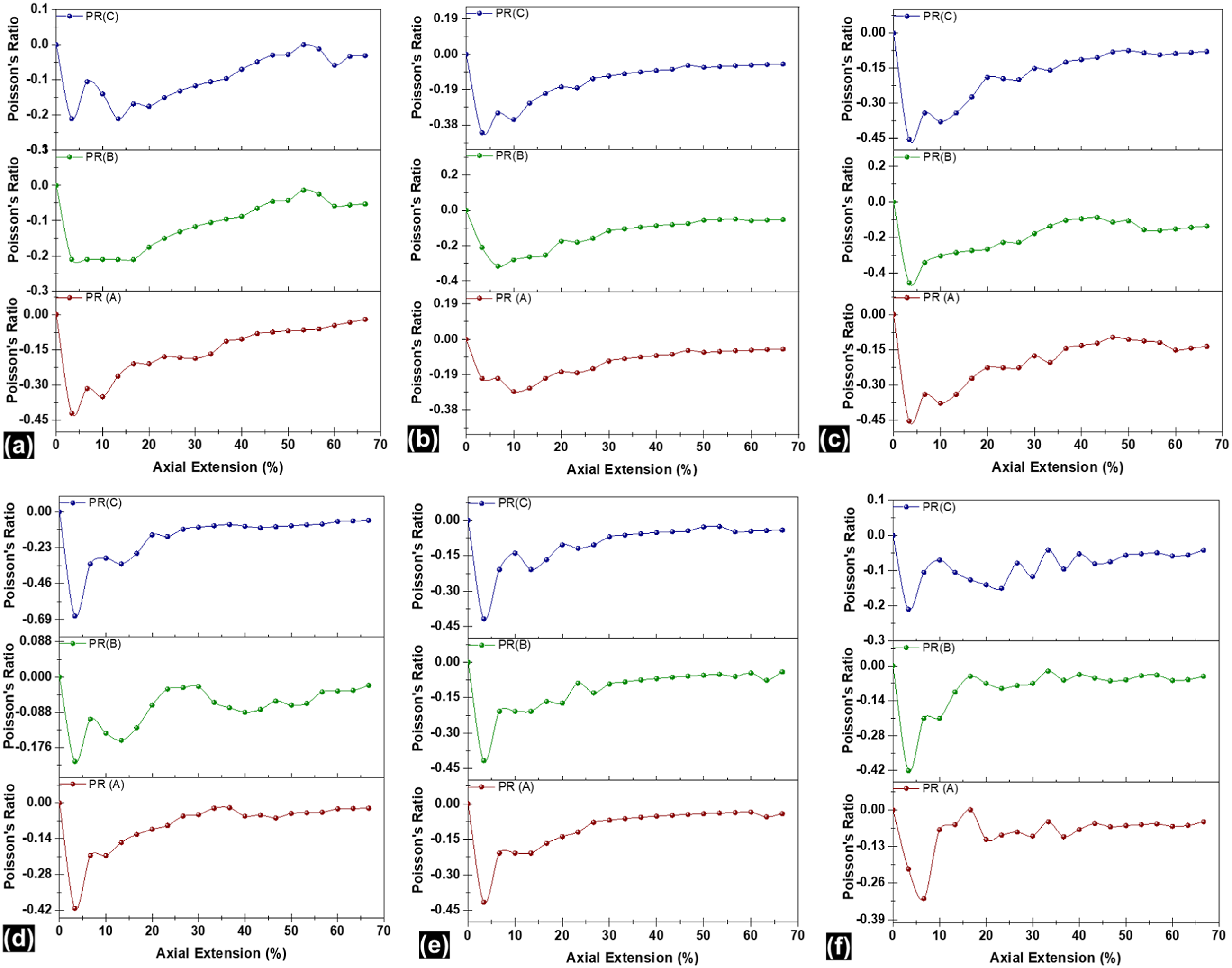

Compared to polyester, higher NPR shifts and lower average values were noticed for cotton-knitted 3D auxetic fabrics. Figure 11 depicts the auxeticity investigations of knitted cotton samples. At Point-A, the NPR values for the 49 SPR and 81 SPR diagonal knit fabrics were lower, while the 121 SPR fabric had the highest value. The square pattern knitted specimen showed an inverse trend, with decreasing NPR towards 121 SPR. The diagonal pattern exhibited a 70.83% increase in NPR towards 121 SPR, while the square pattern showed about a 52% decrease towards 121 SPR. An inverse trend was observed at Point-B (Figure 11(b)); the diagonal pattern displayed a decreasing trend, while the square pattern exhibited an increasing trend. Furthermore, the diagonal pattern followed the same declining trend; however, a parabolic shift was obtained for the square pattern. A 50% decrease in NPR was noted at 81 SPR, with a 25% increase at 121 SPR. Figure 11(d) and (e) show average NPR curves that display behaviors quite different from those of polyester knits. The optimum SPR size (81) offered the least NPR performance. However, 121 SPR had the highest NPR value for the diagonal pattern than 49 SPR and vice versa for the square pattern. The highest NPR of −0.3 was at 49 SPR for diagonal pattern and 121 SPR for square pattern. Knitting structural parameters were constant and relatable for all specimens; hence, inter-yarn frictions were responsible for the observed phenomenon. Cotton knitted fabrics Poisson’s ratio (a) Point-A (b) Point-B (c) Point-C (d) mean curve of diagonal pattern (e) mean curve square pattern (f) mean highest Poisson’s ratio.
The Poisson’s ratio characteristics of acrylic knitted auxetic fabrics are shown in Figure 12. A mean Negative Poisson’s Ratio (NPR) value of −0.2 was observed, while the values for polyester and cotton knits ranged between −0.3 and −0.4. At Point-A, the NPR value remained constant at −0.2 for the diagonal pattern; however, the square pattern exhibited an NPR of −0.15 at 49 SPR, increasing to −0.2 at 81 and 121 SPRs (Figure 12(a)). The maximum NPR was noted at Point-B (Figure 12(b)), where the diagonal pattern showed a constant NPR of −0.4 at 49 and 81 SPR, but experienced a 50% reduction at 121 SPR. The square pattern displayed an NPR of −0.6 at 81 SPR, which was about 300% higher than the value at 49 SPR, but the NPR dropped to zero at 121 SPR. For square patterns, the minimum NPR of −0.05 occurred at Point-C with 49 SPR, while the other readings were closer to −0.2. Significant fluctuations in NPR can be seen in Figure 12(a)–(c) due to variable fold openings and nods at distinctive points. The mean NPR curves of the diagonal pattern in Figure 12(d) demonstrate excellent NPR behavior for the 49 SPR specimens, showing a trend similar to cotton knitted auxetic fabrics. Square knitted auxetic fabrics displayed a distinct behavior, with the 81 SPR showing the highest NPR value. The summarized bar chart in Figure 12(f) shows a parabolic trend for the diagonal pattern, with the lowest NPR at 81 SPR, while the square knitted auxetic fabrics display the opposite trend. Acrylic knitted fabrics Poisson’s ratio (a) Point-A (b) Point-B (c) Point-C (d) mean curve of diagonal pattern (e) mean curve square pattern (f) mean highest Poisson’s ratio.
The main effects plot in Figure 13 provides empirical evidence for the observed fluctuations in Poisson’s ratio. Material variation had the most significant impact on NPR, with polyester knits exhibiting the highest NPR, followed by cotton knits, and acrylic knits showing the lowest. The phenomenon was attributed to the high surface friction of 3.02 for polyester yarn. Such high surface friction kept yarns engaged/stick with each other and restricted yarn slippage causing fabric folds deformation in non-auxetic manner. The trend was followed by decreasing yarn surface frictions of cotton (2.11), and acrylic (1.74), respectively. Among the different SPRs, the 81 SPR samples demonstrated the maximum NPR, while the 121 SPR samples exhibited a halved NPR behavior owing to its large size fabric domes not capable to maintain their integrity during axial loading. Poisson’s ratio fluctuations due to SPR variations were less pronounced than those caused by physical interventions of materials surface attributes. As previously noted, the NPR of the square pattern was superior to that of the diagonal design, attributed to the square pattern’s tuck stitches, which featured sharper domes/folds and a greater accumulation of material. Main effects plot of Poisson’s ratio.
Axial loading and energy absorption
Tensile testing is the global standard for evaluating the mechanical properties of textiles, with tension always applied in the direction of the force. There are various techniques for conducting tensile tests to ensure the collection of the most relevant data. One such method is Grab testing, where the jaws of the testing machine clamp down on the specimen’s middle, across its width. This uniform holding eliminates edge effects that could otherwise result in inaccurate fabric data. A tensile force is applied to the fabric sample until it ruptures, and the maximum force is recorded. The stress-strain curve generated during this process is a crucial visual representation of the material’s mechanical properties under tensile loading. The mechanical characteristics of polyester knitted auxetic fabrics are depicted in Figure 14. Figure 14(a)–(c) present the stress-strain curves for specimens with 49, 81, and 121 SPR. Initial fabric folds resulted in greater standard travel at lower initial forces. Smaller SPRs exhibit more fold accumulation per unit area, which governs the initial extension of folds opening up to 100 mm. The mechanical properties of knitted fabrics with tuck stitches depend on the location and percentage of tuck stitches; typically, the zig-zag arrangement of knit stitches enhances the multiaxial strength.
29
Inherent fiber behaviors also play a significant role. A similar trend is observed in polyester knitted auxetic fabrics, where the 49 SPR square pattern exhibited higher uniaxial strength, while the diagonal pattern dominated at higher SPRs due to the increase in tuck stitches and grid size expansion. As SPR size increased, the number of folds per unit area decreased, resulting in about 45% fewer fold-opening extensions for the 81 and 121 SPR specimens. The parabolic trend of uniaxial strength is visualized in Figure 14(c), though the behaviors are inverse. The diagonal pattern achieved the highest uniaxial strength of approximately 35 N at 121 SPR, while the square pattern’s 49 SPR reached a peak uniaxial strength of 45 N. Uniaxial elongation showed an inverse relationship with strength; specimens with lower strengths exhibited higher extensions. The integrated area under the stress-strain curve, representing the absorbed energy before failure, is shown in Figure 14(f). Specimens with higher strengths had extended stress-strain curves, resulting in higher energy absorption. Mechanical characteristics of polyester fabrics (a) 49 SPR (b) 81 SPR (c) 121 SPR (d) uniaxial strength (e) uniaxial elongation (f) energy absorption.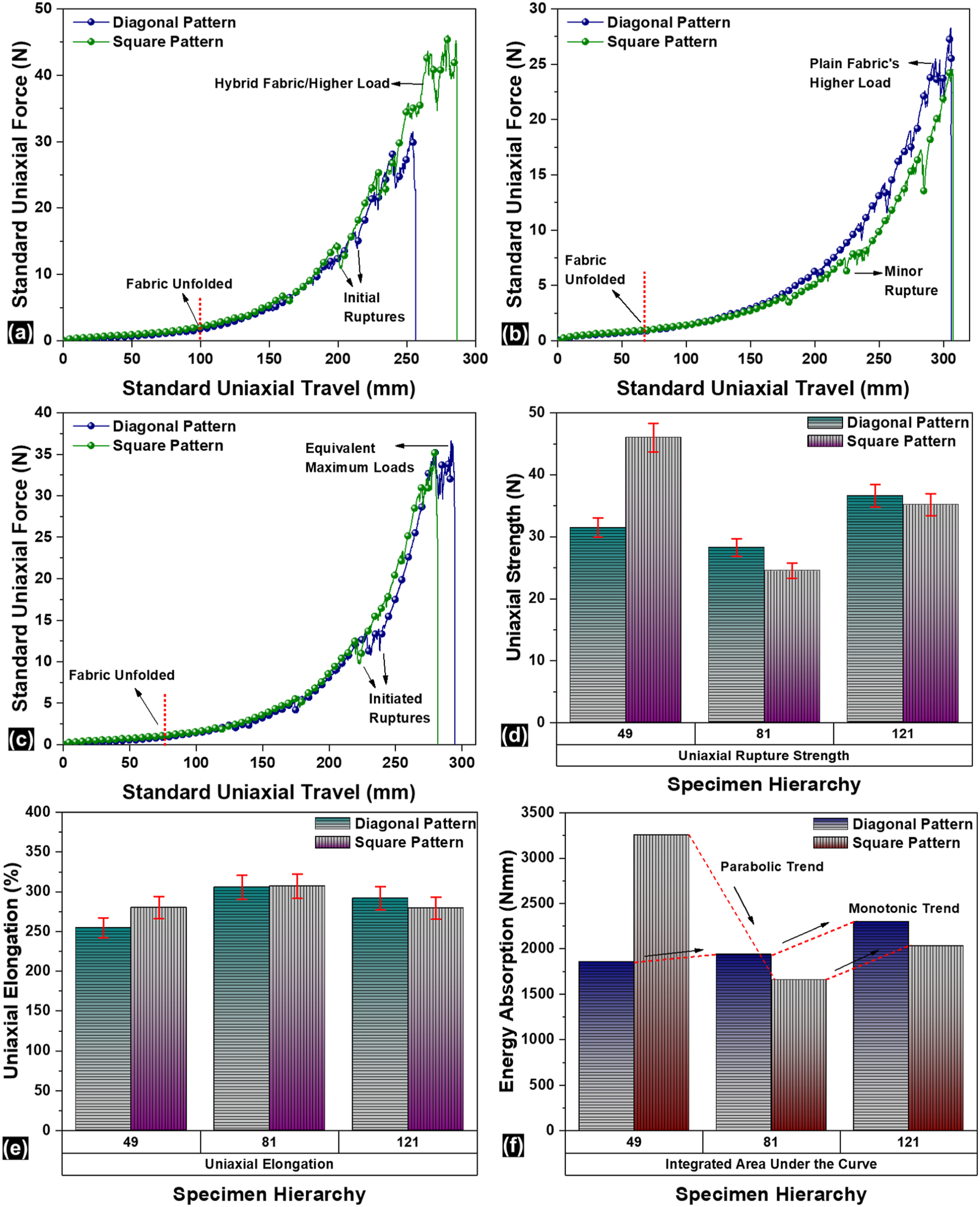
Figure 15 illustrates the uniaxial behaviors of cotton knitted auxetic fabrics. The diagonal pattern, consisting of knit stitches, showed higher uniaxial strength values compared to the tuck stitch-based square auxetic fabrics. At 49 SPR, the diagonal knit pattern exhibited a uniaxial strength of approximately 45 N, followed by a quadratic increase of about 233% at 81 SPR, before declining to 85 N at 121 SPR. This phenomenon can be attributed to the hard segments created by transfer stitch courses, where an optimal amount of transfers contributed positively to the enhancement of uniaxial strength. The maximum uniaxial strength of diagonal knitted specimens was about 100% higher than that of the square pattern, demonstrating the strength reduction caused by adding tuck stitches in cotton knitted auxetic fabrics. Energy absorption trends mirrored those of uniaxial strength, with the 81 SPR diagonal knitted specimen absorbing the highest energy, up to 11,000 Nmm. In contrast, the maximum energy absorption for square specimens was 4000 Nmm, 63% less than that of the diagonal pattern. Figure 16 shows that acrylic knitted auxetic fabrics with tuck stitches exhibited higher strength than knit fabrics, consistent with the conventional trends of multiaxial strengths for polyester. For both patterns, the 49 SPR specimens offered the highest strength, with the square pattern demonstrating a 25% higher strength than the diagonal pattern. Mechanical characteristics of cotton fabrics (a) 49 SPR (b) 81 SPR (c) 121 SPR (d) uniaxial strength (e) uniaxial elongation (f) energy absorption. Mechanical characteristics of acrylic fabrics (a) 49 SPR (b) 81 SPR (c) 121 SPR (d) uniaxial strength (e) uniaxial elongation (f) energy absorption.
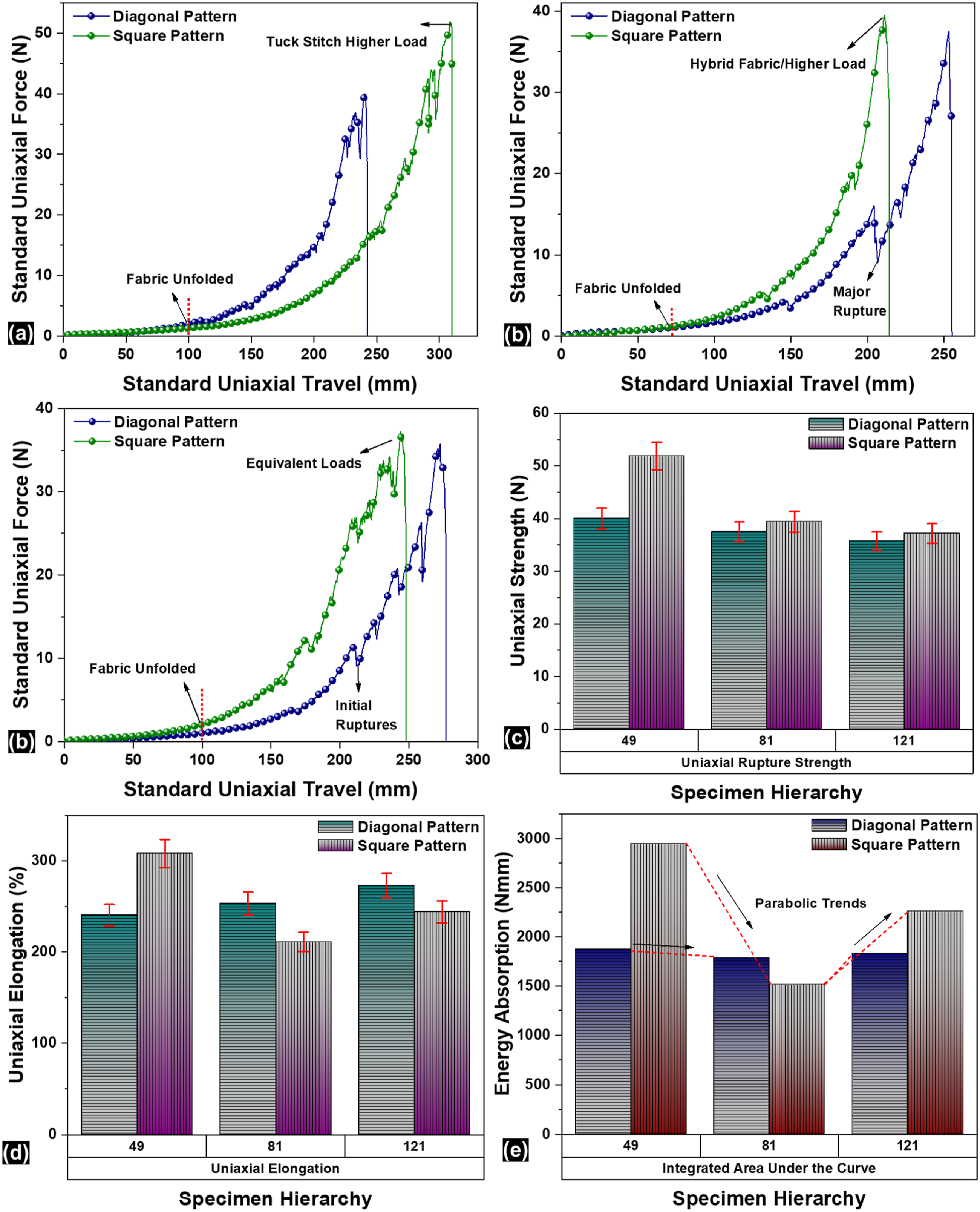
Figure 17 depicts the statistical patterns of energy absorption for the designed auxetic textiles. The enhanced diversity in energy-absorbing tendencies is attributed to variations in material. Cotton knits exhibited the highest energy absorption capability, which gradually decreased for polyester and then acrylic. The 81 SPR size appears to be the optimal grid size for maximizing energy absorption in the knitted specimens. Square-knitted specimens absorbed less energy due to the static tensions introduced by the tuck stitches. Main effects plot of energy absorption.
Conclusion
This study systematically examined the Poisson’s ratio and energy absorption of 3D weft knitted auxetic materials. Compared to conventional knits, these fabrics exhibit significantly higher mechanical properties and energy absorption capacities. Material selection and structural manipulation of the knits can be used to fine-tune these characteristics, and comprehensive measurement techniques are essential for accurate evaluation. The behavior of Poisson’s ratio is largely influenced by yarn surface friction; materials with greater surface friction tend to maintain higher auxeticity for longer periods. Consequently, polyester knits demonstrated 38% and 63% greater auxetic responses compared to cotton and acrylic, respectively. Knitted structural variations also contribute to tuning auxeticity, particularly through the use of tuck stitches. Foldable knitted auxetic fabrics arise from structural imbalances, where tuck stitches create additional yarn tension and imbalance, thereby enhancing the negative Poisson’s ratio (NPR). This explains why the diagonal pattern exhibited about 8% less NPR than the square pattern. Since NPR is also affected by measurement position, not all specimens displayed the same peak NPR value at a constant location; thus, the study averaged readings from multiple locations to provide a more accurate assessment. Increasing the number of stitches per repeat (SPR) size enhanced NPR up to a certain point, beyond which the folds could no longer sustain effective auxeticity. Energy absorption during uniaxial loading was also highest for the optimum SPR size; however, the square pattern exhibited 28% less energy absorption than the diagonal pattern, likely due to structural stresses. Engineered auxetic materials with these enhanced properties are suitable for protective clothing and gear, offering critical performance advantages in high-risk activities such as auto racing, equestrian competitions, and downhill skiing.
Footnotes
Acknowledgments
The authors are grateful to Higher Education Commission Pakistan for providing financial assistance under GCF-63. The authors are also highly obliged to the Department of Textile Engineering (Knitting) and the National Center for Composite Materials (NCCM) for providing the facilities. Authors are also thankful to RMIT University, Melbourne for allowing the researchers to be involved in such multicultural research activities.
Declaration of conflicting interests
The author(s) declared no potential conflicts of interest with respect to the research, authorship, and/or publication of this article.
Funding
The author(s) disclosed receipt of the following financial support for the research, authorship, and/or publication of this article: This work was supported by the Higher Education Commission Pakistan funded the research works under the grant (GCF-063).
