




Abstract
The application of nanomodified polymer impregnation on knitted polyester fabrics was studied to improve camouflage characteristics in VIS, IR, and RF domains to enhance multispectral camouflage protection. Nanoparticles of tungsten disulfide (WS2) were dispersed in an ethanol solution of poly (vinyl butyral) (PVB) and applied as a thin impregnation on polyester fabrics already dyed in camouflage shades. A reference sample impregnated only with PVB, without WS2, was also prepared in the same way. Parallel to the impregnated fabrics, a neat knitted polyester textile sample was submitted to all the examination methods. Diffuse reflection, specular gloss, and color coordinates were measured for all the samples. Moreover, the samples were observed using IR thermography in medium and long-wavelength infrared parts of the electromagnetic spectrum. The best suppression (≥20%) in the IR range of EMS was achieved for the dark green shade sample by applying PVB alone and/or adding PVB/ WS2. RF domain measurement analysis of how impregnated fabrics influence effective Radar Cross Section (RCS), K band radar was used, with the measurements done in terrain conditions. The decrease of the mean RCS value between 11% and 41% was achieved. The obtained results indicate that the addition of WS2 has a positive effect on the observed characteristics and that there is a possibility of using this newly impregnated knitwear in the wider area of the EMS as a camouflage material.
Keywords
Introduction
Like in many other engineering areas, nanotechnologies have found their place in research related to military technology of camouflage protection. Camouflage characteristics of different types of materials are very significant in terms of protecting military equipment1–6 since various types of personal equipment and devices are subjected to mandatory camouflage protection. In recent years not only camouflage coatings but textile materials functionalized with different types of nanomaterials have been a part of extensive research worldwide.2,7–10 Some good examples of meta-material usage are observed in the literature as well, broadening the possible application in multispectral stealth11,12 To obtain valid results for such a complex task as making proper protective material in the wide range of electromagnetic spectrum researchers use even optimization algorithms.13,14
When personal equipment is in question, the most dominant issue is to appropriately protect soldiers ie making valid protective uniforms. Therefore, dying of the materials used for these purposes is a topic of rising importance. The technology and the methods of textile dying have long been familiar, but the most attention was always given to the permanence of color, that is the ways of obtaining constant color for textile dying,15,16 whereas recently the interest has spread to the development of the so-called color-changing fabrics. 17 Nowadays, in the development and design of personal protective equipment the usage of different functionalized materials and composite coatings with specific camouflage protective characteristics is on the rise.18–20
Moreover, modern time warfare and electronic reconnaissance are advancing toward the usage of small-size Unmanned Aerial Vehicles (UAVs). The main and most dominant characteristic of UAVs is their small size, consequently making them hard to detect in both optical and Radio Frequency (RF) domains. Radar Cross Section (RCS) in combination with the low cost of UAVs, is making them widely used by both nations with the most powerful militaries and small countries. In parallel with the development of small RCS Micro UAV’s radars are being adapted to detect small RCS targets. The purpose of this paper is to explore possibilities to reduce the maximum range of detection of UAVs by applying nanocomposite impregnations or covers on UAV bodies since some good attempts of making radar-absorbing composites are observed in the literature. 21
Various nanocomposite coatings or impregnations were studied as potential tuners of the spectrophotometric behavior of the protective fabrics or camouflage materials, often as some chemically modified polymer or nanomodified polymer over the dyed fabric.22–25
In earlier studies, the spectrophotometric properties of thin film coatings of PVB/WS2 on glass plates 26 and on cotton textile materials 27 were examined. Also, WS2 has been added to camouflage paint formulations28,29 in the form of fullerene-like nanoparticles and multi-layer nanotubes. In this research nanoparticles of WS2 were used as a modifier of impregnation material of choice. As a basis for the impregnation, poly (vinyl butyral) was chosen due to its high transparency and very good adhesion to different surfaces, aside from its resistance to wetting and good mechanical characteristics.30–35 PVB is a thermoplastic polymer easy to process, and soluble in a variety of organic solvents, which makes it applicable for many different employments.33–35 Polyester knitwear was used as a basis, as polyester fibers have a wide range of possible applications, not only in wearable garments but also as a constituent of various composite materials.36–38
Tungsten disulfide nanostructures in the shape of multi-layer fullerene-like particles and nanotubes, IF-WS2 and INT-WS2, respectively, were reported to have excellent mechanical properties, and due to them it was studied for a wide range of potential applications: as a reinforcement for composite materials, as solid lubricants, in corrosion protection, ballistic protection, etc.33–35,39 IF-WS2 shows high resistance to impact and pressure, to high temperatures, mechanical wear, radiation, and corrosive environments.31,35,40,41 Recently, the optical properties of these nanostructures have become interesting: the transition metal dichalcogenide nanosheets can be considered as potential materials for photonic and optoelectronic devices. 42 Tungsten disulfide has a direct band gap and photoelectronic features that make it appropriate for use in catalysis, transistors, sensors, energy storage products, and therapy applications.43–47 Literature suggests that these application possibilities arise from WS2 nanosheets’ good absorption of electromagnetic waves that are due to their graphene-like structure. 48 Also, the dependence of the layer thickness on the optical properties has been examined indicating that optical bandgap absorption of monolayer to the overall absorption of light vary as a function of temperature and carrier concentration. 49 Furthermore, it was reported that WS2 has the ability to absorb 5%–10% of incident sunlight, that monolayer WS2 has a direct band gap of 1.98 eV, while multilayer WS2 has an indirect band gap of 1.3 eV. Those properties of WS2 made it a promising material for applications in solar cells, electrocatalysis, batteries, and transistors.50,51
In this research, a new functional nanomodified polymer impregnation has been proposed, aiming to enhance the camouflage performance of the material and to develop flexible, easy-to-use covers for multispectral camouflage protection. The main purpose of the performed study was to enhance the camouflage performance of the material, for use in the middle and far IR part of EMS. Fullerene-like nanoparticles of WS2 were incorporated in PVB solution, and this impregnation was applied on a polyester knitwear already dyed in colors that are common for camouflage patterns. Different laboratory techniques and terrain-conditions examinations were used to determine camouflage characteristics in visible (VIS) and near-infrared (NIR) regions of the electromagnetic spectrum, such as measurements of diffuse reflection, color coordinates, and specular gloss. Every additional treatment or functionalization of the fabrics brings risk regarding the changes of the original color, which is why it is important to perform analyses of the color coordinates and to understand them.52–56 For obtaining results in medium and long wavelength areas of EMS, MWIR, and LWIR respectably, we used two IR thermal cameras, since IR thermography is an important method for composite materials analysis.57,58 To broaden the possible application of polyester knitwear that showed promising behavior regarding camouflage protection,59,60 an RCS examination was conducted in the K-Band of the RF domain, also emphasizing the importance of conducting field experiments regarding explanation of good camouflage properties.
Experimental
Sample preparation
The following materials were used for the preparation of the samples in this research: - polyester knitwear in five camouflage shades (black, brown, dark green, beige green, and light green) that correspond to the shades characteristic for woodland combat background, manufactured by “Dunav” Grocka, - IF-WЅ2 nanoparticles, ApNano, Nanolub,
61
- PVB, Kuraray GMBH, Mowital B45H,
62
- 96% ethanol.
Characteristics of IF-WЅ2 nanoparticles, declared by the manufacturer.

The samples were prepared in the following steps: first, fullerene-like nanoparticles of WЅ2 were ultrasonically dispersed in ethanol by an ultrasonic processor Badelin SonoPuls HD 4100, with sonotrode TS 113 (diameter 13 mm), at 45 kW, 20 Hz, during 20 min. Second, this dispersion was transferred under a mechanical stirrer, and with vigorous mixing, PVB powder was gradually added. After the complete amount of PVB was dissolved in this ethanol dispersion containing nanoparticles, the third step followed: submerging the knitted fabric samples in the prepared solution. The impregnation of the submerged fabric was done under an ultrasonic processor, to provide thorough penetration of the nanostructures between the fibers, with the same ultrasonic processor, same conditions as in the first step, during 10 min. The immersed fabrics were left to dry, that is the fourth step was evaporating the solvent. For the sample without nanoparticles, PVB was dissolved in pure ethanol, and the fabric samples were submerged in this solution in the same way as in the case of a solution with dispersed WS2. The mass concentration of PVB regarding the weight of the textile samples was 3 wt%, and the concentration of nanoparticles was 2 wt% regarding the mass of PVB. This concentration was selected based on reported results of the positive effect of tungsten disulfide in camouflage paints and polymer coatings.24–27
Camouflage properties – VIS-NIR reflection, colorimetry and specular gloss
Camouflage properties were determined by measuring diffuse reflection, color coordinates, and specular gloss. Using the UV/VIS/NIR spectrophotometer UV 3600 from a Japanese manufacturer Shimadzu with an integrating sphere 63 the diffuse reflection was measured in the VIS and NIR area of the EMS (650-1000 nm) using the UV Probe program package, 64 while color coordinates in CIE LAB system were measured in VIS part of the EMS (380-780 nm) using Color program package with 10° and D65 observer. Samples were placed horizontally in the sample compartment of the device, which has a 2 cm aperture diameter. Every sample was measured only once. Diffuse reflection has ±1% measurement uncertainty, while measurement uncertainty for L*, a*, and b* coordinates ranged from ±0.2 to ±0.9.
Specular gloss was measured with Elcometer 480 model T device, at an angle of 85°, which is a standard measurement angle for textile materials, 65 with measurement uncertainty ±0.2.
IR thermography
For obtaining results regarding examined material behavior in the MWIR and LWIR part of the EMS two measuring thermal imaging cameras operating in different ranges were used, FLIR SC620 and FLIR SC 7200. SC 7200 uses “Altair” software for data analysis and acquisition while SC 620 camera uses “ThermaCAM 2.9” software package. 66 The obtained images were analyzed with “ThermaCAM Researcher Professional” software. 67 These two cameras’ specifications are given in the Table S2 of the Supporting Information. In addition to the cameras, the black body TCB-4D, manufactured by Inframet, Poland, was also used in the experiment. Blackbody temperature values were controlled by the TCB TAS-T software. 68 The temperatures of the black body at which measurements were made were 45°C and 60°C. The sample was placed in front of the black body and the exposure time of the samples was 5 min. In this way, the set experiment had the purpose of making a comparison and insight into the processes that take place between samples and electromagnetic energy in the MWIR and LWIR spectral range of EMS.
Radar cross section analysis
The influence of treated fabrics on the reduction of the effective RCS was conducted in terrain conditions, as above stated, using K-band FMCW radar and remotely piloted DJI Mavic Pro Micro UAV. The radar used to perform measurements is Drone Shield Radar Zero. Measurement results were collected and logged by in-house proprietary developed software, and postprocessed by MathWorks MATLAB environment. The Drone Shield Radar Zero radar sensor and DJI Mavic Pro Micro UAV used are depicted in Figure 1. Drone shield radar zero and Dji mavic Pro micro UAV.
As a reference value of the RCS of used Micro UAV, results from laboratory measurements performed by the National Defense Academy of Japan 69 were used. Measurements of DJI Mavic pro-UAV were conducted at 24 GHz frequency. To further confirm the applicability of the used radar sensor first measurement was performed by piloting the used Micro UAV in the central axis of the radar antenna front without applying nano particle-impregnated coating on its body. Results collected confirmed Drone Shield Radar Zero’s precision of RCS measurement, concerning field conditions. Hence weather conditions can influence significantly the detection characteristics of K-Band radar, all measurements were conducted on a single sunny day.
Measurement of camouflage characteristics of nanoparticle-impregnated materials was conducted by covering the body of the used Micro UAV with impregnated material. Piloting Micro UAV is conducted in the central axis of the radar antenna front for each material used.
Maneuvering of Micro UAV on trajectory was performed in a horizontal plane, around Micro UAV central axis, with maintaining altitude parameter as constant as possible. Logging of recorded values was selected to be representative, with a 5 Hz target refresh rate (timestamp, RCS, and position parameters used in analysis).
Postprocessing of gathered data from used radar sensor was conducted using MathWorks MATLAB software environment and was used to calculate and plot: • Mean RCS value from detected samples in Micro UAV route, for each test flight separately • Most incidence RCS value from detected samples in Micro UAV route, for each test flight separately • Standard error and standard deviation in RCS designation by radar, for each test flight separately • Maximum theoretical range of detection (for both Mean RCS and Most incidence RCS calculated) of Micro UAV on route, with its body covered by PVB/WS2 impregnated material, for each test flight separately
Mean RCS value, standard error, and standard deviation were calculated by standard and well-known formulas. The maximum detection range was calculated by use of a modified form Radar equation (Eq.(1)): - R
max
is the theoretical maximum range of detection [m]; - P
t
is transmit power [W]; - G
tx
is transmitter antenna gain [dB]; - G
rx
is receiver antenna gain [dB]; - λ is the central transmitted frequency wavelength [m]; - σ is radar Cross Section (RCS) [m
2
]; - S is the power of minimal detectable signal [dB]; - L is a total signal loss in the system (positive value) [dB];
Modeling of radar sensors signal for calculating maximum detectable range for given RCS value is done using approximated Drone Shield Radar Zero parameters. Characteristics of the radar sensor used are listed in Table S3 of the Supporting Information. Considering that the used radar sensor is continuous wave radar type (FMCW), τ pulse width is not taken into consideration. The measurement sample refresh rate in setup was constant and set to the value of 5 Hz.
Results and discussion
Camouflage properties – VIS-NIR reflection, colorimetry, and specular gloss
Diffuse reflection curves for the untreated and treated with PVB and PVB/ IF-WS2 knitwear are given in Figures 2 and 3. Diffuse reflection for black (left) and brown (right) shade. Diffuse reflection for light green (left), beige green shade (right), and dark green shade (below).

As seen from the figures, the presence of the added nanomaterial in impregnation did affect diffuse reflection values by lowering them, which is a favorable outcome from the aspect of camouflage performance. There can be observed a significant decrease in the diffuse reflection values for all shades in question. Before impregnation, the diffuse reflection values were very high but the IF-WS2 has caused their decrease. This is an important finding because it is coherent with the results of earlier research where similar impregnation was applied to cotton fabric as a basic material. 27 On the other hand, these results show that already dyed material can be modified by this relatively simple way of impregnation and that fine-tuning of camouflage characteristics is possible.
Specular gloss at 85°.

As it may be observed, specular gloss values practically did not change. This means that PVB/IF-WS2 could be used not just for natural fabrics but for polymer threads, yarns, and knitwear as well, to enhance camouflage behavior.
To better understand the given camouflage properties, it is important to know which are commonly requested values of the observed parameters of camouflage masking materials. Military standards regarding camouflage protection can vary from country to country, defining requirements for values of specular and/or diffuse reflection, specular gloss, and color coordinates, as well as defining the camouflage shades and patterns. The most commonly used camouflage pattern is so called woodland pattern where shades of green are dominant. According to the MIL-PRF-85285 standard 70 in the wavelength area from 700 to 2600 nm the value for specular and diffuse reflection can be a maximum 8, while specular gloss cannot exceed 9. On the other hand, the RAL F9 military shade card standard has a different way of characterizing diffuse reflection and specular gloss. 71 The values for diffuse reflection in different militaries that use woodland camouflage patterns on 700 nm vary from 20% to 50% depending on the shade of green (light, dark, grey, olive, etc.). As seen from the graphs in Figure 3, the impregnation of polyester knitwear with an adequate concentration of WS2 nanoparticles could modify diffuse reflection values to meet the standard demands. Also, specular gloss values are not affected by the impregnation. Similar has been observed for the brown and black shades, although the diffuse reflection values are greater than the commonly known criteria demand. A change in WS2 concentration is a possible solution to the problem.

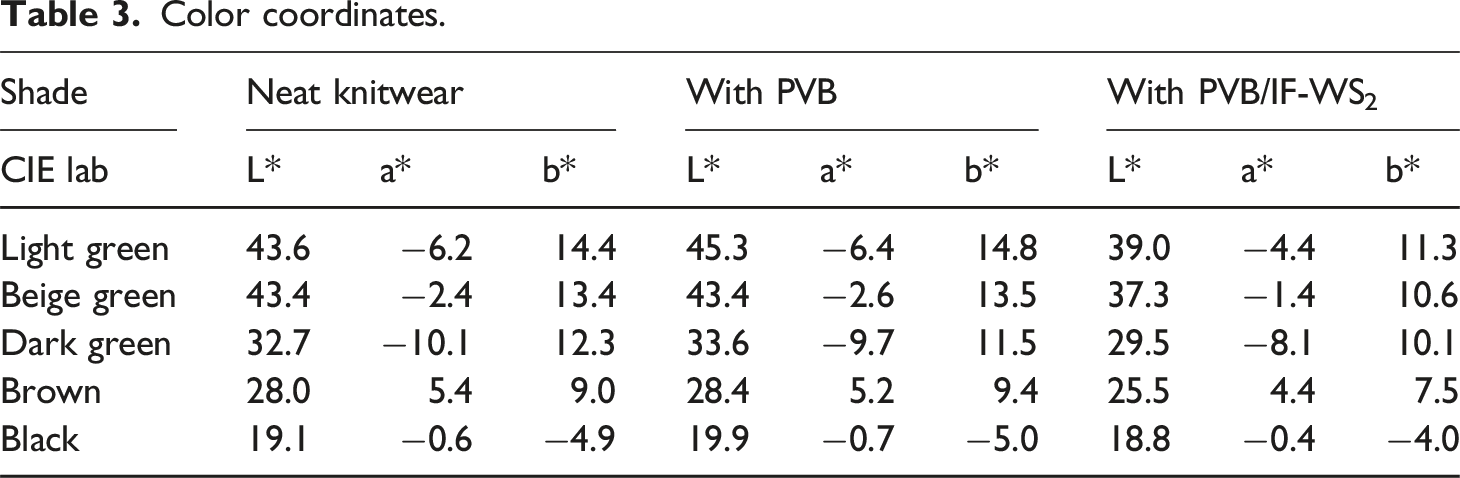
Color coordinates.
ΔE differences.

The observed difference is the smallest for the black shade and the biggest for light green and beige green shade. This is because IF-WS2 can slightly darken the material it impregnates.
26
However, despite these values of ΔE differences, to the human eye, this is not so obvious, as seen in Figure 4. The colors are certainly more similar than different. The value of ΔE represents human eye difference in color sensation, and it is defined that when ΔE difference value is lower than 1 then the difference is not perceptible by the human eye. When the value of ΔE is between 1 and 2 then this difference in color sensation is perceptible through close observation, while greater values of this difference show that the shades’ similarity decreases. If the difference is between 2 and 10, it would be perceptible at a glance. From 11 to 49 shades are more similar than the opposite, and if the value is 100, shades are exactly the opposite.55,56 So, even though the MIL and RAL standard demand values lower than 1.5,70,71 we could potentially use these impregnated shades while working on the WS2 impregnation concentration, which would decrease these ΔE values. The samples’ appearance after impregnation, fabric/PVB (left) and fabric/PVB/IF-WS2 (right): (a) light green; (b) beige green; (c) dark green.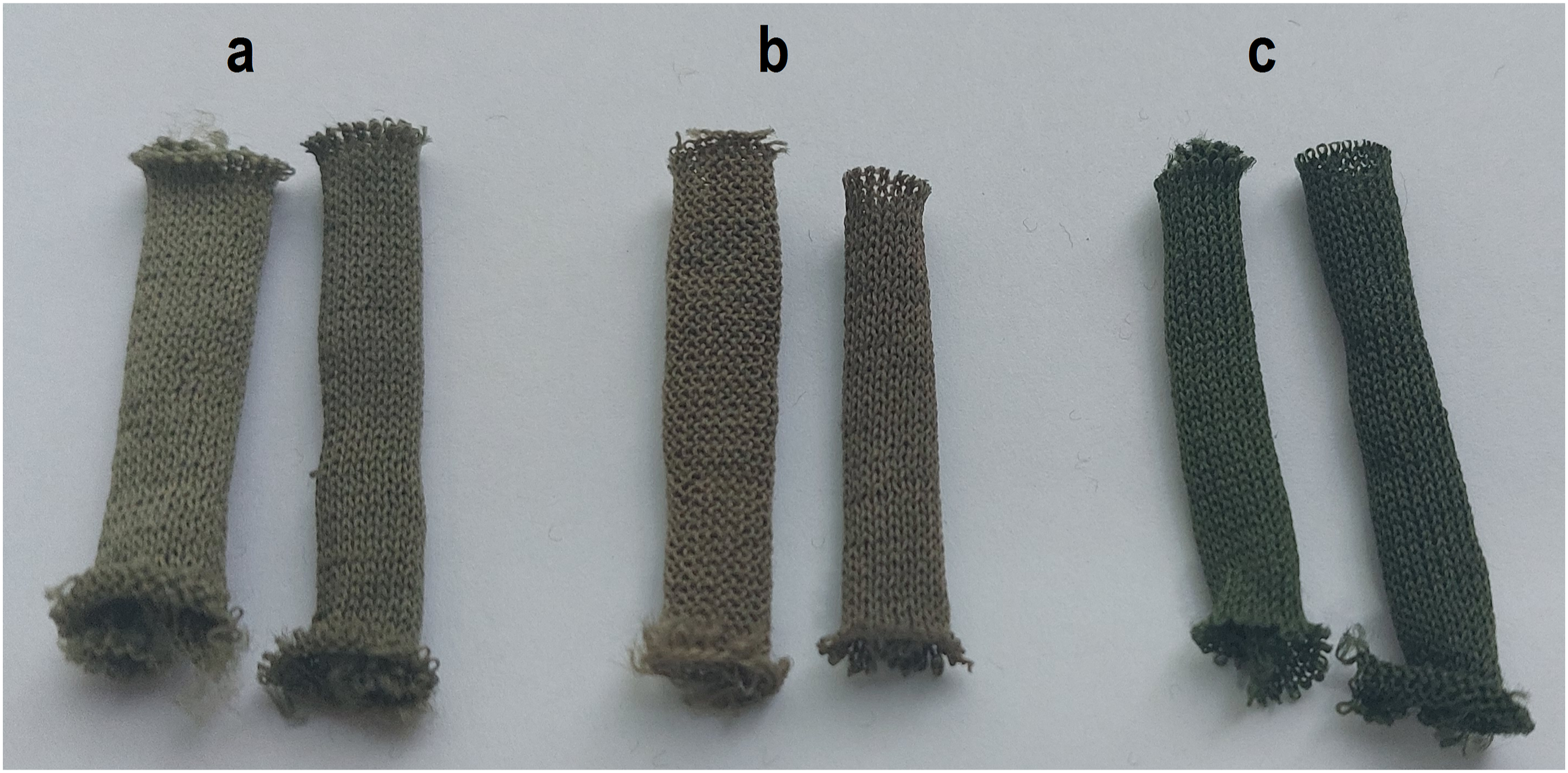
IR thermography
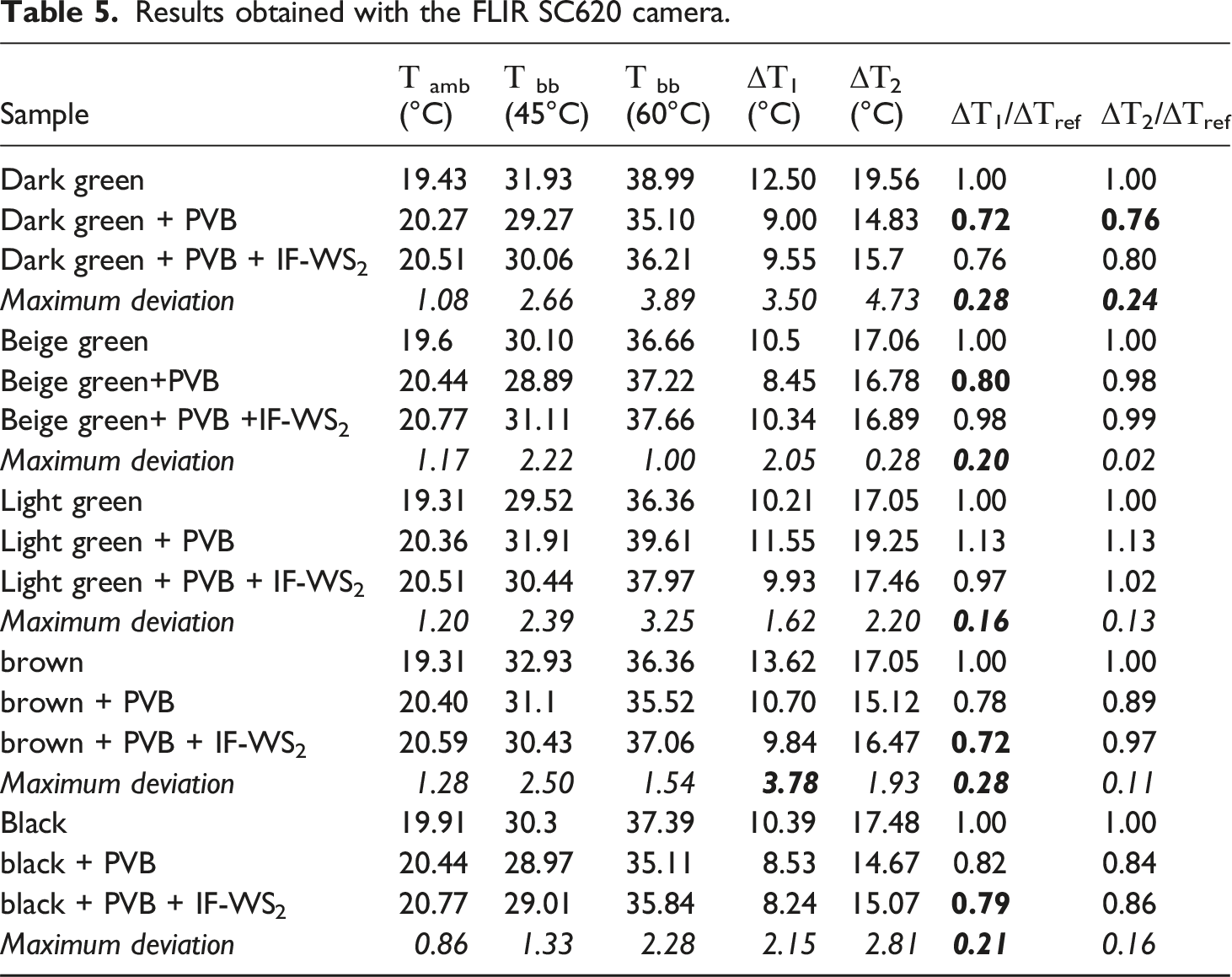
Results obtained with the FLIR SC620 camera.
Results obtained with the FLIR SC7200 camera.

The inconsistency among the results for different shades is quite obvious. As seen from the data shown in these two tables, samples of light green shade do not behave in the manner required for camouflage protection as well as beige green and brown with the addition of PVB/IF-WS2. In contrast, dark green has suppression of IR signature in both MWIR and LWIR spectral areas; the best suppression is gained with the application of PVB alone, but also adding PVB/IF-WS2 gives suppression ≥20%. The black shade gives suppression greater than 20% in MWIR but in LWIR suppression is lower than 20% except for Tbb = 45oC and the addition of PVB/IF WS2, so it cannot be used as camouflage protection in both spectral domains. The same observations were noted for brown shade with the addition of PVB.
On the other hand, the results obtained with the FLIR SC7200 camera (MWIR) show that the reduction of thermal reflection occurs in almost all treated samples. The reductions are larger and range up to almost 40%.
These results are not as clear as the results obtained by measuring the diffuse reflection in the VIS and NIR parts of the EMS.27,54 Namely, it was shown that all shades behave the best when impregnated with PVB/IF-WS2 and that the impregnation significantly lowers the reflection curve giving the possibility of fine-tuning of the reflection features of the material. The reason for such differences in the behavior of the samples should be further examined, but one possibility is that natural fibers, like cotton fibers, behave somewhat differently in this part of EMS, in contrast to polyester knitwear, which exhibits reported differences.
Significant results were achieved with individual colors. Bearing in mind that masking involves a set of applied measures and procedures that involve achieving effects: - Suppression of the radiation signature on the protected object of interest; - Highlighting and strengthening of radiation signatures on mock-ups (both dynamic and static), which simulate objects to be protected, without or with the application of partial protection with camouflage covers; - Extensions of areas with objects of interest that are protected and subject to masking; - Oversaturation in selected zones of the observed material with a radiation signature that contributes to the generation of a false alarm, for example, by achieving multiple reflections in a wide spectral area; and - Mixed surfaces of high-diffuse and regular reflective surfaces (signal suppression effects and shifting of the targeting point position).
To get a visual insight into the camouflage effect in this part of EMS, IR recordings of brown fabric on the black body, without and with impregnations, are given in Figure 5. As may be observed, PVB and PVB/IF-WS2 coated material of the cover is visually darker than the background, meaning that IR camera registers lower temperatures at that surface, that is PVB and PVB/IF-WS2 impregnations provide reduced IR signature of the covered object. IR recordings of brown fabric on the black body, at ambient temperature.
Radar cross section analysis
Results obtained with the Drone Shield Radar Zero.


MEAN and most incidence RCS values measured for different camouflage materials applied.

Calculated MAX range of detection for most incidence RCS and mean RCS.
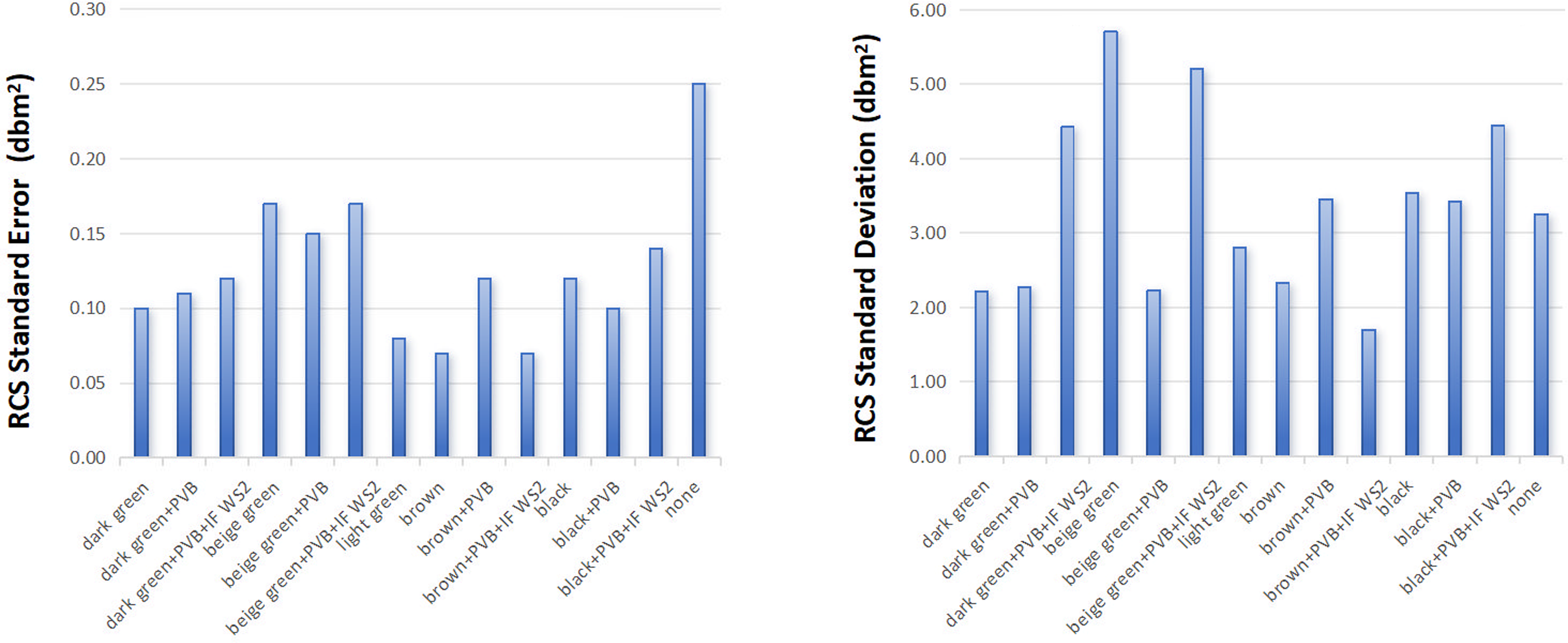
Standard RCS measurement error calculated from RCS measurements obtained by radar sensor.
As these results show, the addition of nanoparticles affects the radar reflectivity of the remotely piloted aircraft. The overall decrease of mean RCS value for different camouflage materials applied on UAV bodies is between 11% and 41%, while the largest decrease in the radar reflective surface was recorded with the nanoparticle-treated knitwear of green beige shade 40.75%. The increased standard deviation of effective RCS value measured when different camouflage materials are applied on the UAV body is also noted, which indicates that the mentioned materials reduce the radar reflectivity to a significant extent. The decrease of most incidence RCS value for conducted measurements further confirms this hypothesis. However, the body of the fuselage of the remotely piloted aircraft used in the experiment, that is its one side, was covered between 30% and 50% of its surface only, so the effect of the knitwear is not fully perceived. To do so, repeating of the test which would include larger samples would be a mandatory requirement. Besides the tests on larger samples, different concentrations of PVB/IF-WS2 should be studied, as well.
Results on RCS analysis implicate the potential for significant reduction of Radar Cross Section for UAVs that are implementing impregnated nanoparticles on the surface layer of the UAV body. Practical considerations of reduced UAVs Radar Cross Section are that the maximal theoretical detection range of UAVs can be reduced, thus, detection of UAVs is postponed and response time for enemy Counter UAV systems shortened.
Also, radar in the K band is selected as the preferable choice because radar in Ku, K, and Ka bands are often used in the concept of Man Portable Ground Surveillance Radar for detecting infantry approach, armored combat vehicles etc. Examples of these radars are (major brands): Thales Ground Observer 12, Blighter B202 Mk 2, Spotter Industrial Compact CK series radar etc. Shown properties of reducing Radar Cross Section in the K frequency band using impregnated nanoparticles have a potential to be introduced in an even broader use for making highly effective infantry and armored combat vehicles camouflage coatings.
Considering previous findings with the impregnated cotton fabrics, 27 with similar PVB/WS2 impregnation, and that the impregnated cotton fabric showed promising behavior in Vis and IR part of the EMS, this research has successfully fulfilled its aim to obtain so-called multispectral camouflage protection in a broader wavelength area of EMS. Compared to results with impregnated cotton fabrics reported earlier, the addition of PVB/WS2 results in both cases in lowering the diffuse reflection curves giving the possibility of fine-tuning of camouflage characteristics in the Vis-NIR part of the EMS. Specular gloss values were of the same order in both cases. Due to the difference between polyester knitwear and cotton fabric, values for color coordinates and ΔE differences show some discrepancies, but smaller differences were obtained for impregnated polyester knitwear.
The IR thermography technique was applied in a somewhat different way in this research compared to earlier tests,27,58,59 but both types of material, cotton and polyester, showed acceptable behaviour. Moreover, the RCS measurements were not conducted for cotton or any similar fabric.
Overall conclusion in this comparative analysis would be that the camouflage properties could be improved and extended which would be beneficial in military camouflage protection of soldiers and equipment, but also in protection from EM contamination. Apart from this, these materials could be potentially used as sensors or in optoelectronic devices, which will extend its application for civil purposes.
Conclusion
A new material was developed with potential application in multispectral camouflage protection, based on polyester knitwear dyed in camouflage shades impregnated with PVB/IF-WS2. The positive influence of nanostructures of IF-WS2 on the camouflage properties of polyester knitwear was confirmed in Vis and NIR parts of EMS. In diffuse reflection values significant decrease was noticed, while specular gloss did not significantly change. The visual appearance of the samples mildly changed what was confirmed by color coordinates values, as well as ΔE differences, but the extent of this visual change depends on the shade.
IR thermography examination with a FLIR SC620 camera showed that the brown and black shades have the best results when impregnated with PVB/IF-WS2. Dark green has suppression of IR signature ≥20% in both MWIR and LWIR spectral areas. On the other hand, the results obtained with FLIR SC7200, which operates in different ranges of the IR part of EMS, show a significantly greater drop in the temperature difference between treated and untreated samples of all shades, with IR signature supression up to almost 40%. RCS analysis in the K-Band of the RF domain of EMS showed that an overall decrease in the theoretical maximum range of detection for mean RCS value for different camouflage materials applied on UAV bodies is between 11% and 41%, while the largest decrease in the radar reflective surface was recorded with the nanoparticle-treated knitwear of green beige shade 40.75%, so that this type of impregnation is prosperous for protecting different types of aircraft.
The obtained results confirmed that the proposed method of impregnation on polyester knitwear has promising possibilities to obtain multispectral camouflage protection in the different parts of EMS using this simple, light-weight and flexible cover material. In further work, some variations could be done in nanoparticle concentrations and in size of the textile samples, and to test the proposed PVB/IF-WS2 impregnation on other textile materials. Main practical implications of the research are in potential military applications in camouflage protection technology and potential civil use of the findings, such as EM shielding, in protection from EM pollution, in sensors, in next-generation optoelectronic devices, etc.
Supplemental Material
Supplemental Material - Tunable spectral properties of PVB/WS2 impregnated fabrics in VIS, IR and RF part of the EMS
Supplemental Material for Tunable spectral properties of PVB/WS2 impregnated fabrics in VIS, IR and RF part of the EMS by Aleksandra Samolov, Darko Pijević, Dragan Knežević, Katarina Mišković, Radoslav Sirovatka and Danica Bajić in Journal of Industrial Textiles
Footnotes
Declaration of conflicting interests
The author(s) declared no potential conflicts of interest with respect to the research, authorship, and/or publication of this article.
Funding
The author(s) disclosed receipt of the following financial support for the research, authorship, and/or publication of this article: This work was supported by the Ministry of Science, Technological Development and Innovation of the Republic of Serbia; 451-03-66/2024-03/200017, Ministry of Science, Technological Development and Innovation of the Republic of Serbia; 451-03-66/2024-03/200325, Military Technical Institute in Belgrade.

Data availability statement
Data will be made available on request.
Supplemental Material
Supplemental material for this article is available online.
References
Supplementary Material
Please find the following supplemental material available below.
For Open Access articles published under a Creative Commons License, all supplemental material carries the same license as the article it is associated with.
For non-Open Access articles published, all supplemental material carries a non-exclusive license, and permission requests for re-use of supplemental material or any part of supplemental material shall be sent directly to the copyright owner as specified in the copyright notice associated with the article.
