




Abstract
The integration of advanced textile materials is crucial to enhance the quality of healthcare solutions. Three-dimensional (3D) knitted spacer fabrics (KSFs) have emerged as a revolutionary class of medical textiles distinguished by their unique ability to provide high breathability, moisture management, and customizable structural properties. This comprehensive review systematically examined the multifaceted applications of 3D KSFs in the healthcare sector. It begins with an overview of various design and manufacturing techniques, including warp and weft knitting processes, that facilitate the production of innovative fabrics. The review then details the distinct structural and functional features of 3D KSFs, emphasizing their cushioning effects, porosity, and adaptability, which enhance their effectiveness in the medical context. Subsequent sections explore diverse applications, including wound care, where their moisture-wicking capabilities promote healing, pressure ulcer prevention, leveraging their ability to evenly distribute pressure, and orthopedic supports, which benefit from their comfort and supportive characteristics. This paper also discusses the potential of 3D KSFs in scaffold development for tissue engineering, as well as their use in assistive devices for enhanced patient mobility. Emerging trends, such as the incorporation of smart technologies for real-time monitoring and commitment to sustainability through washable and reusable designs, are critically analyzed. In turn, this review provides an in-depth resource for healthcare professionals, textile researchers, and product developers, highlighting the transformative potential of 3D KSFs for advancing healthcare solutions and improving patient outcomes.
Keywords
Introduction
Healthcare is essential for human survival, and the development of new biomaterials using polymeric materials and innovative textile structures is at the forefront of medical research. 1 Medical textiles represent a dynamic intersection between the textile industry and medical science, offering a wide array of applications that enhance healthcare quality and patient well-being.2,3 These textiles are engineered to meet specific medical requirements such as biocompatibility, bioactivity, and functionality, which are critical for applications ranging from wound dressings and tissue engineering to medical implants and regenerative medicine.3,4 The evolution of medical textiles encompasses a spectrum from nano- to macroscales, focusing on natural and synthetic materials tailored for their intended biomedical applications.3,5 This diversity is evident in various forms of fibers, yarns, and fabrics, each modified or coated to fulfill specific functions.6,7 Textile fabrics can be categorized into 2D and 3D structures. 3D fabrics, including woven, knitted, and braided structures, have emerged as promising alternatives for various applications compared to their 2D counterparts. For instance, due to their superior mechanical performance and excellent formability, 3D woven fabrics are particularly promising for use in impact-protective clothing and composites.8–12 Similarly, traditional 2D structures often fail to mimic the three-dimensional (3D) nature of human tissues, lacking the necessary structural integrity for certain medical applications. This limitation prompted researchers to explore the development of 3D spacer structures.13,14
Three-dimensional (3D) spacer fabrics are characterized by a unique structure consisting of two separate fabric layers connected by spacer yarns, creating a porous configuration.15,16 This sandwich-like pattern allows engineering of various thicknesses and properties, enabling these fabrics to better integrate with human anatomy and provide targeted support and compression.13,17 The shift toward 3D structures also facilitates the incorporation of advanced materials such as nanofibers and smart textiles, which endow these fabrics with additional functionalities, including antimicrobial properties and physiological monitoring capabilities.13,14,18 Consequently, 3D knitted spacer fabrics (3D KSFs) have gained popularity in medical applications owing to their unique attributes.19,20 Their porous structures ensure excellent air permeability and moisture management, both of which are critical for patient comfort and hygiene. 21 Additionally, the ability to control the density and composition of these fabrics allows for customization of their thermal and moisture-wicking properties, which are essential for maintaining an optimal microclimate for skin health.22,23
Research indicates that 3D KSFs can be effectively used in various medical applications, including wound care and management,17,24–27 orthopedic support and rehabilitation,28–30 personal protective equipment (PPE),31–35 and tissue engineering.17,24,26,36 For instance, the absorbent capabilities of KSFs have garnered significant attention, suggesting that spacer fabrics could effectively replace absorbent layers in advanced wound dressings.37,38 Moreover, spacer fabric-based dressings exhibit superior air permeability and absorbency compared to conventional dressings but also possess antimicrobial properties.25,39,40 The efficacy of antimicrobial treatment on KSF has been studied, demonstrating broad-spectrum antimicrobial effects against various pathogens, making it suitable for infection control in wound dressings. 41
Building on their potential in wound care, 3D KSFs also extend to pressure ulcer prevention, leveraging their unique structural properties and moisture control to promote skin health and healing.16,42,43 In addition, the development of superabsorbent spacer fabrics has shown improved performance in terms of wetting, absorption, and air permeability for wound care applications.27,44 In orthopedics, the properties of biomaterials, including those of 3D KSFs, are critical for applications, such as knee braces. These fabrics should promote rapid healing, prevent infection, and ensure biocompatibility. 45 Research indicates that they provide lower air resistance and higher water vapor transmission rates compared to traditional materials while maintaining comparable interfacial pressures.15,46,47 Warp-knitted spacer fabrics (WKSFs) have been highlighted for their capacity to serve as reinforcements in composites, thereby providing better support surfaces in orthopedic settings.48,49
In addition to orthopedic applications, personal protective equipment (PPE) is another area in which 3D KSFs can play a significant role. The global demand for PPE, particularly during the COVID-19 pandemic, has underscored the need for materials that offer protection while remaining comfortable and sustainable.50,51 Spacer fabrics could contribute to the development of PPE that meets these criteria owing to their breathability and potential for incorporating antimicrobial finishes. 41 Furthermore, in tissue engineering, the 3D structure of spacer fabrics is advantageous for creating scaffolds that support cell growth and tissue regeneration. The ability to control the thickness and density of these fabrics allows customization to meet specific tissue engineering needs.28,45 Additionally, their vibration isolation characteristics suggest the possibility of enhancing the comfort of medical devices and seating.50,52 Given these diverse applications, 3D KSFs are emerging as transformative materials in the healthcare sector owing to their unique properties and extensive potential for medical applications. Their washable and reusable nature aligns with the current emphasis on sustainability and the reduction of environmental impact, which is critical in the context of an ageing population and the associated financial pressures on healthcare systems. 23
Despite the increasing attention on 3D KSFs, there is a lack of comprehensive reviews exploring their applications. This review aims to fill this gap by providing a detailed understanding of the manufacturing techniques, design considerations, and unique properties that render these fabrics ideal for medical applications. It discusses various uses in healthcare, including wound care, orthopedic support, protective equipment, and biomedical devices. Furthermore, this study explores current and future trends, such as the integration of smart technologies, customization through additive manufacturing, and the role of these fabrics in sustainability. The subsequent sections would identify the challenges and gaps in the field, highlighting opportunities for advancing knowledge on the fabrication techniques and applications of 3D KSFs. The review concludes the paper with a summary and concluding remarks.
Review methodology
The exploration of 3D KSFs in healthcare requires a systematic and comprehensive review of the existing literature to understand their properties, manufacturing techniques, and diverse applications. This methodology outlines the approach taken to gather, analyze, and synthesize relevant research, ensuring a thorough examination of the transformative potential of these materials in medical contexts. The review began with a systematic literature search conducted across multiple databases, including PubMed, Scopus, Web of Science, and Google Scholar. A combination of keywords and phrases, such as “3D knitted spacer fabrics,” “medical textiles,” “biomedical applications,” “wound care,” “orthopedic supports,” “pressure ulcer prevention,” “protective equipment,” “tissue engineering,” and “sustainability in healthcare,” was employed to capture a broad range of relevant studies. The inclusion criteria focus on peer-reviewed articles, conference papers, and patents published within the last two decades that discuss the properties, manufacturing techniques, and applications of 3D KSFs in healthcare. Non-English publications, review articles not specifically centered on 3D KSFs, and studies unrelated to medical applications were excluded to maintain the focus and relevance of the review. Data extraction involves gathering pertinent information, including the study objectives, methodologies, findings, and specific applications of 3D KSFs. These data were organized into categories based on their applications, such as wound care and management, orthopedic support and rehabilitation, protective equipment, and biomedical devices, as well as material properties, including moisture management, air permeability, thermal comfort, and impact resistance. A critical analysis of the selected studies assessed their quality and relevance, with particular attention paid to methodologies and the applicability of results to clinical settings. This analysis included a comparative evaluation of findings across different studies to identify common themes, strengths, and weaknesses regarding the properties and applications of 3D KSFs. Current trends in the use of 3D KSFs have been identified, including their integration with smart technologies such as sensors for monitoring physiological signals and advancements in additive manufacturing that allow for customization and personalization. Additionally, this review addresses the environmental implications of using 3D KSFs, emphasizing their washable and reusable nature, which aligns with sustainability goals in healthcare. Moreover, gaps in the literature are highlighted, particularly concerning the long-term performance, clinical efficacy, and user feedback regarding the application of these materials in healthcare settings. The methodology concludes with a summary of key findings, emphasizing the transformative potential of 3D KSFs in advanced healthcare solutions, and the need for further research to optimize design parameters and explore new manufacturing techniques. This will be crucial for translating laboratory findings into practical healthcare products that enhance patient care and comfort.
Manufacturing techniques, design considerations and properties of 3D KSFs
Manufacturing techniques
Warp knitting methods
The 3D KSFs are characterized by two outer layers connected by spacer yarns, forming a sandwich-like configuration. Warp-knitting methods involve each needle loop with its own thread, creating a fabric through interlocking loops in the vertical direction. Warp-knitted spacer fabrics (WKSFs) are typically produced on double-needle bar Raschel machines, which facilitate complex structures and integration of spacer yarns.50,53 Figure 1a illustrates the basic setup of a Karl Mayer spacer machine RD6N, with guide bars 1 and 2 knitting the front base fabric and guide bars 5 and 6 knitting the other base fabrics. Guide bars 3 and 4 carry spacer threads knitted on both needle bars in succession, with the thickness varying between 1 and 15 mm, depending on the distance between the two needle bars.
26
The materials used in guide bars 1, 2, 3, 4, 5, and 6 can vary significantly, and the structures of the two base fabrics can also differ. For instance, Caronna et al.
54
manufactured polylactic acid (PLA) 3D WKSFs using a Karl Mayer double-needle bar Raschel knitting machine. Similarly, Schäfer et al.
55
created 3D WKSFs for tissue engineering using two types of polyester (PET) fibers, demonstrating the versatility of warp knitting for producing fabrics with unique geometries and mechanical properties. Figure 1 illustrates the production methods of WKSFs, showing various aspects of the knitting process and fabric structure. (A) Production Overview: This section highlights the knitting principle (a), a schematic representation of the fabric structure (b), and the interlacing of the chain and inlay yarns (c). The hexagonal mesh structure is depicted in (d), along with the front (e) and side views (f) of the WKSFs, providing a comprehensive visual representation of the architecture of the fabric. (B) Visual Representations: This section includes real images (a) of WKSFs alongside three-dimensional simulation models (b) that describe the surface layers. Schematic representations (g and h) illustrate the unit structure of the WKSFs, emphasizing the arrangement of the surface layers. (C) Detailed Fabric Structure: This section presents a real image (a) of the WKSF, followed by a three-dimensional simulation model (b) that further describes the fabric. Close-up views of the top (c) and bottom (d) layers are provided to provide insight into the intricate design and layering of the spacer fabric. Production methods of WKSFs: (A) Overview of the warp knitting process; (B) Visual representations of WKSFs; (C) Detailed structure of WKSFs.
Warp knitting technology
56
offers high pattern variation, allowing precise adjustments to the pressure stability and air permeability in spacer fabrics,
57
which are widely used in applications such as seating, functional clothing, mattresses, and orthopedics. The open structure of these fabrics provides elasticity, insulation, and acoustic damping, making them suitable for filtration systems and water-harvesting methods.
58
Jacquard double-bar Raschel machines can also produce tubular structures and spacer fabrics by integrating warp and weft yarns.
36
This requires the integration of warp yarns and weft yarns and requires a double-needle bar Raschel machine with a double-faced weft insertion system. High-performance yarns, such as glass yarns, can be integrated on both sides in the 0° and 90° directions, enabling the production of open textile-reinforced mesh structures.
58
Rajan et al.
59
utilized a Raschel double-needle bed warp-knitting machine to create spacer fabrics with varying thicknesses by adjusting the needle bars and guide bar movements, resulting in samples with hexagonal net structures and plain bottom layers. This adaptability demonstrates the potential of warp knitting technology for producing tailored spacer fabrics for diverse applications. Figure 2 illustrates the design of the WKSFs, comprising upper and lower surfaces with several pile yarns (Panel A). The pile yarns connected the upper and lower cover areas and could be arranged in three different geometries, with the geometry shown in B2 being the primary configuration used in most experiments. The morphology of the covered areas also varied, as depicted in panels C and C1-C4. Finally, the WKSFs were infiltrated with a cell-laden hydrogel to generate fiber-reinforced composites, as illustrated in the top (D1) and side views (D2). This integration of hydrogels enhances the mechanical properties and functionality of spacer fabrics, making them suitable for advanced applications in medical and structural contexts.
55
WKSFs design. The fabricated spacer fabrics comprised an upper and lower surface/cover area as well as several pile yarns (A). The pile yarn connects the upper and lower cover areas and can be arranged in three different geometries (B1–B3). For most of the experiments conducted in this study, the geometry displayed in B2 was applied. In addition to the pile yarn geometry, the morphology of the cover areas varied (C, C1–C4). Finally, the WKSFs were infiltrated with (cell-laden) hydrogel to generate the fiber-reinforced composites. Pictures of the fabricated composites are illustrated in the top (D1) and side views (D2).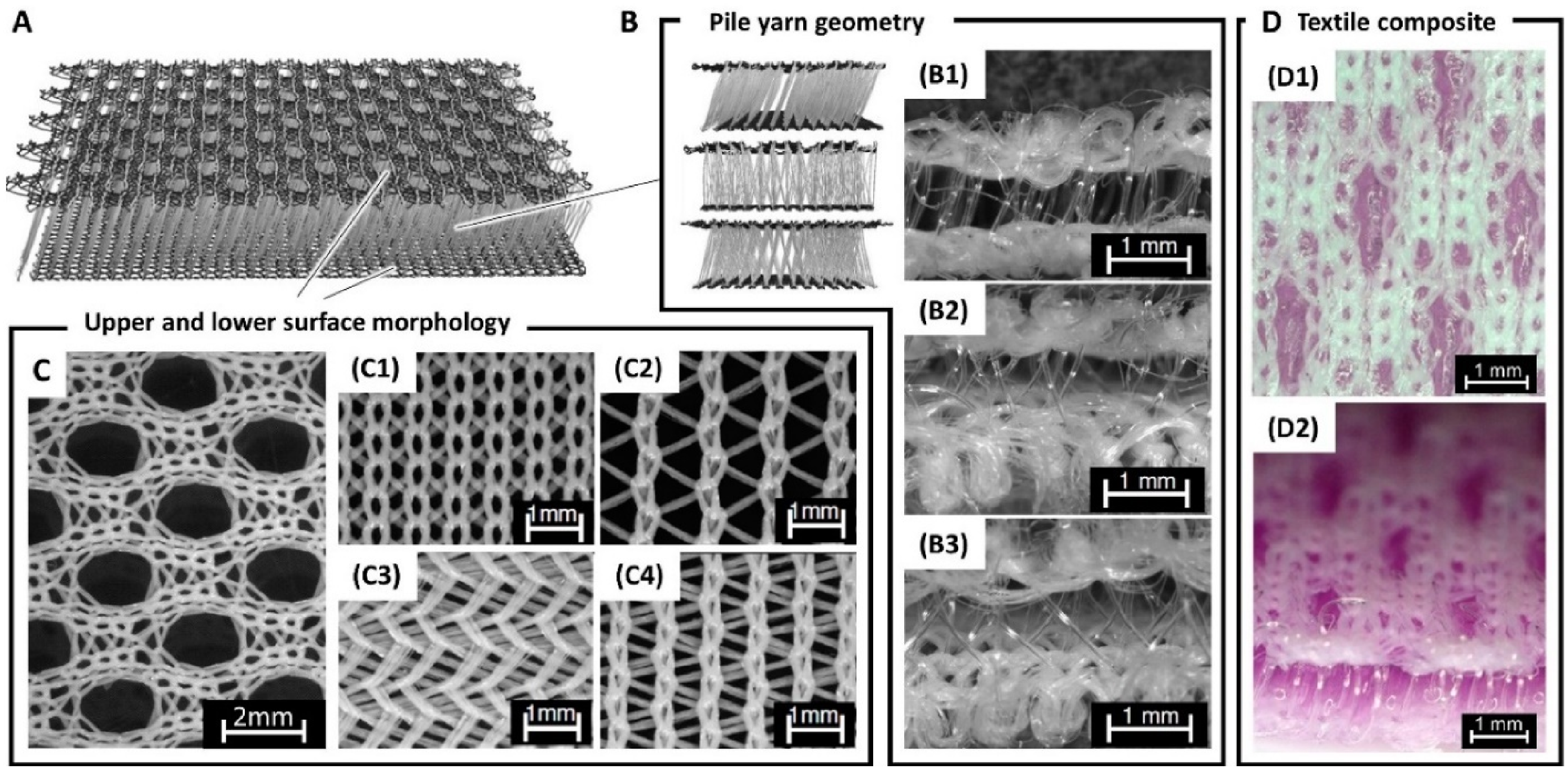
Weft knitting methods
Weft knitting involves the horizontal interlocking of loops using a single thread fed across the width of the fabric. This method can be performed on flat or circular machines, with circular machines enabling the production of seamless tubular structures. Weft-knitted spacer fabrics (WeKSFs) can be engineered with different structural parameters to achieve desired cushioning properties, making them suitable for impact protection applications.
38
During the knitting process, it is essential to use alternate needles to connect the layers because the non-selected group of needles will be involved in subsequent steps. The loop-transferring technique is crucial for establishing connections between the fabric layers. Figure 3 illustrates the knitting procedure of a simple-structured 3D WeKSF, demonstrating the importance of using alternative needles to achieve optimal results.
60
3D spacer weft-knitted fabric production steps: (a) six consecutive steps for producing 3D WeKSF and (b) cross-sectional view of the fabric; (c) 3D configurations of fabrics.
The process involves the formation of two separate layers of predetermined lengths using odd needles from both the rear and front needle beds. The junction between the connecting layer and one of the surface layers is created in the second step, where the connecting layer is knitted by even-numbered needles in the front bed based on a predetermined thickness for the final product. Before loop transfer, the needle beds must be repositioned through a racking operation, aligning the odd needles of the rear bed with the even needles of the front bed. After loop transfer, the needle beds were returned to their original positions. This sequence was repeated to produce a 3D structure, with loops at the connection points significantly larger than those in the rest of the knitted fabric. The loops prior to transfer are adjusted to be 1.15 times larger than the ground loops. The 3D fabric samples with different cross-sectional profiles were then relaxed under wet and dry conditions for 24 h. 60
Flat weft knitting methods
The manufacturing of WeKSFs primarily involves the use of computerized flat-knitting machines. These machines facilitate the production of integrated-knitted spacer fabrics with various cross-sectional shapes 61 as well as the design of fabrics with different thicknesses by varying the linking distance of the spacer monofilament. 62 The process includes the selection of appropriate yarns, such as biocompatible fibers, multifilament, and monofilament yarns, which are then knitted to create a 3D fabric structure consisting of two separate outer layers connected by spacer yarns.38,63 The structural parameters of the spacer fabrics, such as the loop lengths and stitch cam settings, were adjusted to achieve the desired compression properties and air permeability. 64 Additionally, the physical properties of fabrics can be tailored by manipulating factors such as monofilament diameter, linking distance, and the type of monofilament used. 65 Innovative knitting techniques have also been developed to create fabrics with unique geometric structures, such as V-shapes, which exhibit different physical properties compared to traditional U-shaped structures. 66 Furthermore, the inclusion of elastic yarns in the outer layers of spacer structures has been explored to achieve negative stiffness under compression, which is beneficial for vibration isolation applications. 62 The comprehensive use of these flat weft knitting methods allows for the production of spacer fabrics with specific qualities suitable for various applications, from protective equipment to wound dressings and sports bra cups.63,65,67 In summary, the manufacturing of WeKSFs using flat knitting technology is a versatile process that allows the creation of fabrics with tailored properties. By adjusting the structural parameters and material choices, manufacturers can produce spacer fabrics with specific characteristics for a wide range of applications.24,27,61–67
Circular weft knitting methods
WeKSFs, such as double jerseys, can be created on circular dial and cylinder machines using various stitch combinations to connect two fabric layers.
68
Ray
69
stated that all techniques necessitate the use of at least three yarns for each visual fabric course: cylinder needle yarn, dial needle yarn, and a spacer yarn, typically monofilament. A dial height adjustment can manipulate the distance between the two fabrics and determine the amount of pile yarn. Techniques, such as tucking and plating, are used to create spacer fabrics in cylinders and dial machines. Therefore, special feeders are necessary for this purpose. Jacquard patterning can also be used in dial and cylinder machines for creating spacer fabric effects.
69
For instance, Hamedi and Salimi
70
utilized WeKSFs with nitinol wires as spacer monofilaments for insoles in their study, as shown in Figure 4. The feeding tension was controlled using an electronic tension meter, and the machine settings were checked regularly to maintain uniform tension throughout the knitting process. To prevent deformation of the knitted insole, the exiting rollers were bypassed, and a set of combs and weights with a pull-out force of 1.5 kg was used to pull the fabric out of the knitting machine. Two KSFs with 0.1 mm diameter Polyamide and nitinol yarns were used, providing high bending rigidity and superelastic properties compared with the same diameter polyamide monofilament. (A) (a) Nitinol spacer fabric sample (b) Nitinol spacer fabric coursewise cross-section (c) Nitinol spacer fabric knitting pattern. (B) Insole samples (a) Weft knitted insole with nitinol spacer yarn (b) Plastazote insole.
70

However, the production of spacer fabrics on circular knitting machines is technically limited owing to the yarn feeding path geometry of the knitting head. The thicker the fabric, the higher the dial and dial cap that must be raised, resulting in more acute yarn-feeding angles.3,38 There are also limitations to the structure, thickness, and connecting yarn angle. The structures of these fabrics are often simpler than those of warp knitting machines, which allow for more complex layering and geometric configurations. This can affect the fabric’s ability to meet specific performance requirements, particularly in intricate designs. The thickness of spacer fabrics is often restricted by the gauge of the machine and the type of yarn used, with thicker yarns potentially incompatible with certain machines. 69 This reduces the range of applications suitable for these fabrics, particularly in the medical and automotive industries. The angle at which the connecting yarns are incorporated also significantly influences the mechanical properties of the fabric, with a fixed angle-limiting adaptability. Understanding these limitations is crucial for manufacturers and designers when selecting the appropriate knitting technique and machine for optimizing spacer fabrics for specific applications. 68
Most successful commercial manufacturers of KSFs
Both circular and flat WeKSFs are widely accepted for their successful use in various technical textiles and products, potentially competing with Raschel knitted structures for numerous applications, including the medical field. 71 Knitting machine manufacturers, such as Monarch, Terrot, Vignoni, Orizio, Mayer, Cie, and Pai Lung, are focusing on developing specific models for producing spacer fabrics for various products. This development area was viewed as the next significant double-jersey boom. It is worth noting that circular weft-knitted spacer materials have the major limitation of a standard equipment fabric thickness of 10 mm. Machine builders are exploring methods to increase this thickness by reducing the dial diameter.28,30
Karl Mayer has introduced its latest RD7 machine to meet the demand for coarser gauges and wider gaps in spacer materials. The machine is available with widths of 1960 mm and 3500 mm, gauges E12 and E16, and a fabric thickness of up to 15 mm. Special lapping inside the gap can offer thicknesses greater than the distance between the two trick plates. The machine is versatile, with two guide bars available for each base fabric and three middle guide bars for creating 3D spacer designs and the required patterns. 28 Karl Mayer offers standard and up-to-date equipment as optional, such as electronic warp-let-off motions (EBC), pattern drives (N or PN), or electronic pattern drive EL. This versatile machine can be used to produce a wide spectrum of 3D technical textiles for medical applications. Spacer materials can also be produced on Karl Mayer-type RD DPLM equipment with a wide range of thicknesses and gauges. Karl Mayer has also developed a double-bar Raschel machine RDPJ4/1 for producing jacquard-patterned spacer fabrics. The company presented its latest high-distance double-needle bar machine at International Textile Machinery Exhibitions (ITMA) in 2003 to produce spacer fabrics with thicknesses of 25–60 mm. The machine is equipped with an electronic guide bar control, sequential let-off motion, fabric take-up motion, and electronic fabric batching motion.28,30,72,73 The resulting KSFs are primarily used in medical textiles, the automotive industry, sportswear, and footwear because of their breathability, cushioning properties, and enhanced comfort and durability. They are also used in seating and interior applications to enhance comfort and moisture management. 28
Spacer fabric production: double needle bed versus conventional methods and settings
The production of spacer fabrics using double-needle bed knitting machines offers distinct advantages over conventional knitting methods, such as interlocking, double-face knitting, and rib machines. Double-needle bed machines are specifically designed to create multilayered structures by interspersing spacer yarns between outer layers. This design enhances cushioning, breathability, and overall performance, making it particularly beneficial for applications in medical textiles and automotive seating, where shock absorption and comfort are paramount.54,55 In contrast, conventional knitting methods, such as interlock and rib knitting machines, produce fabrics with single or double layers, which lack the spatial characteristics essential to spacer fabrics. For instance, interlock fabrics yield a smooth, flat surface suitable for garments but do not provide the three-dimensional structure needed for cushioning and airflow. Similarly, rib knitting machines create elastic fabrics, but may not offer the thickness and stability required for impact-resistant applications.13,17,74 Double-face knitting machines, which are capable of producing reversible fabrics, also fall short in creating the necessary thickness and cushioning, primarily generating two-layer fabrics that lack spacer yarns integral to the properties of 3D KSFs. 75
Therefore, the versatility of double-needle bed machines makes them particularly suitable for specialized applications in the medical, automotive, and sportswear sectors. These machines facilitate the creation of complex geometries and tailored mechanical properties, enabling the production of high-performance spacer fabrics that satisfy the demands of modern textile applications.25,63,76 However, spacer fabrics can be produced using conventional knitting machines with specific adjustments. These adjustments included configuring the yarn feeders to accommodate the additional monofilament filler yarn and altering the cam settings to establish the 3D structure. Careful control of yarn tension and delivery rates is crucial for maintaining the structural integrity and desired properties of the spacer fabric.77,78 Besides, the selection of needles and patterning mechanisms may require reprogramming to achieve multilayer construction, ensuring that the face layers and connecting yarns are knitted in the correct sequence. Techniques such as modifying stitch configurations, employing tuck stitches, or creating loop formations can enhance breathability and cushioning by generating air gaps between the layers. 79 Moreover, to achieve a multilayered structure, the machine must be programmed to knit multiple layers simultaneously, resulting in a fabric with a central spacer layer flanked by two outer layers. However, regular testing and calibration of the machine settings are vital for maintaining consistent quality and performance. Monitoring key mechanical properties, such as the tensile strength and air permeability, ensures that the final product adheres to the required specifications.80,81
Design considerations of 3D KSFs for medical applications
The design of KSFs for medical applications is a multifaceted process that requires careful consideration of various factors to ensure an optimal performance. Two critical considerations in this process are fiber selection and blending, as well as the structural parameters.44,82 These factors directly influence other essential design aspects including biocompatibility, thermal regulation, weight, washability, and reusability. Collectively, these elements play a significant role in determining the functional properties of fabrics, thereby making them suitable for a diverse range of medical applications.
Fiber selection and blending
The selection and blending of fibers are crucial for producing 3D KSFs tailored for medical applications. The key requirements of these textiles include biocompatibility, comfort, and functionality, particularly for use in tissue engineering, hygiene, wound dressings, and pressure ulcer prevention. 14 The incorporation of biopolymers and nanofibers is important, as these materials can be engineered to exhibit specific properties essential for medical use. Although extensive literature has addressed the physical properties of spacer fabrics, comparatively less emphasis has been placed on the specific fiber types and blends utilized in medical applications.83–86 Nevertheless, some researchers have noted that medical spacer fabrics can be produced from a diverse range of fibers and blends to optimize their performance. For instance, polyester, with its antistatic versions, improves comfort and is used in 3D WKSFs for effective moisture management. 82 Similarly, nylon has been noted for applications in gloves for good gripping characteristics 85 and as monofilament yarns in WeKSFs for impact protection. 83 Although cotton is less commonly used in high-performance medical applications, it is valued for its softness and breathability.87–89
It is worth noting that blending these fibers can maximize their applicability; for instance, a polyester-elastane blend optimizes moisture management and elasticity, whereas a nylon-cotton blend enhances durability and softness. 82 Apart from blending, research has shown that incorporating high-wicking materials significantly enhances the moisture management behavior, which is vital for thermal and physiological comfort in medical textiles.83–86 Innovative fiber options such as Coolmax and Outlast® further improve moisture management and thermal properties, making them suitable for garments worn in close contact with the body. 82 The exploration of sustainable materials in the healthcare sector has led to the development of KSFs for reusable incontinence products, emphasizing both functionality and environmental considerations. 23 Future research could greatly benefit from focused exploration of fiber selection and blending to optimize the performance of 3D KSFs in various medical applications.
Structural parameters
The structural parameters of the KSFs significantly influence their performance in medical applications. Key factors include the type of knitting (warp or weft), yarn fineness, fabric thickness, and spacer layer arrangement. Each of these elements can be adjusted to meet specific medical requirements such as impact resistance or formability.50,90 Different knitting methods offer unique advantages that can enhance performance in medical contexts. Warp knitting is particularly efficient and allows for design flexibility, whereas weft knitting excels in applications where cushioning is critical. Circular knitting provides opportunities for seamless products that can enhance comfort and reduce irritation. Moreover, the type of knitting affects not only the mechanical properties of the fabric, but also its ability to conform to the complex shapes of the human body, which is essential for effective medical textiles.91,92 For instance, WeKSFs have demonstrated efficacy in treating pressure ulcers, showing air permeability, thermal conductivity, and water vapor permeability comparable to existing wound dressings. Their compressional resistance, resilience, and absorbency make them particularly suitable for managing wounds with minimal exudate. 24 Furthermore, WeKSFs are being developed for advanced wound dressings, especially for burns and ulcers, owing to their excellent absorbency and cushioning effects, along with their competitive air and water vapor permeability. 44 Yip and Ng 93 found that WKSFs exhibit lower thermal conductivity than weft knit varieties, which helps prevent the rapid transfer of excess body heat. Understanding these differences is vital for optimizing the functional properties of spacer fabrics for their intended medical applications. 23
The yarn fineness and fabric thickness play pivotal roles in determining the comfort and functionality of medical textiles. Finer yarns can enhance surface properties, make fabrics more comfortable with the skin, and are less likely to cause irritation.94,95 Fabric thickness contributes to the cushioning effect and breathability, both essential for pressure relief and moisture management in medical applications.92,94,95 However, these parameters may have conflicting results. For instance, although increased thickness may improve cushioning, it could also compromise breathability, a crucial factor for textiles that remain in prolonged contact with the skin.92,94 Additionally, the fineness of the yarn can affect the dielectric properties of the fabric, which may be relevant for applications involving electromagnetic fields. 94 Therefore, these parameters must be carefully balanced to satisfy specific requirements such as conformability, comfort, and functional performance.91,92,94,95 Moreover, the spatial arrangement and layering of the components in 3D KSFs are equally important for their functional properties.50,52 The ability to manipulate spatial arrangements allows for the design of fabrics that cater to specific needs such as enhanced cushioning and moisture management. The porosity and double-faced nature of these fabrics further promote breathability and comfort, which are vital in the medical context.23,96–98 By comprehensively addressing these structural parameters, future researchers can advance the development of KSFs that meet the demands of modern medical applications.
Other design considerations
In addition to the fiber selection and structural parameters, several other design considerations are critical for the development of 3D WKSFs for medical applications. Biocompatibility is essential for any medical textile that encounters human tissue, as materials must not induce adverse biological responses. Biopolymers, such as polylactic acid (PLA) and polycaprolactone (PCL), are often chosen because of their biocompatibility and biodegradability. Research by Oprișet et al. 99 emphasized the importance of using biocompatible materials to minimize potential rejection by the body and ensure safety in applications such as wound dressings and implants. Washability and reusability are vital for hygiene products, as they ensure that fabrics maintain their performance after multiple washes. Studies, including those by Budimir et al., 58 have shown that appropriate finishing treatments can enhance washability while preserving essential properties, such as moisture management and comfort. Thermal regulation is crucial for patient comfort, particularly in applications involving prolonged wear. Fabrics that can effectively manage heat and moisture can help prevent skin irritation and discomfort. Barauskas et al. 100 highlighted the role of phase change materials (PCMs) in spacer fabrics, which absorb and release heat to maintain a comfortable microclimate next to the skin, making them suitable for both medical and athletic applications. Moreover, lightweight design is important for comfort, especially in garments worn for extended periods. Heavier fabric can lead to discomfort and reduced compliance with medical recommendations. Research indicates that optimizing the knit structure can significantly reduce the weight while maintaining strength and functionality. 23 Collectively, these design considerations enhance the applicability and effectiveness of KSFs in healthcare, ensuring that they satisfy the rigorous requirements of medical applications.
3D KSF’s key properties for medical applications
3D KSFs are innovative materials that combine advanced textile technology with functional design, making them ideal for various medical applications. Key properties include lightweight construction, breathability, and conformability, which enhance patient comfort and promote optimal performance in clinical settings. Their high compressibility and energy absorption capabilities make them ideal for shock absorption and cushioning applications, such as prosthetics and orthotics. 101 Moreover, 3D KSFs are highly compressible and energy-absorbing fabrics that are particularly useful in surgical cloth applications. They effectively absorb and dissipate impact forces, thereby providing protection against sharp instruments and punctures. This enhances the safety of healthcare professionals and contributes to the integrity of the surgical environment. Their customizable permeability allows for effective moisture management, which is crucial for wound care and pressure ulcer prevention.101–103 Functional and antibacterial properties reduce the risk of infection, making 3D KSFs a versatile choice for various medical devices and support systems. This section explores the essential properties and their impact on their functionality and effectiveness of 3D KSFs in medical applications.101–103
Lightweight, breathable, and conformable
The sandwich structure of the 3D KSFs comprises two separate textile surfaces connected by spacer yarns. This design contributes to its lightweight nature and breathability, making it suitable for thermal and acoustic insulation in medical environments.20,97,98 Building on this lightweight design, structural parameters such as the thickness, density, and surface structure play a significant role in the performance characteristics. For instance, increased thickness enhances acoustic insulation, whereas reduced porosity improves airflow resistance, which is beneficial for noise reduction.
97
These performance characteristics make 3D KSFs viable alternatives to traditional polyurethane foam in medical padding applications.
96
Their resilience and compression recovery, coupled with their thermal properties and breathability, further enhance their suitability in healthcare settings. Additionally, their breathability and air permeability align with current environmental considerations, positioning them as sustainable alternatives to disposable products.
23
Moreover, the lightweight and conformable nature of 3D KSFs is particularly beneficial for the prevention and management of pressure ulcers. Their unique structure distributes pressure and enhances air circulation, thereby reducing the risk of ulcer formation.
23
Owing to their versatile properties, the structural design of 3D KSFs can be tailored for specific medical applications. For example, incorporating polymeric fibers can aid in vibration isolation, which is crucial for products like hip protectors that require compressibility without sacrificing comfort.52,104 These spacer fabrics also maintain their thickness over time and are easy to recycle, making them attractive for cushioning in medical devices such as car seats for patients requiring long-term transport.
96
Research further supports the potential of 3D KSFs in medical applications including wound dressings and tissue engineering. Their ability to provide a ventilated environment along with good compressive resistance makes them ideal for advanced medical textiles.13,14,44,67 For instance, Rajan et al.
59
explored the impact of the insole structure and thickness on air and temperature permeability, as shown in Figure 5(A). Their findings indicated that while a 4-mm thickness resulted in lower air and water vapor permeability, a 3.1 mm thickness with a hexagonal net structure offered improved permeability and lower thermal conductivity. Additionally, Chen et al.
15
developed weft-spacer fabrics with varying thicknesses (4.90 mm, 5.05 mm, and 6.39 mm), incorporating 92% polyester and 8% spandex, providing advantages such as good compressibility, permeability, and recyclability, as shown in Figure 5(B). However, their hydrophobic and oleophilic properties have limitations. Islam et al.
105
studied these characteristics, noting excellent performance in terms of water contact angle and oil absorption for various oils, as illustrated in Figure 5(C).
High compressibility and energy absorption capabilities
3D KSFs are gaining attention owing to their exceptional compressibility and energy absorption capabilities.
50
These innovative fabrics, produced through a single knitting process, maintain structural integrity without the need for additional joining treatments and enhance their overall performance.
50
The unique properties of KSFs are influenced by several structural parameters, including the fineness of the multifilament, arrangement and diameter of the spacer monofilaments, fabric thickness, and surface structure.38,50 The relationship between these structural features and performance is crucial. For instance, fabrics with coarser monofilaments and higher yarn densities exhibit improved compression resistance and energy absorption, although this can lead to lower compression resilience.
38
Understanding these dynamics is essential for applications in human body protection, where reducing the peak contact forces can significantly impact safety and comfort.
50
Researching deeper into the mechanics, the compression process of the KSFs unfolds across four distinct stages, as shown in Figure 6(a): the initial stage (stage I), elastic stage (stage II), plateau stage (stage III), and densification stage (stage IV). In the initial stage, the lower slope reflects the compression of the loose outer layers, which inadequately constrain the monofilaments. As compression progressed into stage II, multifilament stitches formed a fastened microstructure, causing the monofilaments to buckle and secure themselves better, leading to a rapid rise in compression stress and a transition to stiffer fabric behavior. In stage III, the stress becomes nearly constant owing to the complex deformation mechanisms influenced by buckling, rotation, shearing, and the inter-contact of monofilaments, with inter-contact being the most significant factor. Finally, stage IV saw a rapid increase in stress owing to the swift densification of the fabric, resulting in the collapse and contact of monofilaments, which enhanced the stiffness.
106

During knife puncturing, the fabric experiences three simultaneous deformations: tensile surface-knitted structure, yarn shearing, and spacer layer compression, as illustrated in Figure 6(b). Remarkably, the compressive deformation of the spacer layer played a critical role in this protective function. The thickness and density of the WKSFs significantly influence the stab resistance, with increased density promoting the penetration force while reducing the penetration depth. Interestingly, the penetration force initially decreased before increasing with fabric thickness, indicating an optimal thickness that yielded the best comprehensive stab resistance.
108
In addition to energy absorption, KSFs excel in moisture transmission and comfort, making them viable alternatives to traditional cushioning materials such as polyurethane foams.
47
Miao Xu-hong and Ge Ming-qiao
76
identified three key stages in the stress-strain curve of compressed spacer fabric: linear elasticity, collapse plateau, and densification. After reaching densification, the stress increased rapidly with minimal strain change, mirroring the behaviors observed in other textiles and foams. Several studies have highlighted the protective capabilities of KSFs. Liu et al.
50
developed 12 spacer fabrics with varying thicknesses, demonstrating that coarser monofilaments enhance protective qualities. Nayak et al.
109
explored spacer fabrics as alternatives to foam padding, finding that they provide comparable impact protection while enhancing comfort. Zhao et al.
38
demonstrated the potential of WKSFs in shaping impact protectors, with Figure 7 presenting images and cross-sections that highlight innovative features such as silicone tube inlays for improved cushioning.
Further exploration is required to optimize KSFs for specific applications. Hamedi et al.
31
investigated 3D spacer fabrics for diabetic insoles, concluding that those with coarse shape memory alloy monofilament spacers in higher-inclined patterns offer superior cushioning (Figure 8). Additionally, studies by Chen et al.
15
and Liu et al.
49
indicated that specific structural parameters can enhance energy absorption and compressive performance. While existing research emphasizes the mechanical properties and potential applications of KSFs, there remains a gap in studies that focus on their use in medical applications. Nevertheless, the promising compressibility and energy absorption characteristics of 3D KSFs suggest their potential as protective materials and products that require bulk liquid absorption. Future research should prioritize the optimization of specific medical applications. (A) WeKSFs with NiTi monofilaments: (a) walewise-cross-section of polyamide sample, (b) coursewise cross-section of polyamide sample, (c) walewise-cross-section of steel sample, and (d) coursewise cross-section of steel sample.
31
(B) Spacer fabric with varying thickness (4.41 mm, 5.26 mm, 5.28 mm, 5.43 mm from to down respectively).
Thermal insulation and customizable permeability
Warp and weft knit spacer fabrics are highly regarded owing to their excellent thermal insulation properties, making them particularly suitable for active wear in cold medical environments. 112 Fabrics with lower-density pile yarns provide higher thermal resistance, effectively keeping the wearer warm. Yip and Ng 93 indicated that WKSFs exhibit lower thermal conductivity than their weft-knit counterparts, which helps mitigate the rapid transfer of excess body heat. Building on this foundation, the impact of the material properties on thermal comfort is significant. Mishra et al. 22 conducted a comprehensive study that developed six spacer fabrics categorized into two groups: one with a polyester/polypropylene blend and the other incorporating a polyester/polypropylene/lycra blend. Their findings highlighted that factors such as fiber wetting and wicking significantly influenced water vapor permeability, although no correlation was found between air permeability and water vapor permeability. This underscores the importance of selecting spacer fabrics for winter clothing based on specific characteristics, including the thermal conductivity and mechanical properties. In addition to the thermal performance, the customization of porosity and permeability in 3D KSFs plays a crucial role in enhancing comfort and functionality. Arumugam et al. 20 explored how fabric surface properties, porosity, flow resistivity, and tortuosity affect not only the thermal conductivity but also sound absorption. A high porosity exceeding 86% in WeKSFs is particularly beneficial, attributed to the choice of outer layers and the thin multifilament used in the middle layer. 15 Moreover, the influence of the structural parameters extends to sound absorption properties. Zhi and Long 113 examined syntactic foam reinforced with WKSFs, revealing that surface structures and spacer yarn characteristics significantly affect sound absorbability. Liu et al. 49 further demonstrated that the distribution patterns of spacer monofilaments affect the compressive properties of warp-knitted fabrics. Thus, understanding these structural dynamics is essential for optimizing performance in various applications.114,115 To achieve the desired performance, the ability to adjust porosity as a reflection of void spaces within the material is critical. This can be accomplished by modifying the filament linear density, fabric structure, and loop density. 114 The permeability, which represents the capacity of the fabric to allow fluids or gases to pass through, is similarly affected by these design parameters. Studies have indicated that altering structural aspects such as spacer yarn fineness and inclination, air cavity depth, and micro-balloon content can optimize the sound absorption properties of syntactic foam reinforced by WKSFs, particularly for noise reduction in medical applications. 113
Functional and antibacterial
The antibacterial properties of 3D KSFs are vital for medical applications, particularly for infection control. Rodrigues and Thilagavati 41 demonstrated that weft-knitted spacer fabrics (WeKSFs) treated with quaternary ammonium salts (QAS) exhibit broad-spectrum antimicrobial effects against various pathogens, including gram-positive and gram-negative bacteria, fungi, and yeast. The rapid microbial killing and durability of this antimicrobial activity makes these fabrics suitable for infection control, especially in wound care management. However, this study emphasizes the need for further clinical research to validate the effectiveness of QAS-treated spacer fabrics for real-world medical applications. This transition from laboratory studies to clinical trials is crucial for addressing potential practical challenges. In addition to QAS treatment, innovative approaches are being explored to enhance the antibacterial properties of spacer fabrics. Janarthanan et al. 116 developed an antibacterial 3D spacer-knitted fabric by transforming polyester fibers and coating them with silicone-based hydrophilic softeners. This hydrophilic layer was then treated with Aloe vera gel, which is rich in bioactive compounds, such as tannins, phenols, saponins, terpenoids, and flavonoids. Antibacterial tests using agar well diffusion and parallel streak methods demonstrated excellent antibacterial properties against Escherichia coli and Staphylococcus aureus. This approach not only highlights the versatility of antibacterial treatments but also suggests potential applications in medical textiles, protective gears, agro-textiles, and the aerospace sector. Although enhancing antibacterial properties is essential, durability and washability are critical factors for practical applications, especially for fabrics used in environments requiring frequent washing. Therefore, it is vital that these fabrics maintain their properties even after repeated washing cycles. Research efforts have focused on developing durable wash-resistant fabrics to meet these needs. Future research directions include exploring self-cleaning textiles in 3D spacer fabrics using techniques such as nanoparticle treatments. 21 A significant study by Dejene and Geletaw 117 investigated the impact of a zinc oxide (ZnO) nanoparticle coating on the self-cleaning capabilities of textiles. Their findings revealed that textiles modified with ZnO nanoparticles exhibited self-cleaning properties and enhanced the reinforcing effects of textiles in composites.118–120 This study opens new avenues for the development of advanced 3D spacer fabrics with improved functionality and durability, indicating that the integration of multifunctional properties can significantly enhance the performance of these fabrics in medical and other applications.
Medical applications of 3D KSFs
This chapter categorizes the applications of 3D KSFs into four main areas, providing a clear framework for understanding their diverse roles in healthcare. In the first section, 3D KSFs for Wound Care and Management focus on their use in treating various wounds, emphasizing the properties that promote healing and comfort. Subcategories included pressure ulcer prevention, where KSFs distribute pressure evenly; burn treatment, where they protect and facilitate healing; and skin graft support, which ensures stability during recovery. These applications highlight the critical role of 3D KSFs in enhancing patient outcomes through their targeted properties, making them invaluable in clinical settings. Building on the importance of patient care, the second area, 3D KSFs for Orthopedic and Rehabilitation Treatments, explores their application in enhancing the recovery and comfort of orthopedic patients. This includes the development of prosthetic liners for improved fit, orthotic devices that provide necessary support and flexibility, and mobility aids designed to enhance the user experience. The adaptability of 3D KSFs in this context underscores their significance in promoting rehabilitation, further illustrating their multifaceted benefits in health care. In the third section, 3D KSFs for Protective Equipment, we shift our focus to their role in safety applications. This section emphasizes impact-absorbing sports gear that protects athletes and personal protective equipment (PPE) that combines comfort with essential protection. The versatility of 3D KSFs in both healthcare and safety applications demonstrates their crucial role in enhancing overall well-being and reinforcing their value in everyday life. Finally, the chapter concludes with 3D KSFs for Biomedical Devices, highlighting their advanced applications in biomedical technology. These include their use as scaffolds in tissue engineering, drug delivery systems for controlled release, and implantable constructs that require both biocompatibility and mechanical integrity. The innovative potential of 3D KSFs in this area emphasizes their importance in the ongoing development of cutting-edge biomedical solutions, solidifying their place as transformative materials in healthcare.
3D KSFs for wound care and management
The adaptability of KSFs makes them an excellent choice to address the diverse needs of wound care management. By tailoring the absorbency and water vapor permeability, product developers can create fabrics that cater to specific wound types and stages. This customization is achieved cost-effectively through adjustments in factors such as spacer yarn connection distance, number of elastic yarns, and selection of spacer yarn types. 121 Additionally, varying yarn types across layers enhances thermal comfort and regulates body temperature.1,52 Davies and Williams 121 demonstrated that fabric roving in the central spacer zone optimizes absorbency and fluid spread control, positioning KSFs as effective alternatives for absorbent layers in advanced wound dressings. 44
Recent innovations have further enhanced the applications of 3D KSFs. A notable advancement is the development of a novel 3D bandage system at the University of Bolton that specifically targets venous leg ulcers. This bandage features a 3D knitted spacer fabric structure designed using mathematical modeling and Laplace’s law. A pilot study compared this single-layer bandage with a two-layer compression bandage (Surepress® ConvaTec), demonstrating sustained graduated pressure from the ankle to the knee, with readings of 40-50 mm Hg at the ankle and 11-18 mm Hg just below the knee.
122
Both bandages showed similar performances, as illustrated in Figure 9. The design of the spacer fabric dressing includes a top layer of electrospun waterproof film, spacer layer of highly absorbent yarns, and wound contact layer with a hydrophobic surface for rapid liquid transportation. This structure allows KSFs to absorb significant amounts of fluid while maintaining air and water vapor permeability, which is crucial for creating a moist wound environment. Within this context, applications of 3D KSFs can be categorized into three main subsections: pressure ulcer prevention, burn treatment, and skin graft support.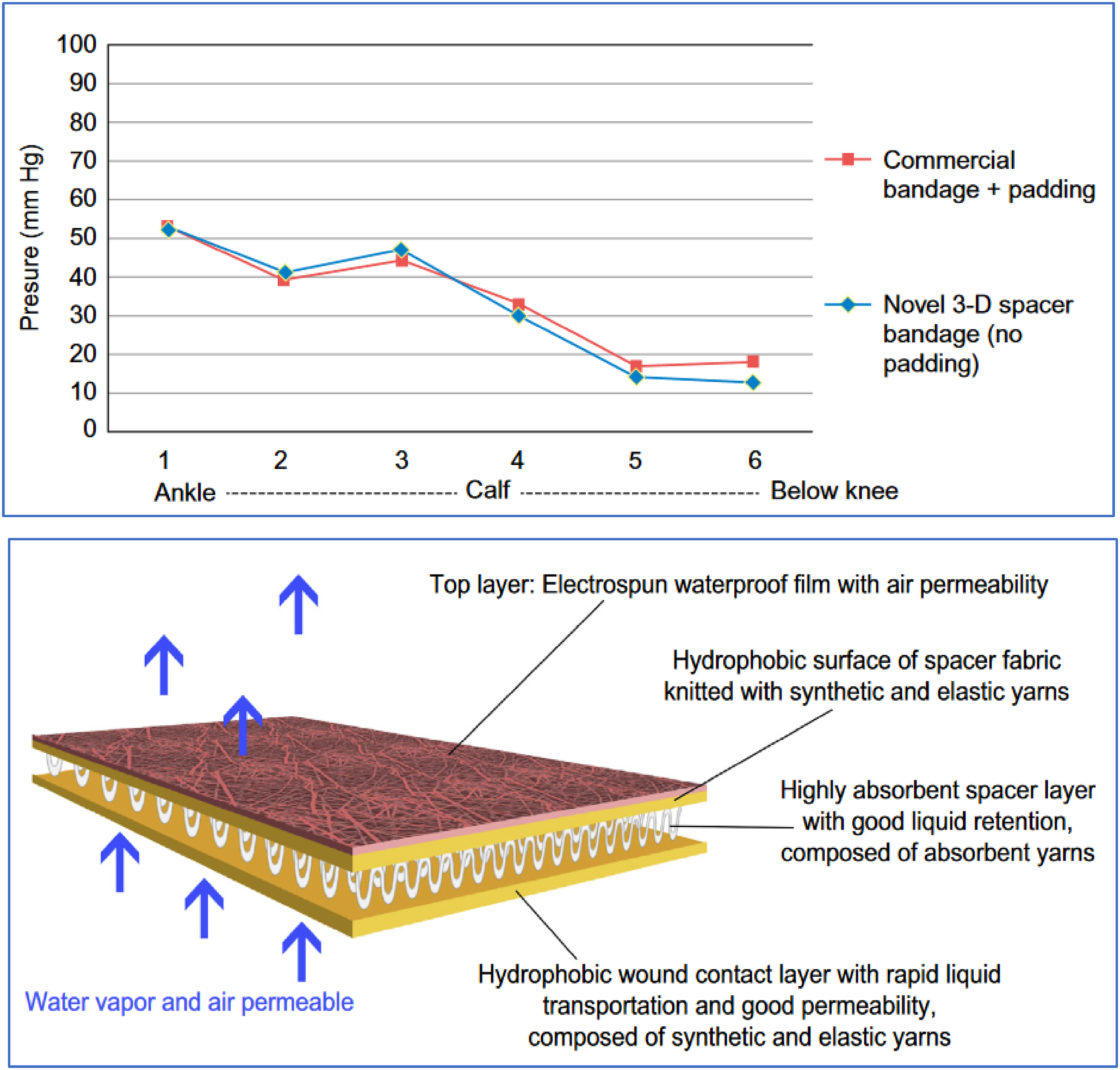
Pressure ulcer prevention
Managing pressure ulcers presents a significant challenge in healthcare, affecting patient outcomes, caregiver responsibilities, and overall healthcare costs.
123
Traditional medical textiles, particularly standard bedsheets made from a blend of 50% cotton and 50% PET, often prove inadequate. These materials can increase the risk of pressure ulcers owing to their high friction, poor moisture management, and limited compressibility.
124
This underscores the urgent need for innovative solutions to effectively address these issues. One promising alternative is 3D KSFs, which have shown great potential for improving patient comfort and safety. Shuvo et al.
124
highlighted the development of a 3D knit spacer bed sheet composed of 70% polyester, 22% polypropylene, and 8% spandex. This innovative fabric not only reduces friction against the skin, but also excels in moisture-wicking, helping to keep the skin dry and comfortable. By enhancing pressure distribution in immobile patients, these KSFs play a crucial role in preventing ulcer formation. Smart 3D knitted cushions have been also introduced as an effective measure. Hepburn et al.
72
developed cushions designed to redistribute pressure away from high-risk areas. Their research demonstrated that these cushions outperformed traditional polyurethane foam, utilizing advanced pressure distribution measurements to validate their effectiveness (see Figure 10(A) and (C)). This innovation is particularly vital for patients who are at risk of prolonged sitting or lying down, as it alleviates the peak pressures that contribute to ulcer development. Further supporting the effectiveness of spacer fabrics, Du et al.
125
revealed significant improvements in the pressure distribution and comfort. Their studies emphasize the importance of using these KSFs to enhance the comfort of seated individuals, which is critical in long-term care settings. Complementing this, Basal et al.
126
engineered functional spacer fabrics by combining polyester, polypropylene, cotton, and viscose fibers. Their findings highlighted that factors such as pile type and height significantly influence comfort and thermal resistance, which are essential for patients who are immobile.
126
Moisture management remains a critical factor in pressure ulcer prevention. Yang and Hu
27
developed superabsorbent spacer fabrics specifically tailored for wound dressings, showcasing faster wetting speeds and excellent air permeability. These properties are particularly effective for managing exuding wounds (Figure 10(D) and (E)), further reinforcing the versatility of 3D KSFs in clinical applications. (A) Anatomical support areas in a sitting position. (B) Pressure distribution along the trochanteric shelf from the ischial tuberosities (iTs). (C) Comparative pressure profiles of PU foam and ASD4 prototype wheelchair cushions in the ischial tuberosity area.
72
(D) Shape changes of Foam A dressings and spacer fabric after water absorption: (a) outer surface of Foam A, (b) wound contact layer of Foam A, (c) outer surface of Foam B, (d) wound contact layer of Foam B, and (e) superabsorbent spacer fabric. (E) Light microscope images of cross sections: (a) superabsorbent spacer fabric and (b) foam dressing.
27
(F) Typical pressure map of spacer fabric under volunteer seating.
125

The compressive properties of these fabrics are vital for an effective pressure redistribution. Li et al.
127
demonstrated that compression peaks increase with curvature, suggesting that optimizing the shape and structure of these fabrics can enhance pressure distribution. This finding aligns with that of Huo et al.,
43
who emphasized the importance of the resin content in improving the compressive resilience of spacer fabric composites. Additionally, Onal and Yildirim
16
explored geometric modeling techniques to predict yarn consumption based on tightness and thickness, which is crucial for developing fabrics that can effectively redistribute pressure. Recent studies, such as those conducted by Wu et al.,
26
indicated that specific designs of WKSFs can outperform traditional materials, such as polyurethane sponges, in terms of moisture management and compression performance (see Figure 11). This growing body of evidence highlights the potential of 3D KSFs to address the multifaceted challenges in pressure ulcer prevention. In conclusion, while conventional methods remain prevalent, the increasing demand for customized and innovative solutions underscores the necessity for continuous advancements in healthcare textiles. By improving pressure redistribution, moisture management, and overall comfort, 3D KSFs can significantly enhance patient outcomes and reduce the incidence of pressure ulcers. Continued innovation in this area is essential to enhance patient outcomes and advance healthcare textiles. The quasi-static compression (a) stress-strain curve, (b) modulus and yield strength and (c) finite element simulation stress nephogram.
26

Burn treatment
The unique properties of 3D KSFs, including moisture permeability, air permeability, and cushioning effects, underscore their potential for medical applications, particularly in burn treatment. These characteristics are crucial for creating a healing environment that effectively manages moisture and promotes air circulation in burn wounds. Additionally, the softness and thermal comfort of these fabrics enhance patient comfort, making them well suited for burn dressings.15,42,128 For instance, Yang et al. 25 conducted a comprehensive study on spacer-fabric-based exuding wound dressings and evaluated 12 different fabrics for key attributes, such as wettability, absorbency, permeability, and thermal insulation. Their findings revealed that all the tested fabrics exhibited high absorbency and air permeability, which are critical for managing burn wounds. Building on this foundation, Yang et al. 39 further enhanced these spacer fabrics by applying polyurethane or polystyrene electrospun nanofibrous membranes to the outer layer. This modification led to improved water vapor and air permeability, along with superior absorption properties compared to those of commercial foam dressings. Although these studies did not directly explore the use of 3D KSFs in burn treatment, they provided valuable insights into their potential applications, paving the way for future research. The absorptive capacity of these fabrics is particularly relevant for managing wound exudates and preventing maceration, which are significant concerns in burn care. Moreover, the high porosity and air permeability of the 3D KSFs suggest their capability to provide effective thermal insulation. This characteristic can help maintain a stable microclimate around the burn wound, reduce heat loss, and facilitate temperature regulation. 41 Collectively, these factors enhance the overall effectiveness of 3D KSFs in promoting wound healing. Furthermore, 3D KSFs exhibit broad-spectrum antimicrobial effects, including biofilm prevention and disruption, which can significantly mitigate infection risks in burn wounds. 41 Their mechanical properties, such as compression resistance and recovery, indicate that these fabrics can endure the stresses associated with dressing changes without losing their structural integrity, which is essential for repeated wound care interventions. These attributes make 3D KSFs a promising option for improving burn treatment outcomes. Therefore, although specific applications of 3D KSFs in burn treatment have not been extensively documented in the literature, their absorptive and insulative properties, coupled with their antimicrobial capabilities, suggest that they could play a beneficial role in managing burn wounds. Therefore, further research focusing on burn treatment is essential to fully understand and optimize these materials for such applications.41,129
Skin graft support
The application of 3D KSFs for skin graft support is primarily focused on providing an optimal dressing environment that promotes graft uptake and healing. Skin grafting is a critical procedure in plastic surgery, and graft success relies heavily on effective postoperative immobilization and protection of the graft site. 130 Given their unique structures and properties, 3D KSFs are emerging as promising materials for tissue engineering, particularly as scaffolds for skin graft support and tissue regeneration. The 3D structures of these fabrics offer several advantages for skin graft support. They can help prevent mechanical displacement of the graft while allowing for the drainage of serous wound exudates and hematomas, both of which are vital for graft revascularization. Furthermore, the cushioning effect and air permeability of these fabrics contribute to a stable and breathable environment for the graft, thereby facilitating the healing process.16,128 Although the application of 3D KSFs in tissue engineering is a relatively new area of research, their versatility and tunability make them suitable for creating microenvironments that mimic the extracellular matrix, which is crucial for successful graft uptake and integration. The ability to customize properties such as thickness, porosity, pore size, and stiffness allows for scaffolds that meet the specific requirements of different tissues. 54
Research at Rhineland-Westphalia Technical University (RWTH) aims to address compliance mismatches between arteries and grafts, which can adversely affect patency rates in small-caliber vascular grafts (Figure 12). This study focused on developing a textile-based vascular graft with physiological compliance properties to mitigate these risks.
131
The goal is to achieve material and structural elasticity in grafts by employing a biomimetic approach that integrates elastic and nonelastic fibers into a tubular warp-knitted structure. Additionally, combining polymers, such as chitosan, with 3D KSFs could enhance the bioactivity and wound-healing capabilities of scaffolds. However, challenges regarding the mechanical strength and solubility of chitosan may require derivatization or blending with other polymers.
106
The biocompatibility and tunable degradation rates of materials such as PLA further strengthen the potential of these fabrics for scaffold fabrication.
54
Moreover, the ability to modify scaffold properties, including thickness, porosity, and stiffness, through processes such as heat setting provides a versatile platform for engineering scaffolds that can support various tissue types.
54
In conclusion, although the application of 3D KSFs in skin graft support is still emerging, their structural and functional characteristics suggest significant potential for enhancing graft healing and integration. Continued research and clinical trials are necessary to optimize their design and effectiveness in medical applications. Synthetic vascular graft with reduced compliance mismatch.
131

Limitations of 3D KSFs for wound care and potential improvements
The exploration of 3D KSFs for wound care and management revealed both promising attributes and notable limitations. According to Tong et al., 44 while WKSFs demonstrated competitive air and water vapor permeabilities, thermal conductivity, and good compressional resilience, their absorbency was only marginally better than that of some existing wound dressings. This limitation may hinder their effectiveness in wounds with heavy exudates, highlighting a significant area for improvement. Asayesh et al. 67 reported that the absorbency of WeKSFs decreased as the inclination angle of the fabric structure was reduced, presenting a drawback for managing wounds with high levels of exudate. However, there is potential for enhancement, Bagherzadeh et al. 82 suggests that the moisture management properties of spacer fabrics can be improved by incorporating high-wicking materials, such as Coolmax fiber. This approach can effectively address the absorbency limitations discussed previously. Additionally, Asayesh et al. 67 indicated that utilizing stitches in the outer layer of spacer fabrics can increase their air permeability, water vapor permeability, and absorbency. This modification represents another promising avenue for enhancing the performance of these fabrics in wound-care applications. In general, 3D KSFs offer several beneficial properties for wound care, such as good ventilation, and protection of their limited absorbency for heavy exudates remains a significant concern.44,67 To overcome this challenge, potential improvements include the integration of high-wicking materials to enhance moisture management 82 and structural modifications, such as incorporating tuck stitches, to improve the absorbency and comfort properties. 67 Consequently, further research and development are necessary to optimize the design and material composition of 3D KSFs, enabling them to fully harness their potential for advanced wound-care applications.
3D KSFs for orthopedic and rehabilitation treatments
In rehabilitation treatments, various materials, including leather, metal, wood, plastics, composites, and viscoelastic polymers, are commonly employed in orthotics and prosthetics. Among them, thermoplastics such as acrylic, polyethylene, and polypropylene are favored because of their ease of molding and adaptability to custom fits.
46
Traditional material selection focuses on optimizing functional performance and rehabilitation outcomes, while ensuring wearer comfort and adherence to treatment protocols. However, challenges arise when pressure garments alone fail to provide adequate compression for actively growing scars, particularly those in concave areas. This highlights the need for ongoing innovation in material selection to improve the patient experience. Recent studies have suggested that specific textile compositions can further enhance the effectiveness of pressure garments. For example, a channeled polyester is ideal for the warp, pile, and top weft in spacer structures, whereas cotton fibers are used for the bottom weft to improve comfort by effectively trapping moisture from the top layer. Despite these advancements, there is limited research on the clinical applications of 3D spacer fabrics.
126
However, the unique properties of warp- and weft-KSFs, such as lightness, compression resistance, moisture permeability, and air permeability, suggest a significant potential for orthopedic supports that are comfortable for prolonged use. Supporting this potential, Pereira et al.
30
demonstrated that KSFs can be effectively utilized in medical applications such as knee braces, provided they exhibit good elasticity and recovery properties. Yu et al.
46
investigated spacer fabrics as potential insert materials and evaluated the physical properties and compression behavior of five different types. Their findings revealed that spacer fabrics offer lower air resistance and higher water vapor transmission rates than Plastazote®, achieving comparable interfacial pressures at various locations on the hand dorsum. A 24-weeks clinical study involving hypertrophic scarred hands confirmed the effectiveness of spacer fabric inserts, showing their comfort, breathability, and enhanced patient compliance in pressure treatment, as illustrated in Figure 13. Original modality and the use of textile inserts in the treatment of hypertrophic scars at the beginning of the clinical study and after wearing the pressure glove and spacer fabric insert for 24 weeks.
46

In addition to their physical benefits, the sound absorption properties of the warp- and weft-KSF composites further enhance their suitability for rehabilitation environments by creating quieter settings. The structural and functional attributes of these fabrics, such as cushioning effects and breathability,
15
indicate their potential for application in medical braces, supports, or prosthetic components requiring a balance of rigidity and comfort. This versatility allows for engineering-specific performance characteristics tailored to the demands of orthopedic and rehabilitation devices.
47
Mousavi et al.
29
explored the use of spacer fabrics as pressure garments to apply a uniform interface pressure on the limbs. By varying the fabric thickness and elastane yarn content, they conducted tests on the mannequins to assess the mean interface pressure. Their results indicated that a spacer fabric with a thickness of 1.8 mm and 25% elastane achieved interface pressure levels comparable to those of commercial fabrics, demonstrating superior uniformity of pressure distribution across the human limb. This finding emphasizes the capacity of spacer fabrics to provide consistent pressure, which is a critical factor for effective rehabilitation. Figure 14(a) illustrates the applied interface pressure profiles across various limb sections, showing that the pressure increases from section 1 (below the knee) to section 6 (above the ankle) as the curvature radii decrease. Applied interface pressure profile on participant’s limb by pressure garment sample: (a) A03 (0.8 mm thickness), (b) B04 (1.2 mm) (c) C04 (1.8 mm) and (d) D (0.5 mm).
29

This trend aligns with Laplace’s law, revealing that as the soft tissue decreases from section 1 to section 6, a broader variation in interface pressure occurs. Notably, the lowest applied pressure was recorded in section 1, where more soft tissue was present. In contrast, the commercial single-jersey weft knitted fabric demonstrated a non-uniform pressure distribution, with pressure levels ranging from 20 mmHg to 44 mmHg in different positions. This underscores the effectiveness of spacer fabrics in providing uniform pressure, comfort, and breathability, thus making them suitable for medical applications that require these characteristics. Therefore, the integration of 3D KSFs into orthopedic and rehabilitation treatments holds promise in enhancing patient outcomes. Their unique properties and adaptability make them valuable alternatives to traditional materials, warranting further research and clinical validation to fully realize their potential in improving rehabilitation practices.
Prosthetic liners
The application of 3D KSFs in prosthetic liners addresses several critical factors including comfort, fit, pressure relief, proprioception, and mobility.132,133 The unique 3D structures of warp- and weft-KSFs provide exceptional compressive properties. 49 This innovative structure can be optimized to improve pressure distribution, as demonstrated by finite element analysis studies that highlight the potential of these fabrics to create a more comfortable fit within prosthetic sockets.132,133 Furthermore, the flexibility and spring-like action of these fabrics contribute to a better fit and reduced wear, which is essential for long-term comfort and prevention of skin issues. 133 The comfort provided by prosthetic liners can be attributed to the thermos-physiological properties of spacer fabrics, such as air and water vapor permeability and thermal resistance. 134 These properties are vital for maintaining a comfortable microclimate between the prosthetic liner and skin. Additionally, the pressure-relief capabilities of spacer fabrics, evidenced by their use in mattresses, suggest that they can evenly distribute pressure, thereby reducing peaks and enhancing the overall comfort of prosthetic users. 135 Moreover, the fit of prosthetic liners can be improved through the structural design of the spacer fabrics. The unique 3D architecture allows for compression and recovery, enabling the material to conform to the contours of the residual limb and ensuring a snug fit during movement. 136 Importantly, the cushioning and pressure distribution properties of spacer fabrics can enhance the proprioception and mobility. Their ability to absorb shock and resist pressure 136 may improve the wearer’s perception of the ground reaction forces, which is crucial for balance and stability. In addition, the stab-resistant properties of WKSFs 42 indicate that these materials provide protective cushioning, leading to safer and more reliable mobility for prosthetic users. Nonetheless, further research and development are necessary to tailor these fabrics specifically for prosthetic applications.
Orthotic devices
The application of 3D KSFs in orthotic devices capitalizes on their unique structural properties to provide custom fit, shock absorption, and enhanced joint stability and function. Characterized by their 3D textile structure, these fabrics consist of two surface layers connected by pile yarns, offering a combination of cushioning and support.
16
Although the existing literature does not explicitly discuss the use of 3D KSFs in orthotic devices, their inherent properties suggest significant suitability for such applications. For example, the compressive and tensile strengths of WKSFs, as discussed by Liu et al.,
136
indicated their potential to distribute pressure and absorb shocks, which is crucial for devices designed to alleviate joint stress. Moreover, the ability to customize the fabric structure, as noted by Zhi and Long,
137
is essential for meeting the individual anatomical requirements of orthotic devices. The integration of materials such as shape memory alloy monofilaments within spacer fabrics significantly enhances energy absorption, which is critical for devices subjected to impact during daily activities.
31
Additionally, the flexibility to adjust the fineness and inclination of the spacer yarns allows the tailoring of the mechanical properties of the fabric, facilitating the design of orthotic devices that enhance joint stability and functionality.
138
A leading example of the application of these principles is Tytex Group, a multinational healthcare company based in Denmark, which has been actively involved in the research and development of 3D products using warp and WeKSFs. Their AirX™ Orthocare range features a variety of soft, semi-rigid, and rigid orthopedic supports and braces for multiple body parts and joints. These supports are designed for areas such as the shoulder, elbow, back, hand, knee, and ankle, boast high breathability, effective heat and moisture management, and low shear and friction properties while providing cushioning.
122
Figure 15 illustrates various AirX™ Orthocare products, showing their innovative use of knitted spacer materials. Orthopedic supports and braces for different body parts.
122

Mobility aids
The utilization of 3D KSFs in mobility aids such as wheelchair cushions and supports leverages their unique structural properties to offer ergonomic and pressure-relieving benefits. 16 The geometric configurations of these fabrics, particularly auxetic designs, enhance their ability to conform to body shapes while evenly distributing weight, which is essential for comfort over extended periods. 139 Although the existing literature does not explicitly address the application of 3D KSFs in mobility aids, their inherent properties suggest strong potential for such uses. The lightweight nature, heat conduction, buffering effect, compression resistance, moisture permeability, and air permeability of WKSFs make them ideal for applications that require prolonged skin contact, such as wheelchair cushions and supports. 128 Additionally, the shock absorption, pressure resistance, and thermal comfort properties demonstrated in insole applications further support the use of these fabrics in mobility aids. 136 Therefore, it can be concluded that 3D KSFs hold significant promise for enhancing both the functionality and comfort of mobility aids, although further studies on this application would be beneficial for a more comprehensive understanding.
Limitations of 3D KSFs for orthopedic treatments and potential improvements
The literature does not explicitly discuss the limitations of 3D KSFs in the context of orthopedic and rehabilitation treatments, nor does it suggest potential improvements for these specific applications. However, by extrapolating from the properties and applications of 3D KSFs, as described in previous papers, one can infer potential limitations and areas for improvement. 3D KSFs are noted for their air-trapping capacity and double-faced nature, which are beneficial for cushions and medical textiles. 98 However, for orthopedic and rehabilitation treatments, these fabrics may need to offer more targeted support and conformability to the contours of the body. Research on the mechanical performance of spacer fabrics in composite panels indicates that structural parameters, such as cross-thread density and yarn linear density, significantly affect their mechanical behavior. 140 This suggests that optimizing the structural design of spacer fabrics is essential to achieve the necessary support and pressure distribution for orthopedic use. Additionally, while the vibration isolation properties of 3D KSFs are promising, 52 orthopedic and rehabilitation treatments may require materials that maintain stability and restrict movement in specific directions. The current research does not address how spacer fabrics can be engineered to meet these specific mechanical demands. In terms of potential improvements, studies on moisture management behavior 82 indicated that enhancing the moisture-wicking properties of spacer fabrics could improve comfort and hygiene in orthopedic supports, which is crucial for long-term wearability. Furthermore, although the acoustic and thermal properties of spacer fabrics19,20 are not directly applicable to orthopedic treatments, they suggest that the material structure can be finely tuned. This tuning can be used to tailor spacer fabrics for orthopedic applications. Further research is needed to address these aspects specifically in the context of orthopedic and rehabilitation treatments. By identifying and overcoming the limitations of 3D KSFs, we can fully realize their potential to enhance patient outcomes in these fields.
3D KSFs for protective equipment
The previous sections focused on the application of 3D KSFs in the medical context, particularly after injury and wound management. By contrast, this section examines their protective capabilities against health risks during daily activities, including medical and sports. The unique structural properties of 3D KSFs make them ideal for use in protective equipment. 16 Their design facilitated the absorption and dissipation of energy, which is critical for an effective protective gear. Studies have demonstrated that properties, such as compression resistance and impact force attenuation, significantly contribute to the suitability of these fabrics for protective applications. For instance, similar to 3D warp interlock fabrics,11,12,141 warp- and weft-KSFs have been employed in soft body armor, where factors such as fabric density, thickness, and spacer structure influence the stab resistance. 26
Impact-absorbing sports gear
Daily activities and sports activities often expose the body to mechanical stress and trauma. Cushioning pads serve as a simple and effective preventive measure to mitigate these risks. Various protective devices incorporate cushioning materials designed to absorb impact energy, each with a distinct maximum allowable stress and energy absorption capacity. These cushioning materials act as intermediates, regulating the impact force gradients and reducing deceleration rates through surface deformation or shape changes. 31 A diverse array of cushioning elements has been reported in the literature. For example, Kurt et al. 142 introduced airbag helmets that use air as a cushioning element to prevent injuries to cyclists, whereas Lin et al. 112 studied the impact behavior of rubberized fibers in bulletproof vests. Dongmei 143 assessed the compressive behavior of corrugated sandwich structures, highlighting that polymeric foams, while cost-effective, suffer from low endurance and reduced elasticity, making them unsuitable for direct contact applications such as insoles or sports protective equipment. 31 Building on this understanding, Salimi et al. 144 emphasized that reducing plantar stress is crucial for preventing diabetic foot ulcers and suggested exploring cushioning materials in protective equipment to enhance stress reduction and lifecycle improvement. In this context, 3D spacer fabrics are increasingly recognized for their potential in impact-absorbing sports gears, providing protection against traumatic injuries in contact sports.16,49 Studies have shown that the compression- and impact-resistance properties of 3D KSFs can be tailored for specific protective applications. For example, the compression property of curved 3D flat-knitted spacer fabric composites increases with curvature, indicating their potential for conforming to body shapes in sports gears. 127 Additionally, WeKSFs with coarser monofilament yarns exhibited lower peak impact forces and higher force attenuation, which are desirable traits for protective padding. 83
Moreover, the incorporation of shear-thickening fluids into auxetic WKSFs has been found to enhance the impact resistance, with the fabric’s negative Poisson’s ratio contributing to improved energy absorption and deformation control under impact.
145
This adaptability is crucial for protective applications, as the structural parameters of spacer fabrics, such as fabric density, thickness, and spacer structure, significantly influence both the stab and impact resistance.
42
Furthermore, the sound absorption properties of syntactic foam reinforced by WKSFs suggest multifunctional potential, such as noise reduction in helmets or other protective gears.
146
Liu et al.
47
studied the compression behavior of 3D spacer fabrics, revealing three distinct stages, as illustrated in Figure 16(A). The first stage involves free post buckling of monofilaments, followed by a plateau stage characterized by a nearly constant deformation force across a wide range of compressions. The final stage, densification, shows a rapid increase in the deformation force as contact occurs between the monofilaments the and the outer layers. This understanding of the compression behavior is further supported by Hou et al.,
147
who used finite element modeling to corroborate these findings. Additionally, Hamedi et al.
31
investigated a design for weft-knitted 3D spacer fabrics for protective applications, specifically for diabetic foot ulcers. Their study revealed that fabrics incorporating shape memory alloy (SMA) wires exhibited superior cushioning behavior under high stress compared to those made with polyamide and steel spacer monofilaments. They reported that the energy absorption increased with the spacer yarn diameter, and higher-inclined SMA samples demonstrated enhanced resistance to compression and greater energy absorption capacity, as depicted in Figure 16(B). The energy absorption capability improved from 25 kJ/m³ for fabrics with polyamide spacer yarn to approximately 60 kJ/m³ for those with SMA spacer yarn, indicating a 2.4-fold enhancement in the cushioning properties.
31
These findings highlight the importance of energy-absorbing structures in maintaining transmitted stress within acceptable limits. Therefore, this study underscores the potential of 3D KSFs for developing impact-absorbing sports gears. Their unique structure allows for the customization of properties such as compression resistance, impact force attenuation, and energy absorption, which are critical factors for reducing the risk of traumatic injuries in contact sports.16,49,145,146
Personal protective equipment (PPE)
The integration of 3D KSFs into personal protective equipment (PPE) marks a significant advancement in enhancing both breathability and comfort in these essential garments. 83 This unique construction improves the air circulation and moisture management, thereby contributing to the overall comfort of the wearer. However, a notable discrepancy exists between the technical specifications for PPE, which often prioritize protection, and the actual comfort experienced by end-users.32,35 Healthcare workers, for instance, have reported discomfort in PPE that, despite meeting safety standards, suffers from poor air permeability and breathability. 32 This discomfort can deter workers from wearing PPE for extended periods, potentially compromising safety and performance. To address this issue, designing PPE with 3D KSFs offers a promising approach to improving wearability while maintaining protective qualities. End-user feedback must be incorporated into the design and certification processes to ensure that PPE is not only technically compliant but also comfortable for the wearer.32,35 In doing so, the industry can produce PPE that enhances safety and performance. Research indicates that 3D KSFs can provide a combination of breathability, comfort, and improved safety. For example, WKSFs treated with shear thickening fluid (STF) have demonstrated significant increases in force attenuation capacity, which is crucial for protective gears such as hip pads. The ability to layer these fabrics and adjust the STF concentration allows for customization of the protection levels. 148 In addition to these advancements, ergonomic redesigns of PPE utilizing lightweight and ventilated materials contribute to better work performance and safety, as evidenced in the case of Korean police equipment. 34 However, although 3D KSFs show promise for PPE owing to their structural characteristics and comfort, balancing protection, portability, and usability remains a challenge. For example, stab-resistant body armor made from WKSFs requires careful consideration of fabric density and thickness to ensure adequate stab resistance without compromising wearability. 42 Furthermore, designers must consider potential hazards associated with PPE, such as heat stress and impaired mobility, which can be mitigated through the beneficial properties of 3D KSFs. 31
Limitations of 3D KSFs for protective equipment’s and potential improvements
The literature provides insights into the properties and applications of 3D KSFs; however, there is a paucity of information directly addressing their limitations in medical protective equipment. However, by extrapolating from the available data, potential limitations and areas for improvement can be inferred. 3D KSFs have been praised for cushioning, impact resistance, and breathability. 104 These characteristics are beneficial for protective medical equipment such as padding in orthopedic braces or helmets. However, the literature suggests that while these fabrics have good energy absorption capacity, their impact resistance can be further enhanced by structural modifications, such as varying fabric thickness, mesh structure, and by adding coatings.47,104 This implies that without such optimization, the current standard of spacer fabrics may not provide the maximal protective capacity required for certain medical applications. Additionally, while the acoustic and thermal properties of spacer fabrics are well documented,20,115,149 there is limited discussion on their antimicrobial properties, ease of sterilization, and resistance to fluid factors critical in medical settings to prevent infection and ensure patient safety. The literature does not address these aspects, suggesting a gap in the current understanding of spacer fabric suitability for medical-protective equipment. To address these limitations, future research should focus on fabric coatings or treatments to improve antimicrobial and fluid-resistant properties, as well as structural modifications to optimize impact absorption. For instance, finishing a fabric or fiber with nanoparticles, as highlighted by Dejene,21,118,119 shows promise for enhancing these properties. Additionally, comprehensive studies on the sterilization and long-term durability of these fabrics in medical environments are valuable.
3D KSFs for biomedical devices
Tissue engineering scaffolds
Traditional surgical methods for repairing severely damaged tissues can be costly, painful, and carry risks such as infection and foreign body rejection. 150 Reconstructive surgeries are often limited by tissue availability and donor site complications. Tissue engineering or regenerative medicine aims to create new functional tissues by combining biomaterials with body cells and biophysical cues for in vitro or in vivo regeneration. An ideal tissue engineering scaffold serves as a template for tissue formation, exhibiting excellent biocompatibility and a 3D interconnected porous architecture that promotes tissue ingrowth and vascularization through an appropriate pore size distribution.151,152 To be effective, scaffolds must optimize their physical and chemical properties to enhance cell attachment, proliferation, and differentiation. They should also possess adequate mechanical properties to withstand surgical procedures and ensure stability during load transfer to the host tissue. Furthermore, a scaffold must degrade at a suitable rate to allow for a gradual load transition to the newly formed tissue. Balancing the scaffold’s 3D architecture, surface characteristics, mechanical properties, and degradation kinetics remains a significant challenge in tissue engineering. 153
3D KSFs are particularly promising for scaffold development because of their customizable structures. These fabrics can be engineered to enhance cell growth and tissue regeneration.54,128 Their porosity can be adjusted to facilitate nutrient transport and waste removal, both of which are essential for cell viability.
54
Additionally, mechanical properties such as stiffness and compressive strength can be tailored during fabrication to match the requirements of specific tissues, ensuring the necessary support while allowing for remodeling.136,154 The adaptability of 3D KSFs extends to the manipulation of various parameters, including the yarn type, knit pattern, and fabric tightness. This allows scaffolds to mimic the mechanical behavior of target tissues, thereby enhancing integration and functionality.155,156 For instance, decreasing the stitch density in weft-knitted silk fibroin scaffolds increases both the porosity and mechanical properties.
155
Recent studies have highlighted the effectiveness of 3D KSFs for tissue engineering. For example, Schäfer et al.
55
developed WKSFs fabric-reinforced hydrogels for soft-tissue engineering, as shown in Figure 17. This figure illustrates the process from are isolated mesenchymal stem cells to integrate hydrogels and textiles for cultivating fiber-reinforced constructs. Ribeiro et al.
157
demonstrated the potential of weft-knitted silk-based spacer fabrics for flat bone regeneration in vitro and in vivo. WKSFs-reinforced hydrogels for soft-tissue engineering.
55

In addition to the structural parameters, the selection of appropriate raw materials for tissue engineering is essential. For instance, bioabsorbable polyesters, which break down into smaller metabolizable fragments, are often used as scaffold-based implants. PLA, a renewable resource, is a notable bioabsorbable polyester due to its excellent biocompatibility and predictable degradation rate.158,159 The use of 3D bioabsorbable PLA spacer fabric scaffolds, as described by Caronna et al., 43 illustrates the tunability of these structures to achieve a specific thickness, porosity, pore size, and stiffness key attributes to foster a conducive microenvironment for cell attachment and proliferation, as shown by the growth of mouse calvarial preosteoblast MC3T3-E1 cells on the scaffold. 54 Although the tailored porosity and mechanical properties of scaffolds benefit tissue engineering, the relationship between these factors is complex. For instance, Khademolqorani et al. 155 noted that varying the stitch density of weft-knitted silk fibroin scaffolds affects both the porosity and mechanical properties, influencing their suitability for applications such as bladder tissue engineering. Similarly, Zhao et al. 160 highlighted how the structured design of honeycomb scaffolds can counteract the negative impact of high porosity on mechanical strength. These insights underscore the importance of structural design in optimizing scaffold performance, with ongoing research poised to enhance its efficacy in promoting tissue regeneration.
Drug delivery systems
While the specific application of 3D KSFs in drug delivery systems has not been extensively covered in the literature, the related concepts of controlled release, improved bioavailability, and enhanced patient compliance are well documented. Varde and Pack 161 and Geraili et al. 162 explored polymeric microspheres and advanced polymeric systems designed for controlled drug release, thereby improving patient adherence. Additionally, Khan and Kumar 163 and Abbas and Swamy 164 emphasized the role of Novel Drug Delivery Systems (NDDS) and alginate-based systems in enhancing bioavailability through extended drug release. Al-Qaysi et al. 165 highlighted the importance of sustained-release systems in improving adherence, particularly for glaucoma treatment. Wildy and Lu 166 noted that electrospun nanofibers share similarities with 3D KSFs, especially their high surface-area-to-volume ratio, which is beneficial for controlled drug release. Similarly, Colombo et al. 167 discussed swelling-controlled drug delivery systems that conceptually align with the properties of 3D KSFs, particularly their tunable release profiles. Given the structural characteristics of 3D KSFs, including their adjustable thickness and 3D textile structure, 16 their potential use in drug delivery systems is worth exploring. These fabrics can be engineered to incorporate therapeutic agents and facilitate their controlled release. By optimizing the thickness and porosity, the release rate of encapsulated drugs can be modulated, potentially improving bioavailability and reducing the administration frequency.16,166,167 The advent of new materials and fabrication techniques, such as 3D printing, presents further opportunities for enhancing drug delivery, suggesting that research on 3D KSFs could be a valuable future direction for this field.
Implantable constructs
The application of 3D KSFs in implantable constructs is supported by the findings of Caronna et al.,
54
who demonstrated the potential of PLA spacer fabric scaffolds. These scaffolds exhibit tunable properties such as thickness, porosity, and stiffness, which are crucial for tissue regeneration. Importantly, the study indicates that these scaffolds effectively support cell attachment and proliferation, which are essential for promoting host integration and long-term stability.
54
To further illustrate this, Figure 18 shows various aspects of the heat-set textile surfaces. Section A highlights the morphology of the upper and lower surfaces at different temperatures, revealing the high porosity and interconnected pores. Section B presents the variations in the textile thickness and porosity with heat treatment, indicating significant changes at higher temperatures. Section C details the pore size distribution, demonstrating a decrease in the pore size across heat settings. Finally, Section D provides stress-strain curves from uniaxial compression tests, revealing an increase in the compressive modulus with heat setting, which indicates enhanced mechanical stability. Although Caronna et al.
54
focused primarily on biomedical applications, the versatility of 3D KSFs extends to various fields, including automotive and body armor, underscoring their strength and adaptability.42,129 These characteristics highlight their potential benefits in implantable constructs, in which mechanical stability and protection against physiological stress are vital. Figure 19 illustrates biofabrication of muscle tissue with biohybrid reinforcement. Section A describes the integration of various cell types, including immortalized cell lines and primary cells, with a matrix material to create a biohybrid structure. This process emphasizes resource efficiency and biofunctionality in tissue-engineering applications. Section B describes the practical applications of this biohybrid technology, highlighting its potential in creating biobotic systems and biohybrid implants, which could significantly enhance the functionality and integration of engineered tissues in clinical settings.
168
(A) Optical images of fabric surfaces (S1 and S2) before (NS = not heat set) and after heat setting, 2 mm scale bar. (B) Fabric thickness and porosity with and without heat treatment. (C) Pore size (diameter) distribution. (D) Stress–strain curves from uniaxial compression tests for different heat-setting conditions (±standard deviation). Significance (in B and C) refers to non-set textile.
54
Building on this versatility, the adaptability in design and function, along with the possibility of combining these fabrics with different types of resins to tailor their mechanical properties,
128
further indicates their potential for advanced biomedical applications. Biofabrication of muscle tissue with 3D biohybrid reinforcement and merging the expertise of different fields of application.
168

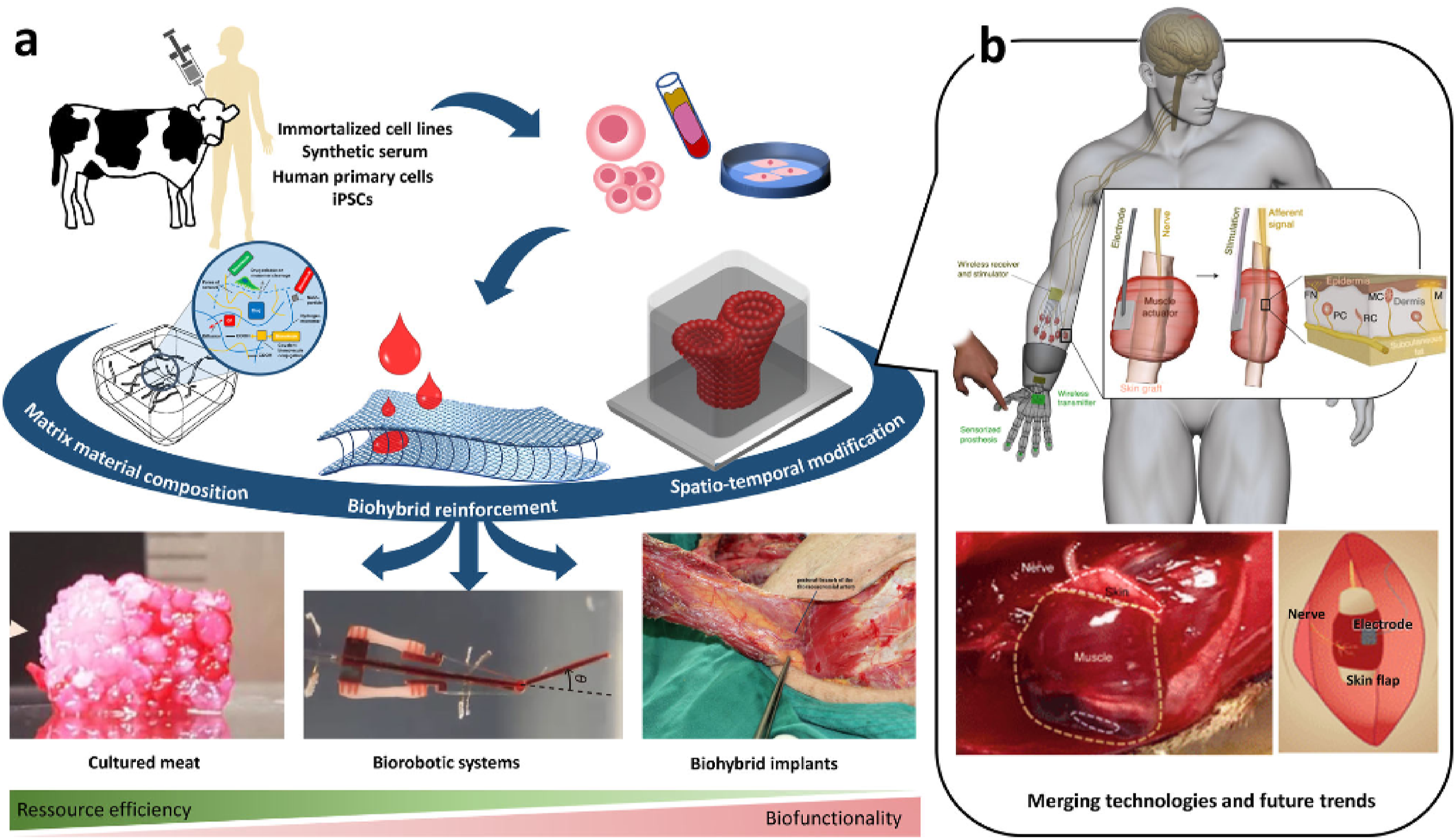
Biocompatibility of 3D KSFs for long-term implantable constructs
3D KSFs used in long-term implantable constructs face significant biocompatibility challenges, necessitating the careful selection of fibers. Synthetic fibers such as polyester and nylon are commonly chosen for their durability and mechanical strength. However, it is important to note that these materials can induce chronic inflammation and adverse tissue responses. In contrast, natural fibers, such as cotton, offer superior biocompatibility; however, they fall short in terms of the mechanical strength and stability required for long-term implant applications. Furthermore, biopolymers such as PLA and PCL have emerged as promising alternatives, resulting in favorable degradation profiles and inherent biocompatibility. 54 However, balancing the desirable mechanical properties of these materials with their biodegradability remains a critical challenge.
In addition to these considerations, the surface characteristics of 3D KSFs significantly influence their interactions with biological tissues. For instance, smooth surfaces can reduce friction but may not promote adequate cellular adhesion, whereas rough surfaces enhance cell attachment and increase the risk of bacterial colonization. To address this, surface modifications, such as plasma treatment, bioactive substance coating, or the application of antimicrobial agents, aim to improve biocompatibility by fostering favorable cellular responses and minimizing infection risks. 168 Moreover, the biocompatibility of the implanted materials is heavily influenced by immune responses. When a spacer fabric is implanted, the body triggers a foreign body response, leading to the formation of a fibrous capsule that can hinder the fabric’s integration with the surrounding tissues. This response depends on the type of material used, its surface properties, and the presence of additives. Ideally, materials should encourage a mild inflammatory response that facilitates tissue integration rather than encapsulation to prevent implant failure.169,170
In addition to immune responses, the mechanical properties are vital for the performance of 3D KSFs in load-bearing applications. These fabrics must maintain their structural integrity under dynamic loads and environmental factors, such as moisture and temperature fluctuations. Over time, materials may degrade or lose strength, posing the risk of implant failure. Thus, long-term studies assessing the mechanical performance of these fabrics in vivo are essential to understand their behavior and ensure that they can withstand physiological loads without significant degradation. 171 Moreover, regulatory considerations play a crucial role in the development and application of biocompatible materials for medical applications. Biocompatibility testing is mandatory for any material, including 3D KSFs. Standard tests evaluate cytotoxicity, sensitization, irritation, and systemic toxicity, whereas long-term studies assess the chronic effects of the material in biological systems.172,173 Moreover, the approval pathway varies based on the intended use of the fabric, which necessitates detailed documentation and evidence of biocompatibility. 98 Therefore, addressing the biocompatibility of 3D KSFs for long-term implants involves a multifaceted approach that includes careful material selection, surface modification, and comprehensive regulatory testing. Future research should focus on developing advanced materials with enhanced biocompatibility profiles, along with innovative fabrication techniques that optimize the performance of KSFs in clinical settings. By overcoming these challenges, the safety and efficacy of long-term implantable constructs can be improved.
Limitations of 3D KSFs for biomedical device and potential improvements
3D KSFs are recognized for their unique structural properties, such as high air-trapping capacity and double-faced nature, which are advantageous for applications that require cushioning and protection. 98 Nevertheless, for biomedical applications, these fabrics must meet stringent requirements for biocompatibility, mechanical performance, and degradation rates, which have not been explicitly addressed in the literature. Moreover, the mechanical performance of 3D KSFs has been investigated, with findings suggesting that fabric structural parameters significantly influence their mechanical behavior. 140 This underscores the importance of tailoring the mechanical properties of spacer fabrics, which is crucial for ensuring a proper mechanical match with the surrounding tissues in biomedical contexts.
In addition to the mechanical properties, potential limitations for biomedical applications include the necessity for precise control over porosity and pore size to support cell attachment and tissue ingrowth. Furthermore, these materials must be non-toxic and non-immunogenic. Equally important, the degradation rate of the fabric must be aligned with the rate of tissue regeneration to avoid complications. 98 Although the thermal and acoustic properties of spacer fabrics have been extensively studied,19,20,92 it is worth noting that these properties are less relevant to biomedical applications compared to their structural and biological performance. Future research could focus on developing spacer fabrics using biocompatible and bioresorbable materials that can degrade at a controlled rate within the body. In this context, the fabrication techniques can be refined to achieve the necessary pore size and interconnectivity to support cell proliferation and tissue integration. Additionally, exploring surface modifications of the fibers could enhance cell adhesion and growth, which are critical for successful tissue-engineering applications.
Emerging and future trends of 3D KSFs in healthcare applications
Research on 3D KSFs has revealed diverse applications and properties, including compression and impact resistance, as well as thermal and acoustic characteristics. In addition to these advantages, the integration of smart and interactive technologies into these fabrics represents a natural progression. This evolution allows the incorporation of sensors or conductive yarns, which can lead to innovative uses in wearable technology and responsive textiles.127,136 Customization and personalization have emerged as key trends in the development of 3D KSFs. The structure of a fabric can be manipulated to create specific properties and designs tailored to individual needs. 128 This focus on tailored solutions not only enhances the functionality of fabrics but also improves patient outcomes in healthcare applications, making 3D KSFs a promising area for future research and development.
Integration with smart/interactive technologies
The integration of smart technologies in medical applications is characterized by advanced sensors and monitoring capabilities, along with feedback-driven adaptability. For instance, wearable sensor technologies, as discussed by Menon et al.,
174
are integral to smart healthcare frameworks, enabling the remote monitoring of health parameters and disease prediction. A notable example is the work of Kim et al.,
175
who developed a carbon nanotube ink drop-coated textile resistive pressure sensor integrated into a 3D spacer textile. This sensor can detect human health metrics and motion and is attached to the wrist (see Figure 20(a)), capturing real-time pulse signals. The analysis of the waveform reveals distinct peaks corresponding to different phases of the cardiac cycle, as illustrated in Figure 20(b). Additionally, Figure 20(c) demonstrates the sensor measuring carotid pulse signals from the neck, showing its conformability to body contours. Real-time and in-situ human physiology monitoring using a 3D textile structure sensor. (a) Measurement of arterial pulse pressure. (b) Zoomed waveform of a single pulse from (a). (c) Measurement of the jugular vein by attaching a sensor to the neck. Relative current change response to motions of (d) finger bending and (e) cheek bulging. (f) Recognition of a sound signal when the wearer spoke the words ‘e-skin,’ ‘wearable,’ and ‘sensor.’ Each word is spoken twice. The inset shows a photograph of the sensor attachment.
175

Beyond pulse monitoring, the sensor’s application extends to tracking finger movements, as shown in Figure 20(d), where bending the finger increases the contact area between the fibers, correlating with changes in the signal amplitude. Moreover, the study illustrated the capability of the sensor to detect acoustic vibrations that are essential for voice recognition. Figures 20(e) and (f) show how the sensor captured subtle muscle movements during speech, recording distinct profiles for different spoken words. Although these technologies offer significant benefits, they also present challenges. The integration of Artificial Intelligence (AI) and the Internet of Things (IoT) in smart devices was explored by Gowda et al. 176 necessitates efficient power management and robust data-security measures. Given this context, the unique properties of KSFs suggest strong potential for such integration, particularly with functional yarns that can enhance moisture management. 82
In addition to these advancements, the structural characteristics of spacer fabrics, such as porosity and airflow resistivity, as discussed by Arumugam et al.
97
and Abedkarimi et al.,
19
could be advantageous for embedding sensors that monitor sound absorption or environmental noise levels. Furthermore, the vibration isolation performance of spacer fabrics, as investigated by Chen et al.,
138
can be enhanced by integrating sensors that detect and respond to vibration frequencies, thereby enabling adaptive vibration damping. Such integration could lead to the development of responsive and adaptive textile systems with applications across various sectors including healthcare, automotive, and protective clothing. For example, Li et al.
177
developed pressure sensors using 3D spacer fabrics via a multi-coating method. These sensors exhibit good conductivity and can measure external pressures up to 283 kPa, with an electrical conductivity range of 9.8 kΩ. They also demonstrated a sensitivity of 50.31 × 10⁻³ kPa−1, which outperforms other textile-based pressure sensors. The mechanism behind this is that the electrical resistance of the sensors decreases when pressed owing to the enhanced conductive connections and fiber bending in the spacer layer. Importantly, these 3D sensor devices can be customized by altering the fabric substrate structure, thereby providing greater flexibility in various applications. Figure 21 shows digital illustrations of the 3D fabrics, highlighting the influence of the structural parameters on the compression behavior. Four samples were uniformly coated with carbon black (CB) and a silicone elastomer (SE), forming robust conductive paths on the fabric surfaces. The coated CB ensures that the fabric maintains its integrity during the cyclic compression processes. Therefore, future research could focus on the explicit integration of these technologies to fully realize the potential of KSFs in smart textile applications. Four types of WKSFs, A, B, C, and D, were used in the experiments: the first row shows the outer layers of the fabrics, the middle row shows the spacer layers of the fabrics, and the bottom row shows the four CB-coated fabrics.
177

Customization and personalization
Additive manufacturing (AM) and 3D printing are pivotal for achieving customization in various industries. By enabling the creation of tailored products that fit individual needs, AM builds layer-by-layer from digital CAD files.178,179 This technology is particularly beneficial for 3D KSFs, which are versatile because of their structural properties. Moreover, customization extends beyond mere size or shape adaptation; it encompasses meeting specific functional requirements and personal preferences. For instance, in the garment industry, custom-fit and co-design methods cater to personal demands without compromising the cost-effectiveness. 180 In the context of 3D KSFs, customization can be achieved through the precise control of fabric tightness and yarn consumption. In addition, AM facilitates the production of complex structures, making it suitable for acoustic and thermal applications owing to the unique porous nature of these fabrics.19,20,97,98 However, although AM is advancing rapidly, the pharmaceutical industry still relies heavily on mass production. This contrast highlights a significant discrepancy with the growing trend in personalized medicine. Consequently, this indicates a potential area for AM expansion to better meet individual patient needs. 181
Multifunctional spacer fabrics through machine knitting
Machine knitting is a versatile fabrication technology that is used to create custom soft goods. Recently, Albaugh et al.
79
focused on knit-shaping and adapting hand-knitting patterns, demonstrating the adaptability of this technique. Specifically, machine knitting can be used to produce multilayer spacer fabrics consisting of two face layers connected by a monofilament filler yarn. By varying the knit patterning and yarn parameters, tactile materials that incorporate embedded functionalities can be created. This innovation enables the formation of soft-actuated mechanisms and sensors with tunable properties (see Figure 22). Illustrates several innovative applications of machine knitting: (A) demonstrates how different tuck spacings generate fabrics with varying thicknesses; (B) shows how bias in spacer fabrics can create anisotropic shear linkages; (C) depicts biased bristles on a pneumatic actuator; (D) presents a pressure-sensitive capacitive sensor using conductive yarn; (E) features a soft control pad providing tactile cues; and (F) showcases fully knitted fingers designed for a soft gripper.
79
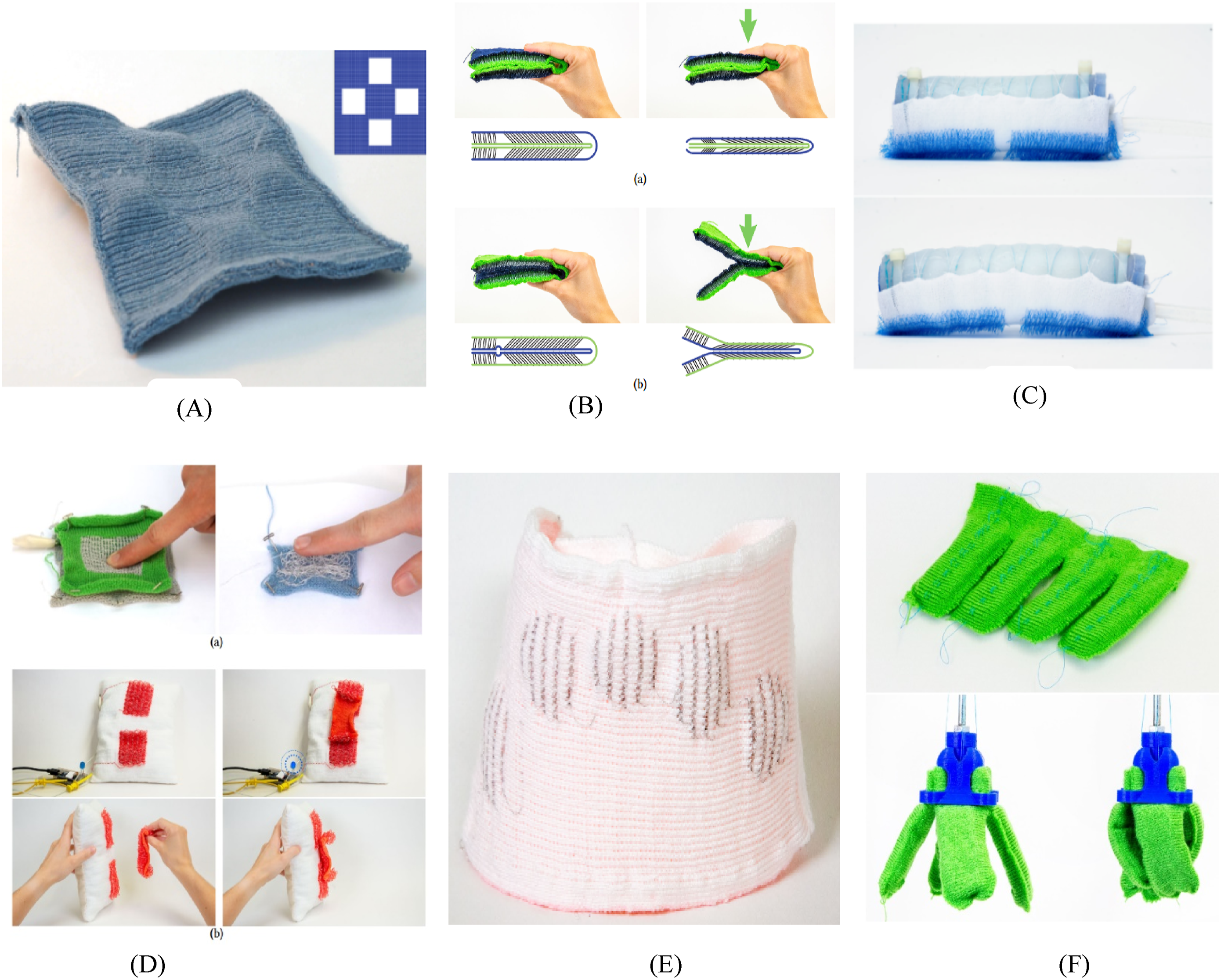
Sustainability and eco-friendly considerations
Sustainability research emphasizes biodegradable materials and efficient production methods to reduce environmental impact. 182 The exploration of sustainable materials in 3D knitted structures highlights the potential of green production techniques to reduce the ecological footprint. KSFs offer sustainable applications, particularly in healthcare, owing to their washability and reusability, and present alternatives to disposable products. This is especially relevant for incontinence products, which require substantial liquid absorption while minimizing environmental impact. Efficient production methods with optimized yarn diameters can lead to reduced material usage, aligning with sustainability goals. While current research has not extensively covered biodegradable materials in KSFs, further exploration in this area could enhance our understanding of their eco-friendly potential. The integration of natural fibers and ecological production methods are critical strategies to improve sustainability in textile manufacturing, promoting eco-friendly alternatives to traditional materials. 183
Challenges and limitations
The challenges and limitations of 3D KSFs in medical applications primarily revolve around their manufacturing scalability and cost-effectiveness. Several key factors can be inferred from existing literature regarding the characteristics and properties of these fabrics. First, the complexity of 3D KSFs, which involves intricate structures and high-performance materials, poses significant challenges for scaling-up production. The manufacturing process requires specialized equipment, such as double-jersey circular knitting machines with spacer attachments. This equipment may not be readily available and often requires substantial investment in terms of acquisition and maintenance. Furthermore, achieving precise control over the knitting process to satisfy the desired properties can be difficult to maintain at larger scales. Second, cost-effectiveness is critical in medical applications where materials must satisfy stringent performance standards while remaining affordable. The use of advanced fibers, such as low-twist ultra-high-molecular-weight polyethylene fibers, combined with specialized manufacturing processes, can increase the costs associated with 3D KSFs. Additionally, the development of composites with specific mechanical properties, such as those reinforced with epoxy resin or impregnated with shear-thickening fluids, can further escalate the production expenses. Furthermore, regulatory compliance is a challenge. The approval process for medical devices and materials can be lengthy and complex and requires extensive testing and documentation to demonstrate safety and efficacy. This regulatory burden can slow the time-to-market for innovative products made from 3D KSFs. Finally, the variability in material properties owing to differences in manufacturing conditions can lead to inconsistencies in performance. This variability poses risks in applications where uniformity is critical, such as load-bearing implants. However, as fabric manufacturers and consumers become increasingly aware of the unique attributes of warp and weft KSFs, their importance and popularity are expected to increase. Continued research and innovation in manufacturing techniques and material selection will be essential for overcoming these limitations and enhancing the viability of 3D KSFs for widespread medical use.
Conclusion
This review paper extensively examines the potential uses of 3D knitted spacer fabrics (3D KSFs) in revolutionizing healthcare solutions. These textile structures exhibit unique properties such as high breathability, effective moisture management, compression, and excellent conformity, making them particularly suitable for a diverse range of medical applications. The fabric structure specifically used from wound dressings and compression garments to prosthetic liners and orthopedic supports, 3D KSFs have demonstrated promising outcomes in enhancing patient comfort, facilitating healing, and improving overall functionality. One notable application is incontinence products designed for direct skin contact, which not only offer comfort but also the advantage of being washable and reusable. This feature contributes to sustainability in the health care sector, aligning with the growing demand for eco-friendly solutions. In addition, the acoustic properties of 3D KSFs enable effective noise control in medical environments, and their thermal properties are being explored for applications such as mattress ticking. This highlights the importance of fabric design and fiber composition in optimizing thermal comfort. Despite these advantages, challenges remain regarding manufacturing scalability and cost-effectiveness, particularly given the specialized equipment and materials required. However, as awareness of the benefits of warp and weft KSFs increases, their significance in the healthcare market is expected to increase. Thus, continued research and innovation in manufacturing techniques, material selection, and design optimization are crucial for overcoming these limitations. Moreover, interdisciplinary collaboration among textile engineers, material scientists, and medical professionals is essential to drive the adoption and integration of these advanced textiles in the healthcare sector. By prioritizing rigorous clinical trials and translating laboratory findings into viable products, the capabilities of 3D KSFs can be fully exploited. Ultimately, this approach will lead to improved patient care and a more sustainable future for medical textiles.
Footnotes
Acknowledgments
The authors express gratitude to the current and previous groups of researchers in the field of technical textiles.
Declaration of conflicting interests
The author(s) declared no potential conflicts of interest with respect to the research, authorship, and/or publication of this article.
Funding
The author(s) received no financial support for the research, authorship, and/or publication of this article.
