In this paper, two-dimensional numerical simulations are performed to investigate the particle filtration performance of multi-fiber filters using computational fluid dynamics (CFD) technology. We combine fluid and particle properties as well as fiber size into single dimensionless numbers to analyze the influence of fiber arrangements on the system pressure drop and capture efficiency during the filtration process. The results indicate that the motion and deposition of aerosol particles significantly depend on the combined effects of Brownian diffusion, interception and inertial impaction mechanisms. The capture of aerosol particles with diameters less than 0.1 is strongly determined by the Brownian diffusion mechanism. For the case where interception and inertia impaction mechanisms dominate, particles with diameters in the range of 1–10 are more easily captured. In addition, the filter with a staggered fiber array structure exhibits a higher capture efficiency than that of parallel and random cases. From the quality factor standpoint, filters with both the staggered and random fiber arrangements show a better filtration performance. The research results can provide a fundamental understanding of the particle filtration process and the theoretical basis for filter design and optimization.
With industrialization and urbanization, energy demand in the global energy mix is changing. The use of conventional fossil fuels produces various hazardous substances and fine suspended particles ultimately causing environmental degradation.1–3 Nuclear energy has emerged as one of the viable options to replace conventional energy sources. According to a filtered containment ventilation study published by OECD/NEA-CSNI in 2014,4 it was concluded that filtered ventilation significantly improves the ability of nuclear power plants to manage severe accidents, as well as reduce geological pollution and negative impacts on human health. Therefore, it has become an urgent issue to enhance the capture efficiency of ventilation systems and reduce the release of radioactive particulate matter.
In the field of small particle filtration, particles with diameter less than 10 are difficult to be captured, in particular for particles of 0.01–1 . Fibrous filtration is one of the most economical and effective technologies to satisfy environmental requirements. The filtration performance normally can be evaluated by the two key factors pressure drop and capture efficiency, which is mainly related to the internal microstructure of the filter, properties of suspended particles and air flow field.5–9 A number of gas-solid filtration studies in multiple fiber arrangements have been analyzed by solving the two-dimensional viscous flow field.10,11 The effects of the fiber in parallel,12,13 staggered14–16 and random arrangements17,18 on the pressure drop19 and capture efficiency20,21 have been investigated. Wang et al22 simulated the filtration process with an inhomogeneous distribution of fiber, where higher capture efficiency and low-pressure drop of submicron particles could be obtained as fiber packing density was reduced. Therefore, the overall performance of fiber filters can be improved by optimizing the fiber arrangement. However, much less regard for the influence of fiber arrangement on filtration performance.
The filtration process generally can be divided into initial and ageing filtration stages according to variations in pressure drop.23,24 At the initial stage, particles are perceived as points without the volume, and there is no particle accumulation on the fiber surface such that the filter is regarded as a clean one.25–27 The fact that the particle diameter is less than Kolmogorov scale of the air phase makes the point-particle assumption acceptable,28 and then the effect of the particle motion on the airflow field can be neglected.29,30 On the contrary, aging stage is related to the clogging of the filter. In this work, we focus on the initial filtration stage.
To obtain an optimal multi-fiber filter with the properties of high capture efficiency, low-pressure drop and long lifetime, detailed information on the filtration process at the particle scale is required.11,31,32 The transport and deposition of aerosol particles in the airflow field are complex due to the involvement of multiple capture mechanisms, including inertial impaction interception, Brownian diffusion and other mechanisms.33,34 Liu & Wang35 analytically investigated the capture efficiency and pressure drop of fiber filters that are governed by the interception mechanism. They found that both pressure drop and filter interception efficiency enhance with fiber separation ratio. Zhu et al.36 numerically investigated fibrous filtration with cylindrical and rectangular fibers. Their results showed that the capture efficiency combining the interception and impaction mechanism was a parabolic function of the Stokes number. Huang et al.37 carried out numerous simulations to examine the particle filtration performance of the noncircular fiber. The findings demonstrated that the diffusion capture efficiency of noncircular fibers was independent of the orientation angle but related to the aspect ratio of the fiber. Other factors corresponding to filtration performance are also investigated by researchers. Qian et al.38 discovered that the capture efficiency depended on the particle properties and fiber structure through gas-solid flow simulation. Previous works12,39 studied the influence of wind speed on capture efficiency and pressure drop, and they reported that both pressure drop and capture efficiency increased with the wind speed.
However, the above researches focus primarily on the effect of a single factor on the capture efficiency and pressure drop, such as the analysis of air velocity, particle diameter and shape of fibrous media.40–44 It is more effective to combine all of these important parameters (fluid velocity and viscosity, particle diameter and density and fiber size, etc.) into single dimensionless numbers to evaluate the filtration performance of multi-fiber filters, and consequently, an optimal strategy can be developed by integrating different methods. Therefore, various dimensionless numbers, including Peclet number , interception coefficient and Stokes number, are employed to analyze the filtration performance in this paper. Then the contribution of the fiber arrangements on the pressure drop and capture efficiency is performed at the particle scale. The present work does not intend to reproduce the experimental data quantitatively but aims to provide an understanding of particle transport and collision at the initial filtration stage.
In the following section, theoretical equations for calculating the fluid flow field and particle motion are described. Then, we introduce the simulation setup including the establishment of single fiber and muti-fiber models, as well as model validation. After that, the modeling results of particle impaction on fibrous media under the dominant of individual capture mechanism are performed. More specifically, the filtration performance is estimated through the analysis of the capture efficiency, pressure drop and quality factor for different fiber arrangements. Finally, the conclusion and future work directions are presented.
Methods
Methodology
The internal flow of fiber filters is generally considered an incompressible viscous and laminar flow.45 In this work, the airflow field through fibrous media is calculated by the CFD model where the finite volume method is adopted. The governing equations for the fluid flow are the continuity equation and the conservation of momentum equation which are given:46
where and stand for the fluid density and dynamic viscosity respectively. is air velocity and denotes the fluid pressure.
Once the flow field in the solution domain reaches a steady state, the suspended particles are released from the different positions into the filter. Note that the volume fraction of the suspended particles is kept less than 10% so that the influence of particle motion on the flow field is negligible. Then the trajectory of each discrete particle can be obtained by the DPM solver which is based on the Lagrangian method in ANSYS-Fluent software.47,48 For particle-air flow, the suspended particles are mainly controlled by the fluid drag force and Brownian diffusion force. Combining the gained flow field and applied force on a particle, the following equations are used to describe the particle motion:39,49
where , and are the velocity, density and diameter of the particle phase, respectively. stands for the Cunningham slip correction factor, where is the particle Knudsen number, is the mean free range of the air molecules. is the spectral intensity distribution function, is the Boltzmann constant and represents the absolute temperature (K). The term denotes the Brownian diffusion force exerted on a particle, where denotes a Gaussian random distribution function with a mean of 0 and variance of 1. is the particle time step. means the relaxation time of the particle.
Simulations procedure
Model setup
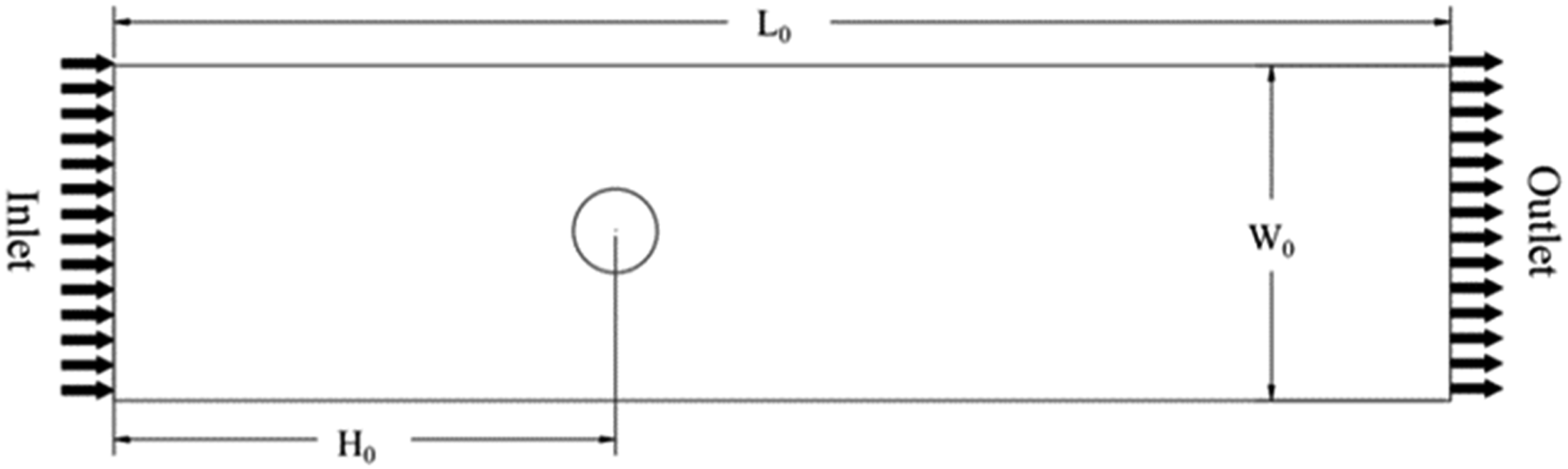
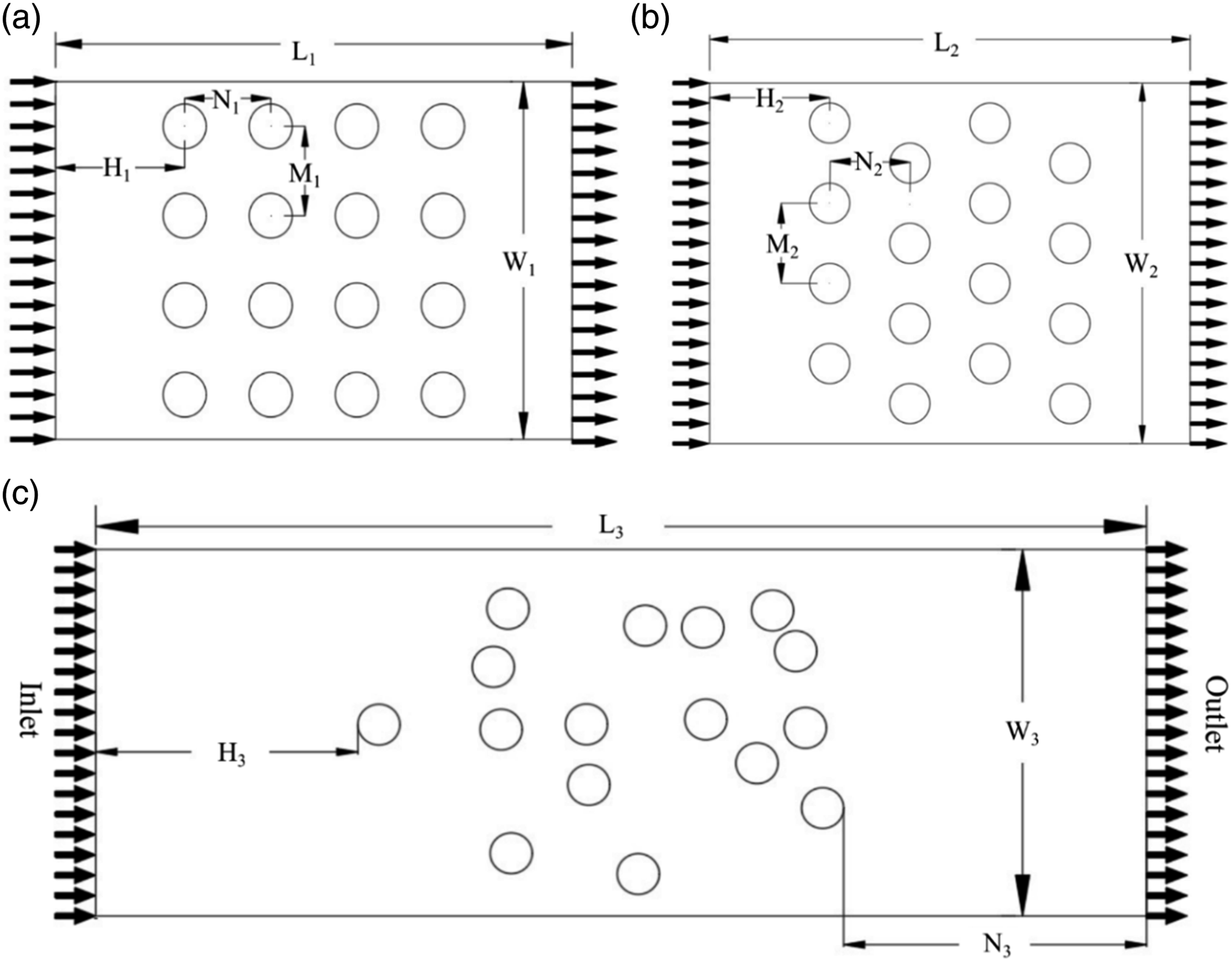
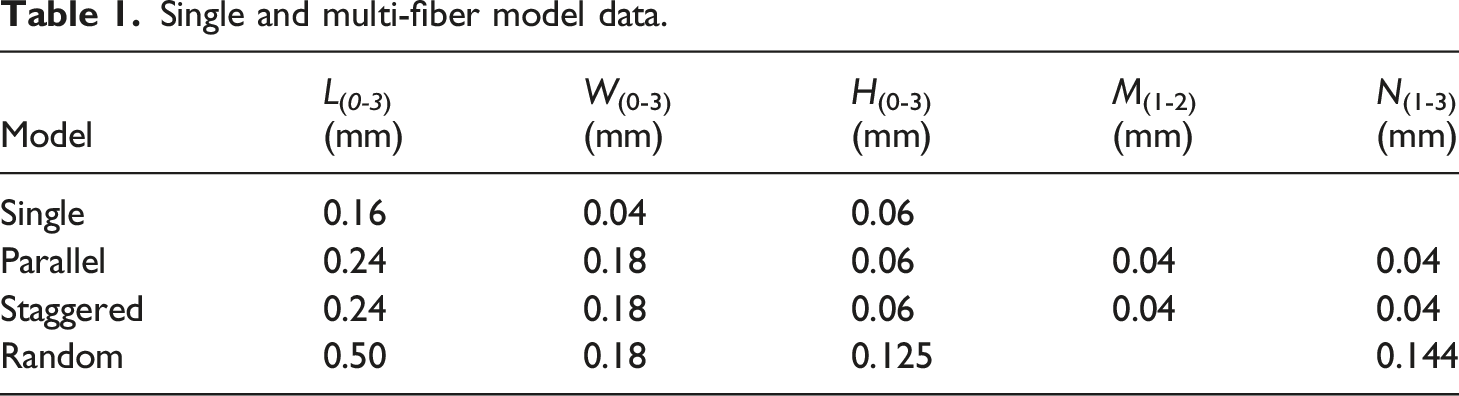
A filter is usually filled with a large number of fibers that are often arranged randomly, resulting in a loose porous structure. To obtain a large effective trapping area, the fibers are expected to arrange perpendicular to the airflow direction. In the present study, first, a circle representing a single fiber is presented in Figure 1 for the basic understanding of particle filtration. Then a two-dimensional computational domain includes three models that are located in the flow field parallelly, staggered and randomly as sketched in Figure 2. All the filter geometric models are established by AutoCAD and MATLAB software, then inputting them into to ANSYS-Fluent to perform meshing, boundary condition setting and iterative calculation. The geometry sizes associated with the fibers and computational domain are listed in Table 1.
Single fiber model.
Three multi-fiber models with the same solid volume fraction () (a) Parallel model (b) Staggered model (c) Random model.
Single and multi-fiber model data.
Model
L(0-3)(mm)
W(0-3)(mm)
H(0-3)(mm)
M(1-2)(mm)
N(1-3)(mm)
Single
0.16
0.04
0.06
Parallel
0.24
0.18
0.06
0.04
0.04
Staggered
0.24
0.18
0.06
0.04
0.04
Random
0.50
0.18
0.125
0.144
Initially, it is assumed that the air without particles flows into the computational domain, boundary conditions are set for an inlet with a constant velocity and an outlet with zero constant pressure. Once the airflow arrives at a steady state, particles with a given density and diameter are randomly injected from the inlet. The periodic boundary conditions are imposed on the top and bottom of the filtration domain. No-slip boundary condition is applied on the fiber surface. The non-slip condition means that there is no relative sliding between the fluid and the solid wall of the fiber filter, and the fluid velocity is zero near the filter wall, which is more in line with the actual situation. All the simulation parameters used for the particle filtration are listed in Table 2.
Parameters used in the air-solid simulations.
Parameters
Value
Particle diameter,
0.002∼10
Fiber diameter,
20
Air density,
1.225
Air viscosity,
1.7894e-5
Air velocity,
0.01∼1
During the initial filtration stage, some basic assumptions50 are made for the discrete solid phase: (1) The particle is a rarefied phase so the back influence of particles on the fluid flow is negligible. (2) The particles in the flow field have the same physical properties as a single spherical particle. (3) Particles are removed from the flow field when they collide with fibers.
The capture efficiency of the filter is computed from the following expression:9,15,49
where is the particle number trapped by the fibrous media and equals the total amount of particles injected into the flow field. During the filtration process, we mainly consider the three capture mechanisms: Brownian diffusion, interception and inertial impaction mechanisms as described in Figure 3. The diffusion mechanism refers to the irregular motion of particles subjected to Brownian forces when the particle scale is around submicron, and the particles may eventually be collected by the fiber surface. The inertial impaction occurs when particles with large sizes are unable to adjust to the sudden changes in original streamlines and hit the fiber surface directly. The interception capture mechanism has the characteristic that the trajectory of the particles and the fluid streamlines are basically coincident, once the gap between the particle center and the fiber surface is less than the particle radius, the particles are considered to be captured by the fiber.
The three capture mechanisms considered in our study.
These three capture mechanisms are controlled by the dimensionless parameters Peclet number , interception coefficient and Stokes number ,51 which are defined as:
where is the fiber diameter, is the incoming air speed, . is the Cunningham correction coefficient, which varies with the particle size.
Model validation
To test the mesh-independent, a different number of grid nodes with quadrilateral mesh around a single fiber are employed for the current model. The velocity of the air phase at the inlet is set to 0.05 . Then the pressure drop between the inlet and outlet is calculated. Table 3 displays the detailed parameter settings of the grid for the simulations. The pressure drop is found to be constant for the resolutions used in the simulations. We take the pressure drop at its maximum for our subsequent studies, then the grid number 11,883 is chosen for the subsequent simulations. Therefore, the selected grid number provides acceptable accuracy for our simulations and the results are mesh-independent.
Test of grid-independence for single fiber.
Quantity
Grid number
3109
8192
11,883
14,598
Number of nodes
3296
8501
12,267
15,035
Pressure drop ()
11.70
11.79
11.94
11.83
The airflow in the filter is governed by Darcy's law for low Reynolds number,39,52 which indicates that the pressure drop is proportional to the inlet velocity. To validate the model, a dimensionless drag force on a unit length of a fiber, which is associated with the pressure drop , can be written as:
where is the fiber thickness and denotes the solid volume fraction (SVF) that is given by: , where and denote the distance between two adjacent fibers in vertical and horizontal directions. is the actual pressure drop of filter. Hasimoto53 gave the dimensionless drag force expression for the parallel fiber model as:
Kuwabara54 proposed a dimensionless drag force expression for the staggered fiber model at low Reynolds numbers:
Figure 4 displays the dimensionless drag force as a function of the Reynolds number. is observed to be an effective cut-off point for dimensionless drag force. F in the staggered model remains essentially constant for , which is in accordance with the results of the Kuwabara expression obtained by solving the Stokes equation. While for , the dimensionless drag of the system is no longer constant but increases with . This is due to the formation of a wake region behind the fibers and the dissipation of additional energy. Note that the Kuwabara model54 is not valid when . For the same reason, the Hasimoto formula53 does not apply to the parallel model when . Meanwhile, the measured dimensionless drag force of parallel and staggered model in our simulations are broadly consistent with the model of Wang et al.55 In summary, these results validate our simulation model properly.
Dimensionless drag force versus Reynolds number.
Results and discussion
Single fiber filtration
Single fiber filtration is essential to study the capture mechanism, which contributes to analyzing the capture efficiency56,57 and pressure drop.58 In turn, it is helpful to clearly demonstrate the feasibility of filtration theory. In this section, the fiber diameter remains at 20 .
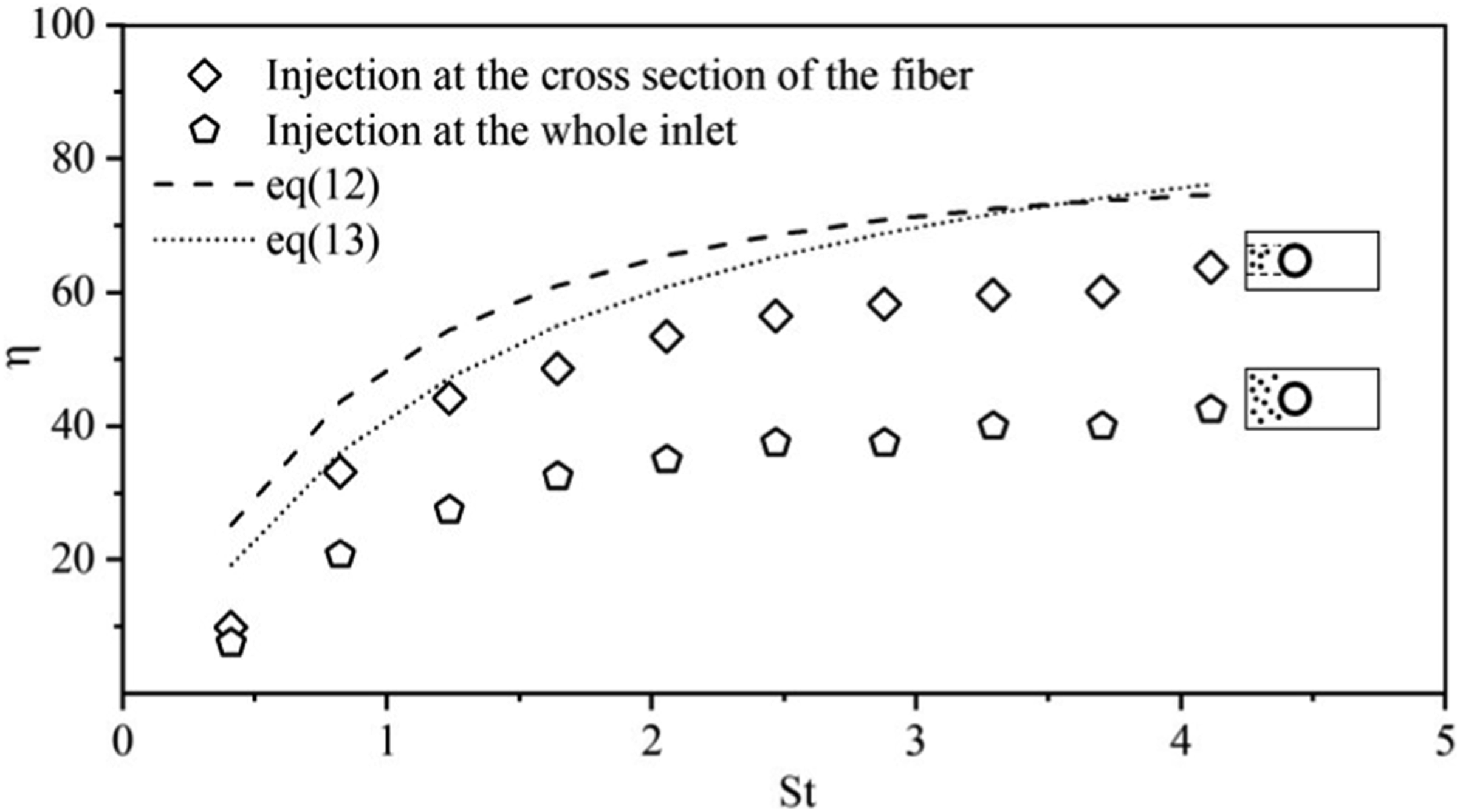
The capture efficiency of a single fiber is one of the main concerns during the particle filtration process,59 which is calculated by the ratio of the number of trapped particles to the entirely injected particles. Figure 5 shows the capture efficiency of a single fiber controlled by the interception parameter at a range of air speeds (0.1 m/s, 0.3 m/s, and 0.5 m/s), where the Stokes number ranges from 0.04 to 10. Figure 6 presents the single-fiber capture efficiency by varying the number.
Capture efficiency in interception-dominated situation.
Capture efficiency in inertial-impaction-dominated situation.
Figure 5. shows capture efficiency increases with until gradually to reach an asymptotic value. The intermediate particles in the range of 1–2 are hardly captured by the fibers since the interception mechanism is fairly weak. As particle size increases, the interception mechanism gradually becomes strong and dominant, which is highlighted to be the most critical role for filtration performance. In this mechanism, particles move along the streamline, when the distance between the particle center of mass to the fiber surface is less than or equal to the particle radius, they are considered to be trapped by the fibers. Furthermore, its capture efficiency is also sensitive to the inlet velocity when 0.1 m/s < υ < 0.3 m/s, however, such characteristic is not obvious when υ > 0.3 m/s.
Capture efficiency is also influenced by the inertial parameter . Schweers et al.60 improved the formulation approximation proposed by Suneja and Lee61 to establish the following single-fiber efficiency equation for inertial collisions considering both and :
Israel and Rosner62 studied the aerodynamic capture efficiency of non-Stokes particles and determined the following expression for .
means the capture efficiency of a single fiber where the particles are injected from the cross-section of the fiber at the inlet. Figure 6. shows the comparison of the simulation results and the one obtained from empirical relationships computed with equations (12) and (13). A good agreement for small can be observed. However, there is discrepancy with our simulation results for large but still with the same tendency. This is probably due to the different boundary conditions applied. For the particles injected at the whole inlet, the capture efficiency of a single fiber increases rapidly with at the initial stage and then stabilizes at a constant value. Capture processes involve both the interception and inertial impaction mechanisms for small . In this case, the inertia of particles with a small number is not sufficiently strong and the trajectories of particles still flow along the streamlines. As number continues to rise, the inertial impaction mechanism is known to be dominant for trapping particles. The particles deviate from the streamlines when approaching the fiber, and consequently collide with the front surface of the obstacle. Therefore, it is easy to obtain a higher trapping capacity with a larger .
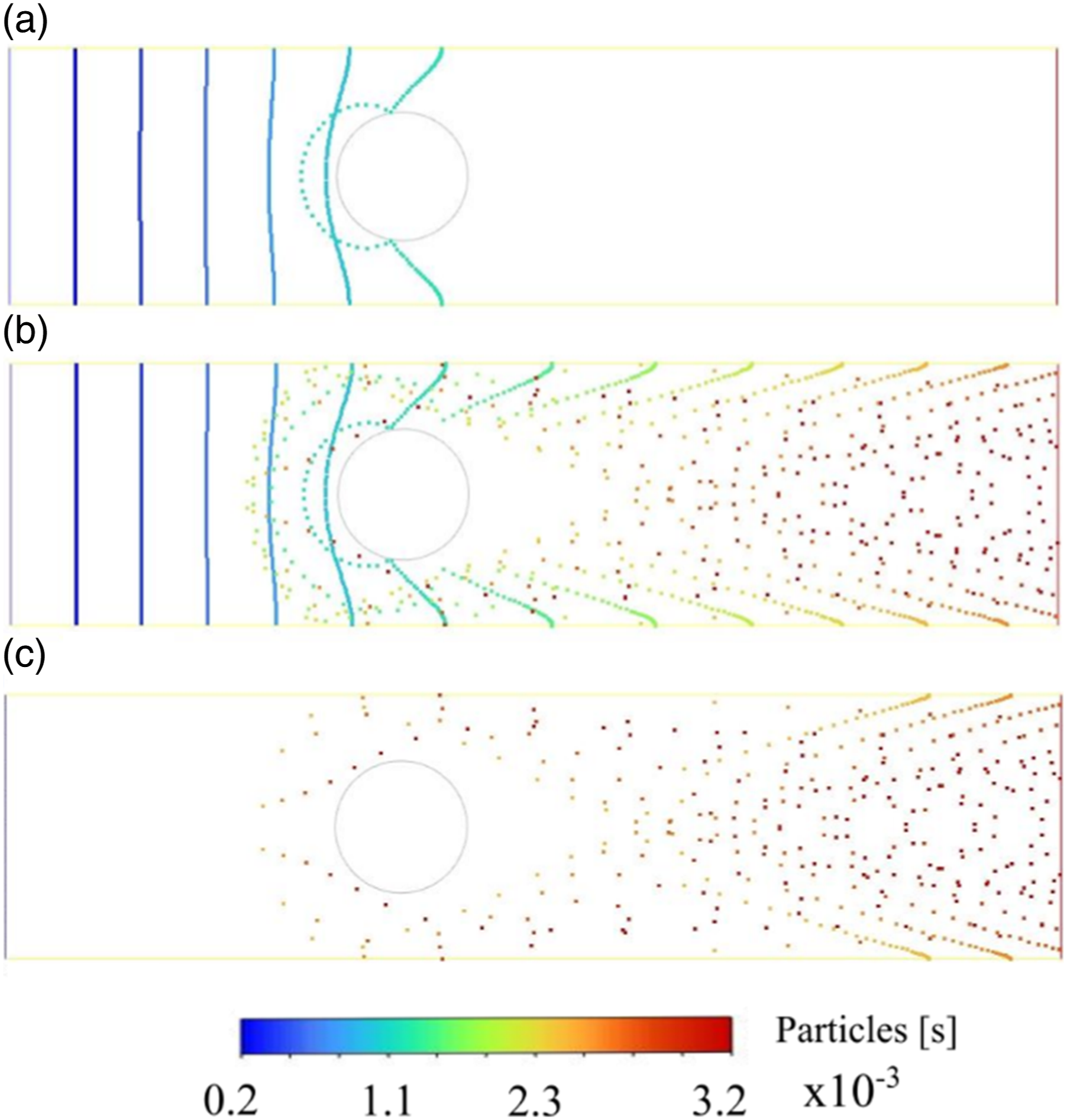
Series of snapshots from one simulation of the trajectory of the particle motion around a single fiber are displayed in Figure 7. The particles motion is influenced by the streamlines of the flow field and their trajectories alter remarkably as they approach the fiber surface. It is interesting to observe that trajectories of lagged particles form a half-circle in front of the fiber, which leads to a delayed capture. Such behavior lasts throughout the entire filtration process. When the particles pass through the fiber, their distribution tends to be disordered. Nevertheless, with the occurrence of the transformation of the streamline, the particle distribution becomes more chaotic.
Particle distribution for during the filtration process at (a) (b) (c) The color bar indicates the time injection particles.
Multi-fiber filtration
In this section, we perform the filtration performance of the filter by revising the dimensionless parameters including number, interception coefficient and Stokes number , making one of the individual capture mechanisms dominant. Then the captured efficiency of the clean filter with multi-fiber in parallel, staggered and random models are calculated based on equation (5). Here, the fiber diameter is selected as 20 and the solid volume fraction remains at 19.6% for parallel, staggered and random models.
Capture efficiency due to Brownian diffusion
The filtration process of the multi-fiber filter for small particles ( < < ) is first studied under the condition of the Brownian diffusion capture mechanism. The relationship between capture efficiency and is shown in Figure 8(a) for the staggered model. For the particles with a diameter of (), they are easier to be captured by the fibers and then a higher capture efficiency is obtained. To this end, a dimensional study of external force exerted on small particles reveals that the Brownian force is substantially greater than the drag force. As a consequence, the role of the Brownian diffusion mechanism becomes considerably more significant. When the particle diameter equals (Pe = 4071), the particle distribution inside the filter is irregular as presented in Figure 8(b). It is deduced that the capture efficiency tends to decrease since the particles with weak diffusion capability have fewer chances to collide with fibrous media. Although the Brownian diffusion mechanism remains dominant, the drag force of the local air phase on particles plays a role. Therefore, it can be concluded that in the case of submicron particles, particle capture is mainly governed by the Brownian force.
(a) Capture efficiency in Brownian-diffusion-dominated cases for the staggered model. (b) Particle distribution at for , the color bar indicates the time injecting particles.
Capture efficiency due to interception
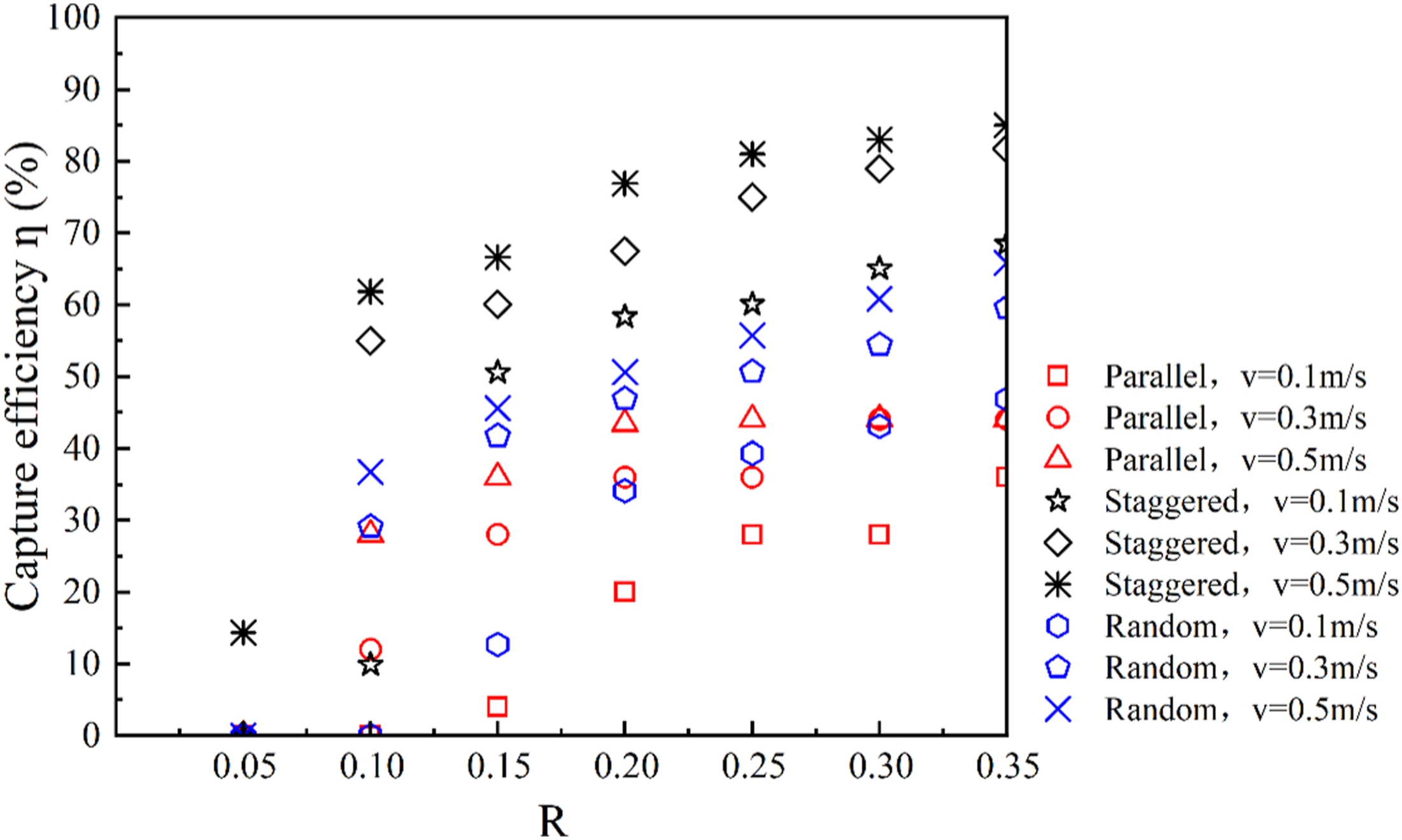
The interception efficiency, quantified by the ratio of particle diameter to fiber size, is generally determined by the fiber structure and arrangement. Figure 9. compares the capture efficiency of the multi-fiber filter in three arrangement models as a function of interception coefficient . It can be seen that the staggered structure has a higher capture efficiency than other cases under the same conditions. Such model design exhibits better obstructive influence on particle transport. The contribution of the random model is greater than that of the parallel pattern. In addition, for an identified arrangement model, the higher-velocity injecting particles are more easily to be captured by the fiber. This probably is because the increased air incoming velocity enhances the flow drag force and particle inertia, leading to an increment collision opportunity with the fibers. Whereas the lower-velocity injecting particles are inclined to transport along the streamline and finally flow out of the filter with the airflow.
Capture efficiency as a function of interception coefficient for parallel, staggered and random models.
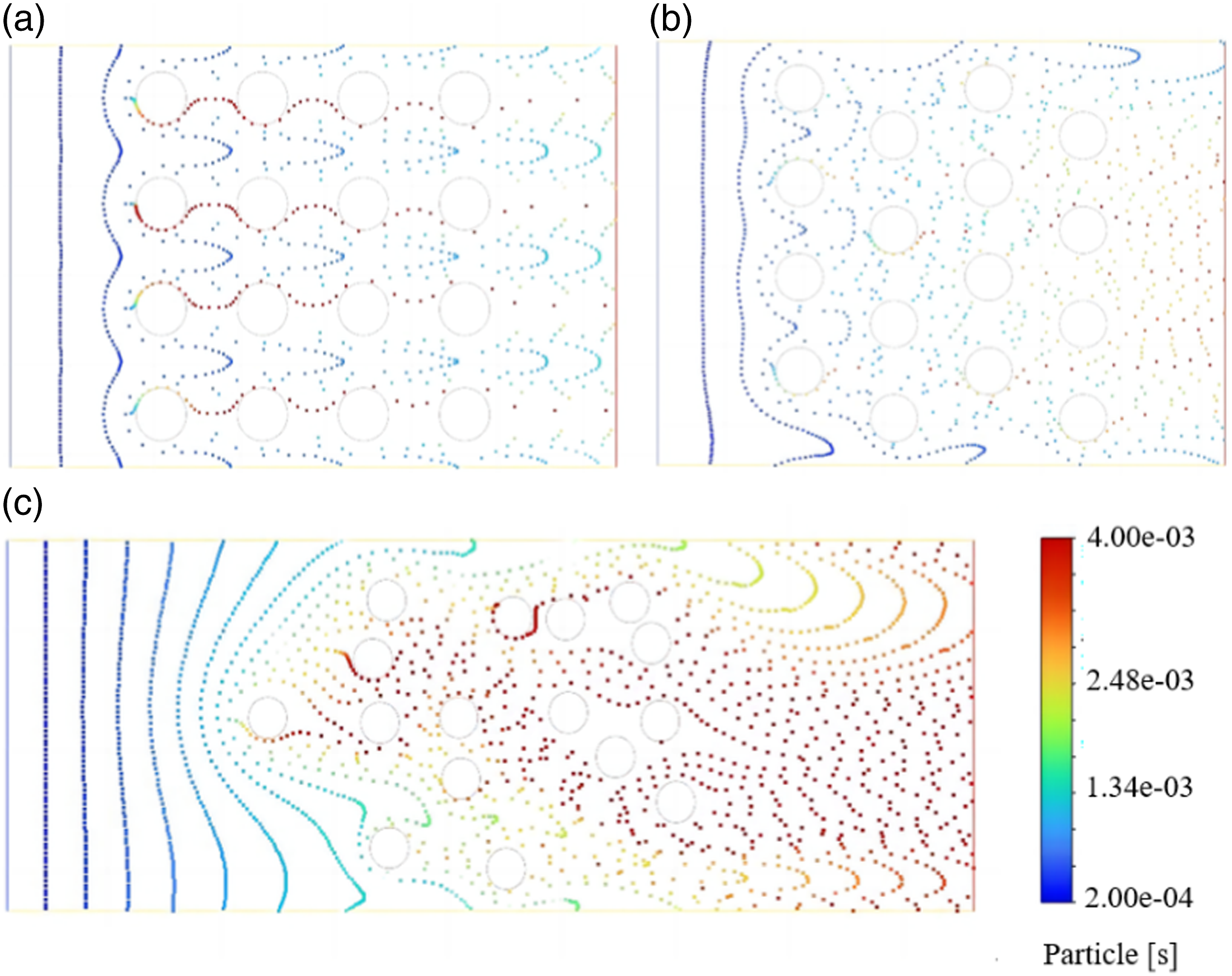
Figure 10. illustrates particle distribution for three fiber arrangements at . The parallel design of multi-fiber provides several microchannels to allow the particle to escape from the filter, resulting in low capture efficiency. Based on the trajectory analysis, their trajectories perform parabolic behavior in the microchannel and follow the streamline close to the fiber (Figure 10(a)). The perturbation of particles in the parallel model is weaker compared to the staggered model where a large number of injecting particles are more easily contacted with the front side of the fiber surface (see Figure 10(b)). Though the particles flow through the gap between two fibers in a staggered pattern, they still have the opportunity to be captured by the subsequent row of fibers. While the random model has a sharper effect on the particle distribution, which is significantly noisy due to the irregular distribution of the fibrous media (Figure 10(c)).
Particle distribution for different models at and (a) Parallel (b) Staggered (c) Random. The color bar indicates the time injection particles.
Capture efficiency due to inertial impaction
For large particle sizes ( 10 ), inertial impaction is regarded to be the main capture regime, which is governed by the dimensionless parameter St. Figure 11. presents the correlation between capture efficiency and St for parallel, staggered and random models. It can be seen that grows rapidly with St in the range of and thereafter increases comparatively more slowly. However, capture efficiency is substantially independent of Stokes number when for three fiber patterns. This is due to the strong inertial effect, and the steady drag force is negligible compared to the force caused by the particle and fluid inertia. Besides, the staggered arrangement demonstrates higher capture efficiency than that of parallel and random cases as inertial impaction becomes dominant. Note that both the staggered and random arrangements have a better hindering effect on the injecting particles. Because these two models are able to effectively reduce the particle channels that existed in the parallel arrangement and enhance the particle capture efficiency.
Plot of capture efficiency versus for parallel, staggered and random models.
Figure 12 illustrates the particle distribution at and for three fiber models. In the parallel model (Figure 12(a)), the suspended particles are almost collected by the fibrous media at the first row, subsequently, the majority of the particle escape through the microchannels which have a higher gas velocity. This may be attributed to the particle trajectory not being controlled by the streamline of the flow field. The suspended particles with strong inertial force deviate from air streamlines and their trajectories are difficult to be altered by the drag force. The first row of fibrous media in parallel arrangement make contribution greater than the rear one in capturing particles. Whereas for the staggered model (Figure 12(b)), this situation is improved due to the effective capture area formed by the fiber arrangement. The staggered pattern is more practical in disturbing the flow field than other designs. The result indicates that particles colliding with the fiber frequently occur in their windward region due to the strong inertial influence. The first and second rows of fibrous media in the staggered arrangement are therefore significantly critical to the capture process, while just a small number of particles are collected by the following fibers. This can be explained by the fact that the capture contribution of the rear fibers becomes weakened since the existence of the shielding effect. Regarding the random model (Figure 12(c)), only the fibers at the front side have the chance to capture the particles. Once the particles pass through the fibers at the front side, they have enough space to escape from the filter.
Particle distribution for different models at and at (a) Parallel (b) Staggered (c) Random. The color bar stands for the time injection particles.
System pressure drop
Another key factor related to filtration performance is pressure drop across a filter. Since we study the particle filtration at the clean stage of the filtration process, the back influence of particle deposition and transport on the flow field is negligible. Thus, the pressure drop at this stage is independent of the particle properties. Figure 13. presents the comparison of the pressure drop of the parallel, staggered and random models with a series of numbers. It is important to note that the pressure drop is significantly affected by the fiber arrangements. The pressure drop of the three designs linearly increases with , which is constant with the previous studies. In addition, the pressure drop of the random model is generally lower than that of staggered and parallel cases, indicating that such void structure formed by the fibrous media permits more air to pass through the filter.
Effect of number on pressure drop for three fibrous models.
Quality factor
A good multi-fiber filter should not only capture more suspended aerosol particles but also induce less air resistance. To estimate the contribution of dimensionless numbers in the filtration process quantitatively, an indicator of quality factor () is introduced by balancing the pressure drop and capture efficiency ,63,64 which can be expressed as:
Figure 14 depicts the evolution of the quality factor with interception coefficient for series of windward velocities (). It can be observed that the obviously increases with and a higher value could be obtained since the role of the interception mechanism gradually becomes strong for large particle size. In addition, the quality factor also depends on the air incoming velocity. In the case of low windward velocity, such as the filter exhibits better performance and has a higher for the same suspended particle size. Moreover, the of the filter with fiber in staggered and random arrangements is greater than that of the parallel pattern when capturing identical size particles.
Plot of quality factor versus R for different windward velocities.
As illustrated previously, the factors such as particle diameter, windward velocity and fluid viscosity have an impact on the capture efficiency. Thus, we combine these parameters into a unique dimensionless number . Figure 15. shows the relationship of the quality factor and for filter with fiber in parallel, staggered and random arrangements. Quality factor initially decreases sharply with the increase of the Stokes number (), then gradually slows down to reach an asymptotic value. It is highlighted that the corresponding to the staggered and random arrangements exhibits a better filtration performance. With the increase of the , the gap for between staggered and parallel becomes apparently small. This is due to the fact that as Stokes number continues to increase, the capture efficiency already has reached a peak value, while the pressure drop becomes larger.
Quality factor of the filter with fibers in parallel, staggered and random arrangements versus Stokes number.
Conclusions
In this paper, we used 2D simulations to numerically study the filtration performance of multi-fiber filters, where air-solid flow and particles transport inside the filter were calculated using the ANSYS-Fluent and Lagrangian form of the particle equation in the DPM solving model, respectively. The effects of dimensionless parameters and fiber arrangements on the capture efficiency and pressure drop were analyzed. Finally, the evaluation of the filtration performance of the filter was then provided from the standpoint of the quality factor in the range of 0.4 < < 20 and 0.01 < <1.37. The following findings of this investigation were reached:
(1) The capture efficiency of the single-fiber filter was mainly characterized by interception coefficient and Stokes number for large particle size. increased with and initially and then gradually tended to be an asymptotic value.
(2) The capture efficiency of the multi-fiber filter with the parallel, staggered and random model was compared under the different capture mechanisms. For the diffusion mechanism dominates at particle diameters less than 0.1 , the capture efficiency of the staggered model decreased as the Peclet number increased. For interception and inertial impaction-dominated situations, the staggered arrangement had a higher capture efficiency than that of random and parallel cases, but it exhibited a higher pressure drop. Detailed knowledge of particle trajectory was also obtained, particles with strong inertial force were more likely to be captured at the windward region of the fibers.
(3) In terms of quality factor, an optimal fiber arrangement was gained where the staggered model showed excellent filtration performance. Although the model shows good particle capture ability, it corresponds to a higher air resistance. Since the quality factor is the reference standard for assessing filtration performance, we can infer that the fiber arrangement serves as a guideline for the design and optimization of filters.
The present simulations for the particle filtration process are investigated at the clean stage, which is helpful to predict the filtration performance at the particle scale. To construct the optimal fiber assembly and provide a basic design model in the real case, we will extend our present study to the particle-loaden flow at the ageing filtration stage by considering the particle-particle interaction and the back influence of the solid phase on the flow field. Furthermore, the instantaneously changed morphology of the fibers due to the growth of accumulated particles needs to be investigated in the future.
Footnotes
Declaration of conflicting interests
The author(s) declared no potential conflicts of interest with respect to the research, authorship, and/or publication of this article.
Funding
The author(s) disclosed receipt of the following financial support for the research, authorship, and/or publication of this article: This work was supported by the National Natural Science Foundation of China (NO. 52205308,22208120), the Department of Science and Technology of Jilin Province of China (Grant NO. 20220508005RC), the China Postdoctoral Science Foundation (2022M711300), the Education Department of Jilin Province of China (Grant NO. JJKH20220975KJ).
ORCID iDs
Jianhua Fan
Lu Wang
References
1.
QianFHuangNZhuX, et al.Numerical study of the gas–solid flow characteristic of fibrous media based on SEM using CFD–DEM. Powder Technol2013; 249: 63–70.
2.
LightyJSVeranthJMSarofimAF. Combustion aerosols: Factors governing their size and composition and implications to human health. J Air Waste Manag Assoc2000; 50: 1565–1618.
3.
WangHZhaoHGuoZ, et al.Numerical simulation of particle capture process of fibrous filters using Lattice Boltzmann two-phase flow model. Powder Technol2012; 227: 111–122.
4.
JacquemainD. Status report on filtered containment venting. Committee on the Safety of Nuclear Installations. NEA, July, 2014.
5.
HeimMMullinsBJWildM, et al.Filtration efficiency of aerosol particles below 20 nanometers. Aerosol Sci Technol2005; 39: 782–789.
6.
KirshAAKhmelevskiyVOBudykaAK, et al.Penetration of aerosol particles through fine fibrous filters. Theor Found Chem Eng2011; 45: 891–897.
7.
KanaokaC. Fine particle filtration technology using fiber as dust collection medium. KONA Powder Part J2019; 36: 88–113.
8.
OrihuelaMPChacarteguiRGómez-MartínA, et al.Performance trends in wall-flow diesel particulate filters: Comparative analysis of their filtration efficiency and pressure drop. J Clean Prod2020; 260: 120863.
TianXOuQLiuJ, et al.Influence of pre-stage filter selection and face velocity on the loading characteristics of a two-stage filtration system. Sep Purif Technol2019; 224: 227–236.
11.
KaradimosAOconeR. The effect of the flow field recalculation on fibrous filter loading: a numerical simulation. Powder Technol2003; 137: 109–119.
12.
ZhangLZhouJWZhangB, et al.Semi-analytical and computational investigation of different fibrous structures affecting the performance of fibrous media. Sci Prog2020; 103: 1–25.
13.
RieflerNUlrichMMorshäuserM, et al.Particle penetration in fiber filters. Particuology2018; 40: 70–79.
14.
Banihashemi TehraniSMMoosaviASadrhosseiniH. Filtration of aerosol particles by cylindrical fibers within a parallel and staggered array. Microsyst Technol2016; 22: 965–977.
15.
ShouDFanJZhangH, et al.Filtration efficiency of non-uniform fibrous filters. Aerosol Sci Technol2015; 49: 912–919.
16.
ChaudhuriJBaukelmannABoettcherK, et al.Pressure drop in fibrous filters. Eur J Mech B Fluid2019; 76: 115–121.
WangPLiuJWangC, et al.A holistic performance assessment of duct-type electrostatic precipitators. J Clean Prod2022; 357: 131997.
19.
AbdolghaderPBrochotCHaghighatF, et al.Airborne nanoparticles filtration performance of fibrous media: a review. Sci Technol Built Environ2018; 24: 648–672.
20.
XuBWuYCuiP. Semi-analytical and computational investigation of different dust loading structures affecting the performance of a fibrous air filter. Particuology2014; 13: 60–65.
21.
LöfflerF. Air filtration. Chem Ing Tech1974; 46: 364–364.
22.
WangQMazeBTafreshiHV, et al.A case study of simulating submicron aerosol filtration via lightweight spun-bonded filter media. Chem Eng Sci2006; 61: 4871–4883.
23.
ThomasDContalPRenaudinV, et al.Modelling pressure drop in HEPA filters during dynamic filtration. J Aerosol Sci1999; 30: 235–246.
24.
DuvalHMassonDGuillotJ-B, et al.Two-dimensional lattice-Boltzmann model of hydrosol depth filtration. AIChE J2006; 52: 39–48.
25.
HubbardJABrockmannJEDellingerJ, et al.Fibrous filter efficiency and pressure drop in the viscous-inertial transition flow regime. Aerosol Sci Technol2012; 46: 138–147.
26.
LiuXWeiALuoK, et al.Numerical study of the effects of particles on the near wake around a circular cylinder. Int J Comput Fluid Dynam2015; 29: 150–160.
27.
QuevedoJPatelGPfefferR, et al.Agglomerates and granules of nanoparticles as filter media for submicron particles. Powder Technol2008; 183: 480–500.
JinXYangLDuX, et al.Modeling filtration performance of elliptical fibers with random distributions. Adv Powder Technol2017; 28: 1193–1201.
30.
XuBGongYWuY. Charged ultrafine particle filtration through vehicular cabin air filters. Particuology2016; 28: 1–5.
31.
GrossnerMTPenrodAEBelovichJM, et al.Single fiber model of particle retention in an acoustically driven porous mesh. Ultrasonics2003; 41: 65–74.
32.
KasperGSchollmeierSMeyerJ, et al.The collection efficiency of a particle-loaded single filter fiber. J Aerosol Sci2009; 40: 993–1009.
33.
ChernyakovALKirshAAKirshVA. Efficiency of inertial deposition of aerosol particles in fibrous filters with regard to particle rebounds from fibers. Colloid J2011; 73: 389–393.
34.
HappelJ. Viscous flow relative to arrays of cylinders, 1959, 174–177.
35.
LiuZGWangPK. Pressure drop and interception efficiency of multifiber filters. Aerosol Sci Technol1997; 26: 313–325.
36.
ZhuCLinC-HCheungCS. Inertial impaction-dominated fibrous filtration with rectangular or cylindrical fibers. Powder Technol2000; 112: 149–162.
37.
HuangHWangKZhaoH. Numerical study of pressure drop and diffusional collection efficiency of several typical noncircular fibers in filtration. Powder Technol2016; 292: 232–241.
38.
QianFHuangNZhuX, et al.Numerical study of the gas-solid flow characteristic of fibrous media based on SEM using CFD-DEM. Powder Technol2013; 249: 63–70.
39.
LiWShenSLiH. Study and optimization of the filtration performance of multi–fiber filter. Adv Powder Technol2016; 27: 638–645.
40.
TaoRYangMLiS. Effect of adhesion on clogging of microparticles in fiber filtration by DEM-CFD simulation. Powder Technol2020; 360: 289–300.
41.
ZhouZ-JZhouBTsengC-H, et al.Evaluation of characterization and filtration performance of air cleaner materials. Int J Environ Sci Technol2021; 18: 2209–2220.
42.
BulejkoPKrištofODohnalM. An assessment on average pressure drop and dust-holding capacity of hollow-fiber membranes in air filtration. Membranes2021; 11: 467.
43.
LiXQinHYouZ, et al.Prediction of the particles collection and pressure-drop characteristics across fibrous media. Sci Technol Built Environ2018; 24: 638–647.
44.
LeeKWLiuBYH. Theoretical study of aerosol filtration by fibrous filters. Aerosol Sci Technol1982; 1: 147–161.
45.
GobiNAarthiRFarzinA, et al.Development of alkali-treated surface-modified coir fibre filter for 1µm to 10 µm particle filtration and process optimization. J Ind Textil2022; 51: 2106S–2123S.
46.
JaganathanSVahedi TafreshiHPourdeyhimiB. A realistic approach for modeling permeability of fibrous media: 3-D imaging coupled with CFD simulation. Chem Eng Sci2008; 63: 244–252.
47.
DhaniyalaSLiuB. Investigations of particle penetration in fibrous filters: part II. theoretical. J IEST1999; 42: 40–46.
48.
ZhangJMengBWangZ, et al.Numerical simulation on cleaning of clogged pervious concrete pavement. J Clean Prod2022; 341: 130878.
49.
WangHZhaoHWangK, et al.Simulation of filtration process for multi-fiber filter using the Lattice-Boltzmann two-phase flow model. J Aerosol Sci2013; 66: 164–178.
50.
PrzekopR. Estimation of filtration efficiency – from simple correlations to digital fluid dynamics. Chem Process Eng2017; 38: 31–50.
51.
NordlundMFernbergSPLundströmTS. Particle deposition mechanisms during processing of advanced composite materials. Compos Part A Appl Sci Manuf2007; 38: 2182–2193.
52.
MüllerTMeyerJKasperG. Low Reynolds number drag and particle collision efficiency of a cylindrical fiber within a parallel array. J Aerosol Sci2014; 77: 50–66.
53.
HasimotoH. On the periodic fundamental solutions of the Stokes equations and their application to viscous flow past a cubic array of spheres. J Fluid Mech1959; 5: 317.
54.
KuwabaraS. The Forces experienced by randomly distributed parallel circular cylinders or spheres in a viscous flow at small reynolds numbers. J Physical Soc Japan1959; 14: 527–532.
55.
WangHZhaoHWangK, et al.Simulation of filtration process for multi-fiber filter using the Lattice-Boltzmann two-phase flow model. J Aerosol Sci2013; 66: 164–178.
56.
LiuYQianXWangL, et al.Hierarchical micro/nanofibrous filter for effective fine-particle capture. Powder Technol2020; 360: 1192–1199.
LiXLQinHYouZP, et al.Study on the pressure drop characteristics for the particles across fibres. IOP Conf Ser Earth Environ Sci2018; 113: 012164.
59.
ThakurRDasDDasA. Optimization study to improve filtration behaviour of electret filter media. J Text Inst2016; 107: 1456–1462.
60.
SchweersEUmhauerHLöfflerF. Experimental investigation of particle collection on single fibres of different configurations. Part Part Syst Charact1994; 11: 275–283.
61.
SunejaSKLeeCH. Aerosol filtration by fibrous filters at intermediate Reynolds numbers (≤ 100). Atmos Environ1974; 8: 1081–1094.
62.
IsraelRRosnerDE. Use of a generalized stokes number to determine the aerodynamic capture efficiency of non-stokesian particles from a compressible gas flow. Aerosol Sci Technol1982; 2: 45–51.
63.
KimHbinLeeWJChoiSC, et al.Filter quality factors of fibrous filters with different fiber diameter. Aerosol Sci Technol2021; 55: 154–166.
64.
FanJLominéFHellouM. Numerical investigation of the influence of fiber geometry on filtration performance with a coupled lattice Boltzmann–discrete element method. J Appl Mech2020; 87: 1–11.