



Abstract
Fibrous media are widely used in particle filtration. However, few studies have investigated the performance of fibrous media with bimodal and dense-sparse structures. In this study, computational fluid dynamics technology was adopted to simulate the filtration performance of fibrous media. A two-dimensional random multifiber distribution model was proposed based on VC++ and ICEM. Reliability was verified by comparing the model with the empirical formula. The filtration efficiencies and quality factors of submicron particle capture within different fiber arrangements, inlet velocities, and particle diameters were determined. Finally, the mechanism for improving the filtration efficiency of multi-fiber for submicron particles was analyzed. The results showed that, as the particle diameter and inlet velocity increased, the filtration efficiency and quality factor of the different fibrous media decreased, and tended to be similar. The fibrous media combined with bimodal and dense-sparse structures had the highest quality factor owing to the placement of the bimodal structure on the windward side and ratio of coarse to fine fibers.
Keywords
Introduction
Recently, inhalable particulates have attracted attention, as they can cause systemic harm to the human body.1–3 Common sources of particulate matter are fossil fuel combustion, industrial pollution emissions, and biomass combustion.4,5 Fibrous media are extensively used in particle collection because of their excellent filtration efficiency. The pressure drop and filtration efficiency are the key parameters that characterize the quality of fibrous media. Extensive studies on fibrous media have contributed to the development of filtration theory. Base on previous research, filtration efficiency and pressure drop as functions of parameters relating to fiber diameter and flow characteristics have been derived and verified under different experimental conditions.6,7 The filtration efficiency and pressure drop of the fiber media have notable effects in industrial applications and should be considered simultaneously. Meanwhile, owing to the development of computational fluid dynamics (CFD) technology, many researchers have begun to use CFD to study fibrous media, and have developed different technologies to generate different multifiber models.
The influence of the fiber arrangement and different fiber structure models on the filter performance of fibrous media has been established. Fuchs first proposed a systematic fibrous form including parallel, staggered, and random structures and investigated its filtration efficiency and pressure drop. The corresponding theoretical formulas were established in a previous study.8,9 Wang et al. 10 simulated the filtration efficiency and pressure drop of parallel and staggered structured fibrous media with different inlet velocities and particle diameters using the Lattice Boltzmann method (LB-CA). The results showed that the staggered structure had the best filtration efficiency, and most particles were deposited on the windward side, indicating that the particles were mainly captured by the fiber in the front row. Li et al. 11 simulated the filtration efficiencies of different arrangements. The results showed that the dense-spare structure fibrous media had the highest filtration efficiency for all simulated particle diameters, but the pressure drop was also higher. Roy and Chatterjee 12 manufactured fibrous media with a dense-sparse structure and investigated their filtration efficiency and pressure drop. The results showed that dense-sparse structures can improve the filtration efficiency and pressure drop of fibrous media. Wang et al. 13 generated a bimodal structure of fibrous media by coating with the nanofibers and found that the coated nanofiber improved filter media quality factor with particle diameters from 20 to 780 nm. Fotovati et al. 14 simulated the filtration efficiency and quality factor of bimodal fibrous media with 1 and 3 μm diameters and solid volume fractions (SVF) of 5%–15%, distributed in a parallel structure. The results showed that the quality factor of bimodal fibrous media was highest when the particle diameter was 100 nm. Kang et al. 15 generated two-dimensional (2D) fibrous models with a poly-dispersed fiber diameter distribution and investigated the filtration efficiency of fibrous media with particle diameters varying from 10 to 1000 nm. The results showed that the filtration efficiency was greater with finer fibers when the SVF of the fiber layer was 4%. Zhou et al. 16 generated 2D elliptical fibrous media with different arrangements using MATLAB, and investigated the influence of fiber shape on the filtration efficiency and quality factor. The results showed that the quality factor of bimodal structures was higher than that of dense-sparse structures, and that reducing the fiber diameter was more effective in improving filtration efficiency than increasing SVF. Bao et al. 17 studied the filtration efficiency of fibrous media with three different fiber diameters. The results showed that the fibrous media pressure drop was related to the ratio of coarse fibers to fine fibers, and the pressure drop increase with the increase of the fine fiber. The aforementioned studies focused on fibrous media with random, dense-sparse, and bimodal structures. Overall, the results showed that fibrous media with a dense-sparse structure had limited improvement in submicron particles, and fibrous media with bimodal structures had a significant increase in pressure drop. Thus, fibrous media with bimodal and dense-sparse structures have been used to optimize the filtration performance.
The fiber arrangement of fibrous media influences its filter efficiency and the mechanisms of these phenomena have been studied. Yue et al. 18 developed a randomly distributed 3D multifiber model and used CFD to simulate the filtration process in fibrous media. The results showed that most particles were deposited on the multifiber surface layer and the deposition of particulates reduced the flow velocity in the fibrous media, thereby enhancing its filtration efficiency. Riefler et al. 19 analyzed particulate matter deposition in fibrous media using X-rays and electron microscopy and found that the particle mass deposition in the filter media had an exponential decay relationship with the deposition depth, indicating that the capture process mainly occurred at the surface layer, and the filtration efficiency of the fiber in the back-row decreased as the number of inlet particle decreased. Overall, these studies showed that the front-row of the filter media is the operative domain and the process of multi-fiber trapping of particles occurs on the windward side. Therefore, the front-row of fibrous media should be optimized.
The previous research optimized multi-fiber by experimental and simulation. Fotovati et al. 14 studied the influence of circle fiber orientation distribution on the performance of aerosol filtration media with a 3D model by simulation. The 3D simulation results showed that particle diameter is in the range of 0.01 < dp < 0.5 μm, the filtration efficiency is close while the solid volume fraction is the same, and the fiber orientation has limited influence on the filtration efficiency and pressure drop of the fibrous media. Kang et al. 15 analyzed the fibrous media by SEM, and the simulation results showed that the circle fiber in 2D has a close filtration efficiency with the experimental results while the SVF is the same. These studies showed that the 2D model could ensure the accuracy of the simulation results, and the 2D models were adopted to save computing resources in this study.
In this study, a 2D random multifiber distribution model based on VC++ and ICEM was developed. A fibrous media with a combined bimodal and dense-sparse structure was created. A computational fluid dynamics–discrete phase model (CFD-DPM) model was adopted to simulate the filtration efficiency and pressure drop of fibrous media and the reliability of the technical route was verified by comparison using an empirical formula. The filtration performance mechanisms were then analyzed. Finally, we analyzed the relationship between the filtration performance and bimodal structure positions and the ratios of coarse to fine fibers. The quality factor of the fibrous media was optimized. These results will be valuable for the development of high-performance fibrous media.
Computational model
Multiphase flow model
For the fibrous media, air-flow is governed by the Stokes equation. The continuity and momentum equations are given as 20 :


The CFD software FLUENT was adopted to solve equations (1) to (3) and the simulation was performed at room temperature and pressure. The SIMPLE algorithm was employed to calculate on the pressure and velocity. Because of the low inlet velocity and small size of the fibrous media, the airflow was regarded as laminar.
Particle motion balance equation
For particle models, the DPM was adopted by solving the force balance equations. 16

where vp is the velocity vector of the particle (m/s), v is the velocity vector of the flow field (m/s), µ is the dynamic viscosity of the fluid (Pa · s), g is the acceleration of gravity (m/s2), dp is the particle diameter (m),


where Knp is the particle Knudsen number, e is the Natural constant, λ is the molecular mean free path of air (m), kB is the Boltzmann constant, and T is the air temperature (K).
The DPM was adopted to solve equation (4). During the simulation, the air density, dynamic viscosity, and particle density were set to 1.225 kg/m3, 1.83245×10⁻⁵ Pa · s, and 2550 kg/m3, respectively.
Calculation models and boundary conditions
To generate a 2D geometry of random fibrous media, a computer program was developed to produce fibrous structures with different fiber diameters and solid volume fractions. The logic of the program is explained in the flow-chart shown in Figure 1. The circle fibers were randomly placed in a rectangular domain. The program started by inputting the total number of fibers and then generated a random two-dimensional array as the center of the fibers. To ensure mesh quality, the fibers should not overlap. If the fibers overlapped, the random two-dimensional array was regenerated, otherwise the data was output to a text file. The data were exported to the ICEM using a script file for meshing. The mesh files were exported to Fluent for finite volume calculations.

Flowchart of C program for generating media with random fibers.
Circles C1 and C2 are shown in Figure 2. Their radii are R1 and R2 and the coordinates of their centers of circles are (x1, y1) and (x2, y2), respectively. The distance between circles C1 and C2 is d. The expression for d is as follow:

d should be larger than the sum of R1 and R2, and the center distances of all circles should be detected. If there was an overlap, it was regenerated.

Schematic diagram of the distance between fibers.
A 2D computational domain models were established as shown in Figure 3. The inlet boundary was set as the velocity inlet, outlet boundary was set as the pressure outlet, lateral surfaces of the computational domain were set as symmetry boundary conditions. The fiber diameters are 4 and 6 μm, the Kn are 0.0345 and 0.023, respectively. 21 The flow station could be considered continuous, and the boundary condition of the fiber is set as the no-slip boundary condition to ignore the slip effect. 22 The inlet boundary condition was placed 60 μm upstream of the fibrous media to ensure full flow development of the flow, and the outlet was placed 60 μm downstream of the fibrous media. For fibrous media with a random structure (Structure A), the fibrous media was evenly divided into three layers of 80 μm thickness. The left, middle, and right layers were denoted as TOP, MID, and BOT, respectively. The total solid volume fraction was 5%. To improve the quality factor while maintaining high filtration efficiency, four types of fibrous media were established. For fibrous media with a dense-sparse structure (Structure B), the SVF of the TOP, MID, and BOT layers were set to 6%, 5%, and 4%, respectively. For the bimodal structure (Structure C), the total volume of coarse and fine fibers was 1:1. For fibrous media combining the bimodal and dense-sparse structures (Structure D), the TOP layer had a bimodal structure and the other part was composed of a fiber diameter (df) of 6 μm. The computational domain was meshed with all triangular cells and the total number of cells varied from 1,800,000 to 2,600,000.
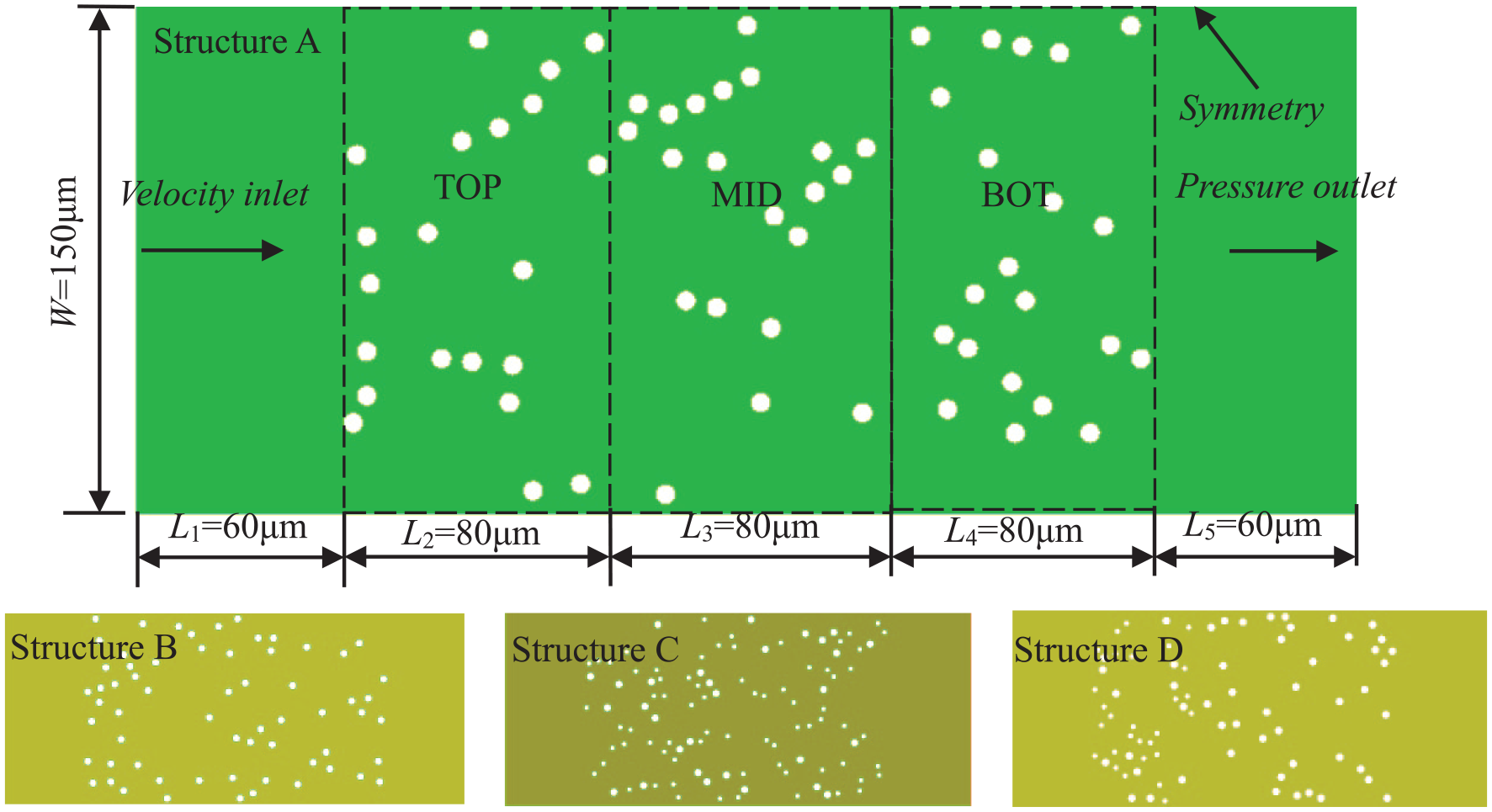
Simulation domain and boundary conditions.
For the DPM treated particles as points, interception effects were ignored. In this study, we developed a user-defined function to instruct Fluent to stop a particle if it came within a radius distance from the fiber surface. This was achieved by continuously monitoring the distance between the particle centers and fiber’s surface during trajectory tracking. If the particle’s center of mass point reached a the distance of dp/2 from the fiber, it was removed. This function is illustrated in Figure 4.

User-defined function for removing particle.
Model validation
Mesh independent test
The effect of mesh density on the pressure drop was considered to ensure the quality of simulation while saving computing resources. Mesh independence was tested for the random distribution structure with SVF = 5%, v = 0.1 m/s, and df = 4 μm (fine fibers) and 6 μm (coarse fibers). To achieve this, we increased the number of mesh points on the circumference from 20 to 80. The relationship between the number of mesh points and pressure drop of the fibrous media is presented in Figure 5. As can be seen, the pressure drop first increase with the increase in mesh points around the fiber but tended to stabilize when the number of mesh points reached 60. In addition, the pressure drop in the fine fibers was always higher than that in the coarse fibers. A 60-point mesh was used to ensure the accuracy of the simulation results.

The mesh independence test.
Pressure drop verification
For incompressible flow at a very low Reynold number (Re), the air-flow in the filter follows Darcy’s law, meaning that the pressure drop is proportional to the inlet velocity of the entrance. 11 The pressure drop of the fibrous media conforms to the Davies equation.7,23 Liu and Wang 24 found that the ratio of the pressure drop to inlet velocity was not constant at higher Re but increased with inlet velocity while the Re was 1. The Davies equation is expressed as follows:


where X denotes the dimensionless drag force, Δp is the pressure difference between the inlet and outlet boundary (Pa).
The relationship between the pressure drop and Davies equation is shown in Figure 6. For these cases where df = 6 and 4 μm, the error were approximately 8% and 14%, respectively. Therefore, the filtration characteristics of fibrous media were accurately reflected by the numerical simulations.

X with different Re.
Filtration efficiency verification
The filtration efficiency of the filter media can be obtained in terms of its thickness (Z), df, SVF, and total single-fiber efficiency (SEF, Es). The total SEF was the sum of the SEFs due to interception (ER), inertial impaction (EI), and Brownian diffusion (ED). The filtration efficiency of a fibrous media (Et) is given as7,23:






where R is the particle-to-fiber diameter ratio, Ku is the Kuwabara factor, and St is the Stokes number, Pe is the Peclet number.
The number of inlet particulates affects the filtration efficiency of fibrous media. To ensure that the result is independent, the filtration efficiency with different numbers of inlet particles is shown in Figure 7(a). The filtration efficiency increased with the increasing number of inlet particles until the number of inlet particles was greater than 8×10⁵. Thus, the number of inlet particles was set as 8 × 10⁵ in this study. In addition, the filtration efficiency of fine fibers was always greater that of the coarse fibers with the same SVF because the fine fibers have a larger surface area than coarse fibers, while the main capture mechanism is diffusion. Meanwhile, the filtration efficiency of the fine fibers sharply decreased as the number of inlet particles decreased because there were more fine fibers in the simulation domain with the same SVF. Figure 7(b) shows the filtration efficiency of the fibrous media with different fiber diameters. For the fiber diameter of 6 μm, the maximum error was 8% while the inlet velocity was 0.1 m/s, when the inlet velocity was 0.6 m/s, the minimum error was 5%, and the average error was 6%. For a fiber diameter of 4 μm, the maximum error was 10%, while the inlet velocity was 0.5 m/s. The minimum and average errors were 4% and 6%, respectively, when the inlet velocity was 0.2 m/s. Therefore, the simulation results were accurate and credible.

Filtration efficiency verification. (a) Filtration efficiency of different inlet particles, and (b) Filtration efficiency of different inlet velocities.
The quality factor (Q) was adopted to evaluate the filtration performance of different fibrous medias, the expression of the quality factor is as follows. 16 A higher quality factor indicated better filtration performance.

Results and discussion
Filtration performance of fibrous media with different structures
The filtration efficiency and quality factor of fibrous media with different arrangements are shown in Figure 8. Figure 8(a) and (b) show that when the particle diameter was set as 100 nm, the filtration efficiency and quality factor of the different fibrous medias decreased with increasing inlet velocity from 0.1 to 0.7 m/s. This phenomenon was in good agreement with Wang et al., 10 in which the trend of the filtration efficiency decreased with the inlet velocity increase. This was due to the diffusion effect decreasing with increasing inlet velocity. Structure C had the highest submicron particle filtration efficiency at different inlet velocities, whereas structure A had the lowest. This is because diffusion is the main trapping mechanism for submicron particles and the diffusion filtration efficiency depends on the surface area of the fibrous media. The fibrous media surface area increased with an increase in the proportion of coarse to fine fibers. The quality factor of structure D was the highest, with a particle diameter of 100 nm and inlet velocity of 0.1 m/s. The combined bimodal and dense-sparse structure fibrous media improved the filtration efficiency of the fiber layer by increasing the surface area of the fiber layer on its windward side and reducing the pressure drop by decreasing the total number of fine fibers, while the particle capture process mainly occur on the windward side. The results were also proposed by Fotovati et al. 14 and Kang et al. 15 As the inlet velocity increased, the filtration efficiency of the different fibrous media decreased, however, the pressure drop increased. Therefore, the quality factors tended to be similar.

Performance of filter media with different arrangements. (a) and (b) Filtration efficiency and quality factor of different inlet velocities, (c) and (d) Filtration efficiency and quality factor of different particle diameters.
Figure 8(c) and (d) show that when the inlet velocity was set at 0.1 m/s, the filtration efficiency and quality factor of the fibrous medias decreased as the particle diameter increased from 100 to 400 nm. This is because diffusion decreased with increasing particle diameter and the interception effect was not obvious. As shown in Figure 8(c), structure C exhibited the highest submicron particle filtration efficiency. As the particle diameter increased, the filtration efficiency of the different fibrous medias tended to be similar and the filtration efficiencies of structures C and D were consistently higher than those of structures A and B. This is because mixing fine fibers increased the filtration efficiency by increasing the surface area through the diffusion efficiency. As shown in Figure 8(d), when the particle diameter was 100 nm and the inlet velocity was 0.1 m/s, structure D had the greatest quality factor. This was because the excessive thin fibers increased the pressure drop of structure C, and the filtration efficiency of structure A was too low. The quality factor of different fibrous medias was similar to that of the increased particle diameter because the effects of either diffusion or interception are insignificant for larger diameter particles.
Effect of bimodal structure position on the filtration performance of gradient-structure fibrous media
The combined bimodal and dense-sparse structure fibrous media possessed the highest quality factor. Meanwhile, differently positioned bimodal structures can affect the performance of fibrous media. Figure 9 shows the filtration performance of fibrous media with different bimodal structure positions. Figure 9(a) and (b) show that when the particle diameter was 100 nm and the inlet velocity varied from 0.1 to 0.7 m/s, the filtration efficiency and quality factor of different fibrous medias decreased with the increase of inlet velocity. This is because the diffusion decreases with increasing inlet velocity when the particle diameter is 100 nm. The fibrous media filtration efficiency and quality factor were greatest when the bimodal structure was placed in the windward layer because the windward side was the operative domain of the fibrous media, and the fine fiber at the windward side fiber layer increased the filtration efficiency. Considering the actual operative domain of the windward side for fine particle capture,11,19 the bimodal structure was placed in the windward layer is the best. When the bimodal structure was placed in the middle and leeward layers, the filtration efficiency of fibrous media was always higher than that of the dense-sparse structure, because the filtration efficiency of fine fibers was always greater than that of coarse fibers at any particle number.

Influence of positions of the bimodal structure on the performance of filter media. (a) and (b) Filtration efficiency and quality factor of different inlet velocities, (c) and (d) Filtration efficiency and quality factor of different particle diameters.
Figure 9(c) and (d) show that when the inlet velocity was set at 0.1 m/s, the filtration efficiency and quality factor of the different fibrous medias decreased with increasing particle diameter from 100 to 400 nm because diffusion decreased with the increasing of inlet velocity with 100 nm diameter particles. The fibrous media filtration efficiency tended to be similar as the particle diameter increased because the diffusion and interception mechanisms became insignificant with increasing particle diameter. When the bimodal structure was placed in the middle and bottom layers, the fibrous media quality factor was lower than that of the dense-sparse structure fibrous media because the filtration efficiency simultaneously decreased with the inlet particle number but the pressure drop remained constant.
Effect of ratio of coarse to fine fibers on the filtration performance of dense-sparse structure filter media
The ratio of coarse to fine fibers affects the filtration performance of the fibrous media. The ratios of coarse to fine fibers in the fiber layer were 1:0, 2:1, 1:1, 1:2, and 0:1. Figure 10(a) and (b) show that when the particle diameter was set to 100 nm, the filtration efficiency and quality factor of the different fibrous medias decreased with increasing inlet velocity from 0.1 to 0.7 m/s. This was because the diffusion mechanism decreased with increasing inlet velocity at a particle diameter of 100 nm. A 0:1 ratio of coarse to fine fibers always had a greater filtration efficiency than that of the other ratios. This is because diffusion is the main capture mechanism of submicron particles, and the windward side layer consists of fine fibers with a capture efficiency larger than that of coarse fibers. When the ratio of coarse to fine fibers was 1:1, the fibrous media had the greatest quality factor. This is because the capture process mainly occurs on the windward side and when the SVF is constant, the quality factor of the fibrous media increases with the fiber diameter.

Influence of the ratio of coarse fibers to fine fibers on the performance of filter media. (a) and (b) Filtration efficiency and quality factor of different inlet velocities, (c) and (d) Filtration efficiency and quality factor of different particle diameters.
Figure 10(c) and (d) show that when the inlet velocity was set at 0.1 m/s, the filtration efficiency and quality factor of different fibrous medias decreased with increasing particle diameter from 100 to 400 nm. This is because diffusion decreased with larger particle diameters when the inlet velocity was 0.1 m/s. When the particle diameter was 100 nm, the quality factor of different fibrous medias showed a trend of first increasing and then decreasing with a decrease in the ratio of coarse to fine fibers. This was because the filtration efficiency of the fibrous media constructed of fine fibers sharply decreased as the number of inlet particles decreased.
Conclusions
A type of 2D random multifiber distribution model based on VC++ and ICEM was generated, and its reliability was verified by comparison with the empirical formula. Based on the process of multi-fiber trapping particles, fibrous media combined with bimodal and dense-sparse structure were created and the filtration efficiency and quality factor were optimized using different parameters. The following conclusions were drawn:
(1) A 2D random multi fiber distribution model was proposed based on VC++ and ICEM and the reliability of the technical route was verified by comparison using an empirical formula.
(2) The quality factor of the fibrous media with bimodal and dense-sparse structures increased significantly for small particles (dp = 100 nm) but the quality factor and filtration efficiency of the fibrous media with different arrangement tended to be similar with different inlet velocities and particle diameters.
(3) Placing the bimodal structure on the windward side and ensuring a ratio of coarse to thin fibers of 1:1 can significantly improve the quality factor of fibrous media.
(4) When the particle diameter was 100 nm, the quality factor of different fibrous media showed a trend of first increasing and then decreasing with a decrease in the ratio of coarse to fine fibers.
Footnotes
Declaration of conflicting interests
The author(s) declared no potential conflicts of interest with respect to the research, authorship, and/or publication of this article.
Funding
The author(s) disclosed receipt of the following financial support for the research, authorship, and/or publication of this article: This work was support by the Nation Key Research and Development Program of China [2018YFC0705305].
