




Abstract
Materials used in personal protective clothing (PPC) are important from both protection and thermal management perspectives, particularly as PPC frequently covers more than 90% of the wearer’s body. There is extensive literature on the risk factors that contribute to thermal load and the related functional characteristics of the PPC, especially in high-risk categories such as fire fighting and the military. In contrast, research on PPC materials in low-risk categories such as mining and construction and their thermal management attributes is scarce. Nevertheless, workers who wear this type of PPC represent a significant proportion of the industrial workforce, and are commonly required to work in hot and/or humid thermal environments. This study provides new knowledge of the thermal management attributes of materials used in low-level risk PPC by evaluating a selection of 19 workwear materials that are used in low-risk PPC worldwide. In addition, four civilian/corporate wear summer materials were tested to compare against the PPC materials. This study identifies relationships between the structure, physical parameters and functional attributes of materials, providing direction for development of new and improved PPC materials. The results show that there are opportunities to substantially reduce PPC material mass and thickness, whilst still maintaining protective compliance requirements. Further, thermal and moisture management attributes of PPC materials can also be significantly improved to reduce thermal burden.
Keywords
Introduction
The primary purpose of personal protective clothing (PPC) is to protect workers from physical, mechanical, chemical and other hazards, which involves mandatory compliance in many cases.1,2 Workplace hazards can range from low-level exposure to risk hazards, such as in some mining, oil and gas, and building and construction activities, to high-risk exposure such as in fire fighting, military and high-level electrical arc exposure. 1
Personal protective clothing performance is covered by many standards that specify material and clothing attributes required for industrial workplaces, such as fire fighting 3 smelter molten metal work, 4 electrical work, 1 heat and flame, 5 daylight and night-time visibility, 6 and protection from ultraviolet (UV) exposure 7 to name a few. These standards detail a wide range of material performance requirements for protection from specified hazards.
The compliance requirements of PPC can vary widely based on workplace hazards and therefore differ in their material and design requirements. For example, workers who wear low-level risk PPC can be involved in work tasks that routinely involve electrical work, exposed to electrical equipment or work in proximity to electrical installations which may involve exposure to hazardous energy. These are obvious populations for electrical injury, but virtually any environment that utilizes or exposes workers to dangerous electrical or arc flash and flash fire events, which can inflict burn injuries, is relevant. 8 Further, these workers are faced with other workplace hazards similar to workers in other industrial sectors, such as thermal stress from machinery, equipment and the thermal environment 9 and therefore are representative of a significant part of the outdoor workforce which is required to wear PPC.
It is common for companies in the mining, oil and gas and building industries to supply PPC to personnel who are exposed to health and safety hazards as part of their daily workplace activities. 10 In many of these workplaces, PPC is purchased “off the shelf” or from catalogue product ranges that comply with the protective requirements associated with the risk categories. This workwear does not provide optimal performance and function because it is not specifically designed for the physical activities that the workers undertake or with the working conditions in mind, such as hot and humid environments.
Environmental conditions can greatly affect outdoor workers, as these workers often carry out their daily tasks in hot and/or humid environments and with exposure to high UV radiation. Climate change is expected to affect workplace environments to an increasing extent, and has been identified as a key factor in high ambient temperature weather-related mortality in numerous parts of the world, 11 along with heat stress illnesses frequently linked to prolonged daily exposure to high outdoor temperatures. 12
The thermal environment includes the environmental air, radiant and surface temperatures; environmental vapour pressure; air speed; and garments worn by workers.13–15 Hot outdoor conditions can be broadly described as those in which the air temperature and skin temperature are comparable (31–33°C),15,16 eliminating the opportunity for convective heat losses. A humid environment can be categorized as levels of humidity at which skin humidity and environmental vapour pressure curtail heat dissipation via the evaporation of sweat. 15 Hot and humid conditions create high potential for heat stress, dehydration, heat exhaustion and heat stroke, all of which can develop or be exacerbated through strenuous work activities. 17 Heat stroke can be fatal; 18 dehydration can slow working speed and reduce productivity. 19
Although PPC aims to protect against external hazards, it is also known that PPC compliance to protection standards can impede ergonomic performance of the wearer through increased thermophysiological strains, cognitive impairment or high levels of discomfort, which can result in fatigue, reduced manual performance or injury.20,21 PPC restricts body heat exchange and its high bulk and weight increases the energy cost of work, raising the potential for harm from physical work in hot and humid conditions. 20
There is extensive literature on the risk factors that contribute to thermal load and heat stress illness and the related functional characteristics when wearing PPC.22–27 Major contributors to risk of heat illnesses are the ambient environment, the physical exertion requirements and duration of activities, and materials and clothing. This research addresses worker safety and wellbeing when using PPC through investigation of the thermal management characteristics of garments.23–30
Materials used in PPC are of paramount importance from both a protection and thermal management perspective, particularly as PPC commonly covers more than 90% of the body.31,32 These materials must be designed to manage competing issues of protective performance and thermal management attributes, such as thermal and vapour resistance and liquid moisture transfer. In addition, the material mechanical properties, such as handle and stiffness, stretch and recovery influence the utility and ergonomic performance of PPC. 33
Numerous studies have found that the thermal load added by PPC materials, alongside restriction of ergonomic function20,34 especially when wearers are working in hot and humid conditions––causes significant physiological stresses on workers and can lead to cognitive impairment or discomfort, fatigue, reduced manual performance and injury.10,20 Therefore understanding the relevant characteristics of materials is essential when assessing the suitability of PPC for hot conditions.
Extensive research has been conducted into high-risk PPC for work categories in which multiple clothing layers are used for protection, such as the firefighting, military, chemical, nuclear and biological sectors.22,28,35,36 Many studies have investigated the performance of high-risk category material structures and garment designs used in PPC.23,36–43 These studies have highlighted the ability of materials and various textile treatments to meet mandatory protection requirements, but found that deficiencies in other important functional attributes, such as vapour permeability, increase thermal load on the wearer.
However, research on low-level PPC is much less extensive, despite the much greater number of workers affected. Further study of materials commonly used in low-level PPC, such as in clothing worn in the electrical, utility, building and construction, oil and gas, and mining industries, is warranted.
This research aimed to investigate and characterize workwear materials that are compliant with low-level risk category standards, such as Hazard risk category 1 (HRC1) and Hazard risk category 2 (HRC2), which are commonly used in the mining, oil and gas and building industries. 1 This was intended to create a benchmark understanding of the physical parameters and thermal management characteristics of materials used in PPC for industrial workers exposed to hot environmental working conditions. A second aim was to determine the differences between the physical parameters and thermal management properties of PPC materials and materials commonly used in hot conditions by civilians. Achievement of these aims will assist in the design and engineering of improved materials for industrial workwear.
Materials and methods
The research began with an investigation of the materials being used globally in low-level risk category industrial workwear, conducted between November 2015 and September 2016. Material protection categories and materials used in industrial workwear designed for hot environmental conditions, particularly materials used in industries such as mining, oil and gas, building and construction, were identified. Then, PPC sample materials that were commercially available globally such as in USA, Middle East, Asia, South America and Oceania and compliant with their relevant protection categories were selected for study. Materials selected were still commercially available at the time of publication Two PPC risk categories – HRC 1 and HRC 2, based on compliance with standards NFPA70E and NFPA2112 1 – were selected to enable a broader view of materials used and identify any differences in performance between the categories. These PPC categories are used in many industrial situations, such as mining, construction, oil and gas facilities located in hot climatic regions such as the Middle East, South America, South Africa and Australia, 44 in which personnel are required to work in very hot and humid conditions.
To provide a broad cross-section and effective representation of existing commercially available materials, a range of low and high-mass materials were identified, along with a variety of fiber types and blends ranging from 100% natural fiber to majority synthetic fiber composition, as well as various material constructions. In addition, four materials from commercially available civilian summer season workwear clothing were selected so their attributes could be compared with those of the PPC materials. This was important to understand and position PPC material thermal management performance in the broader context of the burden imposed on industrial workers versus the broader community of workers.
The physical parameters and thermal management attributes of the selected experimental materials were then determined. The materials were tested using standard methods, and tests were selected based on relevance to thermal management properties in hot conditions, such as thermal and water vapour resistance, liquid moisture transport, and physical parameters such as material mass, thickness, density and air permeability.45–47 The results were analysed to identify statistically significant differences and associations between the parameters and attributes of the materials.
Experimental materials
Physical parameters of experimental materials.

^Elliotts Australia Brand. 54 * Best and Less Brand # Target Australia Brand.
Experimental methods
Physical parameters
The physical parameters characterising the experimental textile materials were measured in a controlled humidity and temperature (20°C, 65% RH) environment according to standard laboratory practice after conditioning all samples for 24 h. Three specimens of each material sample were tested.
Mass per unit area (mass) was established for all specimens (AS 2001.2.13). The thickness of the materials was measured according to AS2001.2.15. Material thread density was measured according to AS 2001.2.5. The number of picks and ends per unit length were counted along a line at right angles to the warp and weft.
Bulk density ρ was calculated as
The bulk density of a material provides insight into its porosity and therefore into its permeability. For example, the greater the bulk density, the lower the volume of air pores in the material and therefore its air permeability. 48
Air permeability is a measure of how well air is able to flow through a material under defined pressure and was measured using the SDL Atlas air permeability tester according to a standard method (AS 2001.2.34).
Thermal and moisture management attributes
Thermal and moisture management attributes – thermal resistance, water vapour resistance and liquid moisture transport – were determined using standard methods. The thermal and water vapour resistance of the materials was tested using an Integrated Sweating Guarded Hotplate (iSGHP). 49 The instrument measures the thermal resistance (Rct) and water vapour resistance (Ret) properties of textile materials. It provides simple, fully automated testing in compliance with the ISO 11092 standard. 50 The iSGHP was operated by automatic control software ThermDAC8, which also calculates thermal and vapour resistance based on a user-defined logging interval. 49
The thermal and water vapour resistance of experimental fabrics were evaluated according to ISO 11092.
50
For the determination of thermal resistance, the air temperature was set to 20°C, relative humidity controlled at 65% and air speed at 1 m/s. After the system reaches steady state, thermal resistance of the fabric is governed by:
For the determination of vapour resistance, the air temperature was set to 35°C, relative humidity controlled at 40% and air speed at 1 m/s. These conditions related to the hot humid environment where the PPC are used. After the system reaches steady state, vapour resistance of the fabric is governed by:
The material’s performance in terms of liquid transmission was assessed using a Moisture Management Test (MMT) instrument (AATCC 195). The device is based on the concept that when moisture travels through a material the electrical resistance of the material changes. The device measures this change using a series of sensor rings on its bottom and top plates.51–53
There are six indices for liquid moisture management, but three were considered and reported in the present research: wetted radius, spreading speed, and wetting time, for both skin and outside, surfaces of the fabric. Wetted radius measures how broadly the moisture spreads across and through the material; a higher wetted radius means a larger moistened surface and therefore more opportunity for liquid to evaporate from the material to the environment. The spreading speed, which is the accumulated rate of surface wetting from the centre of the material, provides an understanding of how quickly the moisture will spread across and through the material. This is important to understand in hot and high-sweating environments, as the faster the spread of moisture the more efficiently it moves across and through the material, providing greater opportunity for evaporation. Thirdly, wetting time is important because it indicates how rapidly the material begins to be wetted after sweating commences. The faster the material takes up the moisture the more opportunity there is for the sweat to move from the skin surface through the material and evaporate. Therefore, in hot and high-sweating environments, the speed at which the material commences wetting and the moisture spreads and the wider it spreads across and through the material will determine the efficiency of evaporation.
Data analyses
Differences between parameter means for pairs of materials were assessed for significance (p < 0.05) using one-way ANOVA with Bonferroni post hoc comparisons. The Spearman rank order correlation coefficient was used to determine the strength and direction of correlations between two variables measured on an ordinal scale. To determine the significance of relationships between physical parameters and attributes, multiple linear regression correlation analysis was conducted. Mean values are presented in bar charts and standard deviations are shown to enable visual determination of the differences between the mean values of paired materials.
Results
Physical parameters
Material physical parameters play an important role in determination of thermal management attributes. Table 1 summarizes the physical parameters for all materials.
Material mass influences clothing weight and therefore is an important parameter for PPC, where the clothing covers more than 90% of the body in many cases. The results for mass (Figure 1) were assessed and divided into three groups, which mostly show mass increasing as materials fulfil successively higher protection requirements. All are significantly different to each other (p < 0.05). These increases in mass probably reflect the higher mandatory protection requirements for each HRC category, whereas civilian materials have no such compliance needs. Mass per unit area for all materials by category in three groups: HRC1, Civilian and HRC2.
The higher risk category materials have significantly higher mass than the civilian materials (Figure 1). However, the materials in both PPC categories vary widely in mean mass; for example, material 2 (144 g/m2) and material 9 (213 gsm2) are the lightest and material 3 (223 g/m2) and material 12 (274 g/m2) are the heaviest in PPC HRC1 and HRC2 categories respectively.
Comparisons of parameter means for pairs of materials show each material has significantly different mean mass per unit area (p < 0.05), except for MHRC1-CVL, MHRC1-P and material 5.
A material’s thickness is known to influence its thermal insulation and therefore heat transfer attributes. Statistically significant (p < 0.05) differences exist between the mean thicknesses of most materials (Figure 2). The civilian materials civil M-S, civil F-S and civil F-P are the thinnest overall, with each being significantly thinner (p < 0.05) than materials in both HRC categories, which are up to three times thicker. A comparison of HRC1 and HRC2 material thickness shows considerable variability, but HRC2 materials MHRC2-S, MHRC2-P and 10 are higher than for HRC1. Thickness for all materials by category in three groups: HRC1, Civilian and HRC2.
Civilian materials civil F-S and civil F-P have significantly higher (p < 0.05) mean bulk density than most other materials (Figure 3). For PPC materials, HRC2 materials 11 and 12 have the highest densities, and both are statistically different to those of all other PPC materials (p < 0.05). Density for all materials by category in three groups: HRC1, Civilian and HRC2.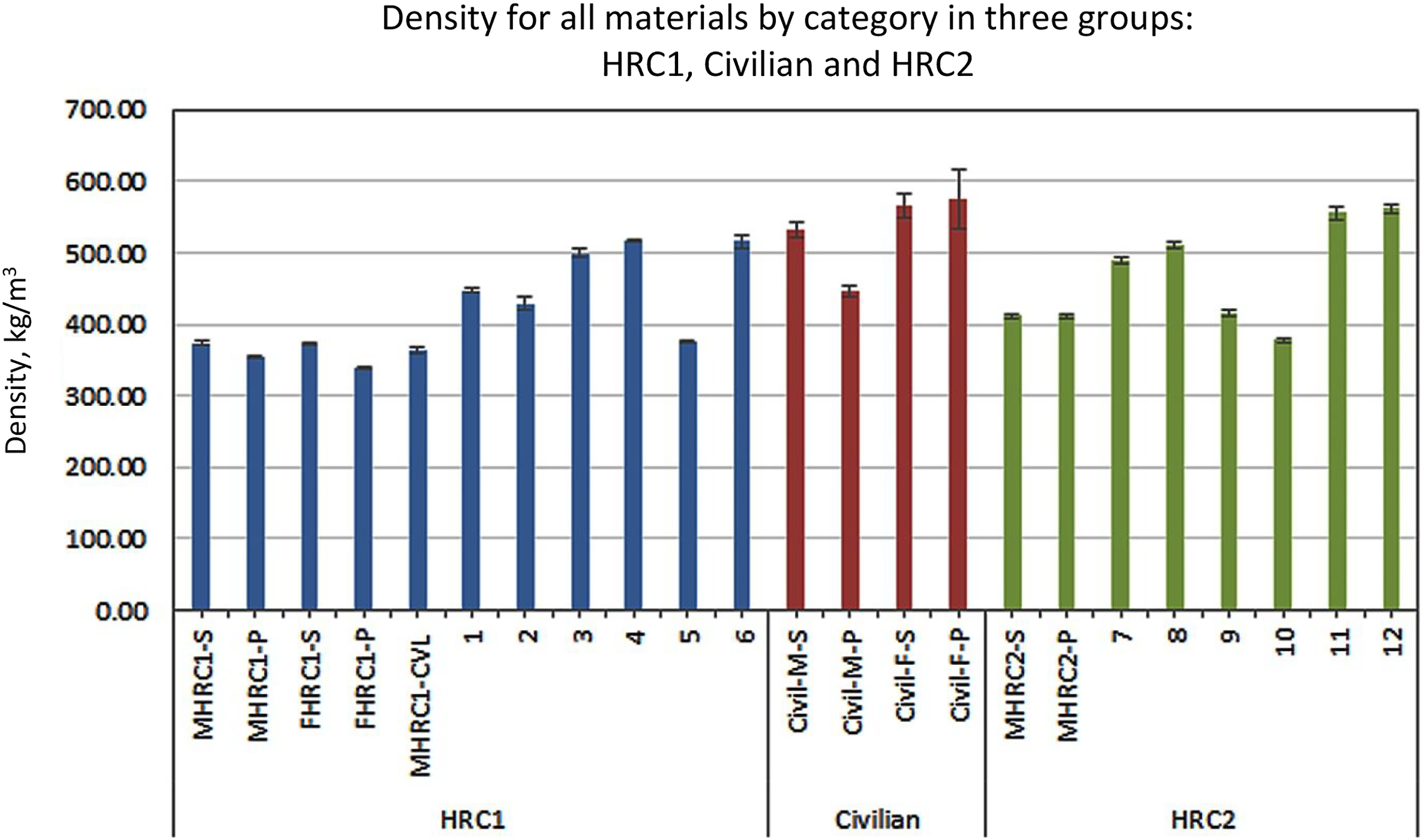
Greater air permeability of a material promotes convective cooling of the body, allowing wind and air movement to remove heat when a negative temperature gradient exists. Materials FHRC1-S, FHRC1-P, civil M-S and 9 have significantly higher mean air permeability (p < 0.05) than all other materials (Figure 4). Air permeability for all materials by category in three groups: HRC1, Civilian and HRC2.
These results demonstrate that some PPC materials achieve air permeability levels similar to civilian materials, allowing for similar air movement through materials whilst meeting protection requirements. However, UV protection levels need to be considered as part of this attribute, as higher air permeability (A/P) may also result in lower UV protection levels.
Thermal and moisture management
The dry heat, water vapour transfer and liquid moisture transfer attributes of materials are important factors in thermal management and therefore PPC wearer comfort. The lower the resistance to dry heat and water vapour transfer, the more easily heat and vapour can pass from the inside of the PPC material to the ambient environment. When hot conditions combine with high metabolic work activities, sweating creates a need for efficient transfer of liquid moisture.
Figure 5 shows that the mean Rct values for civilian materials are the lowest of all materials and have reliably different values (p < 0.05) to all other HRC materials except material 2 (HRC1) and Civil-M-P. The mean values of HRC materials (Figure 5) vary but are statistically indistinguishable in most cases (p > 0.05), except for material 9, which has the highest Rct and is statistically different (p < 0.05) to most other HRC materials. Rct and Ret for all materials by category in three groups: HRC1, Civilian and HRC2.
The mean Rct of the materials is correlated with their mean material thickness: Spearman’s rank order correlation indicates a positive and statistically significant association (rs = 0.505; p = 0.01). Further, there is a statistically significant correlation between Rct and mass for all materials (rs = 0.652; p = 0.01). Finally, a negative (but statistically insignificant) association was found between Rct and material density (rs = −0.222; p = 0.067), consistent with the concept that increased density will reduce the air content within the material structure, thereby reducing its Rct. There was no statistically significant association between the means of Rct and air permeability.
Comparisons of vapour resistance (Ret) means show that civil-M-S has reliably different values (p < 0.05) to all HRC materials with the exception of material 6 (Figure 5). However, it is evident that other civilian materials have similar or higher Ret than some HRC materials, but are statistically indistinguishable (p > 0.05). Material 6 has the lowest mean Ret of all HRC materials, and statistically different to most HRC1 and all HRC2 materials (p < 0.05). Material 8 has significantly higher Ret than all HRC materials (p < 0.05). However, overall Ret is similar for the HRC1 and HRC2 categories.
A positive, statistically significant association was found between the Ret of each material and its thickness (Spearman’s rs = 0.536; p = 0.01). Further, a statistically significant correlation exists between Ret and the mass of each material (rs = 0.671; p = 0.01). Finally, a negative but insignificant association was found between Ret and density (rs = −0.209; p = 0.084). Similarly to Rct, these correlations indicate that a reduction in mass and thickness provides lower vapour resistance, which is important for hot conditions. There was no association between Ret and the air permeability of materials.
Liquid moisture management values for all materials.

MWR: mean wetted radius; SS: spreading speed; WT: wetting time; subscript t: top; b: botto.
Comparison of the moisture management attributes of PPC materials shows that HRC1 materials 2 and 4 exhibit higher mean values of WR and SS, along with lower WT, than all other materials. For example, materials 2 and 4 have the highest SS and lowest WT results of HRC1 materials, with statistically significant differences (p < 0.05) in most cases. For HRC2, materials 8 and MHRC2-S are the best performing, with higher MWR and SS and lower WT, significantly different from other materials in several cases (p < 0.05). The best-performing HRC1 materials exhibit higher MWR and SS and lower WT than the best HRC2 materials, probably due to lower mass and thickness.
A positive and statistically significant correlation was found between MWRt and SSt (Spearman’s rs = 0.852; p = 0.00) and MWRb and SSb (rs = 0.855; p < 0.001). Further, statistically significant correlations exist between MWRt and WTt (rs = −0.510; p < 0.001), MWRb and WTb (rs = −0.663; p < 0.001), SSt and WTt (rs = −0.818; p < 0.001), and SSb and WTb (rs = −0.910; p < 0.001). These correlations provide evidence that improving SS can positively influence the material’s performance in other key indices such as MWR and WT.
There is a negative association between material density and both MWRt and MWRb (rs = −0.356; p = 0.003 and rs = −0.333; p = 0.05 respectively), indicating the reducing material thickness will improve MWR attributes.
Regression analysis
A multiple linear regression of permeability versus bulk density and thickness showed that only bulk density (p = 0.003) was significantly and independently associated with permeability for the HRC1 and civilian materials. However, bulk density and thickness are significantly associated in bivariable analysis, suggesting substantial collinearity, and therefore only one should be included in the model. Using only density as an independent variable gives:
PERM = -0.543*DENSITY + 364.713
This model has an R2 of 0.8567 (it explains 85.67% of the variation in the data).
For the HRC2 and civilian materials, regression analysis showed that both bulk density and thickness are significantly and independently associated with air permeability for the materials (p = 0.005 and 0.009 respectively).
PERM = -0.977*DENSITY – 363.128*THICKNESS + 719.283
The model has an R2 of 0.609 (it explains 60.9% of variation in the data). The standardised coefficients show that density is approximately 1.4 times as influential as thickness in this dataset.
Discussion
Direct comparison of parameters of civilian material and HRC1/HRC2 material clearly demonstrate that the civilian materials are significantly lighter and thinner, contributing to lower thermal burdens than would be associated with wearing PPC, particularly in hot environments. For example, mass and thickness of civilian materials are up to 50% and 70% lower respectively than in HRC1 materials. Further, civilian materials exhibit significantly lower thermal resistance than the HRC materials in all cases, and lower vapour resistance in most instances, providing more effective thermal management attributes. However, results for liquid moisture management showed that HRC materials were more effective in transferring liquid moisture with higher wetted radius, spreading speed and lower wetting times. This could be associated with the use of moisture management finishes to enhance liquid moisture transfer being common in PPC materials, but uncommon in civilian clothing due to cost and lower emphasis on functional attributes.
Mass per unit area of the PPC materials
Reduced mass per unit area can improve thermal resistance attributes for PPC materials. 55 The present study suggests that HRC1 category material mass could be reduced by more than 35% while offering the same protection, which could substantially reduce overall garment ensemble mass, while a 20% decrease in material mass is possible in HRC2 category PPC. This demonstrates that whilst in general greater protection requirements result in different parameters such as higher mass, opportunities exist to engineer HRC1/HRC2 compliant materials with lower mass.
It is known that the higher mass and bulk of PPC can increase the energy cost of work by up to 20%, 56 so lower mass per unit area of the component materials would have substantial ergonomic benefits for the wearer. This would also support the key aim of engineering PPC materials that have physical parameters and thermal comfort attributes similar to civilian materials, enabling reduction or probable elimination of any possible negative attributes associated with wearing compliant low-risk PPC.
In addition, the results demonstrate that significant reductions may be possible in material thickness and density, which are directly related to mass per unit area, with test results indicating reductions of 30–40% and 25–35% may be possible in HRC1 and HRC2 protection categories. Material thickness and density are important in thermal management,27,57 and require consideration when investigating engineering of new materials with improved thermal attributes. Results presented here show a statistically significant relationship between both thickness and density and MWRt and MWRb for all materials, consistent with earlier research; 58 although the earlier study shows this relationship across all MMT indices, not just MWR, and therefore provides opportunities to engineer material attributes to improve MMT performance. Reducing material thickness can also assist with improved design, as thicker woven materials invariably have poorer drape characteristics, such as higher stiffness, which can reduce ergonomic performance and force higher energy expenditure56,59 as well as posing design challenges for functional fit of PPC systems.
Considering that the mass per unit area of a material is a function of its density and thickness, the correlations between these parameters are reasonable. They provide insights into possible modifications of physical parameters that can improve the thermal resistance attributes of PPC materials. For example, reduction in mass and thickness may provide lower thermal resistance, which is important for hot conditions. This is the case in the current study, where civilian materials had the lowest mass and thickness of all materials and lowers Rct in most cases. Further, lower mass/unit area of the comprising materials would lead to the reduction in garment weight which would have positive ergonomic benefits for the wearer by imposing lower burden.
Air permeability of the PPC materials
Outdoor workers usually have the benefit of air movement, which enables heat loss via convection when there is a gradient between the next-to-skin microclimate and outer environment. Convective heat loss can occur when air passes through openings in the clothing ensemble and penetrates the outer clothing layer. 57 Whilst opportunities for air movement through openings in PPC ensembles are generally limited due to protective compliance requirements (e.g. shirts should be fastened at the wrists, and closed at the neck, 1 the air permeability of materials can be changed by modifying their construction. The results of this study show that air permeability is influenced inversely by thickness and density (i.e. as thickness and density are reduced, air permeability increases for HRC2) and therefore increasing permeability enhances the thermal management attributes of PPC.
Thermal and vapour resistance of the PPC materials
The results indicate that the thermal and vapour resistance of PPC materials can be improved by 40% or more, whilst still meeting protection requirements, which could make a substantial contribution to improved wearer comfort by increasing heat loss opportunities through the materials. For example, material 2 has Rct between 12% and 53% lower than other PPC materials. In addition, material 2’s Ret is up to a third lower than other PPC materials, and has lower thickness and density and higher air permeability than most other HRC materials, which supports the results of previous studies. 60
It has been found that thermal resistance attributes are positively related to protective performance requirements; that is, as protection requirements increase, attributes relevant to thermal comfort reduce. 61 The results of the present study confirm these findings, as the HRC2 category materials demonstrate poorer results than HRC1 materials overall in most instances for Rct and Ret, as well as air permeability, due to the protection compliance requirements for this higher risk category. Their greater thickness, density and mass and the lower permeability of most HRC2 materials than HRC1 materials highlight the challenges associated with design of PPC materials for higher levels of protection. Of course, these challenges are compounded in hot workplace environments where wearer thermal management is a priority.
Liquid moisture transfer properties of the PPC materials
The liquid moisture transfer properties of materials become critical in hot conditions where sweat is formed quickly and high sweating rates result from work activities. 31 In these circumstances, it is proposed that MMT becomes more important than Ret. The use of hydrophilic treatments to enhance the moisture management attributes of PPC materials could be extended substantially, as it is known that these treatments enable greater transport of liquid irrespective of the fiber content of the PPC. 62 MMT performance varied substantially between PPC materials, suggesting room to enhance liquid moisture transport capability and improve consistency of MMT performance through hydrophilic treatment and fiber selection (blending hygroscopic fibers) and application. Therefore, development and application of more stable and effective moisture management treatments should be considered in material design and development.
Civilian materials showed the worst MMT results in all indices; specific MMT functional attributes are not necessarily prioritized in civilian clothing. Moisture transfer attributes are known to affect the thermal and sensorial comfort properties of clothing 63 and therefore require focus, along with thermal management attributes, when engineering PPC for hot environments.
Conclusions
This study characterized PPC materials and provided evidence of substantial room for improvement of attributes relevant to the thermal comfort of PPC through the development of new materials. These improvements will enable PPC materials to perform similarly to civilian materials in areas such as Rct. The large disparities in the Rct, Ret, and MMT parameters of the experimental materials indicate that there are significant opportunities to engineer new materials with improved thermal management attributes, whilst still meeting the mandatory protection requirements of their related protection categories.
The results show that key factors such as material thickness, density, air permeability and mass would have to be addressed to improve thermal management attributes of PPC materials. Further, as these attributes have a direct influence on enhancing thermal and moisture management performance they need to be taken into account when engineering new PPC materials; this is especially relevant to Ret and liquid moisture management, which play a critical role in hot workplace conditions where dry heat transfer from the skin to the ambient environment opportunity is minimized or eliminated. Moreover, in outdoor environments where the presence of wind is common, material air permeability is also important, especially with the restrictions of garment openings and vents required when wearing PPC.
These findings provide evidence of the complexity of the engineering of PPC due to substantial variance in material performance with respect to multiple properties. Consequently, all of these relevant performance parameters need to be considered to achieve the objectives of compliant new PPC design with optimal ergonomic and improved thermal management attributes for use in hot outdoor environments.
Footnotes
Declaration of conflicting interests
The author(s) declared no potential conflicts of interest with respect to the research, authorship, and/or publication of this article.
Funding
The author(s) received no financial support for the research, authorship, and/or publication of this article.
