




Abstract
Reusable high-filtration mask could be a solution for the global demand of disposable N95 and the environmental problems caused during a pandemic. We evaluated the effect of ethanol cleaning on the fit performance and comfort rating of Totobobo Masks, a reusable high-filtration mask. Healthy volunteers underwent quantitative fit testing with the Totobobo mask using a PortaCount Plus respirator fit tester. Fit factor ≥100 was considered adequate fit. Masks were then cleaned in 70% ethanol and air drying. Volunteers underwent a second and third fit test after each 15 cycles of ethanol cleaning. The proportion of adequate fit for Totobobo masks and overall fit factor were compared before and after each clean. Forty nine participants were recruited, of which 22/49 (44.9%) achieved adequate fit with Totobobo mask on the first fit test. Subsequently, 17/22 (77%) and 9/17 (53%) participants achieved adequate fit during the second and third fit tests, respectively. Proportion of adequate fit was similar before and after the first 15 cycles of ethanol cleaning (p = .063) but lower after the second 15 cycles of ethanol cleaning (p = .008). Fit factor was similar between the first and second fit tests (p = 0.808) and the second and third fit tests (p = .125). Twenty out of 22 rated the Totobobo mask more comfortable than commercially available N95 masks. All participants rated the comfort level as either better or similar before and after cleaning. There is no significant drop in fit performance and comfort of Totobobo mask with up to 15 cycles of cleaning with 70% ethanol.
Introduction
A fit-tested NIOSH-approved N95 or higher level respirator is recommended for protection against airborne pathogens.1–4 They are used during care of suspected or confirmed cases of respiratory infections during aerosol generating procedures.5–9
During the coronavirus disease 2019 (COVID-19) pandemic, limited stockpile of disposable respirators was a major concern. 10 Stocking up disposable N95 respirators can be difficult due to the large storage space required. In addition, universal masking and use of non-disposable masks in healthcare setting have significant environmental drawbacks. 11 Recent estimate of the global mismanagement of PPE found that a monthly average of 129 billion face masks and 65 billion gloves contributed to environmental plastic pollution. 12 Thus, provision of facemask during a pandemic poses particular challenges. Desirable features of facemask include reusability to reduce sourcing, distribution and storage. Furthermore, a transparent facemask may be particularly important in healthcare. A recent randomized controlled trial found that patients rated surgeons who wore clear instead of covered masks were better in providing understandable explanations, demonstrating empathy and eliciting trust. 13 To facilitate reuse of masks, decontamination of N95 masks have been advocated but there is limited evidence on the optimal cleaning method that preserves filtration performance.14,15
Totobobo mask was developed as a reusable high filtration mask and takes up less storage space than disposable N95 respirators. 16 Previous studies have already shown that Totobobo mask can be personalized and molded to achieve a high filtration factor. 16 Furthermore the mask’s transparent design also enable visualization of facial expressions, in contrast to many other conventional N95 masks. 17 Totobobo masks were rated to be more comfortable on the face and nose in comparison to standard N95 models in a previous study. 18 Cleaning of Totobobo masks is relatively simple since the mask may be cleaned with replacement of the small high-efficiency particulate absorbing (HEPA) filters.
SARS-CoV-2 virus is not viable after 1 min of exposure to 70% ethanol. 19 Thus, cleaning previously fit tested Totobobo mask with 70% ethanol may be a potentially cost-effective and environmental-friendly alternative to disposable N95 respirators. However, it is unclear if cleaning with ethanol would affect the fit performance and comfort level of the Totobobo mask. 16 Therefore, we conducted a pilot study to investigate the effect of repeated cleaning with ethanol on the fit performance and comfort level of Totobobo masks. We hypothesized that repeated cycles of ethanol cleaning would not change the overall fit performance or comfort level of the Totobobo mask.
Methods
Study design
This was a prospective, observational and feasibility study on the filtration performance and comfort of Totobobo mask after repeated cleansing with 70% ethanol. This study was conducted within the Department of Anaesthesia and Intensive Care at Prince of Wales Hospital. A convenient sample of healthcare workers who have previously been fit tested with N95 masks were recruited between the period of July 2021 to Jan 2022. Standard clinical health and safety training at our hospital included a mask fit test using the PortaCount Plus respirator fit tester with N95 masks from 3M (1860, 1860S, 1870+). A fit factor of ≥100 was considered an adequate fit. Inclusion criteria were any healthy medical staff volunteers aged ≥18 years old, with no exclusion criteria. Approval was obtained from The Chinese University of Hong Kong-New Territories East Cluster Clinical Research Ethics Committee (2020.243).
Mask fit testing
The same mask fit testing procedure used for clinical health and safety training at our hospital was used for fit testing the Totobobo mask in this study. After consent, Totobobo masks were molded with a standard procedure, with a cylindrical pen after immersing the side of the mask in hot water. 18 Participants would then put on and adjust the masks. A visual check for mask fit was done by identifying a continuous watermark seal along the edge of the mask. Subsequently, a standard quantitative fit test was performed for each participant using the PortaCount Plus respirator fit tester as described previously. 16 Briefly, the tester compares particle counts inside and outside the protective device during a series of activities. The sampling probe (TSI Incorporated, St Paul, MN, USA) for sampling the mask particle count was inserted through the plastic part of the Totobobo mask. Air samples for measuring ambient particle count were taken from just outside the mask at about 3 cm from the sampling probe. To ensure an adequate ambient particle count throughout the testing, the 8026 Particle Generator (TSI Incorporated) was used to generate saline particles with a median diameter of 0.04 microns and geometric standard deviation (GSD) of 2.2 in a chamber.16,18,20 A fit factor of ≥100 was considered an adequate fit. Volunteers who had a fit factor of <100 in the first fit test were excluded from subsequent parts of the study. For volunteers who had adequate fit during the first fit test, their masks were cleaned with 15 cycles of ethanol immersion and a second fit test was performed. A further 15 cycles of mask cleaning was performed for participants who had adequate fit on the second fit test. A total number of 30 cleaning cycles was chosen to represent 1 month of daily cleaning.
Fit performance
Overall fit factor of different components (normal breathing, deep breathing, head side to side, head up and down, talk out loud, bend over, repeat normal breathing) measured during fit testing was used as a measure of fit performance.
Mask cleaning
After each fit test, Totobobo masks were cleaned by immersion in 70% alcohol for 5 minutes at room temperature (Figure 1). The HEPA filters on the mask were removed and discarded while the mask was submerged in ethanol. The masks were then taken out and left to dry at room temperature. Afterwards they were resubmerged in ethanol for 5 minutes and dried for another 14 cycles to simulate repeated cleaning. New HEPA filters were added on to the used masks after 15 cycles of cleaning and ready for further fit testing. Cleaning procedures for used Totobobo mask.
Comfort assessment
Participants were asked to rate the Totobobo masks as less comfortable, equally comfortable or more comfortable than the usual N95 in terms of breathing comfort, ear comfort, nose comfort, face comfort and general comfort. Participants were asked to rate the mask’s comfort after the second fit test, on comfort of the Totobobo mask before and after cleaning: less comfortable, equally comfortable, or more comfortable after the first ethanol cleaning.
Statistics
Normality of continuous data was tested using Shapiro–Wilk test and expressed as median and interquartile range or mean and standard deviation as appropriate. Proportions and percentages were used to describe categorical variables. The difference in overall fit factor between the first, second and third fit tests were analyzed using the related-samples Wilcoxon Signed Rank test. The proportions of participants passing the first, second and third fit tests were compared using exact binomial test. All statistical analyses were performed with IBM SPSS Statistics (Version 20.0.0). Sample size calculation showed that a minimum sample size of 16 was required to achieve a power of 80% to detect a 20% drop in proportion of adequate fit after cleaning with an α value of 0.05 (2-tailed). This effect size was based on a reported 16% drop in filtration efficiency of masks after ethanol spray cleaning. 21
Results
Cohort characteristics
A total of 49 volunteers underwent initial quantitative fit testing, and 22 volunteers achieved ≥100 fit factor and were included in the study cohort (Figure 2). The median age of the study participants was 30 years old (IQR, 28–35). Eight out of 22 were female and the median BMI was 21.5 (IQR, 19.7–22.8) (Table 1). The majority (21/22) of volunteers was of Asian ethnicity. Flowchart of serial fit tests after ethanol cleaning. Demographics of participants. BMI, body mass index; IQR, interquartile range.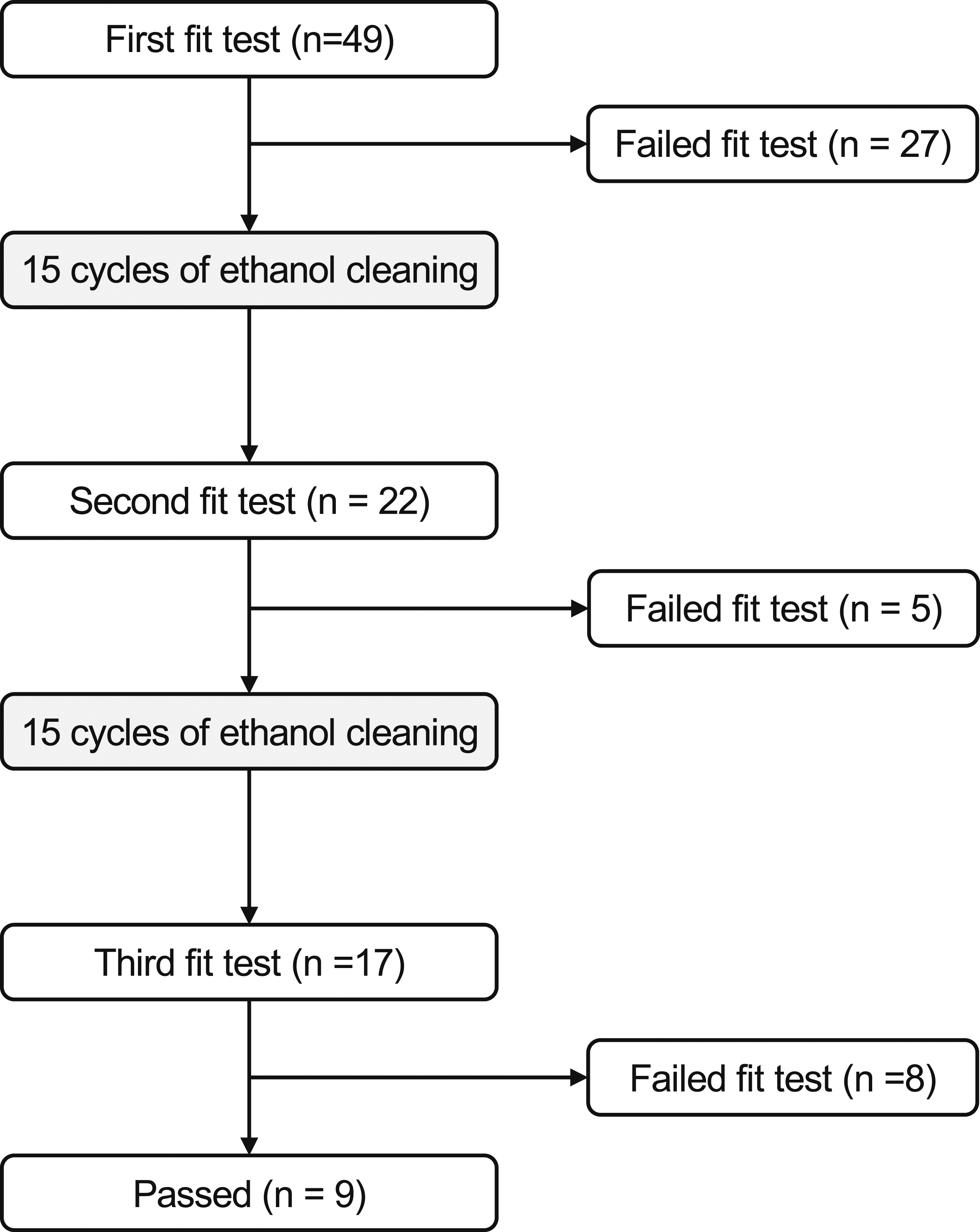

Fit performance
Fit Factors from first, second and third fit tests.

Comfort rating
Sixteen out of 22 (73%) participants rated Totobobo mask more comfortable in terms of breathing, 18/22 (82%) rated it being more comfortable on ear, 16/22 (73%) rated it more comfortable on the nose, 17/22 (77%) rated it more comfortable on the face and 20/22 (91%) rated it more comfortable in general in comparison to the conventional N95 masks (Figure 3(a)). All the participants rated the Totobobo mask’s breathing, nose, face and general comfort level after cleaning as either better or same as before cleaning. One participant rated the Totobobo mask as less comfortable on the ear after cleaning (Figure 3(b)). Comfort level of Totobobo masks. (a) This bar chart shows the results from the mask comfort questionnaires comparing Totobobo masks to the participants’ usual N95 models (b) This bar chart shows the results of the mask comfort questionnaire comparing the Totobobo mask before and after cleaning.
Discussion
Our results suggest the comfort and fit performance of a fit tested, reusable filter mask is preserved after repeated cleaning with ethanol. Both the proportion of those who passed the fit test and fit factor were unaffected by up to 15 cycles of ethanol cleaning.
Different methods of mask decontamination using heating techniques or chemical cleansing have been investigated. 22 Whilst masks cleaned by heat using steam from microwave or oven retain high filtration efficiency, the whole process often takes more than 60 min and often only one mask can be cleaned at a time. Meanwhile, chemical cleansing with bleach can cause unpleasant odor and alcohols or soap can severely degrade the filtration efficiency.23,24 In contrast, mask decontamination with vaporized alcohols or hydrogen peroxide retains filtration efficiency but requires special equipment.25–27
Previous reports found that immersion by alcohol cleansing on different masks significantly degrades filtration efficiency.15,28 Furthermore, most decontamination studies have thus far only evaluated filtration degradation after 1 cycle of cleaning. 29 Instead, we have shown that both comfort and filtration efficiency of Totobobo masks were unaffected by up to 15 cycles of ethanol cleaning. Similar to previous studies, we found that Totobobo masks were rated to be more comfortable on the face and nose in comparison to standard N95 models, even after repeated cleansing. This is particularly important during respiratory virus pandemics as pressure sores may develop after prolonged N95 use. 30 In contrast, Totobobo mask’s ergonomics may offer adequate comfort with relatively good filtration factor.
The strengths of this study include use of an objective, standardized fit testing to assess filtration performance, repeated cycles of cleaning, and assessment of comfort by end users. However, our study had a few limitations. First, as a feasibility study our sample size was small. However, our study was powered to detect at least a difference of 20% in proportion of satisfactory fit after ethanol cleaning. Second, we did not test the efficacy of ethanol immersion on elimination of infection risk of SARS-CoV-2 directly. However, the SARS-CoV-2 virus is inactivated after exposure to 70% ethanol within 1 minute. 19 Third, we did not compare the cleaning process with different solvents such as bleach or hydrogen peroxide. We chose to evaluate ethanol because it was the most easily accessible, without the need of dilution prior to use and was safe in case of accidental spillage. Fourth, most of the volunteers in this study were of Asian ethnicity, and the results may be different in other populations. Fifth, we were unable to assess for important gender differences in fit testing as sample size was limited. 4 Sixth, change in physical properties of the mask material after repeated ethanol cleaning was not assessed. Nevertheless, change in mask filtration performance and comfort are important endpoints to the healthcare end-user. Further research on alternative cleaning methods and their effects on physical and chemical properties of Totobobo masks may be considered.
Conclusions
This study showed that there was no significant drop in proportion of adequate fit, overall fit factor, and comfort level of a fit-tested reusable high filtration mask with up to 15 cycles of 70% ethanol immersion cleaning. However, proportion of adequate fit was lowered after 30 cycles of ethanol immersion.
Supplemental Material
Supplemental Material - The effect of ethanol immersion on fit performance and comfort of a fit tested reusable mask
Supplemental Material for The effect of ethanol immersion on fit performance and comfort of a fit tested reusable mask by Katy HK Li, David CM Yeung and Lowell Ling in Journal of Industrial Textiles
Footnotes
Acknowledgements
We would like to thank Professor Charles D Gomersall for his advice and guidance on this study. We also thank the Department of Anaesthesia and Intensive Care and Prince of Wales Hospital for supporting the study.
Declaration of conflicting interests
The author(s) declared the following potential conflicts of interest with respect to the research, authorship, and/or publication of this article: Totobobo masks were supplied by the manufacturer, but they did not have a role in the design, conduct, analysis nor reporting of the study.
Funding
The author(s) received no financial support for the research, authorship, and/or publication of this article.

Supplemental material
Supplemental material for this article is available online.
References
Supplementary Material
Please find the following supplemental material available below.
For Open Access articles published under a Creative Commons License, all supplemental material carries the same license as the article it is associated with.
For non-Open Access articles published, all supplemental material carries a non-exclusive license, and permission requests for re-use of supplemental material or any part of supplemental material shall be sent directly to the copyright owner as specified in the copyright notice associated with the article.
