



Abstract
Annually, thousands of firefighters suffer injuries, with burn injuries making up 7%–8% of these cases. Despite wearing protective clothing, burn injuries still occur, which underscores its limitations. The effectiveness of protective clothing is heavily influenced by the unpredictable and variable conditions firefighters face during hazardous incidents. This study compared the effects of heat flux, air gaps, and fabric attributes on TPP in multilayer systems. Results revealed a negative correlation between heat flux and TPP, with higher flux intensities increasing energy transfer through conduction and radiation, diminishing protection. Flame exposure highlighted differences in heat transfer mechanisms, with conduction and radiation dominating at high flux, whereas at low heat flux, convection, even though minimal, significantly impacts TPP. Air gaps improved TPP up to 6-mm, providing maximum insulation. However, performance plateaued or declined at 12-mm due to the transition of a stagnant air gap into a convective medium. Under prolonged, low-flux exposure, the protective benefits of 6-mm gaps diminished, revealing possible interactions between air gap size and exposure conditions. This challenges the established thresholds for air gap effectiveness for different exposure conditions. Fabric attributes further influenced TPP, with air permeability showing a positive correlation in multilayer systems due to entrapped air-enhancing insulation, which contrasts traditional findings for single-layer fabrics. Additionally, fabric weight demonstrated dual effects, improving TPP in short, high-flux exposures but reducing it under low-flux, prolonged conditions due to stored heat and thermal diffusivity. These findings underscore the interplay between the study parameters, offering critical insights into the evaluation and design of thermal protective clothing.
Keywords
Introduction
Firefighting is an inherently dangerous profession, exposing firefighters to significant risks during fireground operations. According to the National Fire Protection Association (NFPA), in the U.S., an average of 60–70 firefighters lose their lives annually while on duty.1–3 Each year, around 100 firefighters suffer fatal injuries, and tens of thousands experience nonfatal ones.1–5 Among these, burn injuries are particularly common, making up 7%–8% of all reported injuries. Fireground operations require wearing thermal protective clothing, yet the statistics above highlight its limitations, as burn injuries persist despite its usage.3,5,6
The performance of thermal protective clothing can be compromised by various environmental, physical, and physiological factors present in hazardous environments. Firefighters may face wildfires, structural fires, and/or explosion incidents. They may be exposed to flames with temperatures ranging from 100°C to 1000°C (212°F to 1832°F) based on the fuel availability, proximity to hazard sources, and other influencing parameters in the fireground.4,7–9 Among these hazards, flames are a particularly critical concern due to their complexity. Flames involve simultaneous conduction, convection, and radiation, presenting unique challenges compared to other heat sources. Their temperatures vary widely, and their unpredictable nature makes them a primary cause of burn injuries.9,10 Despite existing protective measures, flame-specific impacts on Thermal Protective Performance (TPP) remain insufficiently explored, making flame exposure an essential focus for advancing firefighter safety. This substantial temperature difference underscores the importance of thoroughly investigating how the factors collectively influence TPP to better understand and effectively mitigate burn risks in hazardous conditions.
Scholars have endeavored to elucidate corresponding burn threats associated with different factors, highlighting their corresponding impacts on the performance of thermal protective clothing. Researchers have identified that total heat flux and flame application significantly influence clothing systems’ TPP.9–13 Higher heat intensities reduce TPP due to increased energy absorption by the fabric, while the ablation effect from convection reduces such energy absorption.14–18 Minimal yet prolonged exposure has also been shown to result in severe burn injuries.19–21 On another aspect, clothing system-associated attributes such as air gap and fabric structure were found to impact protection performance.18,22,23 Variations in air gap sizes are influenced by human body geometry, posture, and movement. Researchers using 3D scanning have examined air gap distribution for firefighters wearing thermal protective clothing, indicating that air gaps typically range from 0 to 80- mm across various body parts, with the average being within the 0–25 mm range.24–27 Studies have shown that air gap distribution directly affects heat flow, with larger gaps reducing heat conduction and improving insulation due to the higher specific heat of trapped air.27–31 However, gaps exceeding 7–8 mm can induce heat convection, complicating this relationship.27,29,30 Fabric attributes, including thickness, weight, and air permeability, are consistently identified as key parameters influencing TPP. Thicker and heavier fabrics generally enhance insulation by trapping more air, while increased air permeability negatively impacts TPP.15,16,18,28,32–35
While valuable, these findings are often too generalized, lacking a systematic exploration of the combined effects of air gaps and fabric properties under different flame intensities, reducing their relevance to the dynamic and unpredictable conditions firefighters face.9,36 Hence, there is a research gap to address how air gaps and fabric attributes interact with hazardous flame exposure. The interaction between fabric characteristics, varying flame intensities, and air gap sizes remains insufficiently studied. Addressing this critical gap is key to advancing our understanding of TPP and improving firefighter safety.
Building on these insights, a holistic approach is necessary to evaluate the combined influence of flame exposure, air gap size, and fabric properties on TPP. The current study aims to address this gap by systematically investigating the intricate relationships between these variables under different flame-simulated hazardous scenarios. This study explores how fabric thickness, weight, and air permeability interact with varying air gap distributions and flame intensities to affect burn protection. Through the estimation of second-degree burn time, this study provides actionable insights into the performance of specific fabric assemblies under different flame-generated hazardous conditions. This approach will not only enhance the comprehensive understanding of factors affecting TPP but also contribute to optimizing protective clothing design for improved safety and comfort- effectively tailored to the dynamic challenges of fireground operations.
Methodology
Fabric materials
To realize the above-mentioned study agenda, the investigation focused on fabrics used in thermal protective clothing, specifically high-performance fabrics in various layers. This material selection followed a 2n approach, where n = 3 represents the three fabric layers: outer shell, moisture barrier, and thermal liner. Each layer considered two variants, resulting in 23 = 8 combinations of multilayer fabric systems.
The selected specimens were chosen based on their commercial relevance and sourced from a North America-based supplier specializing in thermal protective textiles, ensuring real-world applicability. These materials complied with NFPA 1971 standards, validating their suitability for use in thermal protective clothing. This selection approach reflects common materials used in commercial thermal protective clothing, aligning with established conventions in similar studies.18,35,37–39 An approach like this ensures consistency in data analysis procedures, enabling meaningful comparisons with data from previous studies as well as future replicability.33,40

Selected fabrics and their properties.

Note. Weight was measured according to ASTM D3776, thickness was measured according to ASTM D1777, and air permeability was measured according to ASTM D737.
Arrangement of fabric systems.

Note. Fabric codes had been assigned based on Table 1. The fabric arrangement consists of the outer shell on the face side, the thermal liner on the back side, and the moisture barrier positioned in between.
Here,
Test apparatus
A Thermal Protective Performance (TPP) tester, as illustrated in Figure 1, was employed to evaluate the protective performance of the fabrics under varied experimental conditions, followed by the sample specifications in ASTM F2700 (sample size 150 ± 5-mm). Figure 2 represents its schematic diagram—the TPP tester integrated flame heat sources comprising two Meker burners. The intensity of the Meker burners was regulated through propane gas supply. The assembly included a shutter for controlling exposure duration, a specimen holder assembly, a copper calorimeter assembly, and spacers emulating the specific air gaps. TPP tester. Schematic diagram of TPP tester.

The copper calorimeter assembly functioned as a sensor for measuring temperature rise, featuring a blackened face to emulate human skin emissivity. A heat flux transducer and a quartz window radiometer facilitated calibration for the desired flame flux intensity. The radiometer also determined the radiant component of the flame across varying flame intensities, considering distinct attributes of convection and radiation heat flow from the flame. Unlike radiation, convection heat flow could experience a loss in total heat flow to the sensor due to parallel heated gas flow over the fabric surface. Three distinct flame intensities (17.5, 35, and 70 kW/m2) were selected for the research purpose, mirroring diverse flame intensities in fireground operations. The exposure levels were selected to consider the threshold flashover flux of 20 kW/m2 as well as a “flame over surface” heat flux of >60 kW/m2, where above 60 kW/m2 indicates heat flux inside post-flashover burning room.9,12 Considering these benchmarks, this study exclusively simulated the three levels of flame exposure, represented by low, medium, and high-level flame exposures.
To calibrate the desired heat flux levels, the fuel load to the propane burners was adjusted, with total heat flux measured using a copper calorimeter. The burners were ignited, and the propane flow was modified to achieve the desired heat flux levels. Multiple iterative trials were conducted to fine-tune the burners to reach the target heat fluxes. For each fuel flow setting, five tests were conducted to record the mean heat flux. If the recorded mean was within ± 2 kW/m2 of the desired level, that fuel flow setting was selected. After calibrating the desired total heat flux from the flame via the copper calorimeter, the radiometer was used to determine the radiant contribution from the flame. Unlike standard ASTM F 2700, the test protocols in this study considered flame exposure only, closely simulating manikin tests for thermal protection performance. Given the significance of flame as the primary hazard source in fireground operations, assessing the flame’s contribution to affecting protection performance is essential before introducing mixed exposures.
The entire assembly was linked to software that facilitated control over the test procedures. This software also incorporated a data acquisition module to investigate the impact of the research parameters. This study addressed the protective performance of the fabric samples via the 2nd-degree burn time. The fabric systems were exposed to heat until reaching the 2nd-degree burn time, as per the Stoll Curve model criterion.42–45 The software recorded the time-temperature profile for the fabric system when exposed. At the point this profile intersected the Stoll curve, the predicted 2nd-degree burn time for the corresponding exposure conditions was identified. The Stoll curve model is calculated using equation (2).
45
Data acquisition continued for 180 s, documenting the accumulated heat by the copper calorimeter throughout the entire test duration.
Here,
Test protocols
Each test specimen underwent a 24-h preconditioning period at a temperature of 21 ± 2°C (70 ± 5°F) while maintaining a relative humidity of 65 ± 5%. Samples were tested within 30 minutes of removal from the fabric conditioning chamber, and polyethylene bags were utilized for storing conditioned samples requiring extended processing times. The desired flame heat fluxes were achieved using the regulated fuel flow settings determined during the calibration. The copper calorimeter was then used to confirm whether the target heat fluxes were met before proceeding with the tests.
In the TPP tester model mentioned earlier, spacers were employed to emulate the air gap, with selected air gap values of 0-, 6-, and 12- mm. Spacers of corresponding heights were used to achieve the prescribed air gap values. Positioned between the test specimen and the copper calorimeter assembly, these spacers simulated the air gap between firefighters’ bodies and protective clothing. The chosen air gap values aimed to differentiate critical sizes for stagnant air and the natural convection limit under various heat intensities, identifying significantly burn-prone air gap conditions to average burn threats related to air gap distribution, as highlighted in previous works.27,29,30 However, in previous works, this understanding was based on a certain exposure condition rather than diverse simulated exposures. Comparatively, this approach enhances the understanding of how the post-exposed air gap distribution may impact manikin thermal protection performance evaluations under the selected level of flame heat intensities.
Test protocols.

Note. For every test sample, 3 tests were done to yield mean.
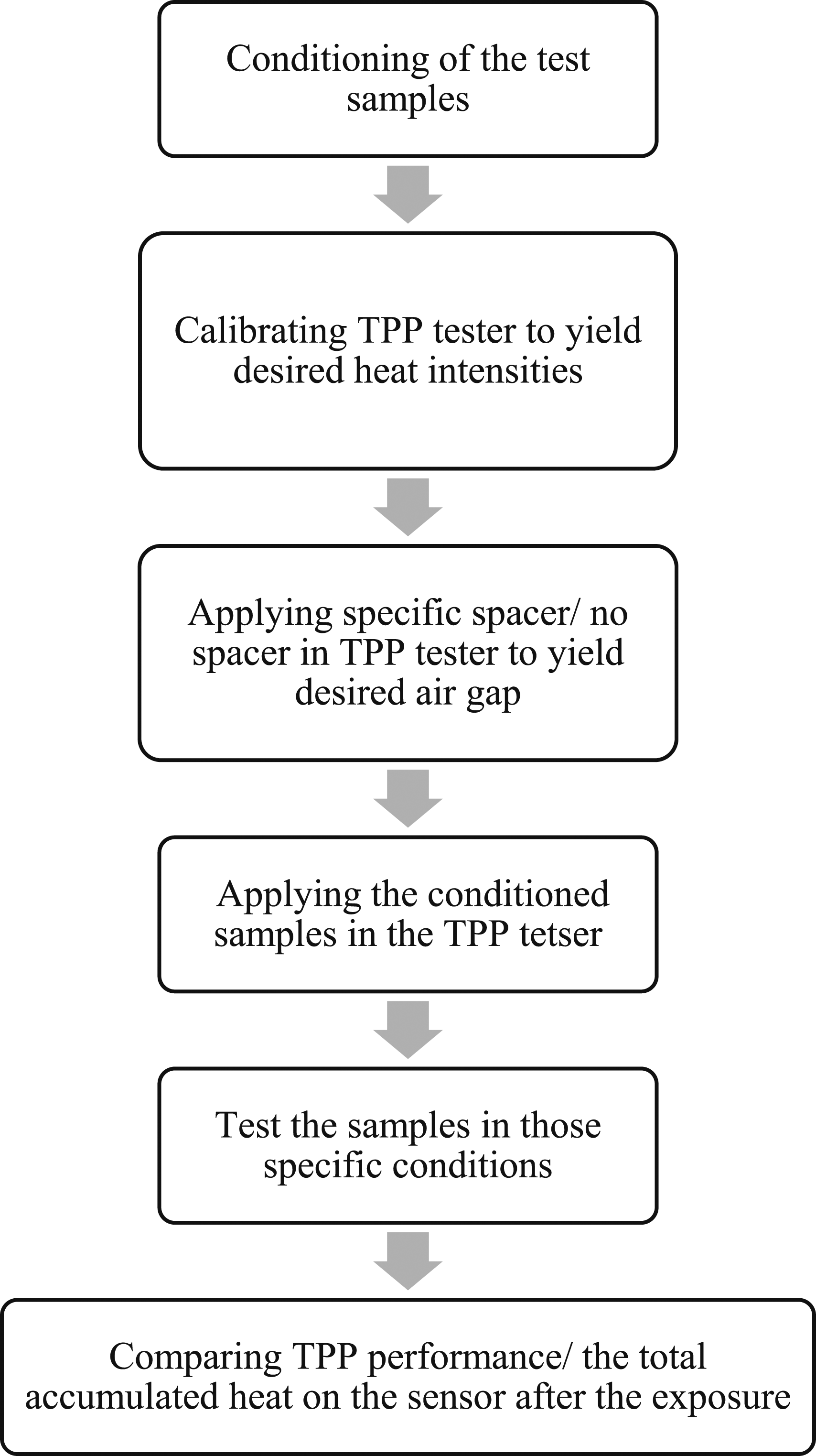
Flowchart for the research protocol.
Data analysis
The statistical analyses were conducted using Excel and RStudio software. Descriptive and subsequent inferential analyses were undertaken to discern trends in the data. ANOVA and Post Hoc analysis were employed to assess the potential significance of mean TPP variations across different exposure conditions, with a p-value threshold set at < 0.05 to establish statistical significance. Multiple Linear Regression analyses were conducted for statistical modeling with fabric properties, heat intensities, and air gaps considered independent variables, while predicted 2nd-degree burn time served as the dependent variable for diverse exposure conditions. Residual diagnostics were utilized to evaluate the adequacy of the chosen models and to detect underlying relationships within the parameters. The potential associations between independent variables and TPP were represented, with a coefficient of determination (R2) approaching 1, interpreted as a strong association in the context of these regression models. Corresponding p values of independent variables were scrutinized to identify significant parameters (p < 0.05) influencing TPP.
Results and discussion
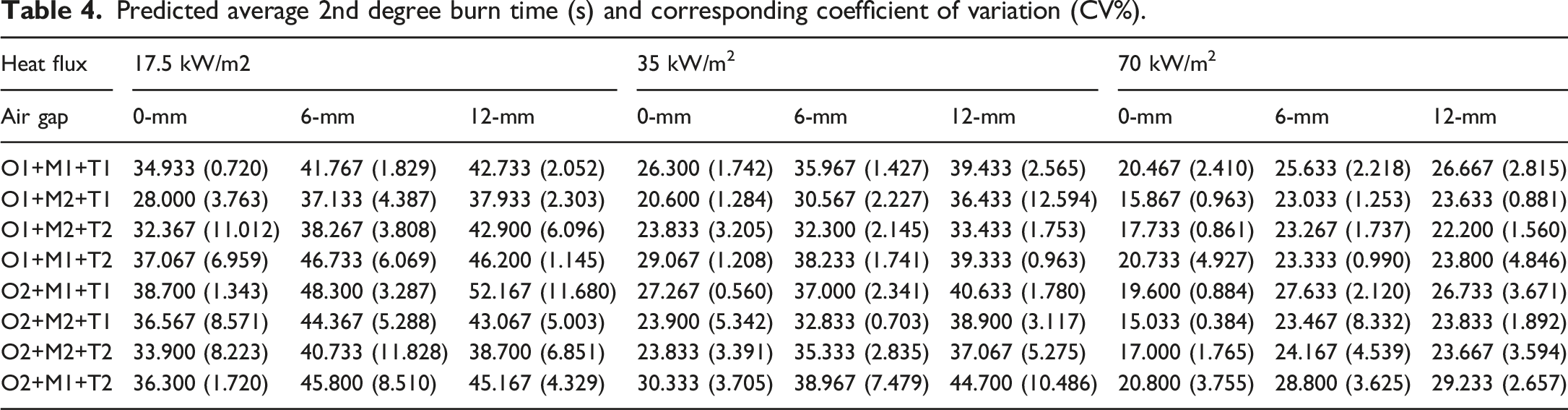
Predicted average 2nd degree burn time (s) and corresponding coefficient of variation (CV%).

Time-temperature profile for O1+M1+T1 for different exposure conditions.
The findings are systematically discussed across four main sections. These sections have individually delved into the effects of independent variables such as heat flux, air gap, and fabric characteristics on the dependent variable, 2nd-degree burn time. The results are presented in detail, highlighting the distinct attributes of the study variables. In the statistical modeling section, a comprehensive model of thermal protective performance for various fabric systems is developed, considering the interplay between the study parameters.
Effects of heat flux
Figure 5 summarizes the predicted 2nd-degree burn time for eight different fabric systems under three heat fluxes (17.5, 35, and 70 kW/m2), measured without any simulated air gap. The highest TPPs were reported for the lowest flame exposure intensities for a correspondent fabric system. Such a scenario was expected as the flame exposure intensities are addressed via heat flux, referring to the heat flow density through a certain area of a substance. Here, the mode of heat transmission was conductive, convective, and radiative. Generally, conduction occurs when the flame touches the fabric surface. Convection occurs when the flame surrounding air is heated up and transferred the heat to the fabric surface. The flame surface also contributes to the radiant mode of heat transmission. Under the given test settings, the convective portion of heat transfer is substantially reduced due to the limited availability of air as a medium for heat transfer between the flame and the fabric.
46
This can even be further minimized under conditions of direct flame contact with the test specimen, where air entrainment is further minimal. Effects of heat flux.
In the present study setting, heat transfer from the flame to the fabric system was predominantly conduction. However, the radiant heat portion of the flame rose significantly with the flame heat intensities. Figure 6 presents a scatterplot showing the radiant heat increasing with the flame heat intensity. It was determined by using the quartz window radiometer readings against different flame intensities. This highlights the comparatively lower portion of heat flux associated with the radiant mode of heat transfer. However, the radiant portion of heat transfer may significantly impact the protection performance of the fabrics. This is because such a mode of heat transfer does not suffer from heat loss due to the parallel heat flow over the fabric surface. Radiant heat component of flame exposure.
When exposed to a flame, the fabric system heats up due to the heat accumulation from the flame and starts transferring the heat to the inner layers. The heat transfer from the outer layer to the inner layers was mainly dominated by conduction. The presence of in-between-layer air gaps could make convection and radiation heat transfer modes significant here.
The mode of heat transfer from the heated inner layer to the copper sensor could be conduction, convection, and/or radiation. In this regard, the mode of heat transfer depends on the in-between air gap size.27,47 For the in-contact fabric system, conduction was the predominant mode of heat transmission, given the direct contact of the heated fabric surface and subsequent higher-induced collisions of adjacent molecules of fabric with the sensor. In the case of air gap presence, convection/radiant heat transfer can be prevalent, details of which have been discussed in the following section. The transferred heat raised the sensor temperature. This simulated the rise of skin temperature, which is used to identify the Stoll criterion for the correspondent fabric arrangements, i.e., the predicted 2nd-degree burn time.
Across all simulated air gaps, we observed consistent negative associations between heat flux and predicted second-degree burn time. Figure 7 depicts a bubble plot illustrating this relationship, with bubble sizes indicating the radiant heat portion of the simulated flame exposure. It is evident that higher heat fluxes result in substantial radiant exposure. The analysis of variance (ANOVA) revealed statistically significant effects of varying heat flux levels on the predicted second-degree burn time (p < 0.05) across all air gap conditions. The findings indicate that increasing heat flux levels significantly reduces the predicted burn time. Furthermore, the post hoc Tukey analysis confirmed that the thermal protective performance (TPP) under two different heat flux levels exhibited significant differences for every air gap simulation, underscoring the critical influence of heat flux on the protective efficacy of the fabric systems. Effects of heat flux in different flame exposure conditions. *Bubble sizes increase with the radiant exposure from flame.
Lee and Barker (1987) indicated differences in protection performance measurement in low versus high heat fluxes. In the case of the heat transfer from low-heat-flux flame exposure, however minimal, convection can significantly affect the performance. Even though slight radiation happened in low flux flame exposure, it was negligible. In such scenarios, the flame was not in contact with the fabric surface, and a negligible amount of heat radiation was incident upon the fabric. Due to the higher convection/radiation ratio compared to other high flux exposures, the turbulence of heated air can contribute to the fabric’s heat accumulation. However, due to the heated air circulation itself and subsequent ablative effect, a substantial amount of heat loss may occur. The change in flame length also affects the turbulence of heated air. Hence, the TPP in low-heat-flux flame exposure is high and corresponds to high CV%. Such scenarios could convolute the TPP measurement while different fabric arrangements are in the test protocols.
In the case of high heat fluxes, aside from minimal convection, a significant amount of heat was transmitted via conduction and radiation. Hence, the heat loss associated with air circulation and ablation over the fabric surface was minimized greatly. Additionally, there is a high portion of radiant heat contribution which also simulates the flashover scenario more closely. 7 This results in lower values of TPP with less variance in the data (if not accommodating any air gap in the test conditions). Unlike previous studies where the research focus was predominantly only radiant or mixed exposure of 50/50: convection/radiation to evaluate the thermal protection performance, the above findings highlight that not only the associated heat flux value but also the modes of heat transfer play a significant role in causing burn, and in case of flame exposure such mode of heat transfer can differ significantly.14–18 Hence, In the case of flame exposure, the potential of these variations in heat transfer medium to the fabric can affect the protection performance evaluation. Given the implications of such considerations, high flame heat flux is significant in clearly understanding/comparing how different fabrics perform in terms of protection under various simultaneous heat transfer conditions.
Effects of air gap
Figure 8 summarizes the predicted 2nd-degree burn time for different air gap simulations at 70 kW/m2 flame exposure. It can be seen that at 0- mm, the protective performance was lowest compared to 6- and 12-mm. This indicated that thermal insulation was raised with the increase of air gaps. Effects of air gap.
From the ANOVA results, it was found that introducing an air gap significantly affects the resultant second-degree burn time at the 0.05 significance level. In 0-mm air gaps, the heat could be transferred to the sensor from the heated fabric via conduction and radiation. With the presence of an air gap, air layers were inserted between the fabric and sensor, which removed the fabric-to-sensor heat conduction. Consequently, fabric-to-sensor heat transfer dominates via radiation along with additional air convection/conduction (Lu et al., 2013; Song, 2007). Additionally, total heat transfer via radiation depends on the radiation view factor, which substantially decreases with the increase in the air gap. As a result, in the test protocols, the radiation mode of heat transfer was reduced with the increase in the air gap. Additionally, the air had low thermal conductivity, which could minimize the heat flow even further.
However, the protection performance of the fabric was not substantially increased with the increase of air gap from 6–12 mm air gap. Here, the air gap introduced the heat convection medium, but air stagnancy prevailed within the 0–6 mm air gap. When the 12-mm air gap had been selected in the test protocols, the stagnant air layer actively participated in convection, resulting in more heat transfer. Such results conform to the previous studies by Song (2007) and Lu et al. (2013).27,30 Those studies reported a 7–9 mm air gap as the stagnant air gap threshold for convection to be initiated. The stagnant air gap threshold also seemed to conform to the cases of multilayer fabrics exposed to flame exposure in this test protocol. Below such a threshold, radiation, and air conduction might occur, whereas above the threshold, radiation and air convection might predominate the heat transfer.
For the consideration of other heat fluxes, Figure 9 depicts the scatter plot of air gap impacts on protection performance under different flame exposures. The different markers indicate the corresponding heat flux. As per the depiction in the given test protocols, across all the heat fluxes, the predicted 2nd-degree burn time increased with the 6-mm air gap incorporation (statistically significant in mid and high heat fluxes); however, when the air gap is increased to 12-mm, the linear association gets convoluted. This is evident for heat flux 70 kW/m2 and 17.5 kW/m2; the circular and rectangle markers are almost at the same plane in 6- and 12-mm air gaps. This may be because the higher heat flux or longer duration of exposure allows for easier convection from the fabric to the sensor compared to lower heat flux or lower exposure duration due to the greater energy transfer over a given time. Given higher exposure time, fabric-stored heat can simulate similar scenarios due to a higher energy gradient. Effects of air gaps under different heat fluxes.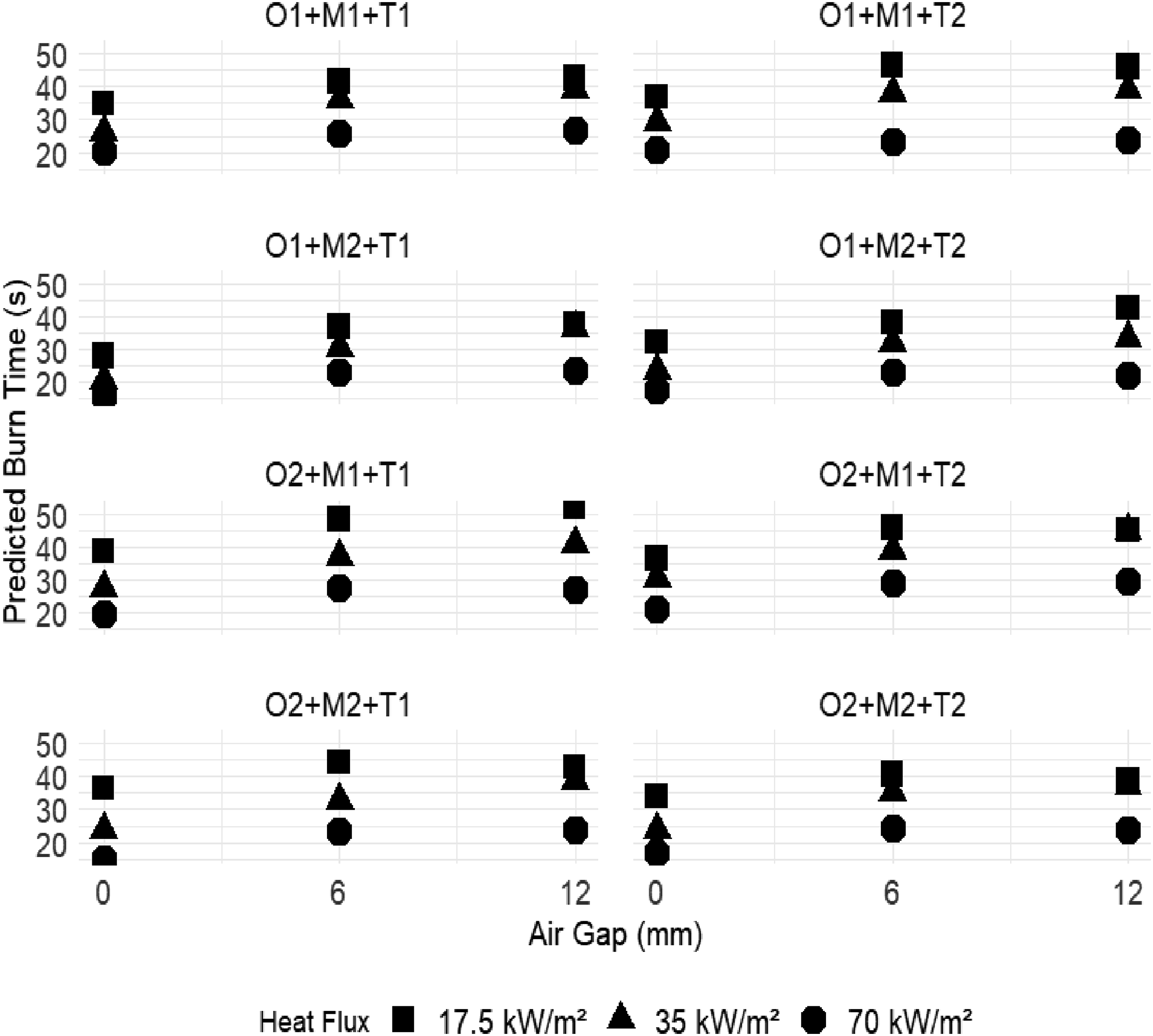
To summarize, above 6-mm air gap air stagnancy was compromised. Hence, the effects of air gaps got convoluted. As the data for 6–12 mm air gaps suggested air participating in convection heat transfer, the protection performance increase was difficult to address for all the fabric arrangements. More considerations of air gaps between 6–12 mm may clarify the boundary conditions of air stagnancy in this regard. This may also be varied for different fabric arrangements and materials. Additional considerations of >20-mm air gaps will direct more accurate modeling of air gap effects for different fabric arrangements.
As discussed above, 0- and 6-mm air gaps showed almost linear increasing trends in protection performance. Without any exception, 6-mm air gaps for all the fabrics reported the maximum predicted 2nd-degree burn time in the given protocol; however, not significantly in the case of 17.5 kW/m2 as per the Tukey Post Hoc Analysis; rather, it was only 0- versus 12- mm air gap. In other heat fluxes, 0- versus 6-mm and 0- versus 12- mm air gaps became significantly different without the 6- mm versus 12- mm air gap simulations. In contrast to previous studies, the current findings reveal that the boundary condition for stagnant air convection is highly dependent on the specific exposure conditions.27–31 Additionally, the results indicate that under low heat exposure of prolonged duration, an air gap of 6- mm may not provide the expected level of protection in the corresponding body parts, challenging the previously assumed protective benefits of air gap insertion in such scenarios. However, for bench-level, in a similar test setting, 0- mm and 6- mm air gaps will cover the range of protection performance for any certain fabric system associated with stagnant air gaps. This consideration is beneficial to provide broader comparative aspects of fabric performance against flame exposure with a view to analyzing fabric systems in between comparisons. Considering the air stagnancy for 0–6 mm air gaps, such an approach would highlight fabric attributes’ effect on stagnant air gap conditions.
Effects of fabric properties
Figure 10 depicts the boxplot for different fabric arrangements under 70 kW/m2 under 0- mm air gap simulations. The predicted 2nd-degree burn time differs across different fabric arrangements. In the cases of multilayer arrangements, M1-incorporated arrangements have higher protection performance compared to M2-incorporated ones. Additionally, the O1 and T2 incorporated assemblies had high protection performance compared to the O2 and T1 incorporated assemblies. The nonwoven layers in the thermal liner and the Polytetrafluoroethylene (PTFE) membrane in the moisture barrier absorb more heat from the exposure before being transferred to the skin. ANOVA Tukey Post Hoc analysis revealed statistically significant (p < 0.05) differences between the moisture barriers (M1 vs M2) across most exposure conditions (prominent in high heat flux and low air gap simulations), indicating that the type of moisture barrier significantly affects the fabric arrangements’ performance. Significant differences were also observed between the outer layers (O1 vs O2) and thermal liners (T1 vs T2) in some conditions (high heat fluxes and lower air gap simulations), though not consistently across all scenarios. Notably, under longer exposure conditions- characterized by lower heat flux and higher air gaps- the effects of the thermal liner and outer layer showed fewer statistically significant differences. Effect of fabric characteristics.
Correlation between 2nd-degree burn time and fabric parameters.

However, incorporating the air gap minimizes the linear positive association in every exposure condition. The impact of the air gap on the protection performance could make the impact of entrapped air associated with fabric system thickness less significant. This may be due to the higher amount of air volume in the air gap compared to within the fabric system. The air gap is also significantly higher than the thickness associated with the vertical heat transfer path.
The effect of the weight of the fabric system is convoluting in the given test protocols. In low heat exposure conditions, the small associations are negative in nature. In the low heat flux exposure, the exposure duration to the predicted 2nd-degree burn time is higher compared to other exposure conditions. In another aspect, the exposure durations before the predicted 2nd-degree burn time are higher. In that regard, fabric systems store significant heat. Weight contributes to the material density, i.e., for woven fabric, higher ends/picks per unit area, and higher density for nonwoven fabrics. With the increase in the material in the unit area, the amount of stored heat might be higher, creating a larger temperature gradient between the fabric and the sensor.
When the exposure duration before the predicted 2nd-degree burn time is lower, a positive association between the material weight and predicted 2nd-degree burn time was observed. In this regard, higher weight-related high heat capacity contributes to the positive associations. In Figure 10, the positive association of thickness and weight could be the reason for higher TPP in the case of M1- and T2- incorporated corresponding systems during 70 kW/m2 and 0–mm air gap exposure conditions. M1 and T2 had a greater thickness and weight than M2 and T1, respectively. However, from Table 5, incorporating the air gap again increases the exposure duration before the predicted 2nd-degree burn time. Hence, in the higher air gaps, the effect of stored heat might result in negative associations. In summary, the impact of the weight of multilayer clothing in different exposure conditions can be positive and negative, given stored heat and its associated thermal diffusivity. It is essential to look further into the impact of fabric weight-associated stored heat over protection performance in different exposure conditions.
Positive associations were observed throughout all the exposure conditions in terms of air permeability. This is opposite to the protection performance of the single-layer fabric. In the given test setting, the range of air permeability of multilayer protective clothing is 0.0334 to 0.0697 cm3/cm2/s calculated by the Clayton (1935) equation for air permeability of multilayer fabric from single layer air permeability. The lower value is mainly due to the incorporation of a moisture barrier.
Considering the range of air permeability, given that the moisture barrier is present within the fabric system, the positive associations of air permeability might be due to the entrapped air within the in-between layers. As moisture barrier air permeability is ≈ 0, the significant contribution to the resultant air permeability is from the outer layer. As the air permeates through the outer layer more easily due to the moisture barrier presence and the air pressure gradient from the convective heat flow, more air might be entrapped within the fabric system under the moisture barrier. This entrapped air may act as a stagnant air layer within the fabric system and improve the protection performance. Given the criticality of addressing the air permeability of multilayer fabric systems, further investigation of entrapped air within a similar structured fabric system and its impact under different exposure conditions is needed.
In summary, this study reveals two significant findings regarding multilayer systems’ thermal protective performance (TPP). First, a positive correlation between air permeability and TPP is observed in multilayer fabric assemblies, contrasting with traditional findings in single-layer fabrics. This result is attributed to the entrapped air within the layers of the moisture barrier, which enhances thermal insulation, providing a critical insight into the design of multilayer protective clothing. This observation directly challenges earlier conclusions by previous works, which emphasized reduced TPP with increased air permeability in single-layer fabrics.15,16,18,28,32–35 Second, the study highlights the dual role of fabric weight, demonstrating both positive and negative correlations with TPP depending on the exposure conditions. Specifically, the findings indicate that stored heat and thermal diffusivity significantly influence the contribution of fabric weight to TPP, particularly under low heat flux and long-duration exposures. Unlike previous studies that consistently treated fabric weight as a beneficial factor, this study underscores the conditional nature of its impact on thermal protection.15,16,18,28,32–35
Statistical modeling
Multiple linear regression modeling was approached to understand the interaction between the parameters and their corresponding impacts on the TPP. The Akaike Information Criterion (AIC) stepwise method was used for this model building. In this approach, the model was developed stepwise from no predictors to gradually adding predictors as per AIC values. For the predictors, the air gap was converted into a log scale. This is to address the nonlinear trend after the 6- mm air to 12- mm air gap. The model-building approach started with the main effects of model-building and then considered potential two-way interactions between the variables to consider the interplay of the exposure conditions on the predictive protective performance.

Prediction model summary.

The resultant model conforms to the regression assumptions. From the model, most of the parameters were significant at a 5% level aside from log (Air gap)
From the model, the effect of heat flux and air gap values is more prominent in the protection performance. As previously discussed, heat flux negatively affects the protection performance. The positive impact of the air gap is also noticeable. Air permeability and thickness positively affect the protection performance in the proposed model. As per the previous section, the negative associations of weight and protection performance were also found to be significant. Among the interaction terms, heat flux: air gap and weight: thickness were found to be significant. Here, the negative effect of heat flux is more prominent than the air gap’s positive impact. Weight: Thickness interaction has been found to be positively affecting the protection performance. Given the negative association of weight in some exposure conditions, this interaction term highlights the positive associations of weight in the rest of the conditions.
In summary, it can be inferred that the protection performance of different fabric systems exposed to different exposure conditions mainly depended on heat exposure and air gap. Fabric parameters also significantly affected the protection performance; however, it was less prominent than heat flux and air gap. It is more evident in the comparative purpose among the fabric system in the same exposure condition. However, it should be highlighted that the model developed here is based on the discussed test protocols. Other considerations of test parameters and a broader range of given parameters need to be further discussed.
Summary and conclusion
Firefighters often experience burn injuries despite wearing thermal protective clothing. To understand how diverse hazardous parameters affect the TPP, this study investigated the effects of heat flux, air gap, and fabric attributes on the thermal protective performance (TPP) of multilayer fabric systems. Results revealed that heat flux negatively correlated with TPP, with higher heat flux increasing energy transfer through fabrics and diminishing protection. In high heat flux flame exposure, heat transfer was dominated by conduction and radiation, minimizing the impact of convection and ablation. However, in low flame exposure, conduction can impact TPP. Such findings emphasize the critical role of heat transfer modes, alongside heat flux intensity, in influencing TPP, especially under flame exposure where transfer mechanisms differ significantly. The study further highlights the dependency of stagnant air convection on exposure conditions. Specifically, for air gaps of 0- mm and 6- mm, an almost linear improvement in TPP was observed, with 6 mm air gaps providing maximum protection in most cases. However, the performance plateaued/ decreased at 12- mm due to the transition of stagnant air into a convective heat transfer medium. Additionally, under low heat flux and prolonged exposure, the protective benefit of 6- mm air gaps diminished, challenging the previously assumed uniform advantage of air gap insertion and its corresponding boundary conditions for air stagnancy.
Regarding the fabric attributes, First, a positive correlation between air permeability and TPP was observed in multilayer systems, attributed to entrapped air within the moisture barrier enhancing insulation. This finding contrasts with traditional studies emphasizing reduced TPP with increased air permeability in single-layer fabrics. Second, the dual role of fabric weight was revealed, demonstrating both positive and negative correlations with TPP depending on exposure conditions. Stored heat and thermal diffusivity significantly influenced the impact of fabric weight, particularly under low heat flux and long-duration exposures, challenging prior assumptions of weight as uniformly beneficial. Statistical modeling underscores that the protective performance of thermal protective clothing is predominantly influenced by heat flux and air gap, with fabric parameters such as weight, thickness, and air permeability playing significant but secondary roles, while notable interactions like weight × thickness and heat flux × air gap further highlight the complex interplay among these variables. This study highlights the need to consider specific heat flux conditions, air gap effects, and heat transfer modes in the evaluation and design of thermal protective clothing. This comprehensive approach will facilitate effective predictive models’ development and develop more effective protective gear for firefighters and other at-risk personnel.
Limitations
This study has potential limitations. It did not account for sweat moisture, which can influence the protective performance of fabric systems, given the presence of moisture. Additionally, only structural parameters were considered. Thermal attributes such as thermal and evaporative resistance can shed light on additional aspects of the effects of study parameters. The use of Multilinear Regression (MLR) may simplify modeling, but more advanced predictive models like Artificial Neural Networks (ANN) could offer better efficiency. It’s important to note that the study’s inferences are limited to the specific test protocols used. Further research considering factors such as air gaps, moisture, and diverse fabric arrangements could provide more comprehensive insights for developing effective thermal protective clothing.
Author's note
In this manuscript, the author utilized AI tools exclusively for paraphrasing purposes. All substantive writing, research, data analysis, and interpretation of results were conducted independently by the author.
Footnotes
Acknowledgments
The authors would like to express their deepest gratitude to the Department of Design and Merchandising and the Fire Protection and Safety Engineering Technology program at Oklahoma State University for their exceptional infrastructural support throughout this research. The authors are also profoundly thankful to the College of Education and Human Sciences for their generous grant support, which played a pivotal role in the success of this work. Additionally, we extend our sincere appreciation to AATCC for their invaluable funding grant, without which this research would not have been possible.
Author contributions
Declaration of conflicting interests
The author(s) declared no potential conflicts of interest with respect to the research, authorship, and/or publication of this article.
Funding
The author(s) disclosed receipt of the following financial support for the research, authorship, and/or publication of this article: This research was funded by the Graduate College at Oklahoma State University through the Summer 2022 Robberson Summer Research and Creative Activity Fellowship/Grant and by the AATCC Foundation Student Research Support Grant Program. Dr. Sumit Mandal like to thank Oklahoma State University for proving the funding to purchase the equipments and continue this research.
