




Abstract
The epidemic virus such as COVID-19 can spread via bioaerosol or droplets, and the use of filtering facepiece is crucial in reducing the opportunity of infection. For healthcare application of filters, the fluid penetration resistance is an additional benefit. In this study, nonwoven characteristics that affect the blood penetration resistance were analyzed, using different coverweb materials including electrospun and spunbond webs. The web properties were varied in the basis weight, porosity, and wettability. The blood penetration resistance was tested using the horse blood and human blood simulant at the stream velocity of 2.83 m/s. The blood resistance was affected by both the surface wettability and the physical parameters. When the coverweb and the filter web were hydrophobized, filtration efficiency against oily aerosol was enhanced, without interfering comfort properties. This study is novel in that the comprehensive effects of physical and wetting properties were investigated in terms of fluid penetration resistance, comfort properties and filtration performance.
Introduction
In an epidemic outbreak such as COVID-19, MERS, and H1N1, the spread of virus and likelihood of pathogenic infection can be aggravated by the exposure to bioaerosol or large droplets of body fluids [1–3]. Other than vaccination and treatment, barrier precautions that cover nose and mouth can be an effective strategy to control the explosive pathogenic outbreaks, which includes face shield and filtering facepiece [4]. Especially, filtering facepiece for healthcare and medical use may need protection from fluid exposure as an additional barrier precaution [5–7], as the medical environment often involves splash of blood and body fluids [8,9]. For that reason, the healthcare facepiece used in the USA requires the fluid resistance performance cleared by the Food and Drug Administration (FDA), together with the filtration performance certified by National Institute for Occupations Safety and Health (NIOSH) [7,10,11].
A filtering facepiece generally consists of multiple layers of nonwoven webs including a coverweb, one or more layers of filter web, and an inner web [12]. In case where the fluid-resistance is required for a filtering facepiece, it is desirable to grant the fluid resistance functionality to the coverweb layer. The resistance to the fluid penetration would depend on the packing density and fluid repellency of the web [13–15]. As the packing density affects the pressure drop of the web, the coverweb should not be too dense, so that it does not add a significant pressure drop to the layered filter construction [16]. For the fluid repellency, hydrophobic surface modification can be advantageous to protect the web from the immediate wetting or penetrating of fluid. In this treatment, it should be noted that the surface tension of body fluid like blood can be slightly lower than that of water [17], thus the web surface should be sufficiently hydrophobic to resist the wetting to blood [18].
A common strategy to design hydrophobic or superhydrophobic surface is to introduce nano- to microscale roughness [19–21] and reduce the surface energy of a material [22], as extensively explained by the earlier models by Wenzel [23], Cassie-Baxter [24], and others [25]. As the fibrous assembly such as a nonwoven web has microscale roughness comprised of fibers [26], lowering the surface energy by itself can significantly reduce the surface wettability [19,27]. Surface wettability is generally determined by contact angle (CA) and shedding angle (ShA) by placing a microliter-sized liquid droplet on the surface [28,29]. Unlike such static contact angle measurements, medical situation of blood exposure may be more dynamic with splash or spray of fluids. To better reflect such an occurrence, ASTM F1862 ‘Resistance of Materials Used in Protective Clothing to Penetration by Synthetic Blood’ is used for a surgical facepiece for FDA approval, applying a flow rate similar to the blood pressure [30]. As the test assumed that the puncture of a blood vessel, this test simulates a very harsh medical situation.
Earlier researches are available on the validation of fluid resistance test for respirators and actual performance for fluid resistance of N95 respirators [7,31,32]. Also, abundant researches have been conducted on the design strategy for anti-wetting surfaces by controlling the surface roughness and surface energy, but the effect was examined mostly by the static CA and ShA [20–22,33]. Still, there’s a lack of understanding on the textile characteristics affecting the resistance to liquid penetration. Also, earlier studies are available on analyzing the filtration performance of respiratory facepiece [34–36] and designing the optimal layer structure [37–39]; however, the analysis on the role of coverweb layer on the filter performance has rarely been discussed.
This study provides an experimental investigation on the influence of anti-wettability and fiber size of coverweb on the fluid penetration resistance, breathability and the filtration performance against oily aerosol. The filter layers were constructed with a layer of coverweb and a layer of meltblown filter web, and the characteristics of coverwebs were varied for the surface energy and physical structure. A test device for a blood penetration resistance was designed to spray the test fluid at 2.83 m/s, which will cover medical situations of possible blood exposure during patient care, blood sampling, and blood dripping/spray [40]. As test fluids, horse blood (HB) and human blood simulant (HS) were used. In addition to fluid resistance, the influence of coverweb hydrophobicity on the filtration of oily aerosol was examined using dioctyl phthalate (DOP) as an oil challenge agent. This study intends to provide a design insight of coverweb material for optimal blood penetration resistance that can be applied to medical and healthcare filtering facepiece. The overview of this study is illustrated in Figure 1.

Schematic overview of this study.
Materials and methods
Web materials
Nonwoven webs with different constructions were used including polyethylene terephthalate (PET) spunbond (SB), polypropylene (PP) SB, PP meltblown (MB), and polystyrene (PS) electrospun (ES) webs. PET(SB), PP(SB), and PS(ES) webs were used as cover of the filter media construction, and PP(MB) was used as a filter media. PET(SB) and PP(SB) were obtained from Guardman (Incheon, Korea). PS(ES) was fabricated via electrospinning process by the research group. PS resin pellets (Mw ∼ 350,000) and all solvents were purchased from Sigma Aldrich (St. Louis, MO, USA).
The PS pre-spinning solution was made with PS resin, N,N-dimethylformamide (DMF), and tetrahydrofuran (THF). The PS resin (20% w/v) was dissolved in a solvent mixture of N,N-dimethylformamide (DMF) and tetrahydrofuran (THF) in a 1:3 v/v ratio, stirring at 750 rpm for 24 h. Electrospun webs were fabricated by an electrospinning apparatus (ESR200D, NanoNC, Seoul, Korea) under 22 ± 2°C and 20 ± 5% RH. The flow rate and voltage was set to 6 mL/h and 12 kV, respectively. The needle gauge of 23 (inner diameter, 0.34 mm) was used as the electrospinning tip, and the tip to collector distance was maintained at 14 cm. The electrospun (ES) fibers were collected on a drum collector at 200 rpm rotating speed. PS(ES) webs were made in two different basis weights. Thicker web of PS(ES)1.0 was prepared by injecting the PS solution of 6 mL, and a thinner web of PS(ES)0.67 was prepared by injecting the PS solution of 4 mL. PP(MB) was obtained through a supplier that makes KF94 grade particulate respirator in Korea (CHL Korea, Seoul, South Korea). Solidity and porosity of the web were calculated by equations (1) and (2), respectively; and it represents the open porosity of the web.


m (kg): sample mass
A (m2): sample area
t (m): sample thickness
ρ (kg/m3): polymer density (1.38 × 10³ kg/m3 for PET, 0.95 × 10³ kg/m3 for PP, 1.04 × 10³ kg/m3 for PS)
Fiber diameter of the web was measured from scanning electron microscopy (SEM) images using ImageJ software (v.1.52e, NIH, USA), randomly selecting 40 fibers from the images. Pore size distribution of PP(SB) and PS(ES)1.0 was estimated using the capillary flow porometer (CFP 1500AE, PMI Inc., Ithaca, NY, USA).
Surface modification of webs
The surface energy of web materials was modified via plasma treatment using a Covance™ plasma system (FemtoScience, Hwaseong, Korea). For hydrophilic surface modification, the webs were treated with O2 plasma at 200 W, 160 sccm for 5 min. For hydrophobic surface modification, the webs were fluorinated via plasma enhanced chemical vapor deposition (PECVD) using C4F8 with 200 W, 100 sccm for 25 min. The generated frequency of plasma was 50 kHz.
Wettability
To analyze the wetting property, static contact angle (CA) and shedding angle (ShA) of liquids on surfaces were gauged using a contact angle analyzer (SmartDrop Lab, Femtobiomed Inc, Seongnam, South Korea). Liquids used for measuring CA and ShA were distilled water (WA), human blood simulant (HS), and horse blood (HB). For CA measurement, 3.0 ± 0.3 µL of liquid drops were dispensed on a surface, and CA was measured within 1 s after the droplets were settled. The mean value of five measurements of each three samples was used for analysis. For ShA, the specimen was tilted at a certain degree and 12.5 µL of liquid was dispensed vertically, 1 cm above the specimen. ShA was defined as the lowest angle where the droplet starts to roll off at least 2 cm on the specimen’s surface. The mean value of five measurements of each samples was calculated for analysis.
The surface energies of surfaces (PET, fluorinated PET, PP, PS, and fluorinated PS) were estimated in our previous studies [33,41]. Surface energies were calculated using the Owens-Wendt model [42] by measuring the contact angles (CAs) of water (WA) and methylene iodide (MI) on film surfaces of the same materials. Only smooth film surfaces were used for calculation of surface energy to satisfy the assumption of the model, and the surface energies of the webs were regarded as the same as those of films.
Blood test
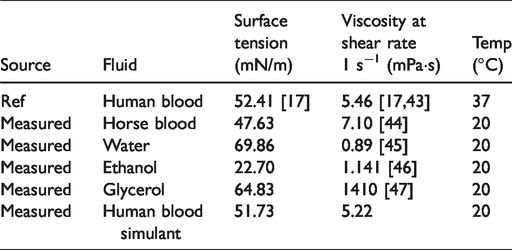
As test blood, horse blood (HB) and human blood simulant (HS) were used. Horse blood defibrinated MB-H1883 was obtained from BenchLAB (Seoul, Korea). Human blood simulant (HS) was synthesized to simulate the surface tension (52.41 ± 0.002 mN/m at 37°C) and viscosity (5.46 ± 0.84 mPa·s at shear rate 1 s−1 at 37°C) of human blood [17,43]. As both horse blood and human blood simulant do not contain fibrin, the surface tension and viscosity may differ from the actual blood. For the model HS fluid, the surface tension and viscosity were adjusted to the ones close to 37°C, to simulate the worst case scenario by approximating the lower end of surface tension.
To adjust the surface tension and viscosity of HS to human blood of 37°C, distilled water (80.78%) (v/v), glycerol (9.83%) (v/v), and ethanol (9.39%) (v/v) were mixed by stirring at 300 rpm for 24 hr. A 0.044 g of blue disperse dye (Jaeil dyes, Seoul, Korea) was added to 120 mL of solution for visual detection. Surface tension and viscosity of HS were measured by Force Tensiometer (K100, Kruss, Hamburg, Germany), and DV2T Viscometer (Brookfield AMETEK, Middleboro, MA, USA), respectively. As HS was made under the room temperature, the surface tension and viscosity of used fluids were measured and referred to the values at 20°C. The reference and measured values of surface tension and viscosity of fluids are shown in Table 1 [17,43–47].
Surface tension and viscosity of fluids.
Fluid resistance test
Test for the blood penetration resistance was designed by modifying the ASTM Test Method F1862/F1862M. ASTM F1862/F1862M is used to evaluate the resistance of medical face masks to penetration of synthetic blood by the impact of a small volume of about 2 mL at a high-velocity (4.49 ∼ 6.35 m/s) [30]. The standard test method assumes the harsh condition of blood penetration during medical procedures, such as puncture of a blood vessel. In our study, the stream velocity was adjusted to 2.83 m/s, feeding 2 mL of fluid through 20 gauge needle (inner diameter, 0.603 mm) for 4.8 s, at the injection flow rate of 25 mL/min. The test was set to spray the blood vertically. The modified setup simulated rather mild blood exposure situation compared to the ASTM F1862/F1862M, and provided consistent linear stream flow during the repeated measurements. The test set up is illustrated in Figure 2.
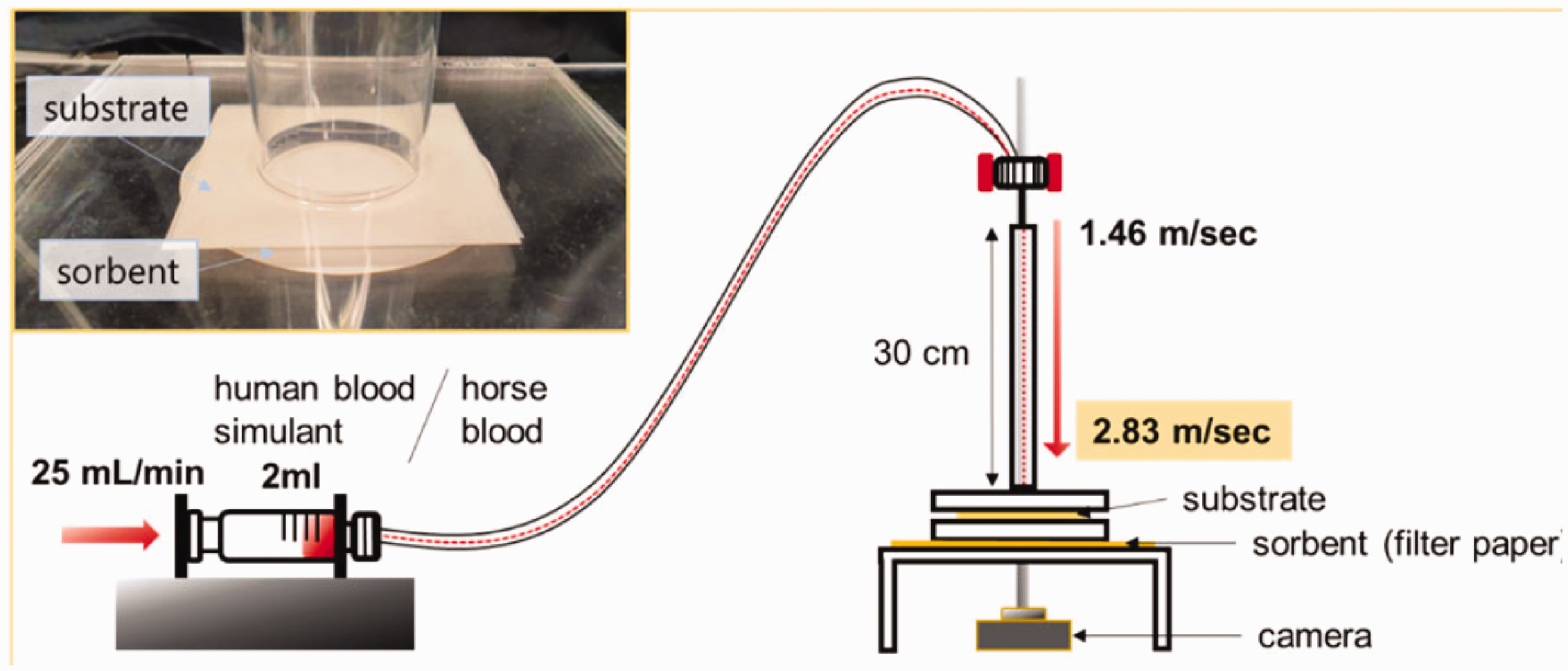
Test set-up for fluid penetration resistance.
The test velocity of fluid was calculated by Equation (3). The blood stream was ejected toward the combined layer of coverweb and MB filter web from 30 cm distance, where coverweb is facing upward. A cellulose absorbent paper was placed underneath the filter web so that the penetrated fluid is absorbed to the paper. The cellulose absorbent paper (diameter, 110 mm) was purchased from Hyundai Micro (Seoul, South Korea). The absorbed area of penetrated blood was measured using ImageJ software (v.1.52e, NIH, USA), to compare the relative fluid penetration resistance among the web samples. The fluid penetration resistance was evaluated by taking the image of the absorbent paper, then analyzing the ratio of the number of pixels corresponding to blood-absorbed area to the total area of the absorbent paper. The measurements for each treatment were done at least three times and the mean value was used for analysis.
g (
h (m): drop height (0.3 m)
Hydrostatic pressure of human blood simulant
Hydrostatic pressure of HS was tested using automatic hydrostatic head tester FX 3000 hydrotester III (Textest Instruments Co., Ltd., Switzerland). The instrument conforms to the American Textile Chemists and Colorists (AATCC) 127, Water Resistance: Hydrostatic Pressure Test [48]. The surface of the test specimen was subjected to a hydrostatic pressure, at the pressure gradient of 5.9 kPa/min, until three points of leakage appeared on its other surface. In this study, the test was conducted on 1) a single layer of coverweb and 2) combined layers of coverweb and filter web, with the coverweb facing the fluid. The specimen was prepared in the size of 20 cm × 20 cm, conditioned at 21 ± 2°C, 65 ± 2% RH for at least 4 h before testing. The specimen was clamped with the test surface facing HS, with the clamping pressure 2,500 N. The mean value of the hydrostatic pressures at the moment HS droplets penetrate the substrate in three different places was recorded in the unit of Pa. The mean value of three measurements was used for analysis.
Filtration performance against oily aerosol
For filter testing, layers of coverweb, PP(MB) filter web, and PP(SB) innerweb were combined, and the combined layer construction were exposed to the test aerosol. The oily aerosol filtration performance test was conducted following the test method of National Institute for Occupational Safety and Health (NIOSH) 42 CRF Part 84 for Respiratory Protective Devices [49]. An automated filter tester (TSI 8130, TSI Inc., Shoreview, MN, USA) was used to evaluate % penetration and resistance (Pa) during the mass loading of dioctyl phthalate aerosol (DOP) with CMD ∼0.185 ± 0.02 µm. A sample area of 40 cm2 was exposed to the airflow with DOP (67.8 ± 4.0 g/L) at the flow rate of 28.8 L/min, which corresponds to ∼12 cm/s of face velocity. The loading of the challenge agent was carried out until 70 mg of DOP was challenged onto the test samples. The % penetration of DOP was determined by reading the relative DOP particle concentration in the upstream and downstream of the test sample. The quality factor (QF), the relative filtration efficiency to the resistance, was calculated to compare the relative filtration performance at the unit resistance as the following: QF =
Scanning electron microscopy
The surface morphology was observed using a field-emission scanning electron microscope (FE-SEM, Supra 55VP, Carl Zeiss, Jena, Germany), with prior Pt coating (∼10 nm) at 20 mA for 200 s using a sputter coater (EM ACE200, Leica, Wetzlar, Germany).
Air permeability and water vapor transmission rate
Air permeability of the layered construction of coverweb and filter web was measured by the air permeability tester (FX 3300, Textest AG Co., Switzerland) in accordance with the ASTM D 737-04, Standard Test Method for Air Permeability of Textile Fabrics [50]. A sample of 12 cm × 12 cm (test area of 0.0038 m2 or 0.0409 ft2) without folds or wrinkles was conditioned at 20°C and 65% RH for 24 h, and a pressure provided by air flow was adjusted to 125 Pa. The air permeability was measured in ft3/min/ft2 (cfm), and the results were also converted into SI units as m3/s/m2. At least five measurements were done for the same kind sample, and the mean value of measurements was used in analysis.
The water vapor transmission rate (WVTR) of the coverwebs was measured following KS K 0594:2015, testing methods for the water vapor transmission rate of textile fabrics [51]. A fabric sample with a 7 cm diameter was fixed on a water-permeable cup containing 33 g of calcium chloride (CaCl2) at 40 ± 2°C, 90 ± 5% RH for 1 h, maintaining a 3 mm distance between the sample and the CaCl2. The mass change (g) was measured after a predetermined time to calculate the WVTR following the equation (4).
Results and discussion
Morphological characterization
The physical characteristics of nonwovens used in this study is presented in Table 2. PET(SB), PP(SB), and PS(ES) were used as coverweb materials. PS(ES)1.0 was fabricated to have higher basis weight and thickness than PS(ES)0.67, whereas the porosity and fiber diameter were not significantly different. The pore size is generally dependent of fiber size, where large fibers form large pores. The tendency of pore size distribution was examined for PP(SB) and PS(ES)1.0 in Figure 3.
Construction of nonwoven webs used.

Note: The value in the parentheses is standard deviation.

Comparison of pore size distribution of large fibers, PP(SB) and small fibers, PS(ES)1.0 (Left) and the SEM images of the respective webs (Right).
In constructing a filtering facepiece, multiple layers of nonwoven webs are generally used, such as coverweb, filter web, and inner web. The coverweb prevents the filter web from the physical damage, so that the filter web can function longer. While the coverweb usually does not have the filtering performance, the coverweb may function as the first layer of barrier that resists quick penetration of liquid contaminants. Of particular interest in this study is the nonwoven properties that effectively resist the spreading and penetration of blood, for the application of coverweb. To investigate the barrier effect of coverweb in the filter construction, the coverwebs with different physical properties were chosen and their surface wettabilities were modified further.
PET(SB), PP(SB), PS(ES)1.0, and PS(ES)0.67 were used as coverwebs, which were in different basis weight, thickness, and surface energy. The physical characteristics of those webs are presented in Table 2. The surface energy of coverweb was modified through plasma enhanced chemical vapor deposition (PECVD) of fluorinated compound (C4F8) or O2 plasma treatment, and the changes of fiber morphology after surface plasma treatment were not observed from SEM images (Figure 4).
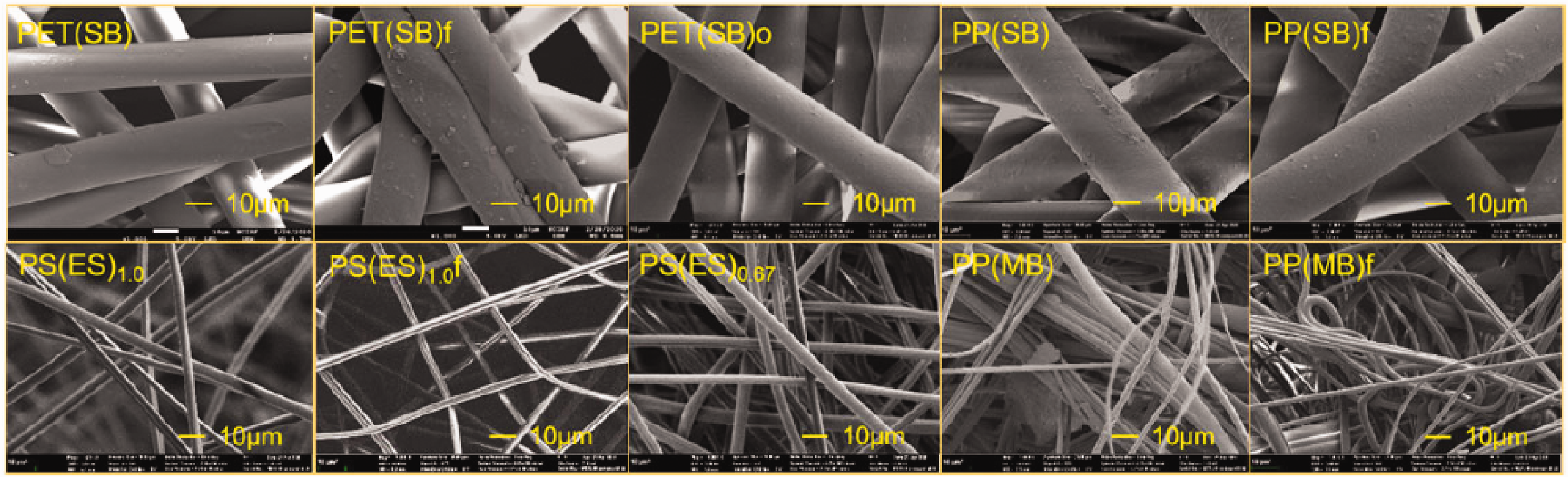
Scanning electron microscopy of webs.

The wettability of materials. (a) Contact angle of liquids with different surface tensions; (b) Comparison of horse blood (HB) and human blood simulants (HS) on the hydrophobic surfaces; (c) Shedding angle of HB.
Effect of surface modification on blood wetting properties
As shown in Figure 5, the wettability against water (WA), human blood simulant (HS), and horse blood (HB), were higher for O2 treated webs and lower for fluorinated webs, as represented in contact angle (CA) and shedding angle (ShA). The PP(MB) that was used as a filter media was also tested for wettability. The wettability of a solid material is influenced by the surface energy and roughness of the solid. Also, the surface tension and viscosity of a liquid affect the wettability of a solid [33,52]. The wettability was measured by CA and ShA; the CA was measured in 1 s upon placing the droplet on the surface. For the liquids with lower surface tension than water (HB ∼48 mN/m and HS ∼52 mN/m), the CAs were measured to be lower than water CA. Most of the web surfaces were hydrophobic whereas the level of hydrophobicity was different. For, hydrophobic webs, the influence of liquid surface tension on CA was apparent. For PET(SB)o, which was hydrophilic, the CA was measured higher for HB and HS than water. In this case, the higher viscosity of HB (∼ 7 mPa·s) and HS (∼ 5 mPa·s) than WA (∼1 mPa·s) seemed to be more influential to result in higher CA of HB and HS than CA of water. On PET(SB)o surface, HB and HS that had higher viscosity formed a compressed droplet at first, then the droplet was absorbed into PET(SB)o slowly, resulting in under 10° of CA after 10 s.
For extremely hydrophobic surfaces such as fluorinated surfaces, the CA measurement may not distinguish the surface wettability; and in this case, ShA is often employed to compare the surface repellency [29]. From Table 3, lower ShA reflects higher anti-wetting property; the fluorinated surfaces (PET(SB)f, PP(SB)f, PS(ES)1.0f) showed lower ShA than the untreated surfaces. Among the coverweb materials, PS(ES)1.0f showed the lowest ShA, due to its low surface energy and small scale of roughness resulting from several micrometers of fiber diameter (Table 2). HS and HB showed higher ShA than water for all web samples.
Wetting properties of nonwoven webs.

Note: The value in the parentheses is standard deviation.
Blood resistance of layered filter construction
In medical use of filtering facepieces, resistance of blood penetration is often necessary for protection against direct contact of bio-hazards. The effect of web wettability and physical structure on blood resistance was further investigated, measuring blood penetration resistance and hydrostatic pressure of liquid. The test set-up (Figure 2) measures the penetration of liquid stream of 2.83 m/s [40]. As test fluid, both human blood simulant (HS) and horse blood (HB) were used. The compositions of HS were varied from literature [53–55], thus, HB was additionally tested to confirm the tendency of results with a real blood sample. The blood penetration resistance was visually presented in Figure 6. The blood penetration was evaluated by measuring the blood-absorbed area of the absorbent paper placed underneath the test samples. The test webs included 1) a single layer of coverweb or filter web (Figure 6(a)), and 2) the layered construction of coverweb/filter web (Figure 6(b)). Generally, HS penetrated more easily than HB, due to the lower viscosity of HS [56]. For the layered construction, the pentration was considerably reduced, as the MB filter layer acted as an effective second barrier to the liquid penetration. Penetration of horse blood (HB) and human blood simulant (HS) through the nonwoven materials. (a) Test with a single layer of coverweb or meltblown filter web; (b) Test with the layered construction of coverweb/filter web.
Figure 7 shows the blood penetration resistance calculated by the ratio of blood-absorbent area to the whole absorbent paper area. The blood penetration was higher for PET(SB) and PP(SB) than for PS(ES) or PP(MB); PET(SB) and PP(SB) had larger fibers resulting in larger pores, and the size of pore was associated with the blood penetration. Clearly, the wettability of coverwebs influnced the amount of penetrated blood, as is shown from lower penetration for the fluorinated surfaces, such as PET(SB)f, PS(ES)1.0f, and PS(ES)0.67f than for the untreated surfaces. It is obvious that the wettability is an important factor influencing the blood penetration resistance, comparing the PET(SB), PET(SB)o, and PET(SB)f, where all the physical parameters are the same. The hydrophilic coverweb material showed a highest blood penetration among the materials. While the anti-wetting property signicantly lowered the blood penetration, the chemical modification itself was not sufficient to completely prevent the blood penetration (Figures 6 and 7).

Quantitative evaluation of blood penetration resistance by the area measurement. (a) Blood penetration through a single layer of coverweb; (b) Blood penetration through the layered construction of coverweb/filter web.
The electrospun webs with smaller fibers and pores showed relatively higher resistance to blood penetration than spunbond webs; the results implicate that the pore size rather than the total porosity (1-solidity) is more critical factor influencing the blood penetration (pore size distribution and porosity are shown in Figure 3 and Table 1, respectively). PS(ES)1.0, PS(ES)1.0f, and PS(ES)0.67f showed the least penetration of blood despite its low basis weight and high porosity. Therefore, it is the pore size rather than the % porosity that governs the fluid resistance of the web [57,58]. When the basis weight of electrospun web was decreased by about 25% for PS(ES)0.67, the blood penetration was increased compared to PS(ES)1.0 as the thickness of web decreased. Thus, if the pore size of web is adjusted same, the higher basis weight or higher thickness would result in the higher resistance to fluid.
When the wettability of PS(ES)0.67 was lowered by fluorination (PS(ES)0.67f), the blood penetration decreased to the level of PS(ES)1.0 or PS(ES)1.0f. PP(MB) and PP(MB)f also showed negligible blood penetration, due to high basis weight and low wettability (water CA 150°). Indeed, coverwebs with low wettability with high CAs, such as PS(ES) and PS(ES)f, showed no blood penetration. For PP(MB), PP(MB) itself showed over 140° of CA for HS and HB, and blood penetration was negligible. While PET and PP with relatively lower CA (higher wettability to blood) showed considerable blood penetration, the fluorinated PET and PP webs showed decreased penetration of blood, due to the enhanced blood repellency with increased CAs. The results demonstrate that the wettability to blood, or blood CA, influences the blood penetration if the surface morphology of a web is the same. Overall, both pore size of the web and the wettability affected the blood penetration of webs.
The SEM images in Figure 4 show the comparative fiber sizes and pore sizes of different webs. Also, the plasma process with O2 or C4F8 did not significantly change the fiber morphology. The measured pore size distribution of PP(SB) and PS(ES) roughly correspond to the observations from SEM images, which again influence the liquid penetration resistance.
As the test setup involves the pressurized ejection of liquid to the fabric surface, the hydrostatic presssure test may measure the similar properties of the fabric. If the tendency of measurement is similar for both tests, hydrostatic pressure test may be convinently replace the blood penetration resistance. The material pore size and its distribution become important in protecting the surface from the pressurized liquid penetration. Thus, the hydrostatic pressure using HS liquid was investigated for coverweb materials in Figure 8. In 2 layer construction, the pressure at which HS droplet starts to penetrate through the combined layers (from coverweb to filter web) was about ∼ 337 Pa in all tested samples. There were no denoting differences among the tested, as the hydrostatic pressure of MB filterweb (∼ 341 Pa) was significantly higher than that of coverweb materials.

Hydrostatic pressure and fluid penetration resistance of coverweb against human blood simulant (HS). (a) Hydrostatic pressure and [100% - blood penetrated area %]; (b) Illustration of hydrostatic pressure test; (c) Hydrostatic pressure test images.
Like the results of blood penetration, the hydrostatic pressure of the single layer of coverweb was influenced by both the chemical (wettability) and physical properties. The hydrostatic pressure increased as the surface wettability decreased, as the hydrophobic surface induced positive capillary pressure that hinders the penetration [59]. The hydrostatic pressure also increased when the web had smaller fiber (or pore size), as the physical barrier was effectively formed agaisnt the pressurized liquid. Therefore, PS(ES)1.0f exhibited the highest hydroststic pressure as it has high level of hydrophobicity and is comprised of small diameter fibers; the results correspond to the lowest blood penetration from the blood penetration test (Figures 6 and 7). However, the electrospun web was very fragile and was torn when the hydrostatic pressure was increased; as the liquid penetration did not occur until the electrospun web was torn, the hydroststic pressure was recorded at the pressure of web tearing point. The actual hydrostatic pressure of electrospun webs is expected to be higher than the recorded value.
The results from the hydrostatic pressure and the fluid penetration resistance were highly correlated, where both test results were affected by the physical property and wettabilty of the webs (Figure 8). To better present the relation of both test results, the blood-penetrated area was converted to (100% - blood penetrated area %). Though both hydrostatic pressure and blood penetration measured the resistance to fluid penetration, the blood penetration with the fluid ejection better simulates the medical exposure situations, where the blood of fluid exposure is dynamic and instantaneous with high speed. Hydrostatic pressure would be more relevant where the material is in constant contact with pressurized liquid.
Air permeability and vapor transmission properties
The measurements of air permeability and WVTR are relevant representative of comfort factors such as breathing resistance and vapor permeability. The breathability of layered materials of coverweb/filter web was evaluated by measuring the air permeability and water vapor transmission rate (WVTR). Among the materials, PP(SB)-containing layers showed the highest air permeability, followed by PET(SB), PS(ES)0.67, and PS(ES)1.0 (Figure 9(a)). From our experiment, the webs with small fibers showed lower air permeability, as small fibers generally produced small pores, hindering the free air flow [12,58]. However, the porosity itself, air fraction of the given volume, was not directly related to the pore size. For example, while PP(SB) had lower porosity than PS(ES), the PP(SB) showed higher air permeability as its pore size was larger than that of PS(ES). In other words, the factor that affects the air permeability was the pore size distribution rather than the porosity itself. Meanwhile, chemical modification by the plasma treatment did not affect the air permeability, implicating that the air permeability is governed mainly by the physical structure of materials, not by the surface chemistry.
Unlike air permeability, WVTR were affected by both surface modification (or wettability) and fiber size. WVTR is influenced by multiple factors including wettability, pore size, and thickness of materials. Moreover, as WVTR refers to the adsorption and transport of water vapor, the pore size and wettability are regarded as important factors [15,60]. For PET(SB) and PP(SB), WVTR increased when the surfaces were fluorinated (Figure 9(b)). However, when the surface of PET(SB) was modified to be hydrophilic (PET(SB)o), WVTR decreased. As the fiber surface becomes hydrophilic, its sorption capacity increases and tends to hold water molecules rather than releasing them, delaying the transmission time [60].
In fact, the absorbed moisture amount of PET(SB), PET(SB)f, and PET(SB)o during the WVTR test was compared. The moisture absorption was calculated by Equation (5) [61].
C1: oven dry weight of coverweb
C2: moisture absorbed/adsorbed weight of coverweb after 1 h (40°C, 90% RH condition)
PET(SB)o showed the largest moisture absorption (32.5%) among them (Figure 9(c)), and this result backed up the effect of absorption capacity of hydrophilic substrate on vapor permeability. For PS(ES)1.0 and PS(ES)0.67, the permeability of water vapor did not show significant differences though PS(ES)1.0 was thicker. While the thickness may affect the vapor transmission of hydrophilic materials by influencing the adsorption/absorption of water vapor on the material, the thickness may not have a significant effect on the vapor transmission for hydrophobic materials, because the hydrophobic materials adsorb or absorb the negligible amount of water vapor. To conclude, the materials with large fibers (large pores) and reduced wettability exhibited higher WVTR. While the physical barrier that prevents the penetration of liquid can block the pathways for vapor or air molecules, the lowered wettability enhances both the fluid resistance and water vapor transmission. The air permeability and the fluid resistance were in trade-off relationship, however, the WVTR and fluid resistance were not. Anti-wetting treatment enhanced both the fluid resistance and WVTR.
Filtration performance against oily aerosol
Employing DOP as an oily aerosol, filtration performance of layered constructions of coverweb/filter web (PP(MB))/inner web (PP(SB)) was examined (Figure 10). Oily aerosol, in contrast to solid aerosol, hardly clogs the filter media, maintaining the resistance throughout the mass loading. However, the penetration of oily aerosol, compared to solid aerosol, deteriorates the filtration performance more quickly as the effective surface area is rapidly masked by the spreading of oily liquid [4,12,62].

Breathability of webs. (a) Air permeability of coverweb/filter web layers (b) Water vapor transmission rate of a single layer of coverweb; (c) Moisture absorption of coverweb after WVTR test.
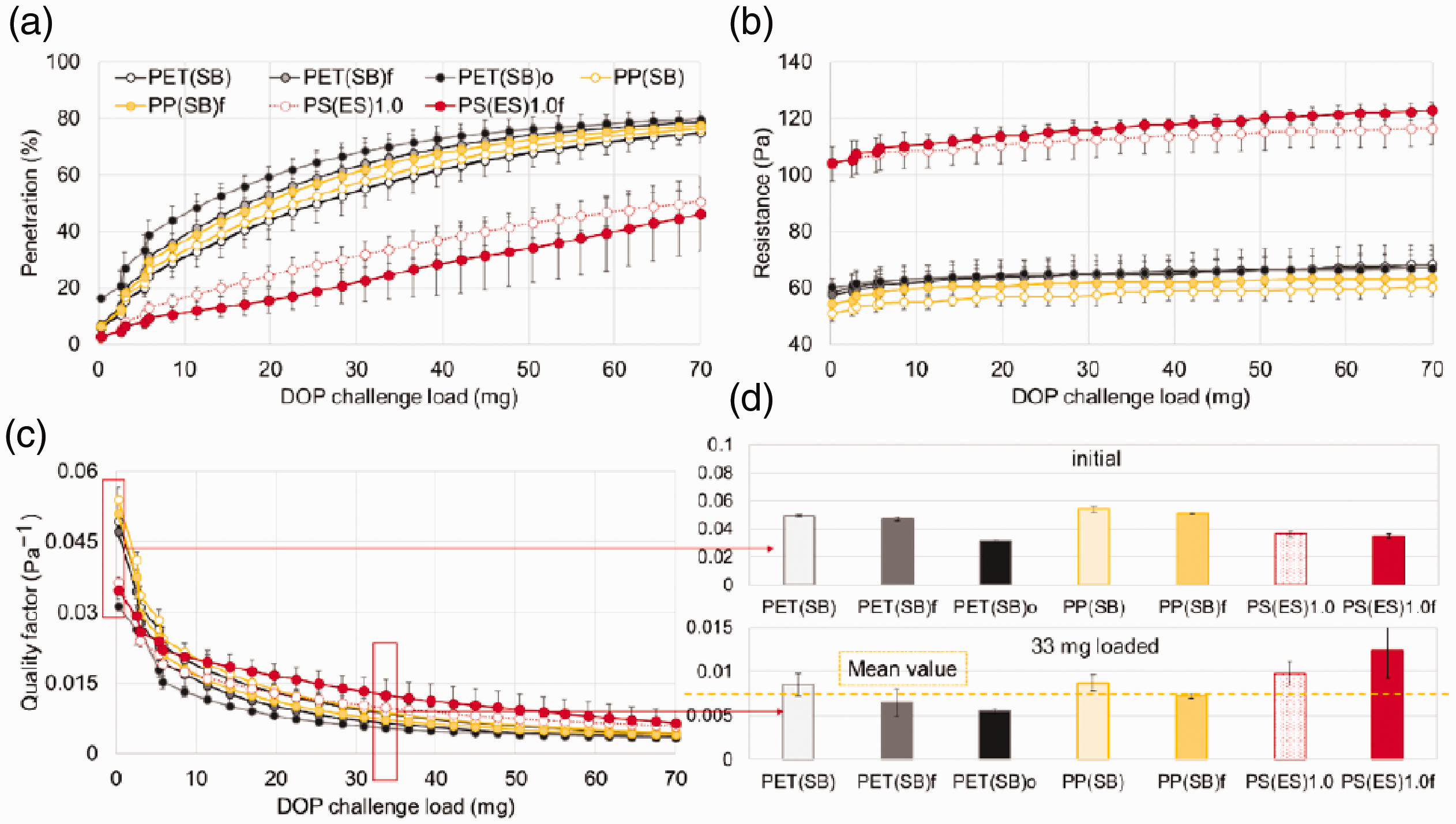
Filtration performance of different layer constructions. (a) Penetration of DOP; (b) Resistance with DOP loading; (c) Quality factor with DOP loading; (d) Quality factor at the initial DOP exposure (upper) and at 33 mg of DOP loading (lower).
The resistance of both PS(ES)1.0/PP(MB)/PP(SB) construction and PS(ES)1.0f/PP(MB)/PP(SB) was high because of the small pore size of the coverweb materials. When the thickness and basis weight of electrospun web decreased for PS(ES)0.67, the resistance was reduced accordingly (Figure 11). The filter construction containing spunbond coverweb showed significantly lower resistance than that containing electrospun coverweb. Meanwhile, the resistances of the layered constructions containing the spunbond webs were not different regardless of the basis weight and surface treatment, because the pore size was large enough not to significantly hinder the airflow. In general, the web with larger fiber diameter tends to give lower resistance due to larger pore sizes, if all parameters are the same. The surface wettability does not affect the resistance of air flow.

Filtration performance of different layer constructions. (a) Penetration of DOP; (b) Resistance with DOP loading; (c) Quality factor with DOP loading.
For aerosol penetration, the effect of surface modification for coverwebs was not clearly observed, except for coverweb of PS(ES)1.0f was used. The spunbond coverwebs, due to loose structure and large fiber diameter, did not have any filtration performance; likewise, the hydrophobic treatment of coverweb had no effect on DOP filtration. On the other hand, as electrospun web was used as the coverweb, the filtration performance was enhanced. The filtration performance against DOP was further enhanced when the electrospun web was fluorinated for enhanced anti-wettability for PS(ES)1.0f. The slight improvement of performance is attributed to the lowered surface energy of PS(ES)1.0f, which prevented the quick spreading of DOP on the web surface. The delayed masking of effective surface area contributed to the improved filtration performance against the oily aerosol. When the meltblown filter media was also fluorinated to further lower the wettability (PP(MB)f) and combined with PS(ES)1.0f, the filtration efficiency with continued DOP loading was improved (Figure 11). PS(ES)0.67f/PP(MB)f/PP(SB) layer combination showed the similar tendency of filtration performance as PS(ES)1.0f/PP(MB)f/PP(SB), but the penetration with PS(ES)0.67f was higher than the thicker coverweb.
For filtering facepieces, low resistance can be translated as good breathing comfort for users [34,39]. As penetration and resistance are often in trade-off relationship, a concept of quality factor (QF) is used to account for both factors. The QF indicates the inherent quality of the filter media, where a higher QF means a higher efficiency at the unit resistance. While the QF at the instantaneous DOP exposure was mainly influenced by the pore size of the coverweb material, the QF with continued loading (Figure 10(d), 33 mg loaded) showed higher QF for PS(ES)1.0f/PP(MB)/PP(SB) construction, due to the lowered penetration than the other constructions (Figure 10(a)).
From Figure 11, effects of anti-wetting treatment on filtration performance and quality factor were compared in more detail using electrospun coverwebs in different basis weights. The QF at the instantaneous DOP exposure was highest for PP(SB)/PP(MB)/PP(SB) construction due to the significantly lower resistance. As DOP loading increased, the penetration of untreated PP(MB) quickly increased, and the QF rapidly decreased. The QFs for the fluorinated web construction with PS(ES)f and PP(MB)f was highest when large amount of DOP was loaded; mainly due to the low penetration of DOP with the continued loading.
Overall, pore size and surface wettability had distinct influence on the blood penetration resistance, breathability, and DOP filtration performance. Anti-wetting treatment was desirable for filtration of oily aerosol, WVTR, and fluid penetration resistance. Large pore size was beneficial for comfort, enhancing the air permeability, WVTR, and reducing the resistnace; however, large pores demoted the filtration perofmrance and the fluid resistance. Therefore, for medical filters, webs with small fibers/pores and anti-wetting properties are suggested for the optimized blood resistance, oily aerosol filtration performance, and water vapor permeability. Among the tested in this study, PS(ES)0.67f combined with PP(MB)f showed the optimal performance with moderate breathing resistance. As the smaller pore size induces higher resistance and lower breathability, the threshold value of optimal pore size distribution needs to be further studied.
Conclusions
This study provides an experimental investigation on the role of surface wettability and structural parameters of a web on the fluid penetration resistance, breathability and the filtration performance against oily aerosol. A test device for a blood penetration resistance was designed to spray the test fluid at 2.83 m/s. Test fluids of horse blood (HB) and human blood simulant (HS) were used for evaluation of wettability to blood, blood penetration resistance, and hydrostatic pressure for coverwebs and/or coverweb/filter web layered structures. The coverweb material with small fibers and pores acted as a good barrier to the liquid penetration. When the web was treated for anti-wetting, the resistance to liquid penetration was enhanced. The air permeability was affected by the physical properties of the webs, but not by the surface wettability. The water vapor transmission rate (WVTR) was enhanced by the dense physical structure and anti-wetting treatment. When the coverweb and meltblown filter web were treated for anti-wetting, the filtration performance of oily aerosol (DOP) was enhanced as the accumulated aerosol loading increased. Overall, the anti-wettability was beneficial for enhancing the fluid penetration resistance, WVTR, and filtration performance of oily aerosol. Tight physical structure helped enhancing the barrier property to liquid penetration, but it deteriorated the breathing resistance and air permeability. Among the tested in this study, fluorinated PS electrospun web combined with fluorinated PP meltblown web (PS(ES)0.67f/PP(MB)f) was considered as an optimal filter construction for medical application, with high blood resistance, high filtration performance, high WVTR, and with moderate breathing resistance.
This study intended to provide a design insight of coverweb material for enhancing the blood penetration resistance that can be applied to medical and healthcare filtering facepiece. This study is novel in that the comprehensive effects of physical and wetting properties were investigated in terms of fluid penetration resistance, comfort properties and filtration performance. Ultimately, the results of this study would contribute to reducing the risk of epidemic spread, by providing an optimal design strategy for filtering facepiece in medical use.
Footnotes
Acknowledgements
The authors acknowledge the facilities and technical assistance of Research Institute of Advanced Materials, Seoul National University.
Declaration of conflicting interests
The author(s) declare that there is no potential conflict of interest with respect to the research, authorship, and/or publication of this article.
Funding
The author(s) disclosed receipt of the following financial support for the research, authorship, and/or publication of this article: This work was supported by the Creative-Pioneering Researchers Program through Seoul National University; and Basic Science Research Program through the National Research Foundation of Korea (NRF) grant funded by the Korea government (MIST) (NRF-2020R1F1A1074295).
