




Abstract
Piezoelectrics are one of the most important materials used for harvesting energies. Several piezoelectric nanostructures have been used to construct nanogenerators (NGs). Nanofibers made by piezo-polymers, especially polyvinylidene fluoride (PVDF) because of their high flexibility, biocompatibility, and low cost, have shown wonderful growth as the key materials for NGs. Despite these favorable properties, fabricated nanofibrous devices still has low efficiency and many studies have been conducted to characterize and improve the performance of the PVDF nanofibers. Here we tried to fabricate PVDF NG device based on align nanofibers to improve the NGs output, using two different methods rotary collector and applying magnetic field. Characteristics of these structures are evaluated utilizing X-ray diffraction, Fourier transform infrared, differential scanning calorimetry, and scanning electron microscopy. Electrical response of fabricated samples is measured through utilization of an impedance analyzer at room temperature. Results demonstrate that crystalline structure increases in both methods but sample fabricated by rotary collector in magnetic field has more improvement in their outputs. This result shows that in addition to the crystalline structure, nanofibers alignment and arrangement play important roles in piezoelectric properties of sample, as well as NG efficiency. These results teach us to establish engineering design rules for wearable power harvesting devices.
Introduction
Small various source of energy are largely available around us which total of these small energies can be considerable [1]. Harvesting energy from these objects has been considered as a splendid approach to solve the energy problem [2–5]. Piezoelectric materials are one of the most important materials used for harvesting energies and many studies have been conducted on issuing the related subjects [6–13]. Recently, several piezoelectric nanostructures have been used to construct nanogenerators (NGs). Mechanical energy can be converted into electrical energy by the NGs [14–17]. The use of semi-conductive and piezo-ceramics, such as ZnO and PZT, has been limited owing to concerns of biocompatibility and brittleness, but piezo-polymers have shown wonderful growth as the key materials for NGs thanks to their flexibility and compatibility. Polyvinylidene fluoride (PVDF), because of its high flexibility, biocompatibility, and low cost, is one of the most popular piezoelectric polymers used to produce nanofiber NGs [18]. Single PVDF nanofiber has been entrusted across a couple of electrodes by a near-field electrospinning process to harvest slight mechanical vibration [19] even though, the ensuing NGs only showed very low piezoelectric outputs [5, 20]. Randomly oriented electrospun PVDF nanofiber webs are another form of flexible devices which are used for energy harvesting from mechanical energy. Difference between the single nanofibers and nanofiber mats is electric potential that formed along the fiber and across the nanofiber membrane thickness, respectively [19, 21]. PVDF is a semi crystalline polymer that has four crystalline phases: α, β, γ, and δ. the non-polar α phase is generally found in commercially available films, polymer solution, and melting form. In this phase, the dipole moments have a random orientation, for this reason they cancel each other out. Dipole moments pointing have the same direction in β phase; thus, this phase is accountable for the piezoelectric attributes of PVDF [22]. To achieve the desired piezoelectric properties in PVDF high β crystal should be formed [5]. Usually, the former is accomplished by mechanical elongating along with an electrical poling treatment [23]. There is no need of additional poling treatment for near field electrospun PVDF nanofibers [24]. Also, randomly oriented electrospun nanofiber mats can be directly used to make a piezoelectric power generator without any extra poling treatment [19]. Nevertheless, fabricated nanofibrous devices still have low output efficiency and many studies to characterize and improve the performance of the PVDF nanofibers have been conducted [25–29]. It has been well documented that under comparable mechanical conditions, the current outputs of devices fabricated with randomly oriented fibers are less than 5 nA and the voltages are in the range of 1–20 mV [18, 21, 24, 29, 30]. It is believed that the device functionality under various stress conditions, such as compression and bending, can be best achieved with high volumetric densities of aligned arrays of fibers. These high densities can be achieved with high degrees of alignment and uniformity in coverage of fibers.
In this paper, for improving the NGs output, align nanofiber mats with different fabrication method are investigated. Various methods are used to produce align or oriented nanofiber mats for different applications (e.g. use of rotating drum [31], use an auxiliary electrode [32, 33], use disc with sharp edges, using template collector [34, 35], use of multiple electrical field [36], and using two vertical wires as collector [37]). In this paper rotating drum method is used to produce align nanofiber mats with piezoelectric properties in a direct spinning approach. In addition, a magnetic field is applied across the electrical field as another method of align nanofibers fabrication and the results were compared. We further assessed the influence of the nanofiber alignment in the NG device on the electrical output compared to the randomly oriented nanofibers.
Experimental section
Materials
PVDF pellets (MW 46,000 g/mol) were purchased from Halo Polymer Co. N,N-Dimethylformamide (DMF, Merck Chem. Co.) and acetone (Merck Chem. Co.) were used as solvent. PVDF solution was prepared by addition of PVDF pellets to DMF/ Acetone solvent mixture (DMF/Acetone = 6/4 wt./wt.), and then the resulting heterogeneous solution was stirred by a magnetic stirrer at 60℃ for almost 2 h. PVDF solution was prepared on 26% (wt./wt.). After stirring, a homogeneous solution was obtained and used for electrospinning.
Preparation of PVDF nanofibers
Electrospinning of nanofibers was performed in a horizontal electrospinning setup (Fanavaran Nano-Meghyas Company, Iran, Figure 1). It consists of a syringe positioned horizontally with its needle, a precisely controlled syringe pump, a high voltage power supply capable of 0–25 kV, and a grounded collector.
Schematic view of electrospinning setup used for fabrication of nanofiber samples. (1) Pump, (2) syringe, (3) high voltage, (4) ground connection (GND), (5) Taylor cone, (6) draft zone, (7) frame of collector, and (8) rotary collector.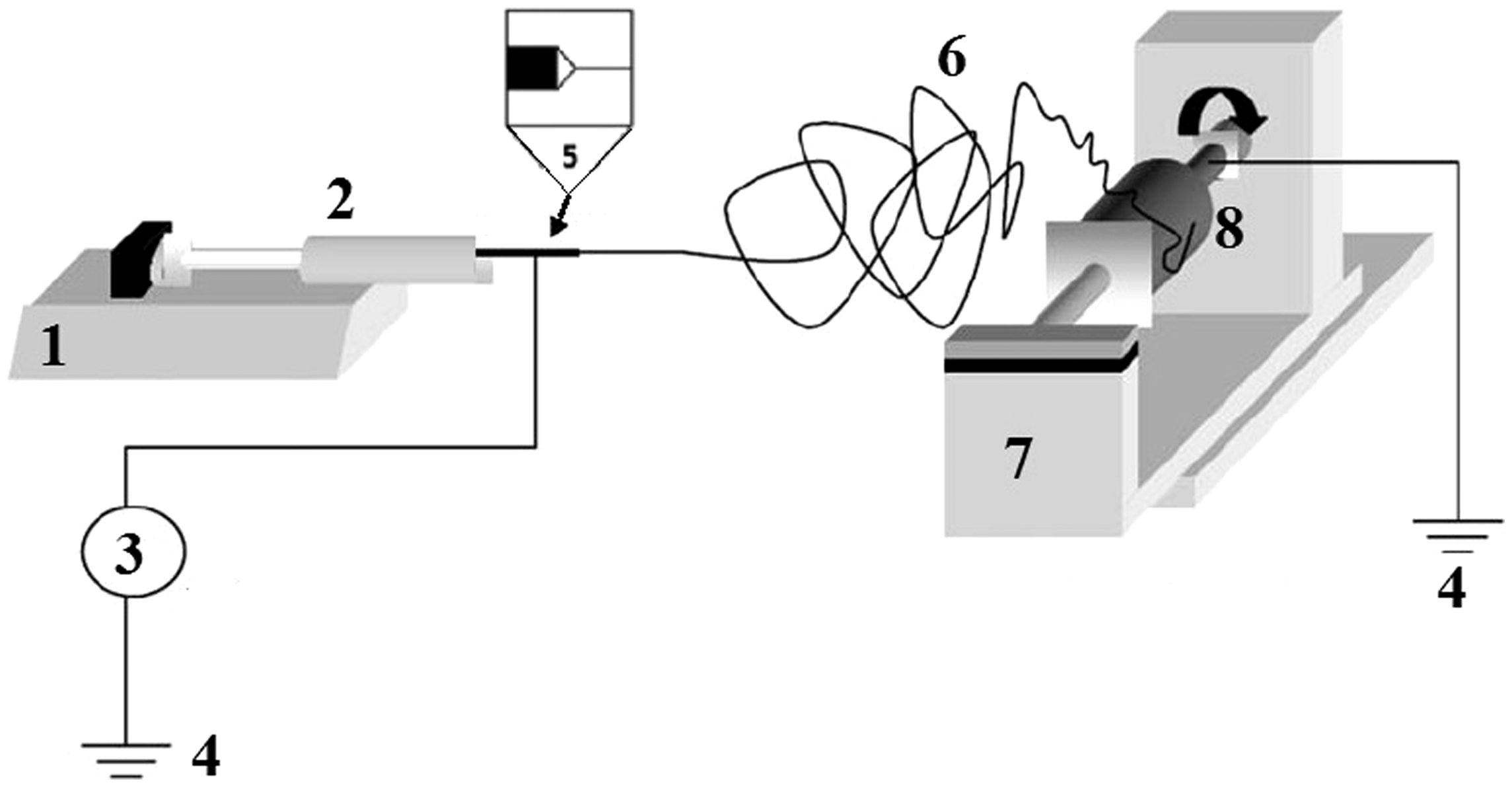
Upon applying the high voltage, a fluid jet was ejected from the tip of the needle. As the jet accelerated toward a target, which was placed at 15 cm from the syringe tip, the solvent evaporated and nanofibers were collected on an aluminum foil substrate. Mass flow rate of the solutions was 0.5 mL/h to produce uniform nanofiber mats. Spinning parameters used in this work were the same as previous studies (needle gage: 22G, cylindrical drum collector outer diameter: 26 cm, distance between the needle tip and the collector: 15 cm, and solution flow rate: 0.5 mL/h) [18, 30].
Samples were fabricated Schematic view of electrospinning setup used for fabrication of align nanofiber samples. (1) Pump, (2) syringe, (3) high voltage, (4) ground connection (GND), (5) Taylor cone, (6) draft zone, (7) magnet, and (8) flat plate. Sample description fabricated in this study.

Fabrication of power harvesting devices
To fabricate each nanofibrous power generator, a small piece of PVDF nanofiber mat (4 cm2, and thickness 120 µm) was used as an active layer, though some modifications were made to the collector of electrospinning device in order to collect nanofibers on the provided two pieces of aluminum tapes as the electrodes. A paper frame was set just outside the nanofiber mat enabling the bent nanofiber web to effectively recover to its original structure. Paper frame also helped to keep away from environmental noises. The whole device was then sealed using a commercial paper tapes (Figure 3).
(a) Schematic structure and (b) photo of an actual of the nanofibrous generator device.
Characterization
Scanning electron microscopy (SEM) images was used for characterizing the microstructure and the morphology of the nanofibers (SEM, model: XL30, PHILIPS Co.). All samples were gold coated (Bal-Tec. SCD50 sputter coater) and the images were taken at an acceleration voltage of 20 kV. FTIR spectra of PVDF nanofibers were documented by Spectrometer (model: NEXUS 670, Nicolet Co.) over a range of 400–4000 cm−1. Melting temperature (Tm), and melting enthalpy (ΔHm) of electrospun nanofibers were measured with differential scanning calorimeter (DSC) (model: DSC 2010, TA Instruments.co) at a heating rate of 20℃/min. The crystalline structure of nanofibers was studied by X-ray diffraction (XRD) (EQuinox 3000 model, INEL France Co.) using Cu-Kα radiation (wavelength 0.154 nm), and the samples were analyzed at room temperature. To compare the properties of piezoelectric and electrical response of samples a measurement system was developed based on the previous studies [17]. In this method a criterion piezoelectric, which is normally used in hydrophone, was placed on the samples, as shown in Figure 4, and it was stimulated by a certain voltage and frequency by a function generator (Synthesized Function Generator—SFG—GwinInsteck Co.) with applied voltage and frequency 21 V and 75 KHz, respectively. Due to the inverse piezoelectric effect, criterion piezoelectric was vibrated and consequently, samples were vibrated. Because of direct effect of piezoelectricity, this movement made electrical response that can be measured by Oscilloscope (GDS-1102—GwinInstek Co.). Frequency, voltage, and criterion piezoelectric are constant for all samples; therefore, force will be the same for comparison of results.
Schematic representation of the designed setup for comparison sample’s electrical response (oil makes better contact between sample and criterion piezoelectric).
Results and discussions
Morphology
SEM image of samples and diagram of their distribution diameter and angle for different samples.

Mean fiber diameter of NG4 sample is less than mean fiber diameter of NG1 and NG2. The finer diameter can be attributed to intense electromagnetic force applied to the NG4 during the electrospinning. However, NG3 nanofibers are finer than NG4, which can be attributed to two factors. First, the tension of the electromagnetic force is less than the tension caused by rotating drum in 400 r/min. Secondly, the electromagnetic force due to short effective length had less opportunity to exert sufficient traction and reducing the fiber diameter. Further, as shown in Table 2, arrangement of nanofiber fabricated in magnetic field is significantly higher than NG3.
Crystalline analysis
After examining the morphology and surface structure, crystal structure of samples was evaluated. Thermal behavior and crystal degree of samples were measured using DSC analysis. DSC melting traces of electrospun PVDF nanofiber mats are shown in Figure 5. Equation (1) can be used to calculate sample crystallites, where Xc indicates the degree of crystallinity of sample and DSC melting traces of electrospun PVDF nanofiber mats.

Summrized DSC results for samples.

Crystal structure of produced NGs was investigated through FTIR spectroscopy. The FTIR spectrum of the nanofiber mats demonstrates vibration peaks at 840 cm−1 and 764 cm−1 which are typical vibration characteristics of the β crystalline phase according to the previous researches and findings [18, 25, 39]. To determine the percentage of beta crystalline phase in each sample, the absorption peak of α and β phases is evaluated at wavelengths 840 cm−1 and 764 cm−1, respectively. Percentage of beta crystalline phase is calculated using equation (2), where Aα and Aβ are absorption at 764 cm−1 and 840 cm−1 and Xα and Xβ are crystalline rate of the α and β phases, respectively.

As can be seen in Figure 6, with increasing collector velocity, the percentage of beta phase increases. By applying magnetic field, an increase in beta phase is observed. The results are shown in Table 4 and Figure 7 in summary.
FTIR spectra of samples. Diagram of beta phase growth of samples. FTIR results of electrospun nanofiber mats.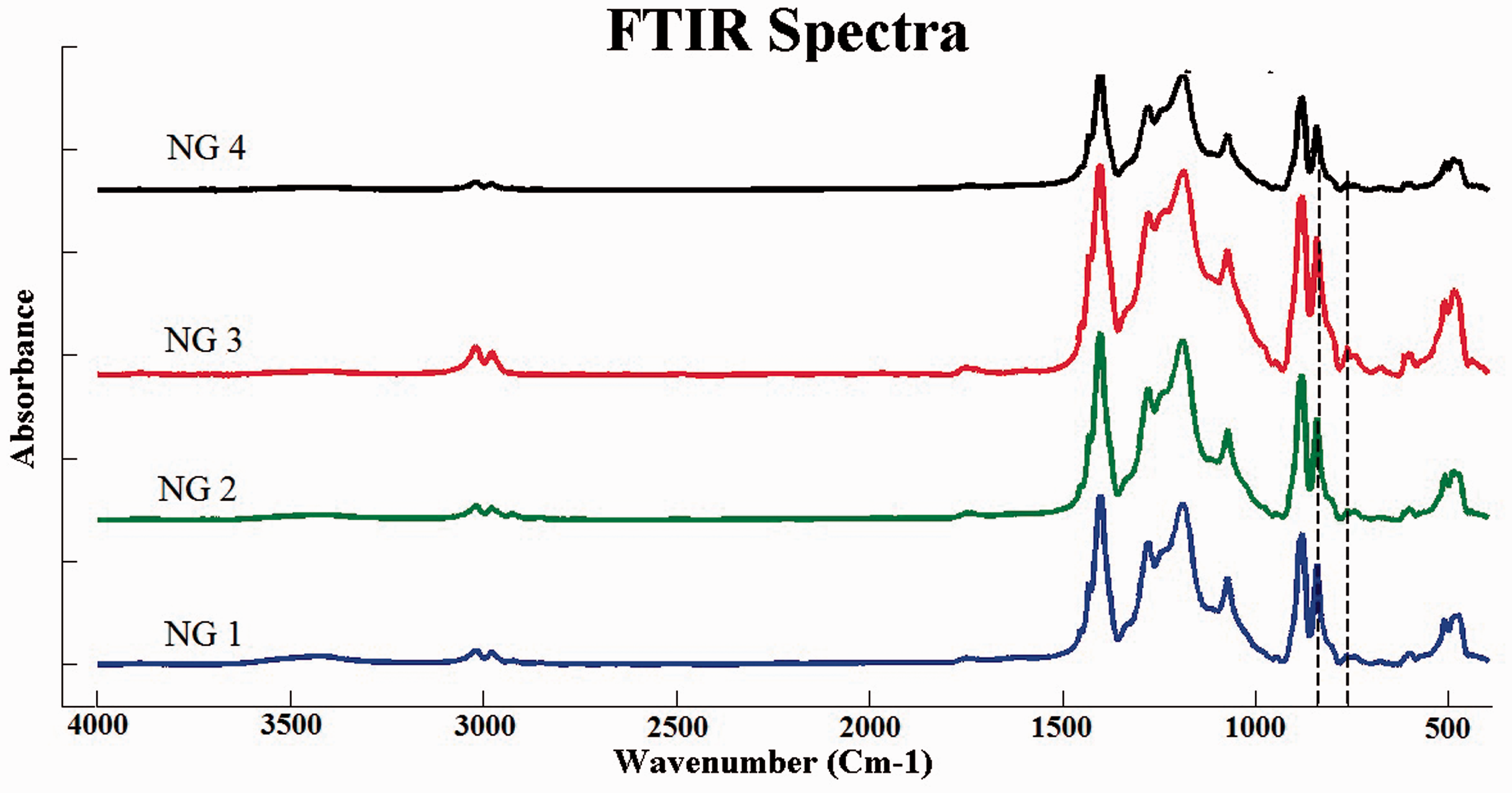


To confirm formation of beta phase in crystaline structure, XRD analysis was performed and the results were processed with the MATCH software. XRD peak at angle 2θ = 20.5 indicates the formation of beta-phase in PVDF nanofibers [25]. Figure 8 shows the XRD results of samples.
X-ray diffraction pattern of samples.
Summrized result of XRD for different samples.

Voltage output
Measuring the electrical response is the best applicable method to compare piezoelectric properties of samples, since it can reveal the final efficiency of a mechanical-to-electrical energy transferring device. To investigate the effect of alignment, i.e. effect of drum velocity and magnetic field, on the electrical response of fabricated devices, four samples were assessed in different situations (NG1, NG2, NG3, and NG4). For ensuring the reliability of these results, each sample was evaluated five times at the same testing condition. An image of set-up used to measure the electrical response is presented in Figure 9. Results are shown in Table 6 and Figure 10.
A view of measurement system used for electrical response of samples. Electrical output of samples. Electrical output of samples.
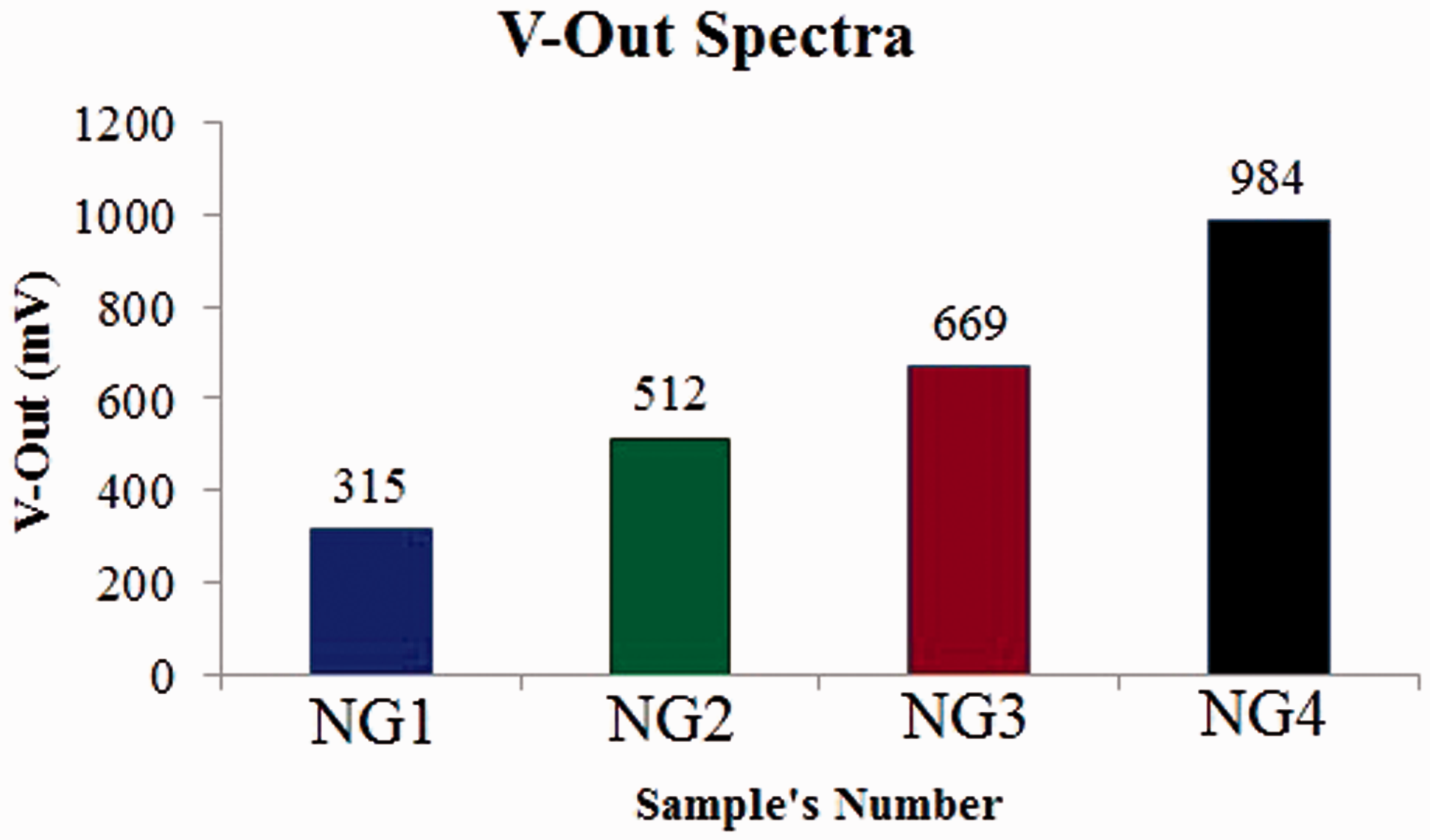
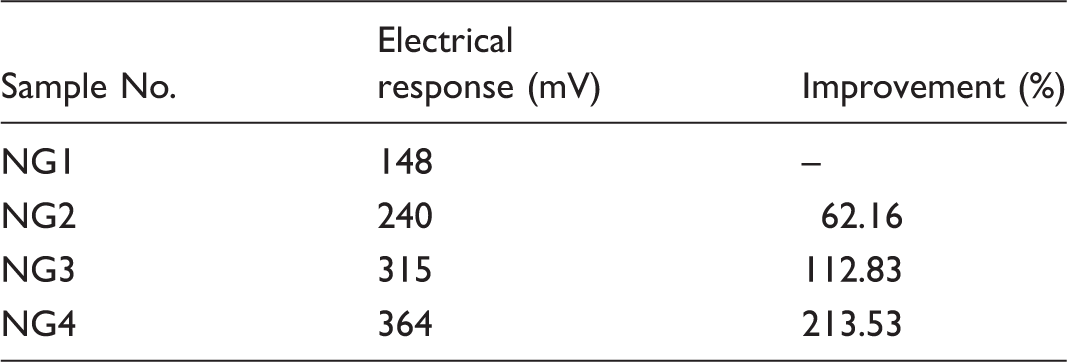
As observed, increase in speed of collector caused an increase in electrical response of samples, so the response of NG3 compared to NG1 shows almost 1.12 fold increases. In addition, by applying a magnetic field, the output significantly increases. As it can be conferred, NG4 compared to NG1 shows almost 2.13 fold increases. NG2 and NG3 output enhancement can be attributed to their crystallinity and beta phase improvement. NG4 improvement in addition to the previous reasons can be attributed to more alignment caused by applied electromagnetic field. In other words, since the degree of fiber orientation in the NG4 sample is very high compared to those in NG3, the uniformity overcome the crystal structures weaknesses and finally caused higher electrical output. By increasing the fiber orientation, dipole moments and the output of each single nanofiber relay each other and increase the overall output of the system, whereas in random orientation (NG3), output of a single nanofiber may overlap by another single nanofiber output and this has led to lower efficiency, for example lower output of NG3 compared to NG4 sample.
Conclusion
In this study, align nanofiber of PVDF fabricated by two different methods. First, we tried to fabricate oriented nanofiber mat by rotational collector and rise in drum velocity (0, 200, and 400 r/min). Result showed that by increasing rotation speed, fibers morphology and their arrangement improved, significantly. Further, due to increase in applied tension on nanofibers during fabrication, increase in collector speed significantly improved the crystalline structure and molecular arrangement of nanofibers and therefore, their electrical output increased around 112% at 400 r/min compared to samples with zero speed of collector. Secondly, align uniform nanofiber mat produced with the help of magnetic field and their crystalline structure and electrical output were compared. Results showed that electrical output of samples fabricated with electromagnetic field improved significantly (almost 212%) compared to the normal samples (NG1). This result showed that in addition to the crystalline structure, fiber alignment and their arrangement play important role in piezoelectric properties of fabricated NG devices. These results give us a hint to establish engineering design rules for fabricating simple, efficient, cost-effective, and flexible wearable power harvesting devices.
Footnotes
Declaration of Conflicting Interests
The author(s) declared no potential conflicts of interest with respect to the research, authorship, and/or publication of this article.
Funding
The author(s) disclosed receipt of the following financial support for the research, authorship, and/or publication of this article: the ATMT Research Institute, Amirkabir University of Technology and INSF (Grant No. 92036082), and ARA Pazhohesh Co.