




Abstract
Fibre materials are widely used as insulation materials in both clothing and the building industry. The transport of heat and air through fibre insulation materials are accountable for both the energy need for indoor space conditioning and the indoor environment quality inside buildings. A better understanding of the thermodynamics of those materials can enable higher quality products for improved energy efficiency. By using fast gas permeability measurements and more time-consuming guarded hot plate measurements, this study investigates the link between thermal conductivity and gas permeability for Rockwool, Kevlar and polyester fibres, at different compaction levels. Correlations between gas permeability and thermal conductivity at different total volumes of solid are presented. The experimental results show that the gas permeability and thermal conductivity exhibited a change in their evolution trend, due to compaction, in the same zone of the total volume of solid for all materials. The presence of this transition zone enables to establish a link between the measurement of gas permeability and thermal conductivity. This correlation can be employed to perform rapid thermal conductivity assessment of fibrous material, which can be cost-effective for fibre manufacturers or building contractors, but also quality assessment in the textile industry.
Introduction
For energy consumption, heat and airflow are essential parameters. The exfiltration of hot air, as well as the internal transport of hot air to cold surfaces, are two of the contributions to heat loss [1]. To decrease heat losses, air transport can be diminished, and the cold surfaces made less thermally conductive. The decrease of thermal conductivity in a material can be obtained in different ways. Solid phase in materials holds the largest share of conductive heat transfer. Replacing this solid phase with trapped air or gas, as in foam materials, or even remove it, like in vacuum insulation panels, is a very efficient way of reducing the thermal conductivity of the material [2].
Fibre materials reduce the movement of air [3]. Woolly fibres from animals as well as plants insulate the host by immobilising the air inside the fibre matrix, while still being permeable to a certain extent [3]. Different applications calls for different properties of fibre materials, e.g. the feeling of comfort of clothing is closely related to thermal effusively [4], while fire fighter protection gear is highly dependent on the heat and moisture transport through the clothing [5,6]. Low thermal conductivity also makes fibre materials suited for use as insulation materials in the building industry [7,8], where they insulate the building envelope and at the same time allow moisture to escape through the fibre network. Hence, fibre materials are commonly used to manufacture insulation elements for the building industry [9]. They insulate by immobilising the air in the fibre structure; convection is minimised, and the limited contact between the fibres reduces conduction [10]. The most common insulation materials employed in the building sector are mineral wool and glass wool [2]. For personal insulation clothing, natural and polymer fibres are often used [3].
The effective thermal conductivity of a material is dependent on the thermal conductivity of each present phase: the natural convection due to temperature gradient, the forced convection due to leakage through open pores, and the coupling between each of the other contributions [2]. Each of these contributions can have different local minima with respect to e.g. total volume content of solids. The overall minimum effective thermal conductivity will then be desirable for insulation material. The mechanics of each of these factors is crucial for the development and application of high-quality insulation fibrous materials.
The choice of raw fibre material for insulation is essential when considering factors affecting heat and air transport processes [1]. The low thermal conductivity of the raw material will decrease the thermal transport by conduction through the solid fibre matrix. If the total volume content of solids falls below a certain threshold, e.g., 0.01 for fibre glass, radiation will become dominant [11]. The convection process is more dependent on the fibre network structure than on the material choice. However, moisture behaviour will be significantly influenced by choice of raw material [1,10]. A hydrophobic material does not attract or adsorb any water vapour, contrary to a hydrophilic one. Furthermore, some materials only adsorb vapour on the surface, while others can diffuse vapour deeper inside the material matrix and release it when ambient humidity decreases [12,13].
The connection between the solid phases for a given total volume content of solids, and hence the tortuosity of the pore network depends on the attraction between each fibre. For glass particles between 20 µm and 100 µm on a silicon substrate, the attractive forces increase with respect to humidity. The increase is larger above 40% relative humidity, suggesting that liquid bridges start to form [14]. This corresponds to two or three layers of water molecules on the fibre [15]. On the contrary, for relative humidity below 40%, it was observed that the force between certain fibres is sometimes repulsive. This is explained by electrostatic repulsion when no liquid layer has formed on the surface of the fibres [14,16]. In general, the thermal conductivity increases with the increase of moisture content due to the high thermal conductivity of water replacing low thermal conductivity air in the pores, and more contact between the fibres [17]. These effects can be further enhanced, if the binder in e.g. mineral wool is not properly cured. In that case, moisture will increase thermal conductivity and decrease the mechanical strength of the fibre insulation material [18,19].
This paper presents the concept of fibre material characterization by combining thermal and pore-network measurements for both convection-dominated and conduction-dominated cases (Figure 1). In a convection dominated-material, the air phase is responsible for the primary heat transfer. When the material becomes more compact, the increased contact between fibres and the less permeable fibre network results in a conduction-dominated heat transfer. By testing three different fibre materials, this paper demonstrates that a change in both thermal conductivity and gas permeability happens when the materials are compressed towards a higher total volume content of solid. The effect of relative humidity on the fibre behaviour is discussed, together with the possibility to use the fast gas permeability measurement as a screening method instead of the more time-consuming thermal conductivity method.

Illustration of two hypothesized states of porosity and pore structure during compression of fibre material. Red arrows represent conduction, green convection. Less compacted and convection dominated pore network (left); higher compaction and conduction-dominated pore network (right). In the middle, an intermediate state where the sum of the two has a minimum thermal conductivity.
Materials and methods
Three different fibre materials were characterized: Rockwool Flexibat 100™, Kevlar 49™ and electrospun polyethene terephthalate (PET) fibres (see Table 1). The Kevlar fibres and the PET pellets used for electrospinning [20] were bought from Goodfellow (Huntingdon, England) and were used as supplied without any further purification or modification.
Fibre materials and their characteristics.

Commercial names: Rockwool Flexibat 100® and Kevlar 49®.
The material characteristics were obtained from the following methods (see Figure 2). All three fibre types were examined with scanning electron microscopy (SEM). The fibres were placed on a silicon wafer, and a droplet of ethanol is added to stabilize the position of the fibre on the wafer. As all fibre materials are non-conducting, they were sputter-coated with a 10 nm gold layer by physical vapour deposition prior to observation. This method produces high-resolution microstructure images together with estimates of the fibre diameters.

Instruments used for characterization of the material properties with a typical size of test samples for fibre materials. For illustration purposes, Rockwool® is used.
The equilibrium moisture content for the relative humidity ranges from 3% to 93%. The sorption-desorption isotherms were measured with a vapor sorption analyzer (VSA), a state-of-the-art instrument developed by METER Inc. [13]. A sample with a weight of 0.5–2 g was placed in the test cell, and the sample weight was measured at different relative humidity levels following wetting (adsorption) or drying (desorption). All performed test fulfil requirements for determination of sorption properties of building materials, set out in [31].
Air permeability (µm2) was determined by an air permeameter. This method is used within the field of soil material characterization [32]. The sample was placed in a sample ring, which was mounted in the air permeameter. A pressure difference of 0.1 mBar was applied over the two sides of the sample, and the airflow through the sample was measured. The gas permeability k was then calculated by applying Darcy's law [33]. Afterwards, the modified Rayleigh number,
Thermal conductivity was measured with a Guarded Hot Plate Apparatus (EP500, Lambda-Meßtechnik GmbH), which is a state-of-the-art method for determination of thermal conductivity [35]. The materials were conditioned at 21°C and 40% relative humidity (laboratory conditions) before measurements. A temperature gradient of 10 K was maintained between the two plates holding the material while the heat flux through the sample was measured. The thermal conductivity was determined for an average sample temperature of 20°C (upper plate temperature of 25°C and lower plate temperature of 15°C).
The typical measurement time of each method including sample preparation is: SEM – 30 min, VSA – 1–3 days, air permeameter – <10 min, guarded hotplate – 12 h.
Results and discussion
The microstructure characterization of the three fibre materials is presented in Figure 3. The length and diameter of the three types of fibre differ significantly.

Images and microstructural characteristics for Rockwool, Kevlar and PET fibres.
The sorption-desorption isotherms of the three materials are presented in Figure 4. The Kevlar fibres exhibited the largest moisture adsorption and storage capabilities per mass, due to the hydrophilic polyaramide bulk material. There was also significant hysteresis (larger moisture content for the drying curve than the wetting curve) for the Kevlar fibres relative to the PET and Rockwool fibres. Furthermore, it was observed that the Rockwool and PET fibres are not water-active at 20–80% relative humidity, meaning that this fibre type will have similar properties under most moisture conditions. It can also be seen that this is not the case for Kevlar, which could be a topic for further studies. These results suggest that for Rockwool and PET fibres relative humidity will most likely not have a significant influence on moisture adsorption. For Kevlar fibre materials, relative humidity may however have a large influence. In order to investigate the magnitude of the effect of moisture content further, more studies are required.

Water vapour adsorption and desorption isotherms for the three fibre materials. The vertical solid line at 40% relative humidity marks the laboratory ambient conditions while running of the thermal tests. Note the connected data points to show adsorption and desorption, and that these isotherms are similar for Rockwool.
The results of the thermal conductivity of this study, together with the results of other studies [9,36,37] are shown in Figure 5. The Vieseh model of thermal conductivity as a function of density is given by

The results of the thermal conductivity and air permeability measurements can be seen in Figure 6. The experiments regarding thermal conductivity and air permeability were carried out at a constant air relative humidity of 40%. Consequently, the effect of moisture content on insulation materials was not considered. One can see that both the curves of thermal conductivity and air permeability with respect to porosity present an inflection point in the region between 0.025 and 0.050 of the total volume content of solid. At low total volume of solids, the thermal conductivity drops with increasing total volume content of solids. In this change zone, the thermal conductivity starts to rise again, and the air permeability drops more slowly. This is due to increased fibre contact, and hence more thermal bridges (increased thermal conductivity) and a more tortious pore network (lower gas permeability).

Thermal conductivity and air permeability as a function of volume content of solids for fibre materials. The shaded area is the change zone. The change point for PET fibres is marked at the first data point, as this measurement was in overflow. Note: Logarithmic y-axis for air permeability, and tendency lines for air permeability are piecewise exponential.
As the fibres become more compacted, the gas permeability decreases, and thermal conductivity becomes more dominant due to increased fibre contact. The convection of air becomes less dominant as the air permeability decreases, and hence, the thermal transport shifts from convection-dominated to conduction-dominated as explained earlier.
As mentioned before, the moisture content in a material is a contributing factor to the connectivity between the fibres. As the fibres have a surface layer of water, liquid bridges develop between the fibres, leading to higher conduction than at a dry state. Furthermore, the water itself is more conductive than the air it has replaced. It should be noted that these experiments were performed at single relative humidity. Materials are expected to perform differently in a dry and humid atmosphere. The laboratory conditions of approximately 40% relative humidity are neither a dry nor a wet state, meaning that this one-point investigation is the middle ground. At drier states, the transition zone is expected to shift towards higher total volumes of solid, due to the lower number of liquid bridges and hence both lower conduction and more open pores network. The opposite is expected if the moisture content increases.
The Rayleigh number describes the relation between convective and conductive heat transfer in a porous media [38]. The modified Rayleigh number versus total volume content of solids for the Rockwool sample can be seen in Figure 7. The Rayleigh number was calculated at a temperature difference of 30°C and a thickness of 30 cm. The number also changes in the same domain as described for the gas permeability and the thermal conductivity. If the modified Rayleigh number is above 2.5, further analysis and measurements of the convective heat flow are required, according to [34]. From the results, it is deduced that an increased total volume of solids can be used to improve the insulation performance and lower the modified Rayleigh number at the same time.
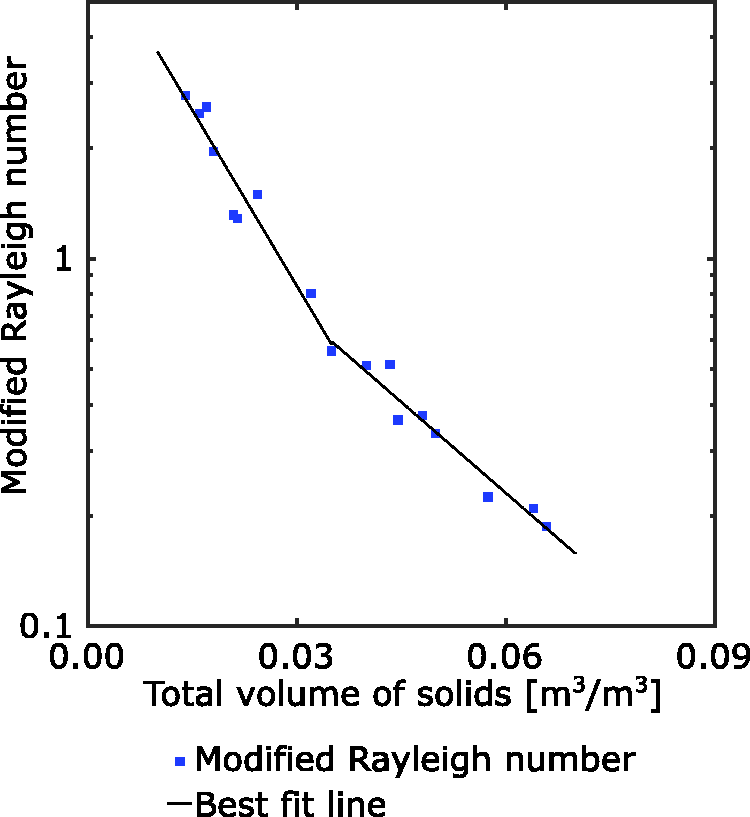
Modified Rayleigh number as a function of volume content of solids for Rockwool. Note: Logarithmic y-axis and tendency line is piecewise exponential.
The novelty of this study is the combination of the different characterisation methods, all state of the art in their respective fields, and the combined overview of the transport properties in non-woven fibre materials. None of the references gives an overview of the correlation between heat, air and moisture characteristics for non-woven fibres, but woven fabrics have similar properties, as porosity and weaving pattern are closely interconnected [39]. This conclusion can be subject for further studies, where the mechanisms of the change in flow can be investigated.
The optimal density for thermal insulation is vastly explained for several materials, including fibre insulation materials and aerogels [36,40,41]. This shift, where conduction increases by increased fibre contact and decreased convection, is what this study describes as the change zone. Thermal conductivity and air permeability are linked together, as found for all three types of materials in this paper [5,39,42]. These studies concluded that thermal transfer and air permeability are connected, and proportional with static modified Rayleigh number.
The connection between thermal transfer and moisture content is well established for building materials [9,37,43] as well as for textiles [6,39]. The thermal conductivity increases with increased moisture content, as the conductive energy transfer increases. The link between permeability and moisture is also known in the clothing industry [44], where the increase of moisture content will decrease the gas permeability, as the fibres stick closer together. When this knowledge from the literature is combined with the results from this study, the change zone of a material can be described as a zone in a total volume content of solids, where transport through the fibres surpasses transport between the fibres.
As it is demonstrated that the gas permeability and the thermal conductivity experiences this shift in the change zone, this knowledge can be used for faster measurements and estimates of the thermal conductivity on basis of the gas permeability. The latter measurement can be performed in less than 10 min, including sample preparation, while the guarded hotplate measurement takes 12 h for a full characterisation. Furthermore, due to the nature of the measurement, gas permeability measurement might even be applied in real time, where e.g., a continuously produces lane of fibre material passes over an air outlet, and the flow on the other side of the lane is measured. This faster technique of quality control could be used to make more homogeneous quality, and hence reduce waste in the production facilities.
Conclusion
This study presents the concept of a transition zone which corresponds to the well-known optimal density for fibre material with regards to thermal insulation. This is also correlated with a change in gas permeability and modified Rayleigh number. This gained insight can be used for further development in thermal insulation materials, as well as in rapid assessment of fibre insulation characteristics by mean of less time-consuming gas permeability test.
It is discussed that the moisture content of some fibre materials might change the value of this optimum density with minimum thermal conductivity. For the tested materials, the transition zone lies between 0.025 and 0.050 of total volume of solids. When the thermal conductivity increases at higher total volume contents of solids, the gas permeability starts to decrease less per unit volume content of solids.
Furthermore, Rockwool and PET fibres adsorbed small amounts of water between 20% and 80% relative humidity, while Kevlar adsorbed more. This corresponds to the fact that polyaramides, the Kevlar raw material, are hydrophilic, while PET and basalt are more hydrophobic. The results of this study will enable faster quality control through rapid gas permeability measurements, instead of the more time-consuming guarded hotplate measurements. With further research and engineering, this technique could be applicable for real-time measurements in an insulation manufacturing process.
Footnotes
Declaration of conflicting interests
The author(s) declared no potential conflicts of interest with respect to the research, authorship, and/or publication of this article.
Funding
The author(s) disclosed receipt of the following financial support for the research, authorship, and publication of this article: This work was supported by The Danish Board of Innovation (J. no. 0052-2012-3).
