




Abstract
High-pressure drop and lower dust holding capacity reduce the performance of nanofibrous air filters. For that reason, this study was carried out to form filters with high-quality factor and high dust holding capacity, thanks to the glass particle additives. In this study, as an approach to such modifications, fluffy nanofiber webs were produced via solution blowing. Polyamide 6 (PA6) was chosen as the base for the nanofibrous mats, where glass microparticles were embedded as an additive to reduce web solidity. The effects of glass microparticle embedding on the filtration performance and pressure drop of the mats were investigated. SEM analysis was performed to analyze nanofiber diameter and morphology. Also, the barrier properties of samples were examined by air filtration and air permeability tests. Findings showed that the addition of glass particles did not alter fiber morphology significantly. However, lowering the pressure drop resulted in higher air permeability and better filtration performance in terms of the quality factor. Glass particles embedded composite samples exhibited a higher quality factor compared to the neat PA6 sample, and the PA6 + 5%GP sample has the highest quality factor value around 0.43. The filtration efficiency of this sample was 99.97% at an expense of 187.3 Pa pressure drop. The obtained enhancement was conducted to the lower solidity of composite webs which was 36% lower for the PA6 + 5%GP sample.
Introduction
Particulate matter (PM) air pollution has always been a serious environmental and human health concern worldwide [1]. More than 25% of children under five years old are at risk of death due to environmental pollution such as air pollution, poor hygiene conditions, unhealthy and unsafe water. According to a report in 2017, three million premature deaths in 2012, in the world were caused by outdoor air pollution comprising particulates less than 10 µm, which cause to respiratory diseases and cancer [2]. To prevent these problems of PM pollutions, air filter media are widely used. Studies on air filtration cover a wide range of disciplines, including HVAC engineering, nonwovens, fluid dynamics, material science, etc.
In general, glass fiber or nonwoven filters are used as conventional air filters. Glass fiber media with a graduated matrix have been a common practice, because of high dust holding capability. However, nowadays, the glass fiber filter media were replaced by synthetic non-breaking fiber filters because of fiber migration in glass fiber membranes. Synthetic air filter media is a durable high performance nonwoven, which is usually produced by melt-spun or carded fibrous webs followed by a suitable bonding process and they are widely used in several areas in daily life such as ventilation of buildings, hospitals and laboratories [3]. On the other side, nanofibrous filters can be classified as advanced nonwoven filter mediums for air filtration due to high filtration efficiency and low-pressure drop, which are the two significant parameters [4–8]. In this context, nanofibrous filter membranes are of great importance owing to the higher capability of holding fine particles at the same pressure drop due to slip flow. At slip flow regime, air velocity at the fiber surface is assumed to be non-zero. According to the relevant literature, slip flow can be observed for fibers thinner than 0.5 µm in diameter under standard air conditions [9]. Hence, during filtration the drag force on the nanofiber surface is much smaller than non-slip flow cases which result in lower pressure drop [10]. Therefore, the slip-flow effect offers a benefit to achieve low airflow resistance and high filtration efficiency, which provides longer operational life for nanofibrous filter media [11,12]. Schematic illustration of non-slip and slip flows through a cross-section of fiber is given in Figure 1.

Schematic illustration of non-slip and slip flows through a cross-section of the fiber.
As one of the first examples of their usage in the ventilation of hospitals, Ahn et al. [13] have demonstrated the filtration efficiency of nylon-6 nanowebs, which found to be comparable to commercial high-efficiency particulate air filter (HEPA). The study suggests that HEPA filters can be replaced by nylon-6 nanofilters with high filtration efficiency (captures 99.95% of all particles 0.3 µm or bigger) in hospitals. Particularly, the electrospinning technique has been widely used in many filtration studies over the past two decades due to simple operation process. Apart from electrospinning, solution blowing is a promising method for nanofibrous web production nowadays. According to our preliminary studies, the productivity of the solution blowing is far more than electrospinning (10 ml/h/nozzle vs. 1 ml/h/nozzle). In addition, SB is much more safe, since fiber formation is not dependent on high electric potential (up to 60 kV). Besides, SB is not dependent on the polymer solution properties such as dielectric constant and conductivity. The system is basically dependent on the drawing forces that were created by compressed air [14,15]. In this technique, compressed air is used to form the fiber from a polymer solution. Compressed air forwards the polymer solution towards collector and fibers are collected as a dried nonwoven structure on the collector (Figure 2) [14–18].

Schematic drawing of the solution blowing (SB) apparatus [14].
There are only a few studies in the literature on filtration applications of solution blown nanofibers. Tao et al. [19] developed polyacrylonitrile (PAN) nanofiber web as a precursor for activated carbon nanofibers with diameters of 200–500 nm to be used for phenol adsorption from aqueous solutions. They demonstrated the advantages of these webs with high specific surface area (2921.263 m2/g) and pore volume (2.714 cm3/g), which are important factors for air filtration applications.
Zhang et al. [20] developed polyimide-nanofiber for air filtration using the solution blowing method to be able to remove particulate matter2.5 (PM2.5). The produced polyimide nanofilter webs demonstrated high PM2.5 removal efficiency (>99.5%) as well as high thermal stability under high temperatures.
In another study, Khalid et al. [21] developed a blow-spinning technique, free of voltage for large scale nanoweb production to be used for indoor air filtration. They produced a transparent air filter with high removal efficiency level (>99%) for PM2.5.
Polyamide 6 (PA6) was selected as a raw material because of the low cost-performance ratio. It has also good mechanical properties such as high tensile strength, flexural strength, and impact resistance. In addition, it is recyclable, and has resistant to mildew and bacteria [22,23]. Glass particles were chosen to be added into nanoweb due to its compatibility and durability in acidic solutions. Also, glass particles do not affect the solubility of PA6 or the solution properties of PA6/acetic acid/formic acid solution significantly.
Since pressure drop directly affects both filter lifetime and energy consumption, it is a critical parameter for filtration performance. In order to lower the pressure drop and web solidity, in this study, polyamide-(PA6) based nanofibrous webs with incorporated glass particles were produced by solution blowing for air filtration applications. Fiber diameter and glass particle distribution were analyzed via scanning electron microscopy (SEM). Finally, air permeability and filtration efficiency of PA6-based air filter webs were tested to investigate the effect of embedded glass particles on the filtration performance.
Experimental
Materials
Polyamide 6 (PA6) chips in particle sizes of ≈2 mm were purchased from İleri Mensucat LLC as A24B (anamide) grade. Acetic acid and formic acid were over 99% purity and purchased from Merck Chemicals. Glass particles with an average diameter of 3 µm were purchased from Omnis Kompozit LLC.
Methods
For solution preparation, formic acid/acetic acid blend solvents were prepared first in the rate of 1:2 wt. Then PA6 was added into solvents with the concentration of 10 wt.% for each, followed by magnetic stirring on hot plate stirrer at 50°C for 10 h. After having homogenous PA6 solution, suspension preparation was done by adding the glass particles with 3 µm diameter into the solution slowly, in concentrations of 1, 5, 10, 15 wt.% of PA6, and stirred for dispersion. To prevent agglomeration or settling of particles during the production, the solution was shaken manually every 10 min. Nanofibrous webs were produced by a lab-scale solution blowing device (AeroSpinner L1.0, Areka Advanced LLC. [17]). Prepared solutions were transferred into a 20 ml syringe with 18 G needle and fed by an automated syringe pump.
Preliminary studies were carried out to determine the optimum production parameters. So that the air pressure, the feeding rate of the polymer solution and the working distance which is between collector and nozzle were set as 2.5 bar, 10 ml/h, and 30 cm, respectively.
The reciprocating nozzle provided a uniform web structure, which was also confirmed by air permeability tests from different points. Blown fibers were collected on a 20 gsm polypropylene (PP) spunbonded nonwoven for 15 min to obtain areal nanofiber density of 2.0 ± 0.05 gsm (PP spunbonded substrate has negligible filtration values ∼5.7 Pa pressure drop and 10.6% filtration efficiency). This structure with a nanofiber web on the spunbond is called a “single-layer.” The two superimposed single layer structures and three superimposed single layer structures were called double and triple layers, respectively.
Characterization
The morphology of the filter samples was examined by scanning electron microscopy (SEM) (TESCAN VEGA3) after coating samples with gold layer. Average fiber diameter and its distribution were analyzed by taking 100 measurements from 20 images. Air permeability test was performed according to EN ISO 9237. The thickness of webs was measured according to ASTM D 5729 where testing gage for thickness (AMES, BG1110-04) has a presser foot diameter of 1 inch and applies at the pressure of 4.14 kPa. To investigate air filtration performances of samples, air filtration test was carried out by the automated filter tester (TSI 8130 A), according to the standard of BS EN 1822. The sample to be tested is placed onto the lower filter holder and the upper one is covered onto it. When the process is started, the aerosol generator delivers solid particles onto the test sample through the upper holder and an upstream photometer, by which the particle concentration is determined. The particles that are not filtrated reach another photometer below the bottom holder, and their concentration is measured. After finishing the test, the device calculates filtration efficiency by dividing the data of downstream concentration by the data of upstream concentration. The pressure drop is measured by a pressure transducer placed between filter holders, and the flow rate is measured by a flow meter placed below the bottom holder. Flow rate (L/min), pressure (mmH2O), and penetration (%) data are provided by the device. NaCl solution (2 wt.%) was used to generate 0.26 ± 0.07 µm diameter solid particles. Aerosolized particles were fed through the nanofibrous filter samples of 100 cm2 of test area at a face velocity of nearly 5.3 cm/s.
Results and discussion
Web properties
SEM images of pure and GP embedded PA6 fibers are shown in Figure 3. According to images, blown fibers have entangled fiber morphologies. The reason behind the entanglement of fibers is the turbulent flow of air. The compressed air exits the custom made nozzle from high pressure ambient through atmosphere. The sudden decrease in air pressure produces turbulence in front of the nozzle outlet [14], which generally causes entanglement of the fibers. The images also demonstrated that all fiber structures contained beads independent from their GP content. Moreover, no relation was found between glass addition, fiber morphology and diameter distribution. After fiber diameter measurements, it was found that samples have an average diameter of 150–200 nm, which indicates that the glass particles exhibit only physical interaction within the polymer solution. As clearly seen in Figure 3(f), the average fiber diameter of each sample is almost the same.

SEM images of PA6 fibers with (a) 0, (b) 1, (c) 5, (d) 10 and (e) 15 wt.% glass addition (scale bar of big images are 20 µm and small images are 5 µm), and (f) corresponded fiber diameter distribution.
Since some of the beads might have similar diameter with glass micro-particles, elemental mapping was performed to differentiate the glass particles from the beads. EDAX mapping (Figure 4) showed that glass particles have an almost homogeneous distribution within the fiber/web structure. Additionally, the analyzed glass concentration has a linear relation with the amounts of embedded glass particles, as expected. Besides, the elemental distributions of glass particles are given in Table 1. As the table shows, the slight difference between the fed and measured Si contents is thought to be emanating from the experimental errors in both feeding and EDAX measurement. EDAX analysis was made to the samples after the filtration test to be sure that the glass particles were attached to the structures of the fibrous web.

Energy dispersive spectroscopy analysis (EDAX) of (a) pure and with (b) 1, (c) 5, (d) 10 and (e) 15 wt.% glass added PA6 nanofibers (green and red for elemental carbon and Si, respectively).
Elemental distribution of glass particles (GP).

Air permeability
Air permeability results are shown in Table 2. Our findings demonstrated that the incorporation of glass particles up to 10 wt.% increased the air permeability compared to the reference sample (neat PA6 sample). However, 15 wt.%GP incorporation has a counter effect on air permeability. This reverse effect might be due to the blocking of pores by a large number of glass particles which lower the air permeability. Solidity, which is calculated using equation (1) is another parameter for the performance of an air filter medium.

Thickness, air permeabilitya, and solidity of three-layer samples.

aAir permeability test (EN ISO 9237) carried at Test Pressure-100 Pa, Test area: 20 cm2.
Note: Number of measurement: 5.
GP: glass particle.
The solidity of filter samples decreases with embedded glass particles. As seen in Table 2, incorporation of 5 wt.%GP decreased web solidity nearly 36% (0.32 for PA6 + 5%GP; 0.50 for neat PA6 sample).
It is known that an increase of solidity leads to better filtration efficiency [24]. As shown in Figure 5, except the PA6 + 10%GP sample, the produced samples showed proper behavior in this trend. Although the same amount of polymer was consumed to obtain the same basis weight, it was found that glass particles incorporation between fibers reduced the solidity due to increased thickness (Table 2).
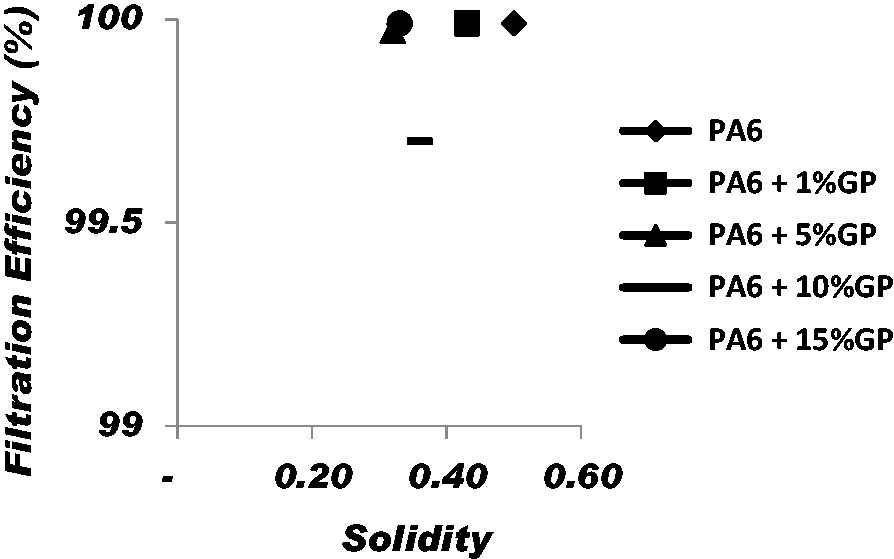
Filtration efficiency versus solidity of filter samples.
The increase in thickness with the incorporation of glass particles provided filter samples to be fluffier. Hence, the structure of samples became less tight with glass particles and the airflow was facilitated through the filter samples.
Filtration performance
Filtration tests were performed for single, double and triple layers of samples with glass particles at different ratios. Pressure drop, which directly affects both filter lifetime and energy consumption [25], was measured by using electronic pressure transducers. As seen in Figure 6, the pressure drop results are in accordance with the air permeability results. The lowest pressure drop was measured to be 42.16 Pa for the PA6 + 10%GP sample. Both single layer and multilayer samples exhibited a decline in pressure drop values up to 10% glass particle content.

Pressure drop values of samples according to a number of layers.
When the glass particles amount increased to 15%, a significant increase in the value of the pressure drop was observed. The reason for the adverse effect might be speculated as that glass particles in excess amounts prevent the airflow.
Previous studies have shown that filtration efficiency increased as the average fiber diameter decreased [26,27]. However, the addition of glass particles has no remarkable effect on fiber diameter and the samples have an average diameter of 150–200 nm, as mentioned above. Thus, while the glass particle addition had a positive effect on the pressure drop, the filtration efficiency did not change significantly with the glass particle addition. As seen in Figure 7, the performance of neat PA6 media changed quite largely upon glass particle incorporation [28]. The effect was apparent even after 1% glass particle addition. However, when the GP concentration exceeds 5%, the slope of the penetration-pressure drop curve changed abruptly. PA6 + 10%GP sample exhibited the lowest three-layer efficiency, which is quite correlated with its high air permeability. Lower solidity resulted with larger airflow through the more open porous structure; 5% and 10% GP addition resulted with similar filtration tendencies, though PA6 + 5%GP sample exhibited better performance at the same basis weight. Thus, it can be said that glass addition has a positive effect on the pressure drop with a slight decrease in filtration efficiency. The filtration performance was ordered as


Penetration versus pressure drop curves of filter samples (dp: 0.4 µm, u: 5.3 cm/s). Linear regression lines were drawn to watch the tendency of neat PA6 and PA6 + 5%GP samples.
The quality factor (QF) which is the negative slope of semilog penetration versus pressure drop plot is a significant value to compare the filter performances. Hence, the efficiency can be normalized according to the filter’s resistance to airflow. This can be expressed as (equation (2) [29]


Quality factor values of the neat and composite samples.
Conclusions
Pressure drop as one of the most significant parameters that affect the filter’s lifetime and energy efficiency should be kept as low as possible. This study showed that glass particles incorporation into nanofibrous filter has a beneficial effect on air permeability. Filter media with high air permeability lead to lower pressure drop and exhibited better filtration performances. According to SEM images, the addition of glass particle does not have an adverse or positive effect on fiber diameter. Therefore, the obtained performance increase can be solely related to lower solidity.
The air permeability of composite filter samples was higher than the neat PA6 media up to 15% GP concentrations. Compared to the neat PA6 sample, there was a nearly 200% increase in the air permeability for PA6 + 10%GP sample. However, the open porous structure according to solidity analysis resulted in lower filtration efficiency compared to other composite webs. Besides, when the amount of glass particle increased to 15%, air permeability decreased because of the possible agglomeration and blocking the effect of glass particles. All of the composite filters exhibited a higher quality factor than the pure PA6 sample. The PA6 + 5%GP sample exhibited the highest quality factor value with 99.97% filter efficiency and 187 Pa pressure drop. When compared with Klair HEPA filter [30] on the market, which consists of polyurethane filter media having 99.97% efficiency value and 160 Pa pressure drop, also compared with MGT H13 high temperature HEPA filter [31] consisting of glass fiber media having 99.95% efficiency with 250 Pa pressure drop, the sample we obtained in this work have closer, even better properties with those of available in the market.
Footnotes
Declaration of conflicting interests
The author(s) declared no potential conflicts of interest with respect to the research, authorship, and/or publication of this article.
Funding
The author(s) disclosed receipt of the following financial support for the research, authorship, and/or publication of this article: This work was financially supported by The Scientific and Technological Research Council of Turkey (TUBITAK, Grant No: 214M371) and the Istanbul Technical University (ITU) Scientific Research Fund (ITU-BAP Grant No 39,606 and 39,128). The authors also gratefully acknowledge “MEDITEKS: The R&D Center for Medical Textiles” project financially supported by Istanbul Development Agency (ISTKA TR10/18/YMP/0075) and Areka LLC for making freely available the lab-scale solution blowing system.
