




Abstract
Nowadays, nanofiber for filtration is drawing attention because of its large surface area and smaller pore size. In this study, aerosol filtration is carried out using nanocomposite filter made of polyacrylonitrile nanofibers with incorporated silver nanoparticles at different weight percentages of 5, 10, and 15 (based on the weight of polyacrylonitrile) sandwiched between polypropylene spun bonded nonwoven. Dimethylformamide acts as both solvent and reducing agent for polyacrylonitrile and the formation of silver nanoparticles, and the silver nanoparticles were characterized using ultraviolet–visible spectroscopy and X-ray diffraction. Further, Box–Behnken method was used to prepare filter media using areal density of nonwoven substrate, electrospinning time, and silver wt.% as process variables. Later, the developed filters were studied for aerosol filtration efficiency at face velocity of 5 cm/s against NaCl aerosol particles ranging from 0.3 to 10 µm, respectively, as well as studied for anti-bactericidal activity against gram-positive Staphylococcus aureus and gram-negative Escherichia coli bacteria. From the study, the developed polyacrylonitrile/silver nanofiber filters possess 99% aerosol filtration efficiency with good anti-bactericidal activity, which potentially improves filter quality.
Keywords
Introduction
Air pollution is one of the reasons among the major environmental risk resulting in respiratory and cardiovascular diseases [1]. Nowadays, exposure to submicron aerosol particles is a growing concern at the workplace, since more than two million workers are involved in nanotechnology. Inhalation is the most direct pathway for the aerosol exposure, some studies suggest that aerosol particle enters the human body through the skin [2,3]. Applying filter is one of the practical ways to reduce risk of exposure to aerosol particle [4]. Filter is a permeable medium designed to protect the wearer from dusts, fumes, and vapors from air and liquid passing through it [5]. Textile fabrics constitute the most important and widely accepted material used as filter media among the several group of materials. Among woven and nonwoven filter media, nonwovens are potentially better filters than woven as they are versatile, offer wide range of functionalities like smaller pore size, higher air permeability, improved cake separation and higher filtration efficiency especially in the submicron range aerosol filtration as well as being economical compared to woven media [6,7]. Quality of the filter media mainly depends on filtration efficiency, lesser pressure drop, and filter performance over life [8].
According to the filtration theory, a reduction in fiber size leads to increase in filtration efficiency while substantially increases the pressure drop across the filter [9–11]. Researchers suggest that nonwoven filter with some fractions of nanofibers possess higher filtration efficiency [12]. Nanofibers are defined as fibers with diameter less than 1 µm [13]. Nanofibers characteristic features like large surface area to volume ratio, low basis weight, and smaller pore size makes them suitable for air filtration application [14–16]. Filtration media by nanofibers are developed by electrospinning, melt blown technique, multicomponent fiber spinning, force spinning, centrifugal spinning, and nanospider method [17]. Currently, nanofibers by electrospinning have attracted considerable attention as they have general fiber diameter in the range of 0.04–2 µm [18]. Electrospinning uses electrostatic force to produce nanofibers from polymer solution. When the polymer solution travels in the air, most of the solvent evaporates and the fine fibers are collected over a grounded plate [19,20]. Filter made of nanofibers alone cannot be used easily, due to its soft and fragile nature. However, nanofibers sandwiched between nonwoven medium to form a composite can be handled readily and used as filter [15,16]. Ungur and Hruza [21] developed modified nanofibers with improved catalytic property for purification of automobile emission. Usage of the filter media are constantly subjected to attacks from environmental microorganism; the microorganisms that are readily captured over the filter grow rapidly, resulting in the formation of biofilms which deteriorate the quality of filtered air. Use of antimicrobial material over the filter will provide a solution for the above problem [22,23].
The objective of this study is to develop and evaluate a composite filter made of polyacrylonitrile (PAN) nanofibers with incorporated silver (Ag) nanoparticles sandwiched between two layers of spun bonded nonwoven. To identify the optimum parameter required to develop a filter media for greater filtration efficiency and lesser pressure drop with antimicrobial property. The polypropylene (PP) spun bonded nonwoven substrate used in this research work has negligible filtration efficiency and pressure drop as compared to nanofiber layer. PAN nanofibers produced by electrospinning were adopted widely as filtration media, due to its thermal stability, high mechanical property, and good solvent resistance properties. The filter samples were fabricated by Box–Behnken design method using areal density (GSM) of PP spun bonded substrate, Ag nanoparticle wt.%, and electrospinning time (h) as process variables. Aerosol filtration efficiency (AFE) was performed using NaCl aerosol from 0.3 to 10 µm. Further, the antibacterial activity of the developed filter samples were assessed against both gram positive Staphylococcus aureus and gram negative Escherichia coli bacteria.
Experimental
Materials
Polyacrylonitrile (MW 150,000 g/mol) was obtained from Sigma–Aldrich, St. Louis, USA. Silver nitrate (MW 169.88 g/mol) was purchased from SRL chemicals, India and solvent dimethylformamide (DMF) (MW 73.10 g/mol) was purchased from Merck, India. Nutrient broth and nutrient agar were purchased from Himedia, India. E. coli (MTCC 1303) and S. aureus (MTCC 96) were obtained from Microbial Type Culture Collection, India. All chemicals were used without further purification.
Preparation of PAN/Ag solution
Initially, 8 wt.% of PAN solution were prepared by dissolving in DMF using magnetic stirrer set at 700 r/min, to which different percentages of AgNO3 (i.e., 5, 10, and 15 wt.% based on weight of PAN) were dissolved individually to form a homogenous solution. The solutions were stirred for 48 h protected from light at room temperature to ensure the formation of Ag nanoparticles.
Electrospinning
A schematic representation of the experimental setup for the preparation of nanofibers is shown in Figure 1. The prepared PAN solution containing Ag nanoparticles was loaded into a 5 mL syringe and pumped through (KDS 200, KD Scientific Inc, MA) a blunt 18-gauge stainless steel needle. The needle tip was connected to high voltage power supply (ES30P, Gamma High Voltage, FL). A piece of aluminum sheet (20 cm × 20 cm) was used as collector, over laid with the PP spun bonded substrate. An electrical potential of 15 kV was applied to the needle, the collector was positioned 15 cm from the tip to needle. The solution was pumped at the rate of 0.5 mL/h. It must be pointed out that formation of beads were observed when 6 wt.% of PAN solution was electrospun to produce nanofibers whereas no bead formation in case of 8 wt.% of PAN.
Schematic representation of the experimental setup for the preparation of nanofibers.
Characterization of electrospun nanofibres
Ag nanoparticles have been characterized by ultraviolet–visible spectroscopy (Hitachi U-2900) and X-ray diffraction (XRD) (Bruker D8). The morphology of the prepared PAN/Ag nanofibers was observed by scanning electron microscope (SEM Hitachi, S-5000). The sizes of the nanofibers were determined from SEM images using image analytical software (Image J). The air permeability was tested using TEXTEST FX3300 air permeability tester according to ASTM D737-04. Since the pore size plays a major role on aerosol filtration, the developed filter media pore size were measured using capillary flow porometer (CFP-1200 AEL, PMI Inc.).
Experimental design plan

Three independent process parameters with three levels for Box–Behnken design.

Box–Behnken design and measure of its functional properties.

Further, the experiment was completed on testing antibacterial activity using gram positive bacteria S. aureus and gram negative bacteria E. coli.
Aerosol filtration efficiency
The experimental setup for measuring AFE based on ASTM F2299 is shown in Figure 2. For experiments the required amount of clean air was obtained from compressor coupled with a pre-filter. The air flow was first split into two ways by precision air regulators. The first one led to the aerosol generator and the second one to aerosol mixing chamber. NaCl was used as the challenge aerosol. The aerosol generator produces aerosol size ranging from 0.3 to 10 micron. Then the aerosol generator output was passed through aerosol neutralizer (P-210) to reach the Boltzmann equilibrium charged state before mixing up with aerosol dilution chamber. The filter samples were held in an 80 mm diameter filter holder and the face velocity of 5 cm/s was maintained throughout the process of measuring AFE. The pressure drop across the filters was measured using a differential pressure gauge. Laser particle counter (Lasair III, Particle Measuring System) was used to measure the aerosol concentration at upstream and downstream from which the AFE was calculated. As the aerosol particles are poly disperse it have natural equilibrium state in this study, the filtration mechanism is purely mechanical in nature. The AFE is expressed as below:
Experimental setup for aerosol filtration efficiency tester.

Antibacterial activity
To test the antibacterial activity (disk diffusion method based on AATCC 90), prepared nutrient agar was poured on to petri dishes and allowed to solidify; 100 µL of microorganism was streaked uniformly over the plate. Square pieces of nanofibers, both the control (pristine PAN nanofibers) and the test samples were gently placed over the solidified nutrient. Then the plates were incubated at 37 ℃ for 24 h, the procedure remains same for both E. coli and S. aureus bacterial strains.
Results and discussion
UV-visible analysis of Ag nanoparticles
Generally, the synthesis of Ag nanoparticles from AgNO3 requires reducing agent and a stabilizing agent, such as a polymer, citrate, or protein; this prevents the aggregation of particles. Here, we explored a method where the polymer solvent itself acted as reducing agent and the polymer itself acted as stabilizing agent. The same polymer solution was further taken for the electrospinning process. It was reported in the recent past that DMF plays a dual role, as a solvent for PAN as well as act as powerful reducing agent for formation of Ag nanoparticles [25,26]. Literature also suggests possible interaction between Ag nanoparticles and nitrogen group of PAN, prevent the agglomeration of Ag nanoparticles, at the same time, responsible for the well distribution of the Ag nanoparticles in the solution. Thus, by combining these two approaches, we explored a simple method for the synthesis of Ag nanoparticles without the addition of reducing and stabilizing agent. Figure 3 shows the UV-visible spectra for PAN solution with 5, 10, and 15 wt.% of Ag nanoparticles. The surface plasmon absorption peak at 417 nm in all three solutions confirmed the formation of Ag nanoparticles. This was adequate for confirming DMF as an effective reducing agent the formation of the Ag nanoparticles. Increase in intensity of the peak, reveals increase in the amount of Ag nanoparticles in the PAN solution.
UV-visible spectra for PAN solution with 5, 10, and 15 wt.% of Ag nanoparticles.
XRD Analysis of PAN/Ag nanofibers
The structural properties and crystalline behavior of the Ag nanoparticles in the PAN composite nanofibers were explored by the XRD diffraction. The resulting diffraction pattern was analyzed by PaNalytical X'Pert High Score Plus software. The prominent characteristic peaks of Ag were shown at 2θ = 38, 44.3, 64.4, and 77.8 representing the (1 1 1), (2 0 0), (2 2 0), and (3 1 1) Bragg's reflections of fcc structure of Ag, Figure 4. These four facial diffraction peaks were in agreement with JCPDS No. 040783. The average diameter of Ag nanoparticles calculated from the XRD profile using Scherer's formula is about 40–50 nm. The XRD pattern confirmed that the polymeric blend was semicrystalline in nature [27].
XRD spectra of PAN/Ag nanofibres.
SEM analysis of PAN/Ag nanofibers
Figure 5 shows the SEM images for PAN nanofibers with 5, 10, and 15 wt.% of Ag nanoparticles. The average fiber diameter analyzed from SEM images is represented in Table 3. The average diameter of pristine PAN nanofibers was about 247 nm whereas the diameter of the PAN/Ag fiber decreased with increasing addition of Ag nanoparticles concentration in PAN solution. The reduction in the fiber diameter should be the result of increase in the charge density of the polymer solution with increasing Ag nanoparticles concentration in the base PAN solution. This increasing charge density imposes stronger elongation forces on the ejected polymer jet during its transport from syringe tip to collector under electrical field, results in reduction of fiber diameter.
SEM images of PAN/Ag nanofibers (a) pristine PAN, (b) PAN-Ag-5%, (c) PAN-Ag-10%, and (d) PAN-Ag-15%. Average fiber diameter of PAN/Ag nanofibers with different wt.% of Ag.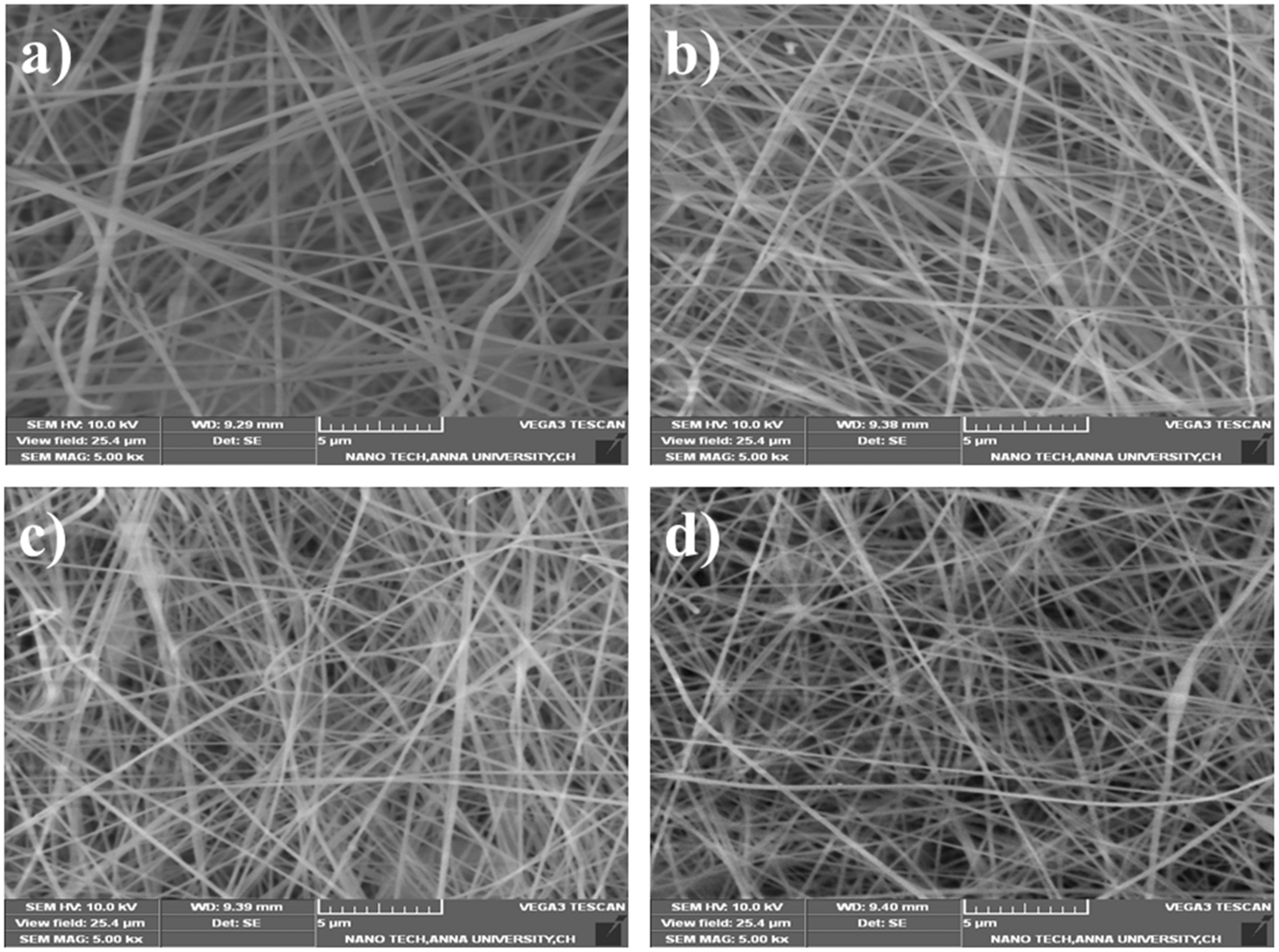

Filtration properties: Pore size
Pore size of the developed filter sample is an important parameter in determining the filtration efficiency of the media. Generally smaller pore sized filter media poses lesser air permeability and higher AFE simultaneously; both of them are the most critical properties of air filters. Capillary flow porometer was used in this study to measure the mean flow pore size of the developed PP spun bonded nonwoven/electrospun composite filter. Table 2 shows the mean flow pore size of the developed filter media. The pore size of the developed filter was influenced mainly by electrospinning time and Ag wt.% in this study. It was noticed that by increasing the electrospinning time from 1 to 3 h (without considering Ag wt.%) the pore size of the filter reduced, which was due to increase in the packing density. Further maintaining the electrospinning time as constant and by increasing the Ag wt.% also leads to reduction on pore size, this attribution was due to increasing charge density with increasing Ag wt.% results in reduction of fiber size during the electrospining process (as mentioned in SEM results). Reduction in fiber size makes closer packing of fibers which in turn gives smaller pore size. By comparing pore size of PP spun bonded nonwoven and developed PP spun bonded nonwoven/nanofibers filter shows nanofibers plays a major role to obtain smaller pores in the developed filter which depends on electrospinning time and Ag wt.%. From Table 2, it was observed that the filter media S1 has bigger mean pore size and S12 has smaller mean pore size of 8.56 and 1.52 µm, respectively. Due to the smaller pore size, the filter media S12 gives highest filtration efficiency of 99.68%. Also Table 2 results show the direct relation of pore size to filtration efficiency.
Filtration properties: Air permeability
The areal density of PP spun bonded nonwoven, electrospinning time and Ag wt.% have direct relation to the air permeability of the developed composite filer. The air permeability results were given in Table 2 and also represented graphically in Figure 6. Figure 6a shows the air permeability results as well as the pore size of the corresponding developed filter. In General, it was noted that the air permeability was higher for filter with bigger pore size and lower for filter with smaller pore size.
(a) Shows relationship between pore size and air permeability and (b) shows effect of Ag wt.% on air permeability.
Consequently, the air permeability of the filter which depends on pore size was in turn related to electrospinning time and Ag wt.% as explained in pore size result section. To understand deeply, Figure 6(b) shows the effect of increasing Ag wt.% as well as electrospinning time over air permeability. It is clear from the figure that the air permeability gets decreases for both, increasing Ag wt.% and electrospinning time. The reason for decrease in air permeability with increasing Ag wt.% and electrospinning time was due to reduction in fiber diameter and increase of packing density of the filter media.
Filtration properties: Pressure drop
Figure 7 shows the pressure drop results of the developed filter media at face velocity of 5 cm/s. The result suggests the Pressure drop is a function of pore size and air permeability. An increase in pore size leads to an increase in air permeability which subsequently leads to a decrease in pressure drop. In turn, the pore size and air permeability of the filter media is based on electrospinning time and Ag wt.% (which determine the fiber size). Similar trends in results were observed for pressure drop across the developed filter media at 5 cm/s as like pore size and air permeability results.
Pressure drop across the developed filter media at face velocity of 5 cm/s with corresponding air permeability and pore size.
Filtration properties: Aerosol filtration efficiency
Filtration behavior of the developed filter media was studied using NaCl aerosol particles of different size such as 0.3, 0.5, 1, 5 and 10 µm particles at constant face velocity of 5 cm/s. Figure 8 shows the filtration efficiency of the developed filter with respect to aerosol particle size. Electrospinning time and nanofiber size (based on Ag wt.%) plays a major role on filtration efficiency of the developed filter. AFE of 99.7% was achieved by sample S12 and it was around 68% higher than the 50 GSM PP spun bonded nonwoven used as substrate (Table 2).
Filtration efficiency of the filter with respect to aerosol size.
Least filtration efficiency of 78.68% was given by sample S1 due to the shorter electrospinning time and larger fiber size compared to S12 sample. With respect to particle size of 0.3 µm, AFE was highest with 99.3% for S12 and least with 54.7% for S1, respectively. Based on the overall filtration efficiency a ranking was given to the developed filter media shown in Table 2 and also it shows the regression equation derived for AFE.
Figure 9 shows the influence of process parameters such as areal density of PP spun bonded nonwoven, electrospinning time, and Ag wt.% on AFE. From Table 2 and Figure 9, it was observed in general that by increasing the areal density of PP spun bonded nonwoven, electrospinning time, and Ag wt.%, the aerosol filtration tends to increase, but the range of increase in filtration efficiency was differed between the individual factor in the following order Ag wt.% > electrospinning time > Areal density. Figure 9(a), shows that the effect of electrospinning time over areal density on AFE, from the figure we can predict that by using areal density of PP spun bonded nonwoven in the range of 50–55 with electrospinning time of 2.5 h we are able to achieve filtration efficiency of 99%. Figure 9(b) also confirms the effect of Ag wt.% over areal density on AFE. Hence, it was confirmed that the effect of electrospinning time and Ag wt.% in the PAN solution play a major role in AFE compared to the areal density of nonwoven fabric substrate. Figure 9(c) shows the superiority of Ag wt.% over electrospinning time on AFE, from graph it was observed that more than 95% of filtration efficiency can be achieved with PAN-Ag-15% with 1 h of elecrospinning time whereas 3 h electospinning of PAN-Ag-5% still attains only 91% filtration efficiency. From the above results, it was concluded that filtration efficiency of the filter media purely depends on electrospun nanofibers, not with respect to the substrate used. On the whole it was observed that with areal density of 50–55 GSM, electrospinning time of 2–2.5 h, and Ag wt.% of 10–12.5 gives the better result as 99% filtration efficiency.
The effect of process parameter over aerosol filtration efficiency.
Antibacterial activity
Filters are constantly subjected to attacks from microorganism present in the environment; the microorganisms that are readily filtered and captured over the filter grow rapidly, resulting in the formation of biofilms which deteriorate the quality of filtered air. Therefore, to make a filter with antibacterial property Ag nanoparticles was incorporated in the developed filter. Hence, pristine PAN and PAN/Ag nanofibers with different Ag wt.% of 5, 10, and 15 were assessed for antibacterial activity against both gram positive S. aureus and gram negative E. coli bacteria. Pristine PAN nanofiber was used as control against the test samples. The inhibition zone lengths were analyzed and are reported in Table 4, and the same was shown in Figure 10. The experiments were repeated in triplicates to evaluate the average inhibition zone. As for pristine PAN nanofiber, no inhibition zones were observed against both S. aureus and E. coli bacteria; this confirms the nonbactericidal property of the pristine PAN nanofiber. On the other hand, inhibition zone of different lengths with increasing order was observed for the PAN/Ag nanofiber with 5, 10, and 15 wt.% of Ag. The increase in the inhibition zone length signifies the increase in the amount of Ag particles in the nanofibers. On the whole, the inhibition activity of all three test samples were more against E. coli compared with S. aureus, the reason behind this is due to their difference in thickness of peptidoclycan layer within the cell wall of S. aureus and E. coli. Overall it is seen that the developed filter media achieves higher AFE with good antibacterial property.
Antibacterial assessment of PAN/Ag nanofibers with different wt.% of Ag nanoparticles (a) against E. coli and (b) against S.aureus. Antibacterial activity of PAN-Ag nanofibers against E. coli and S. aureus.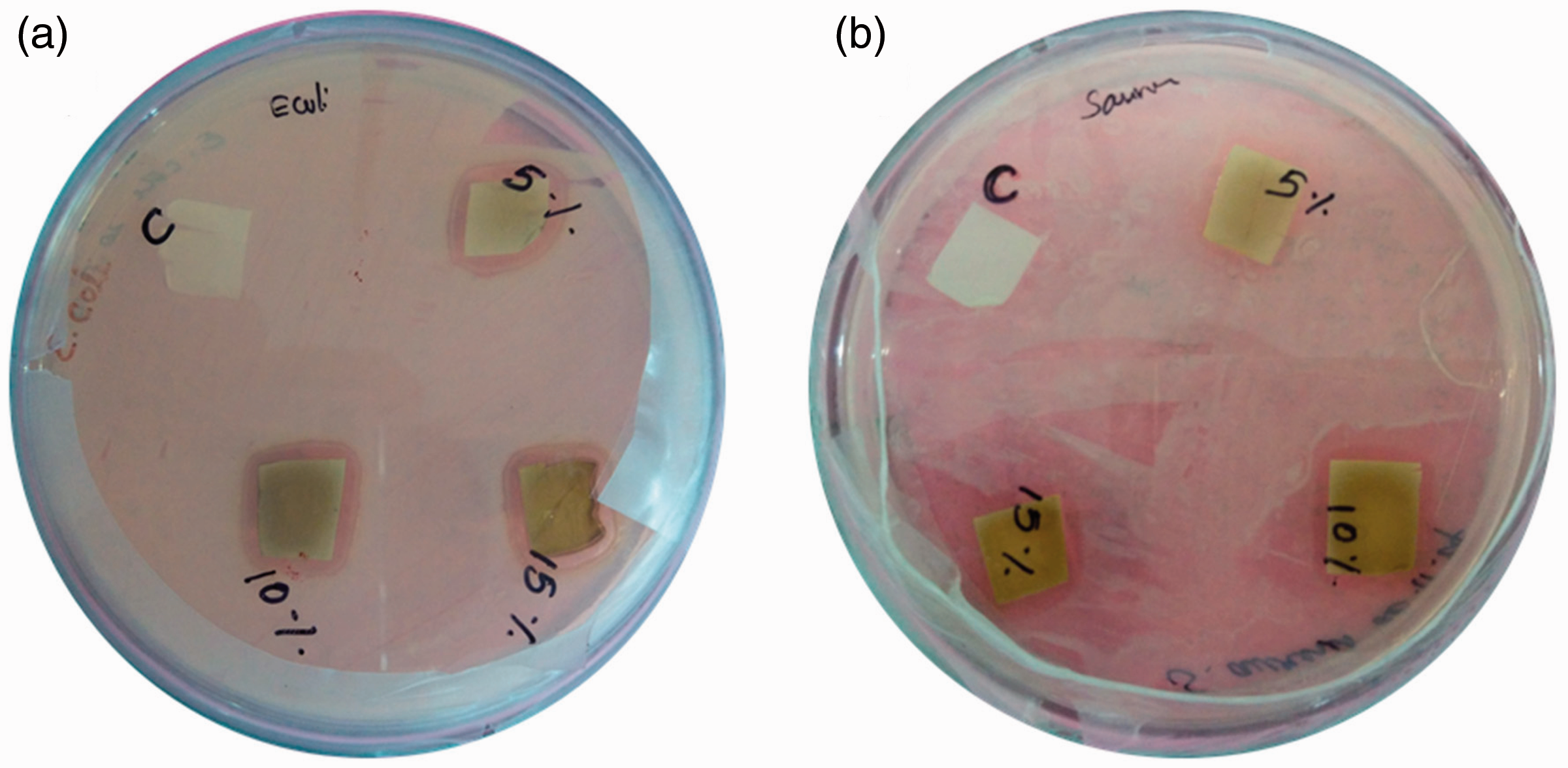

Conclusion
In summary, PAN nanofibers with Ag nanoparticles were successfully produced by electrospinning. The presence of Ag nanoparticle was confirmed using UV-Visible Spectrscopy and XRD. The nanofiber diameter decreases with increasing Ag wt.% was confirmed by SEM image. Using Box–Behnken design with areal density of PP spun bonded nonwoven, electrospinning time, and Ag wt.% as variable fifteen filter media have been produced in this study. AFE was determined using NaCl aerosol at 5 cm/s. For 0.3 µm aerosol size S12 achieves 99.3% filtration efficiency and 54.7% was achieved by sample S1. The effect of process parameter on AFE was determined to be in the following order Ag wt.% > electrospinning time > areal density. It was shown that PP spun bonded nonwoven of 50–55 GSM, electrospinning time of 2–2.5 h, and Ag wt.% of 10–12.5 was sufficient to attain 99% AFE irrespective to particle size ranging from 0.3 to 10 µm. Subsequently, the developed filter media showed good anti-bactericidal activity against both S. aureus and E. coli, which improved with increasing Ag wt.%. Over all, this method provides a versatile strategy for design and development of composite filter media with good antibacterial activity for aerosol filtration application.
Footnotes
Declaration of Conflicting Interests
The author(s) declared no potential conflicts of interest with respect to the research, authorship, and/or publication of this article.
Funding
The author(s) disclosed receipt of the following financial support for the research, authorship, and/or publication of this article:The authors gratefully acknowledge the funding support from the Board of Research in Nuclear Sciences (BRNS), India under the project titled “Development of Nanocomposite Mask for NBC Application” - sanction number 2011/36/06-BRNS/156. The author Arun Karthick Selvam would also like to acknowledge University Grants Commission (UGC), India for providing UGC-BSR fellowship.