




Abstract
The main goal of the presented study was to develop new multi-layered weft-knitted structure for thermal insulation and to investigate the dynamic of the heat transfer through this fabric. For knitting of outer and inner layers of this structure, different raw materials of yarns were used, i.e. wool, cotton, polyester and acrylic yarns. All the newly developed multi-layered weft-knitted fabrics show thermal insulation as, after 1 h of observation, temperature on the outer layer of all tested fabrics does not reach 40℃, i.e. the temperature of a heated plate. The results of this research showed that the nature of the yarns has a significant influence on the air permeability and dynamic of the heat exchange through the multi-layered structure, as it influences porosity of the knitted fabric. The results showed that the best fabric was the one where the outer layers are knitted from woollen yarns and the inner layer from polyester filament yarns.
Introduction
Consumers of textile products have become increasingly aware of the importance of comfort. In addition to aesthetic appearance, comfort is one of the main properties of clothing. Clothing with poor thermo-physiological wear characteristics not only affects the well-being of humans, but also impairs the physical performance and may even act as a health hazard. The proper comfort characteristics of the fabrics increase the significance of attire and are gaining more interest in the global market. Wrong thermal or moisture management minimises the level of comfortability [1].
Physiological comfort is the effect of many coefficients related to the human body, climatic conditions, environment, and clothing [2]. In the case of an equable heat balance condition of human metabolism system, the rate of heat energy produced by metabolism should be equal to the rate of heat transferred from the body to the ambient environment through the clothing. In case the rate of heat loss from body is higher than the metabolic heat generation, body feels discomfort. Maintenance of the comfortable heat loss from the human body is a primary function of the winter clothing [3,4]. The basic heat transfer mechanisms, such as conduction, convection and radiation, are very well known. They all coexist in the heat transfer process from a heated surface through a porous fabric attached onto it [5]. Thermal absorptivity strongly correlates with fabric weave, geometrical structure and raw material and properties of yarns. Many researches have been carried out in order to analyse and evaluate the effect of the fibre type and fabric structure to the thermal comfort of woven and knitted fabrics. Studies of thermal wearing tests showed that fabric properties influence the subjective wearing sensations and the microclimate inside the clothing. It was found that thermal comfort of the textile fabric was influenced by the thickness, water absorption properties and thermal conductivity of the fabric. However, it was also found that these effects varied with the environmental conditions and/or physical activity level [2,6]. The thermal resistance of clothing as a set of textile materials depends on the thickness and porosity of particular layer. Fabrics knitted in combined patterns have higher thermal resistance than plain plated fabrics because of higher thickness of the combined structures. By increasing the thickness of fabrics knitted from the same raw material, thermal resistance also increases, which means that a more thickly knitted fabric gives warmer sense [6].
A lot of published researches show that thermal comfort conditions may be predicted by properties of the fabric (and their packages) such as thermal insulation or biophysical medium buffering indexes [7]. The warmth of a fabric is generated due to the insulation provided by air trapped between fibres and yarns as well as between several layers of fabric. If the level of thermal absorptivity increases, the body feels more cooler. This is desirable in hot weather but not likely appreciated in cold weather [8–11]. Good thermal insulation can be achieved by using double- or multi-layered knitted fabrics. A typical double-layered construction of knitted fabrics includes the following elements: one layer of knitted fabric is made of conductive and diffusive yarns, which directly adjoins the body, and another one is made of absorptive yarn, which is not in direct contact with the skin. The role of this layer is to keep the humidity far from the body and vaporise it to the environment [12–14].
The clothing parameter that could have a strong influence on the heat exchange between human body and the environment is the air permeability. The air permeability is one of the most important indicators of the value of textiles because this physical parameter determines the basic functions of the utility of the textile. The air in the microclimate between individual items of clothing has a physiological function [2]. The air permeability, being a biophysical feature of textiles, determines the ability of air to flow through the fabric. Airflow through textiles is mainly affected by the pore characteristics of the fabrics. The pore dimension and distribution in a fabric is a function of the fabric geometry. The structural parameters of knitted fabrics and majority of physical and mechanical properties depend on the technical characteristics of knitting machine and properties of yarns. The yarn diameter, origin of fibres, knitting structure, course and wale density, yarn twist level and linear density are the main factors affecting the porosity of knitted fabrics [15–19].
Most of the studies carried out in the heat and thermal insulation have been devoted to measure the static thermal properties. However, it is very important to not only consider the amount of the heat released to the environment but the dynamic of the heat transmission should also be taken into account, i.e. the time during which the warmth is lost. However, there are not many investigations in the field of the heat transfer dynamic through the knitted fabric, especially through the double- and multi-layered weft-knitted fabrics. The main goal of this study was to develop multi-layered weft-knitted structure for thermal insulation using different raw materials and to investigate the dynamic of the heat transfer through these fabrics.
Materials and methods
Eleven variants of multi-layered knitted structures were developed for this research. Experimental samples were knitted on the E12 gauge flat double needle-bed knitting machine SES 122-S (Shima Seiki, Japan). After knitting, all samples were stabilised by using steam a thermo-stabilisation equipment, Cosmotex (Spain). For all variants, the same three-layer knitting structure but different raw composition of the layers was used. Woollen yarns were purchased from Filivivi Srl (Italy), cotton yarns – from Johann Müller AG (Switzerland), acrylic yarns – from JSC Vernitas (Lithuania) and polyester filament yarns – from Lakshmi Ganapathy Textiles (India). The characteristics of the yarns used are:
Folded woollen yarns with 33.3 tex ×2 linear density, 210 m−1 twist level and z twist direction (used for inner layer), and 20.8 tex ×2 linear density, 260 m−1 twist level and z twist direction (used for outer layers). Folded cotton yarns with 29.5 tex ×2 linear density, 380 m−1 twist level and z twist direction (used for inner layer) and 19.7 tex ×2 linear density and 380 m−1 twist level (used for outer layers). Folded textured acrylic yarn (PAN) with 32 tex ×2 linear density, 300 m−1 twist level and z twist direction (used for inner layer). Polyester filament yarn (PES) with 42 tex linear density/167 filaments (used for inner and outer layers). Characteristics of multi-layered weft-knitted fabrics. Knitting structure and real view of the multi-layered knit.
The main characteristics of the tested knitted fabrics are presented in Table 1. The values of the wale and course density on the technical face and technical back sides were the same. The structure of knitted pattern is shown in Figure 1. As it can be seen in this figure, inner layer is made of long floats oriented in 45° between two outer layers and infixed into these layers by using tucks. It gives pronounced third dimension, i.e. approx. 5 mm or even more thickness of the knit, which is very important for the fabrics designed for thermal insulation. The thickness was measured according to the standard EN ISO 5084:1996, with the 0.001 mm measurement error.


All experiments were carried out in a standard atmosphere for testing according to the standard ISO 139:2002. The structural parameters of knitted samples were analysed according to the British Standard BS 5441:1998.
The air permeability of the knitted samples was evaluated using L14DR device (Karl Schroder KG, Germany) according to Standard LST EN ISO 9237:2007. The air flow was measured in the circle-shaped area of 5 cm2 at 100 Pa pressure. Twenty tests for each experimental point were performed. Absolute error of the measurements was calculated with the confidence level of 0.95. The air permeability values were calculated according to the formula

The heat exchange dependence on the structure and raw material of knitted fabrics was investigated using the IG/ISOC (Giuliani Technologies, Italy) attachment designed for investigation of the heat insulation. The measurement error of the digital thermometer with a platinum thermo-sensor is equal ± (0.071 ÷ 0.076) ℃. The sample of knitted fabric was laid down on a heated plate (technical-back side down), and the thermo-sensor was superimposed on the outward side of the fabric. The plate was heated up to 40℃, and this temperature was maintained during the experiment. The changes of temperature were observed during 3600 s (1 h) period and recorded every 10 s.
Results and discussion
It is well known that the air permeability of textile materials is related to fibre composition, linear density of the yarns, knitting pattern and structural parameters of the fabric. In order to investigate the influence of raw material of outer and inner layers of the newly designed multi-layered knitted fabrics on the air permeability of these fabrics, air permeability tests were performed according to the methodology presented above. The results of measured air flow through the fabrics are presented in Table 2, and the dependence of the air permeability of the multi-layered knitted fabric on the raw material of different layers is presented in Figure 2.
Dependence of the air permeability on the raw material of inner and outer layers of multi-layered knitted structure. Results of the air flow measurement.
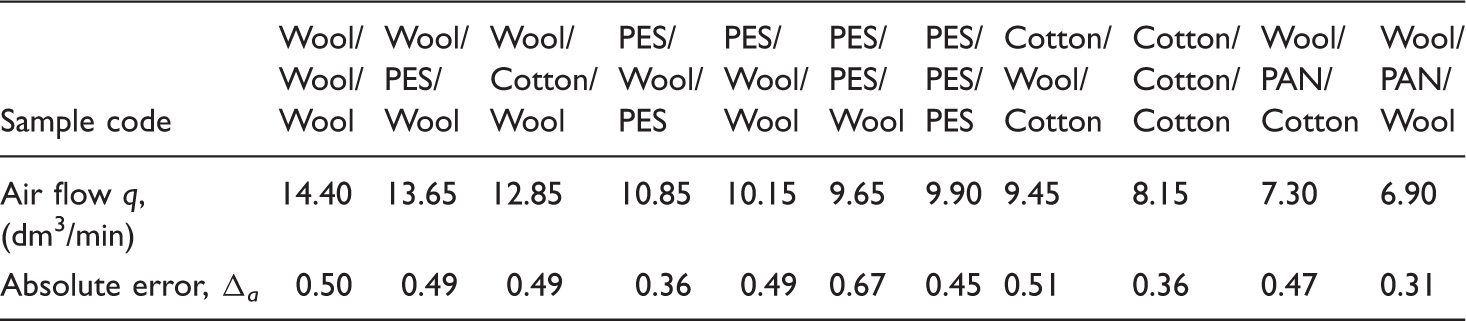
As it can be seen from the results presented in Figure 2, fabrics, both outer layers of which are made of woollen yarns, have apparently the best air permeability: Wool/Wool/Wool (481.0 dm3/(m2·s)), Wool/PES/Wool (455.90 dm3/(m2·s)) and Wool/Cotton/Wool (429.19 dm3/(m2·s)). However, the air permeability of the fabric with woollen yarns in outer layers and acrylic yarn in the inner layer as well as woollen and cotton yarns in the outer layers and acrylic yarn in the inner layer is the lowest of all newly developed multi-layered fabrics (accordingly 230.50 dm3/(m2·s) and 243.82 dm3/(m2·s)). This is because the acrylic yarn is textured and, despite the fact that linear densities of woollen, cotton and acrylic yarns used for the inner layer are similar, the bulk structure of the textured acrylic yarn decreases the porosity of the fabric. Especially, when such textured yarn is used for densely filled inner layer (see Figure 1). It is also confirmed by the fact that wale and course density as well as the air permeability of these fabrics are also the lowest. The air permeability of the fabrics with polyester yarns in the outer and inner layers and cotton yarns in the outer layers varies in the margins of error (339.01–315.63 dm3/(m2·s)). However, on comparison of air permeability of the fabrics with cotton yarn in the outer layers, it can be seen that Cotton/Wool/Cotton fabric has approx. 14% better air permeability (315.63 dm3/(m2·s)) than the Cotton/Cotton/Cotton fabric (272.21 dm3/(m2·s)).
It was unexpected that the air permeability does not depend on the thickness of the tested multi-layered knitted fabrics (results of the thickness are presented in Figure 3). Thickness of the fabrics with acrylic and cotton yarns in the inner layer was the smallest. Air permeability of these fabrics also was the lowest. However, thickness of the fabrics with woollen yarns in outer layers (Wool/Wool/Wool, Wool/PES/Wool and Wool/Cotton/Wool) is similar, i.e. vary in the ranges of error, but air permeability of these fabrics is the highest. Moreover, fabrics with polyester yarn in the inner layer (Wool/PES/Wool, PES/PES/Wool and PES/PES/PES) have almost the same thickness but absolutely different air permeability. Air permeability of the Wool/PES/Wool fabric is approx. 30% higher than the PES/PES/Wool and PES/PES/PES fabrics. Thus, it can be concluded that the raw material and the structure of the yarns used have the main influence on the air permeability of such multi-layered knitted fabrics.
Thickness of the multi-layered knitted fabrics.
Next step of this research was to establish the influence of the raw material of different layers on the thermal insulation of the multi-layered knitted fabrics, first of all on the heat exchange dynamic through the fabric. The main goal was to find the best variant of the raw material composition in different layers of fabrics used for thermal insulation. All the investigated multi-layered knitted fabrics showed good thermal insulation results, as none reached 40℃ (temperature of the heating plate) after 1-h period. As it can be seen from the results presented in Figure 4, after 1-h observation, the best result was seen in the fabrics Wool/Wool/Wool, Wool/PES/Wool, PES/Wool/Wool and Cotton/Wool/Cotton. During 1 h, the temperature of the upper layer (outward side) of these fabrics was increased from initial 26℃ up to 34℃. For the next group of the fabrics (PES/Wool/PES, PES/PES/Wool and PES/PES/PES) the temperature was increased to 35℃ after 1 h . Wool/Cotton/Wool, Wool/PAN/Wool and Wool/PAN/Cotton fabrics reached 36℃at the same period. The worst result was seen in the multi-layered fabric with cotton yarns in all layers – Cotton/Cotton/Cotton. After 1-ho observation, it reached 37℃. Some dependence of the thermal insulation on the thickness of the tested multi-layered fabrics can be observed, i.e. the thermal insulation of the fabrics with lower thickness (see Figure 3) is worse. However, what is important is not only this final result, but the dynamic of the heat exchange through the multi-layered knitted fabric during the particular time of observation.
Dynamics of heat exchange depending on the raw material of different layers.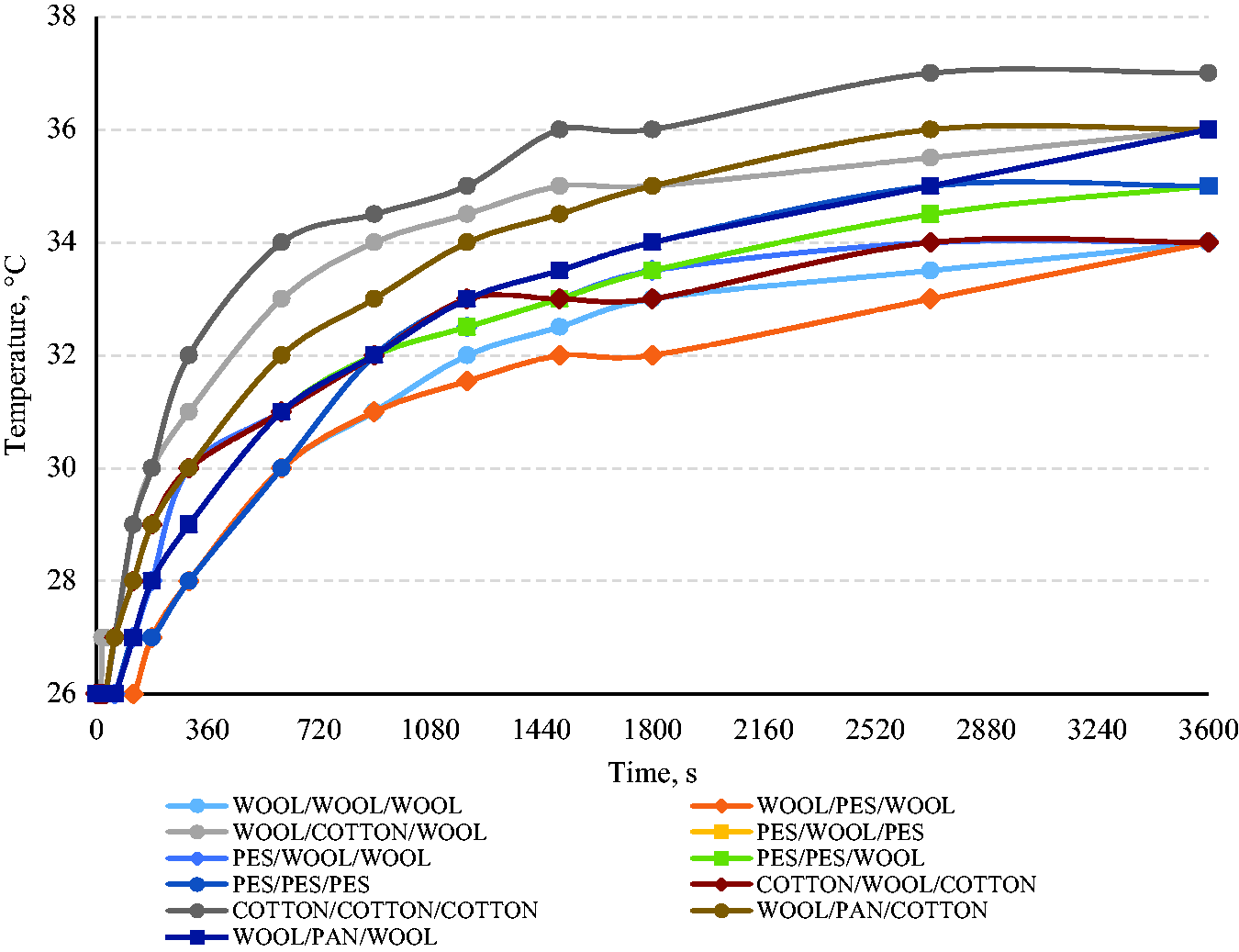
Figure 5 presents the results of the temperature reached by the upper layer of the newly developed multi-layered fabrics after 1, 15, 30 min and 1 h. It is important to know how such insulation material can protect in the long-term cold conditions. At the initial moment (0 s), the temperature of the upper surface of the multi-layered knitted fabrics was 26℃. After 1 min, the temperature of the upper surface of the fabrics with cotton yarns in the structure (Cotton/Cotton/Cotton, Wool/PAN/Cotton, and Wool/Cotton/Wool) reached 27℃. However, the surface of the fabric Cotton/Wool/Cotton remained at the initial (26℃) temperature. After 15 min, the highest (33–34.5℃) surface temperature reached the fabrics Cotton/Cotton/Cotton, Wool/PAN/Cotton and Wool/Cotton/Wool. After 30 min, the temperature of the upper surface of the Cotton/Cotton/Cotton fabric was even 36℃, and after 1 h – 37℃. It means that this multi-layered fabric, where all layers are knitted from the cotton yarns, has the worst thermal insulation. The lowest (only 31℃) temperature after 15 min reached the fabric Wool/PES/Wool. This particular variant showed the lowest temperature after 30 min (32℃) and also at 1 h (34℃). It means that such distribution of the raw materials in different layers gives the best thermal insulation, despite the fact that linear density of the polyester yarn used for knitting of the inner layer was approx. 30% lower than that of the other fabrics with acrylic, woollen or cotton yarns in the inner layer. The filament polyester yarn used for the inner layer formation gives the fabric additional rigidity and helps to keep the dimensional form.
Dependence of the temperature on the outer layer of heated multi-layered fabric on the raw material of different layers of multi-layered knitted fabrics at various times of observation.
After further investigations, it was found that there is no correlation between the heat exchange dynamic and permeability to air. The same results were also obtained in [12]. Also, there is no direct correlation between thermal insulation and thickness of the multi-layered fabric made of different raw material yarns. In Figure 6, such tendency can be seen – when the thickness of the fabric increases, the thermal insulation also tends to increase. The correlation strengthens after longer time of observation (after 1 h, coefficient of determination R2 of the dependence of the thickness on temperature of the upper surface of the fabric is 0.5012). Thus, thermal insulation of the multi-layered weft-knitted fabrics with tightly filled inner layer cannot be predicted only by fabric thickness or air permeability without deeper analysis of the raw material of yarns used for knitting of different layers.
Dependence of temperature on the surface of the outer layer of the heated multi-layered fabric on fabric thickness.
Conclusion
The main conclusion of this research is that the all newly developed multi-layered weft-knitted fabrics showed very good thermal exchange dynamic and can be used for thermal insulation; however, the best thermal insulation property has the fabric outer layers which were knitted from the woollen yarns with 20.8 tex ×2 linear density, and the inner layer was knitted from polyester filament yarn with linear density 42 tex. On the one hand, it can be explained by the fact that the good thermal insulation is a characteristic for woollen fabrics. On the another hand, the filament polyester yarn used for the inner layer formation gives the fabric additional rigidity and maintains the dimensional form of the multi-layered structure, thus ensuring more air gaps between the yarns. The heat exchange dynamic through this fabric was the slowest, and the temperature of the upper surface of the fabric after 1-h observation was the lowest (34℃, i.e. 6℃ lower than temperature of the heating plate). The best air permeability of all tested structures was also peculiar to this fabric. However, it was found that the thermal properties of multi-layered weft fabrics knitted from yarns of different raw materials cannot be predicted or compared according to the air permeability. There is some correlation between the thermal insulation and thickness of the fabric; however, it can be used for prediction of the thermal properties only for fabrics with the same raw composition.
In the next step of this research, authors will analyse the influence of the inner layer density, i.e. the number of the floats in the pattern repeat of the fabrics presented in this work, on the thermal insulation, air permeability and other comfort properties.
Footnotes
Acknowledgements
The authors would like to express appreciation to JSC ‘Gija’ and particularly G. Pacevičius and A. Baleckis for their technical support in knitting of newly developed multi-layered fabrics.
Declaration of conflicting interests
The author(s) declared no potential conflicts of interest with respect to the research, authorship, and/or publication of this article.
Funding
The author(s) received no financial support for the research, authorship, and/or publication of this article.