




Abstract
This study aimed to examine the fabrication of bi-constituent nanofibrous membranes and investigation of their moisture management behavior in various environmental conditions. In doing so, polyurethane with a hydrophobic nature and superior mechanical behavior and poly(2-acrylamido-2-methylpropane sulfonic acid) (PAMPS) with a hydrophilic nature were utilized. Different hybrid electrospun nanofibrous membranes were aligned based on different layer arrangements and composition ratios. Then, the impacts of the solid fraction of polymers, sequence of stacking, and environmental conditions on water vapor permeability, contact angle, and acidic water permeation were measured and discussed. Tracing the water vapor permeability behavior in samples was carried out through measuring the amount of permeation hourly and proposing some regression models. Bi-modal nanofibrous membranes were successfully fabricated using PAMPS and polyurethane with an average fiber diameter of 543.5 and 216.7 nm, respectively. As the volume fraction of PAMPS increased, the porosities of the samples remained unchanged, the number of pores increased, and the pore size decreased (the average pore diameter was 299.97 nm for the PAMPS sample and 492.35 nm for the polyurethane sample). Despite the better water vapor permeability of the polyurethane membranes than that of the PAMPS membranes, in the first 12 h of the water vapor permeability test, the trend was completely reverse. The results also revealed that in the relative humidity of 55%, the polyurethane layer had the highest water vapor permeability among all samples. The results of the acidic water permeation and contact angle tests showed that the hybrid electrospun nanofibrous membranes exhibit better wicking and wetting properties.
Introduction
Breathable and water/windproof fabrics are in high demand primarily due to their moisture vapor transfer and resistance to water and wind penetration. These functional materials can have applications in fields as diverse as sportswear, leisure and outdoor clothing, chemical/mechanical equipment, and, in particular, protective clothing (for example, for medical personnel, military personnel, and firefighters) [1–5]. A thorough review of the related literature shows that in most conventional waterproof breathable fabrics such as densely woven fabrics and laminated and coated fabrics, there is an inverse relationship between comfort and protection level [6–8]. On the other hand, water repellency and water vapor permeability (WVP) are two mutually exclusive functions. Little wonder, then, achieving high WVP for protective clothing is still a serious challenge for manufacturers of waterproof performance fabrics as they usually have to sacrifice breathability for barrier properties [1,7–9]. Serious efforts have been made to address this limitation. New technologies have been introduced for the production of protective fabrics, resulting in the production of other types of breathable materials such as hydrophilic membranes [1,10], smart breathable fabrics [1,11], biomimetics fabric [1], as well as commercial products such as Gore-Tex [12] and Sympatex [12,13]. In recent years, many attempts have also been made to improve the protective properties of natural fabrics while retaining their comfort [14]. Thanks to new methodologies with various functionalizing agents, fabrics have become antimicrobial [15], self-cleaning [16], insect repellent [17], and resistant to ultraviolet radiation [18], features lacking in their older versions. Despite the ever-increasing advances in the technology of fabricating waterproof and breathable fabrics, there is still a lot of room for research and presentation of new technologies such as electrospinning in order to produce structures that combine higher barrier performance and comfort properties. Electrospinning, as an effective and versatile technique to produce porous nanofiber membranes, is widely used in fabricating water/windproof and breathable membranes [19–21]. There are different electrospinning set-ups including solvent electrospinning [22], melt electrospinning [23,24], and also bubble electrospinning [25,26]. Bubble electrospinning has great potential in the mass production of nanofibers within 100 nm [27,28]. All these methods provide a web of extremely fine fibers with diameters both on the micro scale and nano scale, low weight, high flexibility, excellent structural properties, high porosity, and small pore size [1,3,7,8,29,30]. This prevents the penetration of water droplets, while its pore size which is larger than a water vapor molecule allows water vapor to transfer from the body to the environment [1].
Recently, a large body of research has investigated the potential of using an electrospun nanofiber web in water/windproof breathable materials as protective clothing. For example, transport properties of polyurethane electrospun nanofibrous membrane (PU ENM) have been investigated by Gibson et al. [3], and using ENMs as barriers to liquid penetration has been studied by Lee and Obendorf [31]. Gorji et al. [4] studied water/windproof electrospun nanofiber PU membranes. Hydrophobic-breathable membranes with water/windproof performance have also been investigated by Yang et al. [32] and the development of waterproof-breathable fabrics by direct electrospinning of PU on the polyester/nylon blended fabric as substrate has been performed by Kang et al. [33]. Some other works in this area have studied tunable porous structure fibrous membranes [34], multilayer fabrics based on a nanofiber mat in the middle layer to produce water/windproof fabrics [35], waterproof-breathable hydrophobic composite PAN@PDMS membranes [36], and superamphiphobic breathable membranes utilizing SiO2 nanoparticles [37]. The use of hybrid nanofiber mats composed of two different polymeric nanofibers is a newly proposed practice for achieving desirable characteristics [38]. Amini et al. [39] showed how PU and nylon 66 hybrid electrospun nanofiber layers keep waterproof property intact while providing air permeability. Other reports demonstrated that the dual-mode hydrophilichydrophobic electrospun PU/(poly(2-acrylamido-2-methylpropane sulfonic acid) (PAMPS)-GO) nanofiber membrane area is a good candidate for breathable membranes used in protective clothing [40,41].
Many kinds of electrospun breathable and water/windproof membranes have been prepared using various polymers including PU [33], polyacrylonitrile (PAN) [35], polypropylene [42], nylon [43], and polyvinylidene fluoride [44]. Depending on what kind of polymer is used in electrospinning, properties of the nanofiber web can vary. Hence, choosing the right polymer is crucial to attain a desired barrier and comfort performance of water/windproof breathable membranes. For example, PU has good mechanical properties despite its poor moisture absorption and transfer. On the other hand, PAMPS can absorb and transfer moisture, resulting in fast water vapor permeation and better cooling and comfort; however, its mechanical properties are poor [45,46]. Incorporating a hydrophilic polymer and a hydrophobic polymer into an electrospinning setup with two opposite nozzles can result in the production of bi-functional water/windproof breathable hybrid ENMs, with desirable features such as good mechanical strength, high water vapor transmission, and comfort [39,41]. Nevertheless, the moisture management behavior of PU/PAMPS ENMs still remains under-researched. One of the novelties and advantages of the present study is that it has taken into account the effect of layer arrangement (structural geometry), composition ratio (volume fraction of PAMPS), and different environmental conditions (relative humidity) on the moisture management behavior of PU/PAMPS hybrid layers. PU/PAMPS ENMs can be prepared via different polymer contents and layer arrangements which may affect the moisture management of hybrid ENMs. Therefore, different hybrid ENMs have been introduced following different arrangements of two components and different volume fractions of PAMPS in hybrid ENMs. The effects of the layer arrangement (in five levels) and the volume fraction of PAMPS (in three levels) on the WVP and wettability of membranes have been systemically addressed in this study. Regarding the uses of these membranes in different environmental conditions, the effect of relative humidity (in two levels) on WVP has also been investigated.
Materials and methods
Materials
N,N-dimethylformamide (DMF) and tetrahydrofuran (THF) were purchased from Merck (Germany). 2-Acrylamido-2-methyl-1-propanesulfonic acid (AMPS, monomer) was obtained from Daejong Co. (South Korea). 2,2-Azobisisobutyronitrile (AIBN) was purchased from Sigma-Aldrich (St. Louis, MO). Commercial thermoplastic polyurethane (TPU) pellets were purchased from Bayer, Leverkusen, Germany.
Preparation of the polymers solution
PU solution with a concentration of 6% w/w was prepared by dissolving TPU pellets in a THF and DMF mixture (60:40, v/v) with stirring by a magnetic mixer for 7 h at room temperature. PAMPS was prepared by free radical polymerization. PAMPS was synthesized as follows (for further details, one can see Lin et al. [47]). To begin with, 17.031 g of AMPS and 40.623 g of DMF were placed into a three-necked round-bottomed flask (100 mL). Then, the three-necked round-bottomed flask was placed in a water bath. Next, the water bath was slowly heated up to 80℃ and kept in this condition for 10 h. Nitrogen atmosphere was used for preventing compounds from reacting with components of air. After reaching 80℃, 0.190 g of initiator AIBN was added to the solution. The mixture was stirred for 10 h at 80℃ in the water bath to form a 30% w/w PAMPS solution.
Electrospinning
Electrospinning conditions for two opposite nozzles set-ups.

DMF: N,N-dimethylformamide; PAMPS: poly(2-acrylamido-2-methylpropane sulfonic acid); PU: polyurethane; THF: tetrahydrofuran.
Layer arrangement and volume fraction of the components
Sample description.

PAMPS: poly(2-acrylamido-2-methylpropane sulfonic acid); PU: polyurethane.
aA: PU, B: PAMPS, the numbers after the letters indicate the volume fraction of PAMPS.
bThe AB code indicates the simultaneous spinning of nozzles, and the sign “/” between the letters indicates the sequence of spinning.
Generally, electrospinning in hybrid samples can be broken down into two modes, namely simultaneous and sequential. In the simultaneous mode, which is denoted as the AB code in Table 2, both nozzles are utilized in real-time. Therefore, both polymers are simultaneously deposited on a collector. In the sequential mode denoted as the A/B code, only one nozzle is applied in real-time.
Characterization and measurements
Morphology of layers
Morphology of electrospun nanofiber layers was examined using a scanning electron microscope (SEM, VEGA\\TESCAN-XMU). The diameter of the nanofibers was determined for 50 randomly selected nanofibers using SEM images and Image J software (National Institute of Health, Bethesda, MD) and the average fiber diameter was reported. The average pore diameter was calculated by an image analysis technique using Image J software. To this end, the original SEM image of the sample was converted to grayscale with 256 levels based on a proper threshold level by a method developed and described by Ghasemi-Mobarakeh et al. [48]. The average pore size was calculated by Image J software. Finally, the equivalent pore diameter 
Measuring geometrical properties of ENMs
The weight of the sample was measured using a microbalance (with 1 µg readability) in 10 trials. The thickness of the specimens was also measured using a micrometer (Dial Thickness Gauge, Mitutoyo, Japan) and the average of 10 measurements was reported as the web thickness [4,39]. The solid volume fraction (SVF) of ENMs was calculated using the following equation [31]

Water vapor permeability
Breathability performance was evaluated by measuring the WVP of the electrospun samples using a tester M261 (Atlas, England) [4,40,41] based on the ASTM E 96-00 (standard test method for water vapor transmission of materials) [51]. The electrospun layer was sealed into the top of cups containing a predetermined amount of water. The WVP was calculated at relative humidity levels of 35% and 55% in four trials. A laboratory germinator was used to control temperature (27 ± 2℃) and relative humidity (35 ± 5%, 55 ± 5%). WVP test duration was four days (96 h). The total WVP was reported based on the weight loss of water according to equation (3)

Contact angle
Wettability behavior of the ENMs was evaluated by measuring the static contact angle. The contact angle of the sample with water was measured on a drop shape analysis system OCA20 (Date-Physics Germany) at ambient temperature and 30% relative humidity. In doing so, 5 µL of distilled water were dropped carefully from a needle on a microsyringe onto the samples. Once the water droplet had been placed on the surface, images were captured at 1, 30 and 60 s during the test. Afterward, contact angles were calculated through analyzing the drop shape.
Acidic water permeation
This test had been reported previously by Amini et al. [39]. In their study, the waterproof property of ENMs in static state had been investigated using the acidic water permeation test. For modeling acidic rain, an aqueous solution of acetic acid (0.5%) was used as liquid. The sample was firmly clamped between two frames and acidic detector paper was placed underneath the sample. A mirror was also used to better trace changes in the detector color. A drop of the aqueous solution was placed on the sample using a syringe pump. After the color of the detector paper changed, the required time for permeation of the acidic water was recorded. In this test, 10 samples of each layer were tested as trial.
Results and discussions
Morphology of nanofibers
Figure 1 shows the SEM image and diameter distribution of PU and PAMPS electrospun nanofibers. The average diameters of PU and PAMPS electrospun nanofibers were 543.5 and 216.70 nm, respectively. The average diameter of the PAMPS nanofiber was about three times finer than that of the PU nanofiber. It seems that increasing the voltage and the needle gauge and also reducing the feeding rate have led to a reduction in the PAMPS nanofibers diameter [52–54]. In addition to the above factors, the ionic properties of the PAMPS polymer can affect the diameter of the PAMPS nanofibers, where a high degree of sulfonic acid leads to an increase in charge density, and, finally, high elongation forces in the electrical field cause a reduction in the nanofiber diameter [40,55].
SEM image (left) and the corresponding fiber diameter distribution (right): (a) A0 sample, (b) B100 sample.
Figure 2(a) shows the morphology of the electrospun PU and PAMPS hybrid layer which has been successfully produced by simultaneous electrospinning of the PU and PAMPS with two opposite nozzles. In this image, fine electrospun nanofibers with an average diameter of 236.36 nm were obtained from the PAMPS solution and a larger diameter of 659.76 nm was obtained from the PU solution. In contrast to the reference samples (Figure 1), the mean nanofiber diameter of the PU and PAMPS hybrid layer with two nozzles (two-nozzle simultaneous electrospinning mode) increased by 21% and 9%, respectively (Figure 2(f)). This phenomenon can be attributed to the nozzle electrical charging of electrospinning with two nozzles, i.e. the electrical charge of the opposite nozzle can cause electrical repulsion in the other working nozzle. Therefore, a decrease in electrical field due to electrical repulsion can lead to an increase in the nanofiber diameter. A further increase in the PU nanofiber can be attributed to the higher voltage of the opposite nozzle.
(a) SEM image of the AB50 (50% volume fraction of PAMPS) sample, (b) PU nanofiber diameter distribution, (c) PAMPS nanofiber diameter distribution, (d) top view of the A/B50 hybrid layer, (e) side view of A/B50 hybrid layer, and (f) effect of the electrospinning mode on the nanofiber diameter.
Significant difference among the mean nanofiber diameters for the PU and PAMPS nanofiber.
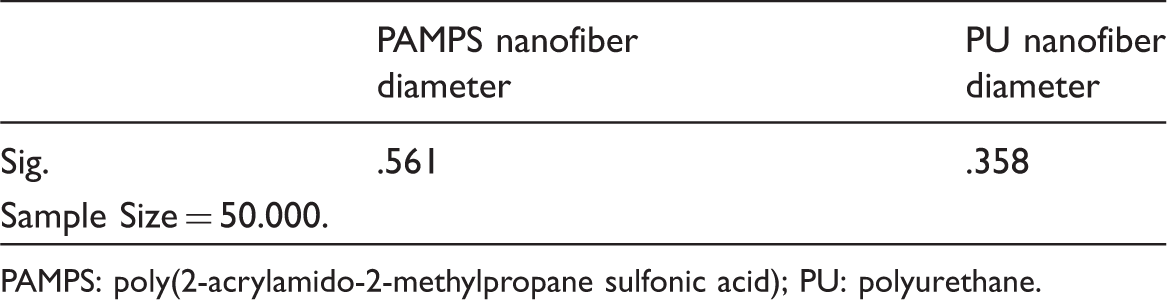
PAMPS: poly(2-acrylamido-2-methylpropane sulfonic acid); PU: polyurethane.
Geometrical properties
Weight per unit area, thickness, and SVF of the samples.

CV%: percent coefficient of variation; SVF: solid volume fraction.
Significant difference among the thickness and SVF of the samples.

SVF: solid volume fraction.
Pore characterization
The pore diameter and its distribution are among the most important characteristics of ENMs, with a significant effect on the breathability of the membrane [34,36,56]. The most common technique for pore diameter characterization is the bubble point method using a capillary flow porometer, which was applied in this method using a wetting liquid and high pressure. This method could not be used to measure the pore size diameter in this study due to the sensitivity of the PAMPS to most liquids as well as the structure of the PAMPS ENM, which is not strong enough to remain intact under such a high pressure. In this study, the pore diameter was measured using the image processing method. However, since this model is capable of evaluating initial surface layers, there are some restrictions in evaluating pore specifications of sequential samples. Therefore, only the pore specification of simultaneous and pure samples (A0, AB50 and B100) was considered in this study. Figure 3 shows typical SEM images of A0, AB50, and B100 samples in (a), (b), and (c), respectively; binary images of corresponding images ((d), (e) and (f)); pore visualizations ((g), (h) and (i)); and pore size distributions ((j), (k) and (l)). It can be seen that the pore size decreases as the volume fraction of PAMPS increases. The mean pore diameter was 492.35, 311.55, and 299.97 nm for A0, AB50, and B100 samples, respectively. In fact, the smaller diameter of the PAMPS nanofiber compared to that of the PU leads to a smaller pore diameter of the PAMPS ENM compared to that of the PU. As the volume fraction of the PAMPS increased, the porosities of the samples remained unchanged, while the number of pores increased and the pore size decreased (see Figure 4).
Typical SEM images: (a) sample code A0, (b) sample code AB50, (c) sample code B100, binary corresponding images ((d), (e) and (f)), corresponding pore images ((g), (h) and (i)), corresponding pore size distribution ((j), (k) and (l)). Pore diameter, number of pores, and porosity of the A0, AB50, and B100 samples.

Moisture management behavior of the ENMs
Water vapor permeability
In this study, as mentioned earlier, the average pore diameter varied between 299.97 nm for the PAMPS sample and 492.35 nm for the PU sample. Regarding the average pore diameter, the water vapor transport mechanism of the nanofiber membrane in either the single layer or the hybrid layer occurred based on the convective flow model [57–59]. The results of the overall WVP of the ENMs are presented in Figure 5(a). Obviously, the overall WVP of the PAMPS ENM is lower than that of the PU ENM. That explains why as the volume fraction of the PAMPS increases in the hybrid layer, the WVP difference between the hybrid layers and the PU sample increases, too. Figure 5(b) shows the WVP results of different samples during the initial hours (12 h) of the WVP test. The WVP of the hybrid ENMs containing 33%, 50%, and 66% PAMPS is illustrated in Figure 5(c), (d), and (e), respectively. According to these results (Figure 5(a) to (e)), the WVP behavior of the samples during the initial hours of the examination is quite the opposite of the WVP behavior of the samples at the end of the WVP test such that in the early hours of the WVP test, the hybrid samples and the PAMPS sample showed higher WVP compared to the PU sample. At the end of the WVP test, the hybrid samples and the PAMPS sample showed lower WVP than the PU sample. During initial hours (12 h) of measurements, the behavior of the WVP of the PAMPS was nonlinear and the WVP of this ENM seemed higher than that of the other samples. The high water vapor transfer through the PAMPS sample during the initial hours of the WVP test can be attributed to the hydrophilic nature of the PAMPS, resulting in more water molecule uptake, more convective flow transfer, and, subsequently, more WVP. This dual behavior of the PAMPS sample during the WVP test can be attributed to the structural change of the PAMPS nanofiber. Figure 5(f) shows the morphological change in the PAMPS ENM after the WVP test. As PAMPS is a water-soluble polymer, absorption of water molecules during water vapor transfer causes the dissolution of the electrospun PAMPS nanofibers. Eventually, PAMPS ENM changes to a barrier film like dense membranes. Also, the dense membrane has the same morphology as the PAMPS film layer and may prevent water vapor molecules from being transferred easily, but they can transfer slowly by the solution-diffusion mechanism [60,61].
WVP of different samples (error bars are confidence interval at the level of 95%): (a) 96 h, (b) 12 h. WVP vs. time for different samples at relative humidity of 35%: (c) 33%, (d) 50%, and (e) 66% volume fraction of PAMPS. (f) SEM image of B100 membrane after the WVP test.
Determining the required time for film formation
To determine the required time for film formation of the sample, numerical differentiation methods and statistical methods were utilized. To this end, it was assumed that the nonlinear behavior could be modeled with two linear sections. Intersection of these lines was considered as the time of film formation. Therefore, to begin with, the slope of the amount of water vapor passed-time curve at each point was numerically calculated using the 9-point central differential method

WVP trend line equation of samples at 33% volume fraction of PAMPS.

PAMPS: poly(2-acrylamido-2-methylpropane sulfonic acid); WVP: water vapor permeability.
According to Figure 5(a) and (c), sample A/B33 has the highest WVP among all samples. In this sample, the structure of the PAMPS nanofibers was destroyed in the first 4 h of the test (Figure 6(a) and (b)). Despite the presence of a polymeric film layer, WVP in this sample is higher than that in the PU sample. Figure 6(a) and (b) demonstrates the surface morphology of the A/B33 sample following the WVP test in two different magnifications. Obviously, there are many pores and cracks (indicated by arrows) in the polymeric film structure. It seems that the absorption of water vapor molecules by the PAMPS nanofibers caused swelling and shrinkage behavior in the PAMPS ENM, which in turn resulted in the formation of pores and cracks in the structure of the polymeric film. To better understand the behavior of water vapor transmission, Figure 6(g) and (h) schematically show water vapor transport through the A/B33 hybrid layer from the microclimate (the distance between skin and clothing) to the environment (Figure 6(g) shows it prior to film formation, and Figure 6(h) shows it following film formation). In these figures, the pale blue spheres represent a convective flow model, the violet spheres represent a solution-diffusion model, the dark blue spheres represent the absorption of water vapor molecules by the PAMPS nanofibers, and the pink arrows represent the absorbing and releasing moisture mechanism. Before and after film formation, in both structures, water vapor transfer through the membranes can occur according to both the convective flow and the solution-diffusion mechanisms; and before film formation, part of the water vapor molecules is absorbed by the PAMPS nanofibers. Before film formation, the convective flow is the dominant phenomenon, but after film formation, the solution-diffusion is the main phenomenon. Due to the slow process of water vapor transfer through the solution-diffusion model, the WVP decreases after film formation. During the electrospinning process, the solvent did not completely evaporate from the nanofibers, and the residual solvent led to the formation of bonding between the PU nanofibers and the PAMPS nanofibers deposited on the collector. This bonding caused adhesion between the two ENM layers. Here, the PU layer acts as the substrate and support for the PAMPS layer, where the adhesion force between the two layers can overcome the shrinkage force and prevent the formation of further pores. However, there are still plenty of pores and cracks in the polymeric film structure due to the low thickness of the polymeric film.
SEM image of the A/B33 membrane after the WVP test: (a) magnification 1:3000, (b) magnification 1:500. SEM image of the hybrid layers after the WVP test: (c) AB33, (d) A/B50, (e) AB66, and (f) A/B66. Schematic representation of WVP through the A/B33 sample: (g) before and (h) after film formation.
The behavior of water vapor transport from the fibrous membrane can be explained by Fick’s first law of diffusion (equation (5)) [61]


The effect of relative humidity on WVP
For examining the effect of environmental relative humidity on breathability performance, the water vapor permeation behavior of the samples at a relative humidity of 55% has been investigated. Figure 7 shows the WVP process of the samples at the 55% relative humidity level. In fact, the WVP of all the samples with a different structural geometry and volume fraction of the PAMPS significantly decreased as the humidity level increased from 35% to 55%. The results revealed that in the relative humidity of 55%, the PU layer had the highest WVP among all the samples. Unlike the humidity level of 35%, at a humidity level of 55%, for all three levels of the volume fraction of the PAMPS, among hybrid layers, the AB sample showed the maximum value of WVP. The higher rate of WVP in the AB sample as compared to the A/B sample can be attributed to the effect of the ambient humidity on the PAMPS nanofibers. Hence, in the A/B sample, the PAMPS nanofiber membrane transforms to a polymeric film faster under the influence of ambient humidity, causing a decrease in the amount of WVP. However, in the AB sample, the PU nanofibers act as a supporting layer and prevent the PAMPS nanofiber from film formation faster. The analysis of the WVP behavior in the other layers (at the humidity level of 55%) is the same as the humidity level of 35%.
WVP vs. time for different samples at relative humidity of 55%: (a) 33%, (b) 50%, and (c) 66% volume fraction of the PAMPS.
In order to investigate the effect of the PAMPS structural change on the water vapor transmission rate, parameter α = m1/m2 has been introduced, which shows the ratio of the slope of a line prior to film formation (m1) to the slope of a line following film formation (m2). This ratio indicates the nonlinearity behavior of WVP. It can be observed (Figure 8) that both layer arrangement and volume fraction of the PAMPS factors can affect the WVP behavior. The amount of α at the relative humidity of 55% is greater than the amount of α at the relative humidity of 35%. At the relative humidity of 55%, due to a decrease in water vapor pressure, the absorbing and releasing moisture mechanism is less likely to happen; therefore, the rate of water vapor transmission after filming (m2) decreases and, consequently, the amount of α increases.
Value of α for different samples: (a) 35% and (b) 55% relative humidity.
In simultaneous electrospinning samples, the uniform distribution of the PU nanofiber between the PAMPS nanofibers in the AB hybrid layer prevented an increase in the water vapor transmission rate before film formation as well as the formation of an integrated polymeric film, which ultimately had the lowest change in the amount of α and the water vapor transmission rate among all the hybrid samples in both 35% and 55% relative humidity levels. Among sequential hybrid samples, the B/A sample and the A/B sample constituted the highest and lowest value of α, respectively. The location of the PAMPS layer in the hybrid sample structure had a great effect on the amount of α. In the A/B layer, due to moisture absorption and release mechanisms between the air and the polymeric film layer, the water vapor transmission rate from the polymeric film to the outside increased, which in turn increased m2 and decreased the value of α.
The results show that different layer positions make it possible to choose the proper sample depending on different environmental conditions and the type and duration of usage. The results show that for a short period of time (12 h), the PAMPS and PU/PAMPS hybrid layers have high breathability properties. The PU/PAMPS hybrid layers are good candidates for disposable protective clothing with a short consumption period, for example in firefighting, disposable clothing, disposable medical supplies, and climbing outfits. At high levels of physical activity and when one breaks out into a sweat in cold and rainy weather, the best sample is the A/B/A hybrid layer with two PU layers placed on top and bottom of the sample. The PU layers act as a water/wind proof layer and the internal layer of the PAMPS accelerates the WVP performance, which has a higher comfort level and evaporation and cooling properties than the PU sample. Therefore, in cold/wet climates, the A/B/A hybrid layer may protect the wearer against hypothermia.
Contact angle
Wettability of a solid surface is one of the most important properties of a textile surface, which plays an important role in many applications and industrial processes. In order to investigate the wettability behavior of the hybrid ENMs, the contact angle (θ) was measured. The surface is considered hydrophilic when the water contact angle is smaller than 90° and hydrophobic if the water contact angle is large than 90° [62,63]. Figure 9(a) shows the result of the static contact angle measurement of the PU, PAMPS, and the hybrid samples at three levels of the volume fractions of the PAMPS for water droplets placed on the sample surface after 1, 30, and 60 s. To investigate the stability of the droplet on the ENM surface, the water contact angle difference between 1 and 30 s and 1 and 60 s was measured. Figure 9 presents the water contact angle and contact angle change of the samples obtained at different times. As shown in Figure 9(d), the PU and B/A samples have the highest water droplet stability among the hybrid samples, showing good waterproof properties. The PU ENM showed a good hydrophobic property with a contact angle of 132° and PAMPS ENM exhibited a high hydrophilic property with a water contact angle of 7°.
(a) Water contact angle images of the ENMs. Contact angle of the samples obtained at different times (error bars are confidence interval at the level of 95%): (b) the one-nozzle sequential and (c) the two-nozzle simultaneous electrospinning mode. Contact angle change over time: (d) the one-nozzle sequential mode and (e) the two-nozzle simultaneous electrospinning mode.
The wettability properties (contact angle) of the PU, PAMPS, and hybrid layers can be studied based on geometric potential, such as the irregular distance between nanofibers, porosity, pore size, and porous structure [64,65]. The balance of attracting force, gravity and repelling force creates a water bridge (Figure 10(a)) between the two nanofibers [64]. The results of previous research [64,65] show that as the pore size decreases, so does the distance between the two nanofibers, resulting in a stronger repelling force and, consequently, an increase in the contact angle. Despite the smaller pore size of the PAMPS ENMs than that of the PU ENMs, the contact angle in the PAMPS ENMs is lower than that of the PU ENMs. It can be concluded that in this study the wettability characteristics of the samples (especially PAMPS layer) are most affected by the hydrophilic properties of the polymers (hydrophilic groups in the polymer chain). The boundary energy is known as geometrical potential [64]. The presence of hydrophilic groups in PAMPS nanofiber walls can create boundary energy in the walls, which this boundary energy (the interactions between hydrophilic groups and water) can be described as the geometric potential. The presence of hydrophilic groups in the PAMPS nanofiber walls can create boundary energy in the walls (red line in Figure 10)(c), which affects water bridge between the two nanofibers. It means that some water molecules will be attracted into the surface of PAMPS, which affects the water contact angle. The interaction between water and PAMPS nanofibers (hydrophilic groups in PAMPS) weakens the water bridge between the two nanofibers; as a result, the water contact angle becomes smaller.
Geometrical potentials of PAMPS and PU nanofibers: (a) a water bridge, (b) PU, and (c) PAMPS [64].
As seen in Figure 9(c), the water contact angle of the AB sample decreases linearly as the volume fraction of the PAMPS increases from 33% to 66%. The results show that it can easily change the hydrophilic and hydrophobic properties of the AB sample as the volume fraction of the PAMPS changes.
At the 33% volume fraction, increasing the drop time on the A/B/A33 sample surface has no effect on the stability of the droplet. In this case, the surface of the PU layer in the A/B/A33 sample is almost waterproof. As the volume fraction of the sample increases to 50% and 66%, as a consequence of a reduction in the thickness of the PU layer, water drops on the surface of PU layer cannot be stable. Hence, as the contact time of the water droplet with the sample surface increases, the water droplet passes through the PU layer and enters the PAMPS layer. In this case, the PU layer loses its waterproof property. The thickness of the PU layer in the A/B/A33 sample is introduced as critical thickness, which is less than this thickness, the droplet on the surface of the sample is not stable, and also, the surface of the sample is not waterproof.
Acidic water permeation
In the contact angle test, droplet stability and wettability behavior of the samples, which are based on the adhesion properties between polymers and water, are not enough for determining hydrophilicity and waterproofness of the samples. Therefore, to evaluate the waterproofing properties of the samples and simulate acid rain, the wicking behavior of the samples was investigated by means of the acidic water permeation test. The behavior of water droplet penetration through a nanofibrous mat is influenced by porosity, adhesion interactions between the water, and polymer and capillary forces, which follow the Lucas–Washburn’s equation (equation (7))
Acidic water permeation of samples: (a) the one-nozzle sequential mode and (b) two-nozzle simultaneous electrospinning mode.

Conclusion
In this study, different PU/PAMPS hybrid ENMs with a hydrophilic-hydrophobic behavior were fabricated and characterized. The impacts of polymer volume fraction, layer arrangements, and environmental condition on the moisture management of these hybrid layers were investigated. The results showed that the WVP behavior of the PU nanofibers as a function of time was linear, while the PAMPS sample showed a nonlinear trend. The WVP of the PU samples could be improved up to 6.20% by utilizing 33% PAMPS with a sequential arrangement. The contact angle of the A/B33 ENM exceeded the 5.33° after 60 s of droplet contact, while this value for the PU ENM was found to be 131.08°. In other words, the wettability of the hybrid ENM increased up to 96%. From the viewpoint of layer arrangement, the location of the PAMPS layer in the hybrid sample structure has a great effect on the WVP because the moisture absorption and release mechanism occurring between the polymer film and outside air is a very important determining factor. At 33% and 50% volume fraction of the PAMPS, the highest value of WVP was observed for the A/B sample and the lowest one for the B/A sample. Considering the effect of the volume fraction of the PAMPS on the number of pores and cracks in the polymeric film structure, changes in volume fraction of PAMPS led to a change in WVP. The results showed that as the layer arrangement of the hybrid ENMs and the composition ratio of polymers in the hybrid ENMs changed, different PU/PAMPS hybrid ENMs with different levels of breathability-comfort and protection could be achieved for different environmental conditions. Therefore, it is possible to produce special PU/PAMPS hybrid ENMs based on our desired applications, different environmental conditions, type of usage, and the lifetime of the structure. Consequently, the PU/PAMPS hybrid ENMs can be potentially used in a range of fields as diverse as protective clothing, disposable medical supplies, and wound dressings.
Footnotes
Declaration of conflicting interests
The author(s) declared no potential conflicts of interest with respect to the research, authorship, and/or publication of this article.
Funding
The author(s) received no financial support for the research, authorship, and/or publication of this article.