




Abstract
In this paper, a novel auxetic weft-knitted fabric was firstly designed, which was based on the rhombus-shaped grid re-entrant structure. Then the fabric was fabricated using Kevlar filament yarn with 200D fineness on a computerized flat knitting machine. And the Poisson’s ratio values in weft, warp, and diagonal directions of this weft-knitted fabric were measured. The results showed that it exhibits the negative Poisson’s ratio effect in all three directions. Then the quasi-static stab resistance tests at five different puncture speeds were carried out on this auxetic weft-knitted fabric and the plain weft-knitted fabric with same raw material and similar loop length. The experimental results show that the auxetic weft-knitted fabric has higher peak load and energy absorption capacity at quasi-static loading. The results also show that the quasi-static stab resistance of the auxetic weft-knitted fabric strengthens with the increase of the puncture speed, but changes little after the puncture speed reaches a certain value (50 mm/min).
Keywords
Introduction
Compared to most conventional materials, auxetic materials, also called negative Poisson’s ratio (NPR) materials, show unique property of becoming thicker in one or multiple widthwise direction when stretched along their length and becoming thinner upon lengthwise compression [1]. The unique property gives auxetic materials many beneficial properties, such as synclastic curvature, good body fit [2], enhanced shear resistance [3], improved indentation resistance [4], increased plane strain fracture toughness [5], better impact energy and sound absorption property [6–8], etc. Therefore, auxetic materials have great potential in a number of practical applications, such as kneepad, bulletproof clothing, shockproof gloves, medical bandages, explosion-proof curtains, and so on.
The NPR effect of a material normally comes from its special structural arrangement [9]. Ma et al. [10] summed up a series of geometrical models to explain the principle of auxetic materials, including re-entrant structure, rotational structure, nodule and fibril model, chiral model, liquid crystalline model, helical model, rod model, etc. Based on these geometrical models, quantities of auxetic materials, such as foam and fiber, have been discovered or developed.
Textile materials have been widely used in many engineering fields due to their light weight, excellent mechanical performance, and low manufacturing costs [11,12]. The NPR effect of a fabric could be obtained by designing fiber structure, yarn structure, or fabric structure. Compared to the former two methods, the method of designing fabric structure has the advantages of continuous manufacture, low cost, and less restrict in material [13]. Compared to woven or braided fabrics, it is easier for knitted fabrics to obtain NPR effect due to their high structure variety and superior conformability to complicated shapes [9]. Among knitting technologies, flat knitting technology is proved to be more flexible and more variable, and have a wide range of applications and great prospects in fabricating various auxetic fabrics [14]. So far, it has been possible to produce auxetic fabrics based on rotating rectangle structure, re-entrant hexagon structure, and folded structure using a computerized flat knitting machine. According to rotating rectangle structure, Grima et al. [15] developed an auxetic weft-knitted fabric. The rotating rectangle structure has the NPR effect in both horizontal and vertical directions in theory while the real fabrics fabricated only exhibit auxetic performance under horizontal tensile. Based on re-entrant hexagon structure, Hu et al. [14] designed two kinds of weft-knitted fabrics with auxetic performance. However, the NPR values of the real fabrics are lower than theoretical values. According to folded structure, Blaga et al. [16] used zigzag alignments of face and reverse loops to make a weft-knitted fabric. The fabric would fold and shrink naturally after knitting and then auxetic performance was obtained. Later, Hu et al. [14] also put forward other kinds of auxetic weft-knitted fabrics based on folded structure.
This paper innovatively presents a novel auxetic weft-knitted fabric produced on a computerized flat knitting machine. It was firstly designed based on rhombus-shaped grid re-entrant structure. Because most protective fabrics are made of aramid yarn, the Kevlar yarn is chosen as the material. The Poisson’s ratio values in weft, warp, and diagonal directions of this auxetic weft-knitted fabric were measured. Then, the quasi-static stab resistance of this auxetic weft-knitted fabric and the plain weft-knitted fabric with same material and similar loop length was tested at five different puncture speeds.
Experiments
Geometrical structure of the novel auxetic weft-knitted fabric
As is shown in Figure 1(a), rhombus-shaped grid re-entrant structure was used to design a novel auxetic weft-knitted fabric. Figure 1(b) exhibits the knitting pattern of the novel auxetic weft-knitted fabric, and the region bordered with the red line is the smallest repeat unit cell. Because of the structural disequilibrium of the face loops and reverse loops, the weft-knitted fabric folded and shrank naturally after knitting and then an obvious three-dimensional effect was formed. When stretched, the folded structure would unfold and generate NPR effect.
Rhombus-shaped grid re-entrant structure (a) and knitting pattern (b) of the novel auxetic weft-knitted fabric (blue represents face loops, white represents reverse loops).
Sample preparation
The properties of Kevlar filament yarn.

Parameters of the plain weft-knitted fabric and the auxetic weft-knitted fabric.

Poisson’s ratio tests
The specimens with size of 150 mm × 80 mm (Figure 2) were cut along the weft, warp, and diagonal directions of the auxetic weft-knitted fabric, and then relaxed for 24 h. To assist in recording the size changes of the specimens during the tensile process and reduce the edge effect, four points were marked at the center of the specimens, as shown in Figure 3(a). In order to test the Poisson’s ratio values, uniaxial tensile tests were carried out on an E43.504 Materials Tester (MTS). As shown in Figure 3(b), two ends of the specimen were clamped by the chucks, with the specimen straight and un-elongated. When testing, the jog control of MTS was used to make the specimen stretched slowly. The width of the specimen was measured using a ruler with each click on the jog button. Whenever the width changes, the change of length and width was recorded. The Poisson’s ratio of the specimens can be calculated according to the following formula
Pictures of specimens cut along the weft direction (a), warp direction (b), and diagonal direction (c). Pictures of Poisson’s ratio test: (a) schematic diagram of the marked specimen and (b) photograph of the clamped specimen.


Quasi-static stab resistance tests
According to the GB/T 20655-2006 standard, the quasi-static stab resistance tests of the designed auxetic weft-knitted fabric and the plain weft-knitted fabric were performed on an MTS shown in Figure 4(a). The spike impactor, whose size and structure are shown in Figure 5, was installed in the upper grip of an MTS Synergie mechanical testing frame. The target specimen was placed below the spike impactor. The photograph of the target specimen is illustrated in Figure 4(b). The spike impactor was penetrated into the target at five different speeds until the target is pierced during the tests. The five different puncture speeds include 5 mm/min, 20 mm/min, 50 mm/min, 80 mm/min, and 100 mm/min. Preload force is set to 1 N.
Pictures of quasi-static stab resistance test: (a) MTS and (b) target specimen. Size and structure of spike impactor.

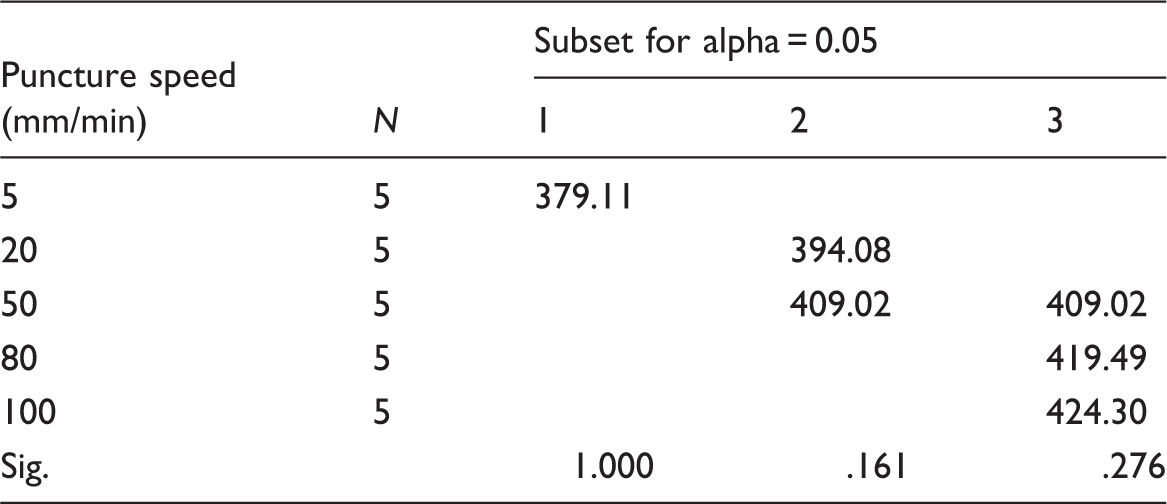
Homogeneous subsets table for energy absorption means of the auxetic fabric.

Homogeneous subsets table for peak load means of the auxetic fabric.
Results and analysis
NPR effect of the novel auxetic weft-knitted fabric
Poisson’s ratio tests were carried out for three times. Map based on the average values of the three test results. When stretched in weft, warp, and diagonal directions, the Poisson’s ratio against tensile strain curves of the auxetic weft-knitted fabric are shown in Figure 6. The NPR effect of the fabric stems from the unfolding of folded structure, as explained in the previous section. The folded structure of the fabric is unfolded gradually with the increase of the tensile strain, so the NPR effect decreases gradually. When the folded structure is fully unfolded, the NPR effect disappears and the value of Poisson’s ratio is positive. Through analysis of three curves, it is also concluded that the fabric exhibits NPR effect in all three directions. The NPR effect is the most obvious when the fabric is stretched in the weft direction, followed by the diagonal direction, and lastly in the warp direction. The rhombus-shaped grid re-entrant structure, shown in Figure 1(a), has the same NPR effect in both weft and warp directions. However, the NPR effect in the warp direction of the real fabric is much lower than that in the weft direction. This phenomenon could be explained by the following two ideas. Firstly, course density and wale density of the fabric are different, so rhombus-shaped grid re-entrant structure formed by the face loops or reverse loops is out-of-shape. Secondly, the arrangements of the yarns in the fabric are complex and different in every direction.
Poisson’s ratio against tensile strain curves: (a) weft direction; (b) warp direction and (c) diagonal direction.
Quasi-static stab resistance at five different puncture speeds
Figure 7 exhibits one of the results of several repeated experiments, including the load–displacement curves of the two fabrics at five different puncture speeds. Because weft-knitted fabrics are formed by interlacing loops of yarns, the spike would pierce into a loop during puncture. With the increase of the puncture displacement of spike, the yarns of loops in the vicinity of the pierced loop are drawn and slid. Meanwhile, the pierced loop expands. That is the reason why the load increases slowly and the slope of the curves in Figure 7 is small in the initial stage of the tests. When the pierced loop reaches a point where it cannot continue to expand (self-locking state), the spike is held by many yarns and is difficult to pierce further. With the continued pierce of the spike, the load increases sharply until the yarns in direct contact with the spike are broken and the breach is generated. Therefore, the slope of the curves at this stage is much larger than that of the initial stage. Figure 7 also shows that the maximum puncture displacement of auxetic weft-knitted fabric is much larger than that of the plain weft-knitted fabric. The reason is that the auxetic weft-knitted fabric with folded structure has a larger shrinkage and deformation naturally.
Load–displacement curves of the two fabrics at five different puncture speeds.
The energy absorbed by a fabric specimen during a whole quasi-static stab resistance test is represented by the area under the load–displacement curve. Figure 8 shows the comparison of energy absorption means of the two fabrics during the quasi-static stab resistance tests at five different puncture speeds. As illustrated in Figures 7 and 8, the peak load means and energy absorption means of auxetic weft-knitted fabrics are higher than that of plain weft-knitted fabrics no matter how fast the puncture speed is. In other words, the auxetic weft-knitted fabrics have better quasi-static stab resistance. This conclusion can be explained by the following point of view: the agglomeration effect occurs at the impact point of auxetic material when impacted, so material at the impact point becomes denser and then its protective performance is strengthened [17].
Comparison of energy absorption means of the two fabrics at five different puncture speeds.
It can be seen from Figures 8 and 9 and Tables 3 and 4 that the peak load means and energy absorption means of the auxetic weft-knitted fabrics at puncture speeds of 50 mm/min, 80 mm/min, and 100 mm/min are close but significantly higher than that at a puncture speed of 20 mm/min. The peak load mean and energy absorption mean at a puncture speed of 5 mm/min are lowest. Therefore, it can be concluded that the quasi-static stab resistance of the fabric strengthens with the increase of the puncture speed, but changes little after the puncture speed increases to a certain value (50 mm/min).
Comparison of peak load means of the auxetic weft-knitted fabric at five different puncture speeds.
The number of the courses included in the breakpoints is counted and shown in Table 5. It can be seen from Table 5 that the number of the courses included in the breakpoints of the plain weft-knitted fabrics is much bigger than that of the auxetic weft-knitted fabrics. It is found that the edges of the breakpoints of the auxetic weft-knitted fabrics are mostly the junctures of face loops and reverse loops, as shown in Figure 10. Therefore, it can be concluded that the alternate disposition of face loops and reverse loops in the auxetic weft-knitted fabric limits the spread of the breakpoints.
Photographs of fabric damage of the auxetic weft-knitted fabric. Number of the courses included in the breakpoints.

Conclusions
A novel auxetic weft-knitted fabric was produced on a computerized flat knitting machine based on the rhombus-shaped grid re-entrant structure. Its NPR effect and stab-resistance at quasi-static loading were tested. The conclusions drawn are as follows.
The novel auxetic weft-knitted fabric produced exhibits NPR effect in all weft, warp, and diagonal directions. The NPR effect is the most obvious when stretched in the weft direction, followed by the diagonal direction. And the NPR effect is the weakest when stretched in the warp direction. The irregular rhombus-shaped grid re-entrant structure and the complex arrangements of yarns are the reasons why the NPR effect of the real fabric in the warp direction is much lower than that in the weft direction. The auxetic weft-knitted fabric has better quasi-static stab resistance than the plain weft-knitted fabric. With the increase of the puncture speed, the quasi-static stab resistance of the auxetic fabric strengthens but changes little after the puncture speed increases to a certain value (50 mm/min). The spread of the breakpoints of the auxetic weft-knitted fabric can be limited by the alternate disposition of face loops and reverse loops.
Footnotes
Declaration of conflicting interests
The author(s) declared no potential conflicts of interest with respect to the research, authorship, and/or publication of this article.
Funding
The author(s) disclosed receipt of the following financial support for the research, authorship, and/or publication of this article: The authors acknowledge the financial support from National Science Foundation of China (No. 61772238), Fundamental Research Funds for the Central Universities (No. JUSRP51727A, JUSRP51625B) , and Provincial and Ministry Joint Open Project (No. M2-201805).